
Dr. Josephus Requa and the Billinghurst-Requa Battery
By Peter H. Jacobsohn, D.D.S. · Originally published July-August 2022 · pp. 3–14
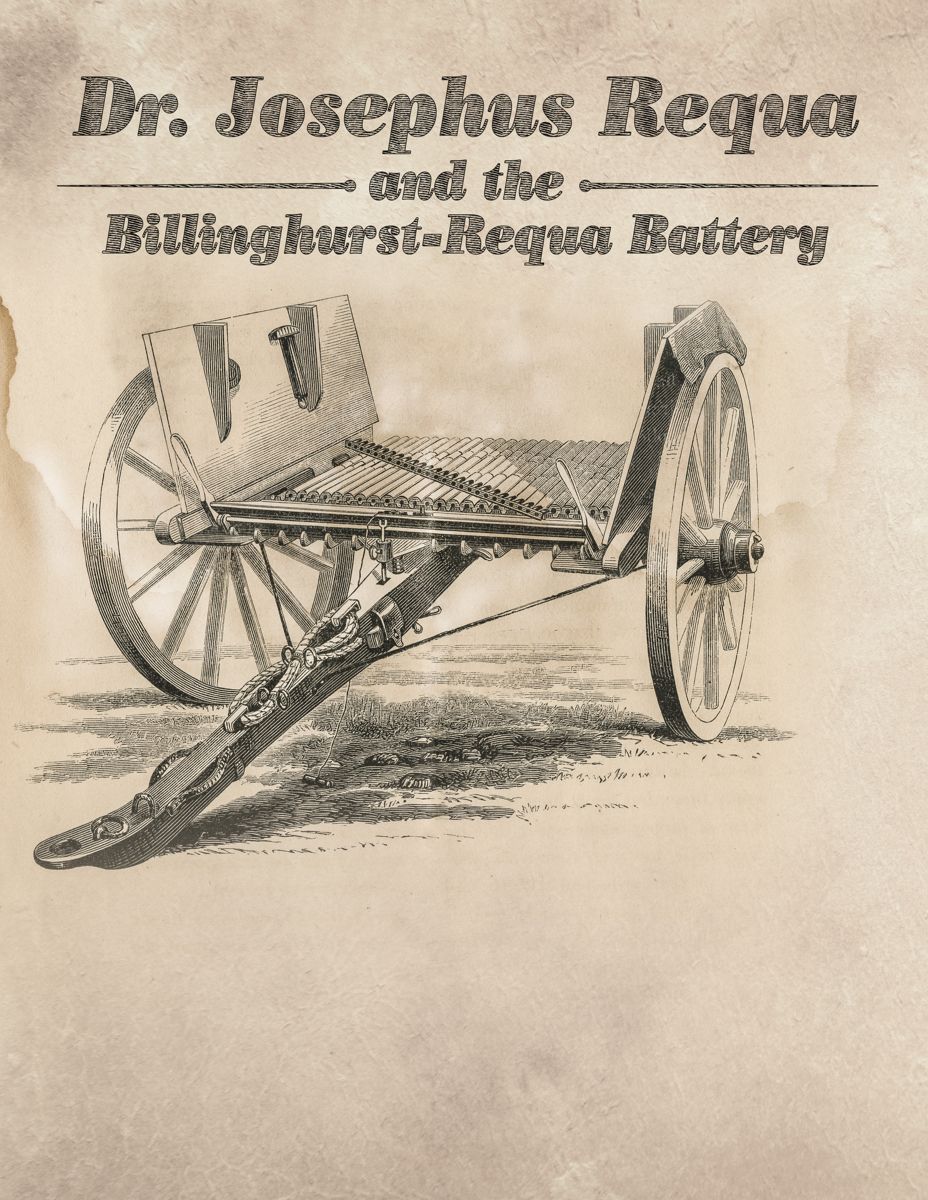
Illustration of a Billinghurst-Requa Battery gun. (Reports Upon The Billinghurst & Requa Rifle Battery. New York: George F. Nesbitt & Co., 1863.)
One of the many innovations to come out of the immediate pre-war and Civil War era was the concept and reality of rapid-fire weapons.
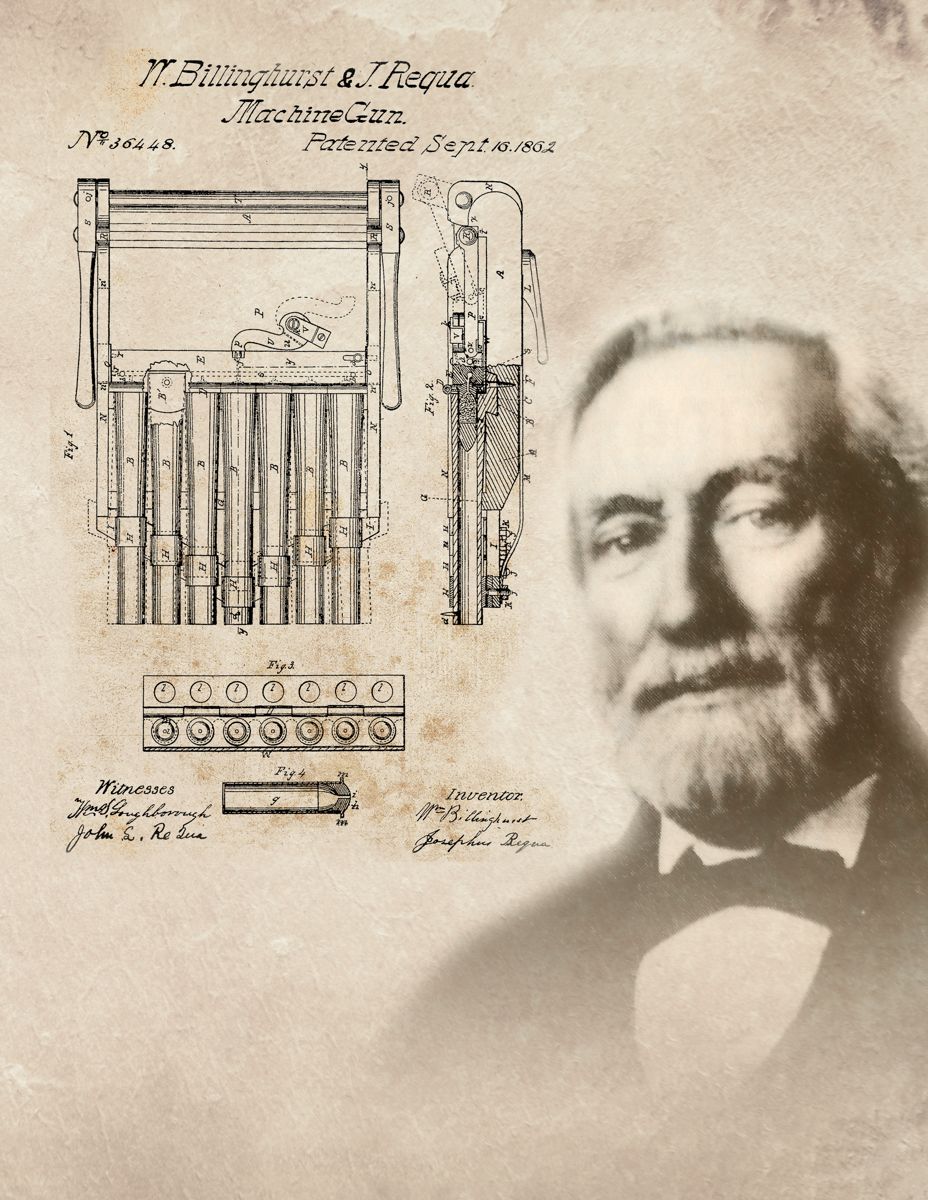
On September 16, 1862, the day before the Battle of Antietam, William Billinghurst and Dr. Josephus Requa received U.S. patent number 36,448 for their “rifle battery” or “machine gun.” It was one answer to a search by Federal military authorities for a gun that was capable of rapid fire. The gun was the result of the collaboration among three men from Rochester, N.Y.: Albert Mack, William Billinghurst, and Dr. Josephus Requa.
Albert Mack came from a patriotic family. His father fought in the War of 1812. His grandfather’s uncle signed the Declaration of Independence. When Civil War came, he tried to enlist but was rejected several times because he was declared physically unfit. Mack’s continuing interest in the military inspired him to give thought to the concept of a rapid-fire gun. William Billinghurst (1807–1910) was a gunsmith with a national and international reputation in the field of weaponry. He was one of the first Americans to work on perfecting a repeating rifle. In addition, he held patents on fishing equipment and was very successful in that field as well.
W. Billinghurst & J. Requa Machine Gun patent. No. 36448, patented on Sept. 16, 1862.
Dr. Josephus Requa (1833–1910) was a dentist who practiced in Rochester for 50 years. Requa had served a dental preceptorship from 1853–1855. Preceptorships, or the apprentice method, was how dentists trained before the evolution of education through accredited dental schools. Prior to entering the dental profession Requa had apprenticed to Billinghurst to learn gunmaking. He apprenticed with Billinghurst from 1849–1853. Albert Mack, who knew of Requa’s gunmaking skills, suggested to Requa that he should make a gun that would fire faster than anything then in use.
Requa took time from his busy dental practice to design a new multi-barreled rapid-fire weapon. He consulted his mentor, William Billinghurst, and together they built a small working model. It was soon followed by a prototype. After successful tests, a full-size gun was manufactured. The gun consisted of twenty-five heavy .52 caliber rifle barrels, each two feet long, mounted together side by side in a secure frame. The wrought-iron frame was attached to a twowheeled field carriage. A lever under the frame allowed the barrels to be elevated, depressed, or diverged laterally.
The .52 caliber cartridge had a brass case with a conical lead bullet. The length was 2 5/8 inches. They had a thin rim with an oval, flanged base with central hole for ignition. The cartridges contained 64.5 grains of loose powder. The cartridges were placed in a quick loading, twenty-five round steel clip with twenty-five holes spaced so they lined up with the open barrel breeches. After the breech was closed, a line of black powder was placed in a trough behind the cartridges. A percussion cap was placed on a centrally located cone. A lanyard was attached to a trigger that, when pulled, released a hammer to strike the cap igniting the powder in the trough and thereby the powder in the cartridges. All 25 barrels fired simultaneously. The gun or “battery” weighed 1,382 pounds. Three men could fire seven volleys or 175 shots per minute at an effective range of 1,300 yards. Preloaded twenty-five round clips were stored in a caisson that held 96 clips or 2,400 cartridges. A two-horse team transported the battery. After tests of the full-sized weapon proved successful, Dr. Requa approached the U.S. Army Ordnance Department for an in-person demonstration. The 5th Chief of Ordnance was Brig. Gen. James W. Ripley. Ripley was widely known for opposing virtually all technological innovations. So, it was not a surprise when Ripley dismissed Requa stating that “his soldiers could already fire rapidly enough and his gun wasted too much ammunition” and it would cost a fortune for the special ammunition it needed.
Billinghurst-Requa 25 round clip with four original cartridges. (Mike Ward Collection)
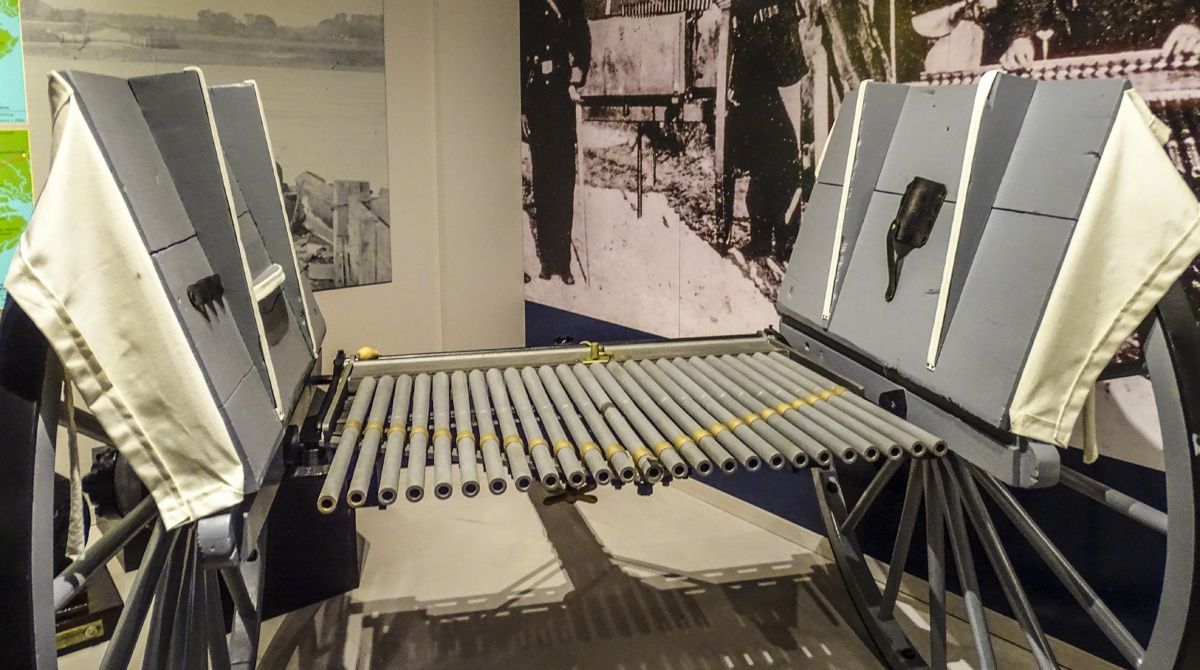
Undaunted, Requa obtained an invitation to speak directly to President Lincoln about his gun. Lincoln, enthusiastic about its potential, ordered a demonstration. The first trial of the gun before military observers was held May 12, 1862. It was under the direction of Lt. William Mitchell, U.S.N. at the Naval Ordnance Yard, Washington, D.C. Lt. Mitchell’s report indicated that the gun performed favorably. Another military test was held on May 24, 1862. On August 12, 1862, a demonstration in Rochester was open to the general public. A public demonstration on August 26, 1862, in Albion, N.Y., attracted 5,000 people. Demonstrations continued long term. As late as February 1864, after witnessing a satisfactory exhibition of the “Billinghurst and Requa battery,” the Legislature of the State of New Jersey adopted resolutions requesting that “the attention of Congress be called to the said battery, with a view to an appropriation for its employment in the public service.” All reports indicated that the weapon performed very well, was user friendly, and was very reliable. After all the tests showed favorable results, venture capital became available from private financiers. Thirty units were manufactured by the firm of Pameater and Bramwell in Troy, N.Y. Twenty more were made in Billinghurst’s shop in Rochester, N.Y. The barrels were manufactured by E. Remington & Sons, Ilion, N.Y. After the Civil War, five more were produced. The literature attributes a variety of names to the weapon. It was known as a volley gun, a machine gun, and as a battery gun. In addition, titles descriptive of its capabilities were used, namely “street sweepers” and “bridge gun.” It found use as a defensive weapon against forces advancing across bridges. Perhaps it is best known as the Billinghurst-Requa gun or battery. It is fitting since it honors its developers.
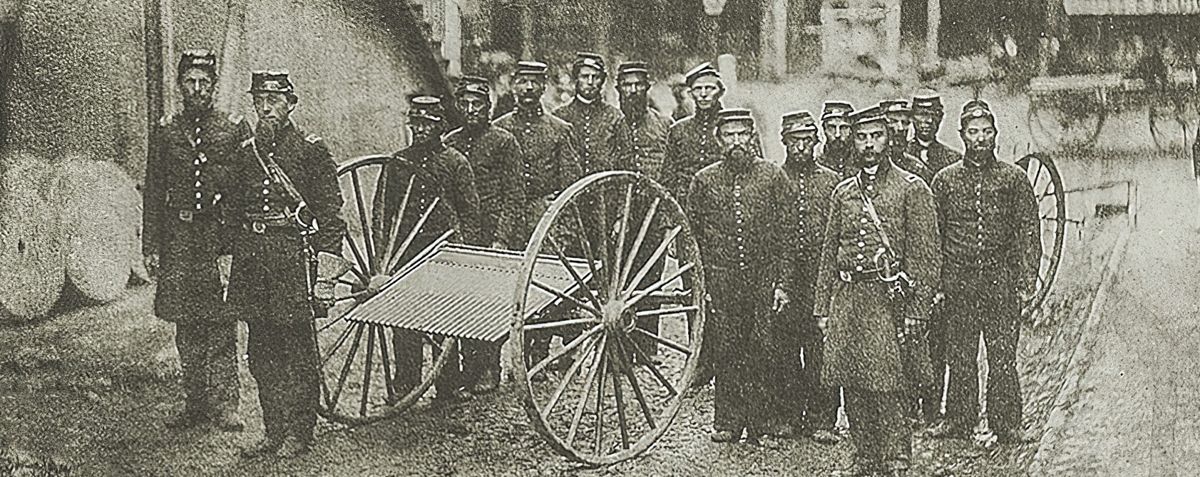
Federal troops with their Billinghurst-Requa Battery gun.
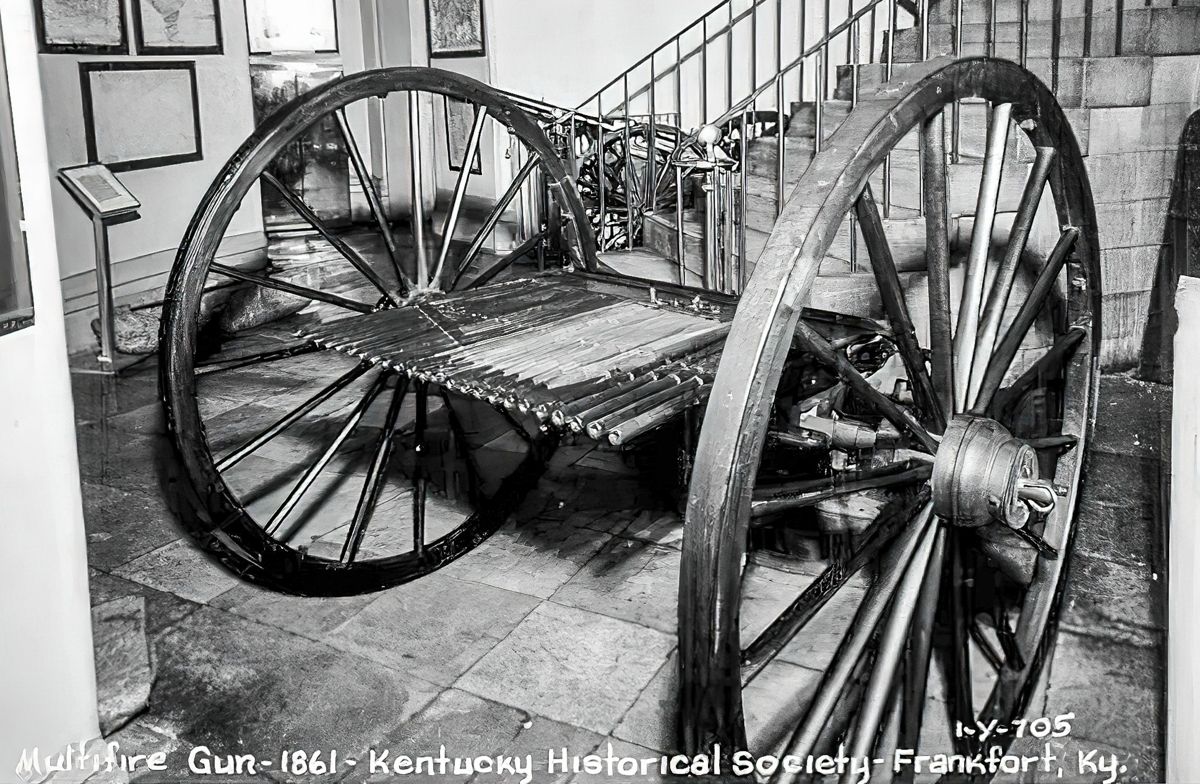
Original Billinghurst-Requa gun on exhibit.
Billinghurst-Requa Battery gun on display in the Parris Island Museum, Beaufort, S.C.
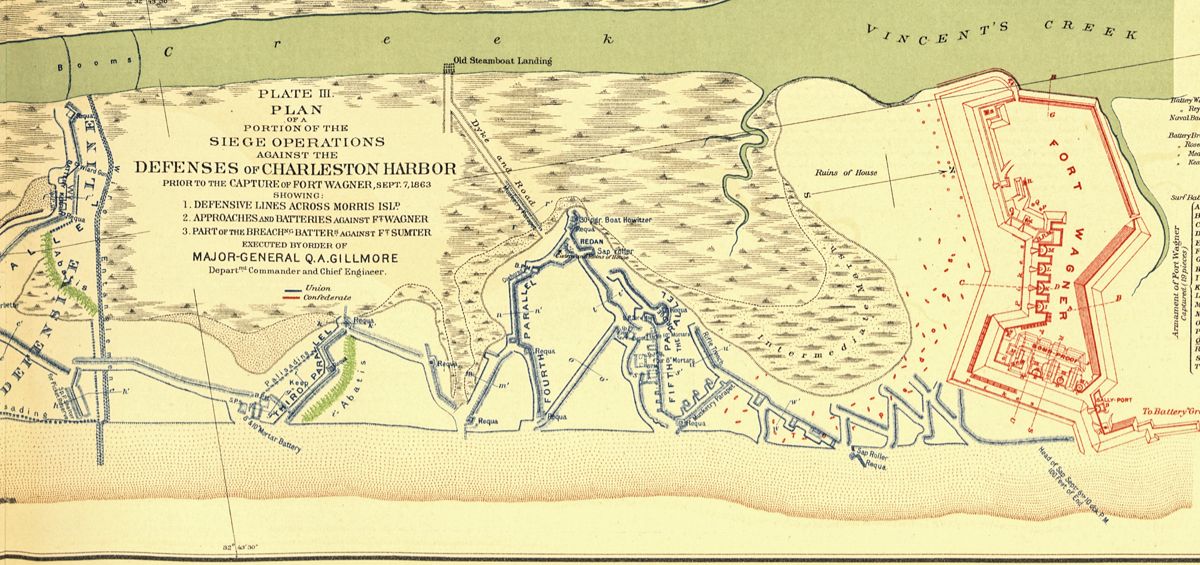
Caption reads “Multifire Gun – 1861 – Kentucky Historical Society – Frankfort, Ky.”
“NOTES TO MAJOR BROOKS’S JOURNAL”. NOTE No. XVI.—(Extract.) From these reports I extract the following description : This rifle battery is a device for multiplying and accelerating infantry fire from rifle barrels, and appears in principle to be a substitute for a six-pounder field gun whenever grape and canister are needed, and, to the extent of its range, case shot, over each of which it possesses greater precision and much less liability to fail in producing desirable results. It consists of twenty-five rifle barrels, each twenty-four inches long, arranged upon a horizontal plane and held in position upon a light field carriage by an iron frame. Upon this frame, in the rear of the barrels, is fitted a sliding bar, worked by two levers, (one at each side,) by which the cartridges are forced to the rear of the chambers. By a lever under the frame the barrels may be diverged so as to scatter the balls one hundred and twenty yards in a distance of one thousand. The weight of the battery, complete, is thirteen hundred and eighty-two pounds. When served by three men, the battery is readily fired seven volleys, or one hundred and seventy-five shots, per minute. It did not foul. Nine degrees elevation gave a range of twelve hundred yards, at which distance, the barrels being diverged, the shot scattered into an effective line. Thirteen hundred yards is probably its [maximum] effective range, although two thousand yards is claimed for it. The axis of the barrels is thirty inches above the plane on which the piece stands. During the siege, four emplacements were constructed for the “Requa rifle batteries” in the first parallel, five in the second, two in the third, five in the fourth, two in the fifth, and one in advance of it, in all, nineteen positions, built successively as the approaches advanced ; all these positions were occupied for a longer or shorter time by these batteries. They were located on the flanks or in the salient angles of the works About one-third were in embrasure. The platforms used were of boards eight feet square, well nailed to five sills of same material. They were moved forward with the pieces. These batteries constituted, up to the 23d of August, the only artillery in advance of the second parallel ; at that date three [24-pounder] coehorn mortars were moved forward into the fourth parallel. On several occasions these batteries were used against the enemy’s sharpshooters and working parties, apparently with good effect. On the evening of August 25th the two batteries in the fourth parallel took an active part in a brisk skirmish. Three infantrymen, who were not thoroughly drilled, served each piece. They were fired rapidly, and apparently with good effect. Being breech-loading, and easily handled, scarcely any exposure above the parapet was required on the part of the gunners. But one piece was disabled during the siege, and it was quickly repaired. Although the defensive properties of the Requa rifle battery were not severely tested in the small amount of service above recorded, I feel quite satisfied that it is adapted to the defence of earthworks, particularly in a flat country like this, where the horizontal line of dispersion afforded by the fire of this piece is more effective than the cone of dispersion of the howitzer. It should be noted that the angle of dispersion can be varied to suit the case in this battery, which is not true of the howitzer. These properties, together with its small recoil, and its loading at the breech, and lightness, are the qualities most desirable in a gun for boat service.” (Source: Gillmore’s Engineer and Artillery Operations, pp. 254-255)
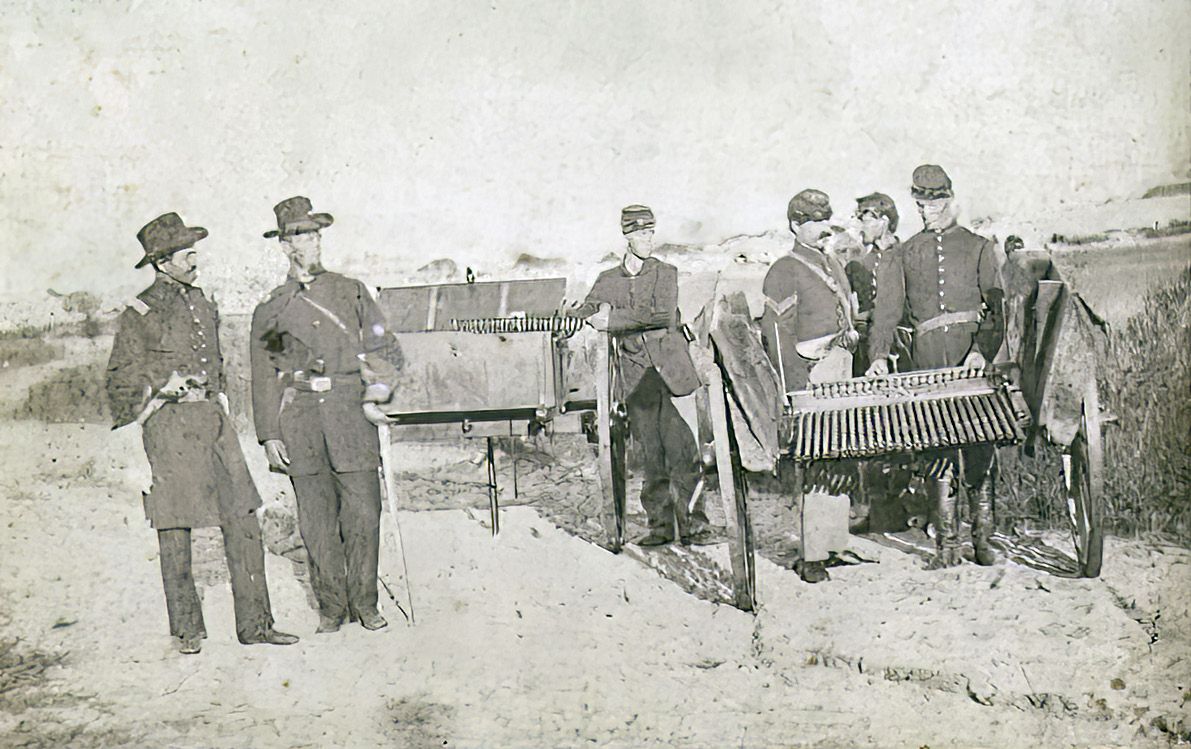
Map of Morris Island with the Union parallel’s advancing towards Fort Wagner. (Atlas to Accompany the Official Records of the Union and Confederate Armies)
Section of Billinghurst-Requa Battery, Morris Island, S.C., 1863, from The History of the Thirty-ninth Regiment Illinois Volunteer Veteran Infantry, (Yates Phalanx.) in the War of the Rebellion 1861–1865 (1889), after p. 362.
In spite of its successful firing tests and the patent it received, the gun was never officially accepted into military service. However, it did see limited service during the Civil War. The Billinghurst-Requa gun saw action at Fort Wagner, the recapture of Fort Sumter, the Siege of Port Hudson, the Siege of Petersburg, and the Battle of Cold Harbor. It would be replaced shortly after the war by the Gatling gun, the invention of Dr. Richard Gatling, a physician and inventor. In addition to Requa, a dentist, and Gatling, a physician, there was another dentist, Dr. Edward Maynard, who held patents in military weaponry including a rapid-fire breech loading carbine. It raises the question—does it make sense that members of health care, healing professions, would be involved in the development of such weapons? It does when one considers that the hope was that their use could shorten war and thereby save many lives. References • • • • • • • • • •
Allen, Sue. “Dr. Requa’s Gun.” Civil War Times Illustrated, February 1989, pp. 28-33. Coggins, Jack. Arms and Equipment of the Civil War. Doubleday & Co. Inc. 1962. Hyson, John. Dr. Josephus Requa Civil War Dentist and the Billinghurst-Requa Volley Gun. Historical Arms Series, No. 40, 1998. Lord, Francis A. “175 Shots Per Minute-Requa Rifle Battery.” Civil War Times Illustrated, June 1962, pp. 29-30. Billinghurst-Requa Battery. Wikipedia.Org/wiki/Billinghurst_Requa_Battery. A Rochester Dentist Helped Save the Union. Rochesterhistoryalive.com/Requa.htm. Resolutions of the Legislature of New Jersey 35th Congress, 1st Session, Feb. 16, 1864. Gillmore, Quincy Adams. Engineer and Artillery Operations Against the Defences of Charleston Harbor in 1863: Comprising the Descent Upon Morris Island, the Demolition of Fort Sumter, the Reduction of Forts Wagner and Gregg; with Observations on Heavy Ordnance, Fortifications, Etc. United States, D. Van Nostrand, 1865. OR Series I, Volume 14, Serial 20, p. 465. OR Series I, Volume 28, Part I, Serial 46, pp. 324-325.
About the Author
Peter H. Jacobsohn, DDS, is retired from the practice of Oral and Maxillofacial Surgery and from the Chair of the Division of Oral and Maxillofacial Surgery of Marquette University School of Dentistry in Milwaukee, WI. He is a past-president of the American Academy of the History of Dentistry and the Civil War Round Table of Milwaukee. Currently he is curator of the Dental Museum of Marquette University. He writes and speaks on various topics related to the history of dentistry and medicine as well as aspects of the Civil War, World War I and II.
Peter H. Jacobsohn, DDS
By Tim Prince n 1853 the British military decided to establish what would become the Army School of Musketry in Hythe, Kent. The decision that an establishment to produce firearms instructors was needed was a direct result of the recent design innovations adopted by the British Army some two years earlier. In 1851, the Pattern 1851 Minié rifle was adopted and, for the first time, all line infantry regiments were to be issued rifled arms. Prior to this, line infantry had fought for more than two centuries using smoothbore muskets, first with firelock (flintlock) batteries and later with percussion locks. In the two earlier periods, tactics revolved around massed volley fire at relatively short distances because smoothbore arms, loaded with loosely fitting round ball, were notoriously inaccurate at any significant range. As a result, there was no need to instruct soldiers in the finer points of aimed fire, but far more tactically important to train them in rapid loading to maintain sustained fire.
I The adoption of expanding base ammunition and the Minié rifle for general use changed all of that, as the firearm was now capable of much greater accuracy and training was required before the solider could take advantage of the new rifled arm’s potential. To that end the Musketry School at Hythe was established in 1853 and listed as an operational post the following year. The goal of the school was to instruct both officers and non-commissioned officers in the “black art” of accurately shooting the new rifles. The course of instruction covered everything from safe gun handling to the mechanics of rapid reloading, fundamentals of sight picture and trigger press, to the more arcane arts of range estimation and determining windage. In fact, the basic fundamentals of drill were stressed so much that many officers and NCOs complained that they spent more time memorizing command sequences than firing a rifle. Further emphasis on the basis that “perfect practice makes perfect” was stressing sight picture, trigger control, and follow through, with more students complaining that the only live firing they participated in was the “requisite forty rounds at each distance.” The goal of the school was to make competent instructors, not marksmen, who would return to their regiments and instruct the soldiers under their command in the techniques required to be accurate riflemen. This was the beginning of the British Army’s focus on individual aimed fire, a skill that would show its worth during the earliest months of the First World War when an out numbered British Expeditionary Force held its own against the advancing Kaiser’s Army.