
Confederate Griswold Revolvers
By John Sexton · Originally published March-April 2022 · pp. 66–79
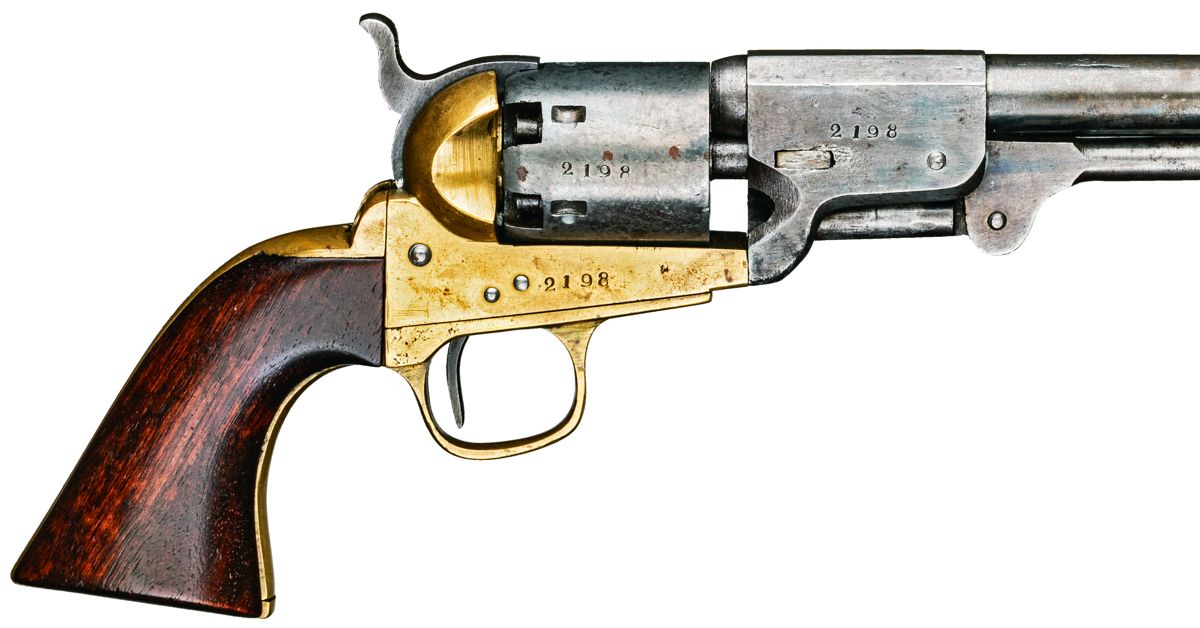
o pistol made in the Confederacy has such renown and reputation as the Griswold & Gunnison brass framed navy revolver made in Griswoldville, Ga. Though it is the most encountered Confederate revolver, it is always in demand. The revolver shows the Southern ingenuity of Samuel, a Connecticut Yankee who made Georgia his home. The industrial base of the South was minuscule in comparison to the North, where numerous arms manufacturers made a few hundred thousand revolvers during the war, while all Confederate makers combined only produced some 7,500. Griswold alone made about 3,500 revolvers. The approximately 350 documented survivors are treasured today. Every year a few new serial numbers (SN) are added to the database. Samuel Griswold was born in Connecticut in 1790, moved to Clinton, Ga., as a young man, and began manufacturing cotton gins. By 1835 the Griswold cotton gin company was wellestablished, and his products were sold throughout the South, making Griswold, at the time of the Civil War, one of the wealthiest men in Georgia. He established his kingdom, Griswoldville, Ga., about 10 miles south of the Macon Central Railroad. On this property, Griswold erected the most modern gin factory in America, along with a sawmill, foundry, candle shop, post office, church, stores, and housing for his employees and 100 slaves. He built a large home along with homes for his eight children and his factory foreman. Every component of his gins was made in Griswoldville; most of the food grown on his 5,000-acre farm fed his workmen and slaves. I previously thought that I might be related to Ebenezer Grier (1821–1888), Sam Griswold’s attorney, trustee, and executor, though it turns out that I am not. My grandfather, Francis “Pappy” Grier (1893–1982) of Macon, Ga., told me stories of the guns of Griswoldville. His accounts instilled my lifelong interest in the Civil War. Arvin N. Gunnison (1824–1882), a native Georgian, was producing cotton gins in New Orleans at the beginning of the war. He also made revolvers, which I believed were the early brass frame navies with small trigger guards (SN 8, 30, 64, 90) but were still, in all probability, made in Griswoldville, based on the recently researched timeline. The same serial number dies, and cryptic assembly markings found on the earliest small trigger guard pistols are found on later Griswold revolvers along with other distinctive characteristics. There are records of Gunnison bringing his pistol-making machinery, including two 20 horsepower engines, shafting, pulleys, etc., to Griswoldville. A letter from Gunnison to the Confederate Secretary of War written from Macon, Georgia, May 14, 1862, stated: “I was involved in the manufacture of Colt’s Navy revolver in New Orleans at the time of capture by the enemy, from which place I have escaped with portions of my machinery to reestablish the same work at Griswoldville.” All governmentrelated documents concerning this manufacturing effort cite “Griswold & Gunnison.” Records most often speak of Gunnison as the principal and contact person. As the war continued, the aging Samuel Griswold must have been less active as Ebenezer Grier signed his letters and documents for him as his trustee. I have studied Confederate handguns for 40 years and have personally examined more Griswold revolvers than anyone alive. In the database I maintain, there are currently records of 347 revolvers and another 28 serial numbered parts. There are several variant Griswold & Gunnison revolvers among the first models with round barrel housings and second models with half octagonal barrel housings. First model Griswolds are the scarcest, especially the earliest guns. There are only 19 survivors accounted for with a serial number under 500. Among the survivors, there are some interesting variations not published previously. All students of these revolvers are aware of the characteristic twisted iron seen in the cylinders. Four survivors also noted (174, 186, 202, & 312) have twisted iron barrels and no twist in their cylinders. William “Bill” Albaugh stated in his 1963 book Confederate Handguns concerning SN 202, “The fault lines or twist of the cylinder may be seen only under a magnifying glass, and then only by exercising the imagination.” SN 202 is the earliest Griswold for which Albaugh had a complete description, and he expected that all cylinders were “twisted;” that is not the case. My examination of SN 202 at the Hugh Benet Auction in 2000 shows no twist; however, the barrel did show welldefined “twisted iron.” Early production run pistols show experimentation in perfecting both the revolvers and the rate of production including; twisted iron with different degrees of twist, the direction of twist, use of iron frame pins, spring wedges, different methods of seating the cylinder arbor, different numbering, and assembly markings. By serial number 500,
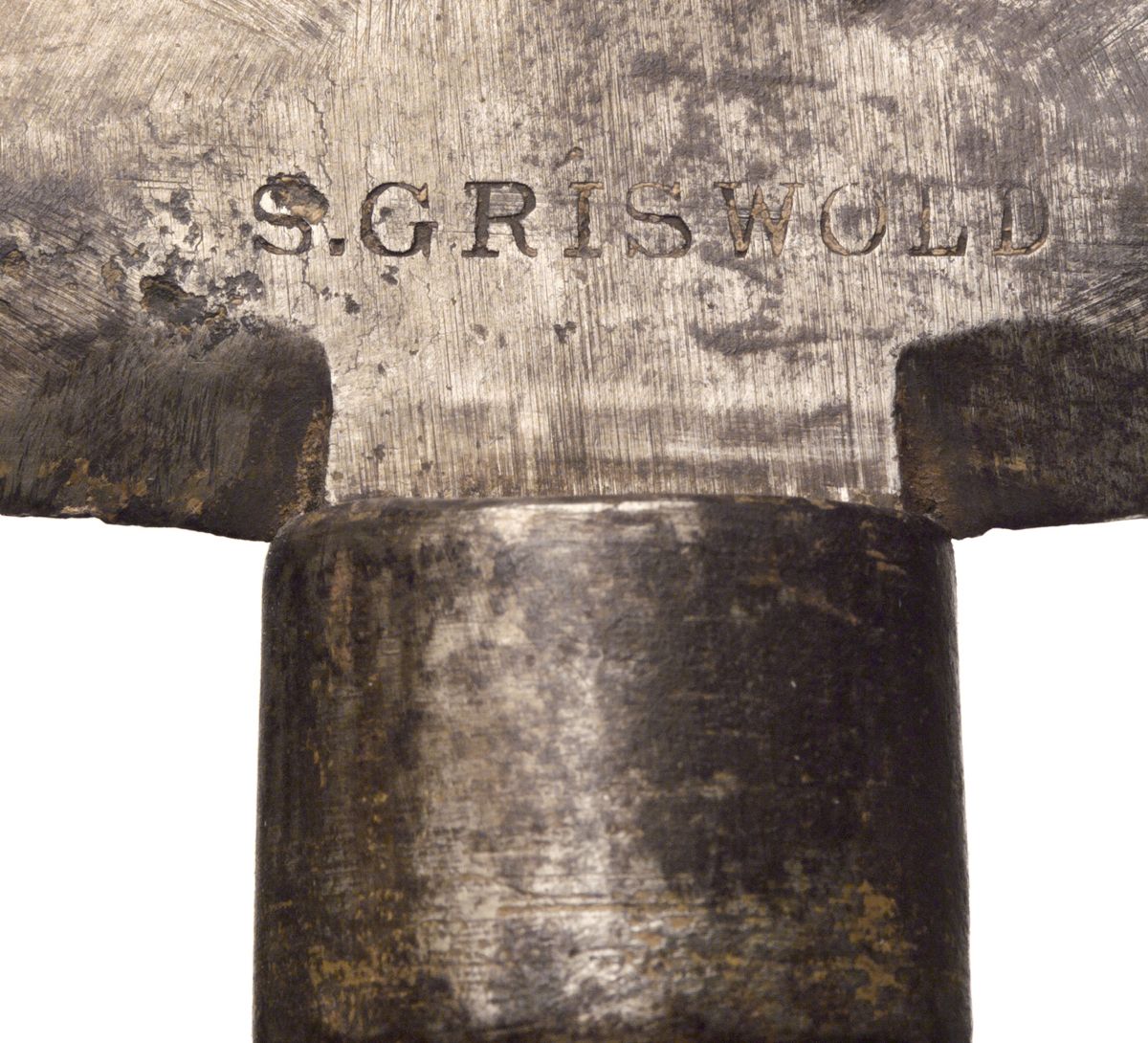
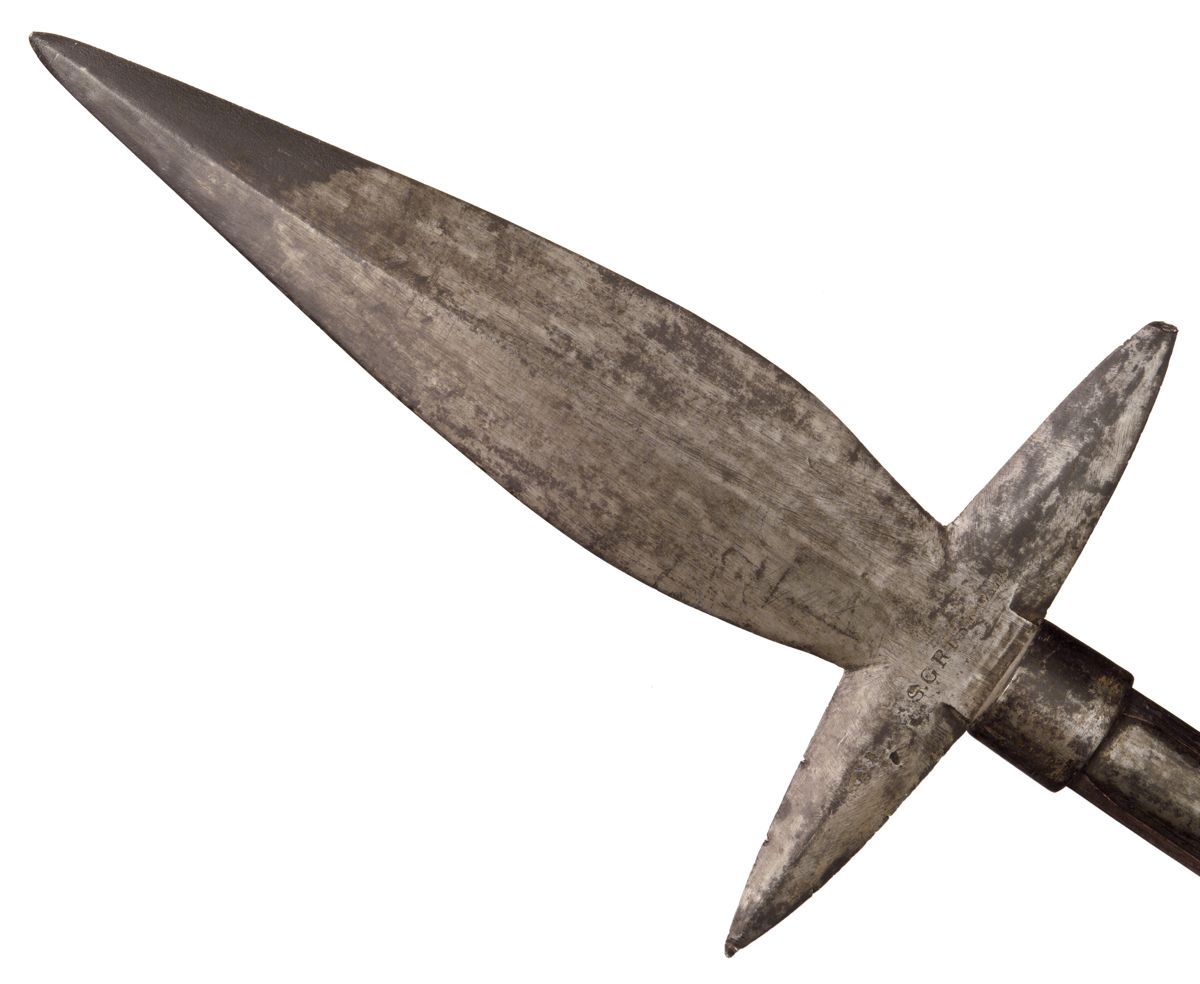
“S. GRISWOLD” marked cloverleaf pike head, attached wooden pole measures about 7 feet long. The length of the pike head is 11 inches and the width is 6.5 inches.
the Griswold methodology of manufacture was becoming consistent. Matching assembly marks on brass components were not at first used, then, sporadically, punch dots came in, until the final Roman numeral marking. The cryptic marks appear to represent final inspection by the workmen assembling a revolver. Matching cryptics are usually found on each brass component and in a “mating position” at the interface of the trigger guard and backstrap. The same cryptic is also found on the frame, barrel and cylinder.
TI M ELI NE: Feb. 20, 1862: Gov. Brown appealed to the mechanics of Georgia for small arms and pikes. April 3, 1862: Samuel Griswold delivered 16 pikes. April 1862: A.N. Gunnison arrives at Griswoldville with pistol-making equipment.
April 1864: Memorandum from the Ordnance department stating that revolvers could be sold directly to officers in the field or about to be deployed for $125 each. This is well above the $50 contract price at this time for all manufacturers including Griswold & Gunnison.
The first payment under the last contract price of $146 each for 142 revolvers delivered Aug. 1 through Sept. 30, 1864: paid Dec. 31, 1864.
Report 6-4-1863 Military Store Keeper (MSK) paid for 182 accepted.
May 19, 1862: Gorgas replied to Cuyler: “Capt. You are hereby authorized to receive from Griswold & Gunnison, all the revolvers they can make in eight months, and pay $40 for each complete: they must stand the usual tests and be of good workmanship.” June 2, 1862: Samuel Griswold delivered the last of 804 pikes. July 16, 1862: Richard Cuyler wrote Walter Hodgkins, “about 100 pistols in progress.” We can guess these were SN 1-100. All survivors have small trigger guards, serial numbers known to me are 8, 30, 64, and 90. Parts from 16, 19, 31, and 45 are found on mixed serial number, later production guns. Oct. 14, 1862: R. Milton Cary wrote R.M. Cuyler, Macon Armory, inspected 22 pistols, 18 passed. There is one survivor SN 39. Oct. 22, 1862: SNs 30-54, all failed except: SNs 36, 39, 41, 48, and 52 (all unknown).
On June 26, 1864, 394 pistols were delivered, but not paid for until Sept. 26, 1864, at $55 each.
On October 28, 1864, Samuel Griswold wrote a letter to James Burton, superintendent of Macon Armory, offering to rent out his manufactory, along with 30 slaves to continue pistol production. He could rent his slaves at a much higher rate in the private sector than what the government was paying him. Burton advised Chief of Ordnance Josiah Gorgas on Nov. 1, 1864, not to rent pistol works, “…I believe it would be better to allow the works to be continued in private hands and to allow such a price for the products as will justify the proprietors to continuing the work. I make the suggestion understanding that the price thereafter paid for pistols made at these works is much under that is paid to other contractors.” The last 367 revolvers were delivered to the Macon Armory between Sept. 1 to Nov. 11, 1864, costing $146 each, up from the last contract price of $55.
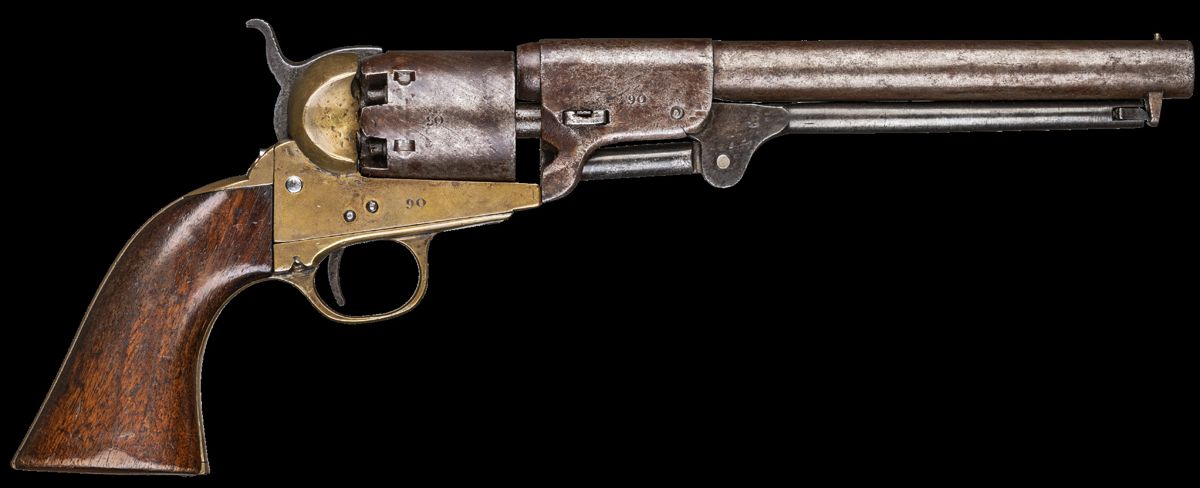
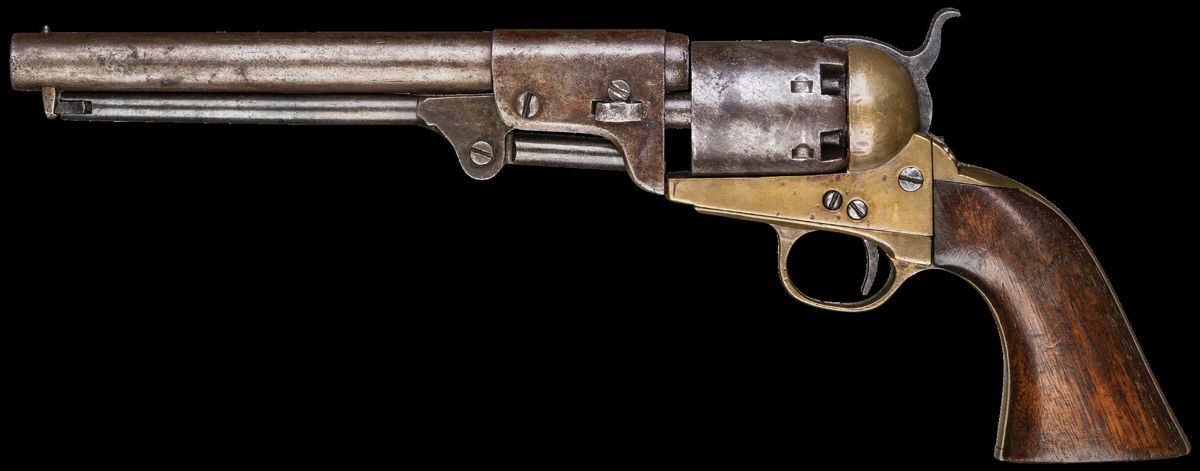
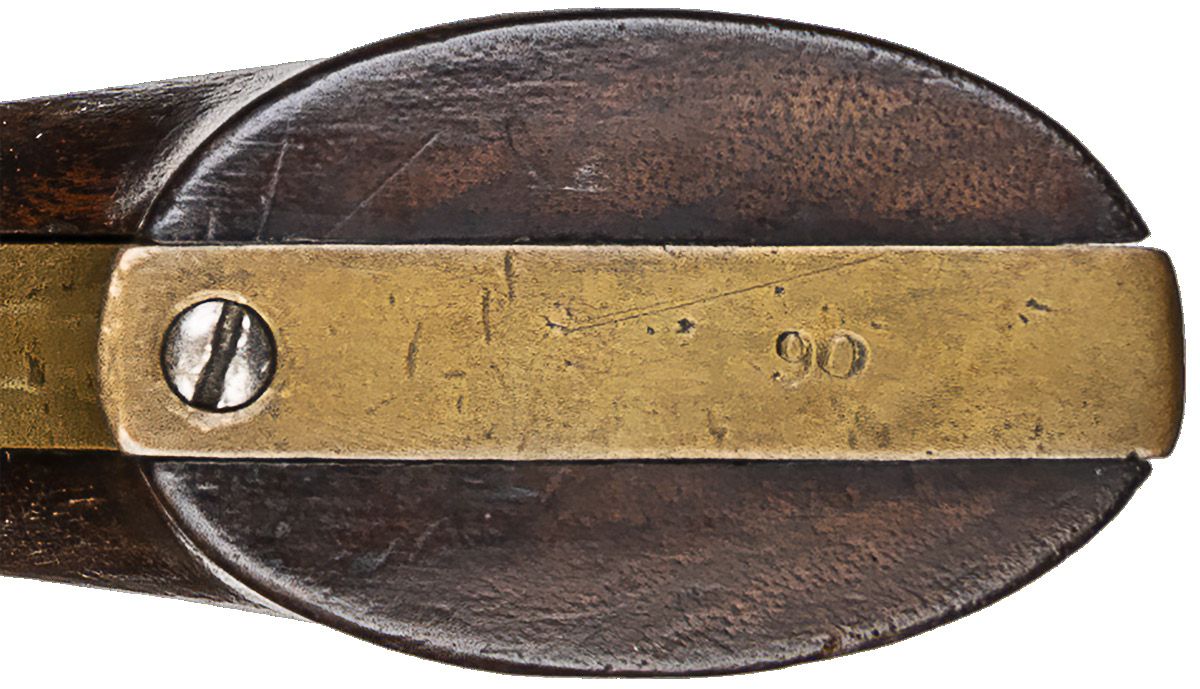
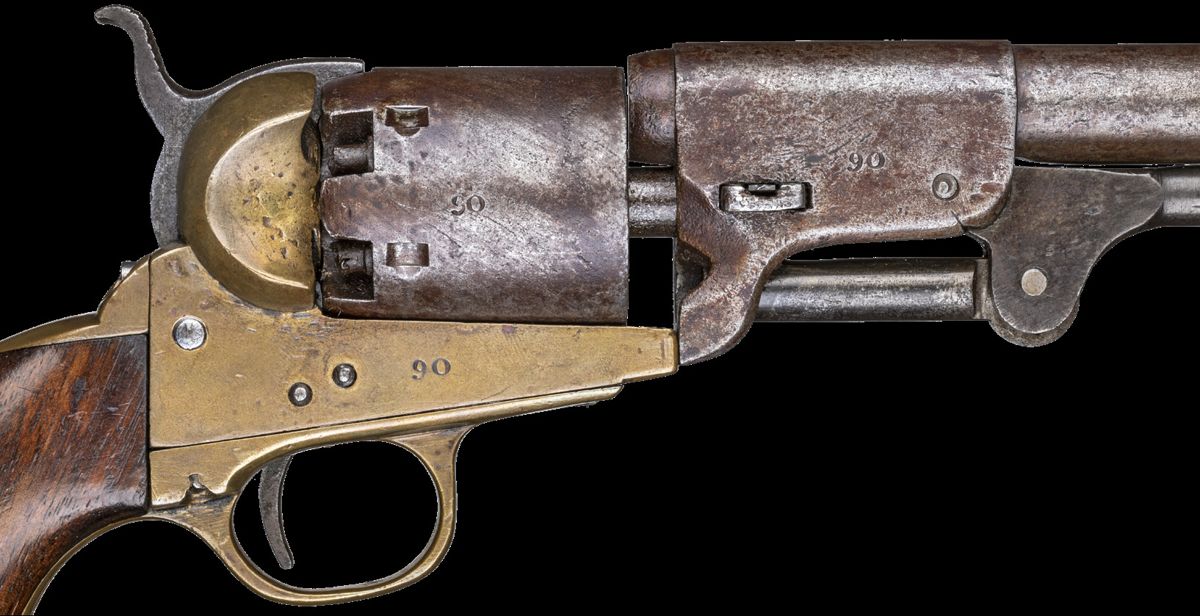
GRISWO L D & GUN N ISO N FIR ST MODEL REVOLV ER , SN 90
Griswold & Gunnison revolver, SN 90, one of four small trigger guard survivors.
Confederate government records show receipts paid for 2,604 revolvers from October 1862 through November 1864; deliveries from the beginning to the end steadily increased from 30-40 revolvers per month until over 300 revolvers were finished each month at peak production. Production increased, and markings became consistent, starting around SN 700. The first 700 guns show more diversity in markings, showing ongoing experimentation. Several low serial numbered parts have been excavated from the Griswold factory site. Several early numbered parts have been observed on standard production deluxe late 1864 manufactured revolvers. These parts appear to be from uncompleted or failed earlier revolvers. Military Store Keeper receipts and payments for the 2,604 revolvers, allow us to estimate the timeline by serial number (SN) when the revolvers were made.
C HA R T S H OW IN G G R ISWO LD & GU NNI SON C HA R ACT E R I ST ICS IN SER IA L NU M B ER RANGES ( M SK REC ORDS) . Date Delivered
Qty
SN Range
Cost
Assembly Marks
10-14-1862
3-32
$40
none
Right
10-22-1862
36-52
$40
Punch Dots
Right
11-19-1862
50-80
$40
Punch Dots
Right
12-1-1862
80-110
$40
Punch Dots
Right
Small trigger guard up to SN 90
12-16-1862
110-140
$40
None
Right all others with large trigger guard
1-13-1863
140-160
$40
None
Right
2-6-1863
160-190
$40
None
Right
3-9-1863
190-240
$50
None
Right
3-13-1863
240-280
$50
None
Right
3-25-1863
280-380
$50
Punch Dots or None
Right & Bottom
3-31-1863
380-430
$50
Punch Dots or None
Right & Bottom
5-11-1863
430-590
$50
Punch Dots or None
Right & Bottom
Serial Numbers Stamped
Roman numerals SN 608, Punch dots, Roman numerals or None
5-30-1863
590-770
$50
Mixed
Right & Bottom
6-1-1863
770-960
$50
Roman Numerals
Right & Bottom
7-31-1863
960-1100
$50
Punch Dots or Roman Numerals
Right & Bottom
9-3-1863
1100-1300
$50
Roman Numerals
Right & Bottom
9-30-1863
1300-1450
$50
Roman Numerals
Right & Bottom
1444 stamped on left
11-30-1863
1450-1650
$50
Roman Numerals
Left or Right
1477 earliest 2nd Model
1-26-1864
1650-1850
$50
Roman Numerals
Left or Right
1522 highest 1st Model
3-24-1863
2000-2400*
$55
Roman Numerals
Left or Right
6-26-1864
2400-2800*
$55
Roman Numerals
Left or Right
9-30-1864
2800-3300*
$146
Roman Numerals
Left or Right
11-11-1864
2800-3300*
$146
Mixed
Right *Estimated, records exist for 2604 guns
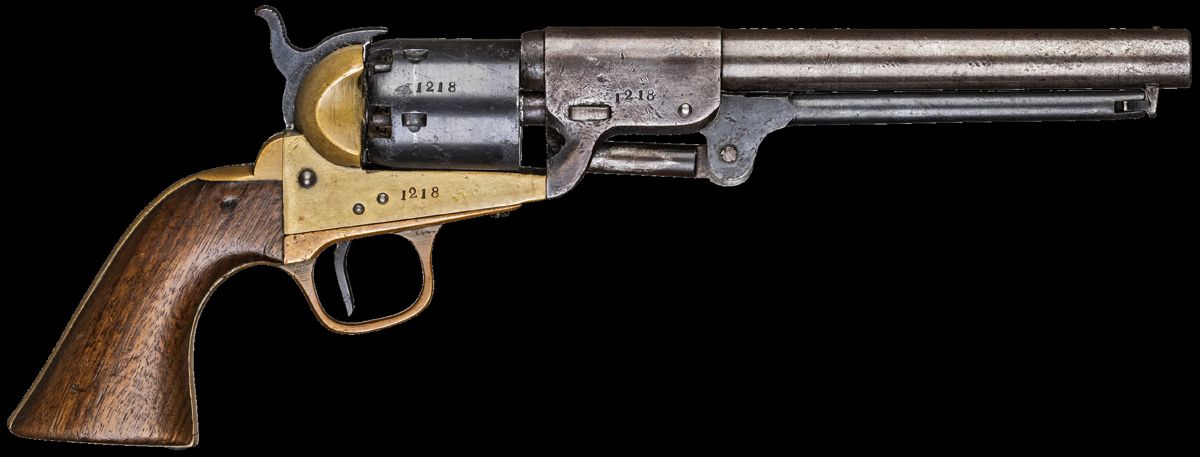
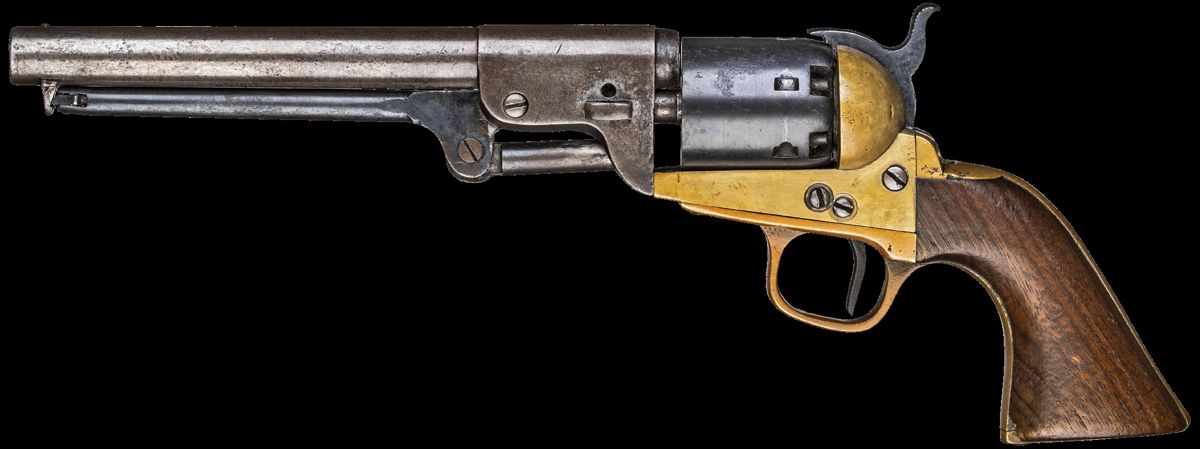
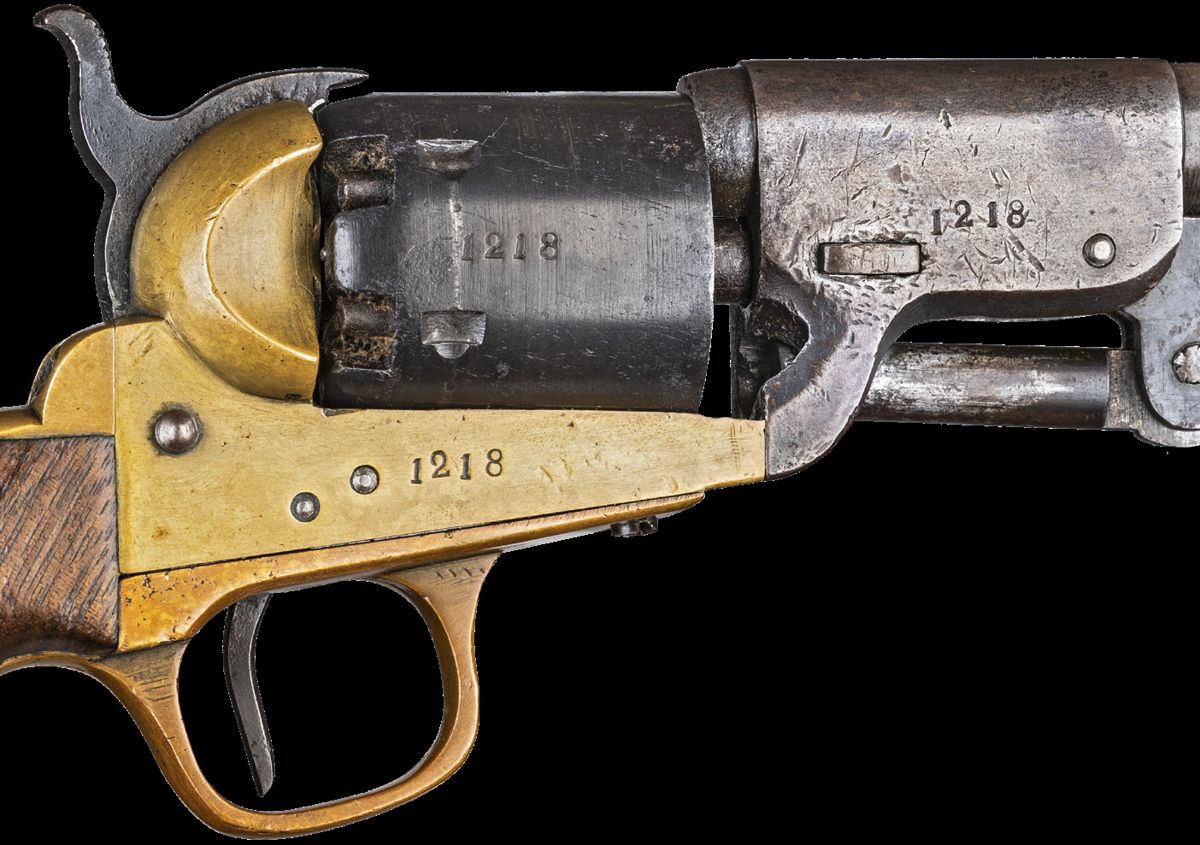
G RISWO L D & GUN N ISO N FIR ST MODEL REVOLV ER , SN 1218
SN 1218 first model made about September 1863.
Standard first model Griswold with half-round barrel housing.
Nov. 20, 1864, production ended with General William T. Sherman’s well-chronicled destruction of the Griswold factory. The rarest anomaly in Griswold revolvers is the unique iron frame example, SN 1941. There are several excavated iron frames in various stages of finishing, but 1941 is the only complete example known. Serial numbers are found on the left side of the barrel and cylinder though not on the frame.
The machining and other physical characteristics of the frame definitively prove the frame’s originality. It is possible that this was one of Griswold’s repairs to a damaged revolver, as there are several excavated iron frames in different stages of finish. This gun also exhibits the “H” or “II” cryptic on the right side of barrel housing which is thought to be an inspector’s mark for factory reworking, first proposed by Cecil Anderson in cited article.
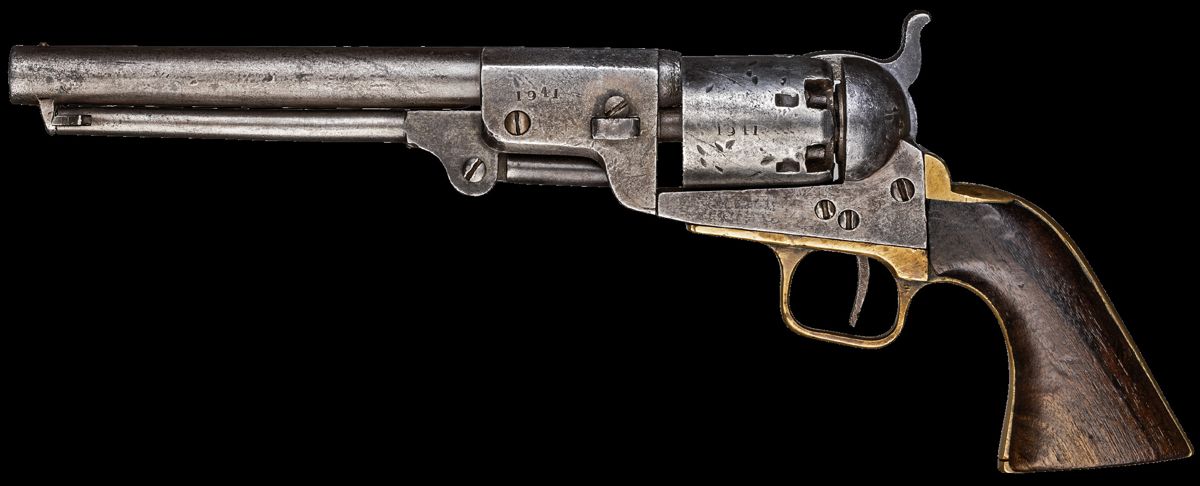
G RISWO L D & GUN N ISO N O N LY KNOWN I RON FRAM E, SN 1941
SN 1941 is the only known iron frame Griswold, made in early 1864.
Sam Griswold had good Connecticut Yankee business sense and no doubt sold many revolvers privately during the high demand for revolvers when the government was paying a low price. There are a handful of semi-deluxe guns with a high polish, silver-plated brass frame, varnished burl grips, with matching assembly numbers on most parts. These highest finish guns are made with mixed parts without SNs, mixed SNs, polished out SNs, mixed cryptics, and mixed Roman numerals polished out, sometimes not even discernible. SN 3581 is a perfect example with “new” assembly number “2” in cruder larger font found on barrel housing face, wedge, frame, arbor, face of cylinder, backstrap, trigger guard, hammer, and grips. Mixed cryptics “RR,” “I,” and “A” are partially discernible along with polished out indiscernible cryptics and mixed Roman numerals and secondary numbers.
Another unusual characteristic of the subject gun and other guns noted in this series is that the face of the hammer is not milled to accommodate safety pins but has a raised triangular surface. Regardless of why these high finished, mixed parts guns were made, they bring to a close Griswold revolver production. It should be noted that the highest serial numbers known on Texas-made Dance Brother revolvers are also found on mixed number guns that were retained by the Dance family. Neither Griswold nor Dance were going to waste any parts sufficient to build a gun that could be sold at a time when sidearms were in very high demand.
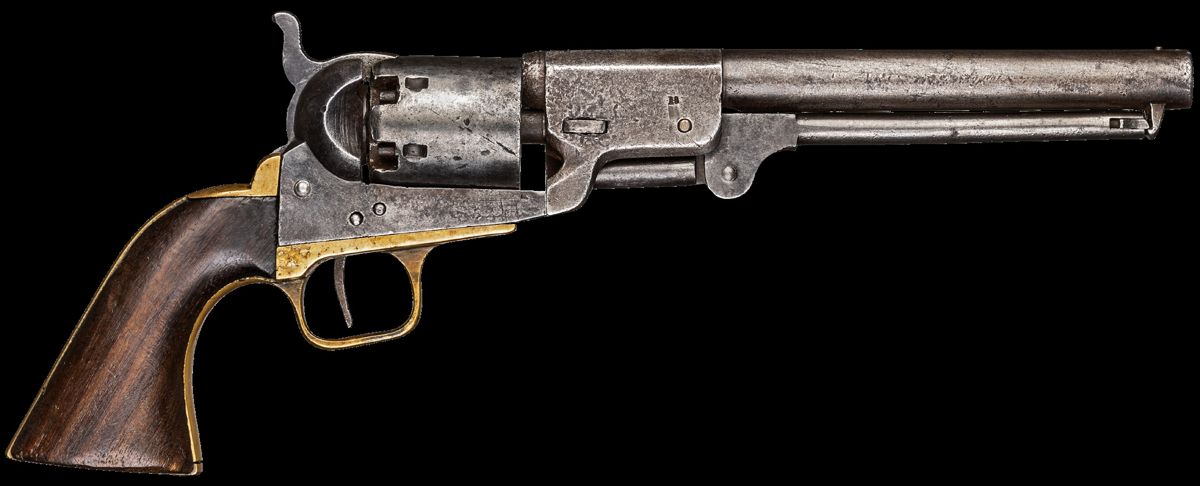
G RISWO L D & GUN N ISO N STA N DA RD SEC OND M ODEL W IT H H AL F O C TAG O N A L BA R R EL HOU SI NG, SN 2569
Secondary number 19 stamped on grip and trigger guard.
G RISWO L D & GUN N ISO N SILVER P L ATED DELU XE REVOLV ER , SN 3581
Deluxe SN 3581, silver-plated frame, varnished burl grips, highly polished iron, made late 1864.
“V” sculpted hammer nose with no knurling, large crude font assembly “2”, and wood burl (following page) observed on deluxe production Griswold & Gunnison revolvers with SNs starting in 3400s.
Historical marker at the site of the Griswold pistol factory.
Penciled assembly number “2”, better grade of wood than normally seen with burled grain. SN 3581.
Above: These three photos of a cylinder, showing cryptic A, and crude assembly “2”” on cylinder face, are for SN 3581.
“VI” roman numeral stamped on bottom of frame on SN 3581.
Matching roman numerals are found on all brass components of standard production revolvers starting about SN 900 and sporadically on earlier guns.
Cryptic “U” (at about 5 o’clock position) on this example’s cylinder is often worn off, but a vestige usually can be seen.
The cryptic “AA” marks adjacent to each other on finished guns at the interface of backstrap and trigger guard are found on all standard production revolvers and also found on frame, barrel, and cylinder. SN 1162.
Cryptic “U” stamped on the bottom of barrel near the latch. Cryptic backward “FF” found on the base of the trigger guard.
SEL EC TED B I B L I OGRAPHY:
Albaugh, William A. III, The Confederate Brass-Framed Colt & Whitney, 1955. Albaugh, William A. III, Benet, Hugh Jr., and Simmons, Edward N., Confederate Handguns: Concerning the Guns The Men Who Made Them and the Times of Their Use, 1963. Anderson, Cecil (no date). Notes of Samuel Griswold revolvers. (Manuscript on file). Gary, William, The Gun Report magazine, October 1979, “Some Observations on the Griswold and Gunnison Revolver.” Gary, William A., Confederate Revolvers, 1987.
The cryptic backward “Q” on this example shows the “mating position” on all standard production revolvers of grip frame. SN 3322.
Sexton, John, Arms Heritage magazine, December 2019, “Griswold Revolvers-Chronology of Manufacture.” Sexton, John, Proprietary Database of Confederate Revolvers. Sexton, John, “Newly Discovered First Model-First Type Griswold Revolver,” Ask the Civil War Collector, Southeastern Antiquing, Feb. 2014 Swinney, H.J., “Gun Iron and Mild Steel,” The American Society of Arms Collectors, Bulletin #78, 1998.
SN 3085 has been known since 1956; it is a total fake but has been handled by several prominent collectors and dealers. There are many more fake and fraudulent examples, caveat emptor. Have your purchases vetted by a knowledgeable authority on the subject matter.
John holds the highest designations as certified appraiser with International Society of Appraisers (ISA-CAPP) & accredited senior appraiser with American Society of Appraisers (ASA) specializing in Civil War memorabilia. He authenticates and evaluates other rare and valuable historic items as well. His website is www.civilwarappraiser.com. He is coauthor of the book Confederate Bowie Knives (2012) by Jack Melton, Josh Phillips, and John Sexton, that was published by Mowbray Publishing Inc., and author of many periodical articles on Confederate arms.