
Doctor Gatling’s Gun
By Philip Schreier, Director, NRA Museum · Originally published March-April 2022 · pp. 27–39
The old story goes something like this: In the summer of 1861 and wounded Federal troops from the recently fought battle of Manassas were disembarking at the train station in Indianapolis, Ind. The gravity and seriousness of their wounds were troubling for those who heard their pitiful cries and moans as they were carried off to local hospitals. Of the 700,000 casualties attributed to the War Between the States, over three-quarters would die of wounds or disease, many while in hospital care. Watching the procession of the invalided and walking wounded was the colonel of the 70th Indiana Volunteers and a dentist who was a native of North Carolina. The colonel remarked that there ought to be some way to make waging war so significantly terrible that neither side would want to continue the enterprise at such a dreadful cost. The dentist set about designing a wonder weapon capable of firing 200 rounds a minute when the standard muzzleloading service rifle of the day fired, at best, three rounds a minute; the resulting carnage was sure to render the enemy hopelessly demoralized and willing to desist in the face of such swift and certain death. The colonel was Benjamin Harrison (1833–1901), who would go on to become the 23rd President of the United States in 1889. The dentist was Dr. Richard Jordan Gatling (1818–1903). The gun that bears his name changed the face of warfare in 1862 and continues to do so today. From an initial 200 black powder cartridges fired per minute to the current 6,000 rounds per minute fired by the electric mini-gun, the Gatling has left an indelible mark on land, sea, and in the air. Sadly Dr. Gatling’s invention was never given its due during the War Between the States. Major General Benjamin Butler is said to have personally purchased the first 12 .58 caliber Gatling guns made at the Cincinnati Foundry Works and used them in 1864 during the James River Peninsular Campaign that included fights at Drewry’s Bluff and Bermuda Hundred. Evidence of their use in actual Civil War combat is quite thin; along with one gun purchased by the Navy for use by Admiral David Dixon Porter on the Mississippi River, there are no first-person accounts of their actual use.
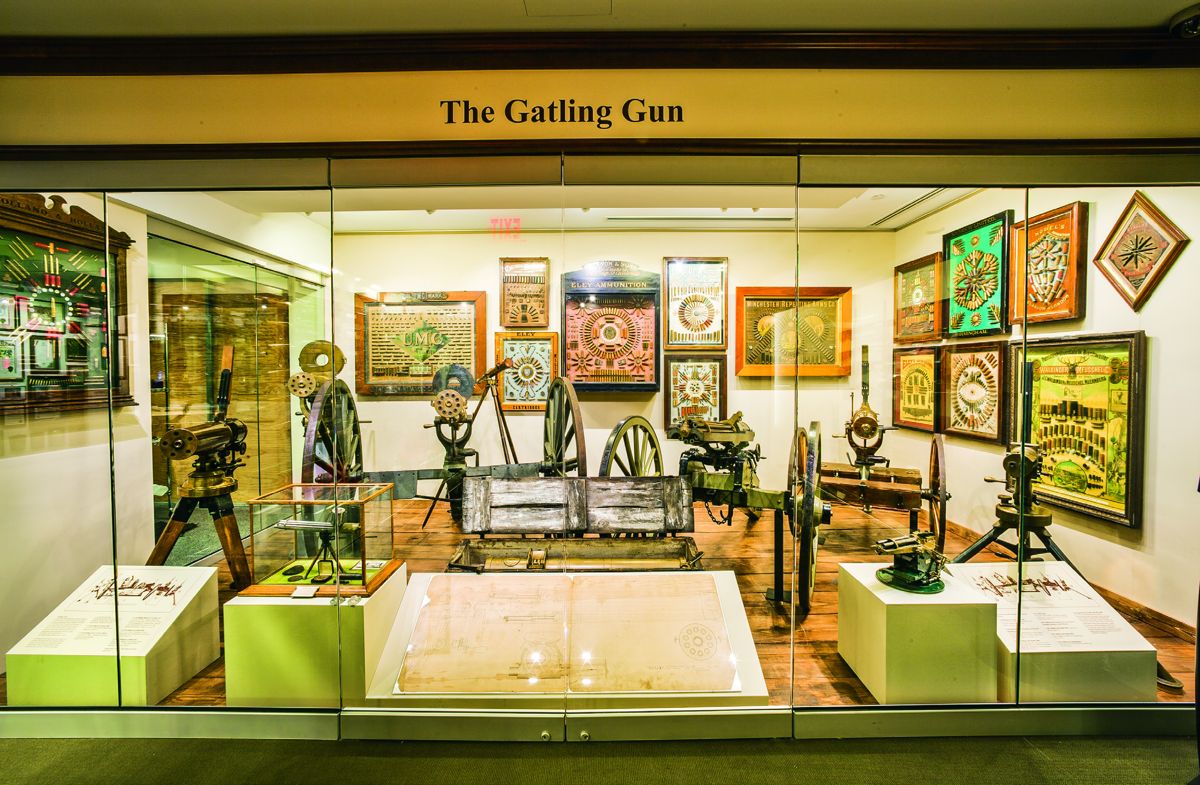
“The Gatling Gun” exhibit at the NRA Museum.
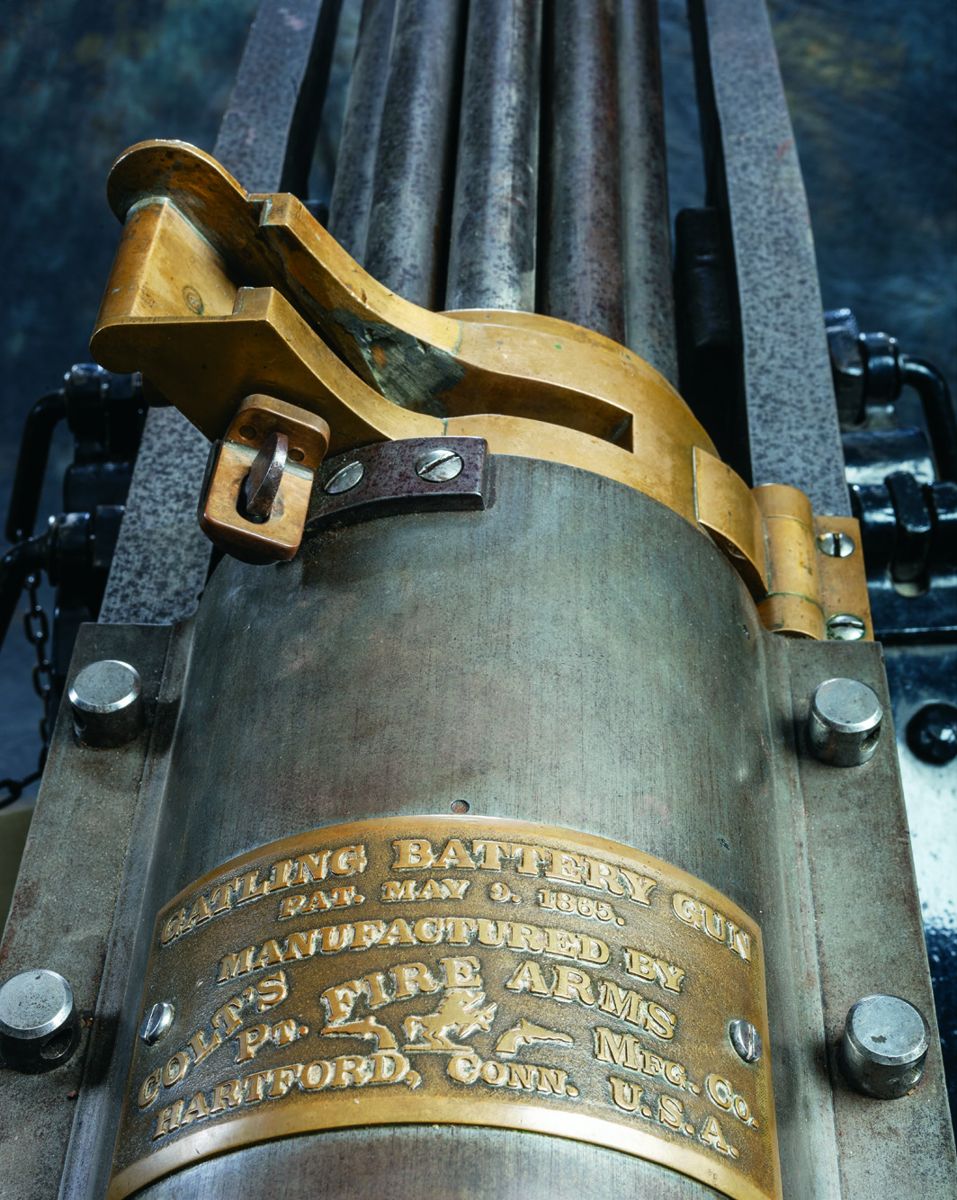
As news of the reliability and smooth functioning of this novel weapon spread, both the United States and Great Britain began purchasing models that accepted the new center-fire ammunition in .50-70 caliber. These guns were manufactured by Colt’s Patent Firearms Manufacturing Company, the firm that produced the entire run of Gatling guns from 1866 until 1903 when they were superseded by belt-fed, fully automatic machine guns. Eventually, the U.S. Army and U.S. Navy settled on .45-70 as its standard service cartridge, and Gatlings were made in a variety of models from 1874 to 1893 in that caliber. They found great use drawn on carriages like artillery pieces in the Army, including some that were fitted atop camels of the U.S. Army’s short-lived Camel Corps in the desert southwest. The Navy mounted them to riverboats and ships of the line on gunwales and in the fighting tops. The models of 1893 and 1895 were manufactured in .30-40 Krag; in this caliber, they came into their most storied use. As the U.S. Army under General Shafter descended upon Tampa, Fla., preparing to invade Cuba during June 1898, Major John T. Thompson of the U.S. Army’s Ordnance Corps was enjoying an “iced-cream” on the porch of the Hotel Tampa when a young Army Ordnance Lieutenant named John Parker joined him for one of these new, novel, refreshing treats. Thompson, who designed the famous “Tommy Gun” in 1919, listened intently to the young lieutenant bemoan the fact that he truly wanted to go to Cuba to “see the elephant,” as it were, but he and his company were unattached without any ordnance to fight with. Thompson suggested that Parker take command of a battery of four Gatling guns Thompson had in Tampa that were in need of a company of soldiers to make good use of them. Parker found a receptive home for his unit when he approached the Executive Officer of the 1st U.S. Volunteer Cavalry, Lt. Colonel Theodore Roosevelt. Roosevelt’s unit, The Rough Riders, had been gifted two Model 1895 Browning-designed, Colt manufactured “potato-digger” machine guns by the families of Louis Comfort Tiffany and the granddaughters of John Jacob Astor. “On July 1st the Rough Riders had their “Crowded Hour.” At the same time other units were getting ready to assault one section of the San Juan Heights, the Rough Riders along with the 3rd and 10th Cavalry were getting ready to make their charge up Kettle Hill, in the northeast part of the Heights. Providing fire support were Lt. John Parker’s three Gatling guns. The Gatling guns expended some 18,000 rounds in eight and a half minutes. That figures out to over 700 rounds per minute.” – Marshall Trimble, “Teddy Roosevelt’s “Cowboy Cavalry” The Rough Riders,” True West Magazine, April 12, 2018. Roosevelt thought that two belt-fed machine guns and four Gatlings, along with a Hotchkiss dynamite gun they had also picked up, would make a formidable fighting force against the Spaniards. Gatling numbers 1040, 1041, 1042, and 1043 were pressed into service and made the trip to Cuba and into the history books. Following the SpanishAmerican War, most serviceable Gatlings still in use by 1906 were converted to .30-06 and then retired. The age of the water-cooled, belt-fed, fully automatic machine gun was settling in, and Gatlings were soon considered obsolete. No more than 1,200 guns had been produced by Colt’s Patent Firearms Manufacturing Company during the entire run from 1874–1903. When the good doctor passed away in 1903, his invention seemed destined to pass with him. Not so fast, dear reader. It took another prolific arms inventor by the name of Melvin M. Johnson Jr. of Providence, R.I., to breathe new life into the old
Lt. Colonel Theodore Roosevelt. (Library of Congress).
war horse in 1945. Using an idea that Dr. Gatling first experimented within 1890, Johnson connected a Model 1893 Gatling to an electric motor and belt system to fire the gun at speeds never before contemplated. Gatling’s hand-cranked gun had been able to sustain rates of fire that fluctuated from 200-600 rounds a minute. Maxim’s water-cooled, belt-fed could also sustain rates of 600 rpm, and the 1942 MG 42 of the German Army was known to cycle at 1,200 rpm. Johnson was able to set records in the immediate post-WW II period with an impressive 5,800 rpm! By 1949 “Project Vulcan” was up and running, producing Vulcan machine guns with sustained rates of fire exceeding 6,000 rounds a minute. What became known as the M61 Vulcan 20 mm became a staple of the U.S. Army and U.S. Air Force that continues to this day. In 2010, the NRA Museums received a bequest from magazine publisher Robert E. Petersen of nine Gatling guns and a Gardner gun. Once they were placed on exhibit at the National Firearms Museum in Fairfax, Va., museum staff was proud to highlight the fact that visitors were looking at the largest collection of Gatlings on exhibit anywhere in the world. A subsequent visit to the Institute of Military Technology in Florida soon disabused the NRA Staff of their proud boasts as they have 20 Gatlings! Here are a few of the Gatling’s in the collection of the NRA’s National Firearms Museum. The museum is open from 9:30-5:00 every day of the week and admission is free; the museum is located in Fairfax, Va., just outside the Capital Beltway. Check out our website at www.nramuseums.org and follow our Facebook & Instagram accounts. (Before traveling the NRA Museum, visit our website for the most up-to-date information on any closures due to Covid.)
About the Author Philip Schreier is the Director of the National Firearms Museum in Fairfax, Va., where he has worked for the past 33 years. A native of Washington D.C., he has had a lifelong interest in military history and firearms. He has written and co-authored a number of books and hundreds of magazine articles. He served as an embedded war correspondent in Iraq & Afghanistan in 2003 and 2009. Currently he is a series regular on American Rifleman television, Gun Stories with Joe Mantegna and former co-host of NRA’s Gun Guru’s.
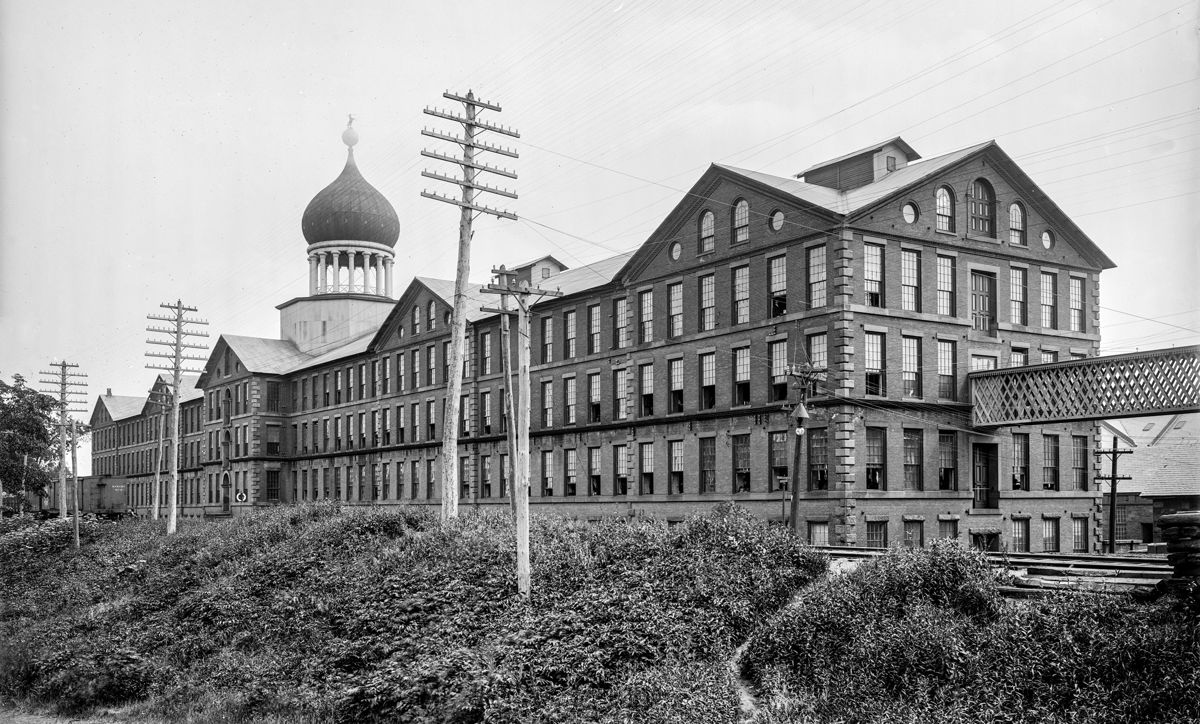
Colt’s Fire Arms Manufacturing Company, Hartford, Ct. (1900-1906). (Library of Congress).
The Gatling Model 1866, caliber .50-70. Although the Gatling gun was not purchased by the Federal Government for use during the Civil War, some states and individual officers purchased them for their own use. They saw action at Petersburg near the close of the war. This post-war Model 1866 was similar to its predecessor in that it fired black powder cartridges in sleeved sabots with percussion caps externally mounted to the sleeve. Later models benefited tremendously from the use of self-contained metallic cartridges. Gift of the Robert E. Petersen Foundation to the NRA Museum.
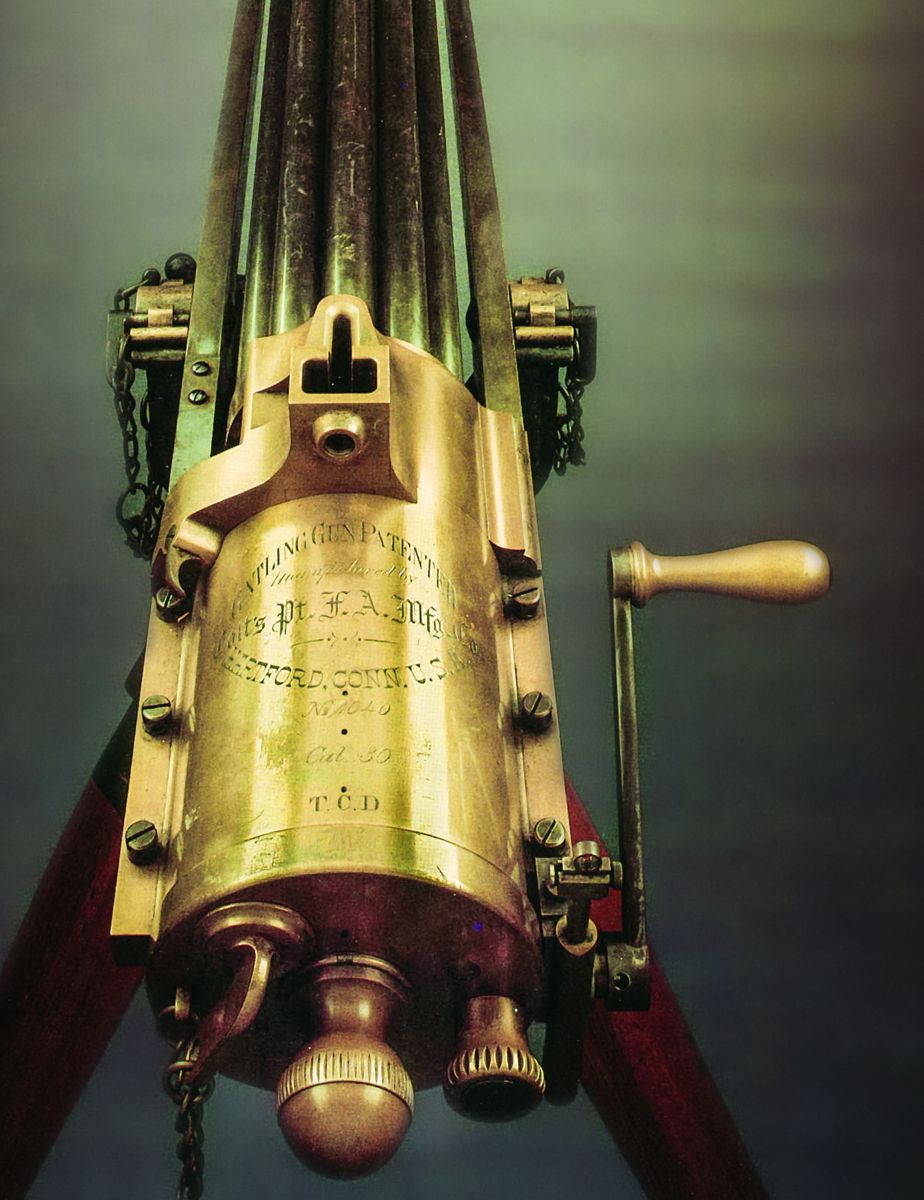
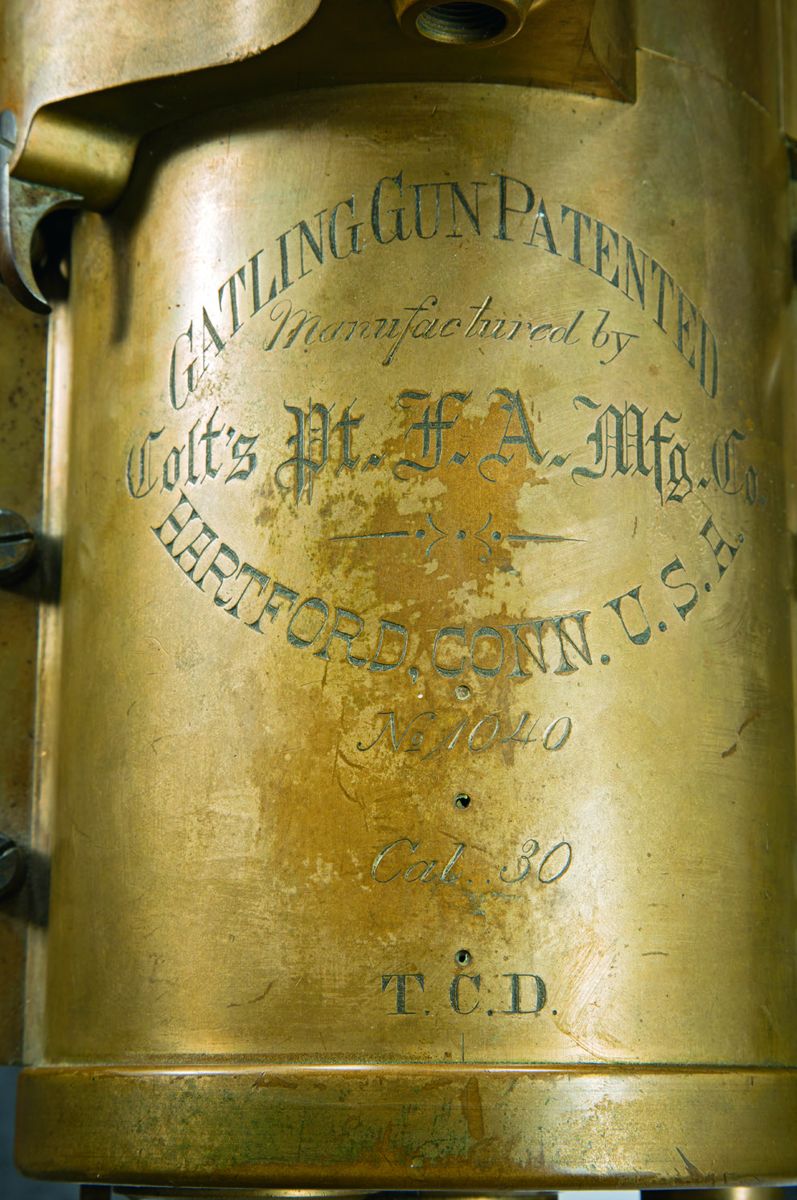
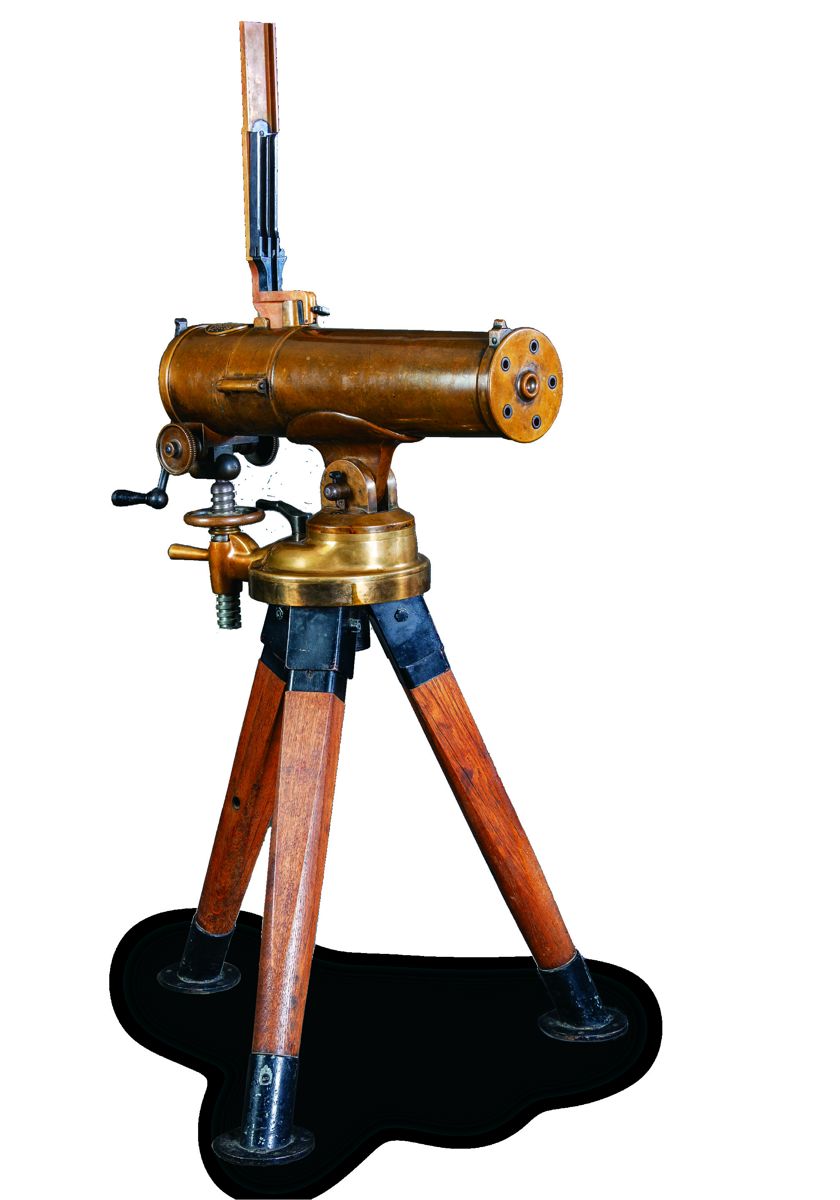
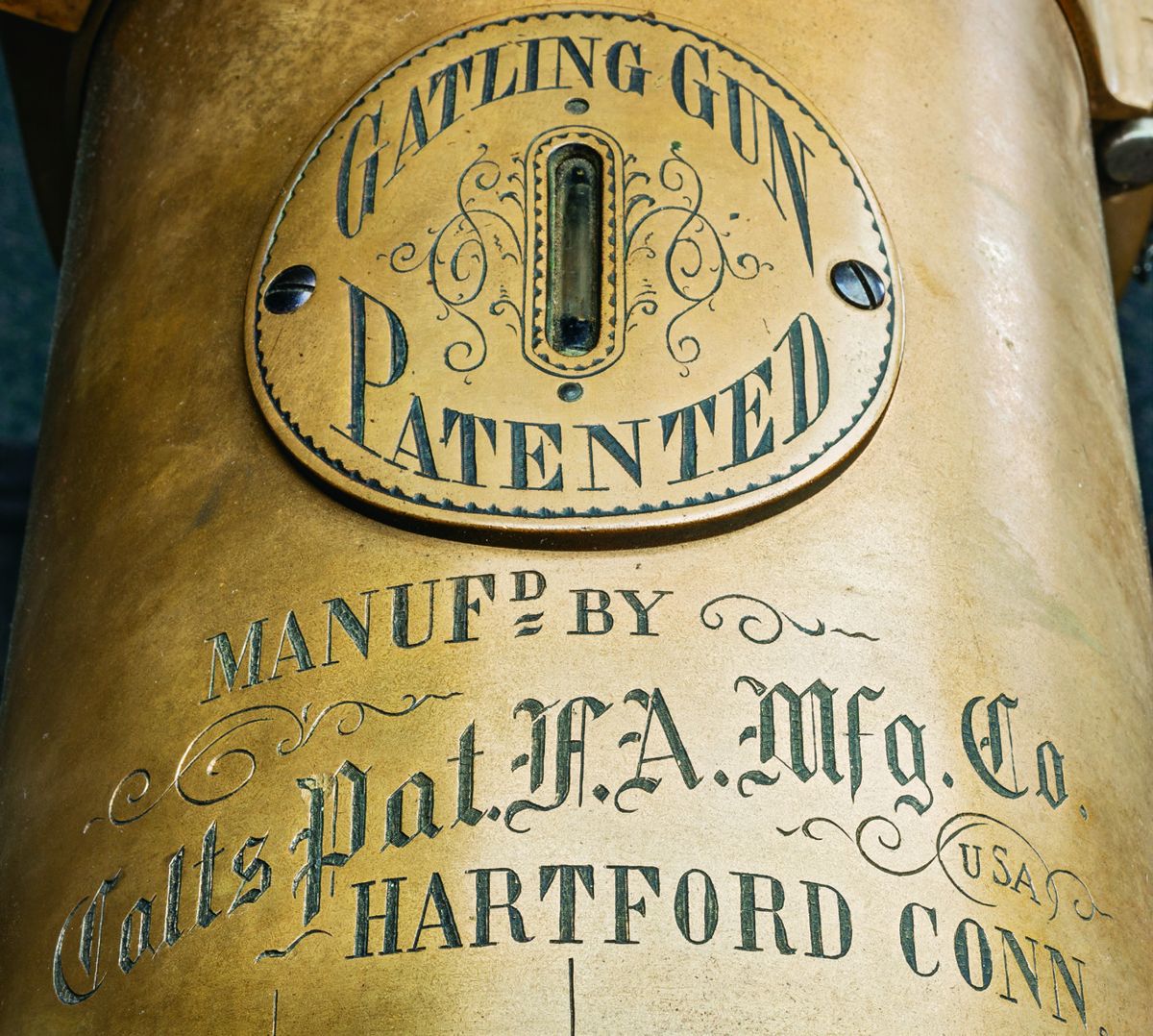
As if being commanded by one of the most colorful figures in all of America wasn’t enough for Theodore Roosevelt’s Rough Riders, they also had the distinction of carrying into battle four .30-40 caliber Model 1895 Gating guns as well as the first two belt-fed, fully automatic machine guns ever used by the United States Army in battle. This gun, serial number 1040, was one of Roosevelt’s original four Gatlings that provided covering fire at the Battle of San Juan Hill, July 1, 1898. Gift of the Robert E. Petersen Foundation to the NRA Museum.
This Model 1877 five barreled gun in .45-70 caliber was known as the “Bulldog” model and a favorite of police units needing firepower in tight spaces. This gun served out its career at the Cincinnati Work House (Prison) in Ohio. Gift of the Robert E. Petersen Foundation to the NRA Museum.
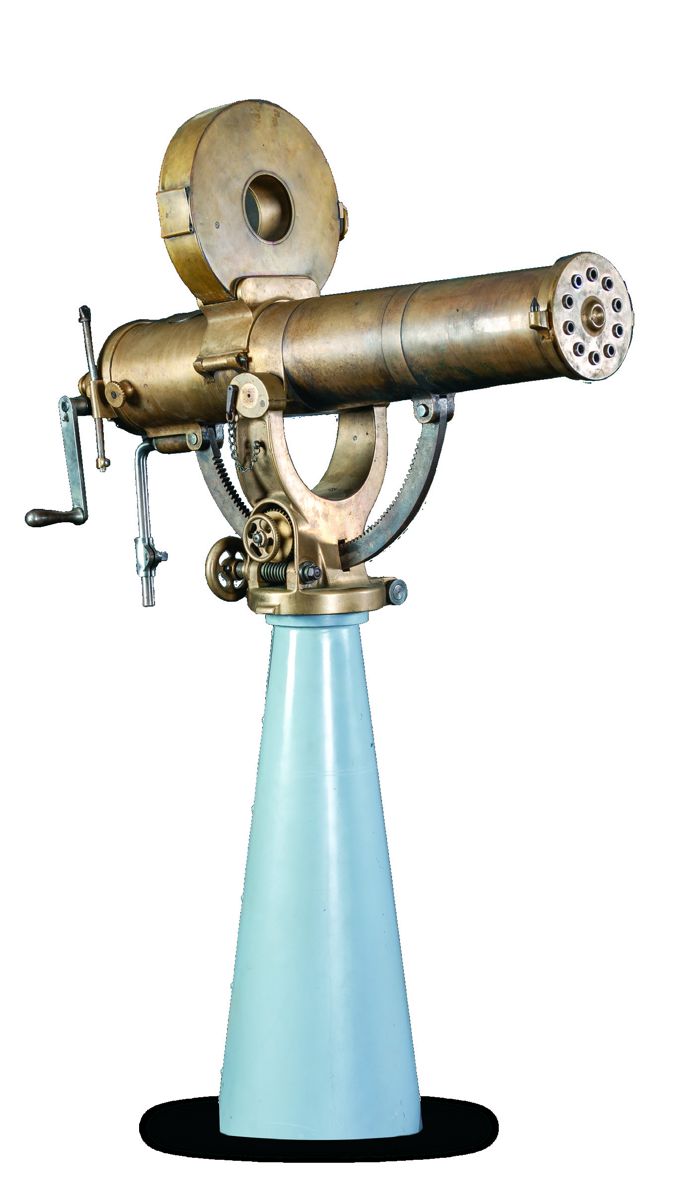
Below and Right: This stunning Model 1883 was made for the United States Navy and served at sea mounted on its unique cone-shaped stand. With ten barrels chambered in .45-70, this was a formidable opponent on the high seas. It is the only complete Model 1883 USN with mount known. Gift of the Robert E. Petersen Foundation to the NRA Museum.
This Model 1883 Gatling with the Accles feed drum mounted atop was manufactured by Colt in Hartford, Conn. This ten barreled gun was made in .45-70 caliber and was considered the last of the black powder Gatling models. This example is shown mounted on an original Colt factory barrel dolly used to transport the barrels to various points in the factory.
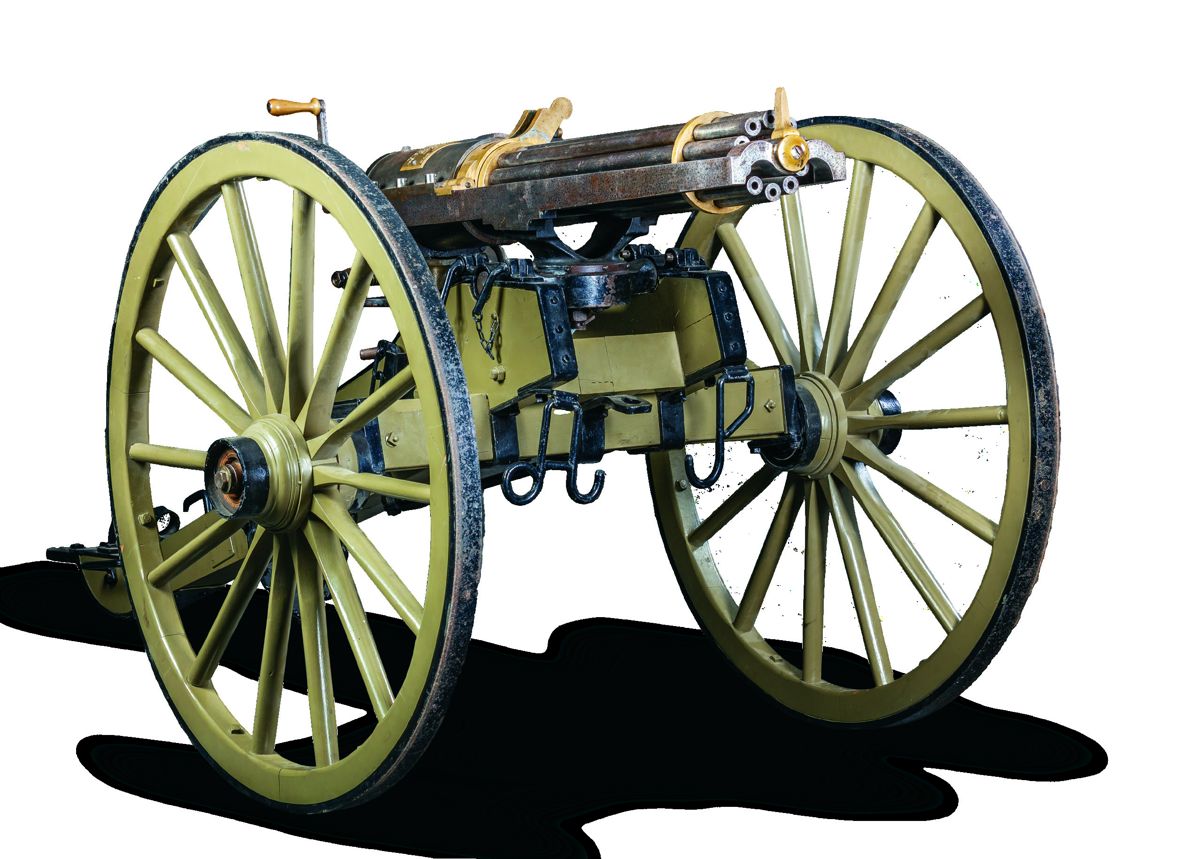
This Model 1883 was used by the U.S. Army during the late 19th century Indian Wars. Mounted on a two-wheeled carriage, these guns were transported and deployed much like artillery pieces of the day. Originally Dr. Gatling thought that the guns should be deployed like artillery and named his invention “Gatling’s Battery Gun.” This particular Gatling gun was used in the 1939 film Gunga Din. Gift of the Robert E. Petersen Foundation to the NRA Museum.
A Model 1883 in its original factory shipping crate. Gift of the Robert E. Petersen Foundation to the NRA Museum.
Not a Gatling gun, this two-barreled gun is a .45-70 Gardner gun. Much more maneuverable due to its lightness, the Gardner never reached the romantic acclaim the Gatling held over the public. Gift of the Robert E. Petersen Foundation to the NRA Museum.
One of Lieutenant Parker’s four Model 1895’s, .30-40 in front of Santiago, Cuba. August 1898. Note the pile of .30-40 twenty-round ammo boxes behind the soldier. (Frank Leslie’s Illustrated Weekly, authors collection).
Model 1903 Gatling .30-40 showing the effects of direct fire upon the defensive shield after a field test of the armor plating. (Author’s collection).
British and American sailors in Samoa defending the British Consulate in Apia during 1899. Armed with a detached Naval Mount Gatling Gun. (The Graphic, London, authors collection).
A vintage photograph of the original patent model of the Gatling gun’s breech mechanism made entirely out of wood, as was the requirement of the United States Patent Office at the time. (Author’s collection)
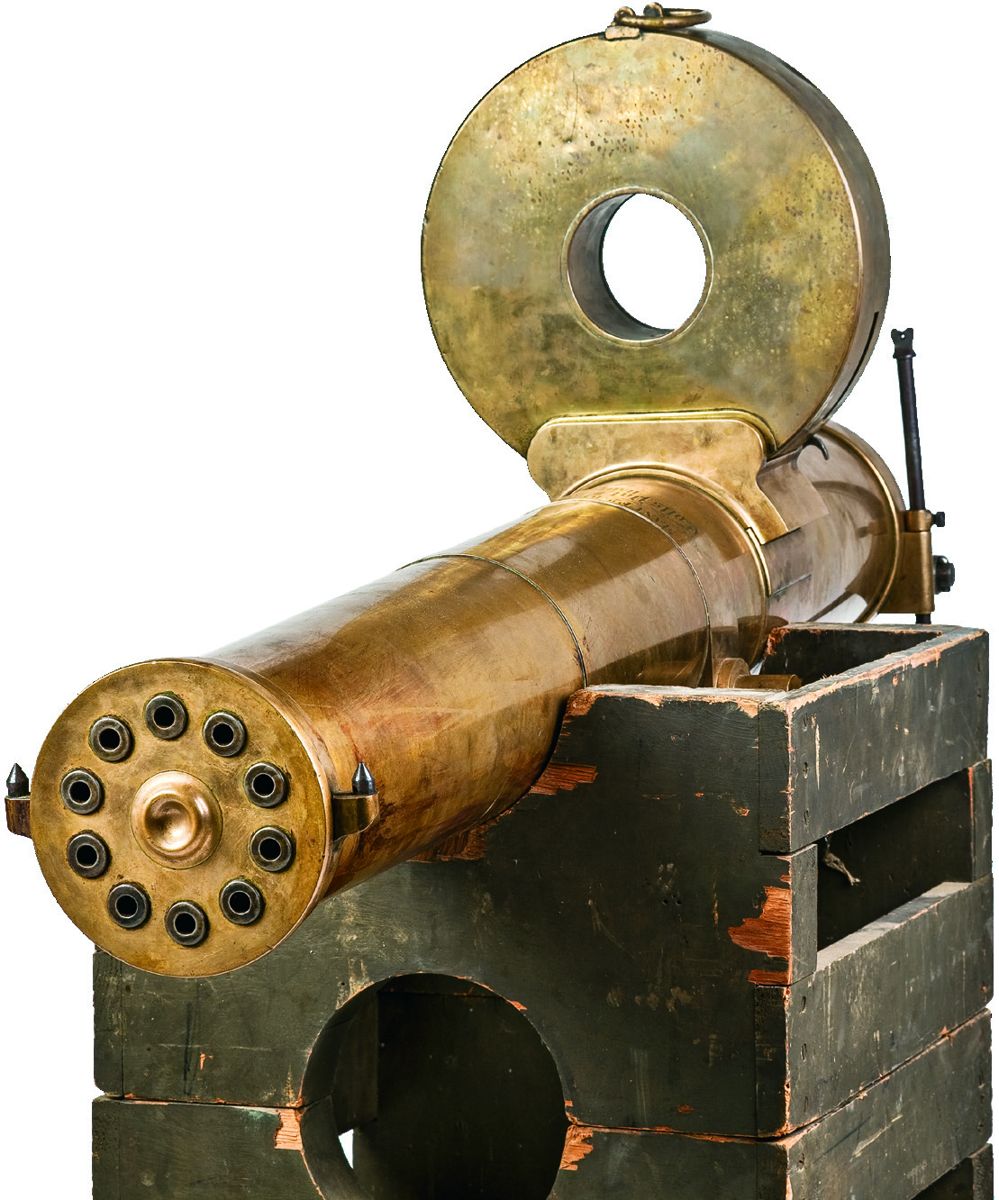
Illustration of the movements of the Gatling firing system. The first 5 stages illustrated show the loading and firing of the cartridge; stages 6-10 show the extraction of the spent casing. (Author’s collection)
The largest caliber Gatling was the 1-inch gun manufactured by the Cooper Firearms Manufacturing Company of Philadelphia, Penn. In 1866, Major General Winfield Scott Hancock ordered 12 for U.S. Army trials and use. (Author’s collection).
A 10 barreled Gatling mounted for naval service on a ship’s gunwale. Some were also mounted in the fighting tops of masted ships. (Author’s collection).
Frontispiece of The Gatling Gun for Service Ashore and Afloat by Major General William B. Franklin (1823–1903). Franklin, a graduate of the USMA, veteran of the War with Mexico and the Civil War, was Vice President of Colt’s Patent Firearms Manufacturing Company when he wrote this guide to the Gatling gun in 1874. (Author’s collection).