
The Flintlock Pistols of Rappahannock
By Craig D. Bell · Originally published March-April 2022 · pp. 42–65
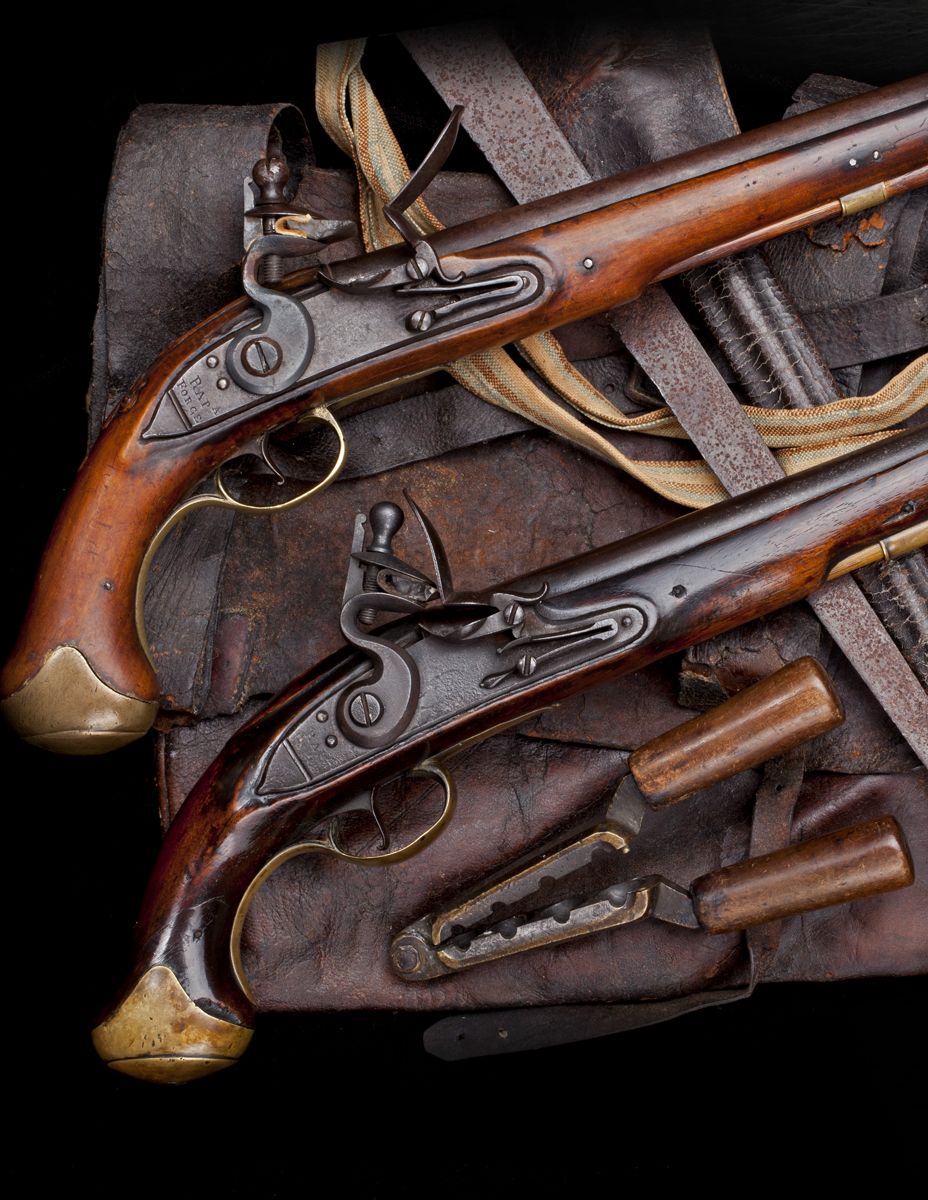
A pair of Rappahannock Forge smooth bore single shot flintlock pistols, resting on a Hunter Iron Works bayonet, and Captain John Paxton Jr.’s leather bayonet sheath with its original linen cloth shoulder strap, his leather knapsack and John Miller-made bullet mold, all from the American Revolution. Captain Paxton served with the Rockbridge County, Virginia, militia during the Revolutionary War and was wounded by gunshot at the Battle of Guilford Courthouse on March 15, 1781. Paxton returned home to Glasgow, Rockbridge County, Va., and died in 1787.
by Craig D. Bell t the outbreak of the American Revolutionary War (1775–1783), the American colonies were poorly prepared to produce any, much less standardized, military weaponry and equipment on a massive scale. Committees (or Councils) of Safety were organized in many colonies, soon to be states, in an attempt to solve this problem. While helpful, most Committees of Safety were not able to generate sufficient numbers of quality muskets, pistols, or swords to properly outfit the Patriot soldiers. Scottish immigrant James Hunter, who settled in the Falmouth area of Virginia in the mid-1740s, became the most successful iron maker to address the colonial shortfall of weapons and supplies at the outbreak of the war. This is the story of James Hunter and his Hunter Iron Works, the Rappahannock Forge.
A James Hunter’s Iron Works was located east of Falmouth, only a few miles from Fredericksburg, Va. James Hunter (1721–1784) was the son of James Hunter, a merchant in Duns, Scotland. His uncle, William Hunter, settled in Virginia sometime in the 1730s and was one of the first Scottish merchants to reside in the Fredericksburg area. By 1749 James Hunter had settled permanently in Virginia, becoming a partner in his uncle’s Fredericksburg store. By the mid-1750s, Hunter was branching out of the mercantile business and developing planting and industrial interests. Construction of a mill and forge was underway during the 1750s. At some point, Hunter’s Rappahannock Forge began producing pig iron it exported to Liverpool, England, as early as 1761.1 Hunter’s Iron Works produced a number of iron products for use at farms and plantations, including hinges, bridle bits, curry combs, kitchen implements, kettles and pots, and horse plows (including the “Farmer’s Friend” plow). Hunter expanded the iron works facilities to include a store, counting house, smith’s shop, tannery, grist mill, saw mill, forge mill, and merchant mill.
By 1770 Hunter’s Iron Works at Falmouth was considered the largest in America.2 With the advent of hostilities brewing in America between the American colonists and England, James Hunter expanded his manufacturing and forging muscle to include the production of small arms. Hunter advertised for all kinds of craftsmen. He offered them inducements of half-acre lots of land and assistance in building their houses:
Wanted, at Hunter’s Iron Works, the Falls of Rappahannock River, in the Manufactory of small Arms, a Number of Hands who understand the File, also Anchor Smiths, Blacksmiths, and Nailers, to whom suitable Encouragement will be given; where may be had, for ready Money only, Bar Iron, Fullers Shears, Files, and a Variety of Articles made in the Iron Branch, and where Tradesmen of every Kind, who incline to settle, may have Half Acre Lots of Land at a small Ground Rent for ever, and may be assisted in building, Provisions, and Materials, and the Produce of their Labour taken in Payment for the same. Apply to John Strode, Manager of said Works.3
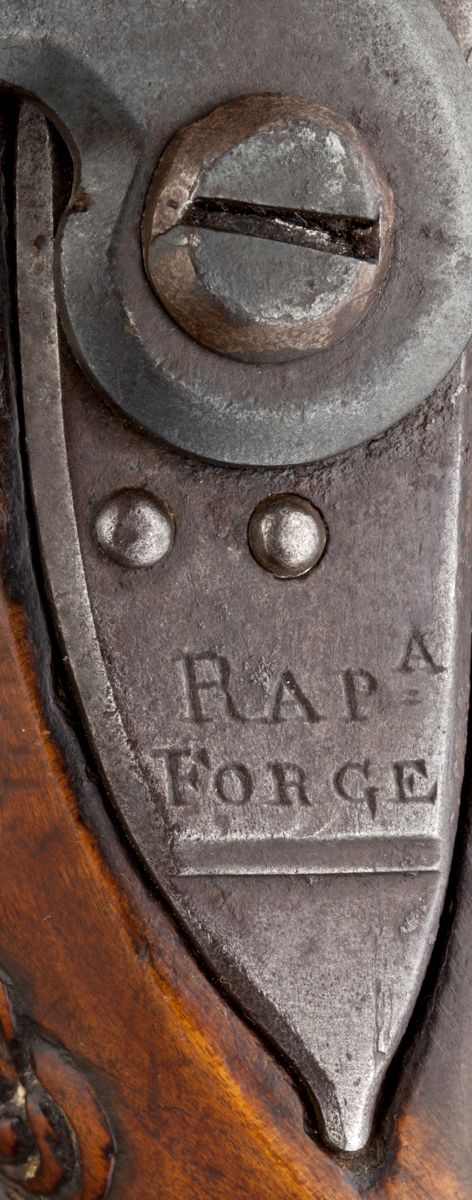
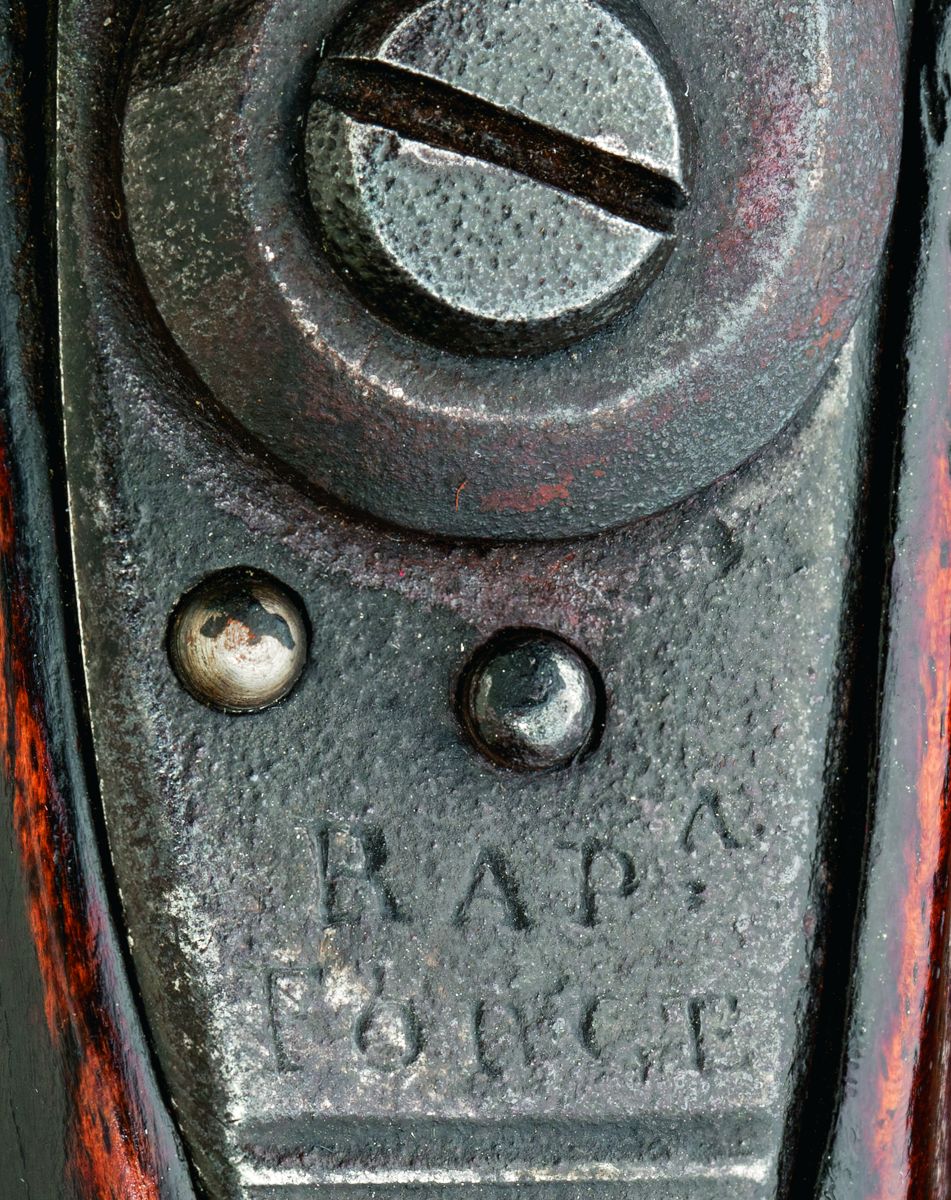
The advertisement was repeated several times during the following year, and Hunter offered to purchase “Negro Tradesmen in any of the above Branches, also Coopers.”4 Hunter was interested in producing military materiel and armaments at least as early as October 1775 when he advertised in a Philadelphia newspaper seeking workers skilled in gun making. In the mid-eighteenth century, Philadelphia was the central geographical location for those experienced in the gunmaking trades. Hunter advertised that he wanted “a gun smith, a complete artist, able to take the charge of a shop, and twenty-four hands under his care and direction; ten gun locksmiths, four gun stockers, two complete workman for turning and welding gun barrels, two complete workman for boring and grinding gun barrels, and a good file cutter.”5 The following year, in June 1776, James Hunter showed a sample musket with bayonet, scabbard, and steel ramrod to the Convention established by the Virginia government to oversee production of arms and materials in support of the Patriot cause. The musket was very well received and adopted as the standard long firearm. Hunter was asked to make as many muskets as possible within the next twelve months. Hunter expanded his gun product line to include other types, including two types of pistols at the Hunter Iron Works, a .69 caliber, 9-inch smooth bore and a .65 Close up photograph of the engraved RAPA FORGE lock plate marking on the martially marked Pulaski Legion-pistol. To the left of the lower lock plate, you can see a portion of the intricate carving located behind the barrel tang on the top of the pistol grip.
caliber, 8.75-inch smooth bore. Additionally, Hunter produced a weapon called an amusette, which the French referred to as light artillery or a wall gun. The amusette bridged the gap between shoulder-fired muskets and artillery. These wall guns were used for protection on boats, ramparts, or the walls of defensive forts. They are semi-portable, weighing about 52 pounds, and had a steel swivel to enable mounting the gun on a wall. The wall gun fired a steel four-ounce, 1.2-inch shot. When the American Revolution progressed into serious, massed fighting, The Hunter Iron Works produced muskets, pistols, swords, carbines, camp kettles, and other items needed for war. In order to protect his business and allow it to expand to serve the needs of the war effort, Hunter made an agreement with the Virginia General Assembly, led by Governor Thomas Jefferson, that stated that his workers would not be drafted for the war (the “Exemption Act”). This important agreement enabled the Rappahannock Forge to maintain a regular work force, largely unaffected by Virginia’s Continental Army and militia drafts to raise troops. Hunter was able to manufacture weapons and goods, particularly to supply Virginia troops. However, a few years later in 1780, the hardships of war necessitated the Virginia legislature to change course and remove the Exemption Act that had kept the craftsmen at Hunter’s Iron Works from serving in the Revolutionary forces. The impact was felt immediately as the tradesmen workers entered the army. By February 1781, the small arms production at the Iron Works ended. Hunter wrote to Jefferson:
I have long ago informed the officers in every department that there was no sword cutter or artificer at my works that could make swords, and unless they are returned on furlough … it will be impossible to furnish them or any other military stores … for the … army.6 When Lt. Colonel Banastre Tarleton threatened Fredericksburg later in 1781, Hunter evacuated the Iron Works and let it sit idle until Tarleton moved on.7 Hunter attempted to continue production at Rappahannock Forge following Tarleton’s departure from the Fredericksburg area; but funding by Virginia was not forthcoming, and the State was deeply in arrears for products Hunter had already sold to the army. In December 1781, Hunter discharged all his workmen, and Hunter himself left Fredericksburg in 1782.8 Virginia owed James Hunter about £180,000 (the equivalent of $800,000–$900,000), even after Virginia had made some substantial payments to Hunter for arms and goods produced during the war. The total amount of the payments to Hunter is unknown, but suggests that Hunter Iron Works was a very significant producer of goods for Virginia. By the end of 1781, the Virginia government was essentially broke and unable to pay its outstanding bills.9 James Hunter died in 1784. The Rappahannock Forge complex was sold by his estate in 1798. At the time of sale, the Iron Works and mills consisted of a forge (128 ft. by 51 ft.),
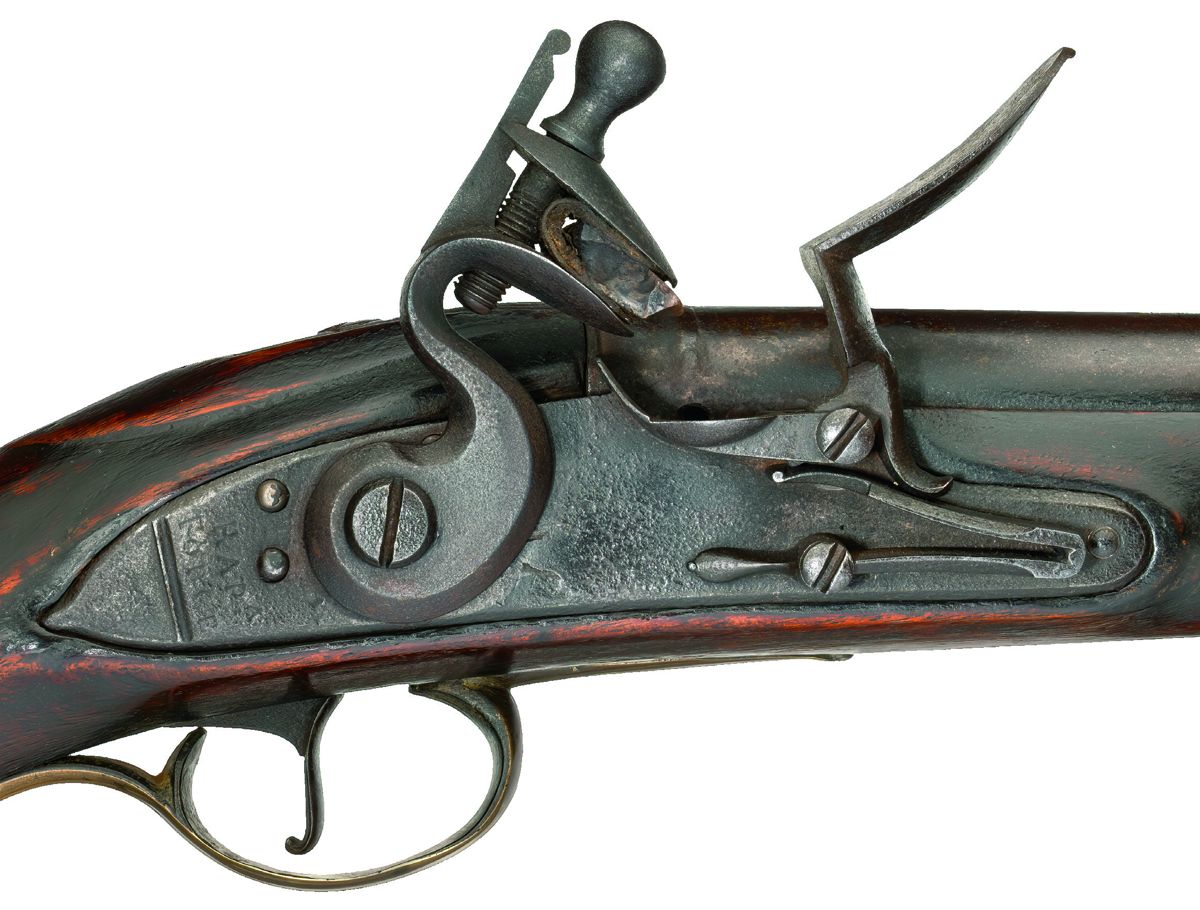
Close up view of the RAPA FORGE marked flintlock on the martially marked Rappahannock Forge pistol. The cast brass trigger guard and delicate carved top of the pistol grip just behind the tang are shown. All the hardware and components are original to this pistol, a rarity for a 245-plus years-old pistol that was issued and used during the American Revolution.
containing eight fires and four hammers; a coal house (80 ft. x 40 ft.); a merchant mill (70 ft. by 18 ft., with one pair of grinding stones); and every other necessary apparatus for making flour, constructed upon the modern improved system. There was also a grist mill (20 ft. by 18 ft.) with one pair of stones, and a saw mill (55 ft. by 41 ft.) with new running gears and machinery. A number of shops were also present at the Iron Works, including a smith’s shop (60 ft. by 26 ft.) with three fires, and a stable (54 ft. by 27 ft.). There was also a nailery, a tan yard, cooper’s shop, carpenter’s shop, and wheel right shop, with tools and utensils for all the mechanical branches. There were houses for the managers, millers, and workmen who were present at the Hunter Iron Works site. All the buildings listed in the advertisement for the sale of the site were made of stone.10 Little is known about the use of the former Hunter Iron Works site following the estate sale. There does not appear to be any evidence of later iron manufacture. The 1870 tax records for the former Rappahannock Forge site list the land as approximately 372 acres, located on a narrow strip adjacent to the Rappahannock River. None of the stone buildings remain today.
Surviving Rappahannock Forge Weapons Surviving Rappahannock Forge arms are quite rare. There are four known wall guns or amusettes, all of which are in federal government museums. There are approximately four to six surviving muskets, all but one located in museum collections. Approximately 12-14 cavalry swords are believed to exist, about one-half of these swords being in private collections, and the remainder in museum and historical society collections. There are ten known pistols; six are in museums; the remaining four pistols are in private hands. Many of these pistols are heavily restored, restocked, or have replacement hardware, locks, and even possibly a replaced barrel which makes one wonder whether the pistol can still be properly classified as a Hunter’s Iron Works product. Advanced collectors still find the heavily restored pistols extremely desirable due to their rarity.
The pistols featured in this article are at the other end or extreme, containing virtually all their original parts. One pistol is regimentally marked (one of only four known regimentally marked surviving pistols); and the other is not.
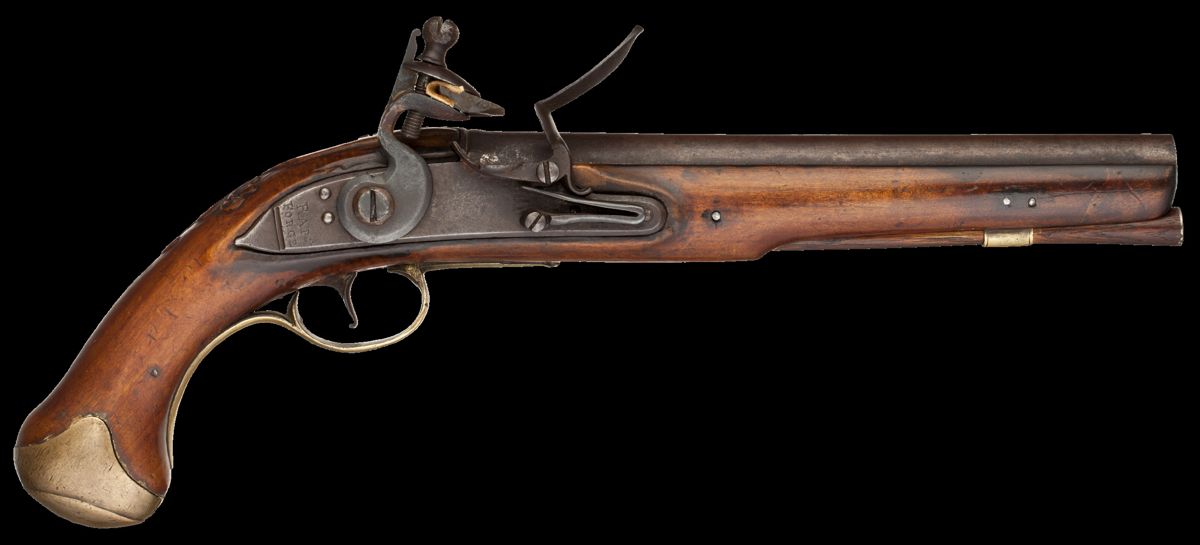
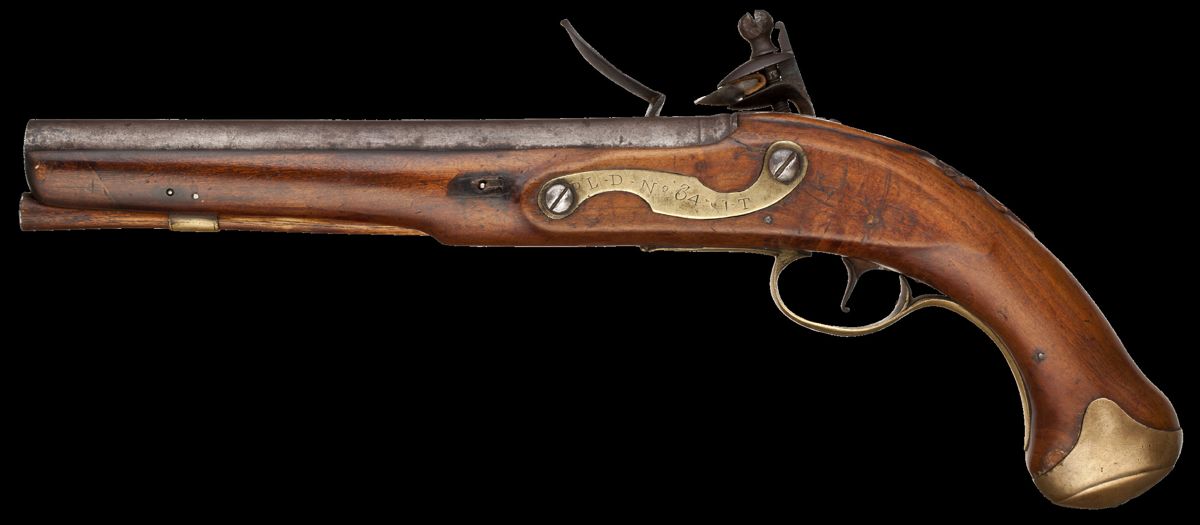
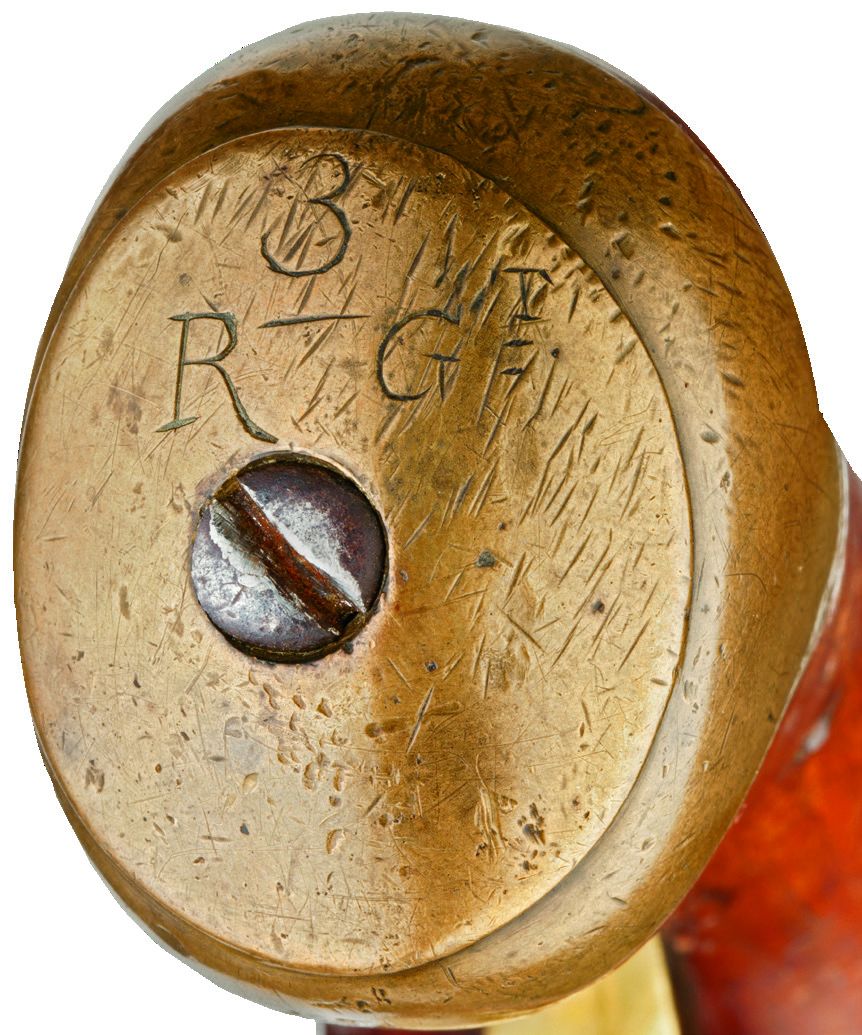
RAPA Forge PLD First Troop Pistol This Rappahannock Forge pistol has martial markings. “RAPA Forge” is stamped in two vertical lines at the rear of the lock plate. The brass side plate is marked “PLD No 34 IT,” and the brass butt cape is engraved “3R-GT.” The “PLD” stands for Pulaski Legion Dragoons. Inside, the lock plate is stamped “IP K XIII;” the inside of the side plate is also stamped with the “XIII” assembly mark. “IP” stands for Joseph Perkin, a prominent and talented gunmaker; the “K” standsfor Frederick Klett, also an established gunmaker, from Stevensburg, Culpeper County, Va. According to the Virginia State Papers held by the Library of Virginia under “Troops raised in Virginia,” the Pulaski Light Dragoons, or Pulaski’s Legion, were consolidated in 1779–1780 with Armand’s Legion into the 3rd Partisan Corps. The December 29, 1779, consolidation was necessary after Pulaski was mortally wounded at Savannah, Ga., in October 1779. His infantrymen went into the First South Carolina while the dragoons were assigned to the First Continental Light Dragoons. The majority of these men were captured at Charleston, S.C., in May 1780. In November 1780, the officers were incorporated into Armand’ Legion.11 The .67 caliber smoothbore round iron barrel is 9 inches long, and has the typical Rappahannock Forge raised turnings at the breech end of the barrel. The barrel is unmarked. The overall length of the pistol is 14 ⅝ inches. All mountings are brass. The grip of the stock is longer and has less curve than the shorter Rappahannock Forge pistols. Of particular interest is the top of the black walnut stock which bears an eye-appealing and well-executed raised carving just behind the beaver tail. No other Hunter pistol has this raised carving, which is similar to the finest carving work on Kentucky rifles and pistols. One Virginia antique furniture expert believes the carving was
RAPA Forge Pulaski’s Legion Dragoons, First Troop Pistol Overall photo of both the lock side and the side plate side (see opposite page) of the regimentally marked Rappahannock Forge pistol. The .67 caliber smoothbore round iron barrel is 9 inches long, and the overall length of the pistol is 14 5/8 inches. All mountings and hardware are brass, and the stock is American black walnut.
Close up view of the brass side plate marked “PLD No 34 IT,” indicating the Pulaski’s Legion, Dragoons, Pistol Number 34 from the First Troop. Pulaski’s Light Dragoons, also known as Pulaski’s Legion, was consolidated with Armand’s Legion in 1779-1780, following General Casimir Pulaski’s death on October 11, 1779, and became the 3rd Partisan Corps, before its amalgamation with Armand’s Legion.
Overall view of the underside of the martially marked regimental pistol showing the pistol’s excellent lines, brass trigger guard and hardware, and wood.
Close up view of the martially marked butt cap engraved “3R-GT,” a postPulaski marking meaning William Washington’s 3rd Continental Light Dragoons. When Pulaski’s Legion was disbanded in 1779, the dragoons went into the 1st CLD which was absorbed into the 3rd CLD. Later in the fall of 1781, it was re-designated 3rd Legionary Corps, accomplished by a Fredericksburg cabinet maker from the 18th century, as the carving is similar to several surviving pieces of wood furniture made by this cabinet maker, all dating to the 1775 time period. This pistol was found in 1957 with a Light Dragoon pistol branded “U. STATES” on its stock.
Non-Regimentally Marked RAPA Forge Pistol
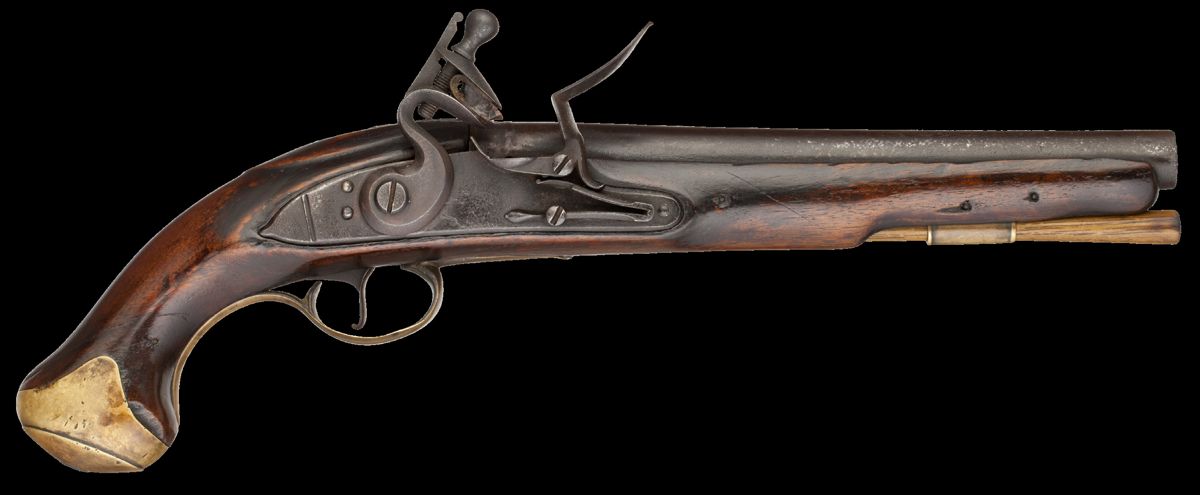
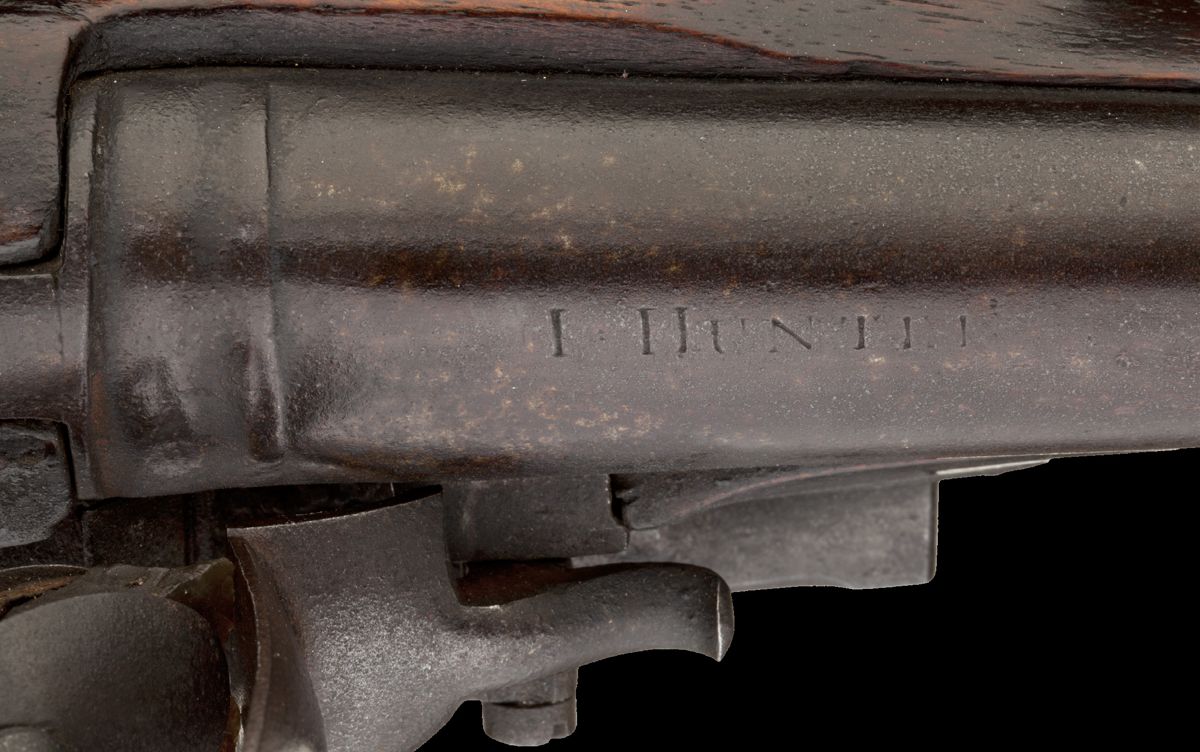
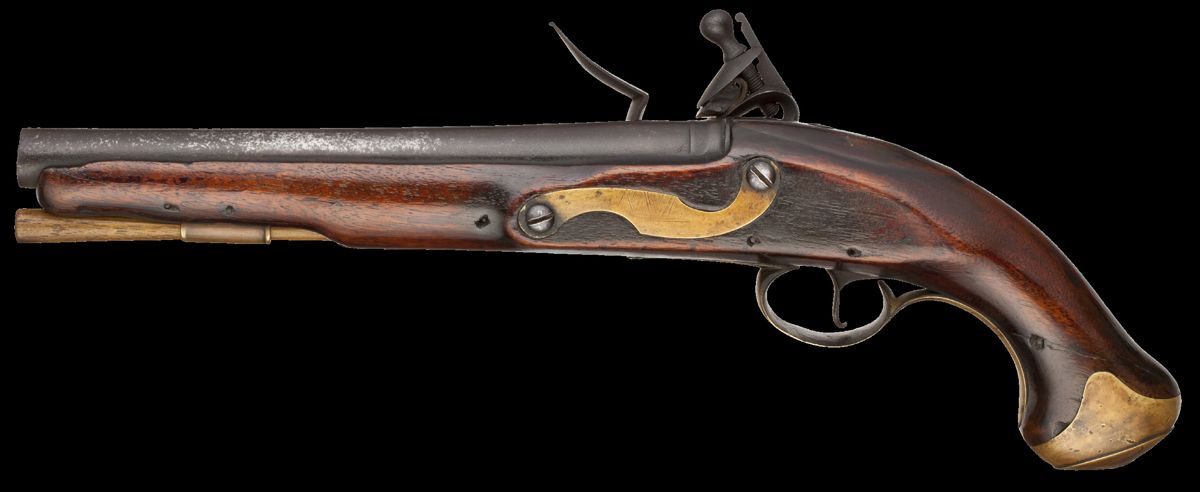
The second Rappahannock Forge pistol is of .68 caliber. The barrel length is 9 inches, and the overall length of the pistol is 15 ¼ inches. The lock is engraved “RAPA FORGE” in two lines behind the cock, similar to the other pistol. The top of the barrel is engraved “I HUNTER.” This pistol is not martially marked. The stock of the pistol is made of American black walnut, and is marked on the stock under the side plate with the assembler mark “XIII.” Together, these pistols represent two of the ten known surviving pistols made at the Hunter Iron Works. The pistols are significant, rare, and recognized as being the first U.S. single shot martial pistols made in the colonies. Equally important, the Rappahannock Forge pistols are accepted as being the only martially marked pistols produced in Virginia during the 18th century.
Endnotes:
William H. Siener, Economic Development in Revolutionary Virginia: Fredericksburg, 1750–1810 (Ph.D. diss., College of William and Mary, 1982), p. 92. 2. H.R. McIlwaine, ed., Journals of the Council of the State of Virginia (Richmond, 1932) Vol. 2, p. 465. 3. Virginia Gazette (Dixon), June 22, 1776. 4. Ibid. November 15, 1776. 5. Giles Cromwell, The Cromwell Collection: Virginia Weapons and Other Material of the American Revolution, (Good Printers, Bridgewater, Virginia, at p. 50, citing an interview with Ken Schwarz, Master Blacksmith, Colonial Williamsburg Foundation on April 24, 2008). 6. Kathleen Bruce, Virginia Iron Manufacture in the Slave Era (New York, The Century Company, 1931), p. 75. 7. Ibid., p. 76. Original source found in a letter from Hunter to Jefferson, May 30, 1781, Manuscripts Collection, State Library of Virginia. 8. Siener, Economic Development in Revolutionary Virginia, p. 118. 9. Bruce, Virginia Iron Manufacture, p. 76. 10. Virginia Herald and Fredericksburg Advertiser, April 14, 1798. 11. Fred A. Berg, Encyclopedia of Continental Army Units. Stackpole Press, Harrisburg, Penn., 1972. 1.
Non-Regimentally Marked RAPA Forge Pistol
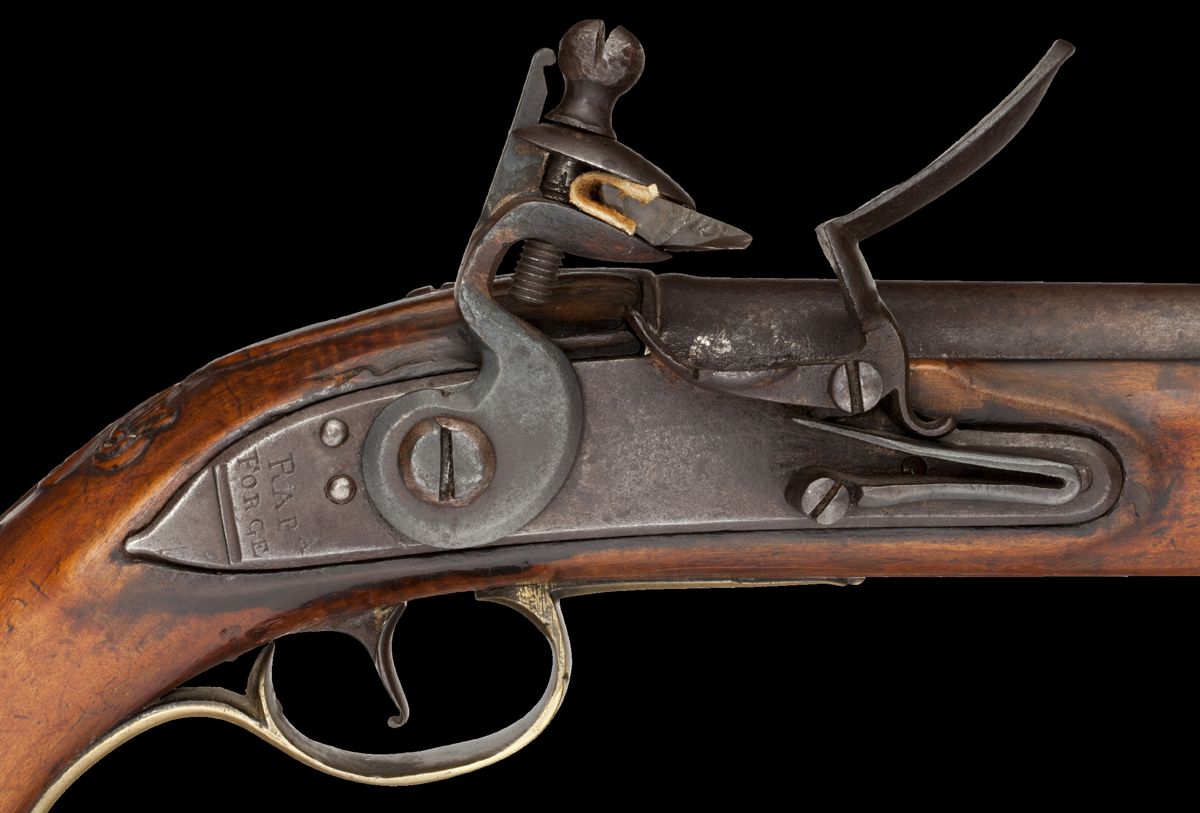
Close-up view of the entire flint lock and side view of the brass trigger guard of the non-martially marked Rappahannock Forge pistol.
Overall lock side view of the Rapahannock Forge pistol, including the brass butt cap and brass trigger guard and ram rod pipe.
Close up photo of the two-line RAPA FORGE engraved mark located just behind the cock on the non-martially marked pistol.
Close up top view of the iron barrel of the non-regimentally marked pistol showing the “I HUNTER” engraved barrel marking located near the breech end of the barrel.
Overall view of the non-regimentally marked pistol showing the side plate profile of the pistol. The ram rod pipe, side plate trigger guard, and butt cap are all in brass. The stock of the pistol is American black walnut.
Close up view of the “I HUNTER” barrel marking on the non-regimental marked pistol iron barrel.
Close up views of the brass trigger guard, and the butt cap of the non-regimentally marked Rappahannock Forge pistol. Stock is American black walnut.
Facing page: Close up view of the intricately carved decoration on the top of the pistol grip stock, just behind the barrel tang. A Virginia Colonial era furniture expert notes that the style and pattern of the carved design closely matches several carved furniture pieces by an 18th century Fredericksburg furniture maker. Fredericksburg, Virginia, is located just a few miles from the Hunter Iron Works site, and it is documented that James Hunter employed wood workers to serve as stock makers for his pistols, muskets, and amusettes (wall guns).
Overall top view of the regimentally marked Rappahannock Forge pistol, showing the detailed wood work behind the barrel tang, as well as the top view of the 9-inch barrel and the top of the cock’s jaw and frizzen.
Rappahannock Forge made bayonet and leather scabbard.
Lower portion of the front side of a Rappahannock Forge made bayonet. This bayonet saw service with the Continental Army as evidenced by the large US surcharge at the base of the blade and just above the “H” marking for the Hunter Iron Works (also known as the Rappahannock Forge). The “H” matches in all respects the size and appearance of the “H” Hunter used to mark the hilt on his cavalry swords.
About the Author Craig D. Bell is an advanced collector of weapons and accoutrements of the American Revolution, as well as Virginia-related War of 1812 and Civil War weapons. He also collects European Armor of the 16th – 17th century, and Scottish arms of the 15th – mid 18th century. Craig is past President of the American Society of Arms Collectors, and the current President of the Company of Military Historians and Vice President of the Kentucky Rifle Association. He is also an Accredited Member appraiser by the International Society of Appraisers, where he focuses his practice on antique arms and armor. Craig served 27 years (active and in the U.S. Army Reserve), first as a Combat Engineer Officer, and then as a Judge Advocate General Corps Officer. Craig is a nationally recognized tax attorney and tax litigator who represents clients having significant tax disputes with federal, state, and local taxing jurisdictions. He is a partner with McGuireWoods LLP, an 1,100-lawyer international law firm. The former Chair of the firm’s Tax and Employee Benefits Department, he leads the firm’s state and local tax, and tax litigation practice areas. He has been peer recognized for over 15 consecutive years as one of Virginia’s Business’ Legal Elite lawyers and as one of America’s Best Lawyers in America for both tax law and tax litigation. On four occasions, he was selected as America’s Lawyer of the Year in both Tax and Tax Litigation by his peers. Craig is also Chairman of the Board of Directors of a publicly owned commercial bank headquartered in Virginia.
IMAGES CAPTURED IN TIME
This Union infantryman is wearing a regulation single breasted greatcoat and forage cap with a hand-tinted American flag in background. Liljenquist Family Collection of Civil War Photographs (Library of Congress).
UNION ISSUE GREATCOAT
This Union issue greatcoat or overcoat belonged to Private D. J. Leech, Co. F, 124th Illinois Infantry; “DJ Leech Oct 6th 1862” is written inside the coat sleeve. Leech enlisted in the 124th Illinois Infantry on August 11, 1862; in July 1863, he was detailed as a nurse in the regimental hospital. Private Leech and his regiment were involved in numerous battles, including the May-July 1863 Siege of Vicksburg. He mustered out on August 15, 1865. (Greatcoat photo courtesy Wilson’s Creek National Battlefield; WICR 30193).
IMAGES CAPTURED IN TIME
COLT’S 1855 NEW MODEL REVOLVING MILITARY RIFLE
Five shot fluted cylinder, .56 caliber Colt M1855 revolving rifle, serial number 7265. The length of the rifle barrel is 37 ½-inches and has a barleycorn front sight. The rear sight has 300- and 600-yard folding leafs. The top strap is marked “COL. COLT HARTFORD CT. U.S.A.” Stamped on the left side of the frame is “COLT’S PATENT / Nov. 24th 1857.” The action features an iron loading rammer and brass trigger guard. The walnut stock has a full length two-band forearm with brass tip; the butt has a trapdoor buttplate. The frame, trigger guard, and buttplate have matching numbers. There are no visible US markings on this rifle. The ramrod is a replacement. This type rifle was issued to the Berdan Sharpshooters. The first order placed by the U.S. in January 1862, was for 1,000, caliber .56 rifles and bayonets. These rifles were shipped on January 28th to Hiram Berdan’s Sharpshooters. Many sharpshooters were unsatisfied with the Colt’s performance and insisted on the Sharp’s rifle as promised. After three months in service, the Colts were withdrawn and replaced by the Sharps rifles. (Courtesy Poulin’s Antiques & Auctions Inc.)
IMAGES CAPTURED IN TIME
Unidentified North Carolinian wearing homespun Confederate coat with North Carolina state seal buttons visible. He proudly holds a Model 1855 Colt revolving rifle. Photographs of soldiers with Colt revolving rifles are seldom seen. Union states, including Ohio and New York, issued state uniform jackets early in the war, and the 21st Ohio Infantry was partially armed with Colt revolving rifles. Liljenquist Family Collection of Civil War Photographs (Library of Congress).
IMAGES CAPTURED IN TIME
This unidentified member of the 28th Pennsylvania Infantry is wearing a frock coat that has a XII Corps, Army of the Potomac, badge dating this photograph after the summer of 1862. The inset of the badge has been colorized and reversed for readability. Liljenquist Family Collection of Civil War Photographs (Library of Congress).
IMAGES CAPTURED IN TIME CORPS BADGE DESIGNATING XII AND XX ARMY CORPS
UNION OFFICER SLOUCH HAT
INTERIOR OF HAT IS RED SILK WITH A “ROCHET, PARIS” MAKER’S LABEL
Civil War U.S. Officer’s Slouch Hat Identified to the 28th Pennsylvania Infantry (Goldstream Regiment). This regiment was formed in Philadelphia and mustered in June 28, 1861. The unit served in the XII Corps from September 1862 through October 1863, including Fredericksburg, Chancellorsville, and Gettysburg. The unit was heavily engaged throughout the war losing 157 men killed and mortally wounded. The hat is constructed of fine wool felt with a ½-inch woven silk tape band along the bottom edge of the brim. There is a 1-inch black silk hat band, bullion and black hat cord with black net over the bullion tassels. Tin backed insignia on the front with gold bullion embroidered infantry horn with separately affixed false embroidered number “28.” A black ostrich feather plume curves around to the back of the hat. Attached to the turn up on the side of the hat is a beautiful XII Corps, 3rd Division, silver corps badge that was continued in use as the XX Corps after April 1864. The large silver star, 1¾-inches across the points, with blue cloth insert, is overlaid by a smaller star, 1-inch across the points. (Courtesy Heritage Auctions).
IMAGES CAPTURED IN TIME
CONFEDERATE ARTILLERY SHORT SWORD WITH LEATHER SCABBARD. MADE BY E.J. JOHNSON, MACON, GA.
These short swords were copies of the U.S. Model 1832, heavy artillery sword, a so-called “Roman style” sword or gladius, manufactured by N.P. Ames.. The overall length of the sword is 24.5 inches with a blade length of 19 inches. The heavy cast hilt on this sword does not resemble the Ames swords’ simulated scale or feather grip motif. It has been suggested that these swords were, for the most part, carried by artillery battery NCOs. The steel blade is double-edged with a less encountered feature, two short, parallel, upper fullers and a single, long fuller. Crudely executed copies of the Ames blades; most of them Confederate, are short swords of this type without fullers. The blade is smooth, with virtually no pitting or oxidation.
IMAGES CAPTURED IN TIME
Henry Augustus Moore, born in 1827, enlisted May 8, 1862, in Company F, 15th Mississippi Infantry at Corinth, Miss. He contracted a malignant fever during the first Vicksburg Campaign and died August 14, 1862. He and seven other members of his company are buried in a single grave near their homes in Water Valley, Miss. The monument reads “Sacred to the dead of Company “F” 15th Regiment, Mississippi Volunteers.” Young Henry was photographed wearing a Model 1832 artillery belt with interlocking US buckle holding an Ames Model 1832 short artillery sword. His shell jacket with dark trim is quite distinctive and unique. Of the 20 plus images by this unknown Mississippi photographer, no props are seen in any two images other than his iconic “JEFF DAVIS AND THE SOUTH!” sign. Though infantryman did not carry short swords, many early war Confederate carried big knives, so this antebellum sword and accompanying belt could’ve been used early war. Liljenquist Family Collection of Civil War Photographs (Library of Congress).
IMAGES CAPTURED IN TIME
8TH OHIO VOLUNTEER INFANTRY FORAGE CAP WITH 2ND DIVISION II CORPS BADGE
This Union forage cap of deep blue wool has a few minor moth holes. Original brass infantry hunting horn insignia, 1/2-inch number “8,” and false embroidered silvered II Corps Badge fastened to the cap with small pieces of wood and a leather tab. The leather chinstrap has a brass buckle, leather loop, and eagle side buttons. The leather sweatband measures 1 3/8-inches at the front and 1 3/4-inches at the back. All leather components exhibit typical crazing and minor wear. The brown polished cotton lining is in excellent condition with an intact paper label in crown that reads “Size No 2 6 7/8 U. S. Army L. J. & I. P.” As is typical, the cap bears the corps insignia of the last organization to which the regiment belonged: the Second Division of the II Corps. The regiment recruited in June 1861, and from June 1862, served in the II Corps, Army of the Potomac, fighting in all their major engagements including Antietam, where they fought at the Sunken Road, and Gettysburg, where they were heavily engaged repelling Pickett’s Charge on July 3. They also fought at Wilderness, Spotsylvania, and Petersburg before mustering out in June 1864, having lost eight officers and 124 enlisted men killed in action or mortally wounded. (Courtesy Cowans Auctions, Frasca Civil War Collection.).
IMAGES CAPTURED IN TIME
This Union infantryman is wearing a four-button sack coat and holding a forage cap with infantry insignia and “trefoil” II Corps (Army of the Potomac) badge that seems to have been enhanced, possibly with unit identification. A stamped brass infantry horn is underneath the corps badge. He is wearing a striped, white shirt under his coat. He has altered the four-button coat by making the interior pocket accessible from outside the coat. The corps badge idea is attributed to Maj. Gen. Philip Kearny, who ordered the men in his division to sew a two-inch lozenge of red cloth on their hats to avoid confusion on the battlefield. This idea was adopted by Maj. Gen. Joseph Hooker after he assumed command of the Army of the Potomac, so any soldier could be identified at a distance. Liljenquist Family Collection of Civil War Photographs (Library of Congress).