
Emory Upton: Soldier and Army Reformer
By Salvatore G. Cilella Jr. · Originally published May-June 2022 · pp. 14–24
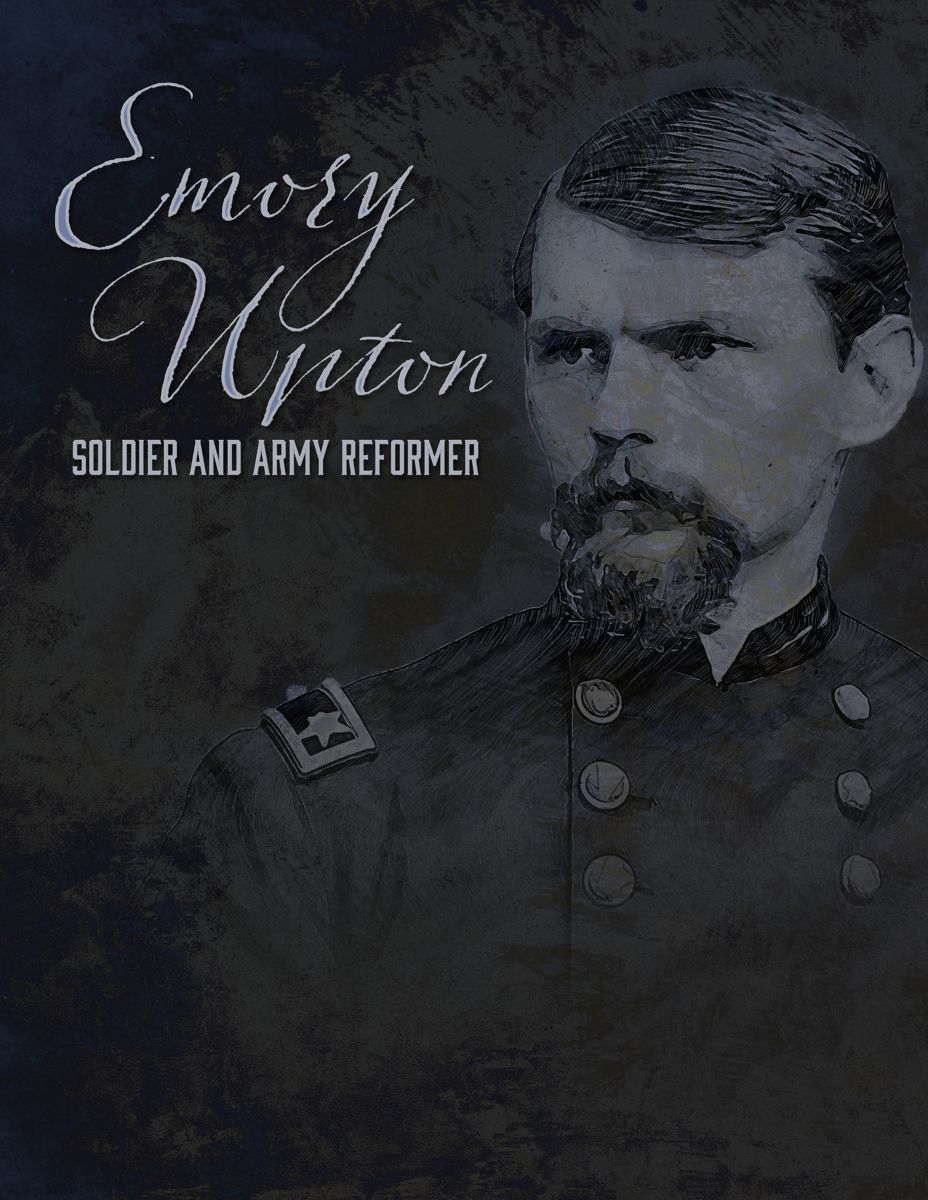
His people were Yankees, strict Methodists, probably Whigs, and descendants of Scottish Presbyterians who had settled near Salem, Massachusetts, in the 17th century. His parents Daniel Upton and Electa Randall, settled in the burned over district in Western New York, three miles from the village of Batavia. Emory was born August 27, 1839, the tenth child and sixth son.1 Upton stood “five feet eleven, blonde and blue-eyed;” weighed “170” pounds, always (in) perfect condition.” General James Wilson called his life “a tour de force of heroic action.” He never “wasted a word in conversation and never was interested in anything but his profession.” Napoleon’s biography convinced Upton that a soldier’s destiny awaited him. His view of the world and his devotion to sacrifice and self-denial made him a rare individual.2 His biographer Peter Smith Michie touted Upton’s letters as verification of his real nature and “all record a clean, pure, and spotless life.”3 Rev. Father O’Reilly, a friend of Upton’s at Oberlin told of Upton’s quirks of sleeping without a pillow, avoiding nuts that might ruin his teeth, and any habit that might prove detrimental to his being admitted to West Point. O’Reilly also noted his poor handwriting, his fear of public speaking, his opposition to slavery but silence on abolition, abstention from sex, profane language, and his dislike of art and music (anything deemed impractical).4 James Wilson described Upton as a man with no flaws, a loyal, honest, sincere, obedient, “pure and upright,” modest, unassuming and “god fearing Christian.” Wilson effusively referred to Upton as the equal of, or better than, obscure European military thinkers; then went on to call him a “credit to the State and family, which gave him his birth, to the Military Academy which educated him, and to the Army in which he served. So long as the Union has such soldiers as he to defend it, it will be perpetual.” To Wilson, Upton was “an incomparable soldier…one of the most accomplished and aggressive soldiers of his time.”5 A review of Michie’s biography endorsed Upton’s “sanctification.” The reviewer predicted, “Upton’s name, as years roll by, will be honored more and more as one of the greatest tacticians of modern times.” In an analogy from which Upton would have recoiled, the reviewer compared him to Stonewall Jackson, who also “developed a religious life of the purest and most lofty type.” He predicted that not only scholars but “all students of history,” including statesmen, would benefit from Michie’s life of Upton.
Second Lieutenant in the 4th United States Artillery. He served at the First Battle of Bull Run, the Peninsular Campaign and Antietam. Through friendship with fellow New Yorker, Major General Henry Slocum, Upton received his first regimental command.
Another reviewer called Upton a “raw, awkward, freckle faced, sober, solemn country lad…as far as possible from the ideal gay, light-hearted, dashing cadet.” That reviewer likened Upton to Charles George “Chinese” Gordon, the hero martyr and zealous religious fanatic of the Battle of Khartoum. One historian blamed Upton’s lack of humor on his early years “growing up in the Burned Over District of upstate New York, noted for its religious and reforming zeal. He had no amusements, which obviously contributed to his productivity.”6
The 121st New York Volunteer Infantry, recruited in the summer of 1862, answered Lincoln’s call for 300,000 volunteers. Newly minted Colonel Upton replaced inept Congressman Richard Franchot in October 1862, drilling and training the 121st into a fit and fighting infantry unit. Within a year, Northern newspapers and the men of the proud regiment called themselves “Upton’s Regulars.”
His letters reveal a caring individual: suffering, rejoicing, humorous; flawed and brilliant, vain and humble, a close family man. Before the Battle of Fredericksburg, Upton slept with his men in an open, wind-swept, frozen field. Although his practical nature drew him to useful disciplines, he insisted on martial music during the intense forced march to Gettysburg to help maintain morale among his troops. Upon graduation from West Point in May 1861, Emory Upton finished eighth in a class of forty-five and was commissioned a
On the army’s left flank at Fredericksburg, the 121st escaped the suicidal assaults against Marye’s Heights. It survived Burnside’s Mud March in January 1863, and the ruinous winter camp of 1862–1863; suffered heavily during the Chancellorsville Campaign at Salem Church on Sunday, May 3, 1863. In a disastrous frontal assault on Confederate infantry entrenched just beyond the church, the 121st lost nearly half of all able-bodied men available for combat. After leaving New York State 1,000 strong, disease, desertions, and details, cut the 121st’s strength by over 50 percent. The 121st fought with 453 men at Salem Church where casualties halved the regiment again.
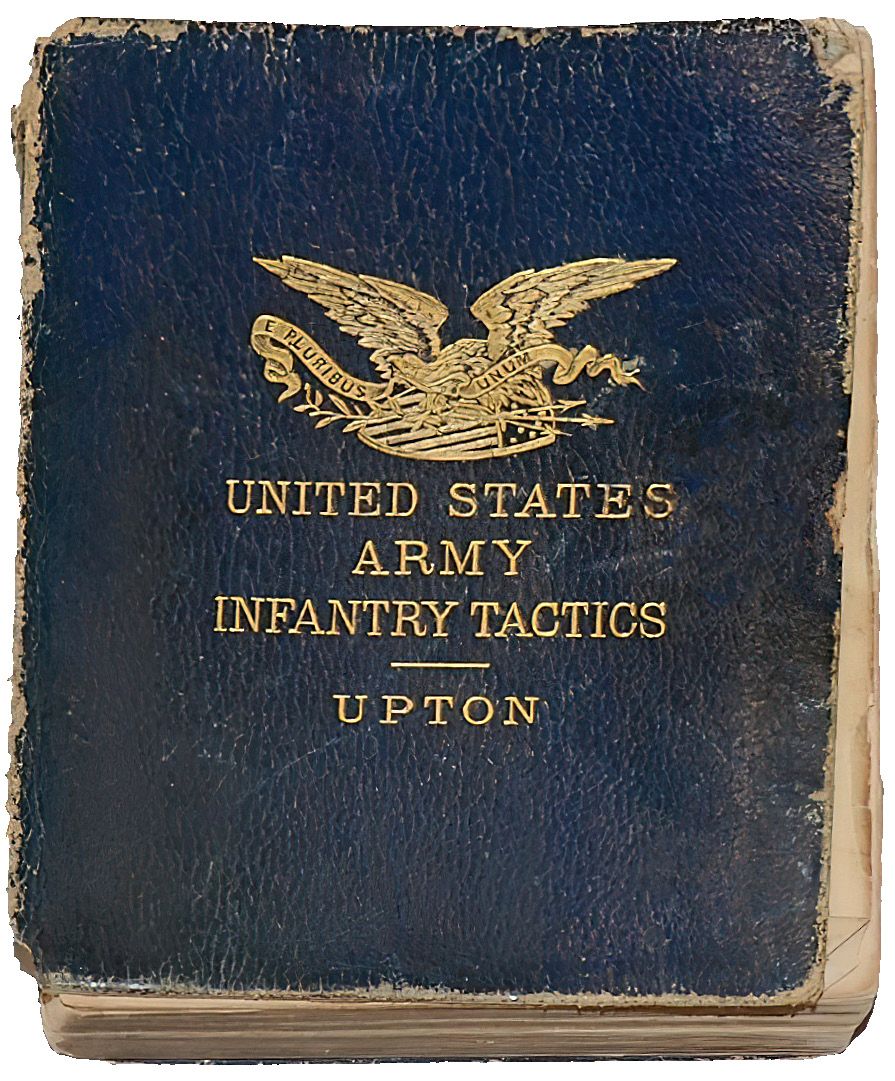
Upton, Emory. Infantry Tactics, Double and Single Rank, Adapted to American Topography and Improved Fire-arms. United States: Appleton, 1875.
At Gettysburg, the 121st, and most of the VI Corps, were held in reserve. There, Upton was promoted to brigade command, leading both his regiment and it’s brigade. On November 8, 1863, he led a brilliant twilight raid at Rappahannock Station. During the spring 1864 Overland Campaign, Upton participated in the Battle of the Wilderness on May 5. On May 10, he led an innovative attack on the Confederate salient at Spotsylvania with an assaulting column of 12 regiments, including the 121st New York. The attacking column was not supported, forcing Upton to retreat after penetrating the Confederate lines. He did not invent the columnar attack; he successfully executed it. Military Policy of the United States, by Emory Upton: 4th Impression.
His brigade was engaged at Cold Harbor on June 1 but not United States: IV, 1917. in the disastrous June 3 assault. The generals leading the army during the battle enraged him with their inept leadership. With the rest of the Army, Upton and his brigade settled down at Petersburg until Grant ordered the VI Corps onto troop ships bound for Washington to repel Jubal Early’s threat in mid-summer. Once that threat was deflected, Grant sent the VI Corps to the Shenandoah Valley where, while commanding a division of infantry at the Battle of Opequan Creek on September 19, 1864, Upton suffered a severe leg wound. He was carted off the field still giving orders to his troops in an eventual Federal victory. That day he was brevetted colonel in the regular army for gallant and meritorious services, and brevet Major General of Volunteers. As he recuperated, Upton took command of the 4th Cavalry Division under Major General James H. Wilson during operations in Alabama and Georgia during February 1865. “Upton’s dazzling career as a writer and proponent of a modern army for the United States,” Stephen Ambrose wrote, “has obscured his important experience as a Civil War officer, which strongly influenced his later contributions.”7 By war’s end Upton had been wounded three times and served in all three branches of the army. In a reduced postwar army, Upton was posted to the districts of East Tennessee and Denver, Colo., achieving the regular army rank of Lieutenant Colonel. In 1867, his Manual of Tactics was officially adopted by the military. On February 19, 1868, Upton married Emily Martin, a frail young woman from upstate New York who died two years later on March 30, 1870. On July 1, 1870, he became Commandant of Cadets at West Point, a post he held five years. In 1873, the army accepted his revised infantry system, modified for artillery and cavalry.
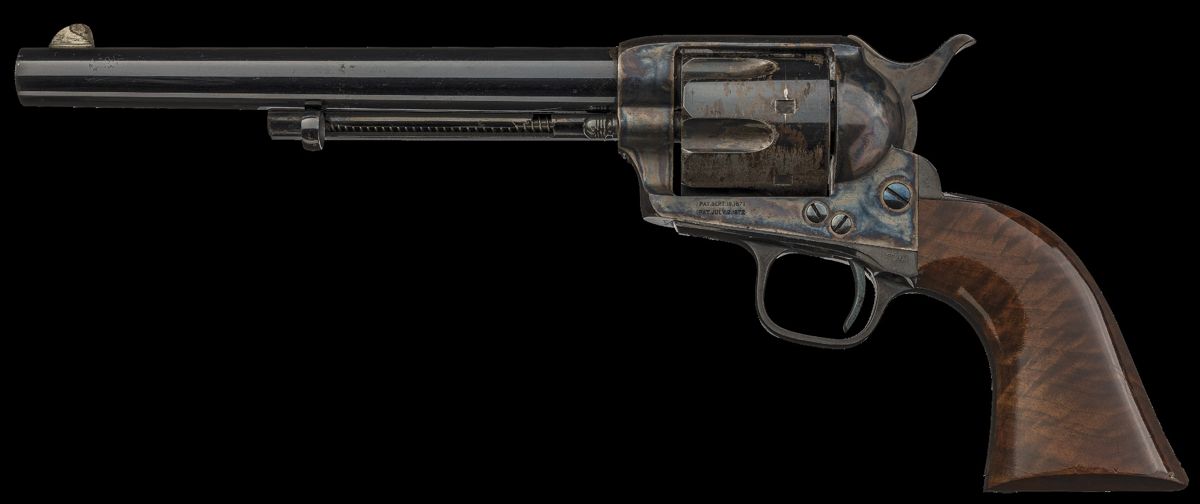
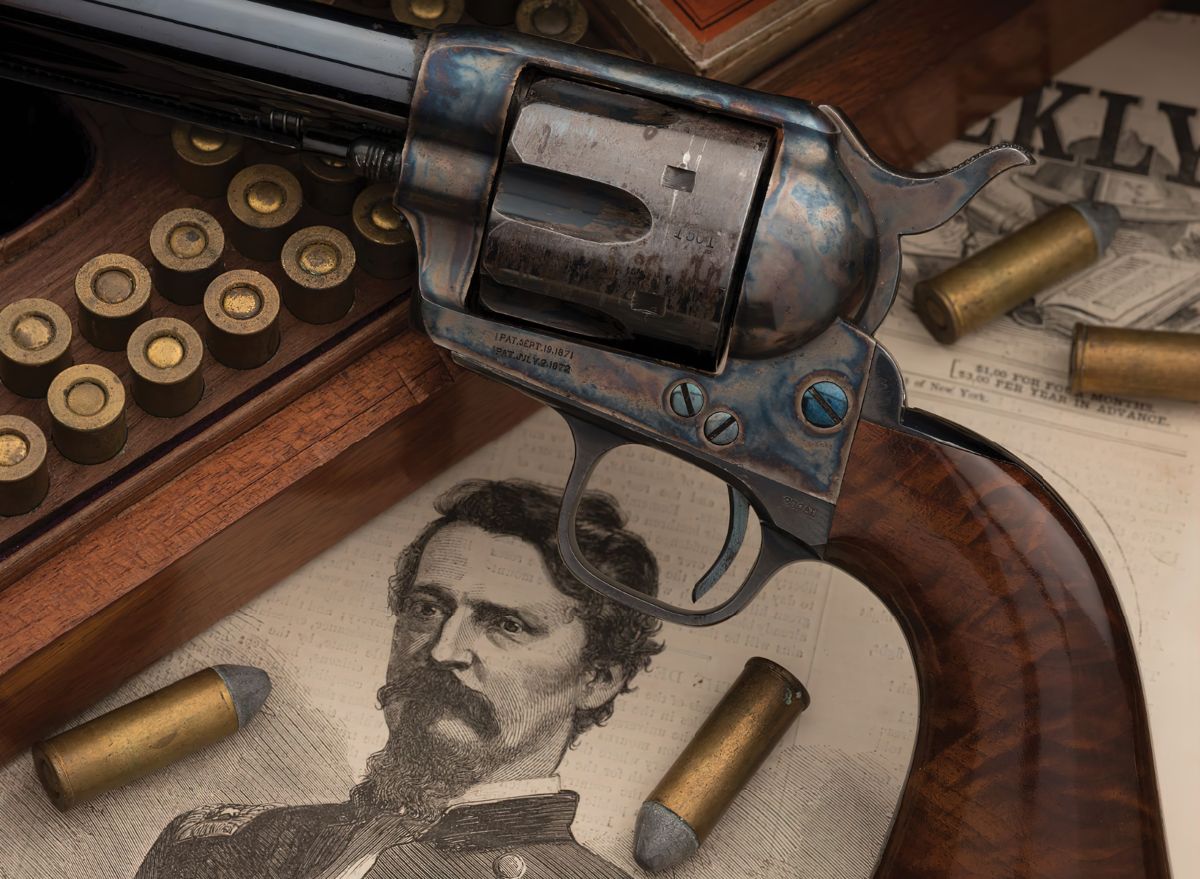
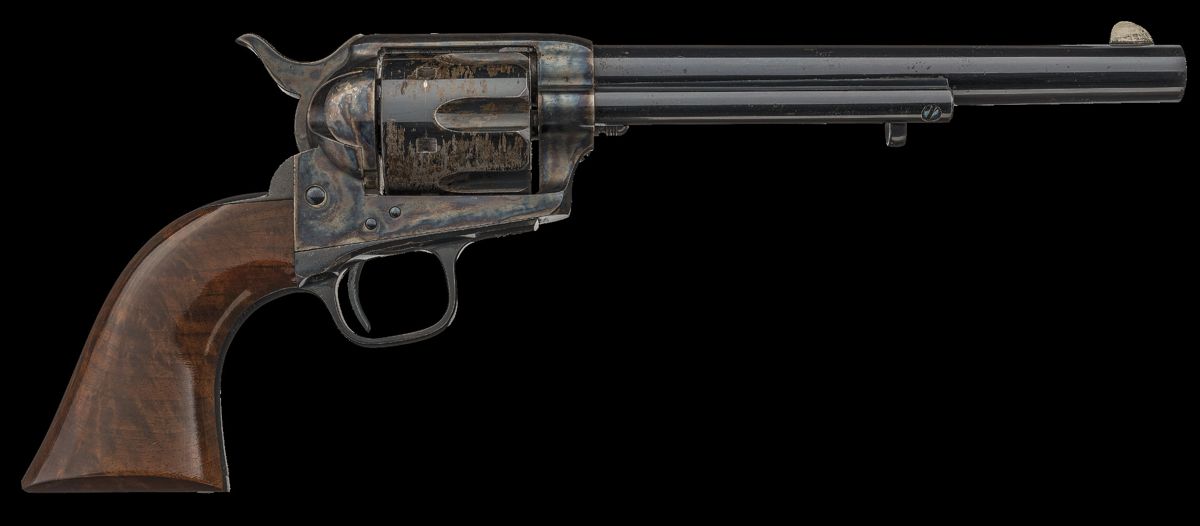
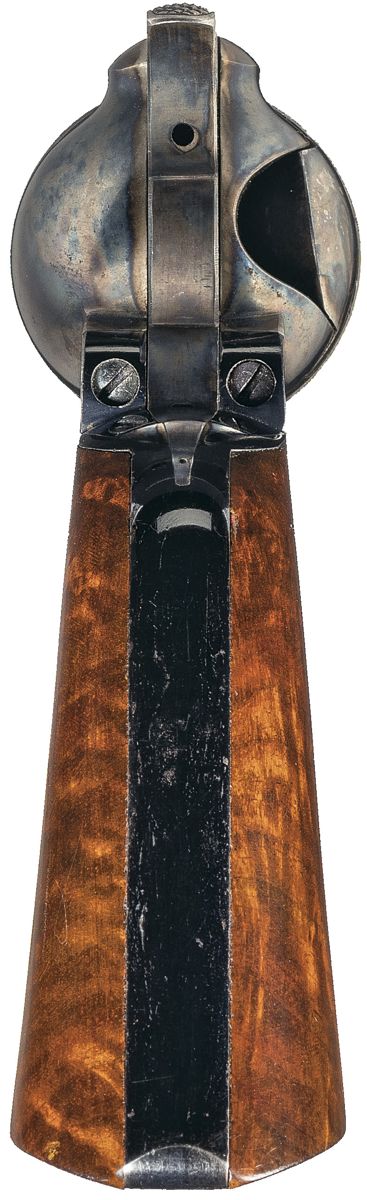
The barrel has a bright nickel-silver blade front sight and is marked “+COLT’S PT. F.A. MFG. Co. HARTFORD. CT. U.S.A.+” on top in serif letters and “1501” on the bottom by the cylinder pin.
The ejector has the classic “bulls-eye” button.
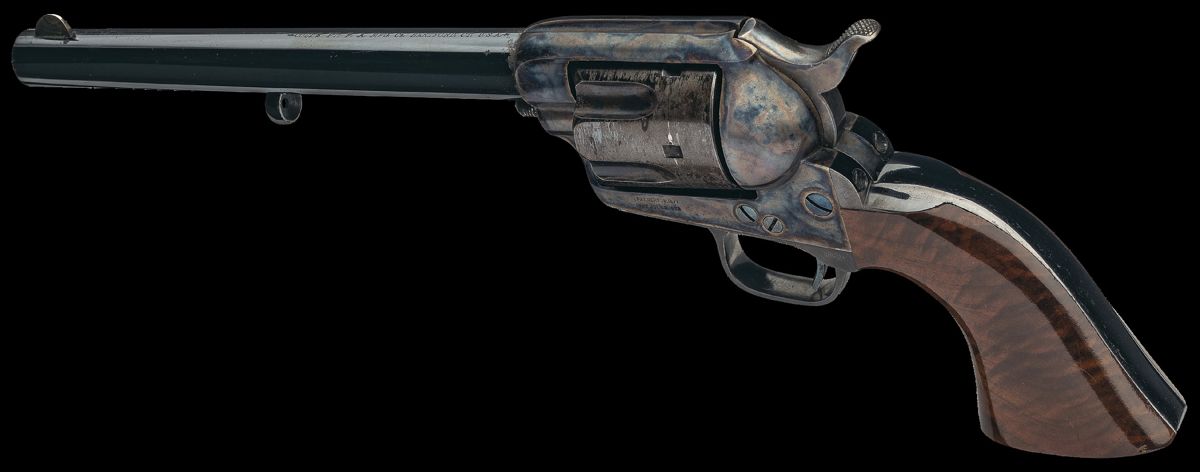
MANUFACTURER: COLT MODEL: SINGLE ACTION ARMY REVOLVER CALIBER: .45 BARREL: 7 1/2-INCH ROUND FINISH: BLUE/CASEHARDENED GRIP: DELUXE FACTORY WALNUT SERIAL NUMBER: 1501
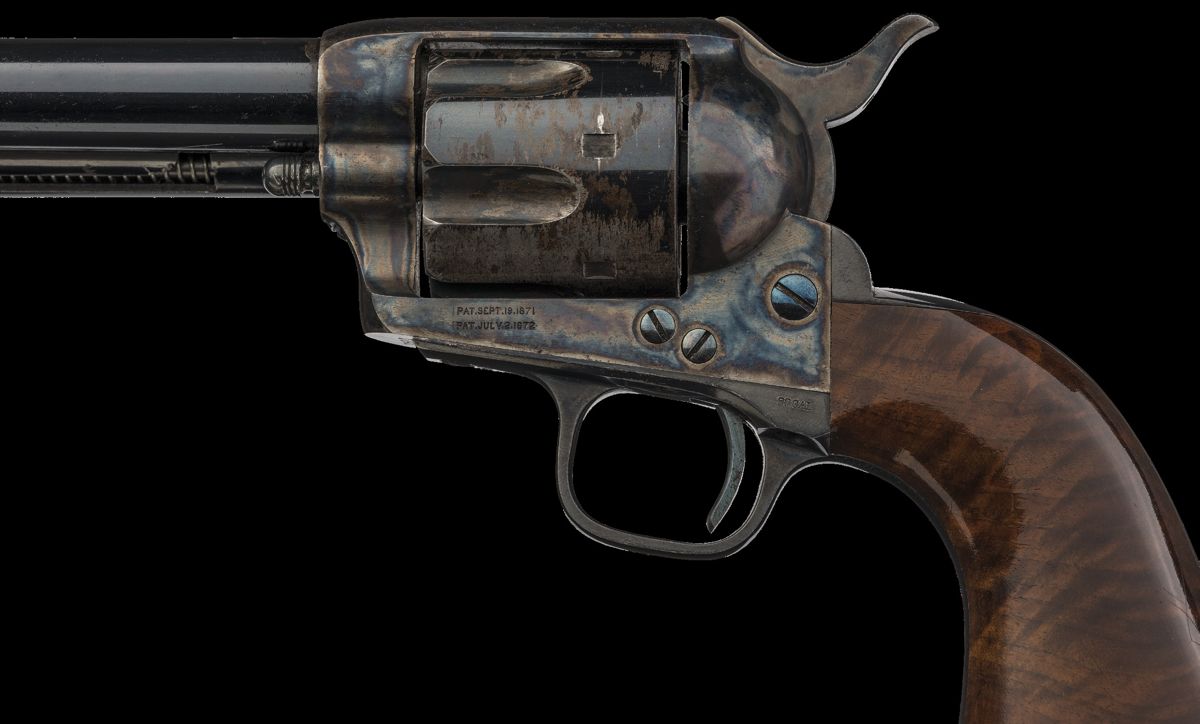
The screws and trigger have bright niter blue finish. Matching serial numbers “1501” are visible on one side behind the flute, frame, trigger guard, and back strap; the loading gate has the assembly number “526.” The frame has the second style “PAT. SEPT. 19. 1871/PAT. JULY. 2. 1872” on the left side. Inexplicably, the left side of the trigger guard is marked “22 CAL” (not introduced to the Single Action line until 1883, but also seen on a few .38 caliber Colt conversion revolvers in the early 1870s). The hammer has bordered knurling on the spur. The deluxe burl walnut grip has a high polish “piano” varnish finish.
General Emory Upton holding a U.S. Model 1860 staff and field officers sword. (Courtesy Heritage Auction Company)
Bottom of the revolver with matching serial numbers 1501.
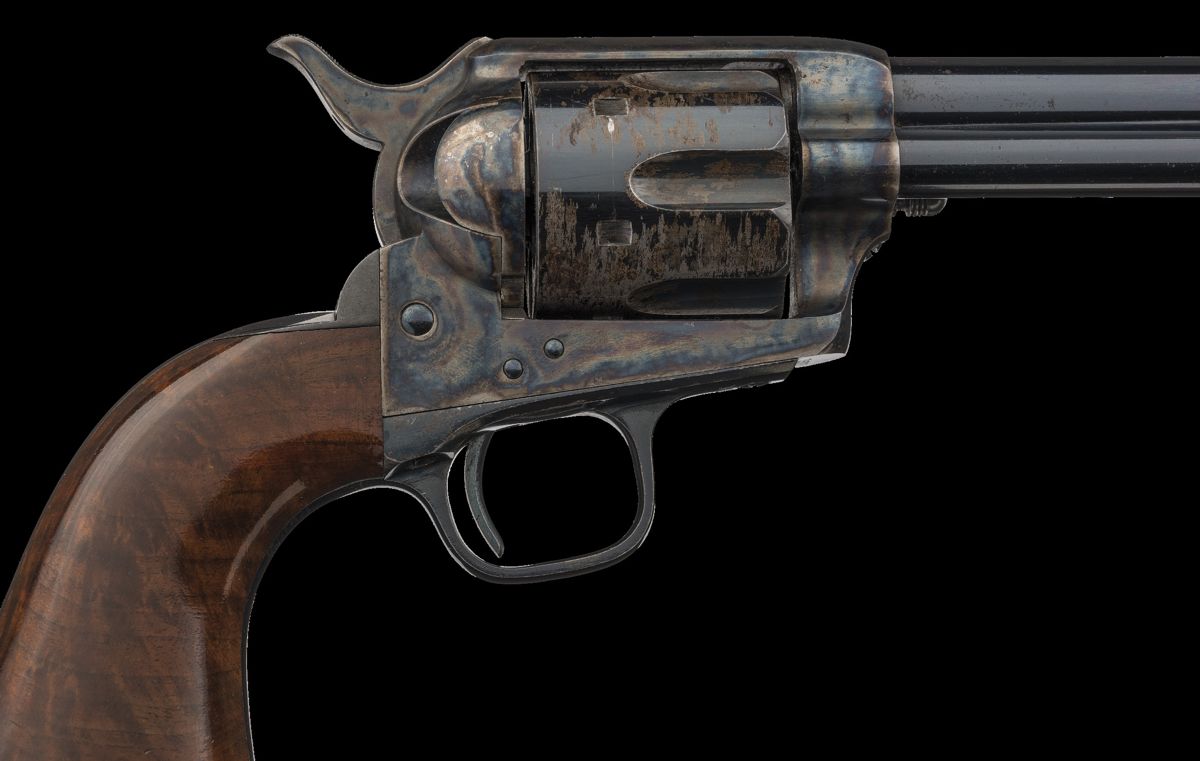
Rear view of the revolver.
On June 30, 1875, at General of the Army William T. Sherman’s urging, Upton embarked on a world tour observing the training and tactics of Asian and European Armies. Sherman thought that a “military tour through Asia,” might be beneficial “to the service.” Upton “was to observe the armies and report his findings to the Government in an official report.” The tour was enlightening, because he was able to observe different tactics, strategies, and changing technological effects on military operations; and revealing, as he realized how inadequate was American military policy and it’s preparations for a major war.8 Upon his return he served from 1877 to 1880, as Superintendent of Artillery Training at Fort Monroe. He published his report on the foreign armies in 1878. He planned a longer manuscript with a history of the American military. For several reasons he decided not to include the history in the Armies but to publish it separately. It wasn’t until 1904 that Secretary of War Elihu Root published the manuscript as The Military Policy of the United States. In 1880, Upton became Colonel of the 4th Artillery, stationed at the Presidio in San Francisco, Calif. During his years as Commandant of Cadets, Upton had begun to deal with a sinus ailment although he had been physically cleared in 1866 by a medical board in New York City.9 To find relief, he took a three-month leave, went to Philadelphia, and visited Dr. Harrison Allen. Upton may have known Allen previously or someone may have recommended Allen to him. Upton wrote his friend and classmate, Henry DuPont in July 1880 that “Dr. Allen told” him that he “could cure [his] ailment” and that he “resolved to take two months for that purpose. There is too much at stake to delay longer.” In September Upton kept his appointment “as originally contemplated.”10 The procedure “consisted in placing a very fine coiled wire upon any particular spot of the disordered membrane and causing it to glow by electricity for a mere instant at a very high heat.” Presumably, the technique would stimulate the rejuvenation or growth of healthy tissue, a process called “firing” often used by farriers to achieve the same results with livestock. Dr. Allen had used the method on others with “great and increasing success” which gave him hope that it would work on Upton. Allen remained unconcerned about any corollary physical problems such as extraneous tissue surrounding the sinus cavity’s bone structure that, if uncontrolled, could invade the cranial cavity. By that point, the mucocele had probably begun to press on the frontal lobe of Upton’s brain.11 It made him “uncomfortable” and, as he told DuPont, “I have not as yet disclosed myself to any of my old friends” yet urged DuPont to visit him at his earliest convenience. He assured his sister Maria that it was “by no means severe. The actual cautery gives very little pain. It was applied about an hour ago and now I feel no disagreeable effects whatever. The worst of my trouble is keeping one nostril stopped with cotton, which makes me talk through my nose.”12 While at West Point, Upton had seen Dr. William Saunders, the post dentist for relief. Saunders wrote later that he had “heard a distinct throbbing in (Upton’s) head, very faint, however, and not beating in unison with the temporal artery on which my hand rested.” Upton “expressed surprise” that Dr. Saunders could hear it and revealed that “he had noticed” it “for some time… and was puzzled to account for it.” Post surgeons were equally at a loss to explain it. Saunders reported that “the pulsation and ticking became more distinct, and the annoyance from it increased to such an extent” that Upton “could not sleep unless greatly fatigued” or when it stopped. At Saunders urging, fearing “an aneurism,” Upton “consulted several physicians,” but Saunders remembered, he did not try “any special treatment before going abroad.” Saunders saw him after his return from the world tour and realized that his condition had not improved; Upton supposedly told him “Cure me of this, and I will give you ten thousand dollars…Allen understands it, and I will submit to his treatment.”13 By March, he began to experience increasingly painful episodes as Dr. Allen’s cauterization decreased in effectiveness. Sunday morning, March 13, Upton’s academy classmate and now colleague, Captain Henry C. Hasbrouck, spoke with him in Upton’s office inquiring into his health. Upton, usually sanguine and un-emotional, had been writing and he threw down his pen, put his hands to his head and told Hasbrouck through his tears that “he was ruined.” Upton told of sleepless nights in the past few weeks. His catarrhal discharge continued to bother him, and he grew despondent fearing it would never be cured. He told of frequent headaches and talked of suicide, condemning it in the “strongest terms” possible. Upton also told the 4th Artillery’s Adjutant, Alexander B. Dyer, who saw Upton that Sunday that he, Upton “had been in great trouble for the last four or five days” and asked him not to mention it to anyone. Upton recovered his composure but told Hasbrouck that his system of fours, which he developed for small unit tactics would not work on a larger scale, company, regiment, and larger. Hasbrouck, whose quarters were next door to Upton’s house, kept close watch on Upton, meeting him again after church, again with a long walk in the afternoon, and then spending the evening with him. Hasbrouck became concerned as Upton continually returned to the tactics and his perception that they had failed. Upton wished that the revision would be done by a board rather than placing the burden on him. He feared that “wrong pecuniary motives” would be “imputed to him.” After all, he had received handsome royalties on his previous versions of the tactics. Chillingly, Upton told Hasbrouck: “Whatever may happen, I charge you, as my classmate, to see that justice is done to me.” Hasbrouck did not see Upton until the following evening, Monday, March 14 around 8 p.m. He noticed Upton was writing a letter as he entered his room. The two talked again about the tactics and about a possible trip to Monterey. He left at 9:30 and an hour later, the lights were still burning as Hasbrouck walked past Upton’s quarters where he observed Upton working at his desk. Earlier, he had told Hasbrouck that he wanted to finish a letter. “That was the last time I saw him alive,” Hasbrouck testified.14 The next morning, around 6:30, when Upton’s servant, Ah Sing went into his room to pick up his boots for cleaning and make the fire, he noticed nothing out of the ordinary. When Upton didn’t appear for breakfast, Cheow Yung, Upton’s cook, sent Sing to his room where he discovered Upton’s body on his bed. Sing saw a pistol on Upton’s chest and blood on the floor. Yung asked Captain Hasbrouck’s servant, Wong Ky Ming to immediately alert the captain who went into Upton’s room. There Hasbrouck found Upton’s lifeless body. He hadn’t undressed “but simply removed his coat, vest and boots and laid himself down, drawing the coverlet over his legs to the knees.” He had put his .45 caliber service revolver in his mouth and pulled the trigger. The pistol came to rest on his chest between his powder-burned hands. Two pools of blood formed on the floor next to the bed. “The large bullet crashed through the brain, passing through the head and penetrating the top of a hair pillow, dented the wooden head of the bedstead about 12 inches from the deceased’s head.” Although the cook and the two servants slept upstairs, no one heard the shot.15 Three letters were found. Two were addressed to the Adjutant General of the United States Army. One exposed Upton’s fear of failure with the revision of his tactics; the other resigned his position as Colonel of the Fourth Artillery. The latter provided a clearer indication that Upton’s thought processes were not working. Long standing military custom stipulated that an officer could resign his commission (perhaps this is what Upton meant) not his assignment as commander of the 4th Artillery. As The Army Navy Journal opined: “Tendering a resignation as ‘commander’ is a somewhat unusual military form.”16
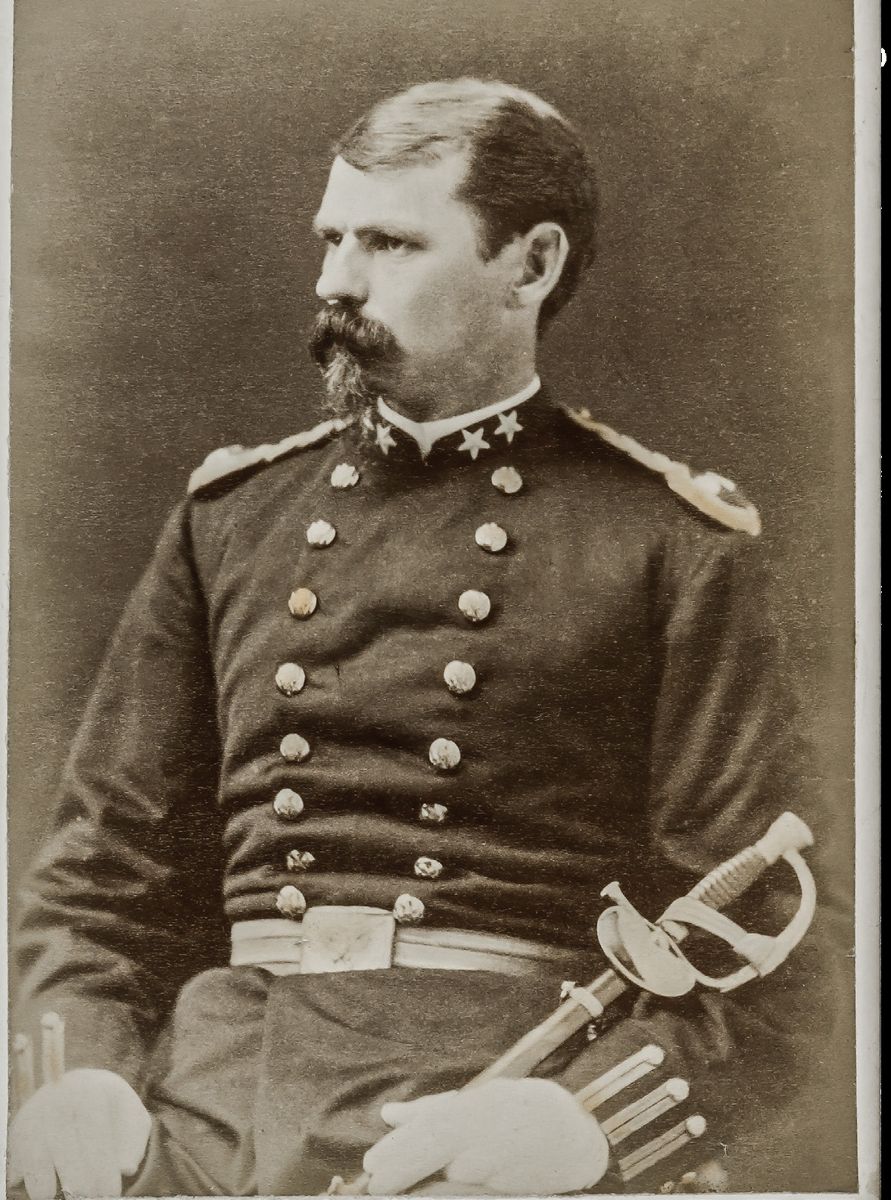
General Upton. (NARA record: 1135962)
The third letter, to Sara, his sister and longtime confidant, closely resembled a suicide note. Upton spoke of the “distress” caused by revision of the tactics. “It has seemed to me,” he wrote “that I must give up my system and lose my military reputation. God only knows how it will end, but I trust he will lead me to sacrifice myself, rather than to perpetuate a method, which might in the future cost a single man his life. I need all your prayers, for I would keep my integrity. I don’t feel like writing any more. Only let me feel that I have your love and sympathy.” He signed it “with a fervent kiss, your affectionate brother, Emory.” Around the room were books in several languages on tactics, tactical diagrams, letters, and photographs. Ashes in the fireplace indicated that he had burned materials, although Ah Sing testified that he made the fire that morning at 6:30. Upton’s dedication to his Emily never wavered. The New York Times stated that “He was devotedly attached to her, and ever had her photographs before him in his rooms and about his person wherever he went. Letters of condolence to him from her lady friends speaking in her praise, he had printed and framed as mementos of her.”17 Years later, comrade-in-arms John Tidball, who attended Upton’s funeral as Sherman’s aide, surmised that Upton killed himself “because of his unrequited ambition, an opinion at variance with those of some modern historians,” according to Tidball’s biographer, Eugene C. Tidball. Those modern historians such as Edward Coffman cite Upton’s physical ailments (“headaches”) and his desire to attain a higher office or status and failing to meet those requirements, led to his suicide. In Upton’s own words, he would liked to have been to be the Superintendent of the U.S. Military Academy. Russel Weigley, an Upton critic, allowed in one monograph in the army that Upton suffered from a “brain ailment,” and in another that Upton was suffering from a brain tumor.”18 In 1990, doctors John M. Hyson, George E. Sanborn, Joseph W. Whitehorne, and William H. Mosberg, wrote an article in Military Medicine entitled “The Suicide of General Emory Upton: A Case Report.” In it, the authors determined that Upton did indeed die from his “catarrh.” In fact, he suffered from a benign cyst in his sinus cavity scientifically known as a “frontal sinus mucocele.” The growth of the cyst would have impinged on Upton’s brain, causing as much damage as a malignant, cancerous growth. And, unfortunately, doctors performed no autopsy; a procedure that might have put all speculation to rest. 19
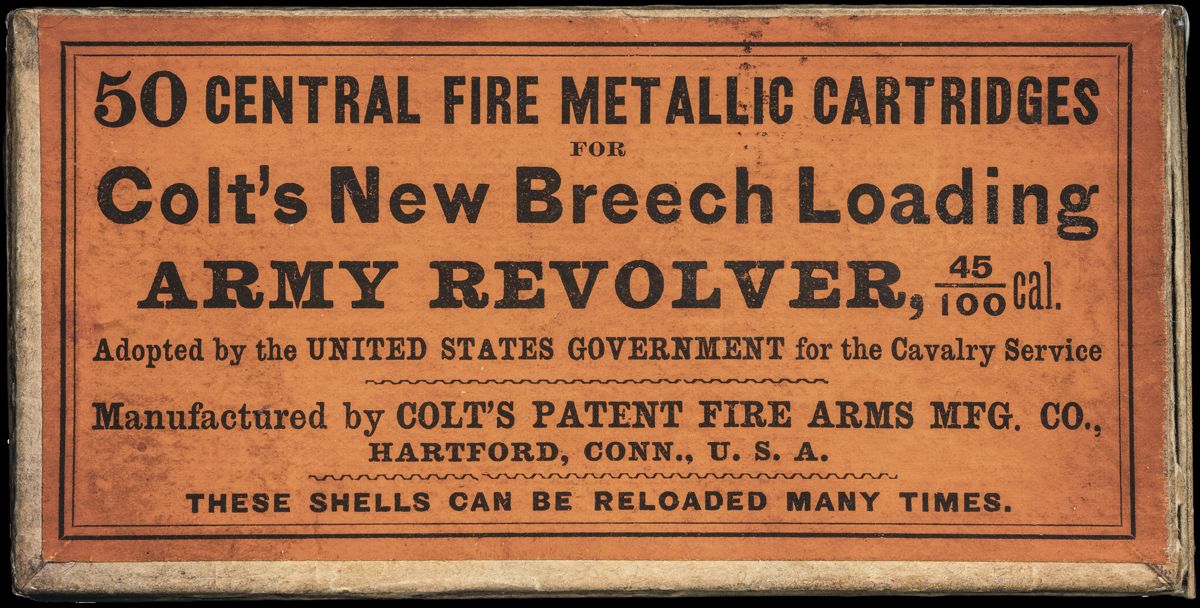
This box of ammunition with orange lid label is marked “50 CENTRAL FIRE METALLIC CARTRIDGES/FOR/Colt’s New Breech Loading/ ARMY REVOLVER, 45/100 cal./Adopted by the UNITED STATES GOVERNMENT for the Cavalry Service/Manufactured by COLT’S PATENT FIRE ARMS MFG. CO.,/HARTFORD, CONN., U.S.A./THESE SHELLS CAN BE RELOADED MANY TIMES.”
The revolver is still in its factory form fitted walnut case with elegant dark purple lining and a fifty-round cartridge block holding 49 unmarked externally primed cartridges. True factory cases for Colt single actions are almost nonexistent with but a handful known, and this original is exceptional.
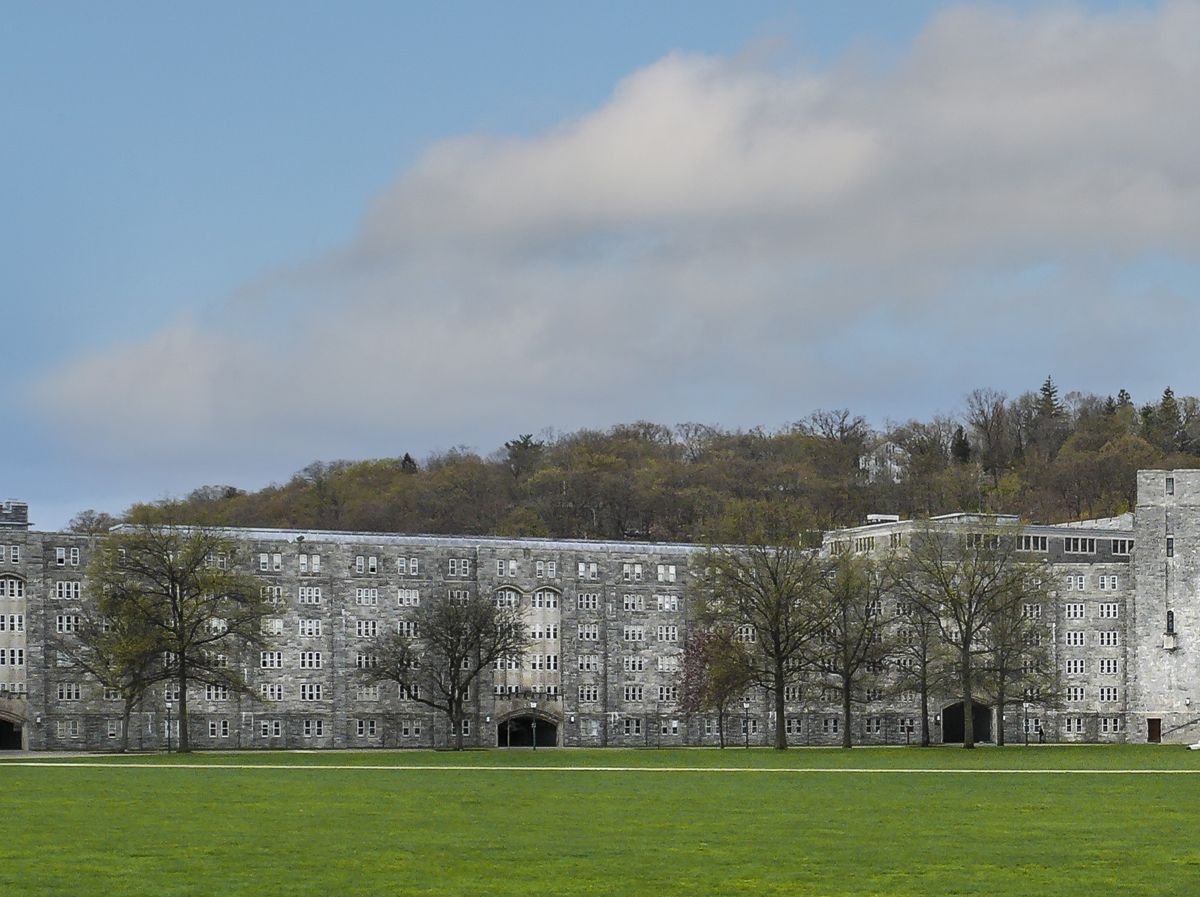
United States Military Academy at West Point. A letter of provenance from an Upton descendant states that this revolver was handed down through the Upton family and that he is an indirect descendant of Major General Emory Upton. The descendant states that Colt single action revolver, SN 1501, was presented to Upton while he served as Commandant of Cadets at the United States Military Academy at West Point.
ENDNOTES
- David Fitzpatrick, “Emory Upton and the Army of a Democracy,” The Journal of Military History, Vol. 77, No. 2, April 2013, 468. The Whig party endorsed the concentration of power in the executive branch, a comfortable balance of power among the three federal branches of government and the defense of republican values (as opposed to democratic). In many of his post war letters, Upton wrote of the excesses of democracy, which he equated with chaos and anarchy. This essay is excerpted from Correspondence of Major General Emory Upton, Vol. 1, 1857–1875. University of Tennessee Press, 2017, Salvatore G. Cilella Jr., ed. and Till Death Do Us Part: The Letters of Emory and Emily Upton, 1868–1870, Salvatore G. Cilella Jr., ed. U. Oklahoma Press, 2020.
- Merritt Starr, “General Emory Upton—His Brothers, His Career,” The Oberlin Alumni Magazine. 1922, 12. Quote by James Wilson appeared in Richard Barry, “Emory Upton, Military Genius,” New York Times, June 16, 1918. See also Book Review of Michie’s Life and Letters in The New York Times, July 20, 1885.
- Peter S. Michie, The Life and Letters of Emory Upton, Colonel of the Fourth Regiment of Artillery, and Brevet Major General, U. S. Army. New York, D. Appleton & Co., 1885, 498. Hereafter, Michie. Michie, an 1863 graduate, served as an engineer in operations against Charleston in 1863 and 1864. He rose to the rank of Brevet General of Volunteers. Returning to West Point in 1867, he taught as Professor of Natural and Experimental Philosophy until his death in 1901 at 62. Although Michie did not shy from criticizing Upton, his biography lionized him.
- Michie, 4-7.
- Wilson’s reference to Upton’s equals is in his introduction in Michie, xxvii. Also, James H. Wilson, Under the Old Flag, New York, D. Appleton, 2 vols, 1912, II, 166. Not everyone thought highly of Upton. John Montgomery Wright called Upton “one of the grossest men in the corps.” In Military Academy parlance, “gross” meant that a cadet was not up to his potential in military matters and did not imply any inferiority in academic matters. According to Wright, Upton must have learned his tactics elsewhere: “If he (Upton) had tactical ability at that time he was reserving if for concentration in his book.” Wright went on to contradict his definition of “gross” writing that Upton certainly deserved his celebrity, but added that Upton “was not a bright man in any direction while a cadet. It is possible that the quickening of mind that brought him into notice and fame was the progress of the change that eventually overturned his mind and led him to self-destruction.” John Montgomery Wright, “West Point Before the War.” The Southern Bivouac: A Monthly Literary and Historical Magazine. New Series, Vol. 1, June 1885 to May 1886, 1321, 16.
- Science, November 6, 1885, Vol. VI, No. 144. Book Review, “Gen. Emory Upton,” The New York Times, July 20, 1885. Ralph Kirshner, The Class of 1861: Custer, Ames, and Their Classmates after West Point. Southern Illinois University Press, 1999, 149.
- Stephen Ambrose, “Upton’s Military Reforms,” Civil War Times Illustrated, Vol. 2, No. 5, August 1963, 24-30.
- Emory Upton, The Armies of Asia and Europe: … Accompanied by Letters Descriptive of a Journey… D. Appleton, 1878. iv., Walter Millis, Arms and Men: A Study in American Military History (New York: G. P. Putnam’s Sons, 1956), 139-140.
- October 10, 1866. Correspondence Files of the Commission Branch (CB), 1863–1870 and the Appointment, Commission and Personal Branch (ACP), 1871–1894. Commission Branch, 1863–1870, M1064. RG 94, M1395, ACP000196.
- Upton to DuPont, July 6, 1880; Sept. 8, 1880. DuPont Papers, Hagley.
- Dr. Samuel Powel to Mrs. Martin (presumably), Philadelphia May 12, 1881 as cited in Michie, Upton, 486-7.
- Upton to DuPont, September 22, 1880 and Upton to Maria, September 22, 1880. Holland Land Office Museum, Michie, 484. In November, Upton assured Maria that he was not suffering and that the “cautery has been applied once since my return (from New York) and the Dr. says he is about through with it.” Upton to Maria, November 3, 1880, HLOM.
- Michie, Upton, 482-483.
- Hasbrouck’s complete testimony at Upton’s inquest was published in The Evening Auburnian, Monday, March 28, 1881, and excerpted in several other papers. “
- The Late General Upton,” The Army Navy Journal (ANJ), March 26, 1881, 707; “The Late Gen. Upton,” The San Francisco Call, March 16, 1881, reprinted in The New York Times, March 24, 1881. “
- The Late General Upton,” ANJ, March 26, 1881, 707. “
- The Late Gen. Upton,” The San Francisco Call, March 16, 1881 reprinted in The New York Times, March 24, 1881.
- Coffman, Old Army, 273-4; Russell F. Weigley, The American Way of War: A History of United States Military Strategy and Policy. Indiana University Press, 1973, 125, 169; Jeffrey Hice explores Upton’s religious training and its view of suicide and eventually agrees that Upton’s mucocele impaired his thought processes. See Jeffrey N. Hice, “The Utmost Devotion to Duty. Rediscovering the Faith and Character of General Emory Upton.” MA Thesis, St. Bonaventure College, 1996. Eugene C. Tidball, “No Disgrace to My Country”: The Life of John C. Tidball. Kent State University Press, 2002, 442. “
- The Suicide of General Emory Upton: A Case Report.” Military Medicine, 155, October 1990, No. 10, 445-452. See also David Fitzpatrick, Emory Upton: The Misunderstood Reformer. University of Oklahoma Press, 2017, 239-242. Fitzpatrick states “After an autopsy…,” 240. There is no evidence that the inquest required an autopsy or that one was ever requested by the family and ever done. In more than one news account the body was embalmed almost immediately. Stephen Ambrose does not mention an autopsy. Ambrose, Upton, 136-150. Michie reprints a letter of Dr. Allen’s to Michie stating: “The report of the surgeons who made the post mortem examination would be valuable in this connection,” to which Michie added a revealing footnote: “None was made.” Michie, Upton, 490.
ABOUT THE AUTHOR
After 43 years in the museum field, Cilella devotes his time collecting American prints and maps and writing. His last professional position was President and CEO of the Atlanta History Center. His most recent books are Upton’s Regulars: A History of the 121st New York Volunteers in the Civil War (U. Press Kansas, 2009). His two-volume Correspondence of Major General Emory Upton, (U. of Tennessee Press, 2017), received the 2017–2018 American Civil War Museum’s Founders Award for outstanding editing of primary source materials. His latest book “Till Death Do Us Part,” an edit of Upton’s letters to his wife 1868–70, was published in 2020 by the Oklahoma University Press. Salvatore G. Cilella Jr.