
Survival of Confederate Revolvers
By John Sexton · Originally published May-June 2022 · pp. 52–78
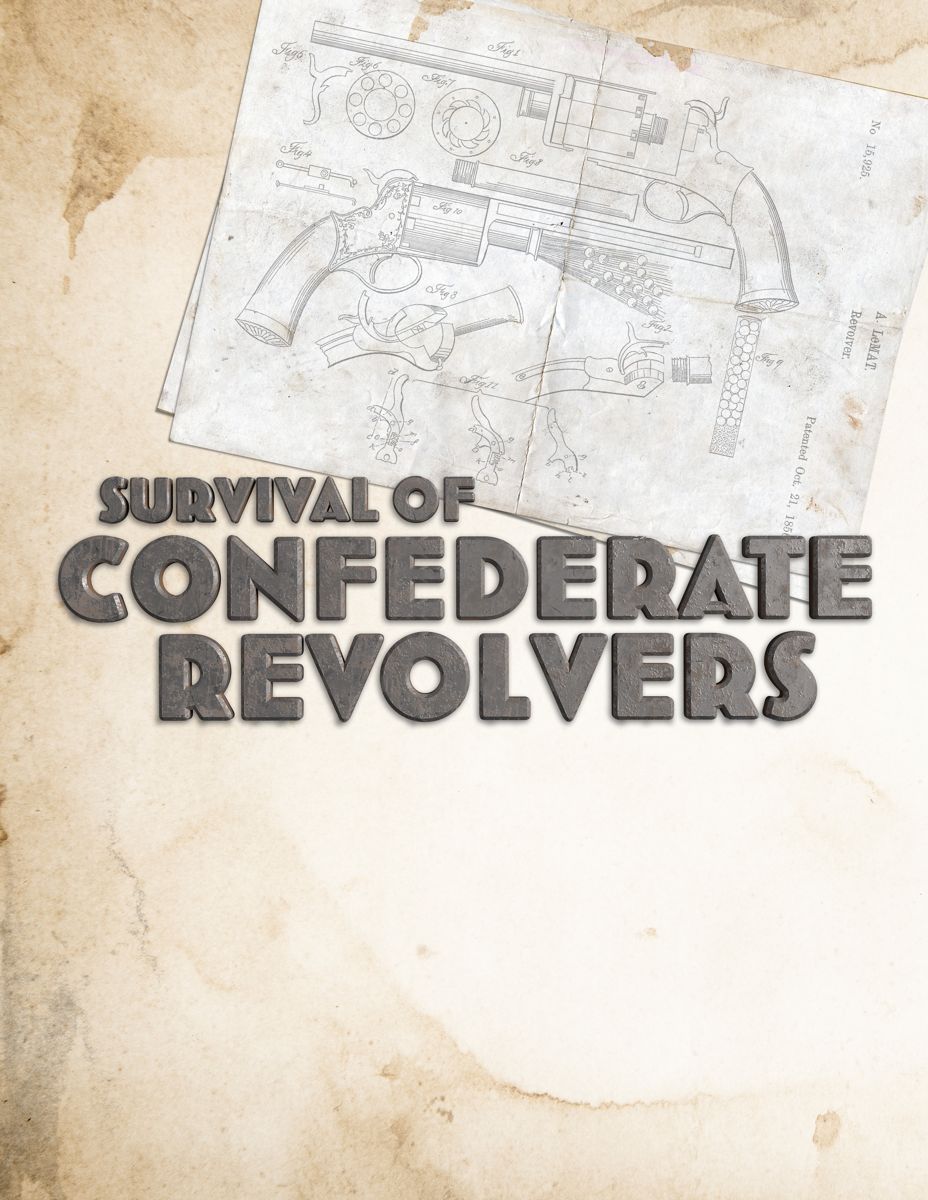
Sidearms were as important to the Confederacy as were other arms. Cavalrymen often were armed with two or more pistols giving them tremendous firepower in close quarters fighting. Southern states bought several thousand Colt army and navy revolvers in the months leading up to war. At least 8,000 Kerr revolvers were imported from England; LeMat produced 2,500 grapeshot revolvers in Paris, almost all for Confederate use; over 1,000 LeMats were also made in England under Confederate contract. Colt, in any given month during the war, made as many revolvers as the total production of all Southern makers in four years of war. There were wartime purchases of Colts through Northern companies as shown by Colt factory letters of large groups of revolvers shipped to agents from New York, Philadelphia, St. Louis, and surely more. This is a subject not written about before. Based on documented Confederate-used Colts, the origins of large shipments of literally hundreds of Colt Model 1860 armies, and especially the Model 1851 navies most popular among Southerners, can be traced back Northern dealers. While Southern wartime purchase of Colts is a project for future research, this article summarizes survival of Confederate made and imported revolvers. Most Confederate revolvers were made in Georgia. Exaggerated promises were made for the large scale production of military revolvers by Southern entrepreneurs. While Spiller & Burr had an initial contract for 15,000 guns to be delivered in 1862 alone, only 12 guns were submitted for inspection by December 31, 1862. Ten passed, and only one of this first model survives.
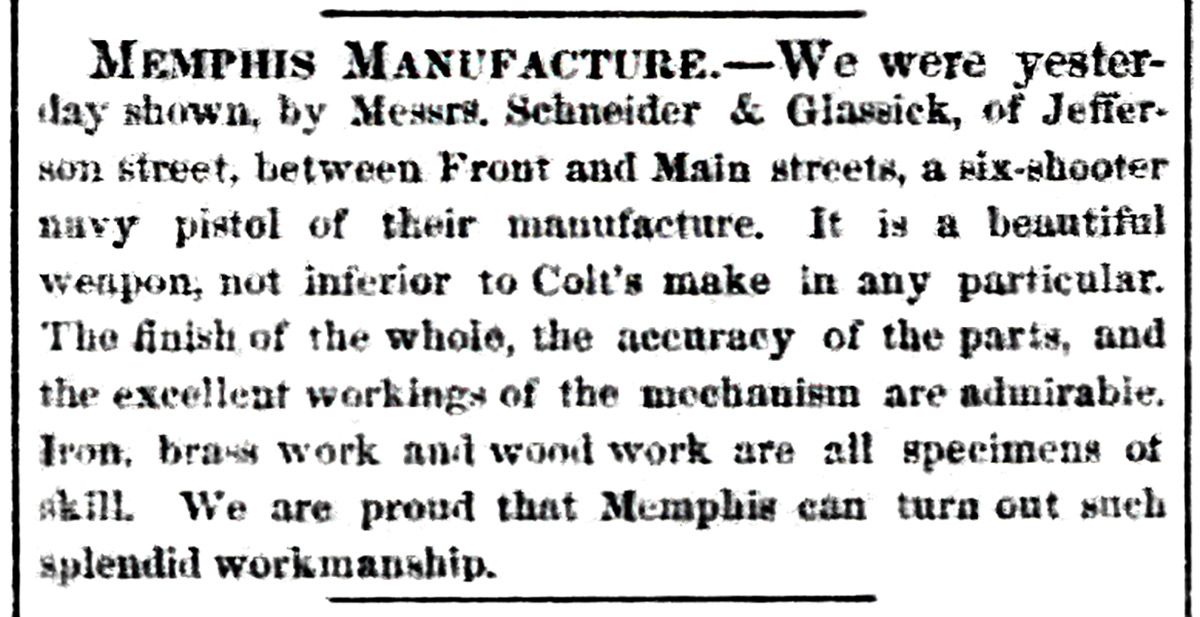
Schneider and Glassick of Memphis made a brass framed copy of the Colt navy as noted by a December 1861 article. Only two documented survivors, numerous fakes exist, Caveat Emptor.
Schneider and Glassick document, Memphis, Tenn., Sept. 9th, 1861, to the Ordnance Department C.S.A., for 30 shotguns and 17 Colts’ pistols. (National Archives, RG 109, Citizens File, Schneider and Glassick)
Memphis Daily Appeal, December 8, 1861.
Cofer’s original patent “for a new and useful improvement in Revolving Fire Arms.” Signed by CSA Attorney General Judah P. Benjamin and Commissioner of Patents Rufus R. Rhodes, the official patent was one of only 266 issued by the Confederate government and is one of just 15 to survive today. (Courtesy Cowans Auction Company)
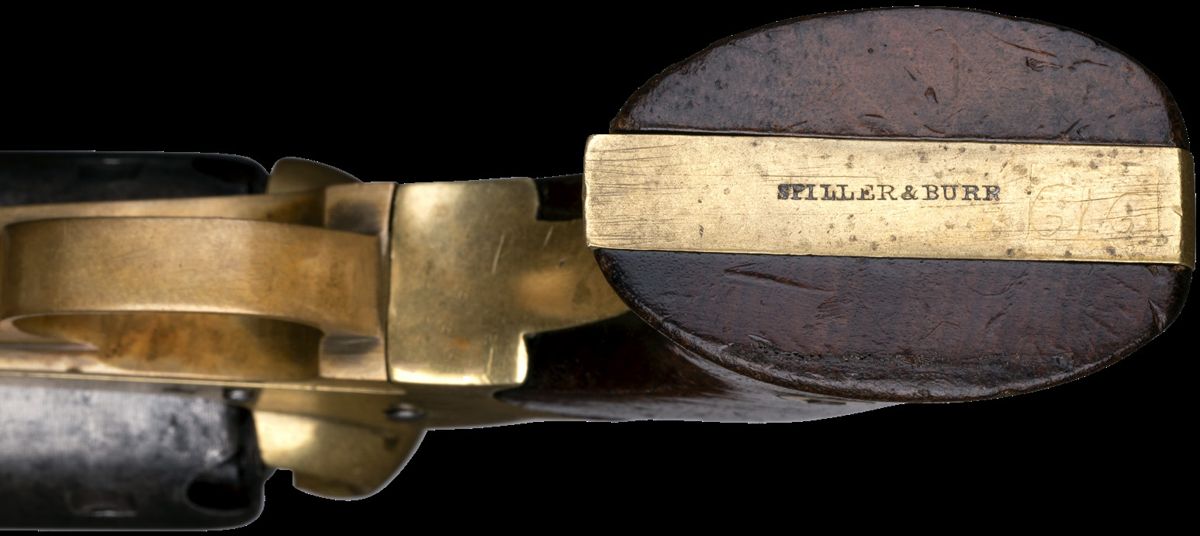
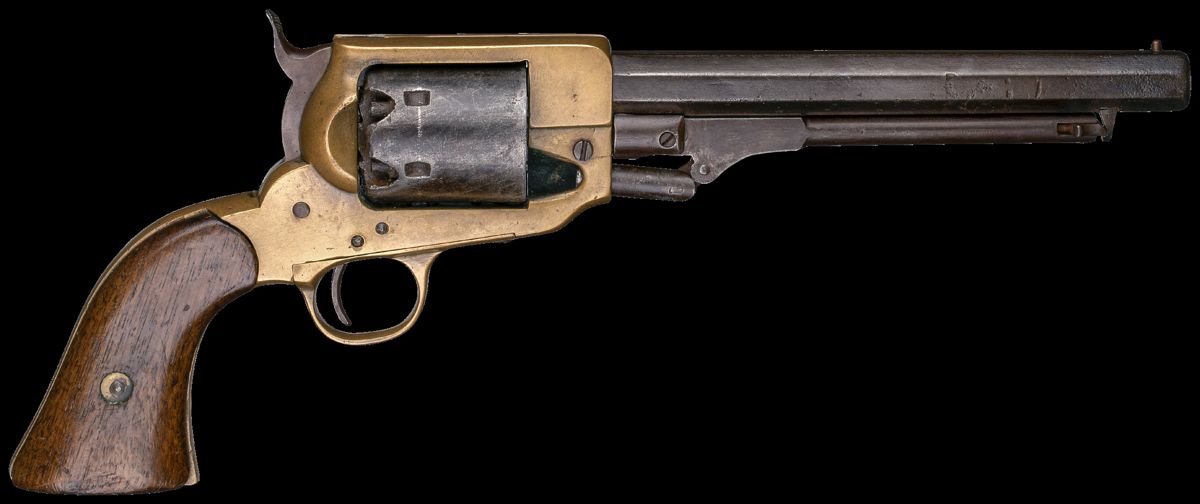
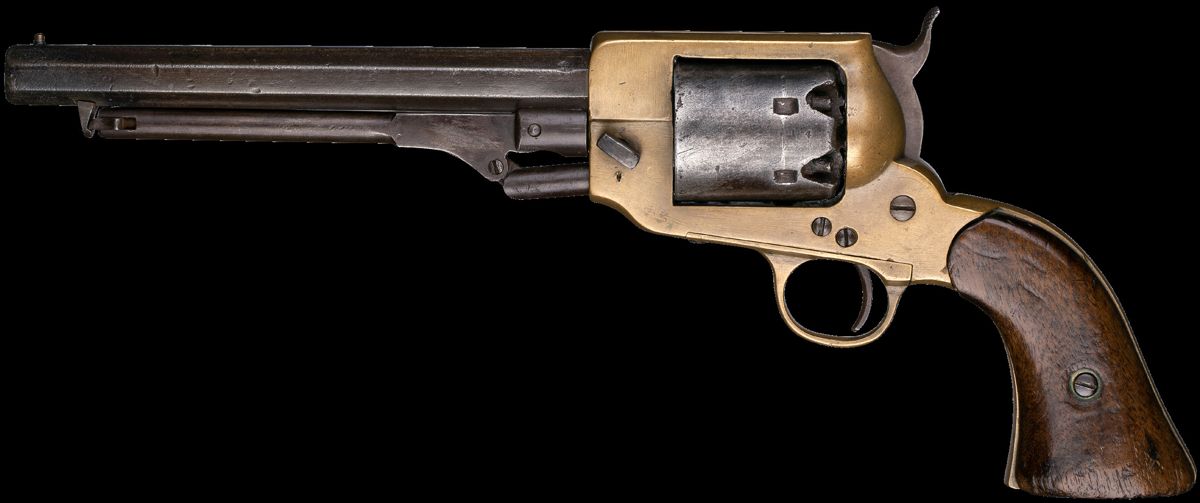
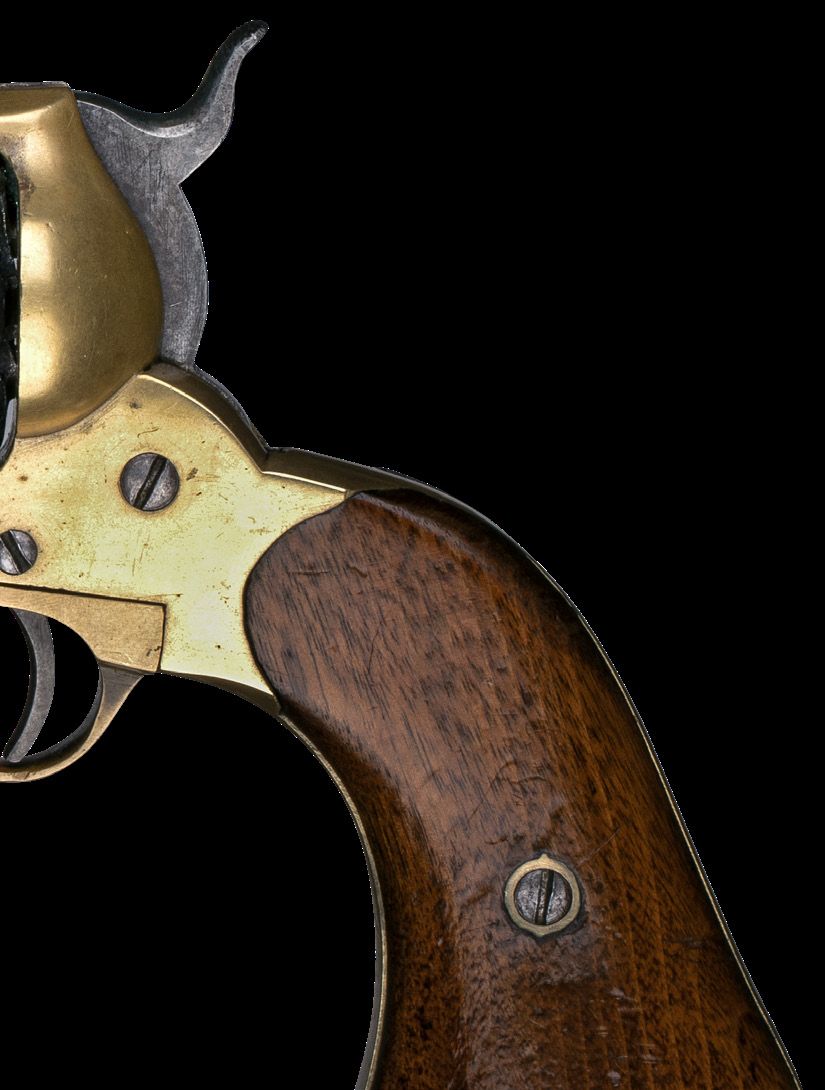
Spiller & Burr started production of their second model revolvers at the Atlanta Pistol Factory during June 1863. The first lot of 112 second models were submitted for inspection August 4, 1863; 100 were accepted. After only five months, Spiller had submitted nearly 1,000 guns for inspection by Dec. 31, 1863. Of that total, 835 passed inspection and went into service. The factory then moved to the Macon Armory under Confederate government supervision where another 677 second model revolvers were fabricated, repaired, or inventoried between March 1864 and the war’s end. Of these 677 Macon revolvers, only a handful of survivors are totally Macon manufacture; most are repairs of the Atlanta issued revolvers that failed in the field, and others started with Atlanta-made parts with additional Macon-made parts where needed. The Spiller & Burr revolver is a brass framed copy of Whitney navy with twisted iron cylinders instead of unavailable steel.
First Model Spiller & Burr, SN 23.
Second Model Spiller & Burr, transitional serial number, SN 124.
Spiller & Burr. Yorkville Enquirer, York, S.C., Dec. 24, 1862.
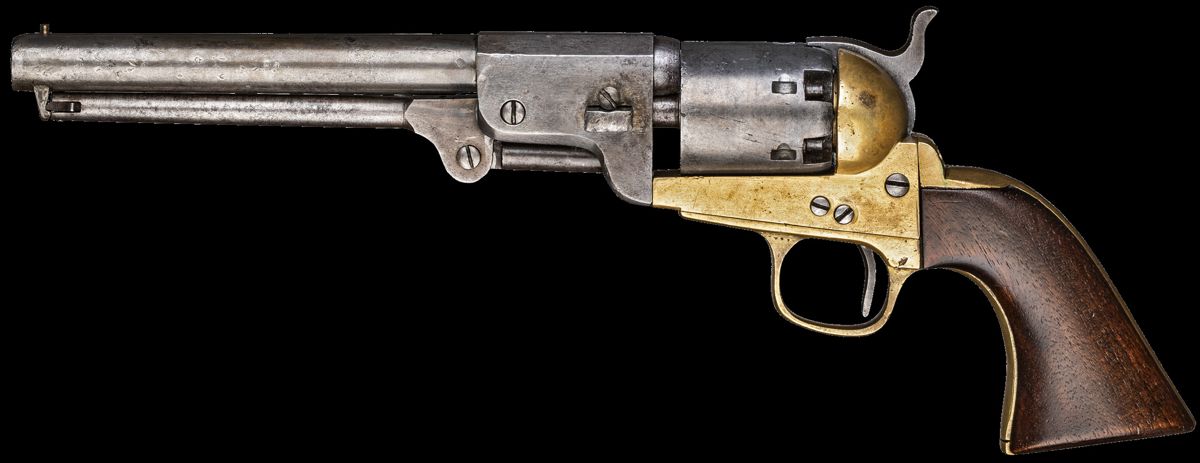
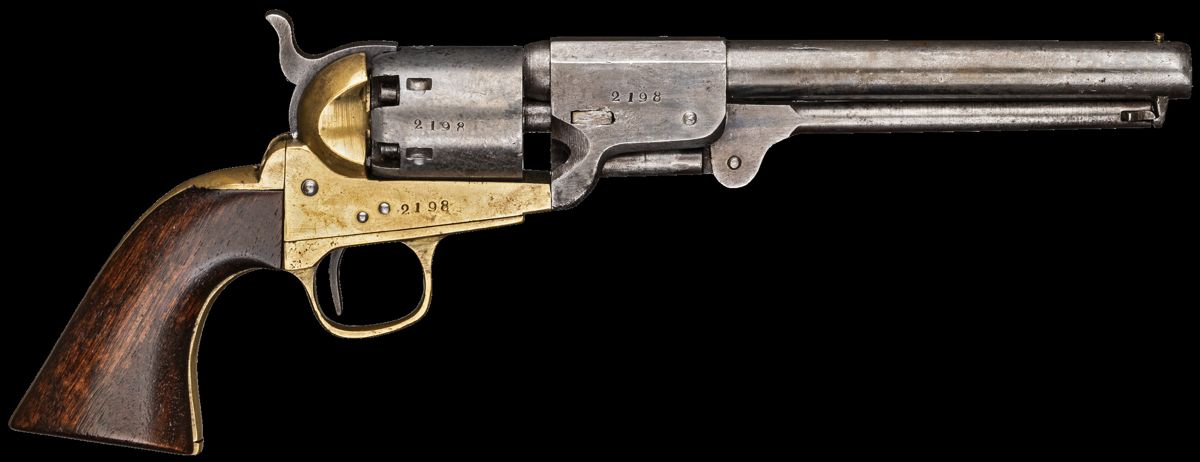
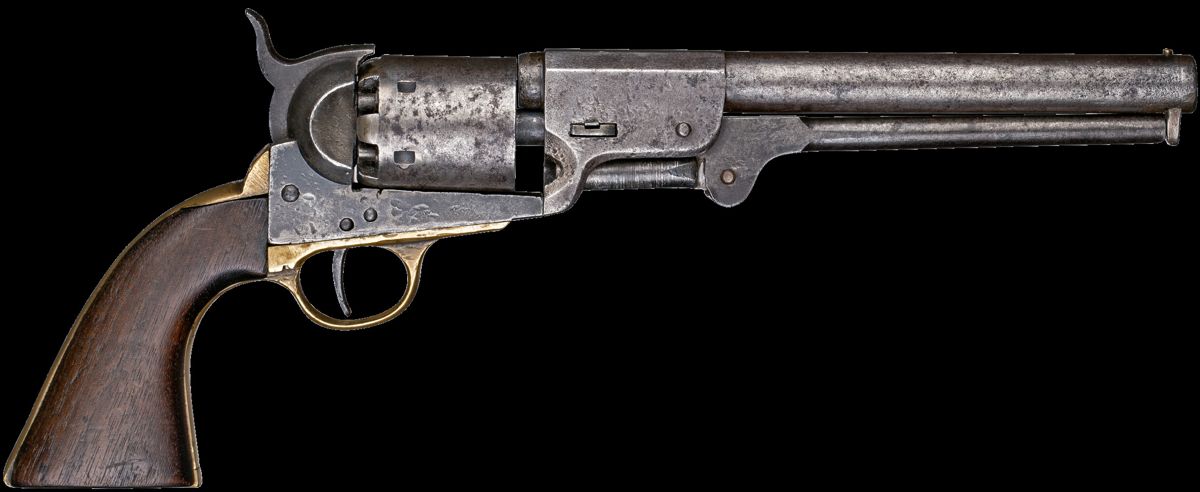
Samuel Griswold, the most consistent Southern manufacturer, made about 3,600 guns between mid-1862 and the factory’s destruction by Sherman’s forces on November 20, 1864. Griswolds are brass framed copies of the U.S. Colt M1851 navy with round barrels. They utilized a twisted iron cylinder (as did Spiller); some guns even had twisted iron barrels. The highest known serial is 3607.
Griswold, SN 2198, carried by Capt. B.G. Brown, 7th Virginia Infantry.
Leech & Rigdon made about 1,500 guns, most in Greensboro and Augusta, Ga., with machinery moved from Columbus, Miss., during March 1863. Leech revolvers are copies of Colt navies with round barrels. There are several variations; SN 1463 is the highest known Leech serial number.
Leech & Rigdon, SN 15, earliest known barrel marking.
Novelty Works ad that appeared in the Memphis Daily Appeal (Memphis, Tenn.) Sept. 10, 1862, page 2.
Approximately 900 Rigdon & Ansley revolvers were manufactured in Augusta, Ga., during 1864. They are improvements of Leech & Rigdons with 12-stop cylinders. Documented original Rigdon serial numbers range from 1482 to 2359.
Rigdon & Ansley, SN 2182 with unusual 3-line marking; most are only “CSA.” The left octagonal flat of the barrel housing is marked “C H RIGDON,” the top flat “CSA,” and right flat “AUGUSTA, GA.”
Augusta Machine Works and Louis Haiman of Columbus, Ga., are thought to have made about 200 revolvers based on period accounts and records. Augusta Machine Works revolvers are copies of Colt M1851 navies; later examples have 12-stop cylinders. Haiman revolvers are round barrel copies of Colt navies; only four marked examples have survived.
Augusta 12-stop revolver.
The Daily Constitutionalist and Republic (Augusta, Ga.) April 9, 1856, page 4.
Augusta 12-stop Serial “J.”
Augusta 6-stop Serial “K.” The finest example known from this manufacturer.
Augusta 6-stop Serial “K.”
Columbus Fire Arms Manufactory Co. of Louis Haiman, SN 23. Only four marked examples survive. There are currently four known unmarked examples; more should turn up as positive identification of unmarked pistols of this type has only recently been confirmed.
Columbus Firearms, SN 23, the finest example of only four known marked pistols.
Top of barrel stamped “COLUMBUS GA.”
Cylinder stamped “MANUF CO / COLUMBUS GA / 23.”
The only other Confederate government contract revolvers made in the South, but not made in Georgia, were products of the Dance Brothers, in Texas, and Cofer, in Virginia. There are also two surviving brass frame navy revolvers made by Schneider & Glassick of Memphis, Tenn., that were private purchases. J.H. Dance made about 350 .44 caliber army & .36 caliber navy revolvers, 105 survivors of army and navy calibers are known at present, most with a unique lack of recoil shields. The highest serial number of a complete Dance army revolver is 322. L.E. Tucker and Tucker, Sherrard and Co. of Lancaster, Texas, made a small number of revolvers in both army and navy sizes; like the Dance versions, their army calibers are large frame copies of Colt Dragoons.
Dance & Brothers army (dragoon), SN 269, the finest example known.
Dance & Brothers navy, SN 51. Early war production with recoil shields. SN 91 does not have recoil shields. These are two of the 14 known survivors.
Dance & Brothers navy, SN 51.
Dance & Brothers navy, SN 91.
Tucker & Sherrard low hammer dragoon, SN 52. Three known survivors.
L.E. Tucker navy, SN 72. Three known survivors.
Thomas W. Cofer of Portsmouth, Va., is thought to have made about 100 revolvers based on 14 documented survivors and NARA research. Cofers are brass framed navy revolvers with spur triggers. Cofer also made a Confederate patented cylinder for selfcontained cartridges; perhaps 10 were made, based on surviving serial numbers 1 and 7. These revolvers were made for the 5th Virginia Cavalry.
Cofer Percussion, SN 11.
Cofer Cartridge revolver, SN 7, one of two survivors. (Courtesy Poulin Antiques & Auctions, Inc.)
Cartridges for the Cofer revolver.
There was an estimated total of about 8,175 revolvers produced in the South for the Confederacy by all manufacturers. There are 973 documented survivors in my database and new guns keep turning up. Texas-made Dance revolvers have the highest survival rate, about 25%, with less than 15% for other makers. If we surmise that 25% of all Confederate revolvers survived, many more will be found in the future. If you have a Confederate revolver/pistol and would like to contribute to the Confederate gun database, email or text the author with photos, serial numbers, and markings.
Survival and estimated production of Southern made Confederate revolvers. Maker
Estimated Production
Surviving Guns (author’s records)
Griswold
3,600
Spiller & Burr
1,250
Leech & Rigdon
1,500
Rigdon & Ansley
Augusta Machine Works
Haiman, Columbus Firearms
Dance & Brothers (.44 cal. dragoon)
Dance & Brothers (.36 cal. Navy)
Tucker & Sherrard (dragoon)
L.E. Tucker (navy)
Uknown
Cofer
Schneider & Glassick
Total:
~8,175
973 ( documented)
Imported revolvers with known Confederate purchase or association Kerr ~9,000 imported, with ca. 350 survivors in the database but this was only started recently; many more are known to exist and need to be included. Most with Confederate association have the JS/anchor marking in the stock.
Jefferson Davis’s personal Kerr, SN 1041, is among the lowest SNs with documented JS/anchor found on Confederate Kerr revolvers. This mark is also found on blockade run imported longarms.
JS/anchor stamp.
Frenchman Dr. Jean Alexandre François LeMat invented and patented a firearm that is named after him. The revolver has a 9-shot cylinder surrounded by a .63 caliber shotgun barrel. Approximately 3,500 made in France and England, with 545 known survivors.
LeMat First Model, SN 22.
“COL. LeMat’s patent.”
LeMat Second Model, SN 1309.
“Col Le Mat Bte s.g.d.g. Paris.” Right side of barrel marked “1309 LM” with star.
Three English 54 bore army pistols, Tranters, Beaumont-Adams, and wedge frame Webleys, are known to be imported but in unknown quantities. No doubt hundreds, if not thousands, of English revolvers saw Confederate use based on period references. There are few records that have surfaced. The ground-breaking book, The English Connection, is the best source to date. Their database of English revolvers is the basis for estimated production. Each of these models is found on an 1864 18th Virginia Cavalry squad inventory recorded by Lt. Julian Pratt that included 17 English revolvers including, Tranter, Adams, Webley, and Kerr Patent revolvers. The serial numbers give us an idea of some ranges in which they can be found.
Julian Pratt’s squad inventory of 17 English revolvers listed by serial number and carried by members of 18th Va. Cav., one of the very few known listings of Confederate revolvers by serial number.
There are several sizes of these popular revolvers made between 1855 and 1870. Civil War-era production runs through SN 900019000, but prewar guns in America often may have a Confederate association as some were made prewar and shipped to Southern retailers, mostly in New Orleans. There were groups purchased that made their way into the army. 15465T, 15476T are listed on Pratt’s squad book of Virginia cavalry, 15339T has a family association with an ancestor in 18th Va. cavalry. This little cluster of SNs in the mid-15000 serial range must have been part of a blockade run purchase. All Confederate associated revolvers are army size, 54 bore. There are Tranters associated with Southerners who became prominent Confederates. The best known of these is SN 7993T, a deluxe engraved, silver plated, and cased, weapon inscribed to Dabney H. Maury, United States Military Academy graduate, U.S. Army officer, and Confederate general. This revolver is also marked by New Orleans agent Hyde & Goodrich, a firm known for fancy firearms, and has survived in very fine condition. There are many fraudulent and fake inscribed Tranters that have been sold since at least the 1960s, few have any documented Confederate association.
Trantner, SN 12368, the only agent-contracted gun without checkered grips.
Tranter revolver owned by Confederate General Dabney H. Maury.
Inscribed on the barrel are the initials of Dabney Herndon Maury, Va.
Major General Dabney H. Maury. (Library of Congress)
Cased deluxe inscribed Tranter of General Dabney Maury. (Chip Newman collection)
Beaumont-Adams revolvers are large frame, and 54 bore. Known Confederate associated revolvers include two from the Pratt 18th Va. list, 36604 and 36609. SN 40568 was captured from Jefferson Davis; SN 40573 was presented by Robert Adams to Stonewall Jackson.
Beaumont-Adams, SN 41080.
“Richmond Hussar,” with “R H” stamped brass letters on his hat. The Hussars were organized in Augusta, Richmond County, Ga. Photograph c. 1861. The white buff holster rig is for one of the 400 Adams revolvers the state of Georgia purchased. Image has been reversed. Liljenquist Family Collection of Civil War Photographs (Library of Congress).
Webley wedge frame revolvers, both 80 bore and 54 bore, were made in two separate serial ranges, but only 54 bore revolvers have Confederate association. SN 3111, 3221, and 5054 are on the Pratt list. SN 3366 was carried by an Alabaman but tagged as a Bentley revolver; a similar identification occurred with 3111 and 3221 on the Pratt list. SN 5533 was carried by a Tennessee quartermaster.
Webley revolver, no SN.
BIBLIOGRAPHY • • • • •
• •
• • • • • • • • •
• •
• • • • • •
Adams, Doug, The Confederate LeMat Revolver, 2005. Ahlstrom, Richard M., “Spiller & Burr, First Model Revolver,” The Gun Report Magazine, Vol. 49, No. 19, March 2004. Albaugh, William A., III, Confederate Arms, 1957. Albaugh, William A., III, The Confederate Brass-Framed Colt & Whitney, privately published, 1955. Albaugh, William A., III, Hugh Benet Jr., and Edward N. Simmons, Confederate Handguns: Concerning the Guns The Men Who Made Them and the Times of Their Use, 1963. Albaugh, William A., III, “Surprising New Discovery: First Model Spiller & Burr,” NSTCW Magazine, Vol. I, No. 2, July 1973. Albaugh, William A., III, (letter to editor relating to the “Model” term for the Second Model Spiller & Burr revolver), NSTCW, Vol. I, No. 4, Nov. 1973. Anderson, Cecil W., n.d., “The Manufacturing of the Firm of Spiller & Burr” (unpublished). Anderson, Cecil W., “The Enterprising Mr. Thomas Leech,” NSTCW, pp. 12-18, July-Aug. 1985. Anderson, Cecil W., n.d., “Notes of Samuel Griswold Revolvers.” Anthony, William Edward, and Richard Taylor Hill, Confederate Longarms and Pistols, 1978. Bridges, Ron, “Dance Brothers,” NSTCW, Jan.-Feb. 1974. Edwards, William B., “Texas Fights Alone,” Civil War Guns, Chapter 30, pp. 368-372, 1962. Forgett, Valmore and Alain Serpette, LeMat, The Man, The Gun, 1996. Forgett, Val, “Why Kerrs,” American Society of Arms Collectors (ASAC) Bulletin, No. 97. Friedrichs, Victor, “Trials and Tribulations of a Confederate Gunsmith,” Texas Gun Collector (TGC) Bulletin, pp. 21-28, Issue 51, Oct. 1954. Friedrichs, Victor, “A Lancaster Texas Revolver” TGC Bulletin, Issue 67, pp. 16-18, Sept.-Oct. 1957. Fuller, Claud E. and Richard Stewart, Firearms of the Confederacy, 1944. Gary, William A., “The Lancaster Pistol Factory,” TGC Bulletin, pp. 34-35, Spring 2012. Gary, William A., “Ogden, Utah or Lancaster, Texas,” The Gun Report, pp. 18-20, July 1980. Gary, William A., “Texas Pistol Makers of the Confederacy,” ASAC Bulletin, No. 55, 1986. Gary, William A., Confederate Revolvers, 1987. Greene, A. C., “Guns for Dixie, Unraveling the myth…,” Dallas Morning News, Texas 150, pp. 12-14, Jan. 19, 1986. Hartzler, Dan, Confederate Presentation and Inscribed Swords and Revolvers, 1988. Hirsch, Chris, The Texas Gun Trade; A Guide to the Guns Made or Sold in the Lone Star State, 1780–1899, 2008.
• • • • • •
• • • • • • • • • • • • • • • • • • • •
Holloway, Carroll C., Texas Gun Lore, 1951. Howard, Robert, The Gun Report, pp. 24-25, July 1963. Janke, Paul, “The Dance Brothers Revolvers,” The Gun Collector, No. 22, pp. 173-177, May 1948. Kusrow, Bruce and Matthew Norman, The Southern Cousin of The Whitney Revolver: From the Federal to the Confederate Model, 1999. Lee, Charles F., “Joseph H. Sherrard, Blacksmith—Civil War Knife & Pistol Maker,” TGC Bulletin, pp. 77-79, Spring 2000. Lee, Charles F., “A Case for a War Time Tucker, Sherrard and Company .36 Caliber Navy Style Revolver,” TGC Bulletin, pp. 3335, Spring 2004. Lee, Charles F., “The Tucker and Sherrard Low-Hammer Straight Thumb Piece Revolver,” TGC Bulletin, pp. 37-39, Spring 2012. Maxwell, Sam, “Dance Brothers Revolver,” The Gun Report, Nov. 1978. Meredith, Edward “Ted,” “Variations of the Leech & Rigdon Revolver,” ASAC Bulletin, No. 72, 1995. National Archives, Confederate Citizens File, RG 109. Norman, Matthew, Colonel Burton’s Spiller & Burr Revolver: An Untimely Venture in Confederate Small-Arms Manufacturing 1996. Otoupalik, Hayes, III, “Evolution of the Confederate Spiller & Burr,” NSTCW, Vol. 3, No. 3, March-April 1976. Pritchard, Russ, Jr., and C. A. Huey, The English Connection, 2015. Rogers, Flem, “.44 Caliber Flat Frame Dance Pistols,” ASAC Bulletin, 106, pp. 2-9, 2012. Salzer, Dick, “The Dance Brothers Revolver, A Texas Legend,” Arms Heritage Magazine, Vol. 2, No. 2, pp. 5-9, 2012. Sexton, John, “Dance Chronology of Manufacture,” Arms Heritage, Dec. 2018. Sexton, John, “Confederate Griswold Revolvers,” Military Antique Collector Magazine, March-April, Vol. 1, No. 1, 2022. Sexton, John, “Griswold Chronology of Manufacture,” Arms Heritage, March 2019. Sexton, John, “Spiller & Burr Chronology of Manufacture, Part 1,” Arms Heritage, Oct. 2019. Sexton, John, “Spiller & Burr Chronology of Manufacture, Part 2,” Arms Heritage, Dec. 2019. Smith, Sam, “Survival Figures for the Dance Brothers Revolvers,” The Gun Collector, No. 22, p. 178, May 1948. Smythe, H., Historical Sketch of Parker County and Weatherford, Texas, pp. 171-172 [Leban Tucker’s manufacture of Colt revolvers] 1877. Steuart, Richard, The Story of the Confederate Colt, Army Ordnance, Vol. XV, pp. 88-93 Sept.-Oct. 1934. Wall, Kent, “Leech and Rigdon Revisited,” ASAC Bulletin, No. 103 Wiggins, Gary, Dance & Brothers, Texas Gunmakers of the Confederacy, 1986. Whisker, James; Daniel Hartzler, and Larry Yantz, Arming the Glorious Cause: Weapons of the Second War for Independence…, 1998.
About the Author
John holds the highest designations as certified appraiser with International Society of Appraisers (ISA-CAPP) & accredited senior appraiser with American Society of Appraisers (ASA) specializing in Civil War memorabilia. He authenticates and evaluates other rare and valuable historic items as well. He is coauthor of the book Confederate Bowie Knives (2012) with Jack Melton, Josh Phillips, published by Mowbray Publishing Inc., and author of many periodical articles on Confederate arms. John’s contact information: website: www.civilwarappraiser.com, email civilwarappraiser@gmail.com, cell 770-329-4984.