
The Palmetto Armory Pistols of William Glaze
By Tim Prince · Originally published May-June 2022 · pp. 3–11
William Glaze of Columbia, S.C., entered the arms business through the same somewhat circuitous route taken by several other famous antebellum southern entrepreneurs, most notably Hyde & Goodrich of New Orleans. Both were dealers in a variety of items from jewelry to “fancy goods,” many of which were imported for sale, but prior to the War, they had little or no arms experience initially. Glaze entered the jewelry business in the late 1830s and by 1848 had partnered with Thomas Radcliffe of Columbia for a joint venture. Radcliffe was also a jeweler, silversmith, and fancy goods dealer who dabbled in firearms sales as well. Antebellum examples of Thomas Radcliffe imported, English-made Tranter revolvers are known to exist, as are other arms that bear his retailer’s mark. In 1849, the pair entered an arrangement to sell arms to the state of South Carolina for the state’s militia. That year the state acquired 100 muskets and 274 rifles from the partners, all of which they simply purchased from northern makers and resold at a profit. The rifles were the U.S. Model 1841 pattern made by Whitney, although with modified barrels that would accept a socket bayonet. The muskets appear to have been U.S. Model 1842 percussion muskets procured from Asa Waters, who would play a pivotal role in the soon to be formed Palmetto Armory of William Glaze. The following year the Glaze & Radcliffe partnership sold an additional 640 M1842 muskets to the state of South Carolina; this time they were obtained from Benjamin Flagg, who had previously worked as the foreman in the Waters operation and who was attempting to strike out on his own in the arms making business. By March 1851 the partnership between Glaze and Radcliffe had dissolved, with Radcliffe returning to his pre-partnership business of general line and fancy good sale sales, while Glaze pursued a new career as an “arms maker.” Glaze partnered with Benjamin Flagg and James Boatwright in establishing what would be known to history as the Palmetto Armory, although it was originally named the Palmetto Iron Works. Both of
Glaze’s partners were instrumental in the initial success of the venture, as he had neither manufacturing experience nor any real experience in the arms trade, other than the small groups of weapons he and Radcliffe had sold in 1849 and 1850. As previously mentioned, Flagg had served as Asa Water’s foreman before venturing out on his own. Flagg had all the required knowledge to establish a functional armory, as well as the contacts to acquire the necessary machinery to make arms and obtain component parts for arms. Boatwright was an old friend of the Glaze family who was well connected politically, with the right connections to obtain further arms contracts from the state of South Carolina. Boatwright, however, would not remain with the firm for long. The looming crisis between Southern slave holding states and the Northern free states was clearly forefront in the minds of the South Carolina government as they sought to establish the ability to manufacture arms within their own borders, rather than rely upon arms from northern factories. This path had been successfully followed by Virginia during the first two decades of the 19th century and likely served as a model for the new South Carolina operation the government sought to establish via Glaze and his partners. In April 1851 the new company had a factory but was probably not capable of producing much of anything. Despite this, they entered into an agreement with the state of South Carolina to provide the following arms: 6,000 percussion muskets, 2,000 percussion pistols (1,000 pairs) and 1,000 each of rifles, dragoon, and artillery sabers. The items ordered, and their relative ratios of production (3 times as many muskets as pistols, half the number of dragoon sabers as pistols, etc.) looked quite a lot like the products and output ratios of the Virginia Manufactory. The contract specified the arms were to be delivered during the calendar year 1852 and were to be the current U.S. patterns then in use. In others words the weapons were to be U.S. Model 1842 muskets, U.S. Model 1842 pistols, U.S. Model 1841 rifles and U.S. Model 1840 cavalry and light artillery sabers.
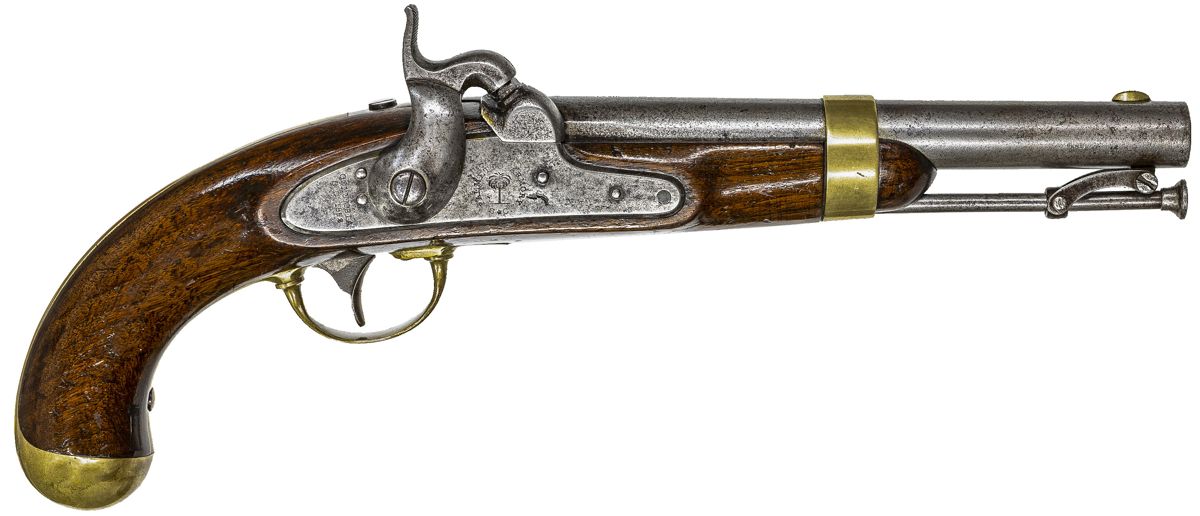
Overall obverse view of a Palmetto Armory pistol that retains some original browned finish on its barrel. (All photos by Tim Prince)

Overall obverse view of a Palmetto Armory pistol that has been cleaned to bright, as most extant examples are found today.
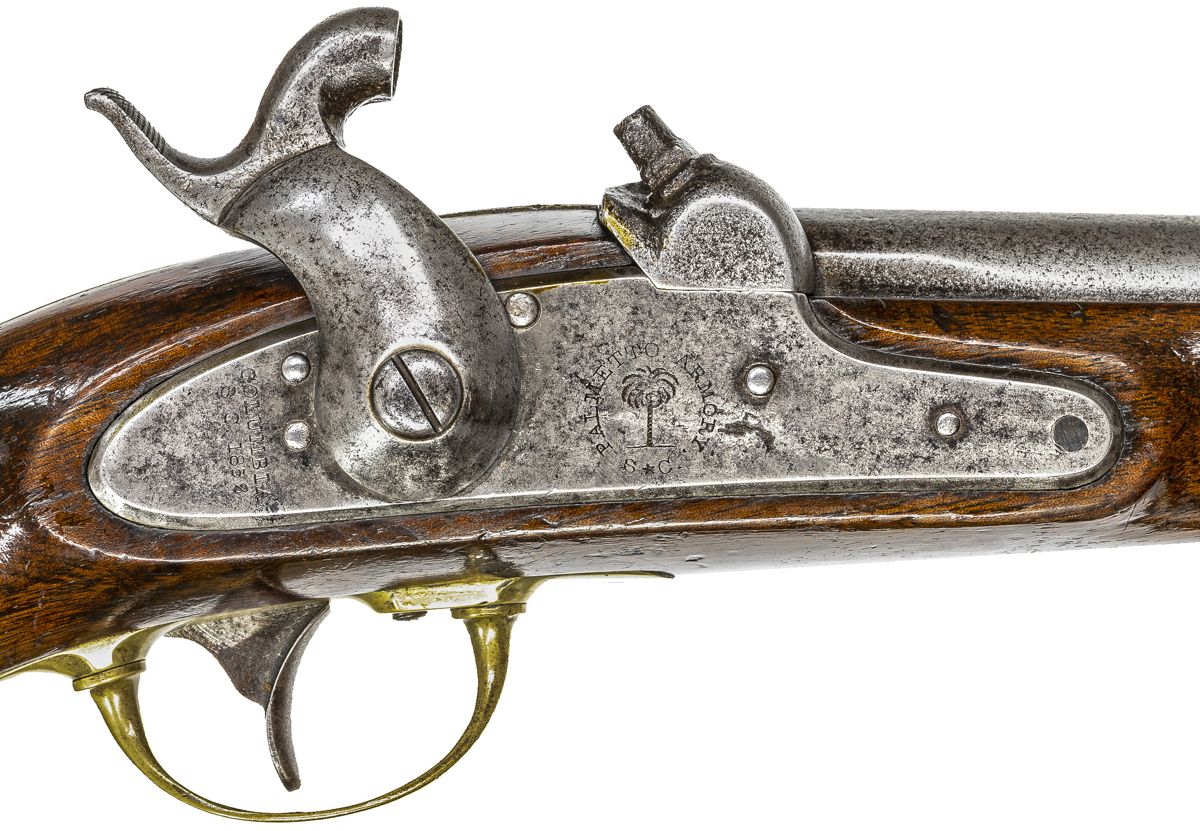
Closeup of a Palmetto Armory pistol lock plate.
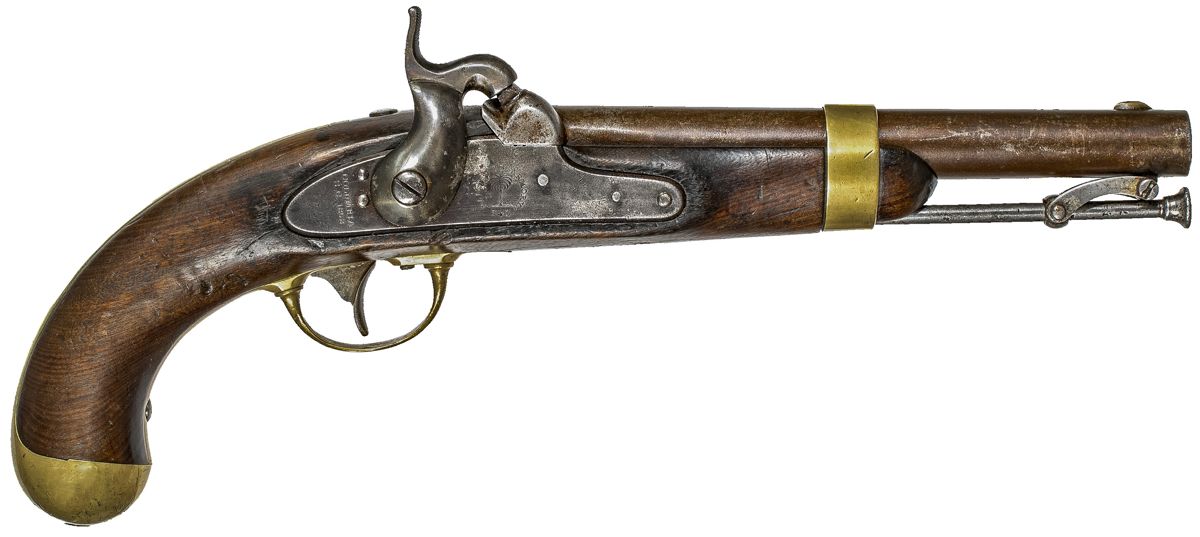
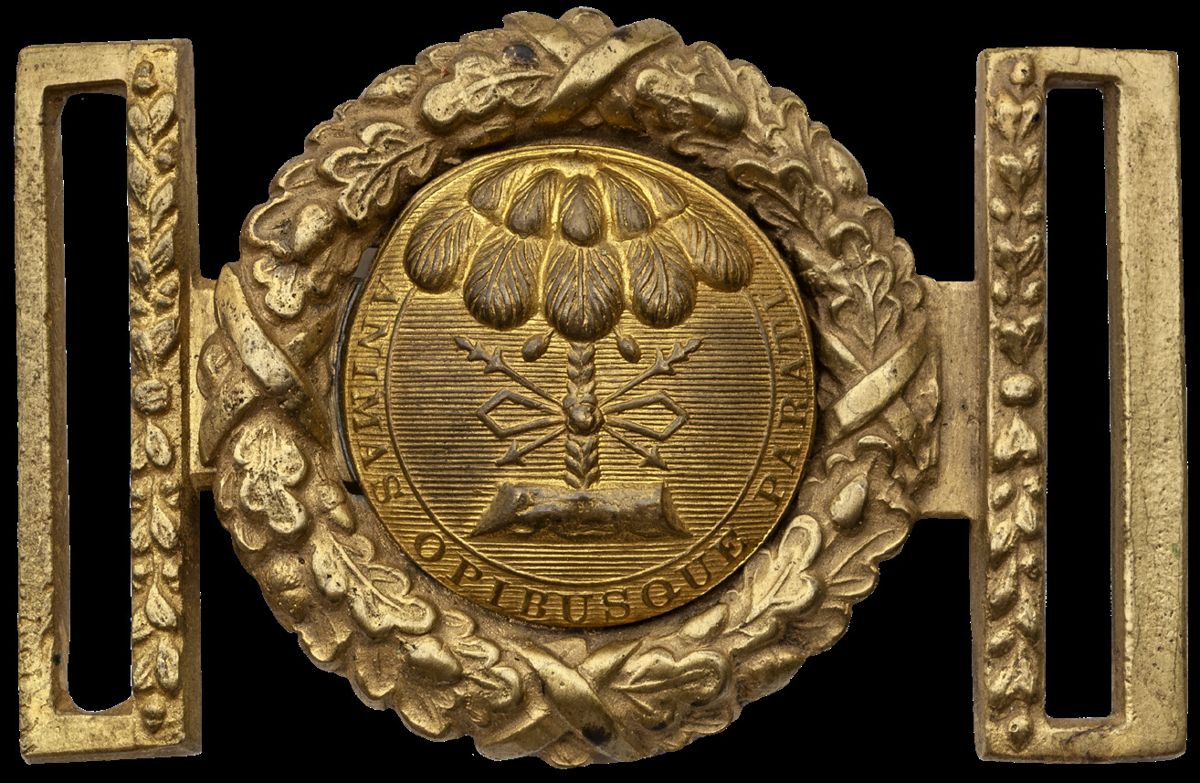
Colonel Joseph Walker, Field and Staff, Palmetto South Carolina Sharpshooters, 1862–1864. He is wearing his uniform, a two-piece South Carolina belt buckle with palmetto tree, a red sash over shoulder for officer of the day and is holding an eagle head sword. His kepi has the palmetto tree insignia with “K,” “5,” and “R.” Liljenquist Family Collection of Civil War Photographs (Library of Congress).
The most important contract requirement noted that, These arms and their component parts, to be manufactured within the State of South Carolina, of the best material and workmanship and as far as practicable, of material and by mechanics obtained in the state foresaid. From this contractual clause it is clear that the State of South Carolina was trying to establish a Virginia Manufactory type facility and wanted to be completely independent of any reliance upon the industrial north for arms manufacture. This clause would be the undoing of Glaze’s enterprise. It appears that even though Glaze built a factory and acquired some machinery, he never intended to actually fabricate any arms in his own facility. Rather he intended, at most, to acquire finished components and assemble them into complete arms. As noted by collector, researcher, and author Lew Southard in his excellent article “The Origin of the Palmetto Pistols” (American Society of Arms Collectors Bulletin 81:29-42) the “economy of scale” clearly indicated that Glaze had no intention of manufacturing complete arms. The very cost of the tooling and machinery to manufacture muskets, rifles, pistols, and two

Overall obverse view of the bright Palmetto Armory pistol.
patterns of sabers would have been so enormous that only large contracts, in excess of 10,000 units of each item, would have justified such a substantial capital outlay. By comparison, Southard notes that the initial Henry Aston contract for M1842 pistols was for 30,000 guns, thus justifying the capital investment. It also took Aston nearly two years from the date of the contract acceptance to delivering his first pistols. Clearly Glaze’s contract for 2,000 pistols, to be delivered within a year, was only possible if he were to rely upon a source of completed parts, if not completed pistols themselves. The later U.S. contract with Ira Johnson was for 10,000 M1842 pistols, but this was only economically feasible because Johnson was a partner of Aston’s and had access to the Aston tooling and machinery to manufacture the guns, rather than having to tool up from scratch. So, it was clearly the Aston-Johnson partnership that Glaze was relying upon in order to deliver pistols when he accepted the South Carolina contract. Correspondence exists that proves this point, that via Glaze’s partner Flagg, as well as the earlier Glaze relationship with Waters, a deal was struck to supply finished components to the Palmetto Armory for assembly into complete pistols. It appears that Johnson was the source for the components and that the locks were assembled by Waters, with all parts subsequently sent to Glaze for final assembly. Further investigation of extant, authentic Palmetto Armory pistols reveals that many parts are condemned pieces left over from the Federal contract M1842 pistols, marked with the condemnation “C,” which is sometimes partially or nearly completely obliterated, no doubt intentionally. While it was certainly bad enough that Glaze was violating the contractual requirement that the arms be made within the state from components and raw materials sourced from the state, the use of condemned parts certainly violated the clause that stipulated the arms were to be of the “best material and workmanship.” The inherent delays in acquiring the parts and final assembly of the pistols resulted in Glaze failing to meet his contractual 1852 delivery date. This resulted in the cancellation of the contract in May 1853. However, via cajoling and in some cases outright lying, Glaze managed to convince the state that 1,000 guns were mostly ready for delivery. Thus, Glaze managed to salvage part of the pistol contract. In the end, he managed to deliver 1,000 M1842 pattern pistols by the end of 1853. Correspondence reveals that at about the same time the contract was about to be canceled by the state, Glaze reduced his order of parts from Johnson, Waters, etc. to about 720 component parts. This suggests that Glaze had some forewarning of contractual difficulties. It is also hypothesized that his machinations to retain a part of the contract is the reason that all extant, authentic Palmetto pistol locks are dated “1852,” while the barrels are dated “1853,” and no guns were delivered prior to late 1853. The theory is that the locks, which had not yet been assembled at the time of the contract’s cancellation, were “back dated” to support the claim that the guns were nearly complete. This certainly seems to be a reasonable assumption. Even though Glaze eventually delivered 6,000 muskets, 1,000 rifles, and 1,000 pistols that he had assembled from parts obtained elsewhere, no further contracts to “manufacture” arms were forthcoming. He also delivered 2,526 sabers, which he only stamped his name upon and did not “manufacture” in any sense of the word. Glaze would additionally convert some 6,000 muskets from flint to percussion for the state, but his clear violation of nearly every term of the contract, from delivery time, parts sourcing, to the quality of the parts used, simply excluded him from any serious consideration for all future arms production contracts with South Carolina. As previously noted, the Palmetto Armory pistol was for all practical purposes a U.S. Model 1842 pistol. The guns were brass mounted, single shot, percussion smoothbore pistols with 8 ½-inch barrels of .54 caliber and equipped with a captive swivel ramrod. The parts were provided by Ira N. Johnson and included a combination of condemned parts from both the earlier Aston and later Johnson contracts, as well as some newly finished parts. The locks were assembled by Asa Waters, and it seems likely that Waters applied the Palmetto lock markings as well, as those markings would have to be stamped before the lock plates were casehardened. It is not uncommon to find some, or in some cases nearly all the parts, marked with a condemnation “C” or some other mark, such as a punch dot, suggesting the parts had not passed inspection for Federal contract use.
Detailed closeup of an authentic Palmetto pistol lock marking.
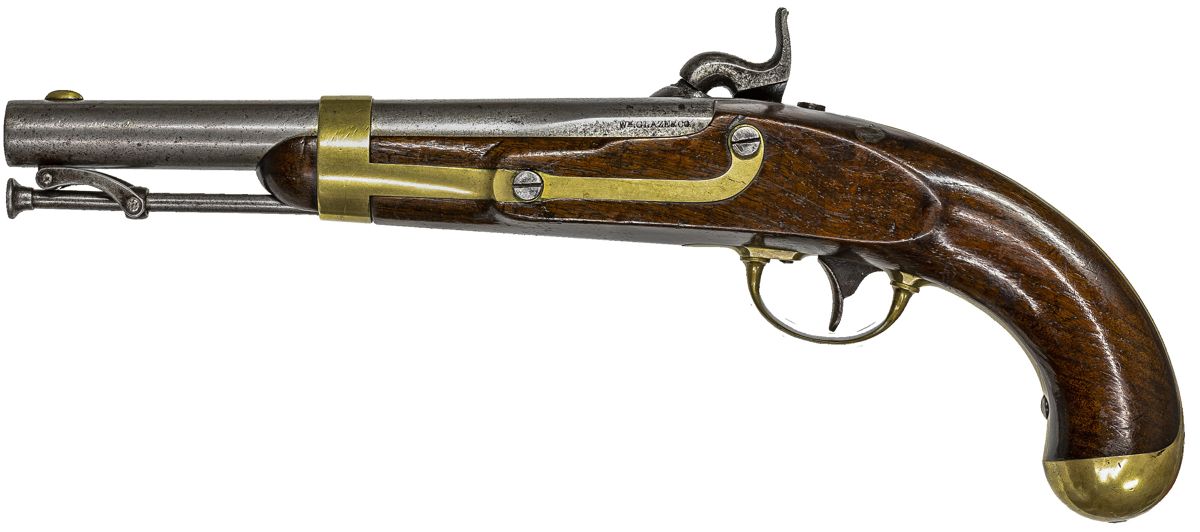
Unlike the U.S. contract M1842 pistols, delivered to the Federal government with bright barrels, Palmetto pistols were submitted with browned barrels. This may have been an intentional attempt to conceal flaws or issues with the many second-hand and condemned barrels used. The barrels were typically marked on the left flat with WM. GLAZE & CO. and with a small “P” proof, a small “V” and a “Palmetto Tree” on the breech where the usual Federal contract larger “V,” “P,” and “Eagle Head” marks are found. On surviving authentic examples, the Palmetto Tree marks vary slightly. This suggests that either more than one die was used during the production of the guns, or as the die wore the image it struck changed slightly. The rear face of the barrel and the breech plug were typically marked with alphanumeric mating codes, such as “F 4.” The barrel breech plug tangs were only dated “1853.”
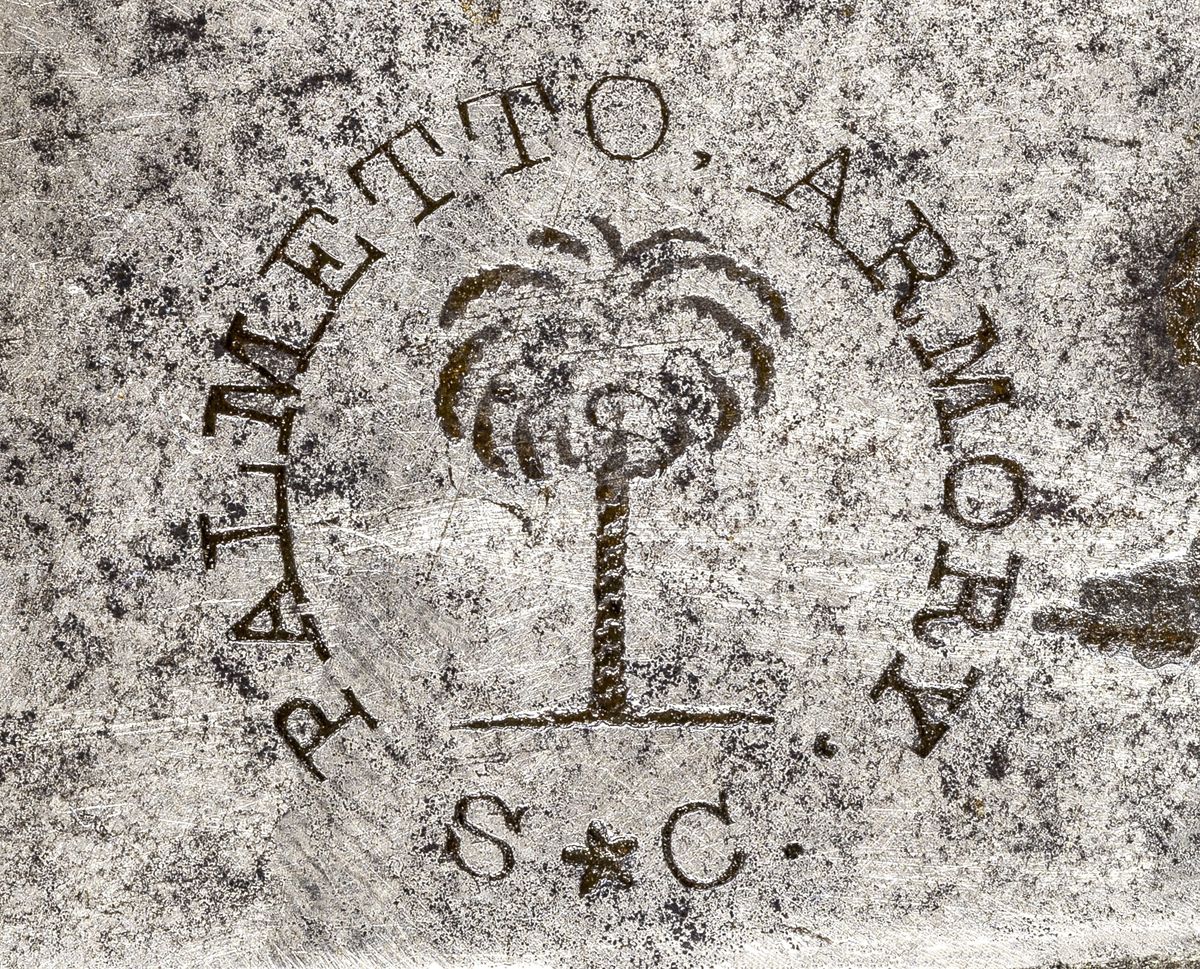
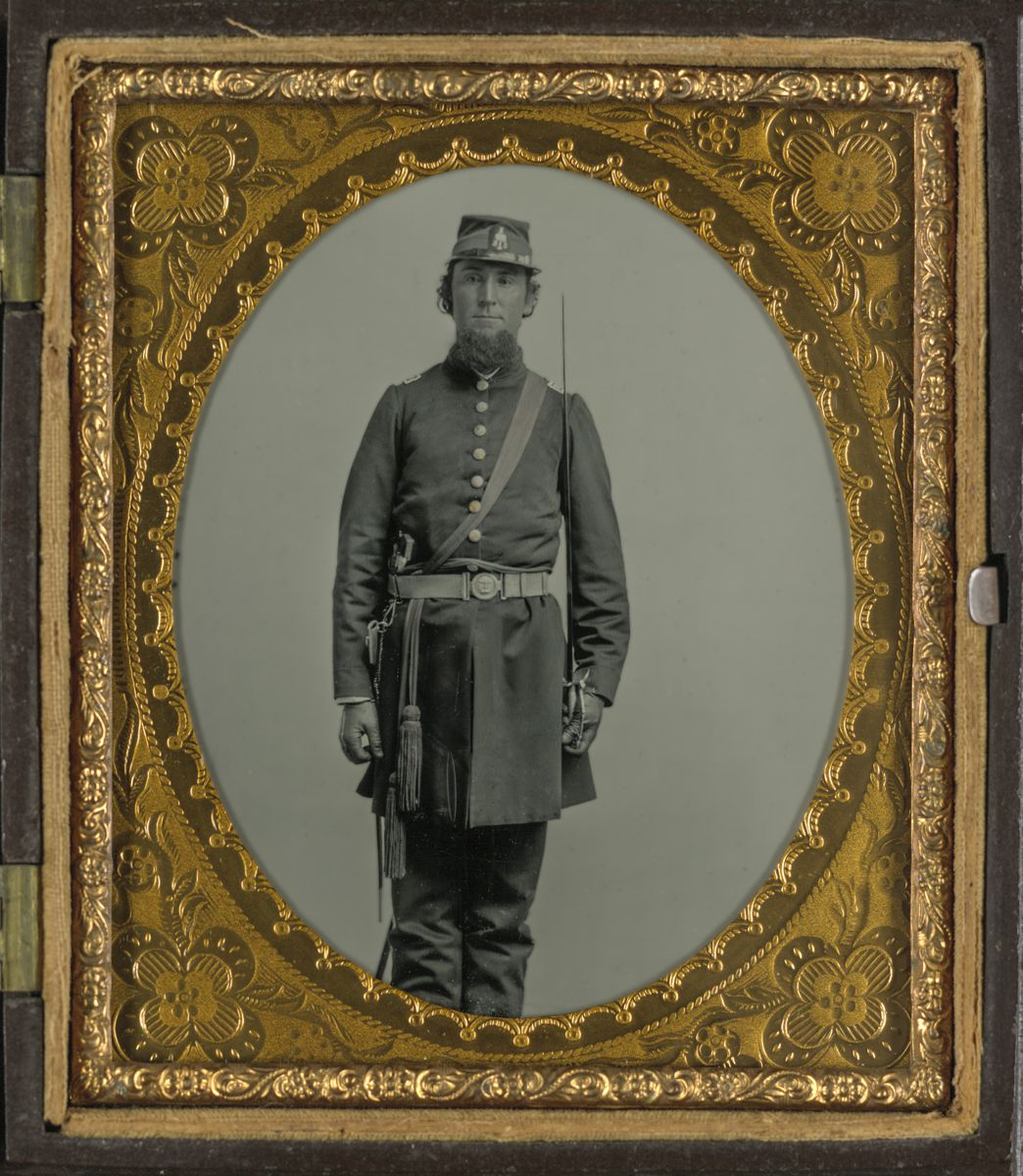
As noted, the locks were only dated “1852,” marked in two horizontal lines behind the hammer: COLUMBIA / S C. 1852. It is worth noting that there is generally no period after the letter “S” on authentic examples. Forward of the hammer, the locks were marked with the circular legend, PALMETTO, ARMORY, S * C. surrounding the South Carolina palmetto tree. The letters “AL” and “ME” in “PALMETTO” and “AR” in “ARMORY” are typically conjoined by the bottom leading and trailing edges of their serifs, respectively. The locks and hammers appear Detailed closeup of a correct Palmetto pistol lock date. to have been delivered color casehardened, rather than casehardened and polished bright, as they were on U.S. contract guns. As the guns used surplus and condemned components, sometimes earlier pattern parts from U.S. M1836 pistols are found on Palmetto Armory guns. Sometimes M1836 triggerguard screws and ramrod swivels were utilized in assembling the guns as well as some M1836 swivel screws. The images accompanying this article show two Palmetto Armory pistols. One retains some of the original browned finish on the barrel; the other is the more commonly encountered variant with the brown worn or cleaned away. Both guns have partially obliterated condemnation “C” marks on their barrels under the bolsters, which can only be seen when the barrel is removed from the stock. The browned gun also has a condemnation “C” on the ramrod. The Palmetto Tree marks on the breeches of both guns are slightly different with the bright gun having a more detailed “bushy” tree and the browned gun showing a less detailed tree with a slightly smaller frond ball. This minor difference could be explained by wear to the die, but it is not clear if that is reason or not. Due to the proliferation of fake Palmetto Armory arms on the collector market, it is essential that all marks be examined in detail so that the authenticity of the guns can be verified.
Detail of the William Glaze & Company barrel marking.
Close up of the condemnation “C” found on the ramrod of a Palmetto Armory pistol.
A comparison of the proof marks and “Palmetto Tree” found on two different, authentic Palmetto Armory pistols. The markings on the bright barrel are more detailed and the tree is somewhat “bushier.”
The extent of the Palmetto Armory’s foundry damage during the burning of Columbia is evident in this photograph taken by Richard Wearn in April 1865. Image courtesy South Caroliniana Library, University of South Carolina, Columbia.
About the Author
Tim Prince is a full-time dealer in fine and collectible military arms from the Colonial Period through WWII. He operates College Hill Arsenal, a web-based antique arms retail site. A long-time collector and researcher, he has been a contributing author to two major book projects about Civil War era arms including The English Connection and a book on southern retailer-marked and Confederate-use shotguns. He is the author of over 60 articles on weapons in Civil War News. Tim is also a featured Arms & Militaria appraiser on the PBS Series Antiques Roadshow and serves as a Senior Consulting Specialist to the Arms & Armor department of Cowan’s Auction.
Tim Prince