
Cook & Brother Carbine Athens, Ga
By Tim Prince · Originally published November-December 2022 · pp. 42–54
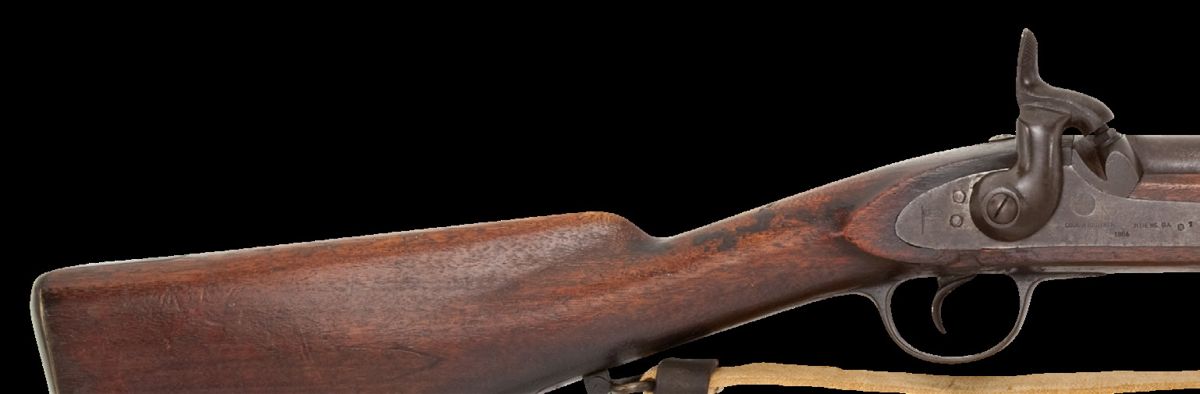
Cook & Brother Carbine carbines were assigned serial numbers distinct from those used for their rifles. That said, after their operation was transferred to Athens, all the long guns were serial numbered in the same range, somewhat haphazardly, with rifle, carbine, and musketoon numbers intermixed. Despite this, Confederate Chief of Ordnance Josiah Gorgas stated that the establishment of the works “reflects much credit upon their senior partner, and he has exhibited a much better appreciation of the requirements of an Armory than any other person who has attempted a like enterprise in the Confederacy.”
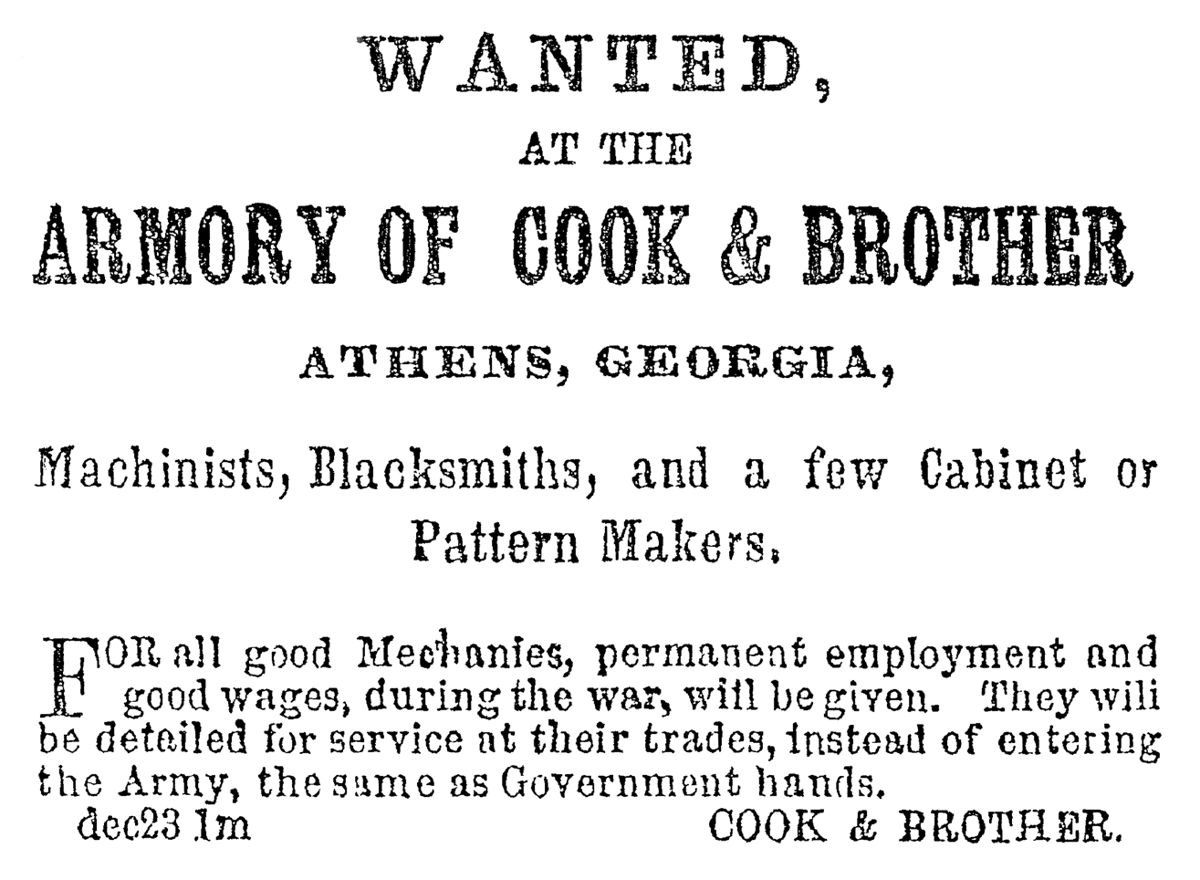
Advertisement in the wartime Athens newspaper for workers. that the company produced roughly 2,200 long arms in New Orleans, most were rifles with a far smaller number of carbines being made, before being forcibly evacuated in April 1862. The Cooks initially fled New Orleans by water, first to Vicksburg, Miss., and then proceeded by wagon overland to Selma, Ala. The brothers took as much of their equipment, completed goods, and raw materials as they could during the hasty evacuation. The Cooks later relocated to Athens, Ga., where they set up their new factory. They were able to put together a reasonable number of completed arms before the facility was fully operational, thanks to the abundance of finished parts that they had on hand. The Alabama contract was therefore finished by the middle of August 1862, and about the same time, the Confederate Ordnance Department signed a contract with Cook & Brother for the delivery of “50,000 stands of arms” (rifles and bayonets, complete) at a price of $25 each.
The new factory was reportedly quite impressive. Confederate Colonel James H. Burton, who had been Richmond Armory’s superintendent before being promoted to oversee all Confederate armories, added to the praise. The Cook & Brother Armory was described by Burton as “the most fitted up and controlled private armory I have yet visited in the C. States” during an examination of the property in 1864. Ferdinand Cook additionally formed a local militia group made up of some employees and other Athens locals to serve as a defense force because he was clearly concerned the company might have to relocate as a result of Yankee incursions into the South. Ferdinand served as the 23rd Georgia Local Defense Battalion’s major, and the unit’s official name was “Cook’s Athens Battalion.” The battalion saw combat at Hardeeville, S.C., and the defense of Griswoldville, Ga., in November 1864.
By the beginning of 1863, the new factory was operating, but instead of focusing solely on producing rifles and bayonets, it had now fully embraced the production of carbines and musketoons as well. The carbine they manufactured was based on the 21-inch barreled English Enfield Pattern 1856 cavalry carbine; their musketoon had a barrel length of 24-inches and was based on the English Enfield Pattern 1853 artillery carbine. It is generally accepted that the New Orleans-made Cook & Brother musketoons and
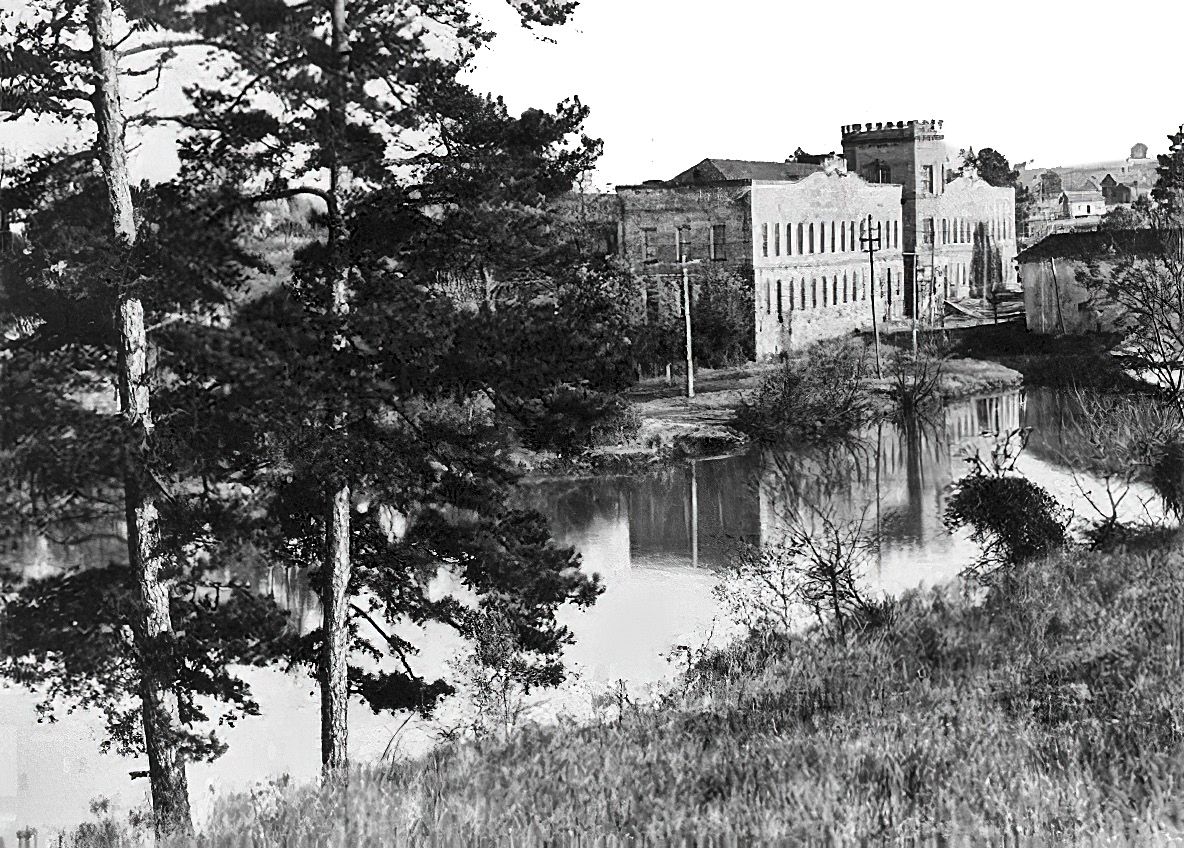
An 1895 photo of the Cook & Brother Armory building near downtown Athens, Ga. (Hargrett Rare Book and Manuscript Library)
ATHENS, GA
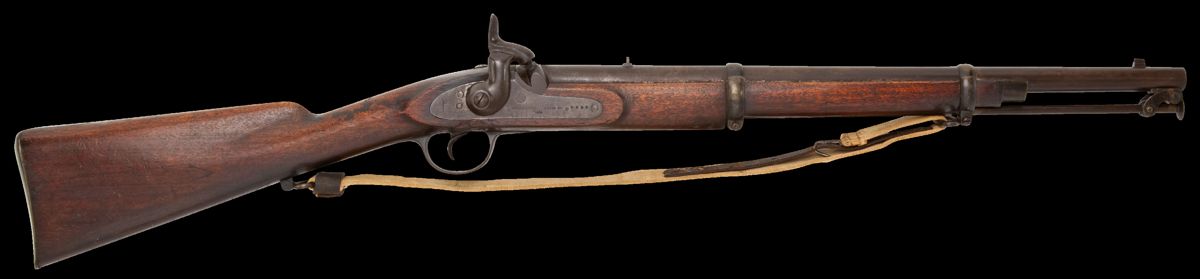
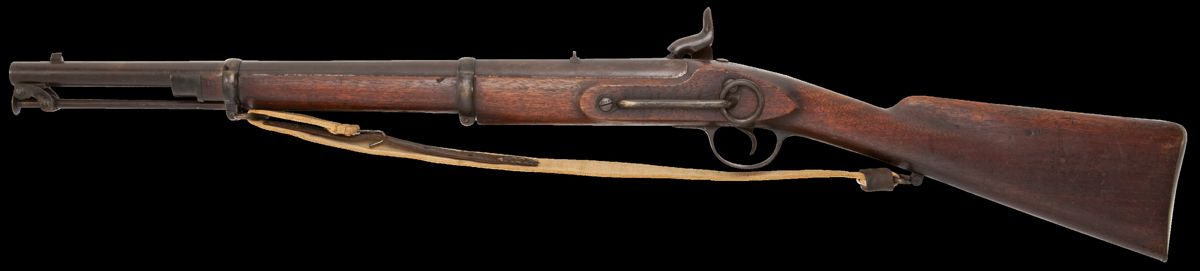
Notice that the brass hardware still retains its original factory blackened finish on this saddle ring carbine. The gun is .58 cal. and is rifled with three broad, shallow lands and grooves. Courtesy Penn Templeman Collection.
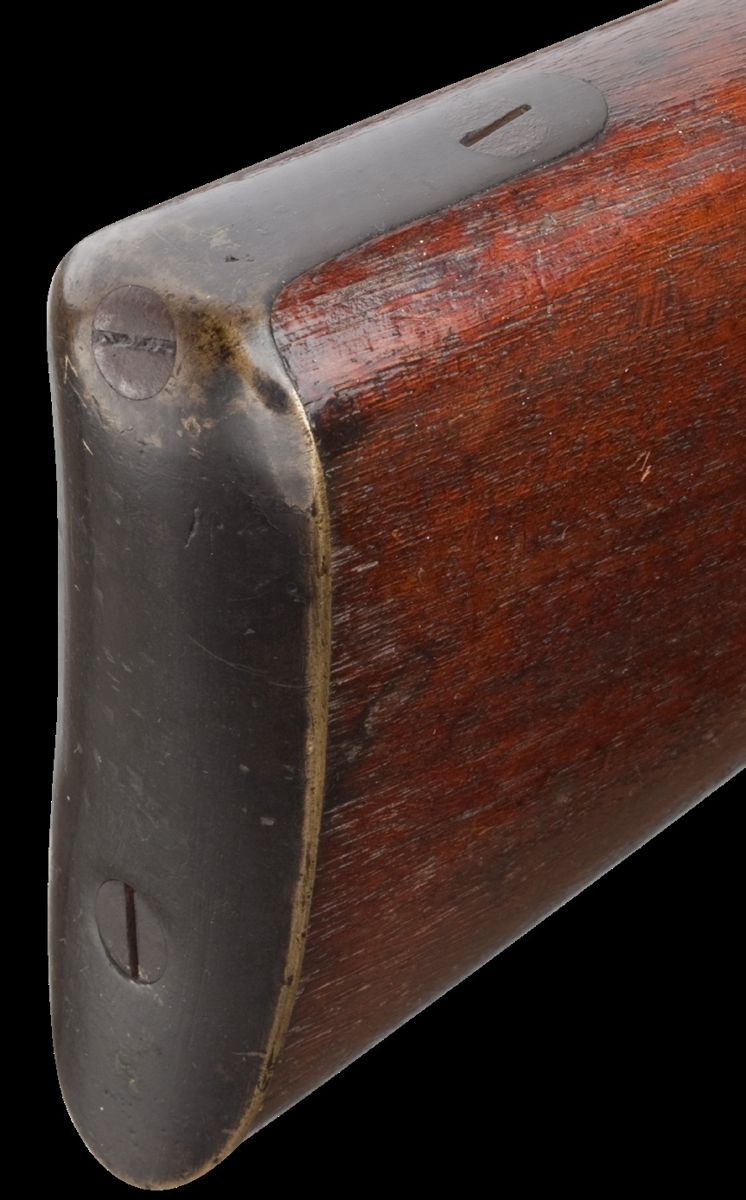
Factory blackened brass buttstock. Stock has its original oil finish. This is the finest example known. Photography by Jack W. Melton Jr.
Cook & Brother Carbine Left side of SN 7555. All parts are typically serial numbered and match with the exception of the tang screw, which is numbered 1448. All furniture of Cook & Brother longarms is brass, obtained for Athens made pieces by melting down household brasses and church bells.
Close up view of the right-side muzzle area of the cavalry carbine showing the clamping style front barrel band and brass stirrup-retained iron ramrod with flattened brass disk tip. The front sight is a small iron block blade set 1 ¼-inches behind the muzzle. The rear sight is fixed and notched.
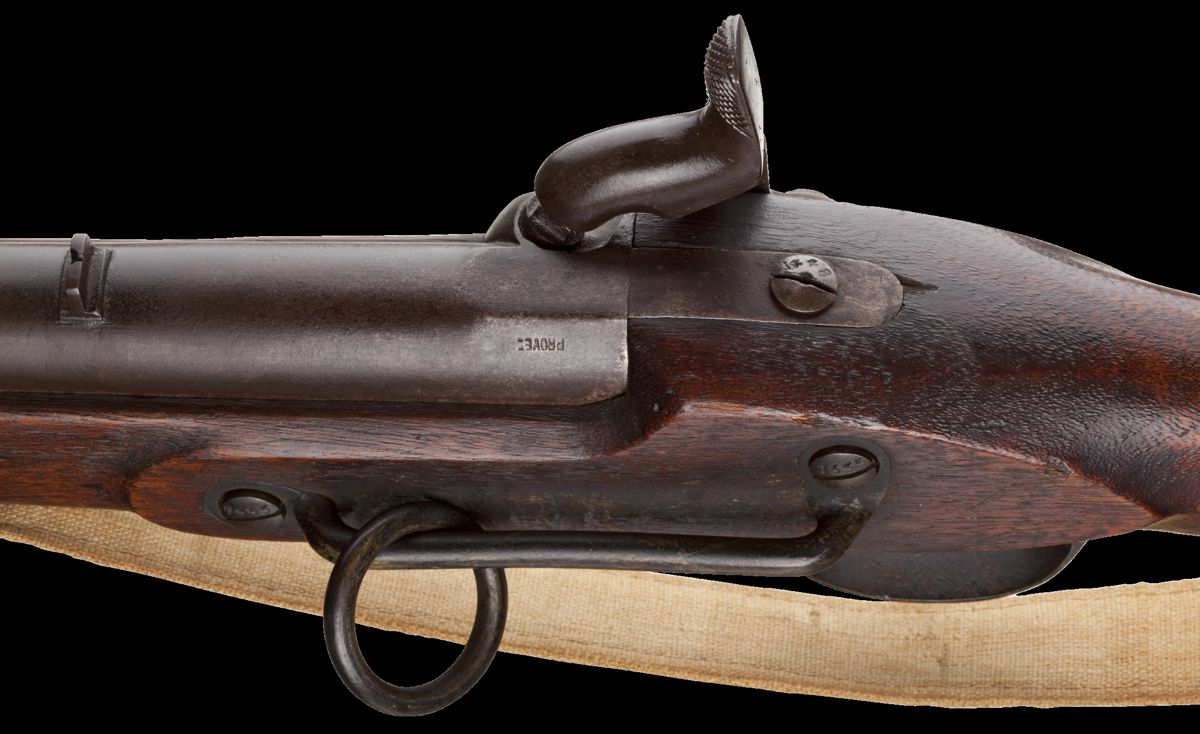
Athens, GA Close up of the top of the barrel area showing ‘PROVED’ marking on the breech.
Left side of carbine showing the brass saddle ring and heavy brass ring bar. Note the serial number 7555 stamped on the screw heads.
Cook & Brother Carbine
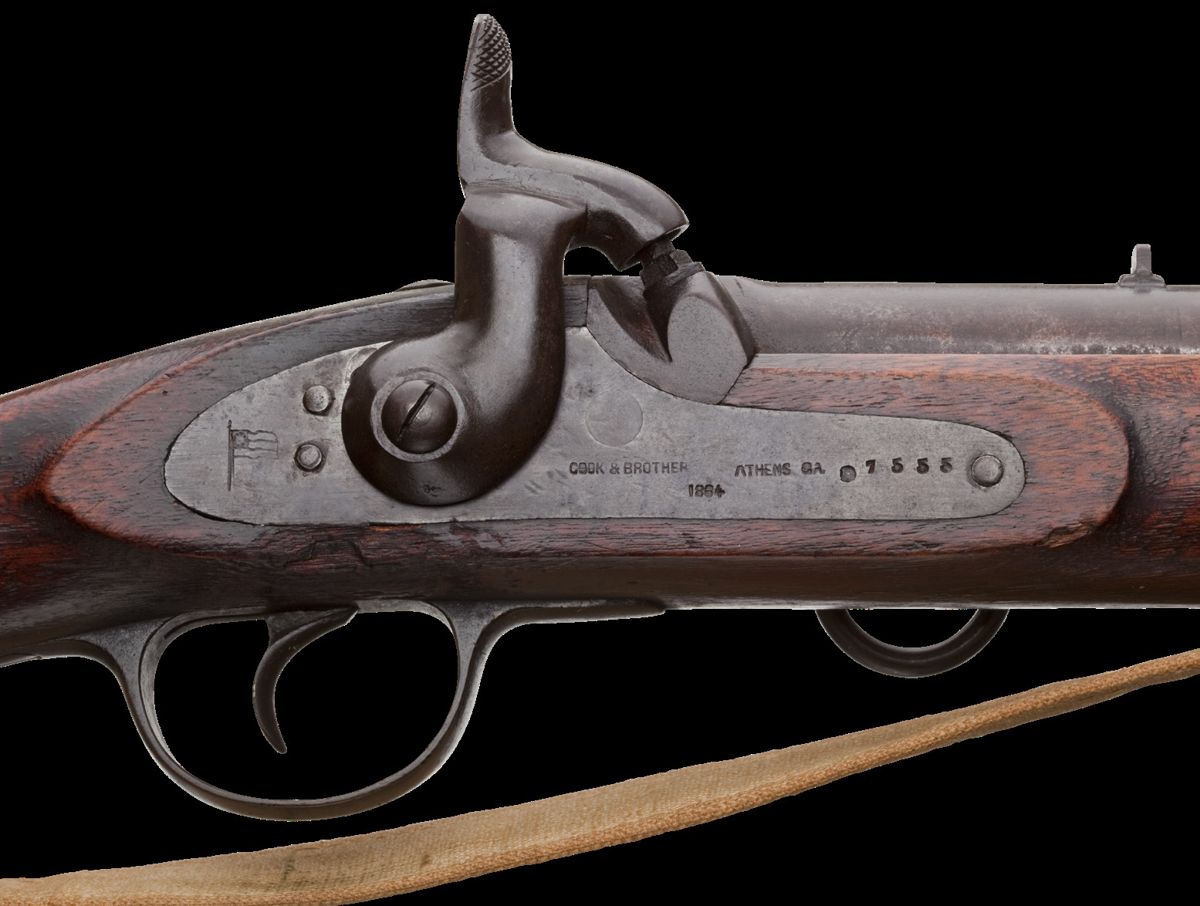
Close up of the lock area. Lockplate is casehardened in a mottled color.
Athens, GA
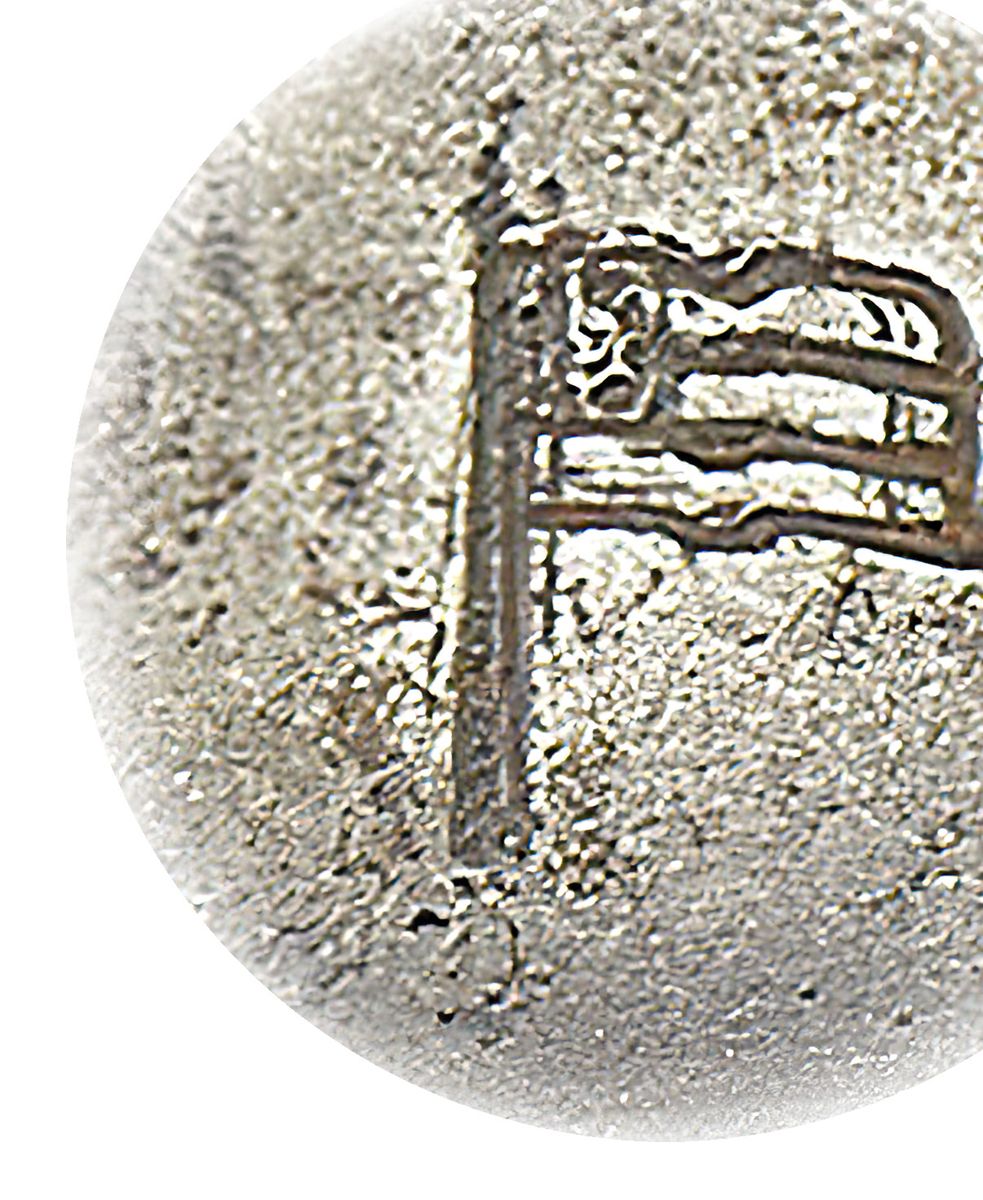
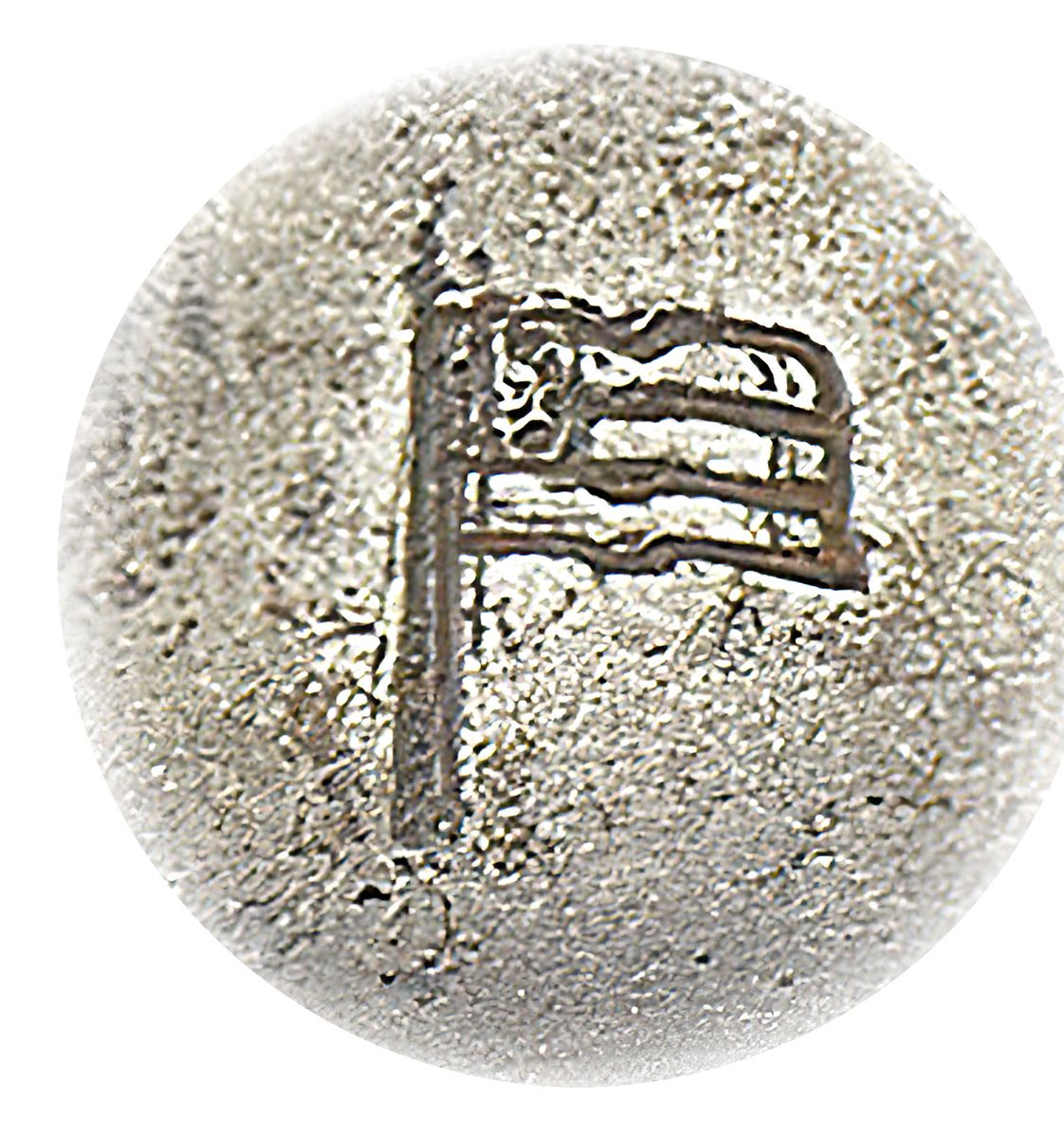
The First National flag lockplate emblem behind the hammer differs on an Athens weapon. On New Orleans made Cooks, the stars in the union form an unbroken circle. On Athens made lockplates, the stars in the union are separate and do not form a continuous circle.
Cook & Brother ARMORY
The Charleston Mercury (Charleston, South Carolina), Thursday, Jan. 8, 1863, page 2.
Marker text reads: Cook & Brother Confederate Armory To this building in 1862 was brought the machinery of the armory established in New Orleans at the outbreak of the War by Ferdinand W.C. and Francis L. Cook, recent English immigrants, the former a skilled engineer, for the manufacture of Enfield rifles, bayonets, and cavalry horseshoes. Said to be the largest and most efficient private armory in the Confederacy, it produced a rifle declared by an ordnance officer to be “superior to any that I have seen of Southern manufacture.” Under contract to supply 30,000 rifles to the Confederate Army the armory operated until its employees, organized as a reserve battalion under Major Ferdinand and Captain Francis Cook, were in 1864 called to active duty upon the approach of Sherman’s army. The battalion took part in the battles of Griswoldville, Grahamville, Honey Hill and Savannah where Maj. Cook was killed. After Griswoldville Gen. P.J. Phillips reported that Maj. Cook and his men “participated fully in the action, deported themselves gallantly and … . suffered much from wounds and death.” Leased by the Confederacy in 1865 the armory was operated until the close of the war. The property was bought by the Athens Manufacturing Co. in 1870.
ATHENS, GA
2013 photograph of the remaining armory building now occupied by the University of Georgia Business Outreach Services and Small Business Development Center.
The historical marker is on East Broad Street east of First Street, on the left when traveling east. Armory is now the Chicopee Building, part of the University of Georgia campus.
Cook & Brother Carbine On December 11, 1864, Major Ferdinand William Charles Cook Sr. was mortally wounded by a Federal sharpshooter, and later died in Military Hospital No. 1, Broughton Street, Savannah, Ga. As is generally known, the Confederate South was doomed both militarily and economically, with the surrender at Appomattox. The defunct Cook & Brother plant was taken over by U.S. Federal Marshalls in March 1867 and sold as ex-enemy property. Through a series of court battles, former Confederate Capt. Francis Lucius Cook was able to stop the confiscation, but after winning the right to keep his property, he was obliged to sell the manufactory to settle his obligations. The plant was converted into a cotton mill by the purchaser, Athens Manufacturing Company. As was previously mentioned, the British-made Enfield Pattern 1856 cavalry carbine served as the basis for the Cook & Brother cavalry carbine. The Cook carbines were identical in size, barrel length, and caliber to the typical characteristics of British-made firearms. Both had nominal overall lengths of around 37 inches and 21-inch barrels. Cook’s carbine had a nominal caliber of .58, while the British carbine was .577 caliber, or 25 bore. The Cook was rifled with three lands and grooves as were the Britishmade carbines. Unlike British barrels, which were either hammer forged iron or later produced of cast steel, Cook & Brother carbine barrels were produced from hot iron bars twisted around a steel mandrel. This twisting procedure created a distinctive grain pattern reminiscent of the “Damascus steel pattern” found on high-quality 19th century shotguns but lacked their eye-catching appearance and patterns. With their twist pattern design, some browned Cook barrels were presumably rather attractive, while those left in the bright were not as eye catching. The Cook carbine variation had a captive, swivel ramrod with a sling bar and ring located on the flat, opposite the lock, like the British carbines. Both guns had brass furniture, including the buttplate, triggerguard, and nosecap, but the
Cook barrel bands, and the side nail cups, or lock screw escutcheons, as well as the sling ring and bar, were also made of brass, while those parts were made of iron on their English counterparts. Additionally, the Cook cavalry carbine included sling swivels in the toe of the stock and on the upper barrel band. The majority of Cook carbines used a fixed rear sight rather than an adjustable leaf sight, another significant difference between the English and southern-made guns. From the start of manufacture in New Orleans to the end of production in Athens, the carbines made by Cook underwent some developmental alterations. Only two New Orleans-made Cook cavalry carbines are known to survive, according to Murphy and Madaus. Similar to the English-made firearms, these weapons appear to have been stocked almost to the muzzle. The weapons made in Athens resemble shrunken-down artillery carbines, with shorter forends that terminate about 5-inches from the muzzle. It is possible that this choice was made to permit the use of shorter pieces of wood for the carbine stocks, while saving longer pieces for rifles and musketoons. For most of the war, the Confederacy would struggle with a lack of a sufficient supply of suitably seasoned wood for gunstocks. The later Athens-produced arms feature distinct lock and barrel marks different from those on New Orleans-manufactured guns. There is even a different version of the Confederate flag stamped on the tail of the lock, depending on whether the gun was made in New Orleans or Athens. The prototypical Athens-made carbine resembles the New Orleans-made weapons quite a bit, but it has a shorter stock as previously mentioned and a new lock marking that reads: COOK & BROTHER ATHENS GA (Serial Number) over the year 1863 or 1864. On the firearms built in Athens, the Confederate First National Flag is stamped somewhat differently at the back of the lock plate. The carbine’s serial number and the three-line markings COOK & BROTHER / ATHENS GA / (Date) were generally stamped on the barrels as well.
Athens, Ga.
Rear sight on Cook & Brother, Athens, Ga., SN 7555.
New Orleans.
The majority of the carbine parts had serial numbers, including the nose caps, the area underneath the triggerguard, the backs of the barrel bands, and even the heads of the lock and tang screws. Guns built in New Orleans had a two-piece triggerguard different from the Enfield pattern guns that they had emulated and was more akin to U.S.-made weapons. The one-piece triggerguard on weapons built in Athens was more closely modeled after the ones made in England.
Athens, GA Matching alphanumeric mating marks were stamped on the breech plugs and barrel bottoms. Although these often had no connection to marks located under the barrel, early Athens carbines also featured alphanumeric mating markings inside the locks. Some Cook carbines have Ferdinand Cook’s “FWC” cartouche, although they are extremely rare, and the mark is rarely visible either due to wear or because it wasn’t stamped in the first place. Additional alterations were made as Cook carbines continued to be produced in Athens, almost certainly for practical improvements, but also in an attempt to streamline production and to save time and money. For instance, it may have been a practical decision to remove the sling bar and ring from the brass lock screw escutcheons as the relatively weak brass bar was not expected to last very long in the field. Doing so also preserved brass for other uses. Swivels for the captive ramrod were also removed, likely done for both practical reasons and to save time and resources. General J.E.B. Stuart of the Confederate cavalry had complained about the inconvenience of the swivel ramrod on the Pattern 1856 Enfield cavalry carbine as early as fall 1862, stating that he and his troops preferred the conventional ramrod on the artillery carbine. Many Confederate marked Pattern 1856 carbines still in existence are found without their iron rod swivels, which were either purposefully removed in the field or broken while being used. The brass swivels on the Cook carbine were most likely too flimsy to withstand heavy usage, thus disposing of them in the design was both practical and a way to conserve costly brass. On the final Cook carbines, it appears that the standard sling swivels were also removed, saving labor, materials, and possibly potentially money. The barrel markings, the serial numbers from various parts, and the mating marks inside the locks are often absent from the Athens manufactured Cook carbines, which also have fewer markings than the earlier ones. In essence, the Cook carbines evolved into simpler, more streamlined copies of their original New Orleans versions as the war went on and the situation for the Confederacy grew more bleak, much like late war arms produced by any nation on the verge of defeat.
RECOMMENDED READINGS Confederate Rifles & Muskets, Infantry Small Arms Manufactured in the Southern Confederacy, 1861–1865, by Dr. John M. Murphy and Howard M. Madaus, 1996. Confederate Rifles & Muskets and Confederate Carbines & Musketoons, by Dr. John M. Murphy and Howard M. Madaus, 2002.
About the Author Tim Prince is a full-time dealer in fine and collectible military arms from the Colonial Period through WWII. He operates College Hill Arsenal, a web-based antique arms retail site. A longtime collector and researcher, he has been a contributing author to two major book projects about Civil War era arms including The English Connection and a book on southern retailer-marked and Confederate-use shotguns. He is the author of over 60 articles on weapons in Civil War News. Tim is also a featured Arms & Militaria appraiser on the PBS Series Antiques Roadshow and serves as a Senior Consulting Specialist to the Arms & Armor department of Cowan’s, a Hindman Company. Tim Prince
Cook & Brother saber bayonet
Nashville Union and American (Nashville, Tennessee), Saturday, Sept. 21, 1861, page 3.
sunflower guards
Memphis Daily Appeal (Memphis, Tennessee), Thursday, Sept. 26, 1861, page 2.
The Louisville Daily Courier (Louisville, Kentucky), Tuesday, Sept. 17, 1861, page 4.
Brig. Gen. Benjamin Grubb Humphreys. Confederate general and 26th Governor of Mississippi. He was elected captain of the Sunflower Guards when the unit was raised in 1861. His signature at the bottom of the photo reads “Benj G. Humphreys Brig Genl C.S.A.” (Courtesy Heritage Auctions, HA.com)