
First Edition Von Steuben Manual
By Lawrence E. Babits · Originally published November-December 2022 · pp. 56–76
First Edition Von Steuben Manual Belonging to a Third North Carolina Regiment Officer
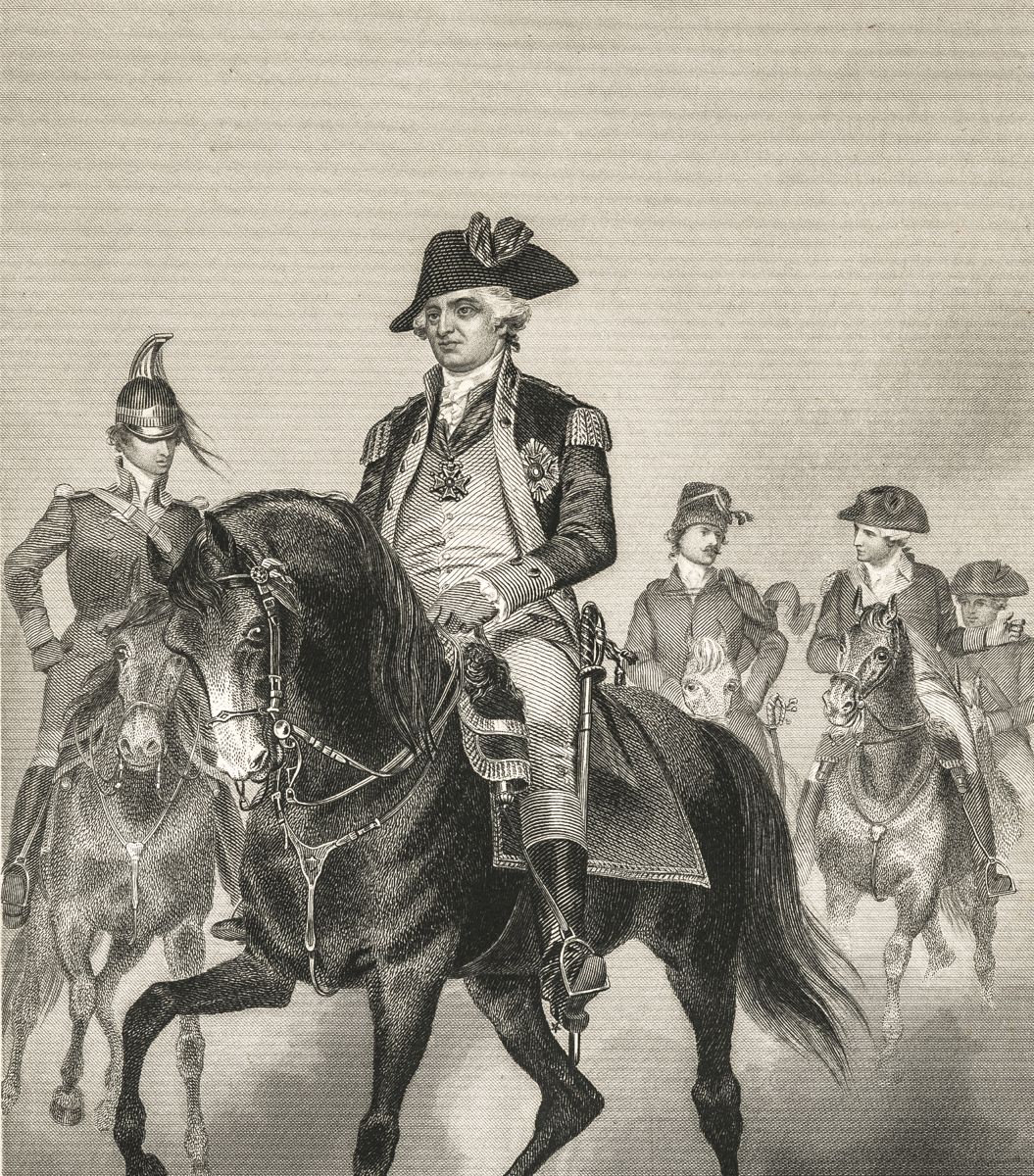
Left: Major General Friedrich Wilhelm Augustus, Baron von Steuben, by Ralph Earl (1751–1801). Gift of Mrs. Paul Moore in memory of her nephew Howard Melville Hanna Jr., B.S. 1931. Courtesy of Yale University, New Haven, Conn.
IN T RO DU C T IO N During the October 2019 Company of Military Historians annual meeting in Princeton, the author learned an original edition of the 1779 von Steuben Regulations had the signature of a Continental officer opposite the title page. The officer, Captain Edward Yarborough, served throughout the Revolutionary War and played a crucial role in raising, supplying, and leading North Carolina Continentals in the 178081 Southern Campaign. In 2022, portions of the manual were examined and photographed with the kind permission of the owner who has chosen to remain anonymous.
VO N S T E U B EN Major General Frederick Wilhelm Ludolf Gerhard Augustin, Baron von Steuben was born in Magdeburg, Prussia, in 1730. His father was a distinguished military engineer in the service of Frederick the Great. At sixteen, he was in the 13th Infantry Regiment (von Lestwitz), a musketeer unit Frederick noted had a good battle record. He was wounded at Prague in 1757, and again at Kunersdorf in 1759. He not only led line infantry but also served as an officer in Free Battalion Number 2 von Mayr, a light infantry partisan corps, the type of independent command where initiative, innovation, and flexibility were important. He had also seen what sorts of discipline worked and those that did not, a key component of his later understanding of American soldiers. In 1761 he was assigned to Frederik’s general headquarters and gained experience reconstituting infantry regiments. By his resignation in 1763, he had both practical field and garrison experience as well as administrative staff work; he had seen the best and worst of Prussian soldiering for over 15 years. As John Laurens, one of his aides-de-camp and translators wrote his father just as the Valley Forge training was beginning, von Steuben was “a man profound in the science of war.” Von Steuben came to the new nation as the result of Benjamin Franklin’s recruiting. His first American service came at Valley Forge when Washington appointed him Inspector General and he set up a model 120-man company that both learned and corrected the new drill system. The initial company’s men were then sent to brigades where they taught more officers and men, until the entire army had been trained and knew the movements. Officers had to run their unit’s drills and attend to their responsibilities as leaders so they knew the manual as well as their men. The ongoing development of the manual came as more advanced topics were introduced and changes to correct things that did not work were implemented. “Von Steuben is the most familiar of the foreign volunteers to historians, but he is hardly the most representative. His training and qualifications placed him head and shoulders above the rest, thoroughly teaching him the business of war” (Peterkin 1989:vii).
THE M ANUAL The Regulations for the Order and Discipline of the Troops of the United States was the result of von Steuben creating a uniform system of infantry drill. The work progressed through several phases including design, training a model detachment, instruction of sub- and brigade inspectors, distribution of hand written copies, and then the printed copies. While most readers today tend to focus on the manual exercise for priming, loading, and firing muskets, the key to understanding what von Steuben accomplished can be seen in his letter to Maryland General William Smallwood, “Improve all the leisure time your Brigade may have … in manoevvring, and teaching the Men in the use of their Legs, which is of infinitely more Importance than learning them the Manual Exercise” (cited in Peterkin 1989:5). This brief note underlies the premise that the army had to get into position to fire their weapons. The men already knew the “manual exercise” part of the drill dealing with firing muskets, but they, and more importantly, their officers, were sadly lacking in knowing how to efficiently move units over a landscape to engage the enemy because there was no uniform system for doing so. Von Steuben did not speak English so his instructions were given in French, translated by his military secretary, Major Pierre Etienne Duponceau, then edited by John Laurens and Alexander Hamilton. The written versions were then practiced with the model company, refined, and then copied for each brigade. As “Baron Steubens Instructions,” the 75 manuscript pages were copied into orderly books. The North Carolina Brigade’s inspector was the Second North Carolina Regiment’s Captain John Inglas. By the end of March 1778, platoons and companies had been drilled sufficiently to allow battalion level training and, by May brigades were drilling as complete units. The May 3, 1778, General Orders stated that “On Monday next the several Brigades will begin their Exercise at six o’Clock and cointinue [sic] ‘till eight o’Clock in the morning and from five to six o’Clock in the afternoon” (cited in Peterkin 1989:11). The hard work resulted in a dramatic improvement first demonstrated at Monmouth, New Jersey. During November 1778, von Steuben and his staff prepared the final manuscript for the new system. With many editing changes, printing was delayed until Congress approved the final version of von Steuben’s Regulations, on March 29, 1779. By then the army had been using it almost a year. When finally printed, the manual was often called the “Blue Book” from its blue covers. Von Steuben commanded the Northern Army’s right wing for a short time, then spent the rest of 1778 training troops and working with Congress to get his manual published. As a major general, von Steuben was entitled to a field command. When Nathanael Greene was assigned to the Southern Theater, he went south with him but stayed in Virginia to organize and train men, and most importantly, raise troops and supplies that he sent to Greene. During 1781, he and Lafayette stalled a British invasion, flexibly falling back and advancing in the face of British raids into the interior. Von Steuben was instrumental in forwarding supplies to the Southern Army and was in constant contact with its commander, Nathanael Greene. He led one of the three American divisions at Yorktown. Following the war, he was declared an American citizen by Pennsylvania and New York, then settled in New York. He never married and died in 1795, leaving his estate to his former aides, William North and Benjamin Walker. (Sources: Peterkin 1989; Palmer 1937; Selesky 2006:1110-1113).
T H E VO N ST EUBEN MA N UA L CO M PAR E D WIT H A N O R T H CA RO LIN A A BST R ACT At some point in time, Lieutenant Colonel Henry Dixon, a veteran North Carolina officer apparently copied key points of von Steuben’s manual for his personal use in drilling soldiers. The document is incomplete, missing any sort of introduction, and ends abruptly. It differs considerably from the von Steuben text as can be seen by comparing the text below with page images. He noted that “This exercise should consist only of such positions as a soldier may have occasion for on the days of action. The execution thereof should be simple and concise as possible”
(Dixon n.d.). This sentence certainly suggests that combat training was paramount and the most likely time this abstract was drafted came when North Carolina called up militiamen for a year’s service as Continentals during the late spring 1781. If this is the case, then this represents the specific emphasis Dixon and other Continental officers put into training their men prior to the Battle of Eutaw Springs. “The next interesting positions required in battle are those expressed by the words of command “Poize – Fire, charge bayonet, load, take sight, and fire.” The author went on to explain why differences were suggested and that “when a column moves forward … the files are liable to be too crowded …” He explained that “The manner of charging with bayonets is to be altered by using only two movements, “either from the poize, or from the carry … under the right arm … and keep it in a horizontal line for the front rank.” The complete abstracted manual no longer survives but the emphasis on musket loading and firing, and bayonet use are particular important for what the Continentals did at Eutaw Springs. This shorthand version was almost certainly for officers to know key commands they should concentrate on as they probably knew the intermediate and supplementary commands already. Other similar shorthand accounts are known (Chuck Fithian, personal communication).
EDWARD YARB OROU GH Yarborough enlisted from Halifax District as an Ensign in Third North Carolina May 8, 1776. He was promoted to Lieutenant April 16, 1777, CaptainLieutenant in William L. Davidson’s Company Jan. 9, 1777, and Captain May 10, 1779, six weeks after von Steuben’s manual was published. His steady rise through the ranks occurred as he was served in the Third Regiment during the Northern Campaigns. He was apparently put on recruiting duty when the regiment marched to Charleston and thus escaped being surrendered on May 12, 1780, when the city fell to the British. At the August 16, 1780, Battle of Camden, Yarborough commanded a company of North Carolina Continentals incorporated into Henry Dixon’s militia regiment posted in the front line adjacent to the Continental Artillery. They are described as having “pushed bayonets to the last.” During fall 1780 and early spring 1781 while based in Salisbury, Captain Yarborough commanded the only North Carolina Continentals as well as serving as a recruiting officer and managing some of the logistical effort at Salisbury. Yarborough and his men evacuated
Salisbury in February 1781, marched with Southern Army during the “Race to the Dan,” and at the March 15, 1781, Battle of Guilford Courthouse, may have defended cannon anchoring the American third line. He is shown as a company commander in the Tenth North Carolina during the 1781 South Carolina Campaign. This unit only existed on paper to enumerate men and units without context. Pension applications clearly place him in the field during the summer of 1781 and at the Sept. 8, 1781, Battle of Eutaw Springs. At that battle he probably served in the Third Regiment because he was assigned to that unit on paper. That said, pension accounts put him in the Second North Carolina because he was training men in that battalion until the final recruits came in and the brigade expanded to three undersized regiments for about three weeks. He retired from the service at the end of the war, effective Jan. 1, 1783. His Continental Army accounts were settled during 1783. He received a land warrant Oct. 23, 1783, for 84 months Continental service. Yarborough settled in Rowan County, N.C., and was an original member of the Society of the Cincinnati who hosted George Washington on his 1791 Southern Tour. Yarborough married Sarah Marshall during April 1788 in Rowan County; the union produced several daughters and two sons; his will mentions sons Wiley and Edward, and daughters “Volly?” and Sarah Ann, and implies several more. His pension application (W4776) says “Edward Yarborough who about the end of the Revolution was Commandant of the Laboratory in the suburbs of this Village [Salisbury] and had under his command Soldiers, he belonged to the North Carolina Line of the regular Army and served to the end of the War” and then goes on to state that his wife Sarah died in 1838, and he had the following heirs: “Edward Yarborough, his son now living in Fayetteville, Nancy Beaty (elsewhere it says she was Ann Beatty – with two t’s, so presumably her name was Nancy Ann Beatty), wife of William Beaty, living in Yorkville South Carolina, Sarah Long who is dead leaving children, and Mary F. Long the wife of Richard W. Long now residing in Salisbury.” Wiley, or Willie, Yarborough apparently died intestate about 1814–1816 intestate as a sale of his property occurred in 1816 and a part of that sale included a “lott of books” to “J. Fulton,” most likely a reference to John Fulton, a Salisbury merchant. There may have been other daughters who died without children. One daughter never married; the other’s married name is unknown. Edward, the son, operated a tavern and hotel in Raleigh and Fayetteville. (Sources: Babits and Howard 2004; Showman and Conrad 1994, 1995, 1997; Heitman 1982:609; National Archives Revolutionary War Pension-Bounty-Land Warrant Files, RG 15, Microcopies M804 and 805; North Carolina State Records XV:74, 433-34; Powell 1994:VI:18-19; Rumple 1881:178-79).
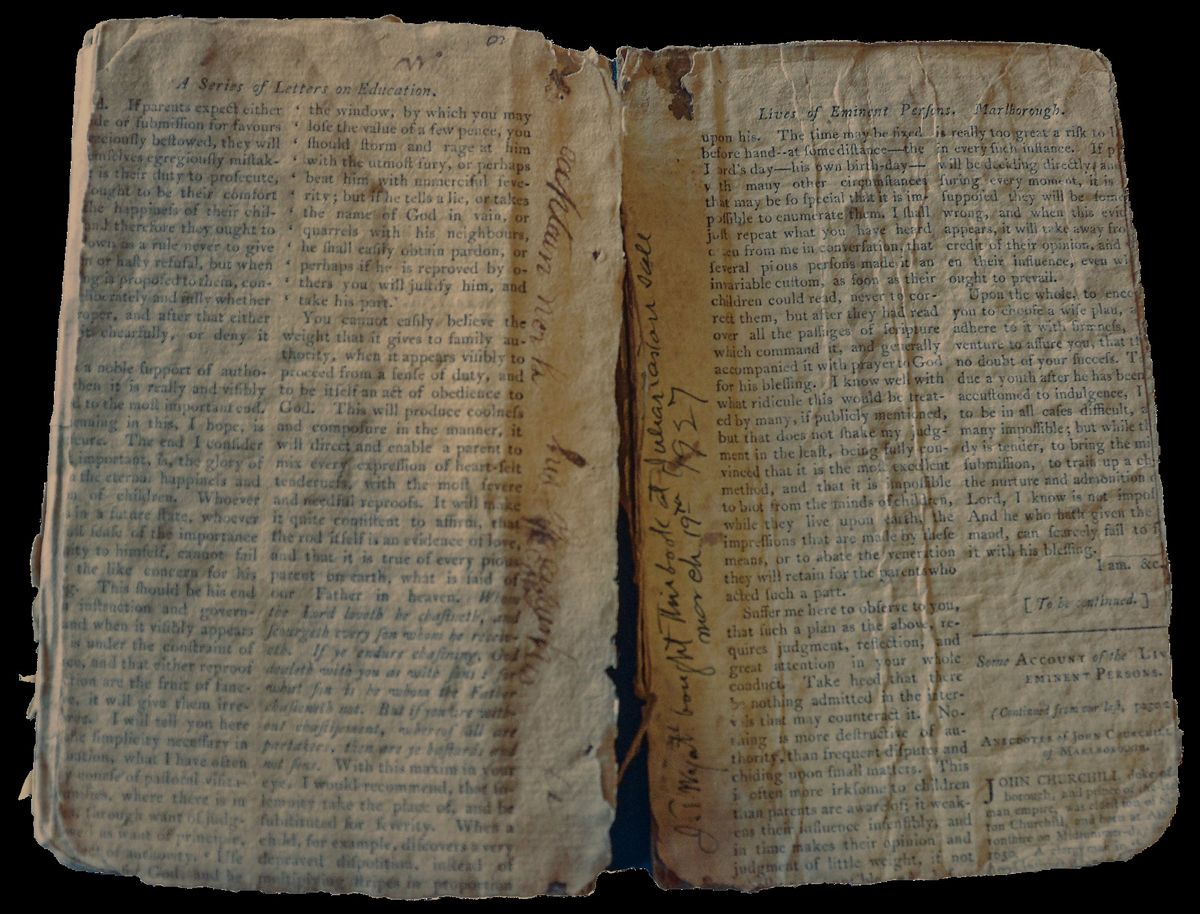
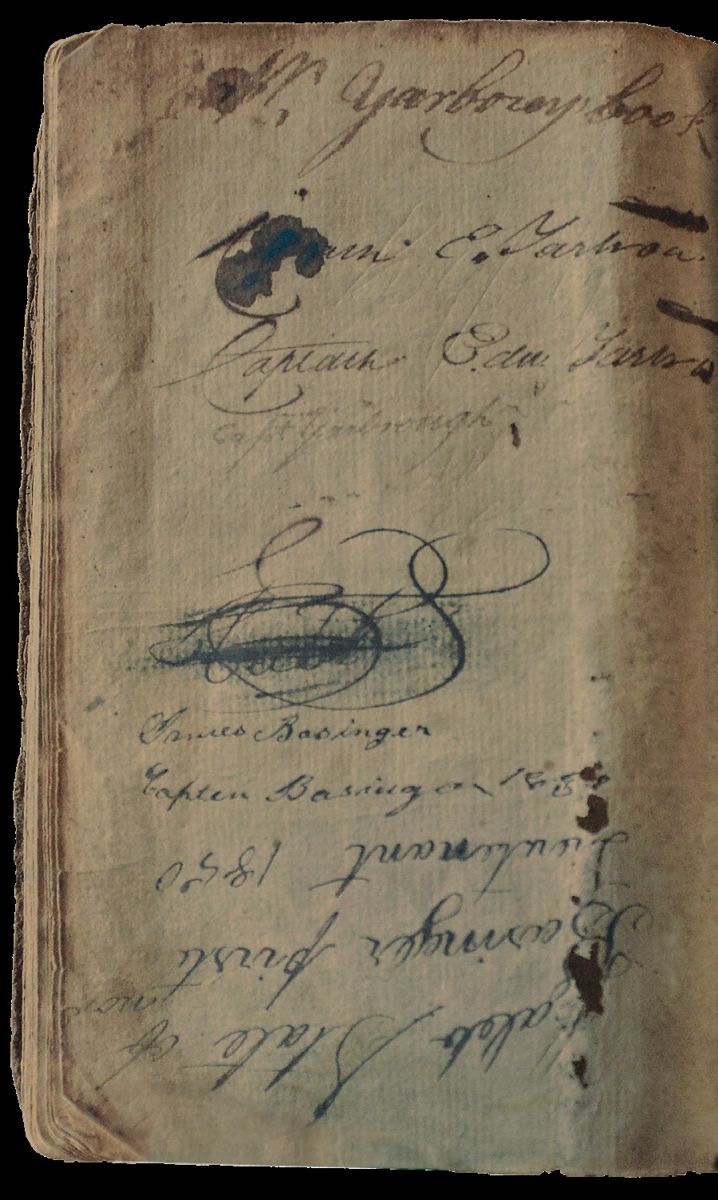
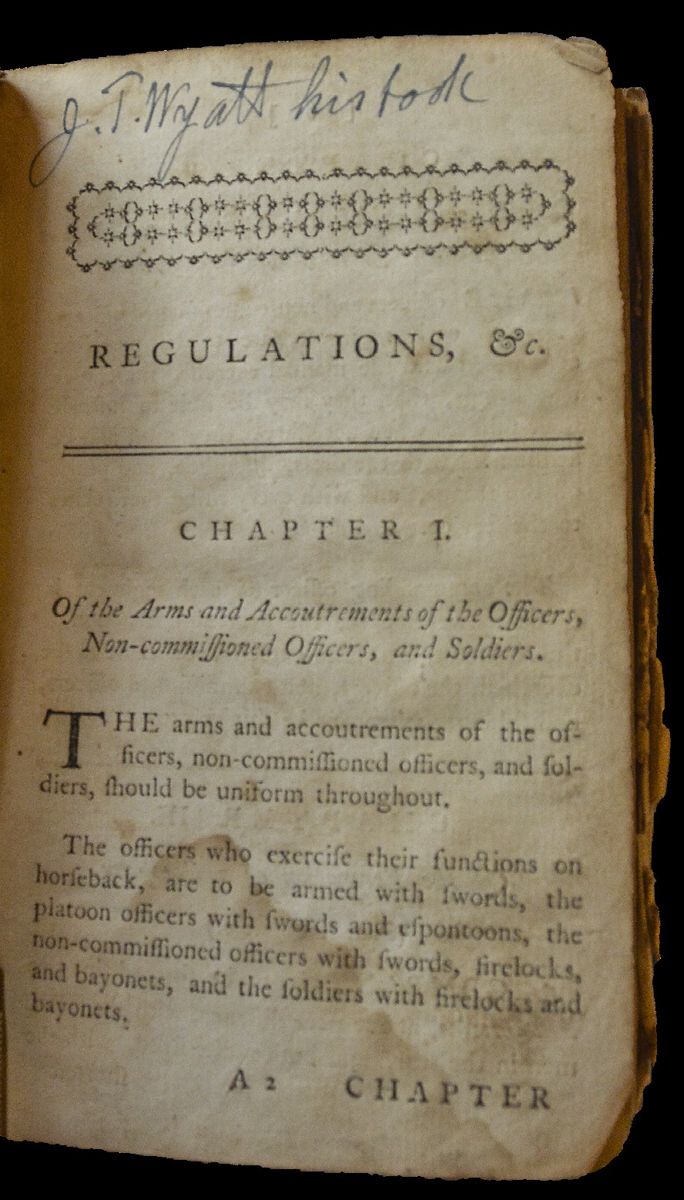
YARB OROU GH’ S C OP Y OF VON STEU B EN The original edition was referred to as “Baron Steubens, blue Book” in correspondence by Generals Anthony Wayne and Henry Knox (Peterkin 1989:viii”), but this first edition has plain brown covers. There are blank pages facing the diagrams and some signatures were placed on the empty spaces. The inside front and rear covers and facing pages had recycled newsprint on them. The front facing page has part of “Extracts from Archbishop’s Land’s Diary; the inside front is covered by “a Remedy for Lameness.” The rear inside has “A Series of Letters on Education” on the facing page; ‘Lives of Eminent Persons – Marlborough” is on inside back cover. The book was acquired by purchase in Texas. How it came to be in Texas is unknown but scattered throughout the text are names and dates that provide something of a “Chain of Title” for this copy of the von Steuben manual. “Edward Yarborough” occurs at least five times. At least two times “His Book” follows the name. There are three dates Feb. 21, 1782, Sept. 4, 1792, Sept. 18, 1794, associated with his name but their significance is unknown. The day and month do not coincide with any obvious Yarborough anniversary and the years are all after the Revolutionary War ended. The name William Simmons occurs on one page, written once as William Simmons and once as W. Simmons. There was a William Simmons who married in Rowan County in 1787 and is listed on the 1790 census. There was another William Simmons whose will was probated in Rowan in 1770, likely the father of the William who married in 1787. A Richard Simmons was paid in Salisbury for service in the North Carolina Light Dragoons during the Revolutionary War. The precise William Simmons is unknown but the county affiliation suggests some one known to Yarborough. Caleb Basinger’s name occurs three times, at least once on the same page as Edward Yarborough’s. In one place his name is accompanied with “First Lieutenant 1850.” The most likely person is Caleb A. Basinger who was born Oct. 5, 1828, in Rowan County, and died Jan. 23, 1906, in Rowan County. He was the son of Joseph Basinger (1787–1845) and Martha/Maria Elisabeth [last name unknown] (1785?–1885), of Rowan County. Caleb A. Basinger married Catherine Ann Eagle on March 27, 1860, in Rowan County. He was living in and around Salisbury for every United States census from 1850–1900. The 1850 census shows him living with his widowed mother, and several siblings. Caleb served in Company B, 46th North Carolina Infantry during the Civil War; records describe him as a 33 years old farmer who stood 5’9” tall. He was captured at Sharpsburg, Maryland, Sept. 17, 1862, exchanged, and then wounded at Bristoe Station, Virginia, Oct. 14, 1863. Eventually promoted to sergeant, he served in the Army of Northern Virginia until sent from Petersburg to North Carolina to round up deserters. Sgt. Caleb Basinger surrendered on April 26, 1865, with Gen. Joseph E. Johnston’s Army of Tennessee. He signed his parole document during May 1865 in Salisbury and took the oath of allegiance in June 1865. He died Jan. 23, 1906, and is thought to be buried in an unmarked grave at Organ Lutheran Church. (Sources: U.S. Census, 1850, 1860, 1870, 1880, 1900, Rowan Co., NC; North Carolina Marriage Records, 1741–2011 (Rowan Co., NC); North Carolina Death Certificates, 1909–1976 (Rowan Co., NC); Confederate service records, Fold3.com; Findagrave.com). The name James Basinger, Caleb’s brother, also occurs and is associated with the phrase “Captain 1856.” At that time, the rank would be in a militia company. James Basinger was born April 18, 1831, in Rowan Co.; he died Nov. 21, 1862, in Rowan County after he came home wounded from the Battle of Sharpsburg. The 1850 census shows him living with his widowed mother and siblings Joseph and Caleb. Marriage records show that James married Louisa Eller on June 27, 1857, in Rowan County. After Louisa died, James married Elizabeth Owen on Jan. 12, 1859. James was mustered into Confederate service as a Third Sergeant in Company D, 34th North Carolina Nov. 25, 1861. At that time, he was described as a 30 years old, 5’9” tall, merchant. Promoted to lieutenant in July 1862, he was mortally wounded at Sharpsburg. When his wife applied for his back pay, she said he died of his wounds at home Nov. 21, 1862. (Sources: U.S. Census, 1850, 1860, 1870, 1880, 1900, Rowan Co., NC; North Carolina Marriage Records, 1741–2011 (Rowan Co., NC); Confederate service records, Fold3. com). Neither Basinger can be shown as kin to Edward Yarborough but they both lived in the same town after Yarborough died. They may be grandsons of Edward Yarborough through his daughter whose married name is unknown or they may have purchased Yarborough’s manual. Another name is much later. J. T. Wyatt wrote his name, “His Book,” and “J. T. Wyatt bought this book at Julian Gaston Sale March 19, 1927,” in the manual. The Gaston sale was possibly a Texas estate sale but Wyatt is also a North Carolina family name. Some Gastons came to Texas from Georgia and Alabama. The shift south and west over time reflects the movement of many following the Revolutionary War and later national expansion. It may be that the manual was never in Texas and never left North Carolina before going on sale by Nate D. Sanders Auctions Dec. 16, 2014. If that is the case, then the names written in the book, including Wyatt, fit because they are all found in North Carolina during the Revolutionary and Civil War eras. A vertical series of numbers (25, 79, and 64 over 167) was on the page facing an encampment layout. Under the summation is the phrase “of god and man.” If this represents the Third North Carolina’s manpower as soldiers arrived and were formed into companies during the High Hills of the Santee training period, the numbers make sense. On July 26, only one North Carolina Battalion was present with the Southern Army; it numbered 506 personnel but 116 were on details or sick absent while another 33 were sick and present. Detachments arrived during early August and one detachment only arrived on September 7. The Third was constituted prior to September 7 to make use of officers then serving without troops and improve command and control by placing experienced men throughout the ranks. No Southern Theater Continental Army regiment was even at half strength in 1781, so the bottom line might represent a regiment going into the Eutaw Springs fight. (Sources: Babits and Howard 2004; Rankin 2005:350-51; Dunkerly and Boland 2017:112; O’Kelley 2005:III;335-42; Continental Army Returns, George Washington Papers).
THI RD NORTH CAROLI NA Yarborough’s regiment was always the Third North Carolina, except for the erroneous listing in the Tenth. Even after the consolidations at Valley Forge and the Charleston surrender when almost 60 officers and 750 men were captured, the North Carolina Line tried to maintain a semblance of organization with officers ranks and regiments clearly specified, even though there were fewer than 150 men in the field until July 1781. The Third was created by the North Carolina Provincial Congress effective April 15, 1776. This represented an expansion of North Carolina’s military force that was built up after the six months enlistments under which the first two regiments were raised expired. Having learned the futility of depending on such short term commitments, regiments raised in 1776 were enlisted for thirty months, a much longer time than other states were requiring. This step ensured that North Carolina’s regiments would be in service well into 1779. Men for the regiment were initially raised from Halifax, Edenton, and Hillsborough districts. Less than a month after authorization, it was accepted for Continental service in the Southern Theater on May 7, 1776. In February 1777, the nine-regiment brigade was reassigned to the Northern Theater and marched to join Washington’s army. Along the way, they were inoculated against smallpox at Alexandria, Virginia, and Georgetown, Maryland. The regiments arrived in time for the Philadelphia Campaign and fought at Brandywine and Germantown, then went into winter quarters at Valley Forge. Two important things happened during the winter camp. The understrength units were consolidated into three regiments May 28, 1778; a nominal fourth regiment was retained for training new soldiers at Halifax, N.C. Excess officers were sent home to recruit or left the service. At Valley Forge, officers and men spent the winter learning the new, standardized system of maneuvering and drill instituted under the leadership of Major General von Steuben. By the June 28, 1778, Battle of Monmouth, New Jersey, there were two North Carolina regiments serving under Lafayette. Sent back to the Southern Theater during the winter of 1779-80, the Third North Carolina arrived in late December or early January 1780; the other two regiments marched into Charleston on March 3, 1780. After a siege, the entire Charleston garrison, including the three North Carolina regiments, was surrendered May 12, 1780; the North Carolina Continental Line lost 814 officers and men. Only those on recruiting duty or other detached service escaped captivity. During the 1781 Southern Campaign’s final stages, the Southern Army camped in the High Hills of the Santee where they rested, refitted, and drilled constantly before marching to Eutaw Springs. Starting July 17, “the Battalions will exercise every afternoon from five o’Clock till sun down, and the Brigades occasionally when call’d upon.” Greene’s orders for August 21, had the troops drilling by brigade with one blank round to be fired “by Platoons from Right to left.” Similar orders were issued the next day and on August 25 and 27, as the men got ready for disciplined battle firing. The training was for both the Carolina militia and all the Continentals. The newly raised North Carolina men were drafted to serve a year. Some 350 North Carolina “New Levies just arrived” are noted in the July 26, 1781, strength report of Greene’s Army. These new men were perceived as untrained because they were accused of fleeing at Guilford Courthouse, so the drilling was extensive and included maneuvering as companies, battalions, and brigades and firing blank cartridges. (Sources: Nathanael Greene Order Book, Babits and Howard 2004; Nathanael Greene Papers 1997:IX:98).
E U TAW S PR IN G S In September, Greene marched his army toward the British and surprised them at Eutaw Springs. On Sept. 8, 1781, the North Carolina Continentals were sent forward to relieve militiamen who were running low on ammunition. They advanced, forcing the British to bring up their reserves. Greene later reported, “they fought with a degree of obstinacy that would do honor to the best veterans and I can hardly tell which to admire most, the gallantry of the Officers or the Bravery of the Troops.” More than a dozen officers were killed or wounded, but only one, wounded, was captured. Two Third North Carolina officers were killed; the North Carolina Brigade suffered 44 per cent casualties, indicating how well they fought after the intensive training with the new drill. (Sources: Nathanael Greene Papers IX; Babits and Howard 2004:118-19; Dunkerly and Boland 2017)
C ONC LU SI ONS This first edition is incredibly valuable and important. As a first edition of a seminal document relating to the United States Army, it stands on its own merits. The presence of Edward Yarborough’s signature enhances that value and importance because Captain Yarborough is one of the unsung and unknown heroes who served and bore true faith and allegiance to a new country during some of its most dire times. Yarborough commanded some of the only North Carolina Continentals in existence from May 1780 until April 1781, while also recruiting, conducting a logistical hub supplying Nathanael Greene’s Southern Army, and then leading those few regulars during the crucial battles at Camden and Guilford Courthouse. As the North Carolina Continentals turned out in the late spring of 1781, Yarborough played a key role in supplying them and then helping train them for the climatic Southern Campaign Sept. 8, 1781, engagement at Eutaw Springs. It is tempting to think he had this copy of the von Steuben Regulations at hand whilst training recruits and then drilling his men prior to that last big engagement.
AC KNOWLEDGM ENTS Fred Gaede, J. B. Howard, and the late Ernest W. Peterkin
REFERENC ES C I TED Babits, L. E., and J. B. Howard 2004 Fortitude and Forbearance The North Carolina Continental Line in the Revolutionary War 1775–1783. Archives and History, North Carolina Department of Cultural Resources, Raleigh. Confederate service records, Fold3.com; Findagrave.com. Dixon, Henry n.d. “Manual Exercise.” Typescript from the Henry Dixon Papers, North Carolina Archives, Raleigh.
Dunkerly, Robert M., and Irene B. Boland 2017 Eutaw Springs, University of South Carolina Press, Columbia. Heitman, Francis B. 2003 Historical Register of Officers of the Continental Army. Clearfield, Genealogical Publishing Co., Baltimore, MD. National Archives Revolutionary War Pension-BountyLand Warrant Files, RG 15, Microcopies M804 and 805, Washington, D.C. North Carolina State Records of North Carolina XV. Raleigh. North Carolina Marriage Records, 1741–2011, Rowan Co., NC. North Carolina Death Certificates, 1909–1976, Rowan Co., NC. O’Kelley, Patrick 2005 Nothing but Blood and Slaughter The Revolutionary War in the Carolinas, volume III. Blue House Tavern Press, Barbeque Township, Lillington, NC., or Booklocker.com Inc. Palmer, John M. 1937 General von Steuben. Yale University Press, New Haven.
Peterkin, Ernest W. 1989 The Exercise of Arms in the Continental Infantry. Museum Restoration Service. Alexandria Bay, NY. Rankin, Hugh F. 2005 The North Carolina Continentals. University of North Carolina Press, Chapel Hill. Riling, Joseph R. 1966 Baron Von Steuben and his Regulations. Ray Riling Arms Books Co., Philadelphia, PA. Rumple, Jethro 1881 A History of Rowan County, North Carolina. J.J. Bruner, Salisbury, NC. Selesky, Harold E. (editor) 2006 Encyclopedia of the American Revolution. Charles Scribner’s Sons, New York. Showman, Richard K. and Dennis M. Conrad (editors) 1994, 1995, 1997 The Papers of General Nathanael Greene. University of North Carolina Pres, Chapel Hill. U.S. Census, Rowan County, North Carolina 1850, 1860, 1870, 1880, and 1900.
About the Author Larry Babits has been reenacting since 1961. For over 15 years he experienced practical application of the von Steuben manual while a member of the recreated First Maryland Regiment. He served in the U.S. Army’s B Company, 21st Infantry (Gimlets) during 1963–1966. Babits earned degrees at Maryland and Brown leading to a career teaching archaeology and military history at Washington and Lee, Armstrong State, and East Carolina. A semi-retired rugby player, Larry is now working on the sequels to his studies of the 1781 battles of Cowpens and Guilford Courthouse.
Lawrence E. Babits
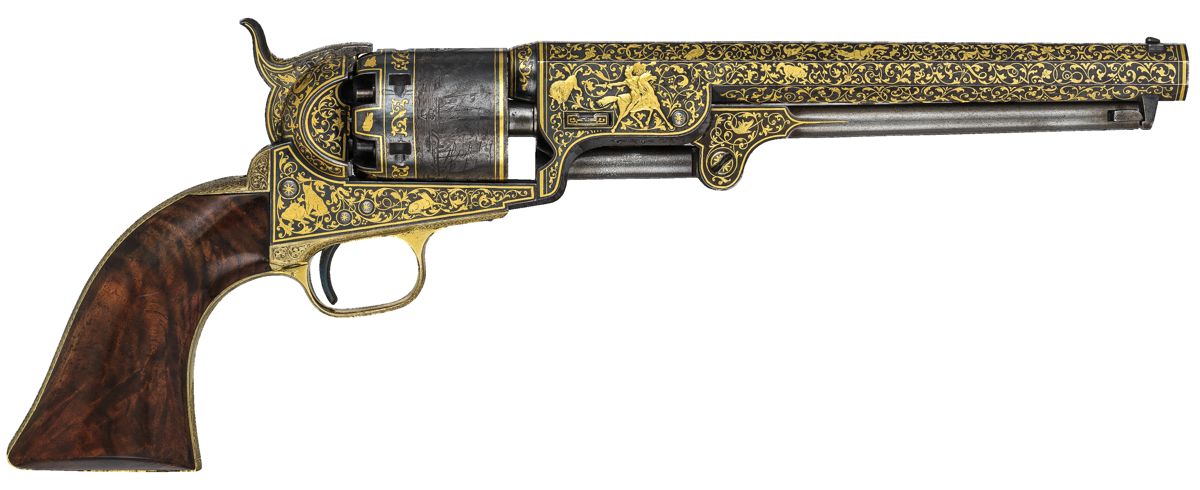
T Courtesy The Metropolitan Museum his Model 1851 navy revolver, serial number 20133, , also known as a belt model, is one of only twenty known examples of a rarefied class of Colt percussion weapons embellished with lavish engraving, relief carving, and flush or low relief gold inlay. They served as diplomatic gifts and showcased the company’s artistic and technical accomplishments. They were created under the direction of Samuel Colt (1814– 1862) for exhibition at international fairs and for presentation to important officials and foreign and domestic heads of state, including the kings of Sweden and Denmark and the czar of Russia. The Robert M. Lee Foundation gave The Met two goldinlaid Colt pistols in celebration of the museum’s 150th anniversary. Although not military issue, their extreme rarity as a kind, the depth of their decoration, and historical relevance, the revolvers rank among the most important additions to the Museum’s collection of American guns in recent decades.
International expos, such as the 1851 Great Exhibition in London and the 1853 Exhibition of the Industry of All Nations in New York, featured Colt’s firearms for public viewing. During his lifetime, Colt, his business, and his family gave away hundreds of pistols to achieve a wider market. He also made gifts of his products, typically embellished samples, to influential people in positions to buy or retail his firearms in large quantities or influence their sale. The navy pistol on display at the Museum is one of a small number of gold-inlaid pistols created during Colt’s lifetime that represent the pinnacle of this category of Colt firearms for display and exhibition.
By creating inventive revolvers with replaceable components and beautiful, long-lasting designs in the middle of the nineteenth century, the American gunmaker, inventor, industrialist, and entrepreneur, Samuel Colt revolutionized the technology and production of weapons. The use of celebrity endorsements, using armed conflicts around the world, and simultaneously marketing weapons to opposing sides were just some of Colt’s practical marketing. Carried a step farther, he attracted consumers’ sense of beauty by designing his firearms to be aesthetically pleasing, giving them graceful forms and variously blued, case-hardened, and polished steel finishes. In rare cases, Colt sometimes had his pistols inlaid and elaborately engraved, another innovative method of product promotion pioneered by him.

Although Colt’s original purpose for this pistol is unknown, it has long been thought to be the mate of another navy revolver with gold decorations now housed in the State Hermitage Museum in St. Petersburg. That revolver is one of three goldinlaid pistols Samuel Colt gave to Czar Nicholas I at Gatchina Palace October 30, 1854. The Hermitage pistol’s serial number (20131) is two digits before the Metropolitan Museum pistol’s (20133), and both revolvers have similar-looking decorations.
The revolver, like almost all other gold-inlaid Colt pistols, lacks a dedicatory inscription, making its past as an exhibition or gift piece in the middle of the nineteenth century uncertain. On the backstrap of several of Colt’s more understated gift revolvers, the recipient’s name is engraved.
The navy pistols from the Metropolitan and the Hermitage are the most ornately decorated of the group, with low-relief figural gold inlays at the barrel wedges and dense inlaid gold scrollwork decorated with animals and fantastical creatures over the entire barrels, frames, loading lever

A close up of the obverse frame and cylinder of the revolver, showing the detailed gold motifs on the frame and barrel web, the decorations between the cylinder chambers, the decorative motifs on the hammer and the excellent condition of the Ormsby cylinder scene. Note also the alternating London commercial view and proof marks stamped into the bottom of the cylinder scene, between the chambers.
A close up of the reverse frame and cylinder of the revolver that again shows the decorative details on the gun. The twoline COLTS / PATENT mark is hand applied, embellished and set slightly further to the rear of the frame than where it was typically stamped on production guns. Again, the alternating London commercial view and proof marks stamped into the bottom of the cylinder scene, between the chambers are clearly visible.
pivots, and hammers. The Goddess of Liberty, a lion, and a mounted Native American brandishing a gun at a buffalo are shown on the figural inlays of the handgun owned by The Metropolitan. The Museum’s dragoon revolver, inlaid with a likeness of the nation’s first president, George Washington (1732–1799), and the arms of the United States, is one of many gold-inlaid Colts identically ornamented with patriotic imagery. The scrollwork designs were inspired by modern northern European pattern books and reflect the fact that many of the best gun engravers employed by Colt and other American gun manufacturers in the second half of the nineteenth century were German immigrants who arrived in the country during the 1850s after being trained in Germany.
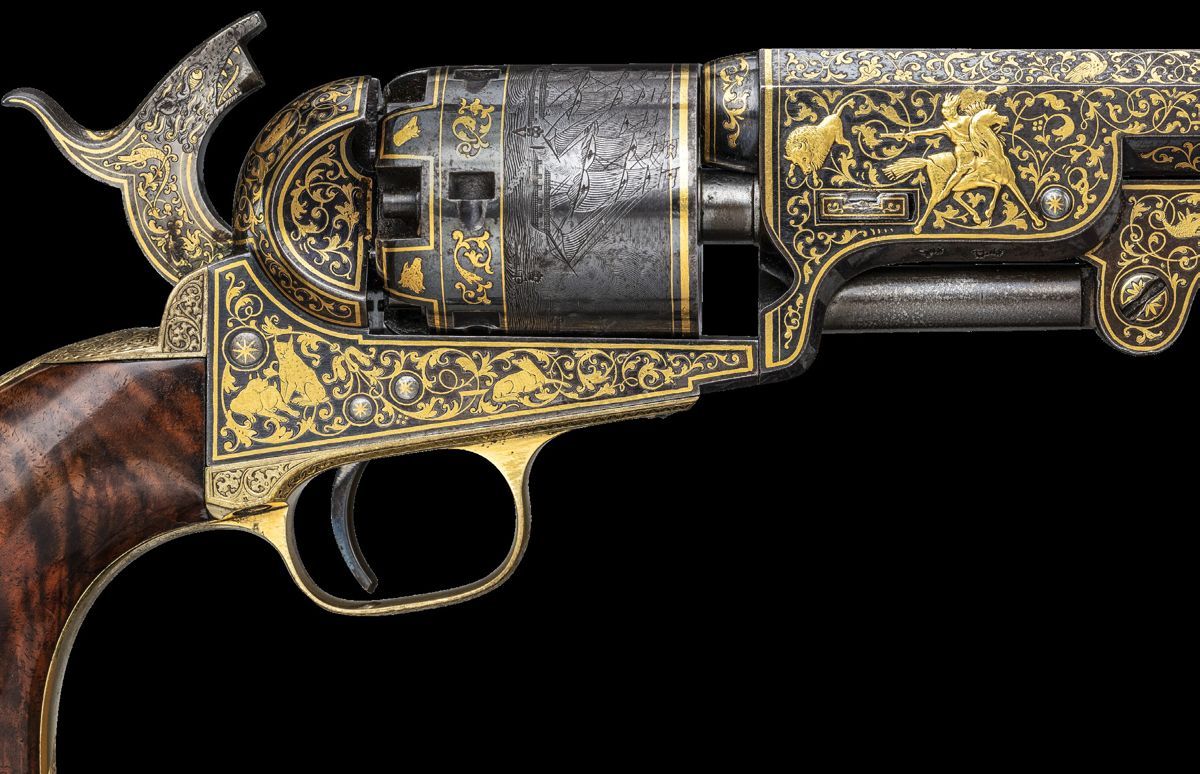
1851 revolver, however on the regular Model 1851 the image is roll-engraved. The scene shows an engagement between Mexican and Republic of Texas vessels that took place on May 16, 1843. It was created by Waterman Lilly Ormsby (1809–1883), an engraver who worked for Colt at least as early as 1839 and specialized in bank notes. Ormsby also created for Colt the equally famous cavalry battle and stagecoach robbery scenes roll-engraved on the cylinders of factory-decorated holster model and pocket pistols. These scenes, in addition to the maritime theme, are both iconic. Due to the popularity of the navy and cavalry designs, the holster and belt revolvers are now formally and colloquially referred to as the dragoon and navy pistols, respectively.
It has long been debated among academics who designed the decoration on the navy pistol on display at the Museum, as well as on all the other gold-inlaid weapons produced during Colt’s lifetime, with Gustave Young (1827–1895), Herman Bodenstein (1829–1865), and John Marr (1831–1921) emerging as potential contenders. For the period between 1853-55, Young is a potential candidate; from 1852-55 and 1856-65, Bodenstein seems more likely, and Marr from 1853-55.
One of Colt’s most well-known and successful percussion weapons was the Model 1851 pistol, first produced in 1851 and continued until 1873. It had a seven and a half-inch barrel, a six-shot cylinder, and was produced in .36 caliber. It weighed two pounds, ten ounces. Many thought it made for the perfect personal sidearm because it was lightweight, accurate, and reliable. Even after the introduction of the .44 caliber Model 1860 army and the new model belt pistol, it continued to be one of Colt’s most well-liked products during the Civil War.
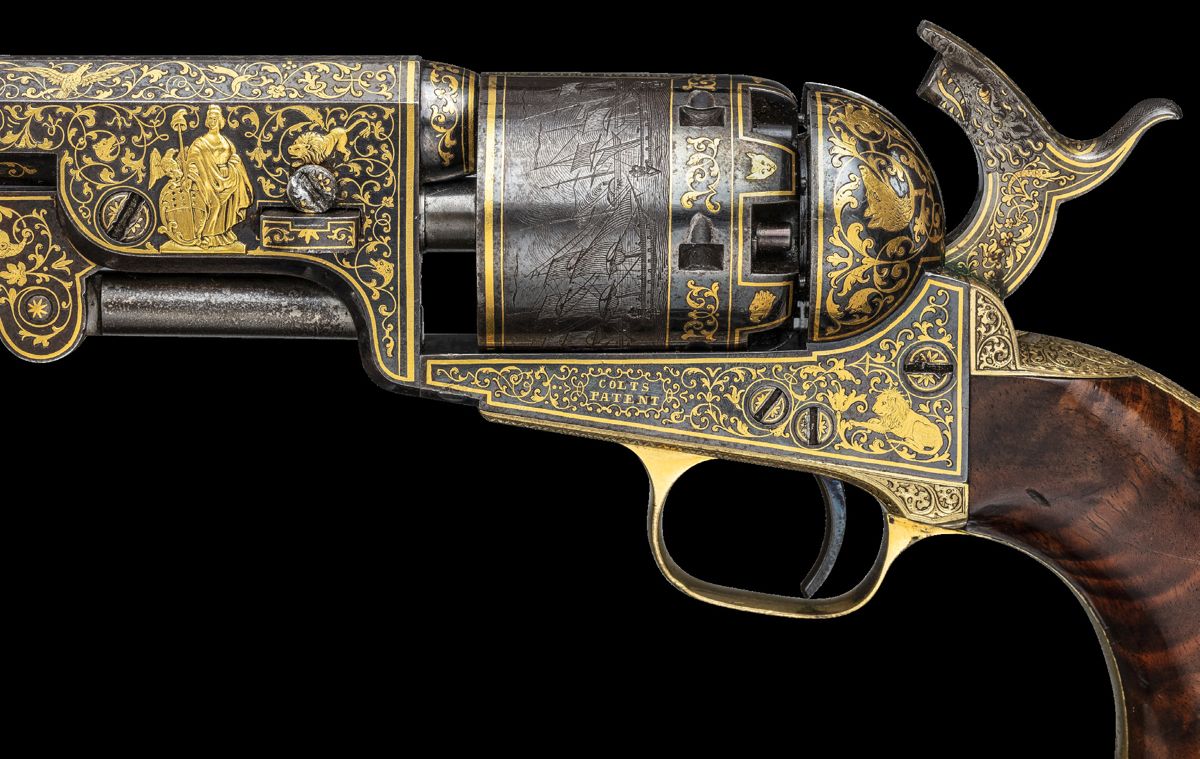
The classic naval combat scene found on Colt factory-decorated Model 1851 pistols of this era is hand-engraved on the cylinder of the Model
The revolver’s dimensions are: overall length 12 ¹⁵⁄₁₆ inches; barrel length 7 ½ inches; .36 caliber; weight 2 pounds, 9.4 ounces.
Obverse view with hammer cocked to show the detailed decoration on the side of the hammer itself.
Overall obverse view of the highly embellished Colt Model 1851 Navy revolver SN 20133.
Reverse view with hammer cocked to show the detailed decoration on the side of the hammer itself.
Overall reverse view illustrating the exquisite craftsmanship of the engraver. The engraving process took a steady hand and months to create works of art.
“Be it known that I, Samuel Colt, of Hartford city and county, in the State of Connecticut, have invented certain new and useful Improvements in Revolving Chambered Fire-Arms…” – Samuel Colt, U.S. Patent No. 7,629, Sept. 10, 1850.
A closer and more detailed obverse view of the elaborate gold decorations; a mounted Native American brandishing a gun at a buffalo.
Goddess of Liberty with lion. Even the “COLTS PATENT NO 20133” is gold inlaid.
Reverse of frame and cylinder of the Met’s stunning Colt Navy. Note also the highly finished walnut grips.
Detail view of the butt of the revolver showing the delicate engraving, the serial number 20133, and the punch dot below the number indicating an embellished gun.
Punch dot.
View of the bottom of the frame and triggerguard of the revolver, showing the detailed engraving and the serial number. This view shows the Colt factory punch dot mark below the serial number on the trigger guard that is often associated with embellished Colt revolvers of the period. Also visible on the left side of the picture, on the lower angled barrel flat are a pair of London commercial proof and view marks which indicate that this revolver was imported into England at some point during its life, likely as part of an exhibition display.
Top view of the revolver showing the simple gold “Saml. Colt” marking, rather than the typical oneline New York address used during 1853.
Colt’s Patent Fire-Arms Manufacturing Co. paper label glued to the felt cover inside the lid.
This Colt revolver in a typical London-style English oak casing, showing the empty compartment for the mate that originally accompanied this gun. Note the typical English bag shaped powder flask. As a set of two, many of the accessories are provided twice, one for each revolvers. This includes the pair of blued iron Colt bullet molds, two English pewter oil containers and two L-shaped combination screwdrivers and cone wrenches.