
The Rifled and Sighted U.S. Model 1847 Cavalry Carbine
By Tim Prince · Originally published September-October 2022 · pp. 19–31
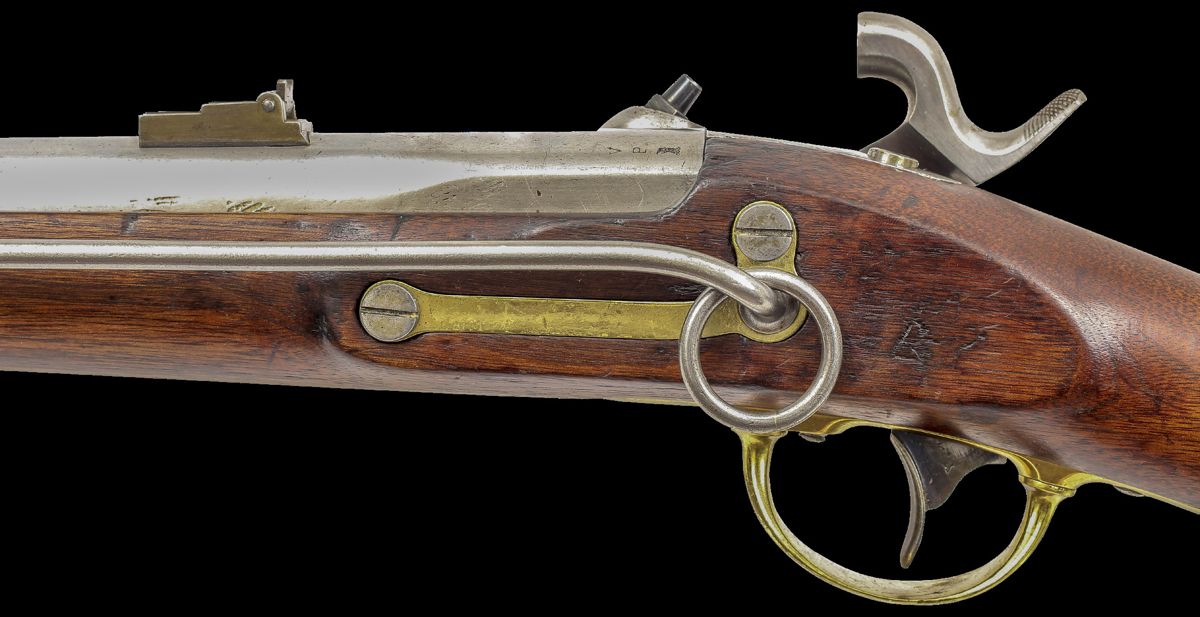
Overall reverse view of the 1847 Rifled and Sighted cavalry carbine.
Counterpane view.
While the family of M1847 “musketoons” originally contained only three models, within a decade no less than ten different variants existed, due to modifications, design improvements, and refitting of some guns for other service. The family of arms went into production in 1847. The first guns completed and accepted into stores during that calendar year were a pair of M1847 cavalry carbines and 200 M1847 sappers & miners musketoons. The arms remained in production for nearly a decade at Springfield; the last guns produced were 33 sappers & miners musketoons delivered in 1856. During the Model 1847 production run, a total of 10,033 carbines and musketoons of all varieties were manufactured. The model production was divided into 1,030 sappers & miners musketoons, 3,210 artillery musketoons and 5,802 cavalry carbines.
specification calling for it to be “similar to the Artillery Musketoon” but equipped with a “swivel ramrod” and “swivel bar to sling the arm on horseback.” The carbine was intended to replace breechloading Hall carbines then in use by the 1st, 2nd, and 3rd U.S. Dragoons. From a technological standpoint, it would appear that this was a huge step backwards, moving from a breechloading weapon to a muzzle loading weapon, and it probably was. In reality, it was probably more indicative of the Ordnance Department’s very traditional, and conservative, attitude and its bias against breechloading arms seen as wasteful of ammunition due to their higher rate of fire. The department also probably preferred the simpler and less expensive muzzleloading carbine for its fiscal frugality in construction and manufacture.
Despite being the largest part of the M1847 production, today it is uncommon for collectors to find M1847 carbines in their original “as issued” arsenal configuration. This is because a large majority of cavalry carbines were altered in some way by the end of the 1850s. Most were eventually converted to conform to the “artillery carbine” pattern, a model that was really intended for use as a “cadet musketoon.” Many sappers & miners musketoons were similarly converted to this new purpose as well.
The first M1847 cavalry carbines were authorized for issue to the 1st and 2nd U.S. Dragoons in April 1849, to start replacing the Hall carbines. However, the first major shipment of the M1847 carbines did not occur until March 1851, when 500 were shipped to New Mexico to rearm the U.S. Dragoons.
The design for what would become the M1847 cavalry carbine was actually approved in 1844 by the Secretary of War and referred to as a “dragoon carbine,” with a
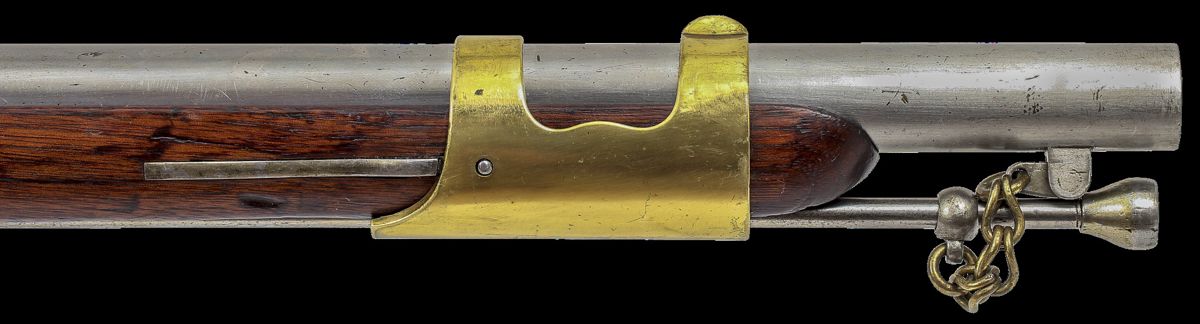
As originally manufactured and issued, the M1847 carbine was a single shot, .69 caliber smoothbore, percussion ignition, muzzle loading carbine with a captive ramrod that operated on a swivel mechanism. The guns were brass mounted with a brass buttplate, triggerguard, side plate, and pair of brass barrel bands. The upper band was double
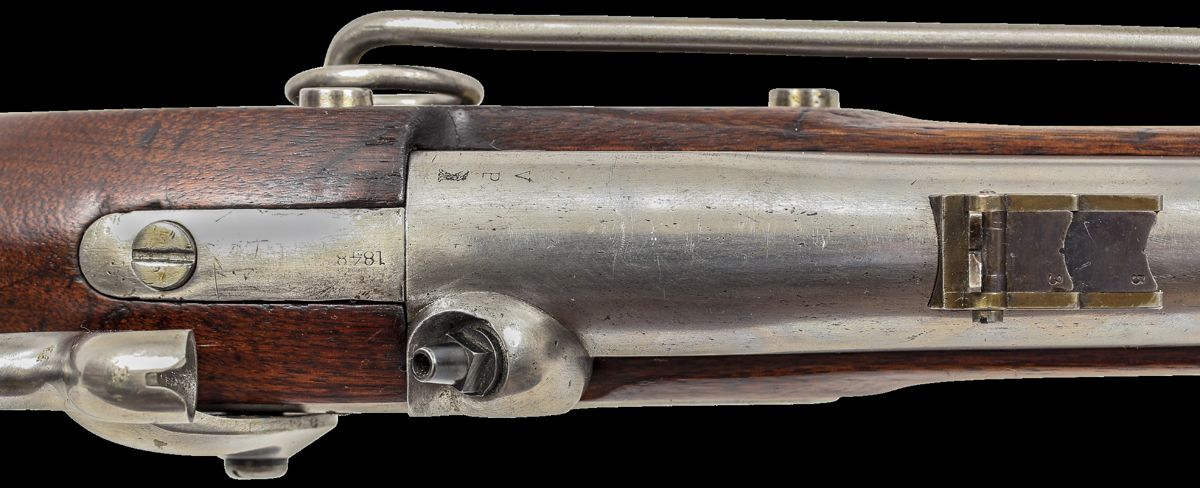
Breech area showing inspection marks and the 1855 pattern three-leaf rear sight added during the upgrade process.
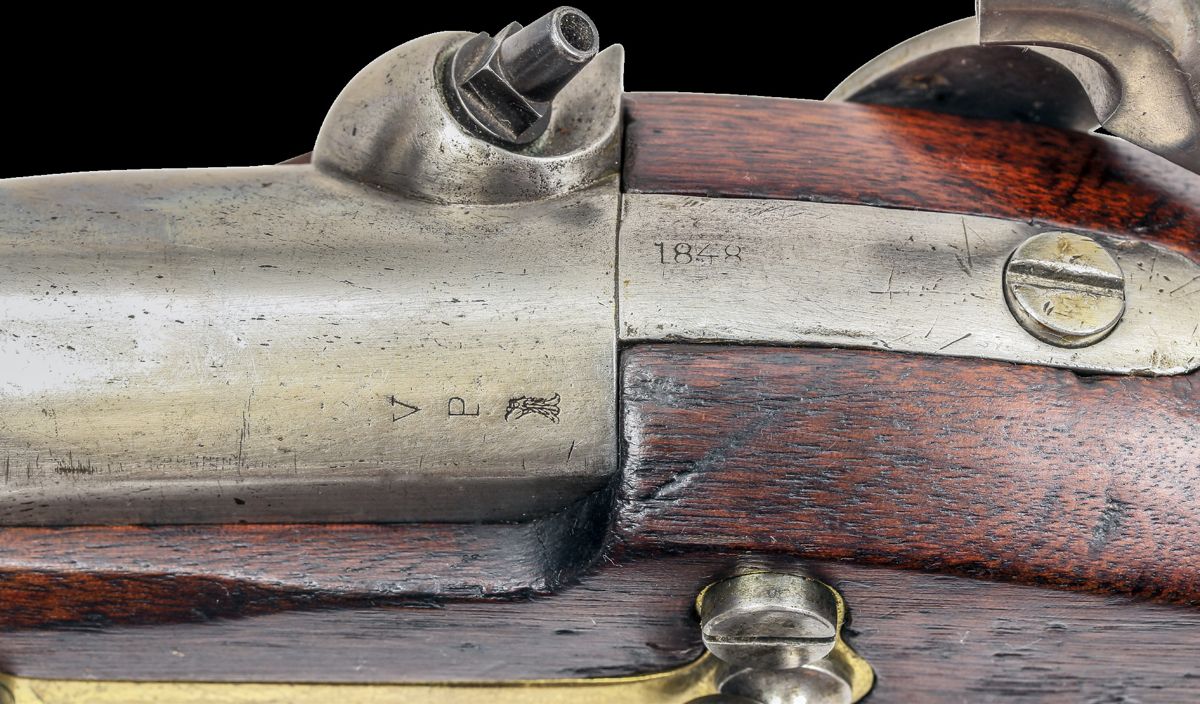
Close up of proof marks and the 1848 date on the barrel tang.
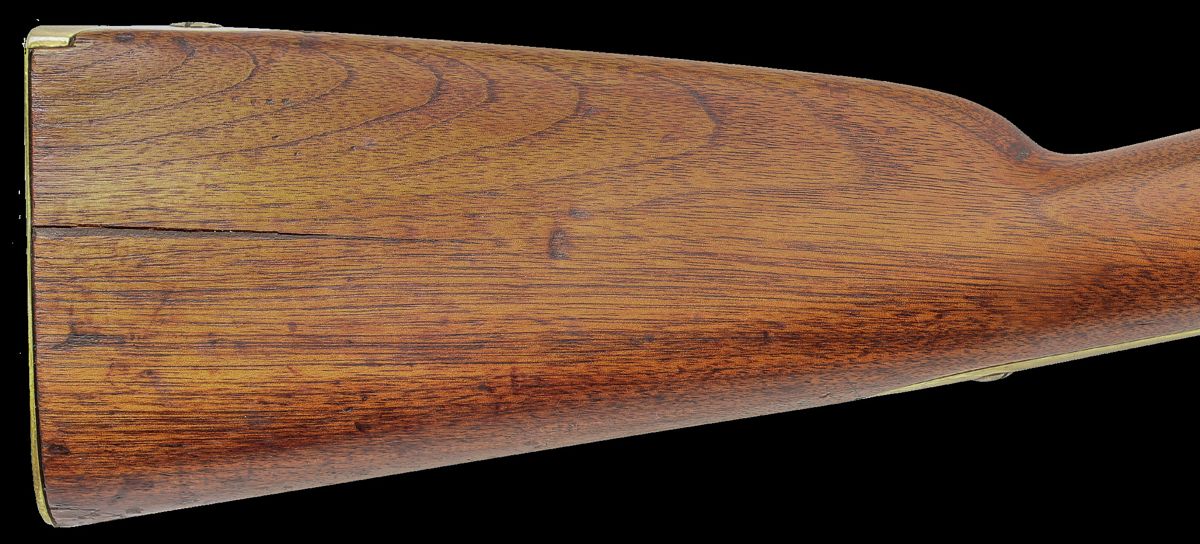
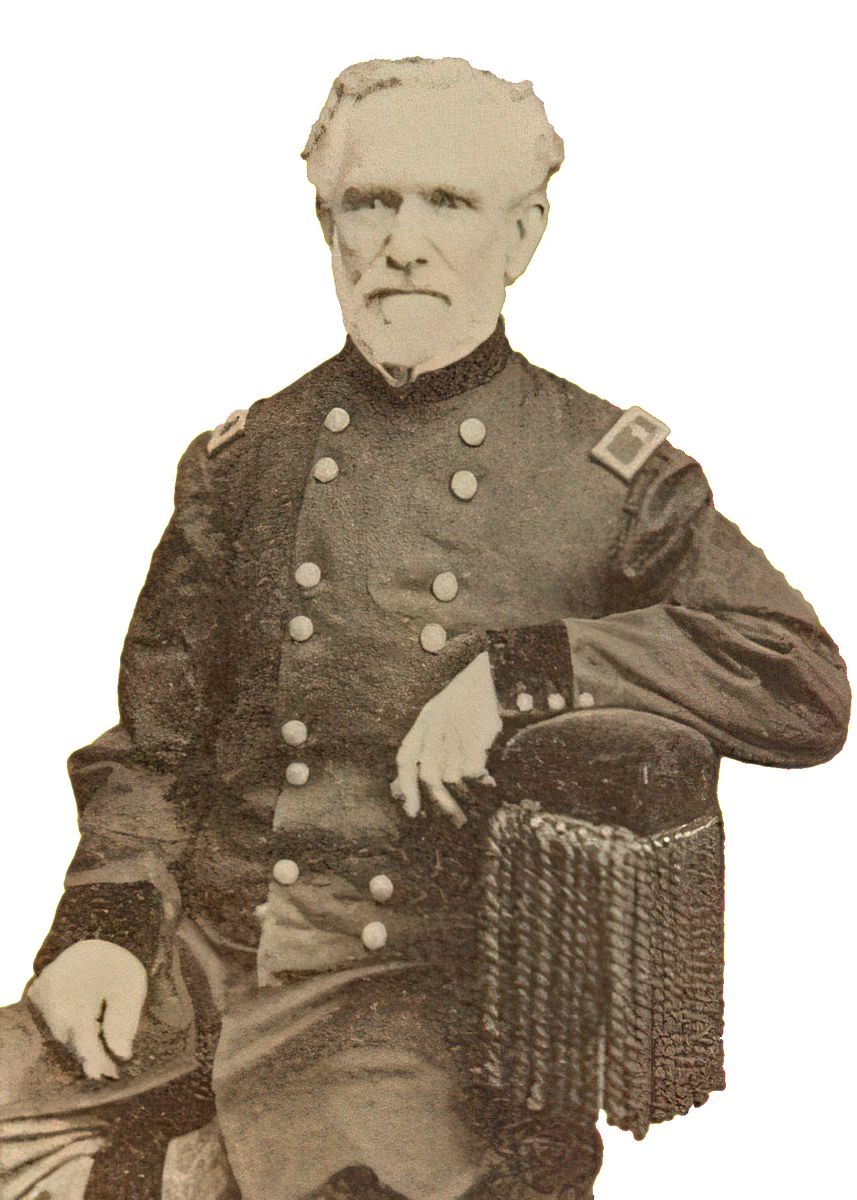
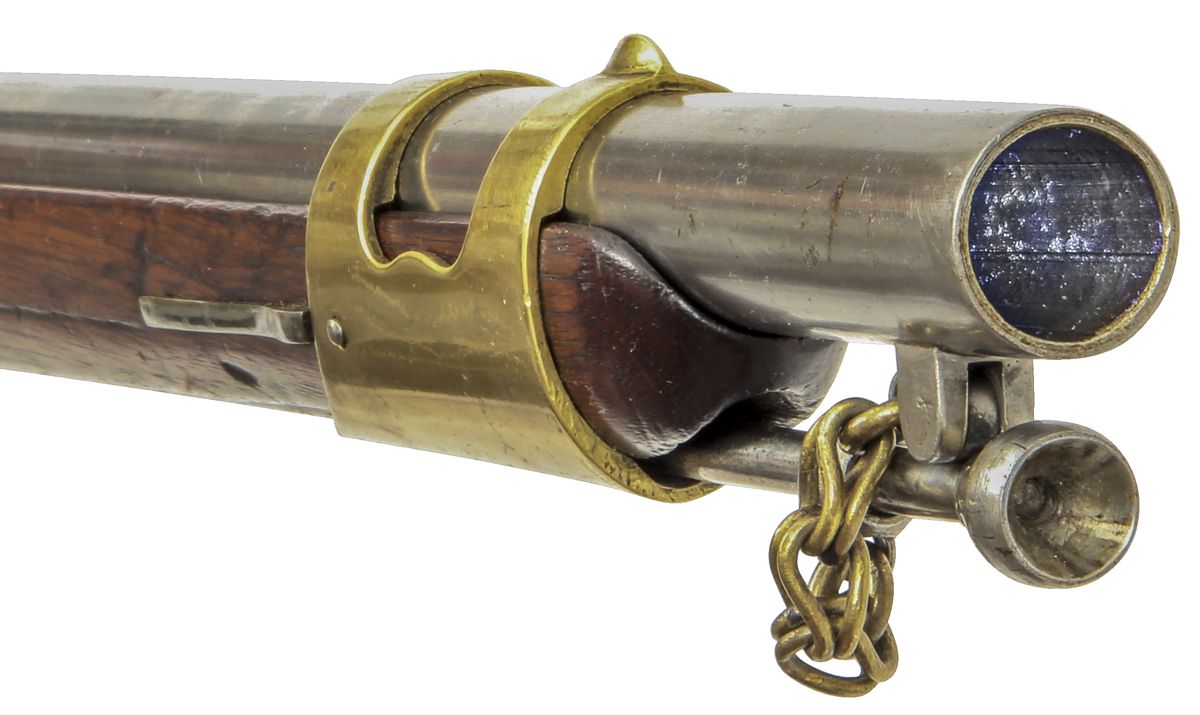
Close up of butt with crack due to expansion and shrinkage around the internal lead weight. strapped, similar to the M1841 Mississippi rifle, but the carbine’s forend extended beyond the barrel band and came to a rounded end two and half inches from the muzzle. The upper band was secured by a steel band spring. The lower band was secured through a threaded lug attached to the 9 ½-inch steel sling bar on the carbine’s reverse where it terminated at the side plate and rear lock mounting screw. A steel sling ring was suspended from the sling bar, to which the trooper could attach the snap hook of his carbine sling. A 3/8-inch stud was brazed under the barrel, threequarters of an inch from the muzzle. Two curved, pivoting arms that secured the captive ramrod were slung from the stud. The lock was the traditional design with only half and full cock notches; there was no “safety” notch. The standard markings on the M1847 carbines included a vertical three-line stamping on the lock’s tail behind the hammer which read SPRING / FIELD / (date). Forward of the hammer was included a spread-winged American eagle with a shield in its breast, surmounting the letters U S. The barrel was marked with the date of manufacture on the breech plug tang as well as the standard Springfield Arsenal V / P / Eagle Head proof marks on the upper left quadrant of the breech. The buttplate tang was stamped U.S. and the stock’s counterpane was stamped with the cartouches of Springfield Armory inspectors and the Master Armorer. Almost immediately after being issued, complaints began to come in from the field from the men who had been issued the new carbine. The deficiencies in design were myriad, and while some things could be fixed easily, the reality was that this single shot carbine was obsolete before it was issued and replaced a much more practical weapon for mounted use. From a military standpoint, the major complaints were that the carbine’s light weight resulted in heavy recoil and the short, smoothbore barrel was quite inaccurate. From a practical standpoint, the gun tended to unload itself when carried muzzle down from the sling because the round ball was easily jostled out of the barrel by movement of the horse. This same problem occurred with the ramrod, which had no retention system in the stock, so it would vibrate loose and come out of the ramrod channel, resulting in damaged and lost ramrods simply from riding the horse. On top of that, the percussion caps often bounced off the cone (nipple) and were lost due to vibration from the horse. The only way to carry the carbine with a cap on it was to lower the hammer onto the cap, a good way to end up with an accidental discharge if the hammer were snagged and then released. If the gun was carried at half cock, there was more than enough room between the hammer nose and the cone for the cap to bounce off. In 1851 the Ordnance Department announced modifications to resolve the cap and ramrod problems. The initial fix for the ramrod was to retrofit a “spoon,” or friction retainer spring, in the stock, as was done for the artillery and engineering musketoons. It was subsequently suggested that the problem could be resolved by increasing the length of the ramrod about half an inch. Over the next couple of years, many existing cavalry carbines were modified by adding the spoon, or the attaching a new longer ramrod; in some cases both modification occurred. However, some were never modified with either upgrade. The solution for the percussion cap problem was to add a third, “safety,” notch to the tumbler. This new notch, forward of the half cock notch, allowed the sear to engage the tumbler at a point where the hammer was barely above the cone, high enough not to touch the percussion cap, but low enough to make sure the cap did not fall off. To the author’s knowledge, this is the only U.S. arsenal produced percussion arm to incorporate three notches in the tumbler. As with the ramrod upgrades, not all the guns were modified, and today they are found with and without the third tumbler notch. Even with improvements made during 1851 and 1852, on many previously produced carbines and, supposedly incorporated into those yet to be produced, the carbines continued to perform poorly in the field, and were universally despised by the men who carried them, as well as their officers. Probably the most damning commentary came from Major William Anderson Thornton, whose “WAT” cartouche is well known on U.S. martial arms. Thornton, an 1825 graduate of the U.S. Military Academy, would eventually serve as the head of the Ordnance Department for the Department of New Mexico and would be the Chief of Ordnance at the New York Arsenal on Governor’s Island from just before the Civil War until his death in 1866. During 1855 and 1856 he was serving in Texas, and from there wrote a scathing condemnation of the M1847 cavalry carbine on Feb. 16, 1856, which read in part: “It is very severe in recoil and wants range and accuracy of fire. It cannot be carried loaded, because the charge is shaken out by the movement of the horse. It is loaded with much difficulty when mounted, and becomes quickly unserviceable by the breaking of the swivel, and loss of the ramrod and tumbler screw, and by the battering of the muzzle when carried in the bucket. The men have no confidence in the arm.” (emphasis added) By the time Thornton wrote his letter, the M1847 carbine was already being replaced in many U.S. Dragoon companies with new Sharps breechloading carbines; the men’s single shot M1842 pistols were being replaced with Colt Dragoon percussion revolvers at the same time. Many cavalry carbines were returned to arsenals around the country as they were replaced by more modern breechloaders. Since the guns were considered obsolete, other uses for the carbines were found. During 1858 and 1859 some 630 cavalry carbines were altered to “artillery” musketoons by removing the sling bar and swivel rammer system and adding conventional ramrod, sling swivels, and a stud to accept the M1835 pattern .69 caliber socket bayonet. These newly minted “artillery” carbines were then sent to various states as “cadet musketoons,” because there were no more M1841 or M1851 cadet muskets in inventory. In the Ordnance Department’s typical parsimonious way, they kept looking for ways to utilize the unpopular carbine. During fiscal year 1859, two M1847 cavalry carbines were modified at the Springfield Arsenal by rifling them for use with elongated ball (Minié) ammunition and adding M1858 3-leaf rear sights. The unpopular swivel rammers were removed and replaced by a tulip shaped head, cupped for the elongated ball ammunition, ramrod secured by a chain with a sliding ring on the rammer’s shaft. The guns were further modified by drilling a hole under the buttplate and adding an 8-ounce lead weight to help minimize felt recoil and improve the carbine’s overall feel and balance. Reports from Springfield claimed the newly modified carbines performed “satisfactorily” at 400 and 500 yards. As a result, some 344 carbines were modified during 1859 at Frankford Arsenal, using sights manufactured at Springfield. Of those 344 altered carbines, 100 were subsequently sent to the firm of Merrill, Latrobe & Thomas, where they were altered to be Merrill system breechloaders. That left only 246, including the two Springfield Arsenal sample carbines, rifled and sighted M1847 cavalry carbines in their original muzzle loading configuration. Despite their herculean efforts to make lemonade out of lemons, the Ordnance Department started disposing of the M1847 cavalry carbines during 1860. Documents indicate that M1847 carbines at the Saint Louis Arsenal were sold to arms dealer A. Hitchcock of New York. At least 30 other M1847 cavalry carbines were sold to Delaware Kemper of Alexandria, Va. Kemper would organize the Alexandria Light Artillery in March 1861 and serve as their captain at the First Battle of Bull Run. This unit would later be merged into the 18th Battalion of Virginia Heavy Artillery, with Kemper promoted to major. Even though there was an active attempt to rid the U.S. military of the M1847 cavalry musketoon, by the end of the 1862, there were still nearly 1,000 in field service, as the Dec. 31, 1862, Ordnance Returns show 947 guns in the hands of active regiments. The two regiments that showed the most M 1 8 4 7 cavalry carbines on their
Major William Anderson Thornton.
Detail of the chained ramrod added during modification and upgrading of the gun.
Close up of the 3-groove rifled bore of the upgraded carbines. returns were the 1st Texas Cavalry (US) with 410 and the 1st New Mexico Cavalry (US) with 301. The guns were also in the field with the 5th Kansas (27), 5th Missouri State Militia Cavalry (51), 12th Missouri State Militia Cavalry (138), and the 13th Missouri State Militia Cavalry (20). Other carbines were in storage at that time as well, because General James Ripley, Chief of Ordnance, responded to a May 17, 1862 request for artillery carbines from Fort Delaware, that no artillery musketoons were available, but that cavalry carbines (either rifled or smoothbore) were. He also noted these guns could not accept bayonets. The modified M1847 rifled and sighted cavalry carbine pictured in this article is one of those extremely rare, 100% complete and correct examples of these scarce guns. The stock flat opposite the lock is marked with the script JS cartouche of James Stillman of Springfield Arsenal. The cartouche is slightly weak, but still legible. The lock has the 1851–1852 third “safety” notch in the tumbler, suggesting this gun remained in store at Springfield three to four years after it was manufactured, and was probably never issued to the Dragoons serving out west prior to modification. The stock has not been altered for a ramrod spoon, so it was not modified for the friction rammer that became standard during 1851. This means the stock pre-dates the modification order, and was one made between 1847 and 1850. The stocks for all other musketoons (artillery and engineers) were originally equipped with the friction retaining rammer spoon. The carbine is a textbook example of the 1859 Frankford Arsenal rifling and sighting modifications and retains all the original alteration components from that upgrade. The carbine retains its original M1858 pattern 3-leaf musket sight with the correct pattern leaves. The bore is beautifully rifled with three crisp lands and grooves that have a slow 1 in 72 inches right hand rate of twist. The original Frankford Arsenal installed chain secured ramrod is in place and 100% complete and correct. The ramrod was produced with an enlarged reverse end, cut with female threads to accept cleaning implements. This enlarged end also helped retain the rod in the ramrod channel, which had to be slightly widened at Frankford to accept it. The other end of the rod has the correct tulip shaped head, cupped for use with elongated ball ammunition, and threaded onto the rammer. It was necessary to be able to unscrew the rammer head to install it or remove the ramrod from the steel doughnut shaped retainer at the end of the brass chain. The retainer is secured to the chain with a round brass link; the chain is brass, in a double-teardrop link pattern. The three links joining the sliding doughnut to the swinging link riveted into the original swivel ramrod’s mounting stud, under the muzzle. The original 8-ounce lead disc is still present in the butt under the brass buttplate. The disc is heavily oxidized with the usual flaky white residue expected on old lead. As is the case with nearly every rifled and sighted carbine the author is aware of, expansion and contraction of the wood due to temperature and humidity fluctuations over time with the solid lead inside the butt has resulted in cracks on both sides of the buttstock. In all, a total of 5,802 M1847 cavalry carbines were produced at Springfield between 1847 and 1854. Most received at least one alteration or upgrade during their service time; many had a second life as “artillery” or “cadet” musketoons. The rifled and sighted variations are extremely rare today, as only 346 were so altered, and 100 of those were subsequently converted to breechloaders. Nearly as rare are 100% complete and correct rifled and sighted examples with their original chain retained ramrods. Very few of these guns appear to have survived and today, these guns are among the most sought after of the rare cavalry carbines by advanced U.S. martial carbine collectors. When the guns are encountered, they often show hard use, excessive wear and damage, and in many cases missing or replaced parts.
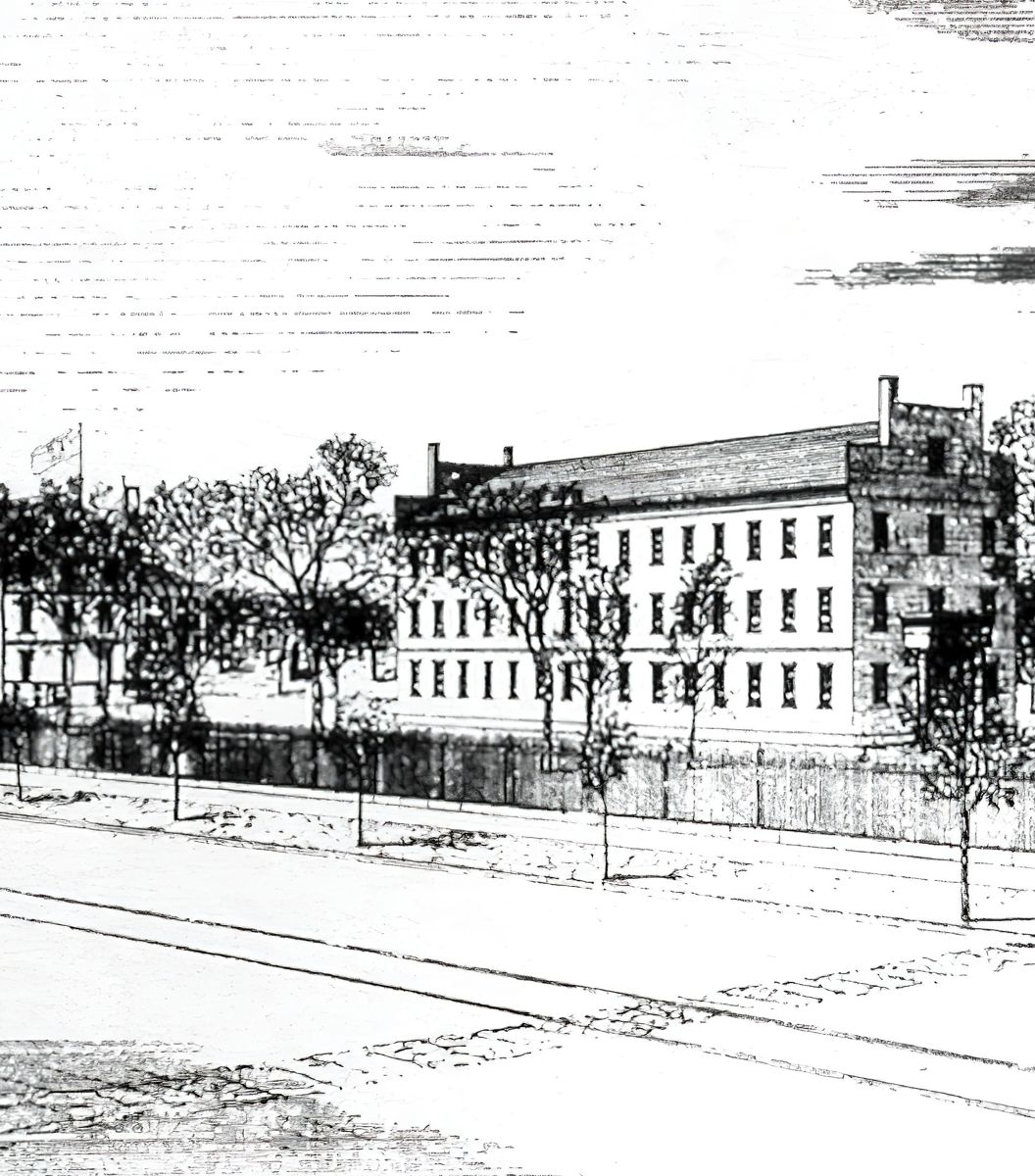
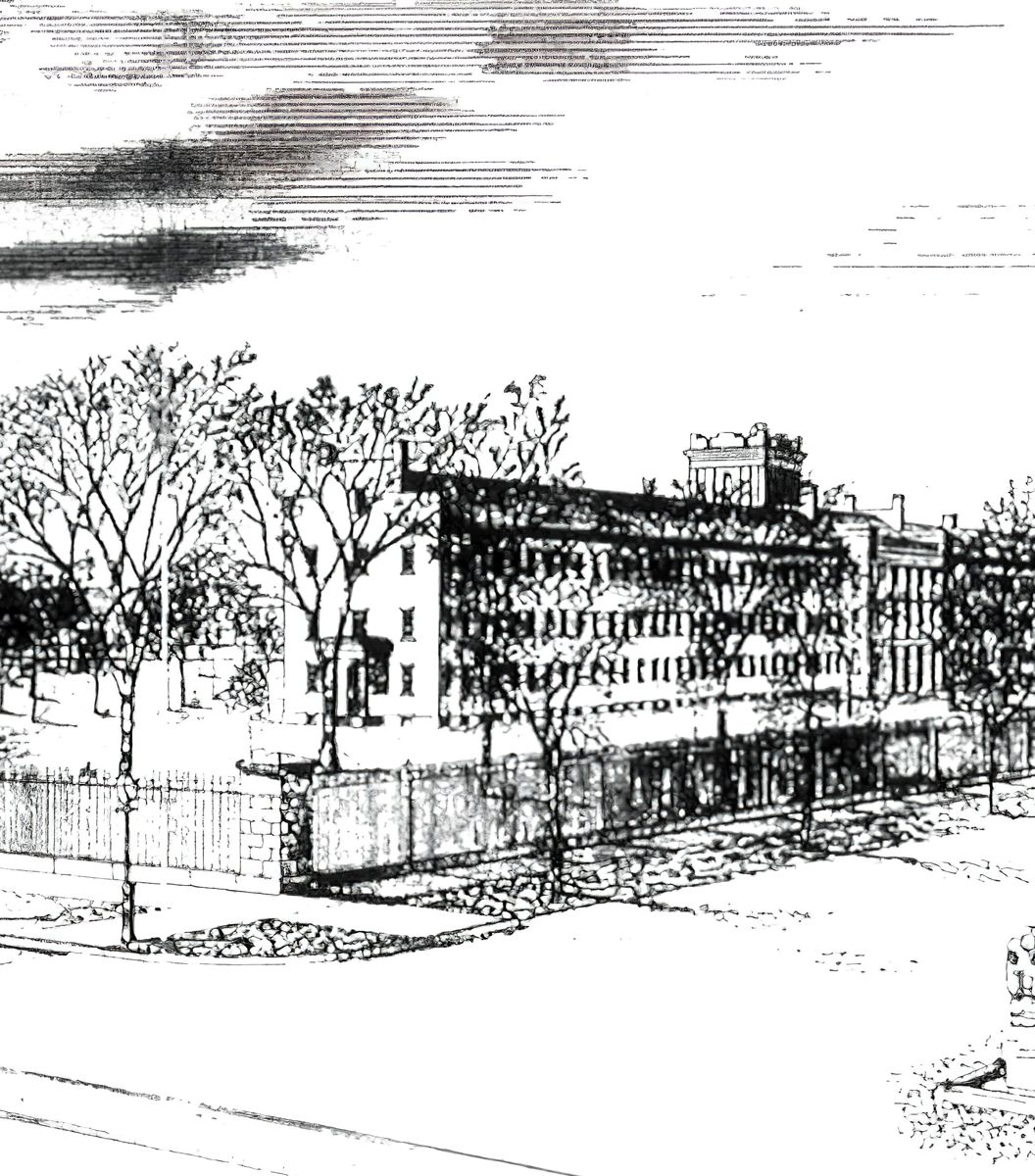
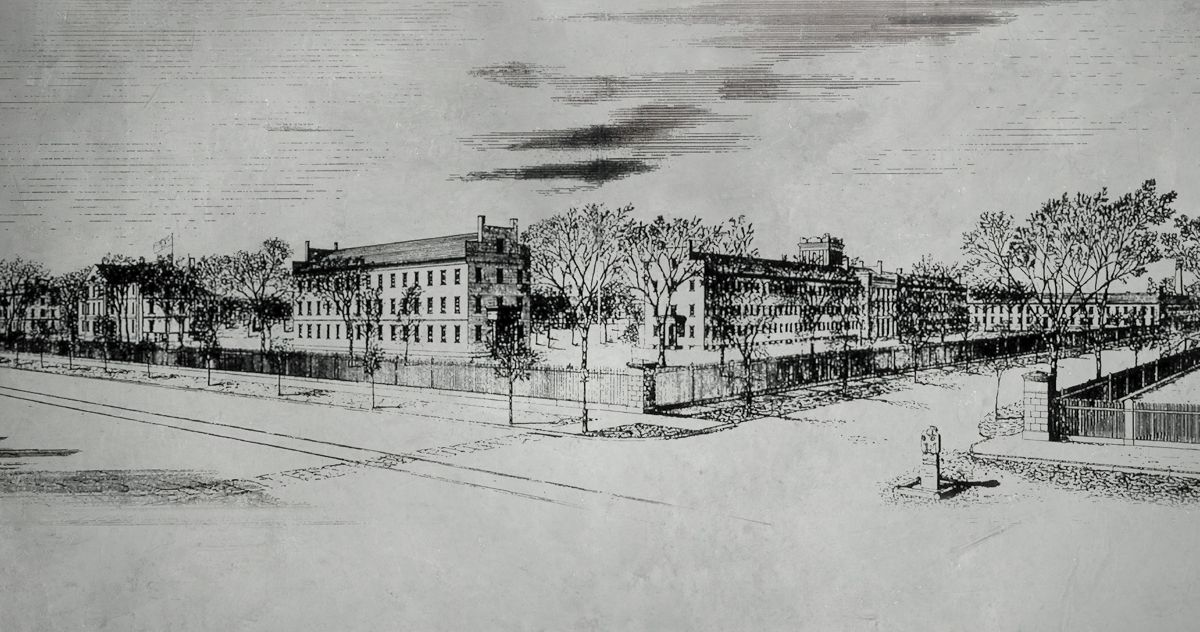
Springfield Arsenal.
About the Author
Tim Prince is a full-time dealer in fine and collectible military arms from the Colonial Period through WWII. He operates College Hill Arsenal, a web-based antique arms retail site. A longtime collector and researcher, he has been a contributing author to two major book projects about Civil War era arms including The English Connection and a book on southern retailer-marked and Confederate-use shotguns. He is the author of over 60 articles on weapons in Civil War News. Tim is also a featured Arms & Militaria appraiser on the PBS Series Antiques Roadshow and serves as a Senior Consulting Specialist to the Arms & Armor department of Cowan’s, a Hindman Company.
Tim Prince
IMAGES CAPTURED IN TIME
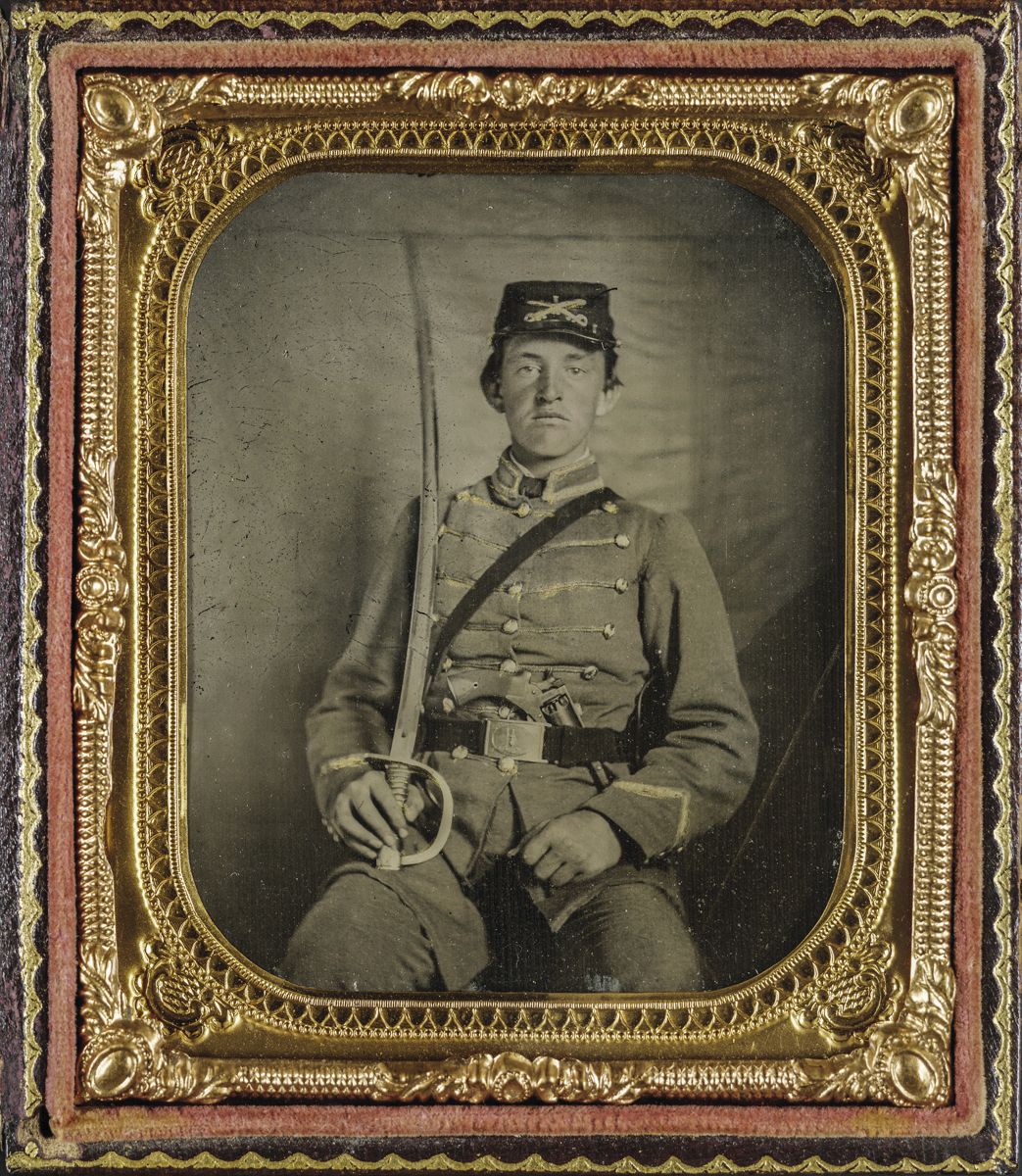
DAVID M. THATCHER Thatcher enlisted at Martinsburg, Va., April 19, 1861, as a private in Company B, “Berkeley Troop,” 1st Virginia Cavalry. He was 17 years old. He was killed in action, still a teenager, in the cavalry fight at Buckland’s Mills, Va., October 19, 1863. He is pictured wearing a distinctive triple breasted frock coat with Virginia state seal buttons and wearing a sword belt with Virginia state seal buckle. His kepi has crossed saber cavalry insignia with “1” designating his regiment. Thatcher holds a cavalry saber and a Massachusetts Arms Adams-patent revolver that the state purchased just prior to the war along with Virginia sword belts and Ames cavalry sabers, many of which went to the 1st Virginia Cavalry. Liljenquist Family Collection of Civil War Photographs (Library of Congress).
IMAGES CAPTURED IN TIME
Enlargements of the Virginia sword belt plate and Adams revolver.
IMAGES CAPTURED IN TIME
A VIRGINIA CAVALRY BELT RIG
The original Gaylord belt was damaged or worn out; the Confederates recycled a used U.S. Model 1851 sword belt to replace it.
The rectangular ring on the back of the belt served as an attachment point for the hanger drop/
by Shannon Pritchard
In 1860, sensing the conflict to come, the state of Virginia purchased cavalry swords from Ames Manufacturing Company of Chicopee, Mass. With each sword necessarily came a sword belt. Ames contracted with Emerson Gaylord of the same city to provide the belts. The belts were identical to the U.S. Model 1851 sword belts, with two exceptions; first, they were dyed black, and second, the belt secured the keeper side of the buckle with two stitches in a crossing pattern, whereas the U.S. Model 1851 keeper was secured with two copper rivets. Thus, the collector can tell an original Virginia belt from its U.S. counterpart. The second change was the belt plate. The U.S. belt carried the Model 1851 plate bearing an eagle within a wreath. The Virginia belt plate was unique in that it bore the state seal of Virginia, with “Virtus,” or Virtue, standing over a defeated “tyranny,” and bore the Latin motto, “Sic Semper Tyrannis” or “Thus ever to Tyrants.” Gaylord produced a very highquality plate by first casting and then die stamping to bring out finer details in the Virginia state seal. After casting and die stamping the face, the tongue was brazed on and a keeper fitted. The highest known number is in the 900 range; it is believed that no more than 1,000 were ever produced. These belts originally had an additional shoulder strap that connected to a brass D ring in the front, ran over the cavalryman’s shoulder and attached to another brass ring in the rear to support the weight of the sword, revolver, cartridge and cap boxes. The sword belts and swords were issued to the 1st Virginia Cavalry, though some of those men were later in the 2nd Virginia Cavalry and perhaps even the 3rd. There are extant numerous images of 1st Virginia Cavalrymen wearing these belts, including David Thatcher, Company B, 1st Virginia, and William Gallaher of Company E, shown on these pages. This plate was struck with the number 600 and the keeper 261, meaning that they did not start life together. This example is not on its original Emerson Gaylord belt; however, there is no doubt that this belt was used during the War as this belt has the tooled border of a Confederate manufactured belt. (Courtesy OldSouthAntiques.com)
IMAGES CAPTURED IN TIME
Emerson Gaylord cast these images in brass, and then pressed them with a die to bring out the detail. Note the fine lines and stippling in the background.
Note the brazed-on tongue and stamped serial number 600. These numbers were always stamped in, any plate having a cast number is a reproduction.
IMAGES CAPTURED IN TIME
LIEUT. WILLIAM BOWEN GALLAHER Gallaher, of Co. E, 1st Virginia Cavalry, is wearing a Virginia state seal sword belt plate and holding a cavalry saber with a holstered Colt Model 1851 Navy revolver. Lieutenant Gallaher entered service May 1861 at the age of 21 but due to ill health left the service in August. He managed the Rose Hill Tannery in Waynesboro, Va., after his service till the end of the war. Leather goods were much in demand for the military and service in manufacturing was just as important in the South as being an officer in the field. Liljenquist Family Collection of Civil War Photographs (Library of Congress).
IMAGES CAPTURED IN TIME
Enlargements of the Virginia sword belt plate and M1851 revolver.