
Who Killed General John Sedgwick
By Jack W. Melton Jr. and Lawrence E. Babits · Originally published January-February 2023 · pp. 61–70
sights and with a roving commission as an independent sharpshooter and scout. This rifle killed Gen. Sedgwick at Spottsylvania [sic] Court House. At the Bloody Angle or bend in the same battle I had four holes shot through my hat. This angle was the bloodiest spot of the war, east or west. I mean where McGowan’s South Carolinians fought. Men lay dead on top of each other in the … A tree 18 inches in diameter was cut down by many balls and came near falling on the 12th Regiment’s colors. It would take many pages to give all or the half of my camp and battle and scouting experiences. I will close with these reminisces by stating that I captured nearly 50 Yankees from Cold Harbor to the surrender, 47 in all. I was severely wounded at Gettysburg, shot through the left shoulder, ball popping out under the shoulder blade. Your affect. husband, B.M. Powell”
The following text is from an article published in The Augusta Chronicle, Augusta, Georgia, November 25, 1917:
WHO KILLED GENERAL SEDGEWICK [SIC] About 10 o’clock in the morning of the 9th of May, 1864, three days after the battle of the Wilderness, and three days before the battle of the Bloody Angle, Major-General John Sedgwick, commanding the sixth corps of Grant’s Army, was killed, near Spotsylvania, by a single shot from a Confederate sharpshooter, over a half mile distant. History thus records, but history does not record who fired the fatal shot. Nor is it generally known, but we of the battalion of sharpshooters of McGowan’s South Carolina Brigade, of which I was first sergeant, knew. The arm of the Confederate infantry was of two kinds, the Enfield rifle, the regulation British Army rifle, imported from England by running the blockade, and the Springfield rifle, the regulation United States Army rifle, captured by us in battle. These two guns, both muzzle-loading, were of the same caliber, and the cartridges of each fitted the other. There were some differences in the make-up of the cartridges; we of the sharpshooters preferred the English cartridge. Along with the Enfields from England came also a small supply of Whitworth rifles, a long, heavy gun of small bore, made for sharp shooting at long range. This gun carried a small telescope on the top of the barrel, through which to sight – the hind sight (within the telescope) was a cross of two fine metal threads. In the distribution to Lee’s Army of these Whitworth rifles two fell to our brigade; one a walnut stock, was given to Ben Powell, and one, an oak stock, to a young fellow of Edgefield district, named Cheatham. Both of these men were excellent shots, and they now became independent sharpshooters, to go where they pleased. And carry on war at their own sweet will. I do not remember that I ever fired either of these rifles, but my younger brother, Blackwood, a corporal in the sharpshooters with me, has sometimes fired Powell’s. Once, in the trenches at Petersburg, Powell let him shoot it; the enemy camp was quite over a mile distant; my brother raised the gun at its highest elevation and fired at random. It was too far and enemy objects too obscure to note any effect, but some little time afterward we got hold of a New York paper and in this paper was news from the camps that on that day two men were killed at a well by a shot that came from an unknown [spot as] no report was heard. Powell enjoyed being around the main body of sharpshooters a good deal and sometimes I would take him with me on a scout patrol. Not infrequently Powell would have a duel with a Yankee sharpshooter and usually Powell got the best of it. But one morning he came to us with a bullet hole through his hat. A Yankee sharpshooter had done it. “Well Ben,” we asked, “did you get him?” “No, I didn’t” say Ben very frankly, “he kept picking closer and closer to me, and when he put the bullet through my hat, I quit.” On the 9th of May, Ben came in about noon and walking up to me, he said: “Sergeant, I got a big Yankee officer this morning.” “How do you know it was an officer?” I asked. “I could tell by the way they behaved; they were all mounted; it was something over half a mile; I could see them good through the telescope; I could tell by the way they acted which was the head man; so I raised my sights and took the chance; and, sir, he tumbled right off his horse. The others dismounted and carried him away. I could see it all good through the glass.” “Oh Ben,” I said, “you shot some cavalryman, and you think it was an officer.” “No, sir, he was an officer and a big one too. I could tell.” That night the enemy’s pickets called over to ours: “Johnny, one of your sharpshooters killed General Sedgwick today.” So we knew that Ben did what he said.”
“HOW GENERAL SEDGWICK WAS KILLED. BY V. M. FLEMING, FREDERICKSBURG, VA.” “Thinking you would like an interesting incident connected with the life of an old Confederate veteran who passed away April 5, 1908, in his eighty-fourth year, I give you the following:
Thomas [S.] Burgess, the subject of this little notice, was born in Spartanburg County, S. C.; and died at Jonesville, S. C., some fifteen miles below the town of Spartanburg. He belonged to Company H, 15th Regiment South Carolina Volunteers, Anderson’s Division, Longstreet’s Corps. At the battle of Spottsylvania, May 9, 1864, Jenkins’s Brigade was thrown on the right of General Lee’s line and left of Spottsylvania C. H. to watch the enemy approaching in heavy force. This body of Federal troops was commanded by Gen. John Sedgwick, one of the finest corps commanders in General Grant’s army. Jenkins’s Brigade was massed in a body of timber with open field in front. Beyond this open space and some four hundred yards in front was a very heavy pine thicket in which Sedgwick’s Corps was concealed. A number of Confederate pickets were thrown out in front of their lines to determine the exact locality of the Federal force, with positive instructions not to fire, so as to conceal the whereabouts of Jenkins’s command, but to watch the movement of the Federal forces. Thomas Burgess, of the 15th South Carolina Regiment, was one of these pickets. While on duty and concealed in front of the Confederate line they discovered several Federal officers who rode out in front of their lines reconnoitering and selecting positions for the artillery. The opportunity being inviting, Burgess, contrary to orders, fired at one of these officers, who proved to be General Sedgwick. The shot was fatal, and Sedgwick was carried back into the Federal lines. I think he was killed instantly. Burgess was the only picket who fired, and the fact was incontestably settled that he killed Sedgwick; there can be no question about this. Burgess never recurred to the circumstance in after life; and when the matter was mentioned in his presence, he always changed the topic of conversation or retired. Somehow he was sensitive on the subject, and could never divorce the thought from his mind that the occurrence was something akin to murder. A less sensitive nature would never have viewed the matter from his angle of observation. During his last night on earth, though, a week ago, his wind wandered back to the scenes of that campaign—the “Bloody Angle,” Spottsylvania, and the tragic death of Sedgwick. I was at Jonesville, S. C., a few days after his death, and was informed that he would wake up in his passing hours and relate the whole occurrence. This is a statement of facts and an addition to history.” Source: Fleming, V. M., “How General Sedgwick Was Killed,” Confederate Veteran XVI, July 1908, No. 7, p. 347.
my solicitation I was transferred to the Twiggs County Volunteers, my home company, which I found in Virginia. The Twiggs Volunteers were nicknamed the ‘Jorees’ because of their uniforms having three black stripes upon the tail of the coat, resembling the three black feathers on the bird called ‘Joree.’ I was nicknamed ‘Kildee’ because of my slenderness and agility, and because I was in the ‘Joree’ company. “In ‘62, Gen Lee received thirteen fine English Whitworth rifles that were warranted to kill at 1,800 yards. These were the best guns in the service on either side. Thirteen of the best marks men in the army were detailed for this special service, and I was the only Georgian that was selected.
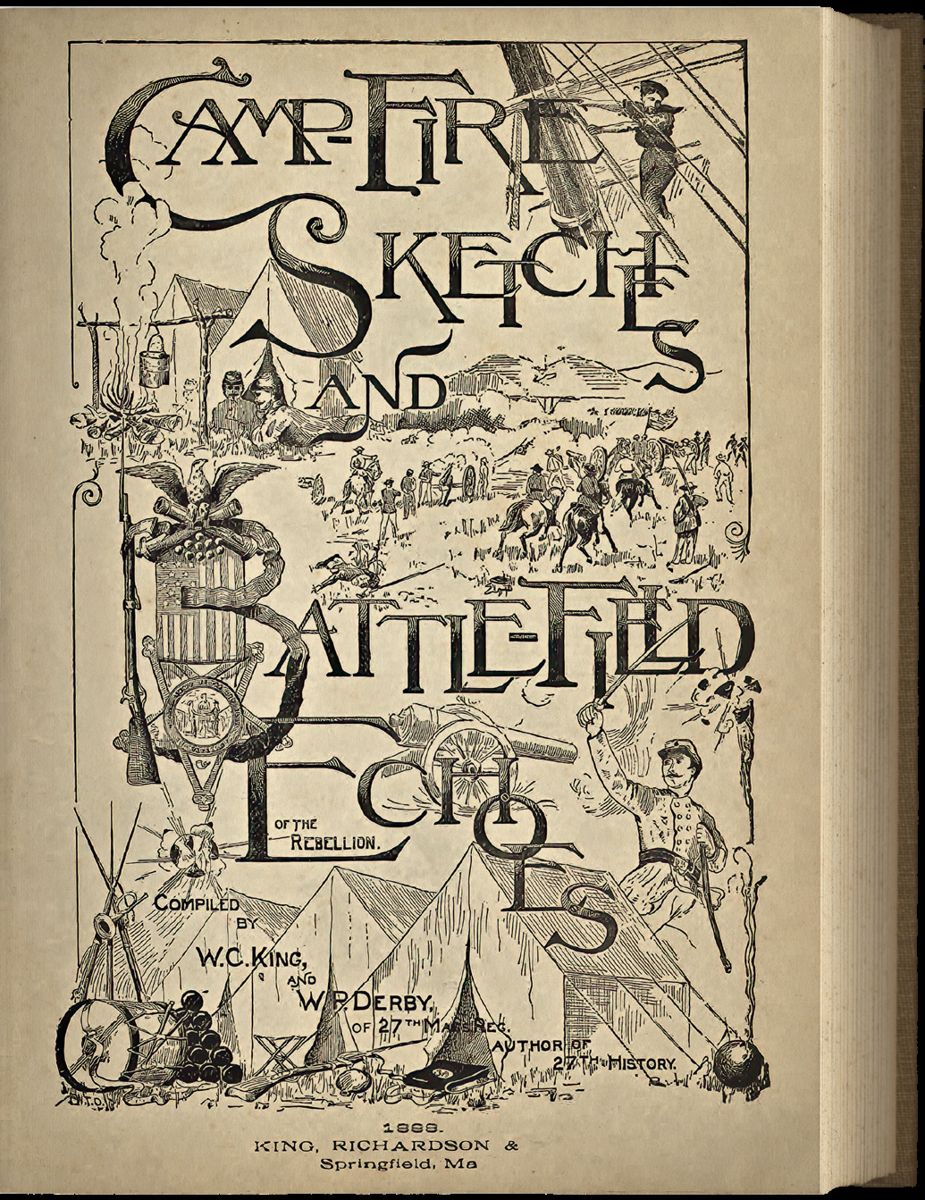
oes of 61-5. Battlefield Ech d an es ch et , pp. 278-280. Camp-fire Sk ardson, 1886 h ic R , g in K : United States
In an interview with the Irvington Southerner, December 1885, Kildee provides these interesting reminiscences.
KILDEE THE FAMOUS SHARPSHOOTER OF THE CONFEDERACY
It was our good fortune a few days ago to meet in Twiggs county, John West, better known during the war by the sobriquet of “Kildee,” the most noted sharpshooter of the Confederate service. In response to our inquiry, he gave us some interesting facts connected with himself in that perilous service. “I was born and reared in Twiggs county, Georgia,” said he, “but went to the war from Louisiana as a private. At
“We were placed under the command of a Colonel Brown, who had no other duties than to command us. We were practiced three months before going into service. A score of every shot was kept during this three months, and at the end I was one hundred and seventy-six shots in the bull’s eye ahead of the rest. The last day of the practice, our marksmanship was tested by our superior officers. A white board, two feet square, with a black diamond about the size of a hat in the centre, was placed 1,500 yards away. The wind was blowing stiffly, and it was very unfavorable for good shooting, but I put three bullets in the diamond, and seven in the white of the board. I beat the record and won the choice of horse, bridle, saddle, spurs, gun, revolvers and saber. Our accoutrements were the best the army could afford. Then we entered active service, and I have been thro’ scenes which have tried men’s souls. I soon became indifferent to danger, and inured to hardships and privations. I have killed men from ten paces distant to a mile. I have no idea how many I killed, but I made a good many bite the dust. “We were sometimes employed separately and collectively; sometimes scouting then sharpshooting. Our most effective work was in picking off the officers, silencing batteries, and protecting our lines from the enemy’s sharpshooters. I am certain I killed Gens Banks and Shields. I was the only confederate sharpshooter on our lines on the days when those generals were killed. The enemy were fourteen and fifteen hundred yards away, and my rifle was the only gun that could reach them. I was shooting at officers, and I know that I killed them. Artillerymen could stand anything else better than they could sharpshooting, and they would turn their guns upon a sharpshooter as quick as they would upon a battery. You see we could pick off their gunners so easily. Myself and a comrade completely silenced a battery of six guns in less than two hours on one occasion. The battery was then stormed and captured. I heard Gen. Lee say he would rather have those thirteen sharpshooters than any regiment in the army. We frequently resorted to various artifices our warfare. Sometimes, we would climb a tree, and pin leaves all over our clothes to keep their color from betraying us. When two of us would be together and a Yankee sharpshooter would be trying to get a shot at us, one of us would put up his hat on a ramrod and poke it up from behind the object that concealed and protected us, and when the Yankee showed his head to shoot at the hat, the other one would put a bullet thro’ his head. I have shot ‘em out of trees, and seen ‘em fall like coons. When we were in grass or grain, we would fire and fall over and roll several yards from where we shot at, and the Yankee sharpshooter would fire away at the smoke. I was captured once. Col. Brown and I got caught inside of the Federal lines at Cold Harbor, and Sheridan’s wagon train was between us and liberty. We had on Yankee coats, and we rode along up the wagon train for some time trying to head it, and escape. But we couldn’t do it. Finally, Col. Brown rode up to a driver and ordered him to turn out to one side and let us pass. “By whose authority?” asked the driver. “By my own,” replied Brown authoritatively. “Who are you?” asked the driver. “Col. Coleman,” answered Brown who had found out the name of the colonel who was in command of the train. The driver then began to question Co. Brown pretty closely, and was about to catch up with us. Col. Brown drew his revolver, and sent a ball crashing through his brain. We turned our horses and dashed down the lines of wagons at full speed, and we ran right into a company of Federal cavalry who were protecting the train. A shower of bullets whistled around us. We wheeled to the right, jumped a stone wall, and just as my horse cleared the wall, a bullet struck him behind the ear, and down we came. Brown’s horse was shot from under him about 20 steps ahead, and we were both captured. John “Kildee” West continues… “As I scrambled out from under my horse, I threw my gun to one side in the grass. Three weeks after that I went back and got it. We were in a tight place. Having on Yankee coats, we would certainly be shot for spies. Night came on and we were guarded by four sentinels, who paced back and forward in a square several yards in extent. It was very dark. During the second watch, I whispered to Brown that I was going to leave. He asked me how it could be done. I told him I’d rather risk four bullets in the dark, than twenty in daylight, at Fort Delaware. He said he would follow me. We then began crawling like snakes, out of the square. Four times a sentinel passed right by us. We kept gliding along until we were entirely out. We straightened up when about fifty yards from the sentinels, and struck out for the mountains. We came near perishing for want of food, before we could get back to the Confederate lines.
yards, and was concealed behind a rock. Several times he had shot at me. About fourteen hundred yards in front of us was a strip of woods. I knew the sharpshooter was in them somewhere, but the tree tops prevented my seeing the smoke of his gun. He hadn’t shot at me in two hours, but confined his fire to the line in my rear. “Gen. Doles advanced to where I was and asked me if I couldn’t silence that fellow, as he was doing terrible execution in his lines. I told him I had been trying to do it all day, but had failed. He asked me to do my best. He then stepped in front of me, and faced the woods, exposing his entire person. I told him he had better look out as that fellow had shaved me very close several times, and it was dangerous to expose himself. “I had scarcely spoken the words when a ball struck him in the right side, passing through his body and coming out under his left arm. Gen. Doles turned half around and fell forward, face downward, and never spoke – being killed instantly. I carried him off the field, and was detailed to carry his remains home. Gen. Doles was a fine officer. “I was shot through the body once. While I was in the hospital Charley Grace of LaGrange, Ga. used my gun, and is said he killed Gen. Sedgwick, but others doubt it. Four of the guns [Whitworths] were captured during the war. I lost mine at the surrender, while I was trying to conceal it in my blanket, to carry home with me. I think I will be able to get it yet, as Gen. Phil Cook, Joe Brown and others are trying to obtain it for me Charles D. Grace from the government. It (1840–1906) was private property, and I was entitled to it. The Fourth Georgia Regiment regard it as a valuable relic.” Source: Savannah Morning News. (Savannah, Ga.), December 14, 1885, page 5. Reprinted from the Irwinton Southerner. John W. West enlisted July 9, 1861, as a private in Company C, 4th Georgia Infantry. He surrendered April 9, 1865, at Appomattox Courthouse.
“I was within ten steps of Gen. Doles when he was killed. A Federal sharpshooter had been picking off our men all day, and I had been trying for hours to locate him, but had failed to do so. I was in advance of our line a hundred
A Theory on Who Killed Major General John Sedgwick
D By Jack W. Melton Jr. and Lawrence E. Babits uring the 1864 Overland Campaign against Confederate forces protecting Richmond, Major General John Sedgwick was killed at Spotsylvania, famously just after stating that “they couldn’t hit an elephant at this distance” (Pollard, Edward Alfred. Southern History of the War: The Third Year of the War. United States: C. B. Richardson, 1865, p. 265). The distance from Sedgwick to the Humphreys and Henagan Brigades skirmish line in front of their earthworks was about 600 yards. The distance down the Brock Road from the northern junction with Grant Road to General William Wofford’s skirmishers at the southern junction with Route 628 was a little over 500 yards. Either distance suggests that a sharpshooter may have deliberately targeted him. Deliberately targeting an officer suggests Sedgwick was mounted but the record is confused. Witnesses reported a distinctive whistle was attributed to the Whitworth bullet in flight was heard about the time the general was struck down (Tim Prince Whitworth Article this issue 2022 Military Antique Collector, Vol. 2, (1):15). This article presents views challenging those who claimed they, or who were credited, with firing, fired the fatal shot. Sedgwick was born in Connecticut and graduated from West Point in 1837, in the class that also contained Braxton Bragg, Jubal Early, John C. Pemberton, and Joseph Hooker. During the army’s expansion while Jefferson Davis was Secretary of War, Sedgwick was assigned as Major to the First Cavalry under Colonel Robert E. Lee and Lieutenant Colonel William Hardee. When the War broke out, he was a lieutenant colonel with prior service in the Seminole Wars, Mexican War, and during the campaign against the Mormons. He was promoted to brigadier general during 1861 While Hooker tried to march around the Army of Northern Virginia in May 1863, Sedgwick’s VI Corps was
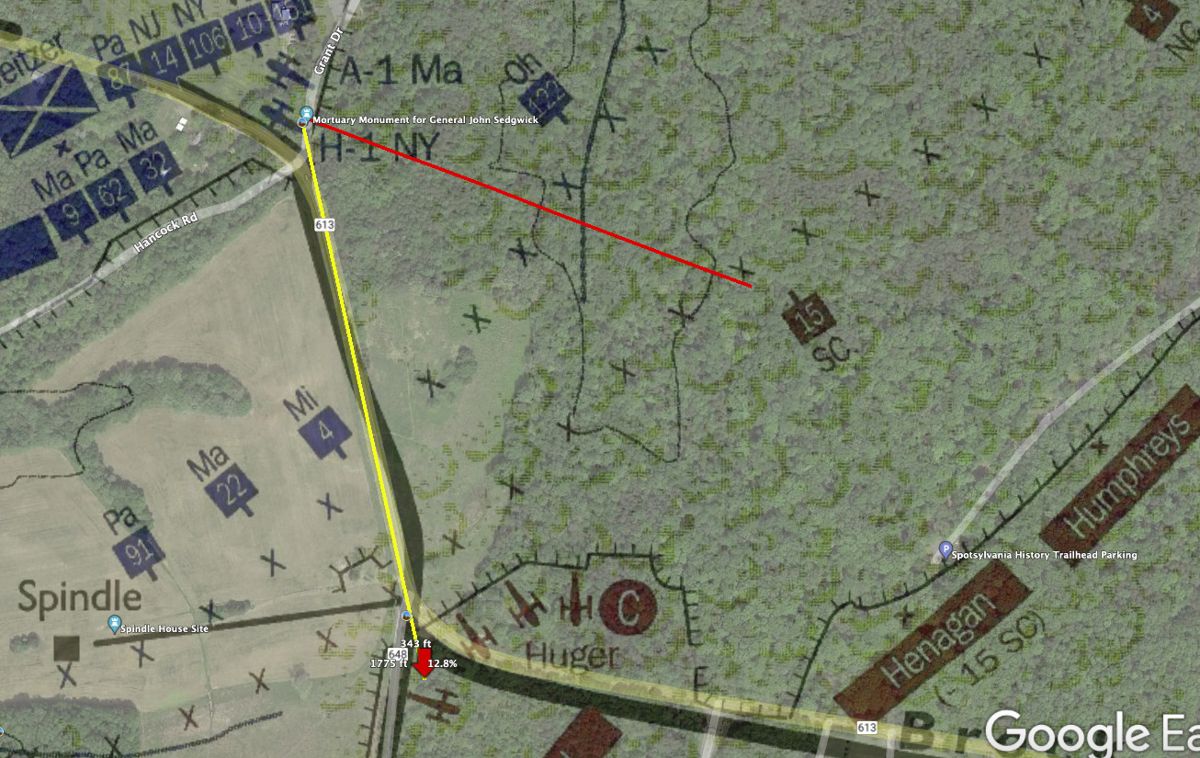
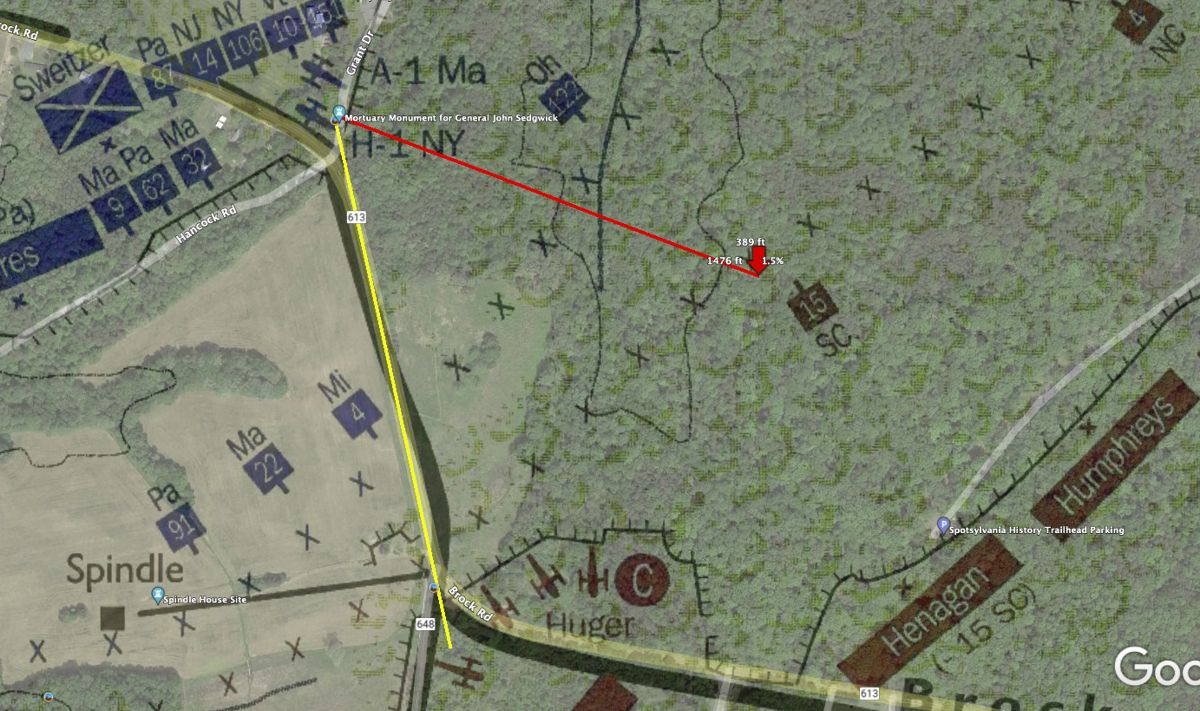
The upper road junction provides the location toward which Confederate fire was directed. Using the artillery position marked by the Sedgwick monument as a starting point, a line comparable to the 1,200 yard range of a Whitworth rifle using iron sights can be extended out to the east and then arced around to the south and southwest. Where that line intersects the Confederate positions and the skirmish line in front of them identifies potential sharpshooter locations. To narrow down the possible site, a second point The approximate location of Company F, 15th South Carolina Infantry, has been estimated northwest of the artillery by using the location where two fired Whitworth bullets were recovered on private property to position where two fired generate the red line drawn through the Sedgwick monument. This spot is actually the center Whitworth bullets were of the Fifteenth’s skirmish line and not a position where the target area could be seen. recovered from private assigned to take the Confederate Marye’s Hill position at property, limits the arc of possibilities because the shooter’s Fredericksburg that bloodily repulsed the December 1862 location must be on a straight line from the bullet recovery attacks. His men carried the position and advanced to site through the Sedgwick monument. Extended out to support Hooker who was already recoiling from Jackson’s 1,200 yards, the line should pass through the sharpshooter’s flank attack at Chancellorsville. The VI Corps attempt to location. reach Hooker’s was thwarted by Confederate resistance at Salem Church. The corps was spared at Gettysburg, but then One issue that will be referred to several times later is played a major role through the rest of the war. Sedgwick’s tree cover. It is hard to see or shoot through woods. The military career was marked by excellent performance and 6th Maryland’s Lieutenant Erastus Norvell was in charge of gallantry. His men loved him, even Lee respectfully and Colonel Benjamin F. Smith’s pioneers who were fortifying warmly regarded him. ” “Uncle John” never married; the the road junction. He pointed out that “there was an old army was his family. road which ran through the woods to a clearing in front of our lines, and about 500 yards across the clearing stood an Sedgwick’s VI Corps was subjected to long range fire old chimney, which concealed the sharpshooter who fired April 8, so he must have been aware of the danger. He the fatal shot” (Erastus S. Norvell, “Sedgwick’s Death: Maj. was certainly no stranger to being struck as he had been Norvell, 6th Md., Tells of the Sad Event,” National Tribune, wounded at Glendale during June 1862; less than three June 16, 1887). The most important parts of his recollection months later he was hit three times in Sharpsburg’s West are that there was a 500 yards long line of sight in front of Woods. At Spotsylvania, his aides tried to make him the position and that the sharpshooter may have been near take better care while he was busy chiding others for an old chimney where he saw a puffs of smoke. Later, he dodging Confederate fire (A Season of Slaughter The Battle mentioned that General William Morris, the other brigade of Spotsylvania Court House, May 8-21, 1864. Christopher W. commander of General James Ricketts’ Division was Mackowski and Kristopher D. White, Savas Beatie, 2012:39). wounded at the same point a short time before Sedgwick was hit. While he says it was the same shooter who shot The Confederate fire was actually directed at a two-gun the two generals, and other men, within a “half an hour,” section, probably of the 1st Massachusetts Artillery (A.J. that could be hard to prove as there were other skirmishers Bennett, The Story of the First Massachusetts Light Battery, firing on the artillery section. Attached to the Sixth Army Corps: A Glance at Events in the Armies of the Potomac and Shenandoah, from the Summer of 1861 Norvell’s comment about a chimney “about 500 yards to the Autumn of 1864 (Boston: Press of Deland and Barta, across the clearing” suggests the shot may have come from 1886), 151-152), positioned in the ”Y” where Brock Road the Spindle Farm house lot, a little over 500 yards from the divided at the northeast corner of the Spindle Farm’s field. road junction. Not only is there a clear field, but the position Cutting down artillerymen was, like picking off officers, a allowed enfilade fire onto the right flank of the artillery primary goal of sharpshooters. In the hail of bullets directed section. Enfilade shots are particularly effective because at the gun crew and officers around them, Sedgwick was hit. they can be under or over and still hit men in a line.
At least three sharpshooters are traditionally named as having used a Whitworth rifle to kill Sedgwick. They are; Thomas S. Burgess, Charles D. Grace, and Benjamin M. Powell. It is interesting that the three soldiers came from three different Confederate corps, almost as if each corps had a vested interest in claiming Sedgwick’s death. At any rate, by limiting the search to just three men, it is relatively easy to first locate their brigade and then their regiment. Private Thomas Burgess was in Company F, 15th South Carolina Infantry, a regiment assigned to General Joseph Kershaw’s Brigade, McLaw’s The possible location of another Whitworth sharpshooter was at the “Y” intersection of Division, Longstreet’s First the Brock Road and Route 648. The yellow line on the chart illustrates the line of sight Corps. As a result of casualties between the two positions. The slightly lower elevation at the road junction might have and politics, Richard Anderson blocked a view of the artillery position, but the difference of a few feet and a victim on now commanded the First horseback might make it possible. Corps; Kershaw was leading McLaw’s Division while line shown on the map, he would have been 1,612 feet, 537 Col. John W. Henagan led Kershaw’s South Carolinians. yards, away from Sedgwick’s monument. The Sedgwick On May 9, Henagan’s Brigade was positioned with its left memorial is located 336 feet above sea level. The elevation flank on Brock Road and extending east along the ridge. makes this shot all but impossible. While the monument The Confederate line extended to their right and joined the is marginally lower than the area immediately in front left of General Benjamin Humphrey’s Brigade, then Battle’s of it, two tree covered ridges are between the skirmish Alabama Brigade from General Robert Rodes’ Division, line’s center and the artillery position. Even without the then General Stephen D. Ramseur’s Brigade to General intervening ridgelines, the fairly dense woods would have Cullen Battle’s right. The 15th South Carolina was assigned made long range viewing impossible except, perhaps along to the pickets, or skirmish line, in front of the Confederate a road. The opposing picket lines were out of sight of each earthworks held by Henagan and Humphreys. This line other and stood in relative safety. was about 500 yards long and Burgess could have been posted anywhere along it. Intervening ridges between the If Burgess was on the left end of the Twelfth’s skirmish skirmishers and the artillery position make it very likely line, directly in front of Henagan’s Brigade’s left flank [just that Burgess was on the left end of the line rather than the north of the C in the red circle on the map], he was center or right. nearer the crossroads of Brock Road and Route 648 (the southern road junction). If Burgess were positioned directly The red square with the 15 inside marks the center of above Huger’s Battery (the C in the red dot), he would the skirmish line. The men were spread out along the lower be slightly higher and still have a reasonably clear sight slopes of the ridge some 400 yards beyond and below their line to the northern road junction about 500 yards away. earthworks and over 600 yards from the Federal artillery Obstructing trees would be limited if he were in a tree as position at the Brock Road junction northeast of the Spindle well. There was no intervening ridge and the tree cover was Farm’s field. Without going forward the ridge crest that was minimal most of the way toward where Sedgwick was hit. behind the Union skirmishers, they Confederates could not Discounting a spot up in a tree, the height in this area is 389 see either their opponents or the artillery along Brock Road. feet. The crossroads is about 1,476 feet, or some 490 yards, That makes it unlikely that Burgess, or anyone else in the from the Sedgwick Monument. The height of the Sedgwick 12th South Carolina, shot Sedgwick because he could not monument is 336 feet, and the elevation of the spot where have seen him from the middle or right half of the skirmish two fired Whitworth bullets were found on private property line. is 325 feet. The alignment is intriguing because a shot from this position could drop where the bullets were found. If the The ridge where the Henagan and Humphreys Brigade common problem of “overshooting” when firing downhill skirmishers were positioned is 343 feet in elevation and occurred, the bullet find area is pretty telling. This location southeast of the Brock Road and Grant Road intersection. makes it somewhat possible that Burgess fired the fatal shot. If Burgess was located at the center of 15th SC skirmish
Charles Grace was in Company B, 4th Georgia Infantry, a unit in Brigadier General George Doles’ Brigade, Major General Robert E. Rodes’ Division of Lieutenant General Richard S. Ewell’s Second Corps. Doles’ Brigade was stationed on the left flank of the Mule Shoe Salient east of the road connecting the Scott/Shelton Farm One of two fired Whitworth with the Harrison bullets that were recovered from Farm. Measured on private property behind General a straight line from a John Sedgwick’s memorial. map, this distance is (Rusty Hicks Collection) almost a mile (ca 1,500 yards) from the Brock Road/Grant Road junction where Sedgwick was killed. The Fourth Georgia was positioned on the brigade’s right flank. Company B was not only much farther away from the road junction but the intervening land included two tree covered ridges that were higher than the Fourth’s position. This situation did not provide a reasonable field of fire for long range shooting. At 1,500 yards the range was not beyond the Whitworth rifle’s capability using the Davidson sight, but the intervening tree cover would pose severe problems. The questions about tree cover, ridge elevations, and the Fourth’s exact location must be answered before suggesting Grace as the shooter. Benjamin M. Powell served in Company I, 12th South Carolina Infantry, on the right flank of McGowan’s Brigade (letter from Benjamin Powell to his wife dated Nov. 21, 1907, published in “The Westchester Civil War Round Table Newsletter,” Croton Falls, N.Y., November 1980; Dunlop, William S., Ward, Robert F. Lee’s Sharpshooters; Or, The Forefront of Battle. A Story of Southern Valor that Never Has Been Told. United States: Tunnah & Pittard, printers, 1899, pp. 47-49). The Twelfth was part of Brigadier General Samuel McGowan’s Brigade, in Major General Cadmus Wilcox’s Division of A. P. Hill’s Third Corps. As with the First Corps, the Third was led by a temporary replacement while Jubal Early filled in for a sick General Hill. There is better documentation for the activity of the McGowan’s Brigade where Powell is claimed as the Sedgwick shooter. This detailed account notes the brigade’s position on the far eastern flank, southeast of Spotsylvania Courthouse. Since the 12th South Carolina was on the right flank, Powell could not be considered as participating in the Brock Road fighting where Sedgwick was killed. Still, the following account, given by Major William Dunlop detailed movements of the brigade’s sharpshooters on May 9, 1864. Remember, the 12th South Carolina was not near the Brock Road junction with Grant Road on May 9. The relevant statements are highlighted for this article.
“Hill’s corps reached the field early on the morning of the 9th, and was placed in position east of the court house, on the Confederate right. This day was principally spent by both armies in active preparations for the impending conflict, with now and then a sharp fusilade between the opposing skirmish lines, as when one or the other of the great captains pressed his lines here and there too far to the front and trespassed upon the territory claimed by the other. In the settlement of these preliminary difficulties the sharpshooters took a lively interest; and whenever or wherever their services were needed for the adjustment of any misunderstanding as to the rights of parties, they were freely contributed. As soon as McGowan’s brigade [Wilcox’s Division, Third Corps] was assigned its place on Hill’s line the sharpshooters were ordered out, with instructions to cross the small stream in front and sweep through the thicket beyond, until the position and strength of the enemy were discovered. The order was promptly obeyed, and we drove forward across the stream and through the woods until we reached the backbone of the ridge, near the edge of a field which lay out beyond. Here we could plainly see Sedgwick’s corps in line of battle on the crest of another hill, busily engaged in rectifying their lines and constructing breastworks, with their skirmishers well advanced. Upon these we opened a scattering fire with some effect. We discovered an angle protruding from their main line towards the right of the battalion, which brought a four gun battery with its infantry supports placed there for the defense of the salient, barely within reach of our long range rifles. And to these Ben Powell with his ”Whitworth” and a few files on the right paid their respects. Presently an officer of rank with his staff approached the salient, and adjusting his field glasses began to take observations of the front. A few shots only had been fired at the group, when the ringing peal of Powell’s ”Whitworth” was heard some distance to the right; the officer was seen to stagger and fall; and the brilliant career of that gallant and distinguished soldier, Maj. Gen. Sedgwick, commandant of the fifth Federal army corps, was closed and closed forever. Powell reported at once that he had killed a Federal general, but we knew not his name or rank until it came out a few days later in the Northern papers, announcing that General Sedgwick had been killed by a Confederate sharpshooter; which fact, so published at the time, has gone into history, but the name of ”the man behind the gun” has never before been mentioned.”
CONCLUSION
Starting from McGowan’s starting position on the Army of Northern Virginia’s right flank, the account does not ring true. The battery where Sedgwick was killed was only a two gun section, located at a road junction on lower ground, not a ridge. Sedgwick was leading the VI Corps. In addition, the Third Corps reached their position east of Spotsylvania in mid-afternoon May 9, via a route that would have taken them almost a mile south of the Spindle Farm and Sedgwick was shot north of that property (James I. Robertson, General A. P. Hill. New York, Random House, pp. 268-69; Douglas S. Freeman, Lee’s Lieutenants III:392, New York: Charles Scribner’s Sons, 1951, pp 392). Powell also claimed that he shot the officer in the morning (Augusta Chronicle, Augusta, Ga., November 25, 1917). Another VI Corps general, William H. Morris, was wounded on May 9. Morris was leading the VI Corps’ First Brigade, Third Division, when shot and he was north of the Brock Road/Grant Road junction where Sedgwick was hit (Ezra J. Warner, Generals in Blue. Baton Rouge: Louisiana State University Press, 2002, p. 336). Again, Powell’s regiment was nowhere near the site. The same argument for excluding Powell from Sedgwick’s death, applies to the Morris wounding. In Scales’ Brigade on McGowan’s left, Private Monroe Robertson, Company A, 13th North Carolina, was presented with a Whitworth Rifle by General William Dorsey Pender some time before July 18, 1863 (this issue page 58). Robertson was never credited with shooting Sedgwick but the fact he had a Whitworth and was in the line next to Powell’s unit, makes him ineligible as well. Two of the three candidates put forward as the man who shot Sedgwick were not located where they could have done so. There are still other things to consider. Was it a Whitworth bullet? There were certainly Whitworth’s firing in that area, at least two have been found near the Sedgwick monument. How did the witnesses know the bullet was from a Whitworth? At least one witness, General Martin McMahon, Sedgwick’s chief of Staff, said he heard the distinctive “long shrill whistle” of a Whitworth round at the time the general was hit. That doesn’t necessarily mean he was hit by one. The Confederates had the artillery position under fire and much of it was apparently typical bullets or they would not have remarked on the Whitworth sound at the time Sedgwick was hit. If there were as many bullets flying through the air as the accounts suggest, even the whistling sound attributed to the Whitworth would not “prove” Sedgwick was shot by that weapon. The standard .58 caliber rifle musket could easily carry the 600 yards from the C position to the monument and still have the necessary striking power, so the general may have been by a ”mere skirmisher” who was also firing on the position when the bullet hit home instead of a sharpshooter. That doesn’t sound as interesting as if he were struck by a designated shooter firing a unique weapon. There really is no other confirmation short off exhuming the body to check on this. Even that ghoulish effort might not be useful because there is no information about whether or not the round exited his head. No one says. Was Sedgwick mounted? If not, how could the skirmishers a quarter mile and more away tell he was an officer, much less a general? At least one account said he prodded a soldier with his foot, something he could only have done while dismounted. If Sedgwick was mounted, he would have stood out as well as being foolish. If on foot, he would have been virtually indistinguishable from the ruck of soldiers digging the guns in and returning fire. Although there are no names ascribed to sharpshooters in General Evander Law’s Alabama Brigade, there is a possibility that the fatal shot came from a soldier assigned to the 4th Alabama. Lieutenant Robert Cole served in the Fourth and he recalled, “We had brought our Whitworth rifles from Virginia with us,” when the unit fought at Chickamauga with Longstreet’s Corps (See Tim Prince Whitworth article, page 7, this issue). Law’s Brigade was under Colonel William F. Perry on May 9. The brigade was posted on a ridge line with the skirmishers at the edge of woods. This position was not only almost level with the artillery section where Sedgwick was killed but the men had a clear field of fire across the Spindle fields. On top of all that, they were shooting slightly uphill and had the sun at their backs, a situation similar to the Devil’s Den/ Little Round Top sharpshooting a year earlier. Why no one came forward from the 4th Alabama to claim credit may be because they didn’t know. A special thanks to Christopher W. Mackowski, Ph.D, and Edward Alexander, for additional research on this subject. Co-authors Jack W. Melton Jr. is the publisher, and Lawrence “Larry” Babits is the editor of The Artilleryman magazine, Civil War News, and Military Antique Collector magazine.
J&J Military Antiques
Part 1 – 1st Models by John Sexton