
£100 Lloyd’s Patriotic Fund Sword of Captain Robert Redmill
Courtesy Rock Island Auction Company · Originally published March-April 2023 · pp. 54–66
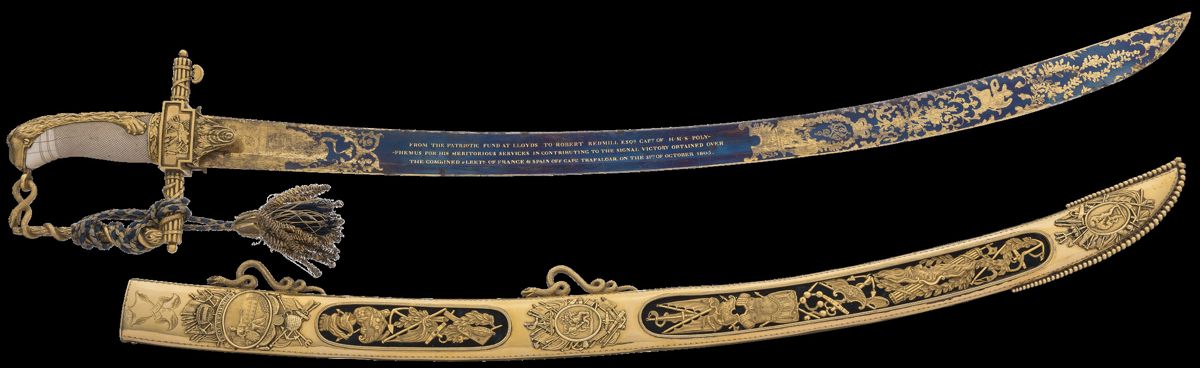
This well documented cased Richard Teed £100 sword, scabbard, and sword belt were presented by The Lloyd’s Patriotic Fund to Captain Robert Redmill of the HMS Polyphemus for his meritorious service at the 1805 Battle of Trafalgar. This sword set was crafted by Richard Teed of Lancaster Court, Strand, London. It is the £100 grade, the highest of the three grades, and reserved for captains. These swords were presented and paid for by the Lloyd’s Patriotic Fund. Lloyd’s Patriotic Fund was founded on July 28, 1803, at Lloyd’s Coffee House to help fund veterans who were wounded in service and the dependents of men who were killed in action. As one example, the fund donated over £60,000 to the Royal Naval Asylum in 1807. The Fund also recognized British naval personnel, including Marines, for service seen as beyond the call of duty. These prizes were awarded in various forms as cash, a sword or silver plate. The string of victories rewarded by Lloyd’s, including twenty-three swords just for Trafalgar, created a drain on resources, so emphasis was changed to ensure priority went to support the wounded and dependents. Today, the Lloyd’s Patriotic Fund still works closely with armed forces charities to identify individuals and their families who are in urgent need of support. Lloyd’s Patriotic Fund issued almost 150 swords before discontinuing the practice. They came in three grades based on the recipient’s rank. The swords for Midshipmen, masters’ mates, and marine lieutenants were valued at £30 pounds. Navy lieutenant and marine captain swords were rated at £50, while commander and navy captain swords were £100. There were fifty-eight £100 swords issued, including twenty-three that went to Royal Navy captains who fought at Trafalgar. These swords are found today in multiple prestigious collections such as the Metropolitan Museum of Art, Royal Museums Greenwich, and Royal Armouries. Very few are held in private collections, especially outside the United Kingdom. Only some 175 swords across all three grades were awarded by the fund before the practice ended in 1809.
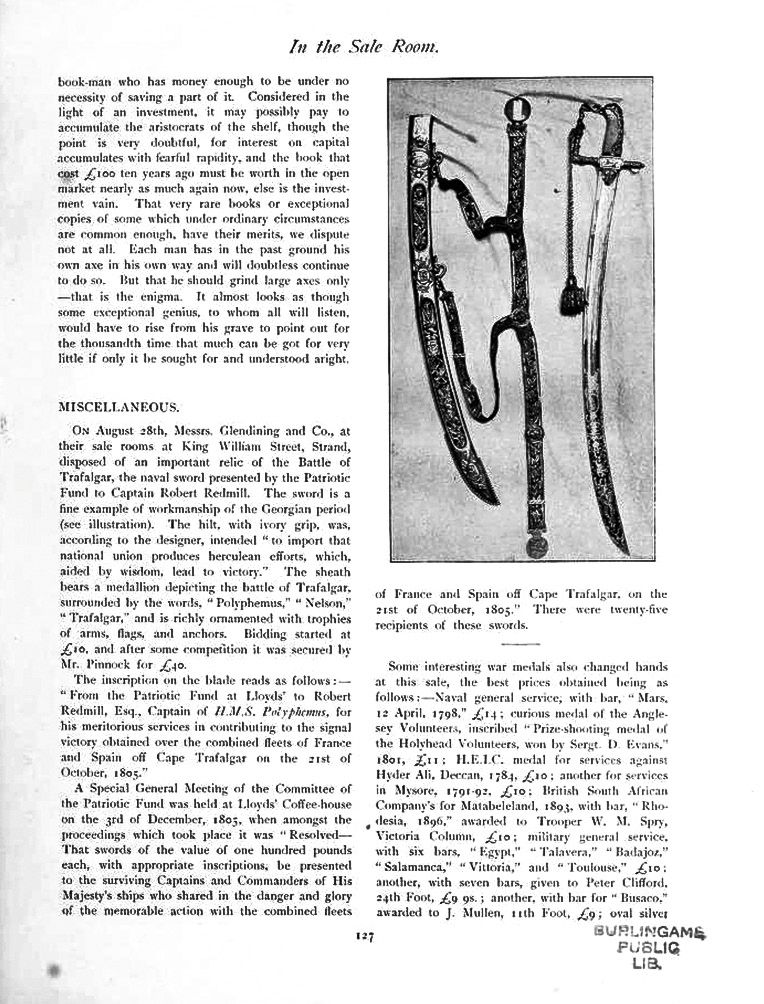
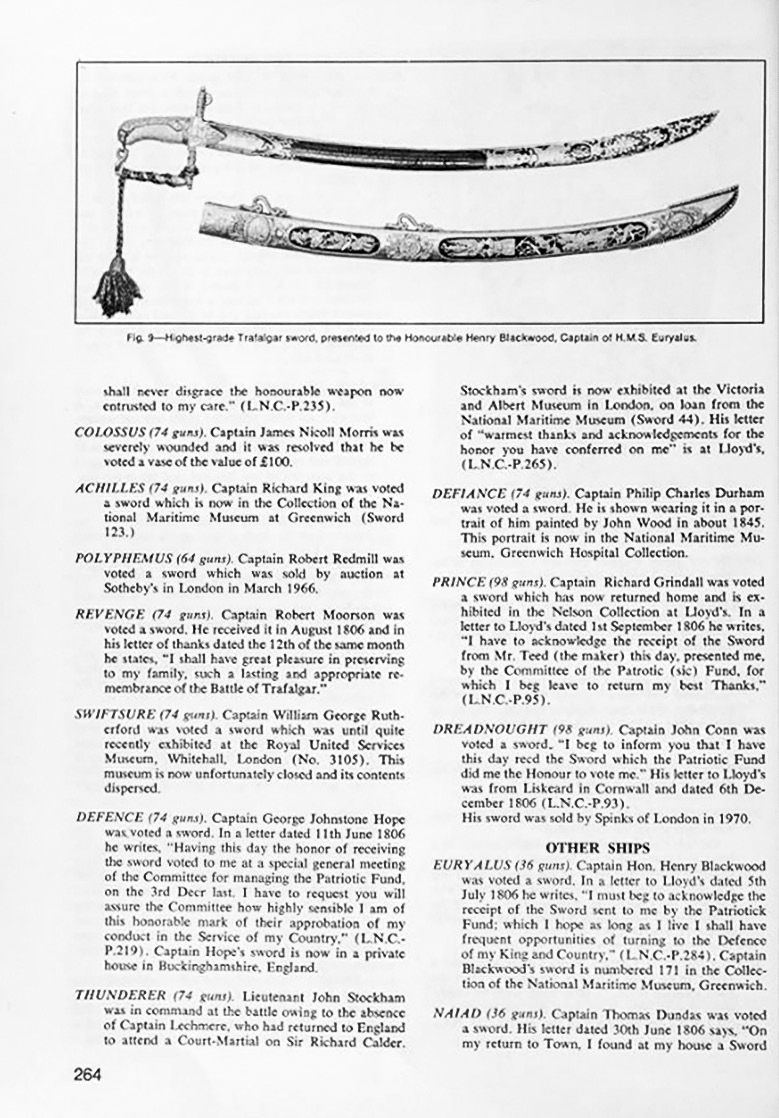
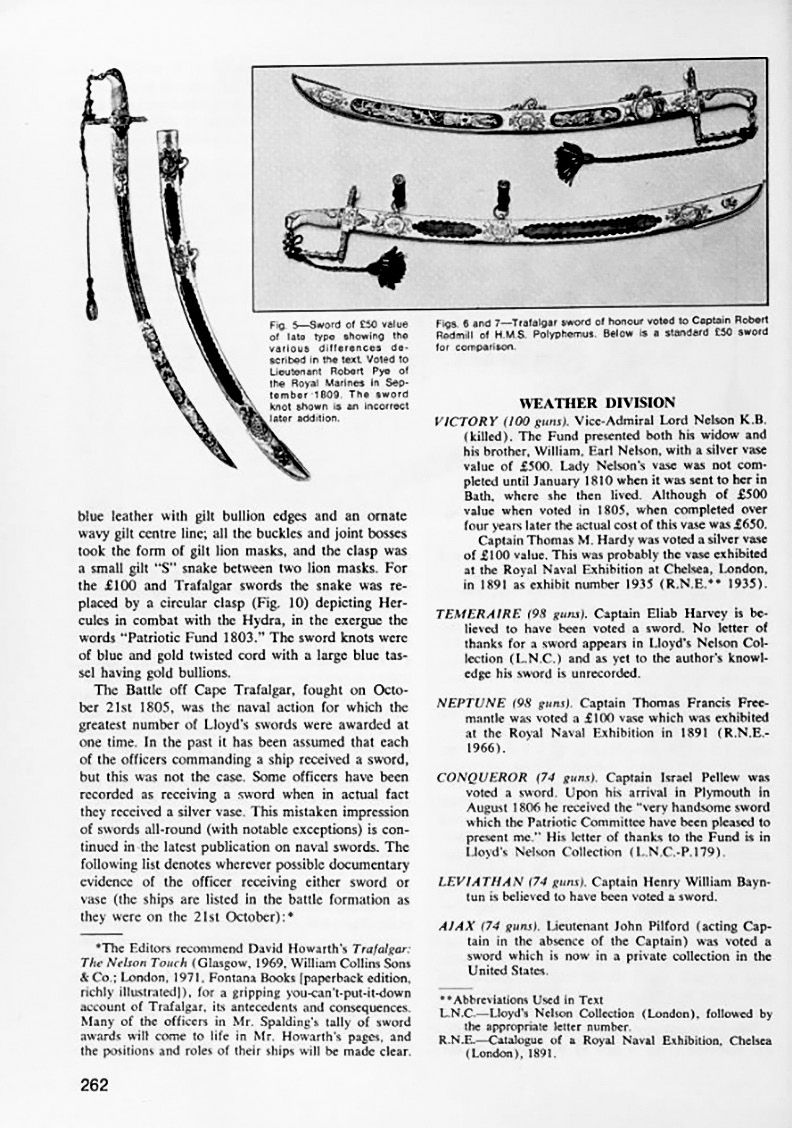
given his own command until 1799. Redmill and his ship participated in the invasion of Egypt in 1801, and was granted a gold medal by Selim III, Sultan of the Ottoman Empire. Following the Battle of Trafalgar, Redmill served during the 1806 Atlantic Campaign, but severe illness, forced his retirement to England. He was lauded as a hero, but unable to find work due to his poor health. He was made a Companion of The Order of the Bath on June 4, 1815, a reward for his long and honorable service. Redmill died in Stevenage during February 1819. His grave at St. Nicholas Church is no longer known, just as the many details about his final years. The World War II U.S. built destroyer escort HMS Redmill was named in his honor. The sword’s provenance runs from Captain Robert Redmill and family from 1805 to 1824. There is a period of unknown ownership from 1824 to 1901. The sword was offered for sale by Messrs. Glendining & Co. August 28, 1901, and then by Sotheby’s during March 1966. Butterfield & Butterfield offered it on October 15, 1996, John Rinaldi, and William Koch. This individual sword was illustrated and discussed on page 127 of The Connoisseur: An Illustrated Magazine for Collectors Vol. 1 (1901) which notes, “A Special General Meeting of the Committee of the Patriotic Fund was held at Lloyds’ Coffee-house on the 3rd of December, 1805, when amongst the proceedings which took place it was ‘Resolved — That swords of the value of one hundred pounds each, with appropriate inscriptions, be presented to the surviving Captains and Commanders of His Majesty’s ships who shared in the danger and glory of the memorable action with the combined fleets of France and Spain off Cape Trafalgar, on the 21st of October, 1805.’ There were twentyfive recipients of these swords.” This particular sword was listed as sold by Messrs. Glendining & Co. on August 28, 1901. It is also shown on
This particular sword was presented to Captain Robert Redmill (c. 1765 – February 1819), commander of the Intrepid class, third rate ship of the line HMS Polyphemus. Redmill was a British naval officer who served during the French Revolutionary and Napoleonic Wars. He is virtually unknown today but he had a solid, if almost unspectacular, naval career and is remembered today for his performance immediately after Trafalgar. He was made post-captain in December 1796 but not page 262 and discussed on 264 of 1973 Arms and Armor Annual Vol. 1 where it was identified as being sold by Sotheby’s in London in March 1966.
HMS Polyphemus Redmill’s Polyphemus was ordered in 1773: her keel was laid at Sheerness in 1776. She was launched in 1782 and commissioned under Captain William C. Finch, who then sailed her to Gibraltar. Named after the cyclops blinded by Odysseus in Homer’s “Odyssey,” the battleship was 159.5 feet long on the gun deck (in modern terms, roughly between perpendiculars) with a keel length of 131 feet, a beam of 44 feet, 4 inches. At the time these worked up to give a rating of 1369 and 50/94 tons. The odd fraction is because part of the “Builder ’s Old
Measurement formula calculation included dividing the hull’s volume by ninety-four. The Polyphemus was one of sixteen two-decked third rates in the Intrepid/Magnanine Class. Third rate ships were line of battle ships carrying twenty-six, 24-pounders on the gun deck, another twenty-six, 18-pounders on the weather deck, and ten, 9-pounders on the quarter deck. The ship and her guns were worked by a crew of approximately 500 men. Polyphemus had connections to a variety of famous British seaman and their battles.
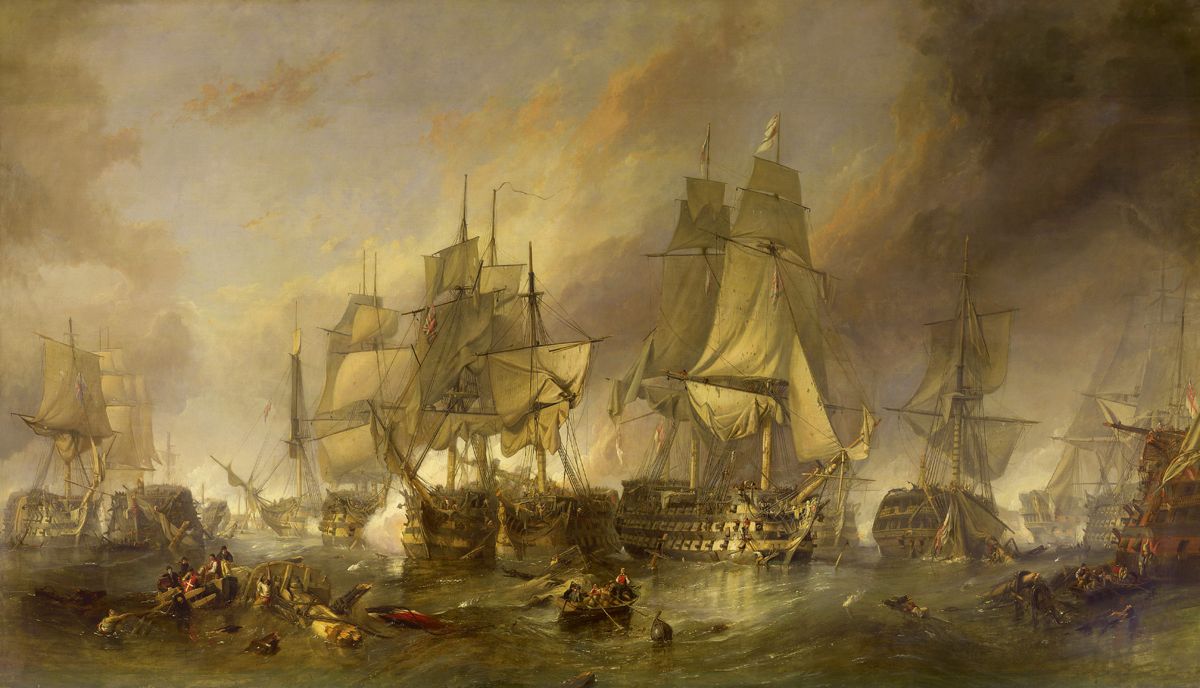
The Battle of Trafalgar, oil on canvas, by William Clarkson Stanfield (1793–1867), 1836.
Under Admiral Richard Howe she successfully resupplied Gibraltar despite it being under siege. The ship was present when the British fought a Franco-Spanish fleet in the October 20, 1782, battle of Cape Spartel. In late 1782, Admiral Sir Richard Hughes led a squadron, including Polyphemus, to the West Indies that fought a French convoy off Martinique. For that engagement the Polyphemus crew shared in prize money for capturing a vessel. On the Irish station she was the flagship for Admiral Robert Kingsmill, took part in capturing several vessels, and broke up a 1796-97 French attempt, Expédition
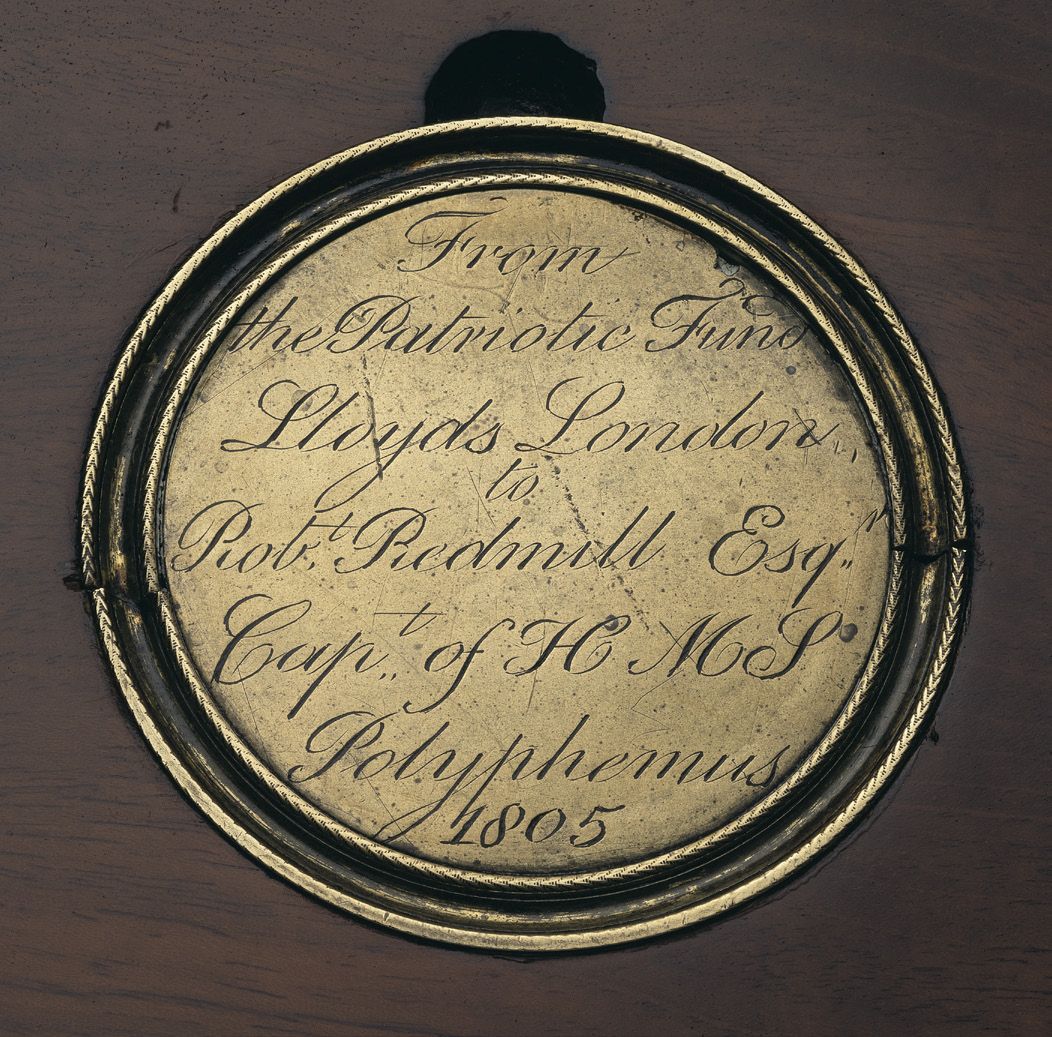
Metal medallion on the mahogany case lid is inscribed:
From the Patriotic Fund Lloyds London to Robt Redmill Esqr Capt of HMS Polyphemus 1805
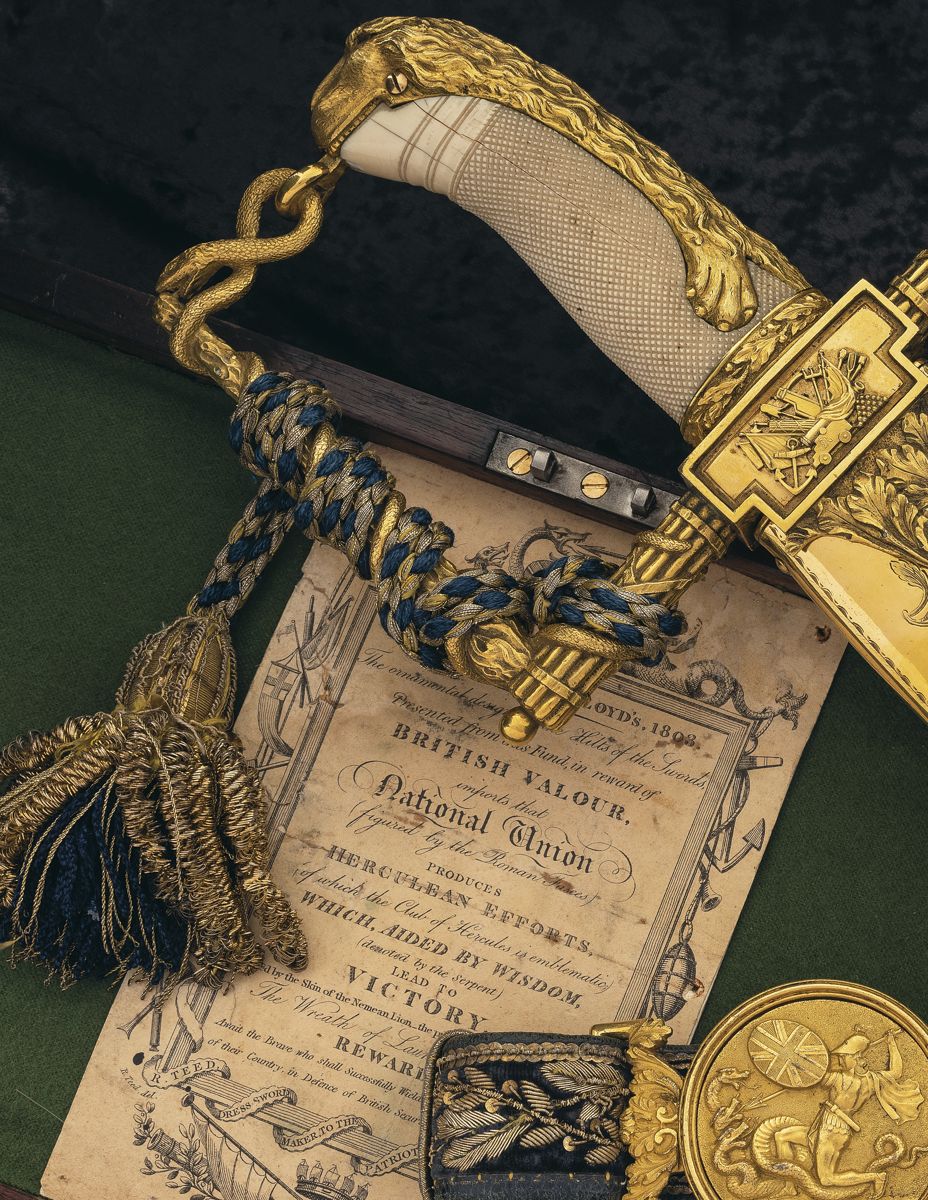
The label inside the lid explains the details of the sword: “PATRIOTIC FUND, LLOYD’S 1803. / The ornamental design for the Hilts of the Swords, / Presented from the Fund, in reward of / BRITISH VALOUR, / imports that / National Union (figured by the Roman Faces) / PRODUCES / HERCULEAN EFFORTS, / (of which the Club of Hercules is emblematic;) / WHICH, AIDED BY WISDOM, / (denoted by the serpent) / LEAD TO / VICTORY (implied by the Skin of the Nemean Lion, the proudest of that Hero’s Trophies) / The Wreath of Laurel denotes that / REWARDS / Await the Brave who shall Successfully Wield their Swords in the Cause / of their Country, in Defense of British Security, Independence & Honor.” Below these details is “R. TEED DRESS SWORD MAKER, TO THE PATRIOTIC FUND, LANCASTER COURT STRAND.”
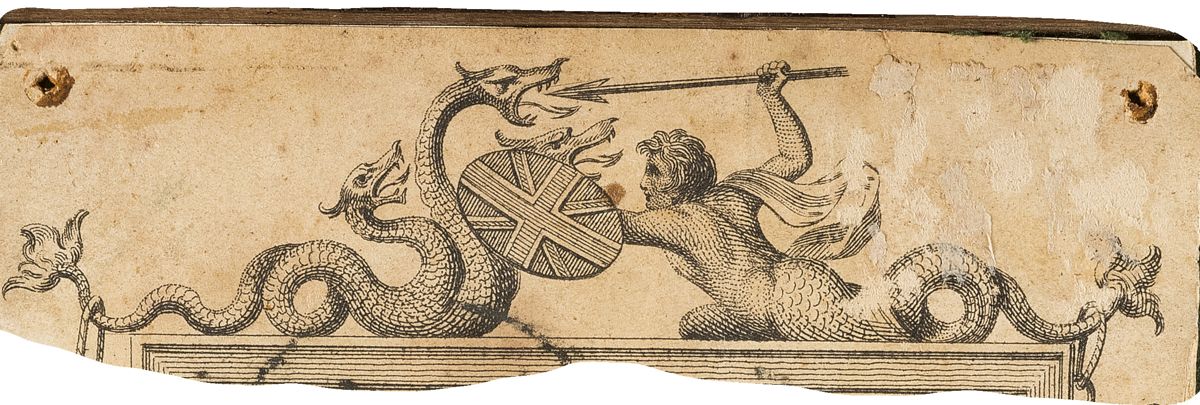
The floral embroidered sword belt has a gold buckle with Britannia slaying a triple headed hydra over “PATRIOTIC FUND / 1803,” gilt lion mask hangers, and anchors as part of the designs on the other gold hardware.
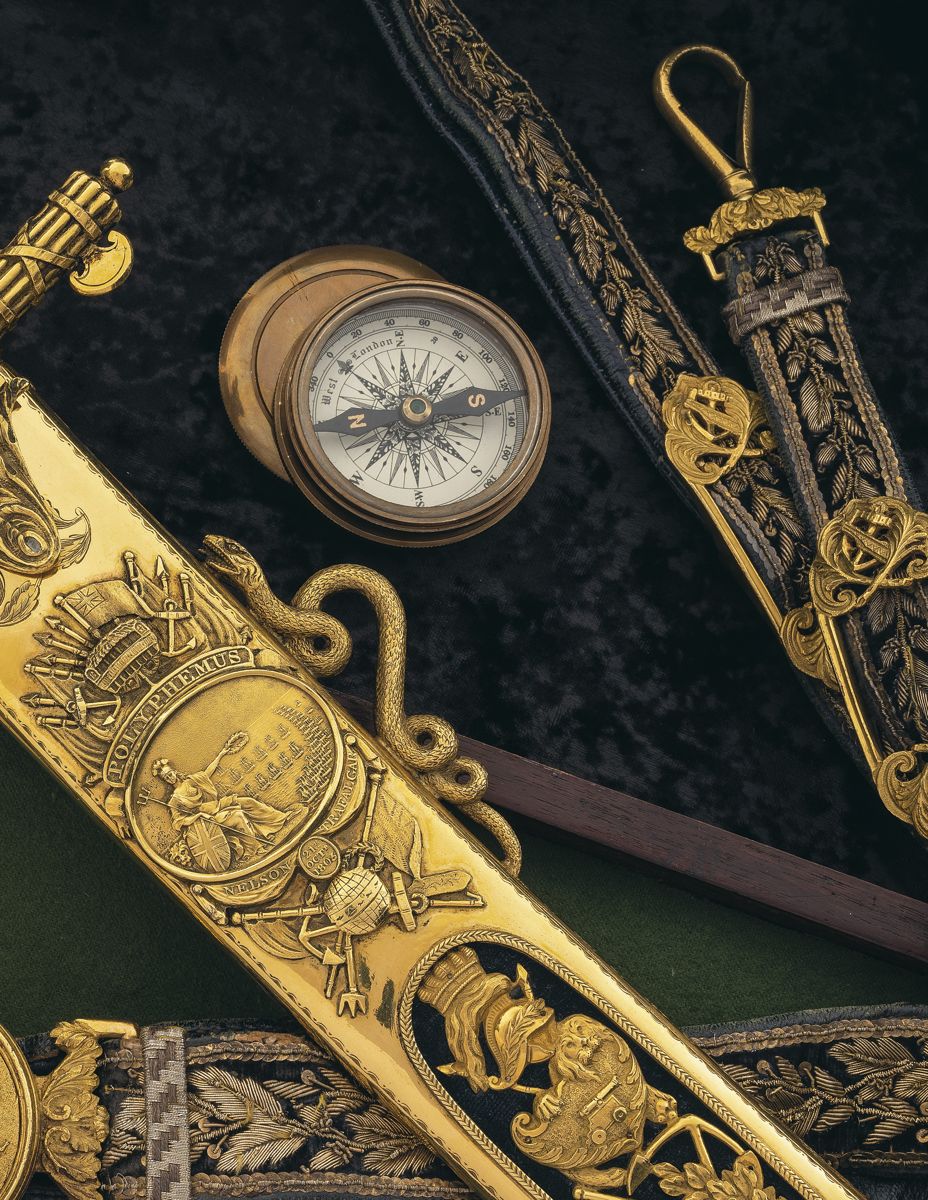
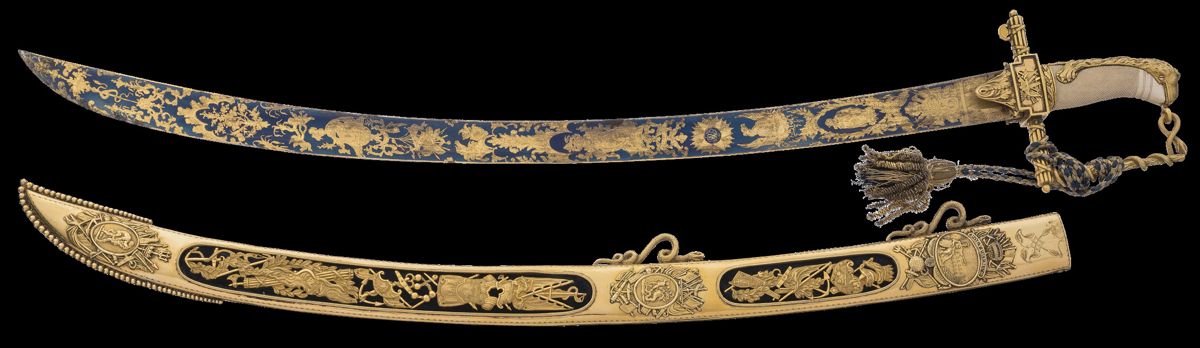
The 30 ½-inch curved, single edged blade is fully decorated with neoclassical, martial, naval, and British patriotic gilt designs on a niter blue background. The obverse side of the blade has: FROM THE PATRIOTIC FUND AT LLOYDS TO ROBERT REDMILL ESQR CAPT OF H . M . S POLY-PHEMUS FOR HIS MERITORIOUS SERVICES IN CONTRIBUTING TO THE SIGNAL VICTORY OBTAINED OVER THE COMBINED FLEETS OF FRANCE & SPAIN OFF CAPE TRAFALGAR ON THE 21ST OF OCTOBER 1805.
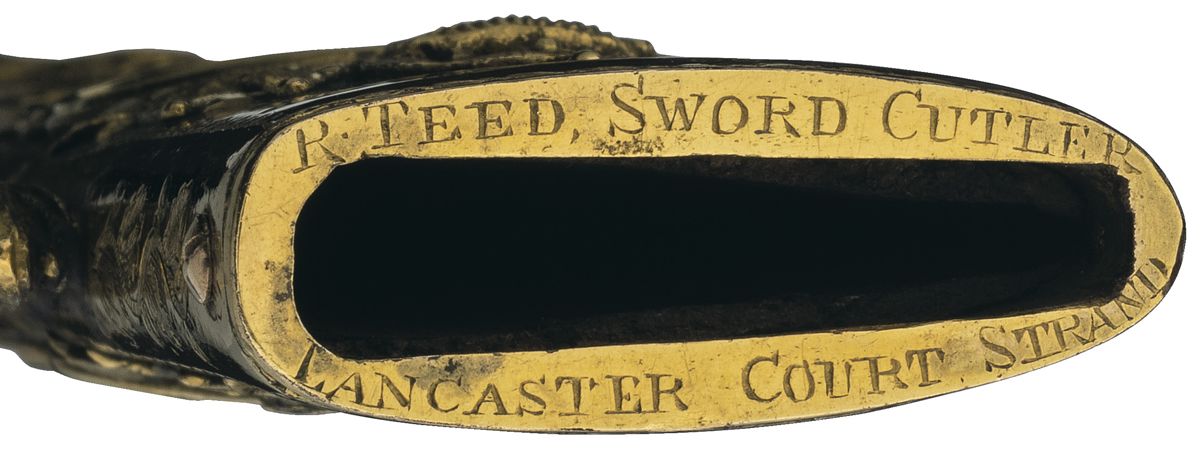
The throat of the scabbard is marked “R. TEED, SWORD CUTLER / LANCASTER COURT STRAND.”
The gold hilt (ormolu) has acanthus leaf languets, a fasces cross guard with naval trophies at the center, club of Hercules wrapped in a serpent, a Nemean Lion pommel and back strap, checkered and carved antique ivory grip, and navy blue and gold sword knot.
The gold scabbard (on the following pages) has naval and classical trophies, serpents for suspension rings, “POLYPHEMUS” over Britannia holding a laurel crown directing the two British squadrons into battle as they head toward the Franco-Spanish line over “NELSON 21 OCTR 1805 TRAFALGAR” in the upper section, a contrasting panel below, a medallion with Hercules battling the Lernaean Hydra by the lower serpent, another contrasting panel Hercules strangling the Nemean Lion on the drag, and beading (likely representing cannon balls) around the edges of the drag.
d’Irlande, intended to support a republican uprising in Ireland. At another stage of her under-appreciated career, Polyphemus was the flagship of Rear-Admiral Thomas Graves and part of fleet that bombarded Copenhagen in 1801.
Nelson planned a totally different engagement than the one the French and Spanish expected. Nelson’s plan was simple but ran against the era’s prevailing naval tactical doctrine. Instead of engaging the enemy in a parallel lines ahead formation broadside to broadside, he divided his fleet into the Windward Squadron and the Leeward Squadron and drove straight into the enemy’s line under heavy fire and broke through, “crossing the T,” so that his broadsides would sweep from bow to stern (or stern to bow depending on ship positions) down the decks. Not only did this enfilade the vessels; it allowed Nelson’s ships that broke the French and Spanish line to fire both broadsides at the same time and, initially eliminated the possibility of a side to side firefight culminating with boarders storming a ship’s decks. The hard part of this attack was facing the combined French and Spanish broadsides firing left, right, and center at his leading ships until they got to the line of battle. Nelson’s plan succeeded but at heavy cost to the leading British vessels.
Then came the Napoleonic Wars. Captain Robert Redmill recommissioned her out of ordinary in July 1804 after refitting. In the year before Trafalgar, Polyphemus captured several vessels off Spain, including Santa Gertruyda which was carrying $1,215,000.
FRENCH/ SPANISH
BRITISH
1st rate (100 guns)
2nd rate (98 guns)
3rd rate
Ships of the Line
(One 3rd rate had 80 guns, sixteen had 74 guns, 3, including Polyphemus, had 64 guns) Frigates (38 or 36 guns)
Brigs
Schooner
Cutter
Number of Crew
Finely checkered ivory grip with back-piece formed by a casting of the Nemean lion.
30,000 men
17,000 men
Two-piece buckle depicts a warrior in classical habit in combat with a hydra, his shield bearing the design of the Union Jack. Under the scene is marked “PATRIOTIC FUND/1803.” Lion medallions form the hangers with buckles of naval motifs. (Courtesy Cowan’s A Hindman Company)
By Trafalgar, the Polyphemus was comparably old and weathered as she had been serving almost twenty-five years. The Polyphemus, sixty-four guns, was the smallest ship in Vice Admiral Collingwood’s Leeward Squadron that struck the rear of the French & Spanish line. Because of her age, speed, and guns, Polyphemus was the last ship in the Leeward Squadron. That meant she would not bear the brunt of the fight but would be in position to finish off damaged opponents. As it worked out, she exchanged broadsides with the French ships Neptune and Achilles, then captured the Spaniard Argonauta. For the French and Spanish, the battle was a disaster. The combined French and Spanish fleet is believed to have lost 16,000 men killed, wounded, or captured compared to British losses of 1,587 men killed or wounded. Initially twenty-two of the allied ships were captured or destroyed but in the storm that followed, many of those were recaptured, but eleven ships were ultimately taken into British ports. The October 21, 1805, Battle of Trafalgar, was one of the largest and most significant naval battles during the Age of Sail. The British victory during War of the Third Coalition against France and Spain prevented any possibility of the British Isles being invaded and secured British naval supremacy. Captain Redmill and his crew performed their role well and but their most important task came in the week of storms that followed. Polyphemus had suffered very little structural damage in the battle. Needing no repairs to speak of, she provided materials to damaged ships. Polyphemus took Lord Nelson’s flagship, the HMS Victory, under tow and heroically saved it from sinking. Then they had the honor of towing the flagship back to Gibraltar. A parliamentary grant of £300,000 to the battle’s participants was awarded during and after September 1806. In March 1807 prize money for the hull,
Ormolu hilt with foliate langlets forming into a panel depicting naval trophies, naval cannon, and anchor, with quillions terminating in fasces. (Courtesy Cowan’s A Hindman Company)
stores, and head money for four French and two Spanish ships captured at Trafalgar was distributed. Captain Joseph O. Masefield replaced Redmill in September 1806. In an action on September 25, 1806, a British squadron of six ships of the line, including Polyphemus, intercepted a French squadron. The British caught the French convoy and captured four French frigates Infatigable, Minerve, Armide, and Gloire. Polyphemus shared in the prize money for these four frigates.
After her moment of fame, Polyphemus continued in service until retired, dismasted and used as an ammunition storage ship in 1813 at Chatham Dock. She finally wore out, forty-five years after being launched, broken up in 1827. HMS Victory, the flagship Redmill and Polyphemus saved, is still in commission as a historical site in Portsmouth Naval Yard. Auction date: May 15, 2021, price realized: $287,500. Rock Island Auction Company. (Unless credited otherwise all photographs courtesy Rock Island Auction Company) Additional research by Lawrence “Larry” Babits, PhD.