
Spiller & Burr Revolvers – Chronology of Manufacturing Part II
By John Sexton · Originally published March-April 2023 · pp. 3–44
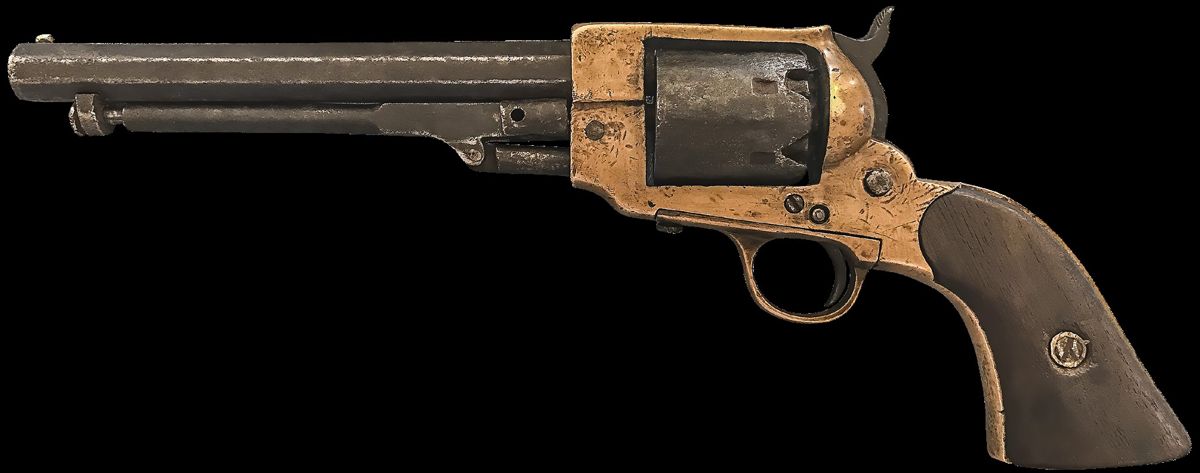
Spiller & Burr finally had a solid frame pattern that worked. After two years of failure that produced only fifty-two first model revolvers, with only seventeen passing inspection, and two surviving to the present, the 2nd model was born. The first lot of 112 2nd models were submitted for inspection August 4, 1863, 100 were accepted. In only five months Spiller would submit close to 1,000 guns for inspection by Dec. 31, 1863. Eight-hundred-thirtyfive passed inspection and went into service. The factory then moved to the Macon Armory. Now under Confederate government ownership, the machinery, pistol parts, and failed and unfinished guns were used to produce new, and repair damaged, the new 2nd Model Spiller & Burr revolvers. Moving, getting machinery set up in Macon, and finding new employees took until February 18 when production restarted. The first 100 pistols delivered to Atlanta in March, 100 in April, 150 in May. Since there was a large quantity of parts that came from Atlanta, the first guns no doubt were repaired failed Atlanta production. Lists of inventoried parts included over 5,000 good steel barrels in various stages of finish. No barrels needed to be manufactured in Macon. Applying the “SPILLER & BURR” marking on a barrel would never be needed in Macon. “SPILLER & BURR” marked revolvers issued in Macon were repaired or reworked guns usually found with distinct Macon inspected or numbered repair marks.
SN 5 – MACON ISSUE – EARLY 1864
All 2nd model serial numbers (SNs) known started out as Atlanta production, since highest SN is 1248 and Spiller was paid for 854, there were over 400 unfinished Atlanta revolvers sent to Macon. Production totaled 665 revolvers issued and twelve still in inventory in January 1865. Macon production appears only to be finishing and fabricating parts needed for failed Atlanta revolvers and field failures from earlier issued revolvers. This can be proven with SNs known passing inspection during 1863 in Atlanta and then being inspected and passed again in 1864 still with Atlanta “CS” surcharge on left side of frames. The 2nd model serial numbers issued in Macon, recorded in the Macon Armory Memorandum books now located in the National Archives, range from 25-1237, most clustered under 600. Cecil Anderson stated in his 1974 monograph that he felt Macon produced no new revolvers, only repairing earlier Atlanta examples. There are a few survivors which appear to be 100% Macon manufacture including barrels with Macon SNs. These Macon made guns are usually low SNs, 100s and 200s. There are about a dozen surviving revolvers with a variant “C.S” final proof clustered among survivors in the SN 200 range listed by SN in the Macon records as being made in May and sent on to the Military Store Keeper (MSK) in Atlanta on June 4, 1864. The following photos are of revolvers and serial numbers that can be dated as to manufacture and issue. They show details and comments demonstrating Atlanta or Macon issue, and in some cases, Atlanta issue and later Macon reissue. The revolvers are shown in chronological serial number, not the date issued.
Serial number (SN) 5 is the only single-digit Spiller & Burr revolver known. It is standard 2nd model with thin sighting channel, large brass front sight, and no barrel address. The SN 5 appears on the barrel, frame, and trigger guard, with SN 4 on the loading assembly. All the numbers are early Atlanta die fonts. Atlanta SN 4 and 5 both must have failed inspection during 1863 and their parts were then utilized on this early Macon issued revolver with its iron cylinder, inspection letter “M,” and “C.S.” Both “M” and “C.S.” are stamped on frame’s right side, consistent with other Macon Armory MSK listed revolvers. The “M” inspection mark possibly indicates the chief factory inspector Isaac B. Meyer, The “M” right side inspection is found on many known early Macon delivered revolvers.
DISTINCT DIFFERENCES BETWEEN 1ST AND 2ND MODEL SPILLER & BURR REVOLVERS 1ST MODEL
2ND MODEL
Thinner and shallower sighting channels in 2nd model below. The 1st model has wide channel duplicating its Whitney pattern. Front sight on 2nd model is large, pointed cone. The 1st model has small pin like it’s Whitney pattern.
1ST MODEL
2ND MODEL
1ST MODEL
The 1st model’s most distinctive feature is 5/16” gap between frame and cylinder face. There is more metal in 2nd model frames, and the top strap is notably thicker.
2ND MODEL
“SPILLER & BURR” stamp is same on 1st and 2nd models, it never changed during production.
SN 27 – MACON ISSUE
SN 27, has a CS stamp on right so it was inspected in Macon, “SPILLER & BURR” is stamped on the barrel; there is no inspection on frame, so it is probably one of 400 unfinished revolvers sent to Macon January 1864. This revolver was carried home by Union soldier from Battle of Nashville. (Courtesy of Morphy Auctions, www.morphyauctions.com)
Unknown initials of soldier who carried this revolver.
SN 12 – ATLANTA MANUFACTURE
SN 12 has all early Atlanta dies, no inspection letter, or CS, but barrel is stamped “SPILLER & BURR.” This revolver was manufactured in Atlanta during 1863 but there is no record of inspection. This may be a gun that was sold privately. At one point, at least one chamber of the cylinder blew out, breaking top strap of frame, that has since been restored. (Dennis Headlee collection)
SN 43 – MACON ISSUE – JUNE 1864
One of only four complete original revolvers with “SPILLER & BURR” marking, “CS”, and serial numbered cylinder. There are seventeen survivors with all three features, highly sought by early collectors. SN 500 is the highest known Spiller & Burr with a numbered cylinder.
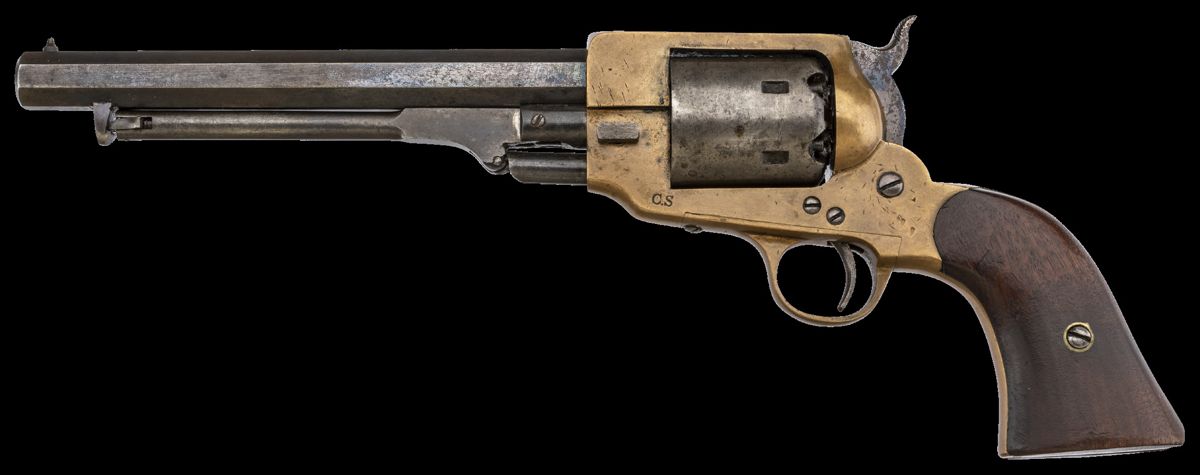
SN 43 is marked with a “C.S.” stamped on the right side and “SPILLER & BURR” on the top barrel flat. The inspector’s initial “M” is on right side of the grip frame. SN 43 is the lowest numbered surviving revolver listed in the June 4, 1864, Macon Armory memorandum book as issued to MSK. This revolver was made in 1863 but did not pass factory inspection in Atlanta. It must have been one of the 400 unfinished revolvers sent to Macon after December 1863. (James D. Julia’s lot 1248, Nov. 1, 2017. Photos courtesy of Morphy Auctions, www.morphyauctions.com)
SN 64 – MACON ISSUE – JUNE 1864
Lowest SN with variant “C.S” stamp which is always stamped on left side but is known early Macon issue, unlike the typical “C.S.” stamped on Macon on right. Listed by SN as sent to Military Storekeeper (MSK) June 4, 1864. SN 64 is as found recently and typical of many Spillers found with broken and missing loading arm but original cylinder pin. Most surviving revolvers have been restored over the years as collectors want perfect examples.
SN 67 – ATLANTA LOT 1 – AUGUST 1863 SN 67 has “C.S.” on the right side. The “SPILLER & BURR” stamp and early serial number die fonts, including one on the cylinder, likely indicate the lot 1, August 1863, Atlanta issue. (James D. Julia’s lot 1312, Fall 2007)
SN 74 – ATLANTA LOT 1 – AUGUST 1863
Lot 1 revolvers were inspected in Macon with “C.S.” on right, all other Atlanta made revolvers were inspected in Atlanta with “C.S.” stamped on the left with exception of “C.S” variant found on SN 64. SN 74 is marked with early die fonts and “C.S.” on right side. No inspection initial is documented. This incomplete pistol is likely part of the lot 1 August 1863, Atlanta production. It was excavated in Alabama where Gen. Joseph Wheeler’s cavalry operated. Wheeler’s men are known to have been the first to get these guns immediately prior to the 1863 Battle of Chickamauga.
SN 75 – MACON ISSUE
SN 75 has Atlanta font stamping on frame. The loading arm and cylinder pin are both numbered 166, with the inspector’s initial “M” on the frame’s left side indicating original Atlanta factory inspection. There is no CS indicating initial failed final government inspection. SN 75 and 166 were probably two of the 400 failed/unfinished guns that went to Macon. SN 75 had “SPILLER & BURR” stamped barrel added with no serial number and steel cylinder in Macon after July 1864. Steel cylinders were fabricated from steel received at the armory starting June 30 though twisted iron cylinders were still in inventory. Revolver has survived in superior condition also pointing to late issue. SN 166 barrel is found on SN 131 which was issued June 1864 (twisted iron cylinder).
SN 76 – ATLANTA LOT 1 – AUGUST 1863 Pistol SN 76 was stamped using early fonts including on the iron cylinder, “C.S.” on the frame’s right, an “M” inspection mark on the left, and “SPILLER & BURR” on the barrel. This gun was in the August 1863 lot 1 Atlanta issue. After a field failure it was reissued by Macon MSK during June 1864. (Courtesy Heritage Auction Company)
The Newcastle Daily Journal (Newcastle-upon-Tyne, Tyne and Wear, England), Thursday, Aug. 11, 1864, page 3.
SN on cylinder was applied after original cylinder failed.
SN 76 is one of 17 revolvers documented with “SPILLER & BURR” marked barrel, “CS”, serial numbered cylinder.
SN 77 – MACON ISSUE
SN 77 and SN 75 are Macon issues most likely among the first 300 guns issued prior to June 1864. Revolver SN 77 has a steel cylinder with Macon dies on the cylinder. The barrel is stamped SN 77 stamped over 75. The numbers used with the SN 75 are in the Atlanta font, the over stamped 7, or 77, was done with a Macon serial number die. This pistol was issued by Macon MSK after July 1864. Note that SN 75 has no serial number on barrel; it was probably issued at same time as SN 77 as both have steel cylinders.
UNSERIALIZED
Pistol SN 79 is stamped with its number on the barrel with the “SPILLER & BURR” mark. This unnumbered early open frame revolver’s loading arm has SN 6; it’s cylinder pin is SN 17. The combination of numbers shows parts reused from an unaccepted earlier production run. It is the only example known with a reused 1st model frame. SN 17’s loading arm was used on SN 239, a June 1864 Macon MSK issue. There is a crack in the frame’s top strap, that would have caused this revolver to fail after much more use. No wonder this is only the third surviving example of a complete open frame Spiller & Burr. (Courtesy Hayes Otoupalik collection)
SN 91 – ATLANTA LOT 1 – AUGUST 1863
The pistol numbered SN 91 is the best surviving lot 1 Atlanta issue revolver and possibly the only totally complete example extant. The “B” inspector mark, probably representing A.J. Bass, is on left under grip frame. The Macon government inspected “C.S.” is on the frame’s right side as found on all first lot pistols. The cylinder failed during the initial inspection, was replaced, and then numbered. “Spiller & Burr” is stamped on the top barrel flat. SN 91 is also inscribed on left side of frame “C B Mims 20th Geo Regt” and “C B Mims” on the butt. This revolver was most likely a souvenir taken at his capture though there was no record of where the original collector Russ Goldstein found it over sixty years ago.
Charles B. Mims (1839–1903) was a Columbus, Ga., native assigned as the commandant at Columbus after he was disabled by wounds received at Manassas and Sharpsburg. Mims originally mustered into the 20th Georgia as a sergeant May 23, 1861; he was promoted to lieutenant three months later, and to his final rank of captain July 17, 1862. He was Post Commandant at Columbus, Ga., after taking the place of Major F.C. Humphreys during June 1863. Humphreys was a well-known inspector at the Columbus Arsenal and went on in this capacity to the Macon Armory where this revolver was inspected. Mims would have received this revolver in his capacity as post commandant during August 1863. Mims returned to the 20th Georgia in July 1864. He was wounded again and captured September 29, 1864, at Fort Harrison, Va., and remained a prisoner of war until his release from Fort Delaware May 30, 1865. Why there is no other lot 1 survivor in its original configuration, other than excavated SN 36, can be explained by examining SN 91. The frame on revolver SN 91 has a crack that probably would have failed with much further use. Mims would not have seen the field again until July 1864 and was only in action for less than three months before being captured.
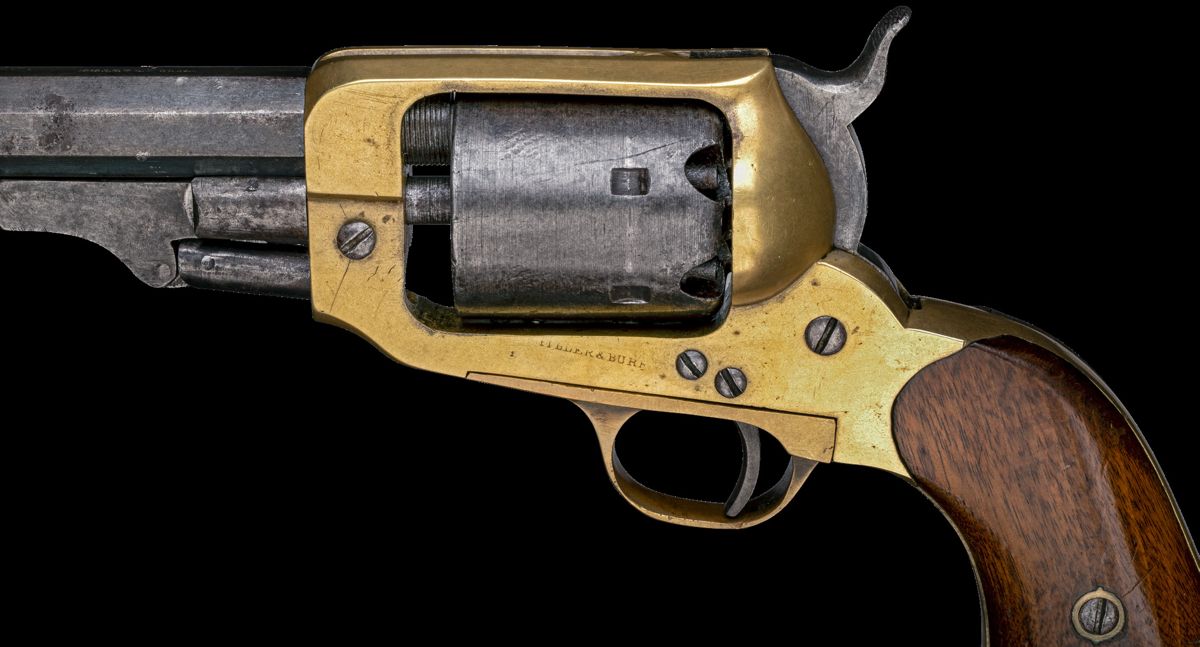
Note the dovetailed braised two-piece structure of the loading arm’s linkage with the swivel. This was no doubt an inherent weakness as many survivors are missing the loading lever or have a replacement loading lever while the attached cylinder pin is still original. This is only example known with this two-piece construction.
In “Burton’s proposed order of operations on the various parts of revolving pistol, Whitney’s Pattern, to be manufactured in the Richmond S. Arms Factory, 1862,” every part is meticulously detailed like the “loading lever” manufacturing description here: LOADING LEVER 1. Forge complete, of iron. 2. Anneal, in annealing furnace 3. File the ends square and center the ends. 4. Drill the end for catch and spring. 5. Turn the lever end, in lathe 6. Mill sides, two at once, in milling machine 7. Mill straight edge and part of end, crosswise, in Do. 8. Mill jointed edge and part of end, Do, in Do. [crosswise, in milling machine] 9. Slit the large joint in milling machine. 10. Slit the small joint in milling machine. 11. Drill holes tor two Joints, in one tool. 12. Drill small hole for catch stop-pin, in tool. 13. File and Finish complete and number. 14. Polish 15. Caseharden in casehardening oven No mention is made about two-piece construction, so the alteration is probably an armory repair, as no other examples are noted other than SN 91.
SN 104 – ATLANTA LOT 1 – AUGUST 1863
SN 104 is marked “C.S.” on the right side. The “Spiller & Burr” mark on the barrel was made using early die fonts. The cylinder failed the initial factory inspection, was replaced, and then numbered. It is likely from the August 1863 lot 1 Atlanta issue. The inspection initial is unknown. This revolver has long collection history dating back to pioneer collector and author Richard Steuart (1878–1951); William Albaugh bought it in 1952. James D. Julia’s lot 1207, April 2017. (Courtesy of Morphy Auctions, www.morphyauctions.com)
SN 105 – MACON ISSUE – JUNE 1864
“C.S.” government acceptance die is same whether Atlanta or Macon.
“Warping” of top strap prominent here is observed only many Spiller & Burr revolvers after repeated firing.
SN 105 has the “CS” acceptance mark on the right side; “M” is also on right. This is one of the few revolvers that appear to be totally Macon manufacture. It probably dates to April 1864. All the serial numbers, including one on the barrel, were made using late die fonts not seen on Atlanta revolvers. This pistol’s collection history dates to the earlier Confederate collectors, including Robert Howard and William Albaugh who both owned it prior to 1965; Bruce Kusrow and Ted Meredith acquired it later. These collectors all believed this was an early serial numbered gun like serial number 104, and identified it as an early Atlanta manufactured piece. This interpretation can now be refuted as this is demonstrably identified as Macon 1864 issue. (James D. Julia’s lot 1414, March 2015)
Atlanta
Distinct pointed cone front sight, often worn down.
Macon
Comparison of the “1” and “0” in die fonts used in Atlanta and Macon. (Courtesy of Morphy Auctions, www.morphyauctions.com)
SN 124 – ATLANTA LOT 2 – SEPTEMBER 1863
Atlanta pistol SN 124. The first revolver in lot 2, Atlanta production with the “CS” removed from left side. This pistol’s markings were all made using early Atlanta SN dies.
Good example of earliest die fonts.
SN 124 – MACON ISSUE
Macon pistol with duplicated SN 124. The pistol barrel was originally “24”, a late font “I” was stamped in front making it “124” as seen on a few other Atlanta made barrels with 2 digit numbers. Early Macon guns numbered to match, but soon mismatched parts were used to put guns into service. The other SN 124 Macon gun has “OOO” stamped on left grip frame. Albaugh theorized that the “O”s might mean “overstamp” in The Brass Framed Colt & Whitney. This revolver started out as SN “24” on barrel with the later font “I” added. This gun also has the variant “C.S” inspection mark without the second period that was a known Macon inspection for a short period in early 1864. (James D. Julia’s Fall 2009 auction)
Later Macon die font “1” stamped in front of SN “24” barrel, other numbers all Macon.
Overstamp “OOO“ stamped on 124 and 129 that also have the Macon “C.S” variant.
SN 129 – MACON ISSUE
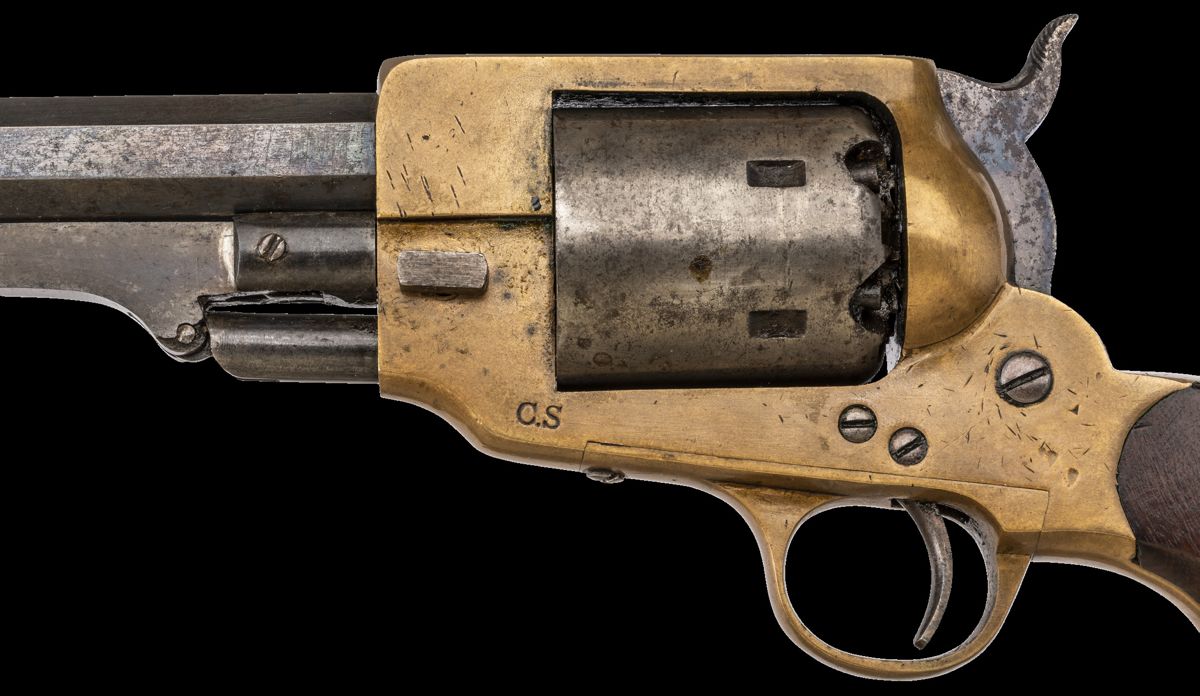
Variant “C.S” mark, early Macon, SN 129. There are repeated serial numbers among other survivors; 124 and 564 are two. In each case the serial number die fonts are different, indicating early (Atlanta) and late (Macon) manufacture. It may well be that a single die set was used to number guns, as the early numbers seem to be the same fonts through the end of serial number range. It is not uncommon to find two different sets of dies numbering the same gun showing later replaced failed parts. One Macon Armory ledger shows 322 as a duplicated number but no pistol numbered 322 has surfaced. The duplication may have to do with using rejected parts from early production runs or parts of guns broken in the field and sent to the armory for repair or salvage with the good parts being recycled.
and 1086. Several guns have a mix of early Atlanta serial numbers with Macon serial number fonts on some parts. At least seven of these guns have all Macon fonts. The thirteen outliers are scattered among standard Atlanta production. Seven serial numbers are listed on the June 4, 1864, Macon MSK list and I am confident all other “C.S” surcharged revolvers are earlier Macon issue, among the 350 guns issued prior to the June 4 issue. None of these thirteen revolvers are marked “Spiller & Burr” or have serial numbered cylinders. There are three revolvers with long collection histories, that have oddly placed “CS” stamps without periods that are known to be original and probably not government inspection marks. These will be pointed out later in this article on those specific revolvers.
Dies used in Atlanta did change through that operation’s production run. The first “1” die was broken or discontinued sometime after SN 241, but before 651. Rechecking of examples must be done to confirm this and narrow down the range. The “2,” “5,” and “0” (zero) dies appear consistent through the entire Atlanta production series covering the lowest (SN 5) and highest (SN 1248) numbered 2nd models known.
SN 214 has long been known in the collecting community. It has an inscription on the backstrap “Luke to John.” The only number on this revolver is 214 in early Atlanta font on the “SPILLER & BURR” stamped barrel. Based on other survivors in the June 1864 Macon MSK list, there is the possibly that another SN 214 marked in the same way as SNs 218, 255, 278, and 287, may exist as SNs listed in armory records are taken from frame.
The CS surcharge is “C.S.” on 95% of all marked guns whether it is on the right or the left side of frame. The die is the same for both Macon and Atlanta. There is an original variant found on thirteen guns. The variant mark appears virtually identical to the standard one except for the missing period after the “S.” It is always stamped on left side. These Spiller & Burr’s are known to be early Macon issued.
There are a few identified Spiller & Burr revolvers owned by Confederate officers that have no surcharge. Two Confederate officer owned, unsurcharged pistols, have a higher finish and no internal inspector’s initials. Revolvers were sold by Atlanta arsenal direct to officer’s who could pay $125-200, a price well above the $50 the government contract paid. It makes sense that private purchases from armory had no proofs. See SN 239.
Documented SNs with the variant “C.S” are 64, 124, 128, 129, 131, 160, 170, 190 (upside down), 255, 278, 287, 345,
SN 214 – ATLANTA ISSUE LOT 2 SEPTEMBER 1863
Atlanta dies.
SN 239 – MACON ISSUE, PROBABLE OFFICER PRIVATE PURCHASE JUNE 1864
SN 239 is among the finest survivors. “SPILLER & BURR” is marked on the barrel. The serial numbers are all in the early Atlanta font and all matching except for the loading lever which is SN 17. Another SN 17 is found on the cylinder pin used in pistol SN 79. Matching SN 239 numbers are found on barrel, loading lever, cylinder, frame, and penciled on each grip half. No doubt this was a privately purchased with well figured varnished burl walnut grips that were never used on government issue revolvers. SN 239 is listed on the June 1864 Macon MSK list. There is no doubt that some revolvers were inspected at the factory as noted by internal inspector initials with no final CS surcharge. There are examples listed by serial number in Macon MSK inventories such as this revolver. Private sales were authorized by the factory and six are noted as privately sold in Atlanta lot 2 where SN 239 should fall. That may explain the reason for most non-CS surcharged revolvers.
SN 239 – CONTINUED
Atlanta die fonts.
This gun also has the inscription: “Dr THOS. HILL” on the brass butt strap. Dr. Thomas Hill was a Confederate surgeon commissioned June 10, 1862, and enrolled in the 40th NC State Troops, the 3rd North Carolina Light Artillery. Dr. Hill is shown on the unit rosters as a surgeon assigned to several different North Carolina and Virginia hospitals until he was discharged at Salisbury, N.C., May 3, 1865. Dr. Hill is known at that time to have been stationed in Raleigh, North Carolina, at Confederate General Hospital No. 8. (Courtesy Hayes Otoupalik collection)
SN 241 – MACON ISSUE – JUNE 1864
All SNs are early Atlanta font, failed factory inspection, sent to Macon in January1864, inspected in Macon, inspection “L” stamped on right side. Like SN 239, no “C.S.” inspection, but listed as sent to MSK June 1864.
SN 241, like SN 239, has no CS surcharge but the barrel is marked “SPILLER & BURR.” Inspector mark “L” is stamped twice on the right side of the grip frame. Serial numbers on both barrel and frame are early Atlanta fonts. The grips on this revolver also show similar burl to 239. This may be a privately purchased revolver. It appears on the June 1864 MSK list. SN 241 is last survivor known with the earlier “2” die font, as the font is different on the next survivor SN 255.
SN 255 – MACON ISSUE –JUNE 1864
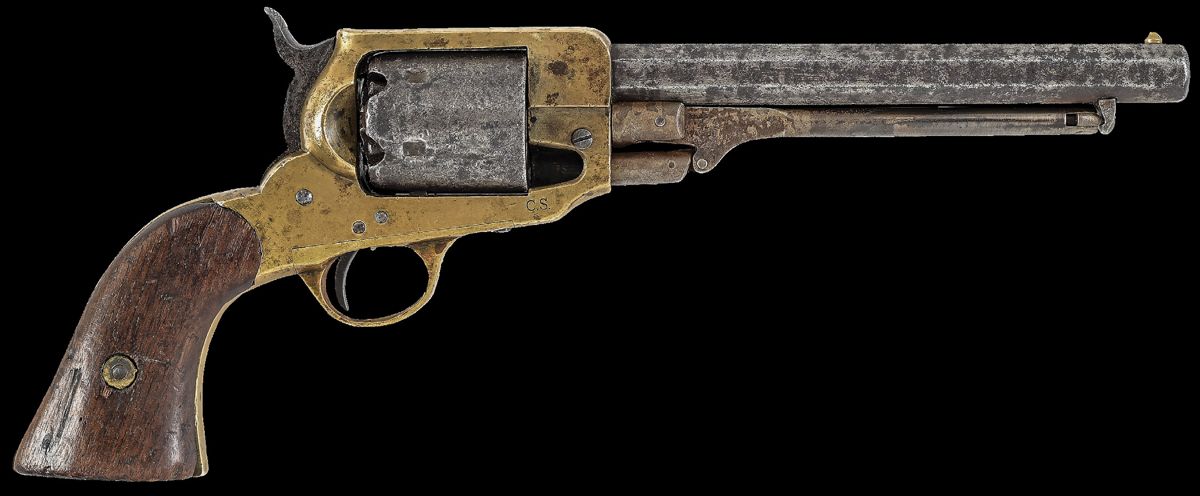
SN 255 is the finest surviving Spiller & Burr and it has a long collection history. It was issued June 4, 1864, at Macon and has the variant “C.S” stamp on left side of frame. The factory inspection mark “T” is found on the frame’s right side. (Jim Eaton collection)
Cylinder shows twist, but only with close scrutiny. “Twisted iron” appears like steel on higher condition Macon revolvers. The twist is clearly visible on all Atlanta made cylinders.
The SN 255 stamp on the barrel has the numbers “55” in the Atlanta font; the “5” die was unchanged until later in Macon. Apparently a transitional “2” found on Macon production, steel barreled revolvers was one of over 5,000 barrels sent with machinery from Atlanta.
This SN on the frame was made using all Macon fonts. Most guns in this 200 serial range were assembled using mixed Atlanta and Macon parts. Most were issued during June 1864.
SN 265 – ATLANTA ISSUE 1863, REISSUE MACON JUNE 1864
SN 265 stamps, left to right: Tang, cylinder, and barrel. SN 265 was also issued during June 1864. This gun has all Atlanta numbered parts, but this revolver with both factory inspection and “CS” on left was originally issued by Atlanta in 1863. The only Macon marking on this pistol is a “W” inspection mark in the grip. Inspection marks in the stock are found only on Macon issued revolvers. SN “265” was issued in 1863, broken during field use, turned in, repaired, then reissued by Macon during June 1864.
SN 268 – ATLANTA ISSUE 1863, REISSUE MACON JUNE 1864
Atlanta dies.
SN 268 is marked “C.S.” on the left frame. There are Atlanta fonts on the barrel, frame, and cylinder stampings. This gun was most likely issued as part of Atlanta lot 2 during September 1863. After field failure it was sent to Macon for repair, and then reissued by Macon Armory in June 1864.
SN 287 – MACON ISSUE JUNE 1864
Macon dies on underside of barrel.
Macon die fonts on loading assembly.
Frame stamped 287. Atlanta dies.
Variant “C.S” stamp with no period after S.
Frame was Atlanta made, Atlanta dies.
MACON AND ATLANTA DIES
Barrel SN Atlanta dies.
Frame (Macon dies).
Triggerguard (Macon dies).
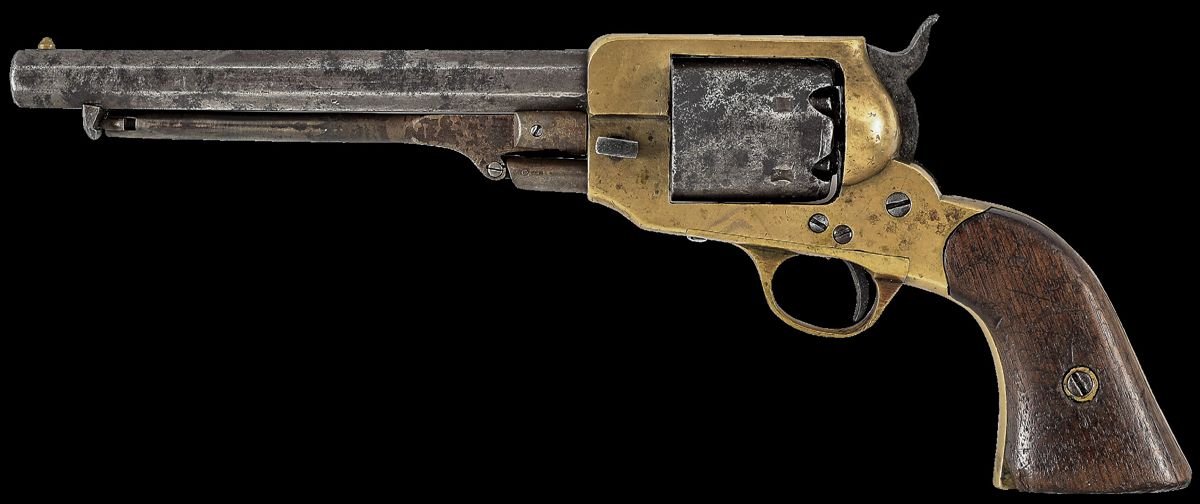
SN on frame (Macon dies).
Frame (Macon dies).
Revolvers with SN 278 and SN 287 both have the “C.S” variant surcharge on the frame’s left side. Both have inspection stamps on the frame’s right grip frame. These guns are listed as issued on the June 1864 MSK list. SN 255, 278, and 287 are all very similar. All have the variant “C.S” government surcharge on left side of frame and were issued by Macon Pistol Factory June 1864 on MSK list by serial number. All three have a few parts with Atlanta made parts in the range of Atlanta lot 2, September 1864. The author would appreciate opinions and needs detailed photos of other “C.S” variant revolvers including all the stamped numbers and inspection letters on grip frame.
SN 288 – ATLANTA ISSUE, MACON REISSUE 1864
Atlanta 288 stamped on the loading lever assembly. Cylinder with burst chambers.
SN 288 stamped on frame and EDDIE carved into butt stock.
SN 288 was made in Atlanta, broke in the field, was repaired in Macon, and reissued during June 1864. The bursting of cylinders due to inherent weakness of twisted iron was a major complaint by inspectors who often stated that two chambers would ignite together, creating a major failure as noted in the November 28, 1863, inspection report. This revolver never went back for repair again. “F” Macon inspection on the grips and inspections marked in wood are only seen on Macon issued revolvers. “F” possibly for Macon master armorer Jesse Fuss.
SN 302 – ATLANTA ISSUE, MACON REISSUE JUNE 1864
SN 302 stamped on frame (Atlanta dies). SN 302 has a “SPILLER & BURR” marked barrel. There are Atlanta fonts on the barrel and frame. The “C.S.” stamp on the left frame indicates Atlanta issue in 1863. The inspection mark “E” on the right grip frame, indicates reissue by Macon on June 4, 1864. Only the frame, hammer, and barrel are original Spiller manufacture; the remainder are the result of restoration.
SN 322 – ATLANTA 1863 ISSUE, MACON REISSUE JUNE 1864
SPILLER & BURR stamped on top of barrel.
“J. D. GRADY” scratched into the bottom of the frame.
Cylinder stamp 322. Atlanta dies. Loading lever stamped 322. Atlanta dies.
Atlanta “C.S.” stamp on left side of frame.
SN 322 was found in Alabama near the home of “J. D. GRADY;” the name that is nicely scratched on the bottom of the grip strap. John D. Grady (1843–1895) was born, raised, and died in Chambers County, Ala. He enlisted in Co. A, Hilliard’s Alabama Legion, July 7, 1862. This company became Co. A, 5th Alabama Cavalry. The “SPILLER & BURR” mark and early matching Atlanta serial number fonts indicating its original issue by Atlanta, probably as part of lot 2 during September 1863. After breaking in the field, this pistol was sent to Macon for repair, then reissued June 1864. A “W” inspection mark stamped in bottom of the right grip is seen on other known Macon Armory issued revolvers. (Courtesy Poulin Auction Company)
SN 354 – ATLANTA MANUFACTURE, MACON REISSUE JUNE 1864
Frame stamp. Barrel stamp. SN 354 was marked with all Atlanta SN dies. The “C.S.” was stamped on left frame. These attributes indicate Atlanta manufacture during 1863. The SN on the cylinder and inspection initial “M” on frame’s right side show this pistol was reissued by Macon, June 1864.
SN 446 – ATLANTA ISSUE 1863, REISSUE MACON JULY 1864
“W” inspection in butt.
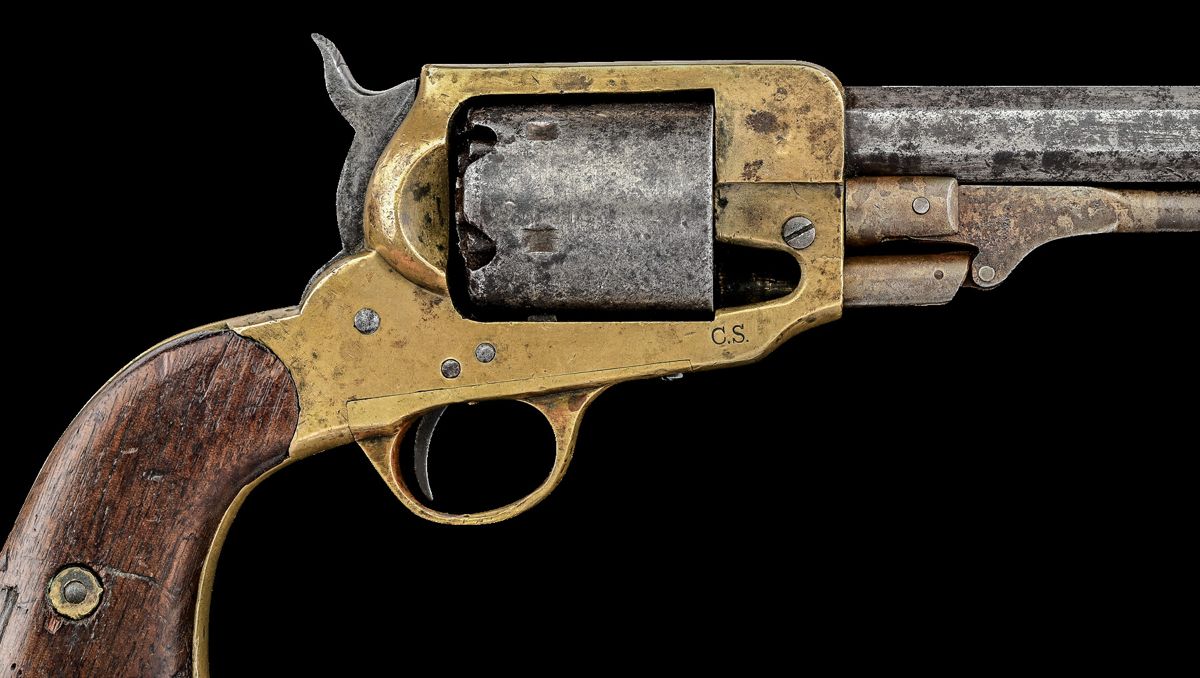
SN 446 has all early fonts, but the 4 and 6 fonts didn’t change. The “C.S.” and inspection “D” mark on the left frame indicate original Atlanta issue, probably lot 3, October 1863. At some point the cylinder apparently failed and was replaced with a serial numbered cylinder. This gun is listed with these markings on the July 1864 Macon MSK list. This revolver also has a “W” stamped in both grips, consistent with known Macon inspection practice. The “W” possibly indicates Wescom Hudgins,a government inspector between April and November 1864 at Macon Armory. He used a “WH” cartouche when inspecting Leech & Rigdon, Rigdon & Ansley revolvers, and Cook & Brother rifles. He did use just the “W” when inspecting frames on Rigdon & Ansley revolvers.
SN 476 – ATLANTA ISSUE 1863, MACON REISSUE NOVEMBER 1864
Macon serialized steel cylinder.
Atlanta SN font on excavated trigger guard. Macon SN 476 on cylinder; note the later “7” font. The excavated triggerguard’s numbering for pistol SN 476 used Atlanta dies for all three numbers. SN 476 was originally issued by Atlanta in 1863. The “SPILLER & BURR” marked barrel and Macon serial number on the replaced steel cylinder November 1864 reissue. The inspection mark “W” is stamped on grips. The trigger guard is restored. The original trigger guard with Atlanta SN dies was excavated.
SN 500 – ATLANTA LOT 4 – MACON REISSUE NOVEMBER 1864
Pistol SN 500 has an inspection “E” on left grip strap. This gun’s cylinder failed during inspection and was replaced and numbered during September-October 1863. When it passed government inspection, it was stamped “C.S.” on the frame’s left. “SPILLER&BURR” is stamped on top of the barrel. (Courtesy of Rock Island Auction Company)
SN 500 gun broke in field and was sent to Macon for repair. It was repaired and reissued in November 1864. Since all SNs are Atlanta fonts, the repair must have been to “links” as the armory called the combining of internal parts, which were not numbered.
SN 517 – ATLANTA LOT 4 – MACON REISSUE NOVEMBER 1864
CS surcharge filed off left side of frame where the original government proof marks were place in Atlanta. Soldier probably took gun home and didn’t want evidence of theft. “US” removed from US martial Colts from Walkers to Single Actions.
SN 644 – ATLANTA LOT 3-4 1863
SN 644, CS left, inspection left “E” Atlanta fonts, Atlanta issue lot 3 probably October 1863, and is missing its cylinder.
SN 679 – ATLANTA LOT 3-4 SN 679 with “C.S.” on left frame side. All SNs are Atlanta early fonts so this is an 1863 Atlanta lot 3-4. The cylinder pin is a Macon replacement and with mis-transcribed number and “F” stamped in grip; Macon issue in 1864. Stamp on loading lever.
SN 804 – ATLANTA LOT 3-4, MACON REISSUE
Macon “O” from 1865 souvenir barrel.
Atlanta close “0.”
SN 804 is among the finest Atlanta Spiller & Burr surviving in excellent condition. The cylinder chambers are still bright with no wear. The blue was removed so the gun would be bright. The blue is retained where the barrel was protected by loading lever. Whoever cleaned it didn’t know how to take it apart. Revolver has no “CS” stamp but passed factory inspection as there is an “M” stamped on the left side. This is one of the 400 revolvers sent to Macon during January 1864. The loading lever is numbered 904. It was reissued with “J” inspection mark in the grip, but no “CS” mark. The “CS” mark seems to have ceased at some point in Macon when revolvers were needed desperately for field. The Macon font stamped on the barrel of SN 804 above was taken as a souvenir from the Macon Armory during April 1865 by a Union soldier and is attached to an unfinished frame. Note the Macon serial number differences in “0.” (Dec. 29, 2021, at Hess Fine Art Auctions, St. Petersburg, Fla.)
SN 977 – ATLANTA LOT 4 NOV.-DEC. 1863, LATER MACON REISSUE 1864.
SN 977, Atlanta fonts, “C.S.” and “J” are on frame’s left side indicating Atlanta lot 4 of Nov.-Dec. 1863. The later Macon reissue identified by the “W” in grips as most are found in Macon MSK lists. (Courtesy Heritage Auctions, HA.com)
SN 983 – ATLANTA LOT 4, POSSIBLE PRIVATE PURCHASE
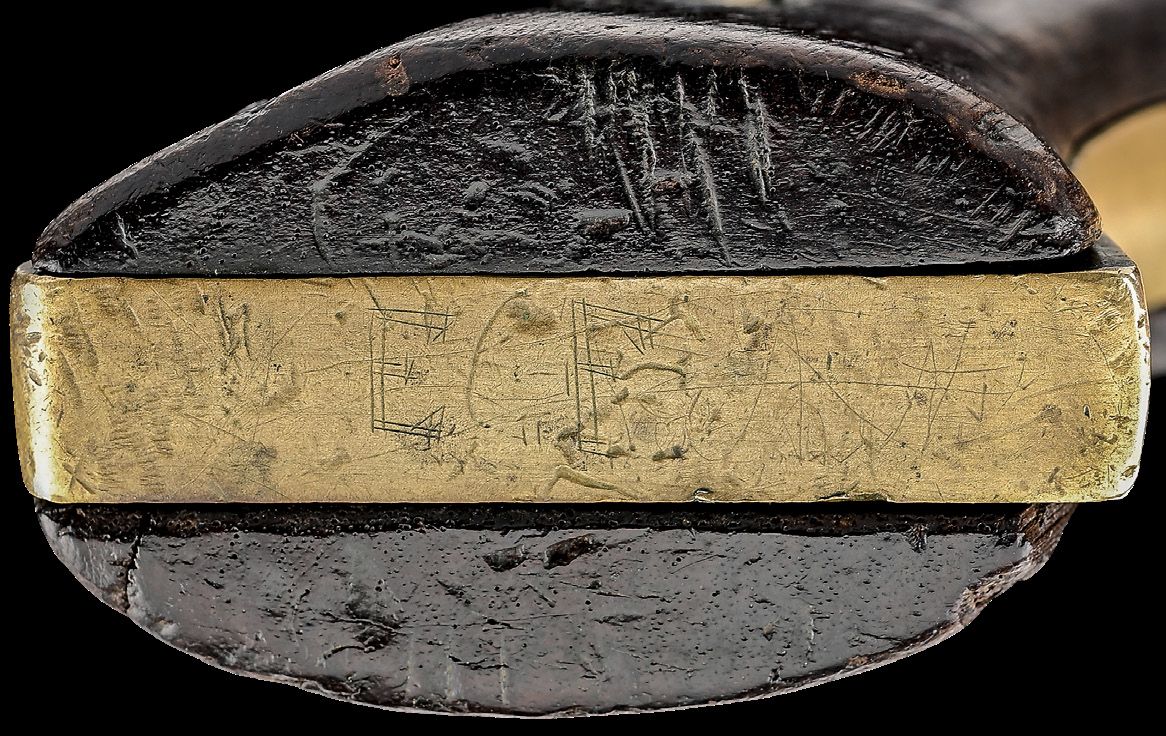
“CS” without periods observed on 2 or 3 examples stamped in center of frame.
SN 983, all Atlanta fonts, probably unfinished and sent to Macon January 1864. Possibly privately sold with burl grips, inset blade front sight, and most unusual CS surcharge stamped on right side frame with different font and position than other revolvers. Long collection history staring with William Albaugh in 1940s. (Arston Grant collection)
SN 1062 – ATLANTA NOVEMBER-DECEMBER 1863
Atlanta later “1” die font.
SN 1076 – ATLANTA NOVEMBER-DECEMBER 1863
Beautiful red hard rubber grips.
Atlanta die fonts.
SN 1076, Atlanta font, no inspection on frame, like SN 1066, extremely fine with sculpted rounded polished frame. This revolver is fitted with beautiful “coral red” hard rubber grips, long collection history but customization most likely postwar. (Courtesy Cowan’s A Hindman Company)
SN 1086 – ATLANTA MADE, MACON ISSUE
Atlanta die fonts.
Highest SN known of “C.S” variant stamp known early Macon die.
SN 1086, Atlanta fonts, highest number of early Macon issued revolvers with variant “C.S” stamped on left side of frame. It is most likely one of 400 unfinished/failed guns sent to Macon January 1864 and issued in March or April when there was no list of SNs sent to MSK. The range of guns listed sent from to MSK in May-June 1864 range from SN 25-1237 with most concentrated in 200300 serial range. (Courtesy the Atlanta History Center, George Wray Jr. collection)
SN 1107 – ATLANTA – NOVEMBER-DECEMBER 1863
Atlanta font 000 over-stamped 415 and 1107 on bottom of barrel.
SN 1107 has no “CS, barrel has stamped over SN 415, all Atlanta fonts.
SN 1182 – ATLANTA AND MACON
SN 1182 has Atlanta fonts, but no “CS.” It was made in Atlanta during late 1863. An “E” on the frame’s right side indicates it was last inspected in Macon.
(Courtesy Rock Island Auction Company)
Iron cylinders failed over 50% of the time in initial proofs during April-June 1864; 235 either burst or cracked of the 416 tested. Steel cylinders introduced late June had only one failure in July. (Macon Armory Memorandum book, NARA)
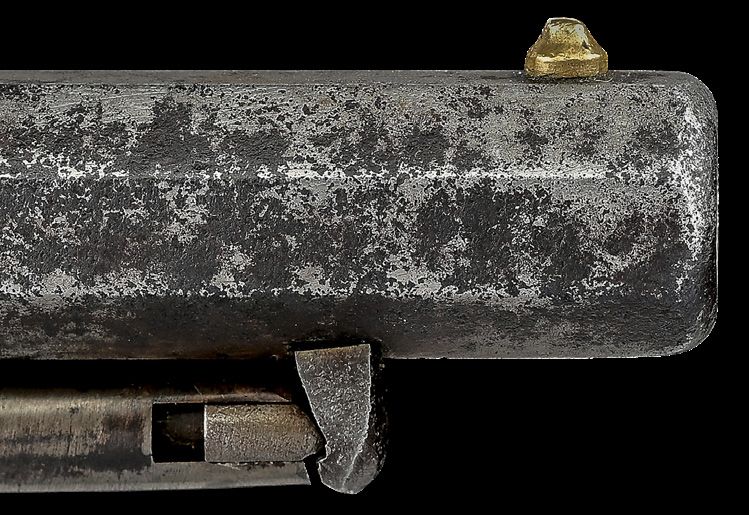
SN 1192 – MACON
SN 1192 is a dug relic with a steel cylinder. The “C.S.” is on the frame’s right side. It was made in Atlanta during 1863, did not pass inspection as there is no initial. It was later issued from Macon during 1864.
Not pictured: SN 507, has all serial numbers in the Macon font, including the barrel, “C.S.” on and “J” inspection marks on the right frame, and an unnumbered steel cylinder. This pistol was issued by Macon in November 1864. This is among the few known Macon revolvers with all matching Macon applied numbers.
November 16, 1864, boxes were being sent to Columbia, S.C., as capture of this Armory was thought eminent. The last serial number of a frame fitted to a barrel was 597 showing sporadic numbering sequence. These boxes would be sent back as Sherman’s army by passed Macon on the March to Sea. Production resumed but only ninety-seven more revolvers were recorded finished by January 1865. (Macon Armory Memorandum book, NARA) SN 509 is represented by only its excavated frame. It has Atlanta serial numbers on the butt and frame bottom, with a, “C.S.” and inspection mark “E” on the left frame. This gun was in Atlanta lot 3, an October 1863 issue. SN 534 has Macon fonts on frame with “C.S.” on right side and inspection “M” on left. This was an 1864 Macon issue. It has the rarely seen large stamped SN “534” on one original grip panel; grips normally have penciled SNs. This revolver could have been an earlier Atlanta issue with extensive repair at Macon. It needs to have the barrel’s serial number
SN 1196 – ATLANTA
SN 1196 has all Atlanta numbers with the “C.S.” and “E” on the frame’s right, as with SN 1192. This gun was made very late in 1863 and sent to Macon in January 1864, either unfinished or because it did not pass inspection. It was then Macon issued and inspected in 1864. (Courtesy Rock Island Auction Company) and original frame number checked for font as they were not initially recorded.
SN 903 with “CS” on frame’s left side indicating Atlanta lot 4 Nov.-Dec. 1864.
SN 564 has all Atlanta fonts, including a failed, replaced and numbered cylinder. There is a “C.S.” on the frame’s left side. This is most likely from the lot 3, Atlanta issue October 1863. A “J” inspection letter is haphazardly stamped on right frame which is unexpected for an Atlanta revolver. It is quite probable this revolver was repaired in Macon, though currently it can not be proved. A few other revolvers with Atlanta “C.S.” on left, inspection initial on right, and all Atlanta fonts are listed in Macon MSK lists. There is also a duplicate serial number 564 listed in Albaugh with mismatched serial number (616) on barrel and 581 on trigger guard. The 564 is most likely a Macon issued gun as earlier noted, Atlanta issues did not have mixed numbers.
SN 917 marked by “C.S” and inspection initials “LL” on frame’s left side with, “SPILLER & BURR” marked on the barrel. This pistol is from Atlanta lot 4, Nov.-Dec. 1863.
SN 719 and SN 798, “C.S.” on left frame, Atlanta lot 4 November 1863. SN 843 has “C.S.” on left frame. Only the butt is serially marked. The SN is in Atlanta font, with a “D” inspector mark on the left frame, Atlanta lot 4, Nov.-Dec. 1863. SN 901, no CS and mixed serial numbers indicate a Macon issue.
SN 920, “C.S.” left, inspection “LL” left, “F” stamped on grips, Atlanta fonts all matching, Atlanta lot 4, Nov.-Dec. 1863, later Macon reissue as repaired. SN 1011, Atlanta issue. SN 1066, Atlanta serial numbers, inspection letter “D”, The unique feature of this revolver and SN 1076 which are extremely fine is the sculptured rounded frame with traces of silver plating, bright blue finish to barrel and cylinder. The gun was most likely refinished and “slenderized” postwar according to noted authorities, but long collection history and published. SN 1092, has no “CS,” but does have all matching Atlanta fonts throughout. It has a special high polish blue finish and was probably an officer’s private purchase in late 1863.
MACON DIES
Known late Macon dies, large open “0,” sharp pointed “2,” long tail “5,” bulbous base “7.”
Penciled list of fifty inspected revolvers delivered to Military Storekeeper (MSK) in Macon November 18, 1864. Note the list is not chronological though the range runs from 342 to 530. These fifty revolvers were received in Wilmington, N.C., November 30, 1864. Many of these were originally made in Atlanta and passed inspection in 1863. It is amazing that so many went back to the armory for repairs. Of these fifty revolvers, there are sixteen known survivors, 393, 432, 454, 465, 476, 482, 486, 487, 490, 493, 494, 498, 500, 507, 514, and 517. Note that SN 490 must have failed after the July issue; it was repaired and returned to field use in November. (Macon Armory memorandum book, NARA 109-4-57) The “CS” inspection surcharge most often applies to Atlanta production passed revolvers, whether they were inspected in Macon or Atlanta. Many, if not most, Spiller & Burrs passed and issued from Atlanta failed after several months of field use. Some of these broken revolvers were discarded in the field. Seven battlefield recoveries are all “CS” surcharged, 36, 74, 160, 188, 482, 914, and 1192. Reworked Macon guns usually have a “CS” surcharge from an 1863 issue, but many guns were issued without the “CS” stamp as noted by serial numbers issued from armory to MSK. The earliest Macon reworked revolvers using parts and unfinished guns seem to have utilized the same die fonts from the last Atlanta revolvers. It has been observed that several survivors, especially barrels, have a “1” or “2” added off center to the normally more precise stamping when renumbering a revolver to match. Later guns were not renumbered, and mixed parts are not uncommon on Macon revolvers. There are numbered parts from one original gun seen on multiple later revolvers. If a good barrel, cylinder pin, loading lever, or even cylinder was available, these parts would be utilized. In early Macon production, several renumbered barrels exist, the old SN was over stamped or crossed out and a new number added in front. Several renumbered barrels are stamped with “O” instead of a factory inspector’s initial. This possibly means “over stamp.” Later barrels were not renumbered, simply issued with mixed numbered parts.
ATLANTA DIES
Atlanta dies for SN 5 to 1248. During production several dies failed and were replaced. They can be followed in the numerical sequencing. Note the changes in “1.” Additional photos needed of SNs on other survivors to aid in research.
SN 1248 – ATLANTA – HIGHEST SURVIVING SN
SN 1248 has all Atlanta die fonts, the same as SN 1192 and SN 1196 that were manufactured Atlanta during December 1863. Either these guns were unfinished or did not pass inspection before being sent to Macon. SN 1248 is highest serial number known. The 1248 is stamped over 1242 on the barrel. The grip frame is stamped “OO,” most likely designating “over stamped,” as is seen on other revolvers with “O”s. These were issued in Macon with steel cylinders after July.
Revolvers fabricated early in Macon still followed Burton’s guidelines, so no serial numbers are expected on steel cylinders unless they were repaired, of which there are examples cited previously. Finding any inspected “CS” stamped Spiller & Burr revolver in 100% original condition and complete as first issued is difficult because they often failed and were discarded or turned in for repair. Survivors delivered July 1864 in Macon: 421, 434, 446, and 490. There are more original records available on Spiller & Burr pistol manufacturing than any other Confederate revolver. These include contracts, pistol specifications, inspections, and even some records of workers who made each gun part. Comments and information are welcome on other revolvers anyone may have as more survivor data adds to the Spiller & Burr story.
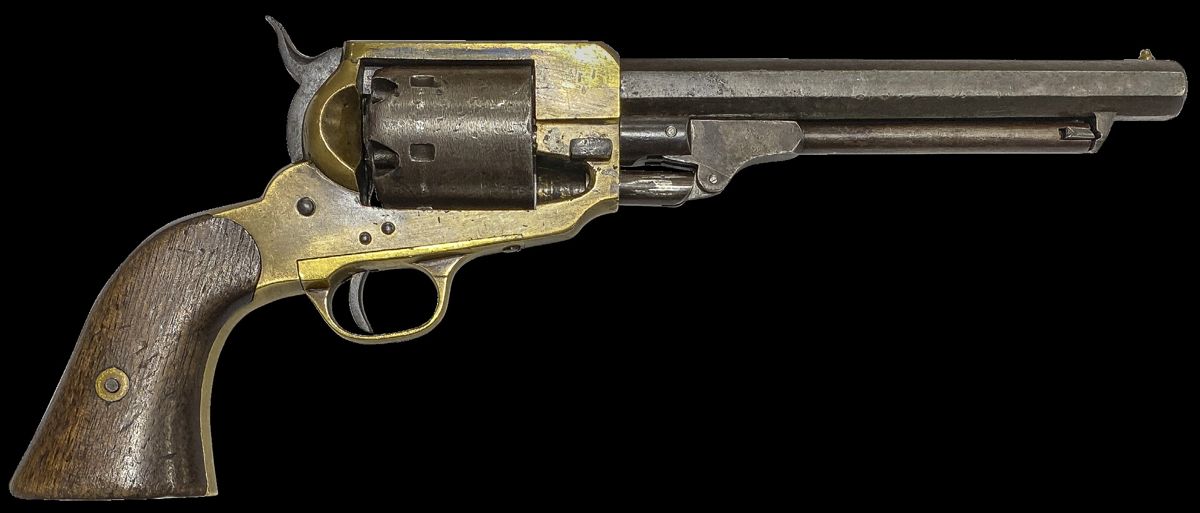
TIMELINE OF SPILLER & BURR REVOLVER PRODUCTION Nov. 9, 1861 – James Burton proposal letter to Spiller & Burr of pistol factory in Richmond, Va. Nov. 20, 1861 – Burton, Spiller & Burr are the principals, with Burton the engineer in charge of design, etc. The “Model” revolver to be supplied by War Dept. Model is known to be the 1st type 2nd model Whitney navy revolver.
(4,500 barrels were sufficient for entire Spiller production of 1,552 revolvers), 800 cylinders, but only 112 frames or “lock frames,” the term used by Spiller & Burr. Dec. 20, 1862 – Macon Daily Telegraph, describing pistols as white metal, i.e. silver plated. Dec. 24, 1862 – Twelve pistols submitted for inspection. Maj. William S. Downer reported, “I find the workmanship on the pistol to be a character in the highest degree credible to the makers—much of it exceeding in quality that of the model.” SN 13 is only surviving 1st model 1st type. Dec. 26, 1862 – W.S. Downer inspection report requested changes seen on next delivery lot. These included a Colt style catch for the loading arm, no plating on frame, added safety slots to cylinder rear, and changing the caliber to .36 from the .35 seen on Whitney model. Jan. 22, 1863 – “System of Inspection…revolvers…S&B, Atlanta…” This first inspection requires appropriate stamp on left side of frame” under the axis pin of the hammer.” This explains a factory inspector’s initials on grip frame and “CS” government inspection mark. Atlanta revolvers have factory inspection stamped on frame’s left side, Macon on right; the same with “CS” inspection marking. Feb. 16, 1863 – Spiller took the new model with new loading lever (Colt style, 1st model 2nd type) to Burton in Macon.
Nov. 30, 1861 – Contract signed by Judah Benjamin, Secretary of War with Burton, Spiller & Burr.
March 3, 1863 – New contract for inspection and standard gauges including .36 caliber for new barrels effective March 20, 1863. The first New Pattern Pistol submitted, 1st model, 2nd type.
May 15, 1862 – Burton submitted detail manufacture details. “Proposed order of operations on the various parts of Revolving Pistol, ‘Whitney’s’ pattern, to be manufactured in the Richmond Small Arms Factory.”
April 29, 1863 – Forty pistols (1st model, 2nd type) submitted for inspection by Hiram Herrington in Macon; thirty-three were condemned. The only known survivor of the seven passed revolvers is SN 23.
May 28, 1862 – Pistol operation moved to Atlanta; crates packed with Richmond machinery.
May 20, 1863 – Maj. Moses Wright’s detailed letter to Gorgas with recommendations to strengthen frames with thicker top strap, solid frame face to barrel housing, no gap or threads visible, and the 2nd model is introduced. This letter also shows the inventory of 5,267 barrels in various stages of production including 1,227 barrels finished, a number that would be sufficient for all Spiller & Burr Macon Armory production. There were 3,317 frames cast, 231 finished. These 1st model frames are now known not capable of holding up in field. After this point, 2nd models will be started based on the recommendations by Major Wright. There were at least forty completed and condemned 1st models of both types. These forty guns were probably taken apart and the parts utilized for 2nd models. As one example, serial numbered parts 4, 5, 6, 12, and 17 are found on second model revolvers, with the frames being numbered to match parts of pistols SN 5 and 12.
June 25, 1862 – Macon, Ga., picked as site of C.S. National Armory which would eventually be the largest in Confederate States and larger than Springfield. Though partially in operation by mid-1863 for inspection of revolvers, The 177,000 square foot facility never fully went into operation before it was captured in early 1865. June 17, 1862 – Pistol machinery arrives in Atlanta from Richmond. Spiller had already found a location near Atlanta for the armory complex. Dec. 15, 1862 – 1st pistol completed and found satisfactory by Burton. Dec. 18, 1862 – Burton letter to Gorgas detailing Atlanta Pistol Factory inventory of partially finished revolver parts, over 4,500 pistol barrels, in various stages of completion
June 18, 1863 – E.N. Spiller letter to Maj. Wright, completed tooling to make new frames, i.e. 2nd models “We have entirely overcome our weakness in the lock frame and completed the changes … our pistol is as strong as any made.”
May 1864 – 100 pistols finished.
Aug. 4, 1863 – 112 revolvers sent to Macon for inspection, the first lot of 2nd models.
June 1864 – Steel arrives from Thomas Firth, Sheffield, England, The same steel Colt purchased. This steel had been in Bermuda since Burton purchased it Burton in England on August 22, 1863.
Aug. 12, 1863 – Herrington report of inspection: two lost, ten condemned, 100 passed. Aug. 18, 1863 – 100 pistols shipped from Macon. Aug. 27, 1863 – Ninety-nine pistols received in Kingston, Ga. Aug. 31, 1863 – One revolver was delivered to Major J.K. McCall, 2nd Ga. Battalion State Troops who commanded the “Atlanta Arsenal Guards.” Most Company D soldiers were workers from Spiller & Burr. Sept. 9, 1863 – 173 guns inspected, 167 accepted, inspected in Atlanta. Sept. 18, 1863 – 167 Spiller & Burr revolvers inventoried at Atlanta Arsenal. Sept. 20, 1863 – Battle of Chickamauga, first field use of revolvers by Wharton’s Cavalry. Oct. 16, 1863 – Burton back in Macon, inspected 306 pistols, 263 accepted. Nov. 17, 1863 – Negotiations for Government purchase of Spiller & Burr pistol factory.
June 1864 – 162 pistols finished.
June 1864 – Last week of June, first steel cylinders produced by Spiller & Burr. July 1864 – Eighty pistols finished. October 1864 – Fifty pistols finished. Nov. 16, 1864 – Last day of “true production” of pistols Macon Armory. Serial number 597 was last revolver barrel fitted to frame. Nov. 18, 1864 – Fifty pistols delivered to Macon MSK. Nov. 28, 1864 – Griswoldville factory destroyed by Union forces nineteen miles from Macon. Spiller & Burr machinery was being packed to be shipped to Columbia, S.C. November 1864 – Thirty-five pistols finished. December 1864 – After Sherman by passed Macon, Burton attempted to have machinery sent back to Macon where pistols were still being assembled; thirty-five pistols were finished but not proofed.
Nov. 28, 1863 – 273 pistols inspected, 200 accepted.
January 1865 – Last thirty-five pistols recorded for delivery to Richmond MSK. Twelve pistols remained at Armory, serial numbers 193, 197,199, 201, 206, 347, 381, 443, and 454.
Dec. 31, 1863 – Last 105 Atlanta produced pistols sent for inspection.
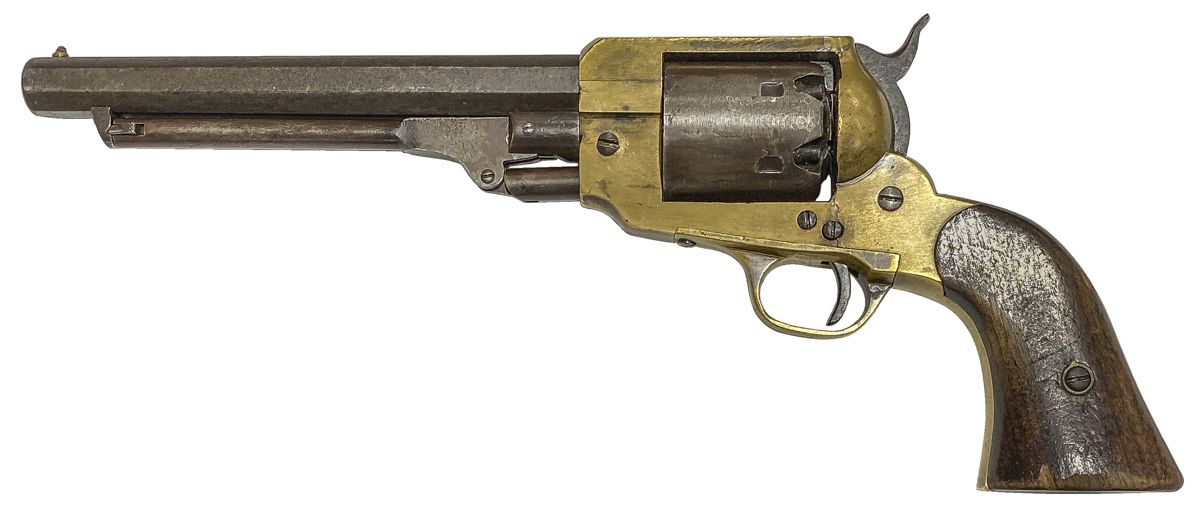
April 20, 1865 – Gen. James Wilson enters Macon, all manufacturing ends.
Jan. 7, 1867 – Last Atlanta produced pistols inspected and accepted by Herrington. Jan. 11, 1864 – Government purchase of pistol factory finalized. Jan. 18, 1864 – Wright’s letter to Spiller & Burr finalizing payment for factory and stating 836 pistols had been delivered under government contract paid, all made in Atlanta. Feb. 11, 1864 – Macon pistol factory is set up with machinery and revolver parts from Atlanta. Feb. 18, 1864 – Revolver manufacture begins. March 1864 – 100 pistols finished, mostly from unused parts sent from Atlanta. April 1864 – 150 pistols finished.
SELECTED BIBLIOGRAPHY Gary, William A., Confederate Revolvers, 1987
Ahlstrom, Richard M., “Spiller & Burr, First Model Revolver” The Gun Report magazine (Vol. 49, No. 19) March 2004
Hardman, James “Gutta-Percha, Hard rubber, & Synthetics in Firearms, ASAC Bulletin No. 96, September 2007
Albaugh, William A. III, Confederate Arms, 1957
National Archives, Record Group 109, Chapter 4, Volumes 57-58 (Macon Armory Memorandum books)
Albaugh, William A. III, The Confederate Brass-Framed Colt & Whitney, 1955
Norman, Matthew, Colonel Burton’s Spiller & Burr Revolver: An Untimely Venture in Confederate Small-Arms Manufacturing, 1996
Albaugh, William A. III, “Surprising New Discovery: First Model Spiller & Burr” North South Trader magazine (Vol. 1, No. 2) July 1973
Otoupalik, Hayes III, “Evolution of the Confederate Spiller & Burr,” North South Trader (Vol. 3, No. 3), March/April, 1976
Albaugh, William A. III (letter to editor relating to the “Model” arm for the Second Model Spiller & Burr revolver) North South Trader magazine (Vol. 1, No. 4), November 1973
Sellers, Frank M. and Smith, Samuel E., American Percussion Revolvers, 1971
Albaugh, William A. III, Benet, Hugh Jr., and Simmons, Edward N., Confederate Handguns: Concerning the Guns The Men Who Made Them and the Times of Their Use, 1963
Sexton, John, Proprietary Database of Confederate Revolvers
Anderson, Cecil, (no date) “The Manufacturing of the Firm of Spiller & Burr” (unpublished)
Swinney, H.J., “Gun Iron and Mild Steel,” The American Society of Arms Collectors, Bulletin No. 78, 1998
Anthony and Hill, Confederate Longarms and Pistols, 1978
Texas Gun Collectors Association Bulletin, describing SN 1076, February 1955
Fuller and Stewart, Firearms of the Confederacy, 1944
Williams, D.N. The Whitney Revolver, 2012
Kusrow, Bruce and Norman, Matthew, “The Southern Cousin of The Whitney Revolver: From the Federal to the Confederate Model,” 1999 (unpublished)
About the Author
John Sexton holds the highest designations as certified appraiser with International Society of Appraisers (ISA-CAPP) & accredited senior appraiser with American Society of Appraisers (ASA) specializing in Civil War memorabilia. He authenticates and evaluates other rare and valuable historic items as well. He is coauthor of the book Confederate Bowie Knives (2012) with Jack Melton and Josh Phillips, published by Mowbray Publishing Inc., and author of many periodical articles on Confederate arms. John’s contact information: website: www.civilwarappraiser.com, email civilwarappraiser@gmail.com, cell 770-329-4984.