
R.J. Hughes and the Georgia Armory
By Shannon Pritchard · Originally published May-June 2023 · pp. 18–33
R.J. Hughes and the Georgia Armory By Shannon pritchard
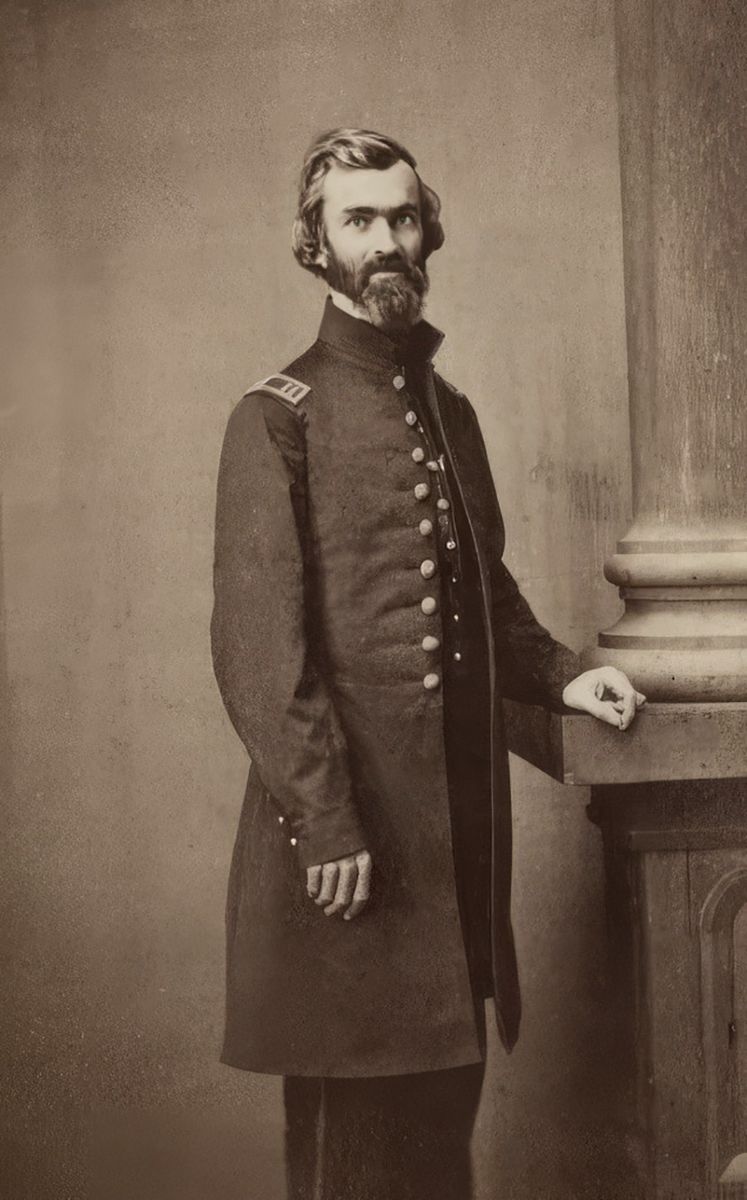
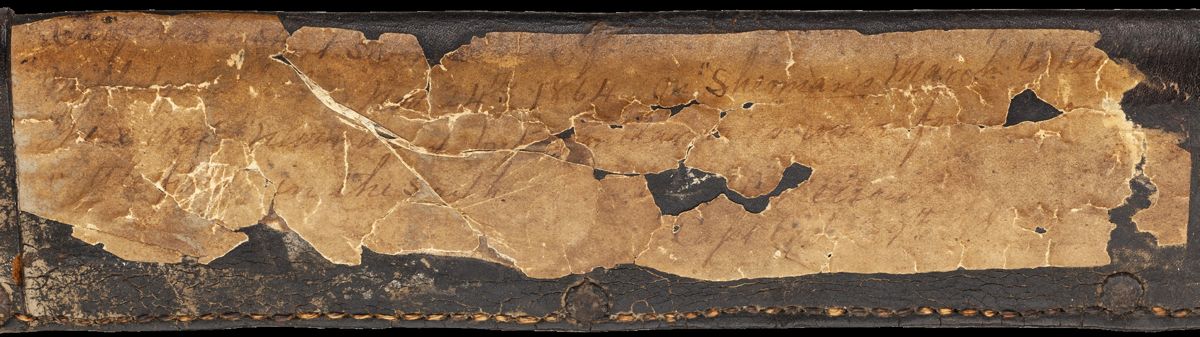
The discovery by the collecting community of the twenty-two and eleven sixteenths inch Confederate D-Guard knife shown here was the Rosetta Stone that opened a window to an extensive and important part of Georgia’s wartime manufacturing.1 The key was a paper label glued to the scabbard which reads: “Confederate short sword (indiscernible) / Milledgeville Ga Nov. 24th 1864 on “Sherman’s March to the [Sea]”. / This was never used but similar ones were found on / battle fields in the south. (signed) I. C. Nelson / Capt. Co. d 89th O.V.I.” (Company D, 89th Ohio Volunteer Infantry) The contents of this note were substantiated by Captain Nelson’s memoirs, in which he elaborated: On the 26th of November, we reached Millidgeville [sic] which was at that time the Capital of the State and remained in that vicinity a day or two which gave us an opportunity to visit the public buildings. I visited the State house and from the office of the Secretary of State I secured a series of resolutions, which had passed by the houses of the legislature and was signed by the proper officers and the governor.
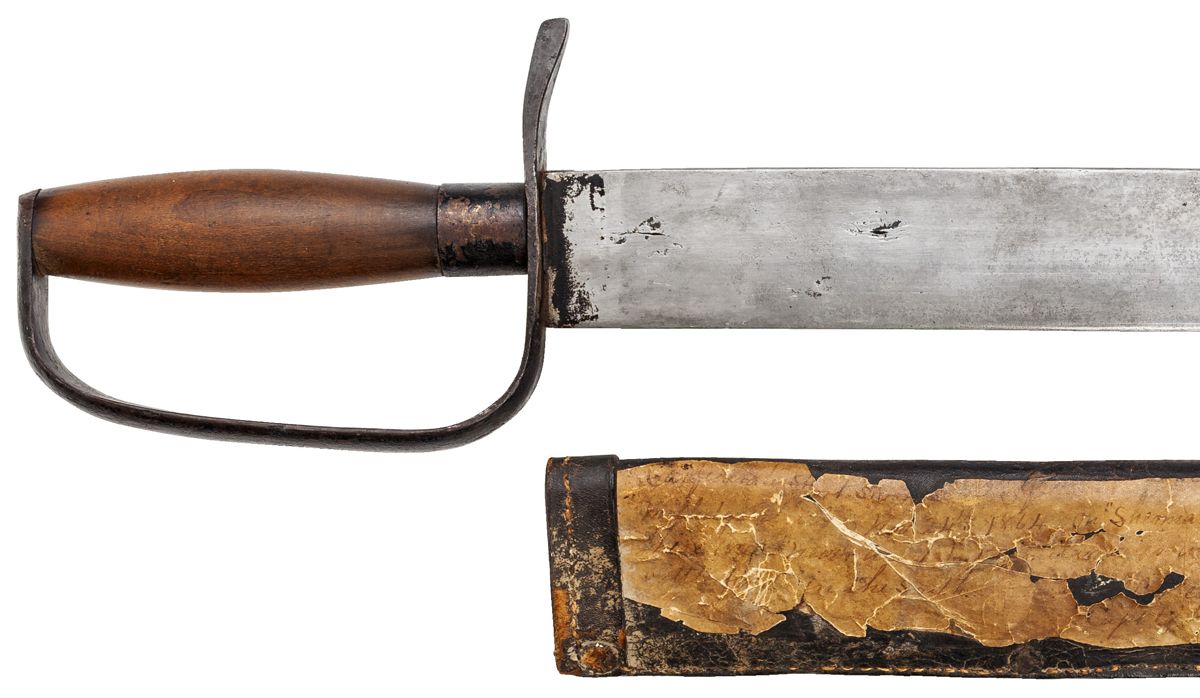
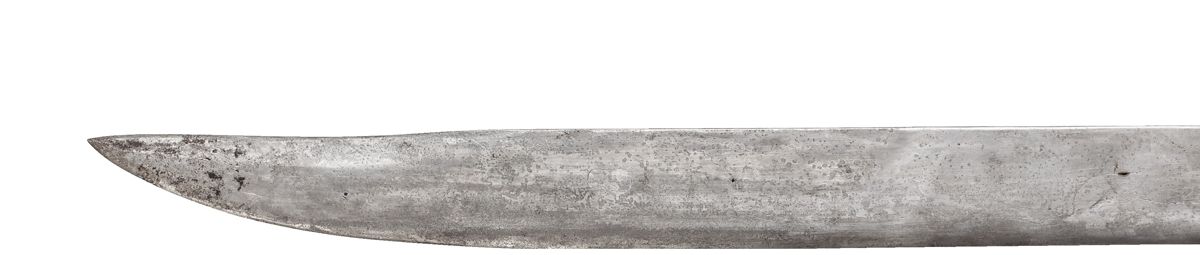
Following this plan, on March 12, 1862, Chief Ordnance Officer Major Lachlan H. McIntosh sent a letter to Captain T.M Bradford, the Military Store Keeper (MSK) at the Milledgeville Arsenal, along with a “pattern knife” advising him that $4.60 would be paid for each of “The knives with scabbard tipped, belt and clasp” delivered, upon their passing inspection. M.S.K. Bradford would have then displayed the pattern and notified all potential suppliers of the $4.60 per set offer. Rapidly the knives began to come into the Georgia State Arsenal at Milledgeville. In the spring and summer of 1862, at least fifteen makers sold nearly five thousand knives to the arsenal which followed the “pattern Knife.”2 The knives produced from this pattern are twenty to twenty three inches in length, have approximately five inch wooden grips (with one special exception), surrounded by a D shaped iron handguard and all have clip point blades and reverse edges.
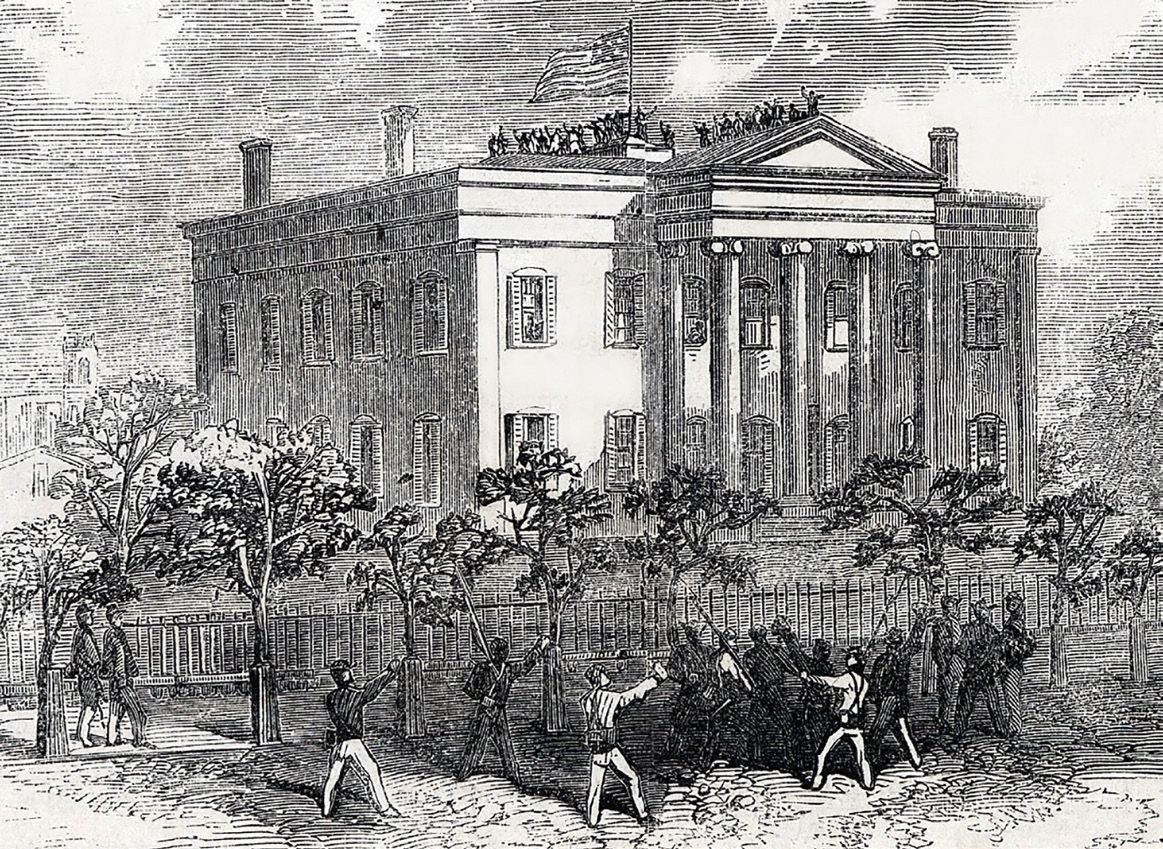
From the State Armory I secured some savage looking knives or short swords-with blades about sixteen inches long and two wide, which had evidently been prepared for, close work with the “Yankees.” There was also there quite a quantity of murderous looking pikes or spears, which had long handles and various shaped knives or blades on the head. Presumably intended to be used against Cavalry for cutting bridle reins, etc. I think both of these weapons had been abandoned as impracticable.
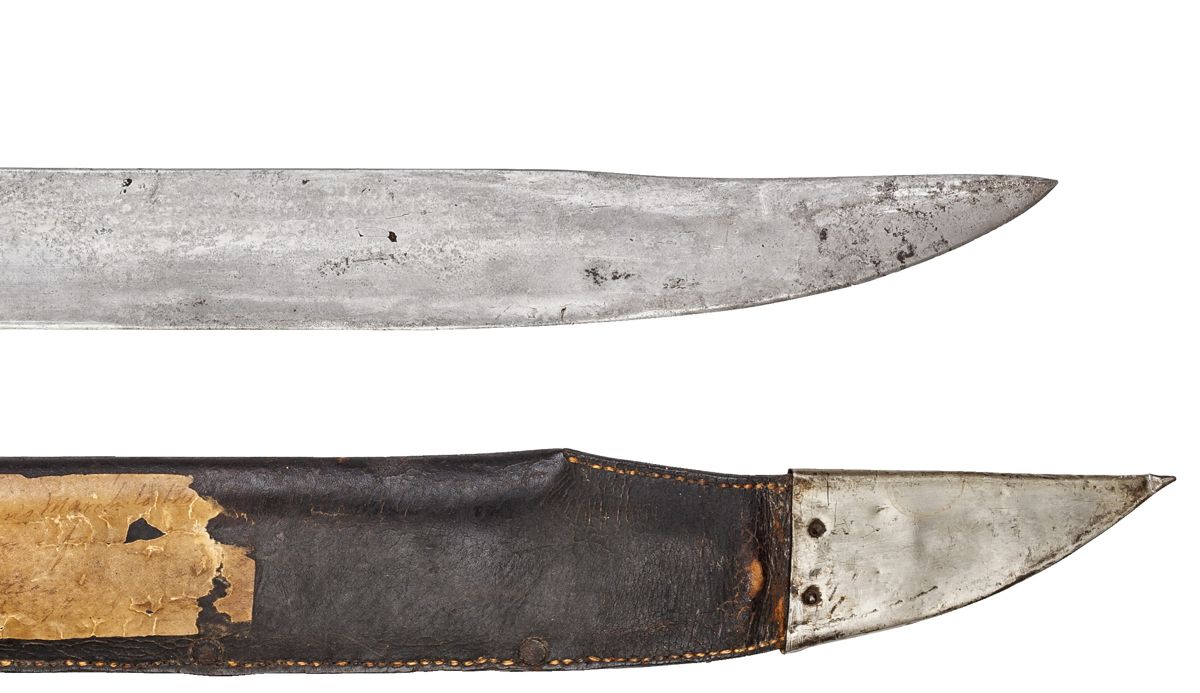
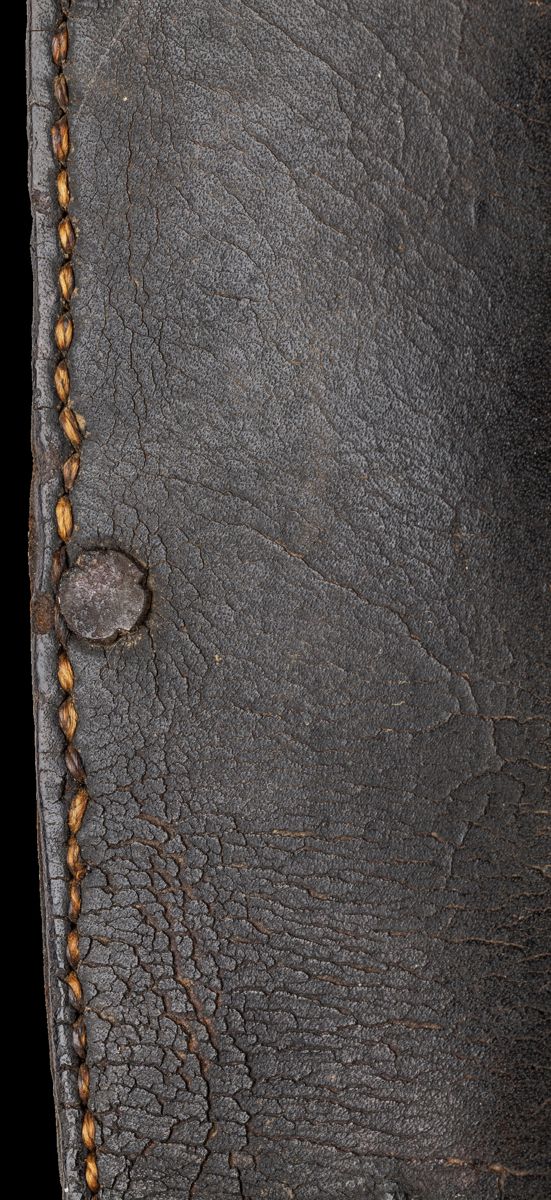
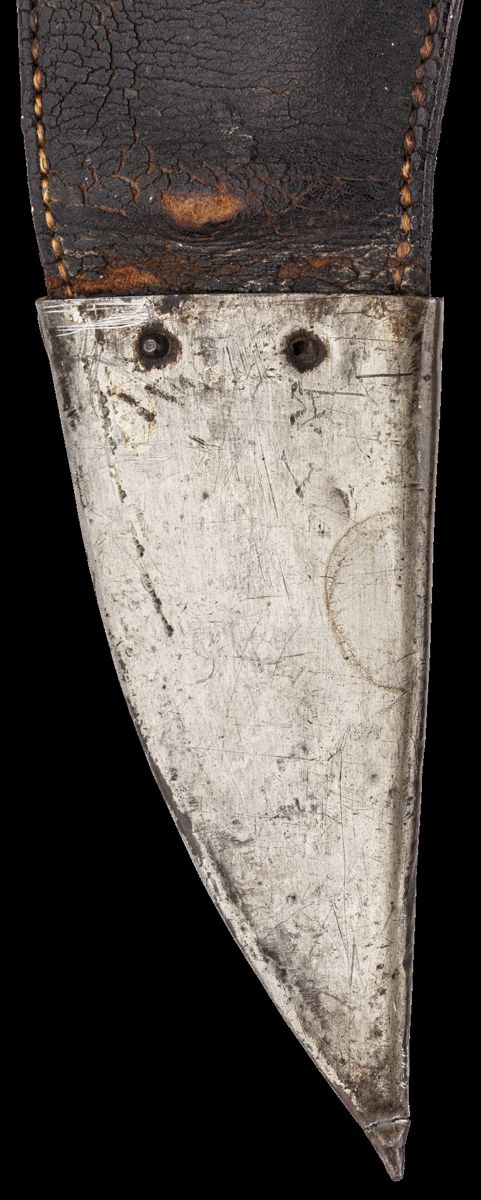
Those that retain their scabbards are sheathed in tin tipped leather scabbards that are sewn and are also riveted along the bottom seam with lead, or iron like the example shown here. These rivets prevented the blade from cutting through the scabbard’s stitching thread. All the scabbards have a narrow leather belt loop, which was an obvious weakness in an otherwise well-made knife and scabbard.
We considered all these things a legitimate plunder and took what we wanted. While carrying my “captures” to camp I met some citizens to whom I showed the knives and asked them if that was the welcome they had expected to give us. They seemed surprised and expressed ignorance of any knowledge of such things being in the city. Prior to this knife and belt having been sold by the descendants of Captain Nelson in the early 21st century, collectors recognized the general characteristics of this particular knife pattern and its close relationship to similar knives with only slight variations. The variations of this knife fit into what was and is termed “arsenal knives.” They are called arsenal knives because there are relatively numerous examples, though still rare, which are very well made and were produced following a standard pattern. It was the various Confederate arsenals, depots, armories that let out contracts, or simply gave notice that they would buy all knives and scabbards, belts and buckles, canteens, uniforms etc…presented, at so much each. The arsenal supplied a pattern that was displayed at the arsenal, or sent multiple patterns to prospective craftsmen. This is the way the arsenal/depot system worked throughout the Confederacy. The arsenals themselves only did the work that they were most suited to do, such as making rifles, ammunition, casting cannon and shot etc…the rest was done by the civilian population. The arsenal or depot often provided the raw materials the craftsmen could not get on the open market because of wartime shortages. For example, the Richmond Depot provided pre-cut uniform cloth to seamstresses who sewed them into uniforms, and then sold them back to the depot.
“Union troops raising their flag over the Governor’s Mansion, Milledgeville, Georgia, November 1864, artist’s impression,” House Divided: The Civil War Research Engine at Dickinson College, https://hd.housedivided.dickinson.edu/node/43538.
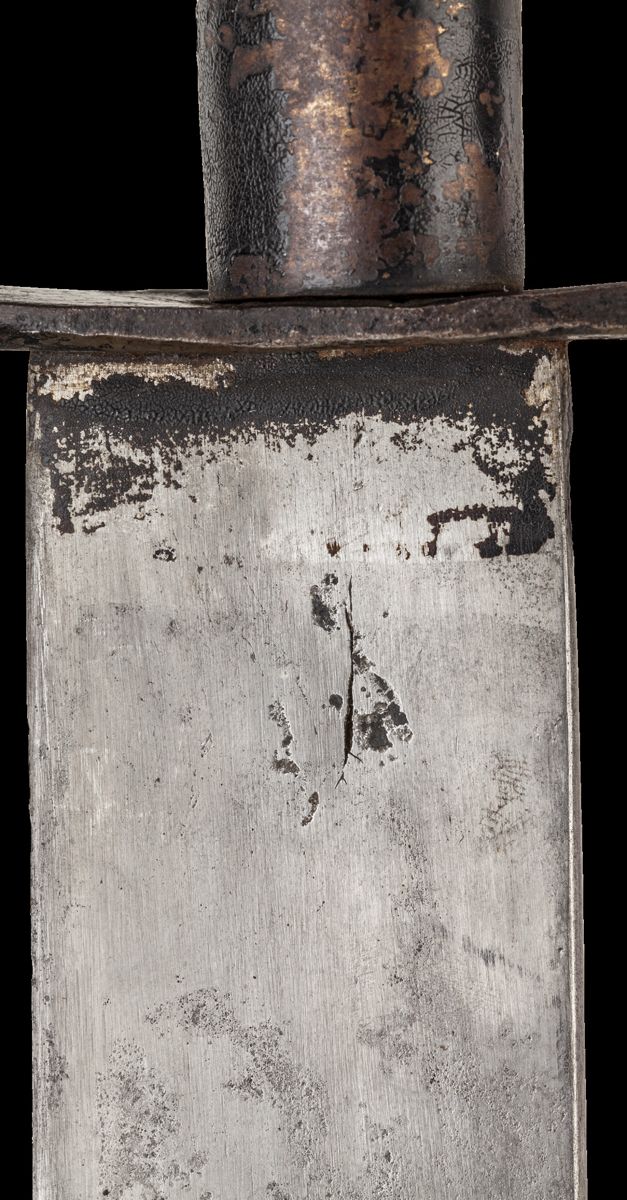
Captain Nelson’s note and memoirs leave no doubt that this is the “pattern” knife purchased by the Milledgeville Arsenal. Josh Phillips has documented seven different knives that follow this same pattern, which were supplied by the fifteen makers. The example shown here is designated a Type I. Examples of the Type I Georgia Armory knives like the one shown here have remnants of a black japan, an early term for paint made of asphaltum, pitch, linseed oil, and turpentine.3 The japan extends to the ricasso, and sometimes beyond, which demonstrates that the hilts were dipped in a vat of japan after the knife was assembled. Before dipping them in the vat, the wood was covered with oil, grease, or wax so that the paint could be wiped off of the grip after it had dried. The iron buckle on the belt was also dipped in the same japanning process. None of the surviving knives have any type of individual maker marks on them, but Captain Nelson’s captured knife and belt offer us an important clue to tentatively identify one of the Milledgeville knife suppliers. As mentioned earlier, the knives were to come complete with belt and clasp and Captain Nelson’s knife is still complete with the belt which has an unusual and heretofore unique painted clasp. The oval cast iron clasp, complete with an integral bar and a fixed tongue protruding inward from the outer ring. In other words, it has a fixed tongue like a fixed tongue belt clasp, ie… a fixed tongue like a “Georgia Frame” buckle Confederate suppliers adopted because they required the least material and labor while still producing an item that would do the job. It was a cost and labor cutting measure. As alluded to earlier, of the 4,909 knives purchased by the Milledgeville Arsenal that spring and summer, more than half came from just two manufacturers, R.J. Hughes & Company, sent 1,469 and J.W. and L.L. Moore, sent 1,183. All the knives sold by R.J. Hughes & Company were accompanied by belts, of the remaining 3,440 knives, 2,969 came with belts.4 The makers of the knives purchased by the Milledgeville Arsenal included cutlers, textile manufactures, gunsmiths, and blacksmiths. Not a cooper (canteen maker) among
The Confederate Records of the State of Georgia Vol. II, Atlanta, Ga, 1909, pp. 350-351.
made canteen straps, the fact that the clasp on this knife, and the clasp on this canteen are the only two of this type known to exist, are both oval, made of cast iron, and both have the heavy black japan. They are likely from the same maker. Rufus Hughes partnered with numerous other manufacturers to make accoutrements, bridles, and cotton webbing. Operating as R. J. Hughes & Co., Hughes and Pendergrass, and Hughes, Pendergrass & Snow (R.J.’s wife was a Snow) in Monroe, Ga., the firm was likely the western South’s largest provider of cotton webb (this is the spelling used in the original contracts) and webb bridle reins, canteen straps, and shoulder belts. It appears that Hughes and Pendergrass were primarily makers of webbing, but they had the necessary government contacts to acquire contracts, so they partnered with others such as bridle, cartridge box, belt, and canteens makers. It appears that the additional party to the contracts supplied the manufacturing labor and additional materials such as, leather, buckles, canteens while Hughes, Pendergrass and Snow supplied webbing and the contracts. Rufus J. Hughes. them.5 However, one of the fifteen knife suppliers, R.J. Hughes did provide at least 50,000 canteen straps to the Confederate Government.6 This is important because a Confederate wood drum canteen has been discovered with its original strap, which has a similar, but unique iron clasp as that found on Captain Nelson’s captured knife and belt. The wooden canteen itself is a one of a kind. The canteen’s body consists of two turned wooden faces, joined by staves. This is common enough, but what is very unusual is that the bands are made of copper, rather than the iron band typically used. Among the other unusual features are the japanned tin loops, which are each pinned to the band by small nails. Most Confederate wood drum canteens came with round spouts, but today nearly all are missing the spout because they had been inserted, or sometime screwed into, a ³⁄₁₆ inch stave, which did not give it much support. In this case a mouthpiece 1 ⁹⁄₁₆ by 1 ¾ inches, by ¹¹⁄₁₆ of an inch tall was nailed on from inside the stave, making it totally secure. Into this was inserted a lathe turned wooden spout. The resultant canteen is easily the highest quality Confederate wood drum canteen that I have encountered in more than forty years of collecting. The canteen’s strap is also a one of a kind. It is made of very coarsely woven cotton webbing and fastened with a cast iron, oval buckle that was coated with black japan. Even the strap with the japan. Naturally much of the japan has come off the exposed areas of the strap, but the less exposed areas and where the strap overlaps is still black. Since the knives were provided with “belts and clasps” and we know7 that R. J. Hughes provided Knives, belts and clasps to the Milledgeville Arsenal, and that R.J. Hughes
Rufus Hughes was in numerous manufacturing enterprises to supply the Confederate Government. For example: On the “23rd day of December 1862 between major M. H. Wright, CSA for and in behalf of the Confederate States of America of the first part and E. A. Smith, R. J. Hughes, A. F. Nunnally & W. N. Pendergrass, trading and doing business under the firms and style of Smith, Hughes & Co of Monroe, Walton Co. Geo. of the second part” to furnish the Confederacy “boxed and delivered on the cars at Social Circle Geo. Five hundred sets of Infantry accoutrements Complete consisting of cartridge box, and cartridge box belt, cap box waist belt and bayonet scabbards to be made according to the example furnished & to be delivered by the 1st of March, 1863.” The contract goes on to say that the Confederacy will accept up to 3,000 additional sets delivered at the same time and price. On March 7, 1863, only six days after the original contract was due, and presumably filled, Hughes, Pendergrass and Tillman contracted for the 3,000 additional sets of infantry accoutrements, to include a cartridge box with cotton web sling, one percussion cap box, one bayonet scabbard and one waist belt. Tillman must have been the supplier for the leather accoutrements, with Hughes and Pendergrass supplying the straps and slings of webbing. So, we know that R.J. Hughes submitted knives with belts to the Arsenal at Milledgeville and we know that he often partnered with other craftsmen to produce a complete item to sell the Confederate Government. Certainly, he personally did not make them, but no record of a partnership is extant, so it is possible that they were made in his own carriage shops. It is also possible that he partnered with another craftsman to make them. In all of his surviving contracts he partnered with craftsmen that could add to his own product, rather than simply hiring them to make an entire product. On October 25, 1864, T.M. Bradford, M.S.K. submitted his annual report of the Ordnance and Ordnance Stores in the Arsenal and Magazine at Milledgeville. On that date the Arsenal held 3,856 knives and 1,600 belts. The following month, on November 24, 1864, General W.T. Sherman’s men entered Milledgeville and seized the arsenal, Captain Nelson and the 89th Ohio Volunteer Regiment among them. The 89th had joined General Rosecrans forces in Tennessee, after the December 31, 1862 to January 2, 1863, Battle of Stones River, also known as the Second Battle of Murfreesboro. The regiment went on to fight in the battle of Chickamauga, where most the regiment was forced to surrender to the victorious Confederates. The remnant of the 89th, joined Sherman’s advance on Atlanta, fighting in all the battles. It burned its way across Georgia with Sherman, before entering Milledgeville. The Arsenal was ordered destroyed, but prior to the destruction of the material, the soldiers and slaves alike were encouraged to take what they wanted and as the note tells us Captain Isaac C. Nelson 89th Ohio Volunteer Infantry took this knife and belt. Federal Colonel William A. Hawley, promoted to colonel on March 10, 1863, boasted of his men’s work of destruction in Milledgeville which included, “The following is a list of the property seized, with the disposition made of the same: Burned—2,300 muskets, smooth-bore, caliber .69; 10,000 rounds cartridges, caliber .69; 300 sets accouterments; 5,000 lances; 1,500 cutlasses;
15 boxes U. S. standard weights and measures. Thrown into the river—170 boxes fixed artillery ammunition; 200 kegs powder; 16 hogsheads salt. A large amount of cotton, say 1,800 bales, was disposed of by General Sherman; the manner of disposition was not made known to me. About 1,500 pounds tobacco was taken by my order and distributed among the troops generally. Besides the property above enumerated, a large lot of miscellaneous articles, such as harness, saddles, canteens, tools for repairing war materials, caps, &c., was burned in the building situated in the square near the State House.”10 Afterwards, the 89th Ohio looted it way up through the Carolinas and on to Richmond. Moving to Washington, it took part in the Grand Review. The regiment mustered out in Ohio, June 13, 1865.11 It is not known where the Confederate wooden drum canteen with the intact presumed R.J. Hughes strap turned up, but it could not have been taken at the same time as the knife and belt for two reasons. One, the M.S.K. report of October makes no mention of canteens in the Arsenal, and two, because the captor of the canteen stamped “1st Mass” into one of the canteen’s outer bands. The 1st Massachusetts Infantry served the entire War in the Eastern Theatre. The 1st Massachusetts Regiment arrived in Washington on the evening of June 17, 1861, and never got closer to Georgia than the Virginia Peninsula before mustering out on May 25, 1864. The canteen must have traveled from Georgia to Virginia; the canteen’s captor never went to Georgia. The note, the belt, the canteen strap, and the documented history taken together, strongly suggests a couple of things, one, that Rufus J. Hughes is the maker of what is designated the Type I Georgia Arsenal D-Guard and two, what the Hughes, Pendergrass & Snow belts, webbing and straps, and perhaps his canteens, looked like. History is unraveled a little piece at a time, and modern historians owe a debt of gratitude to Captain Isaac Nelson for taking the time to record the history of his capture.
Captain William A. Hawley (1824–1873).
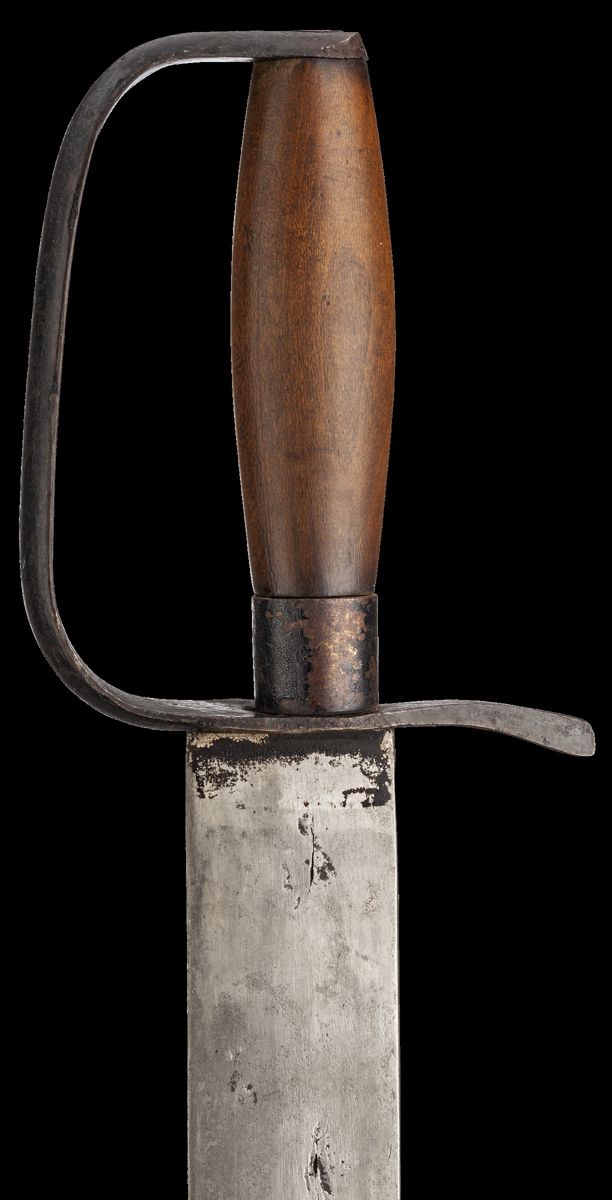
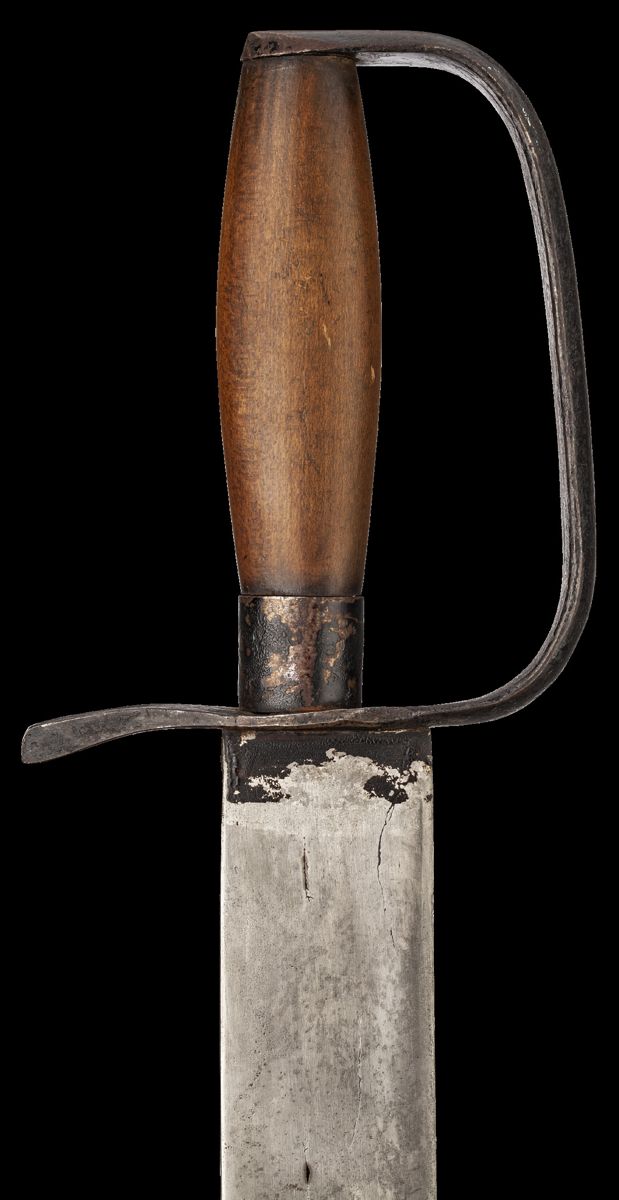
The japanned, half round guard is very uniform on all Type I, Milledgeville knives. (Knife photos by Jack W. Melton Jr.)
Note the black japan extends down the blade, beyond the ricasso as a result of the entire hilt being dipped.
Note the form of the D shaped guard and quillon. Though there is slight variation in other Types, it is these characteristics that define this as a Type I.
Note stains in the blade resulting from high carbon content and forging flaw.
Captain Isaac C. Nelson’s captured Georgia Armory Type I, D-Guard knife.
Manufacturer: Georgia Armory Contract Overall Length in Scabbard: 23 ¹¹⁄₁₆ inches Overall Length: 22 ¹¹⁄₁₆ inches Blade Length: 17 ⁷⁄₃₂ inches Blade Thickness One Inch from Ricasso: .189 inch Blade Width at Ricasso: 1.61 inches Maximum Blade Width: 1.65 inches Maximum Diameter of Wood Handle: 1.25 inches Length of Wood Handle: 4.89 inches Scabbard: Leather sewn along cutting edge with double rows of stitching with 4-inch tin drag attached by two pins on each side. There are four iron rivets that secure the stitching. Three of the rivet ends on the backside were small rectangular pieces of metal, that are now missing. Scabbard throat is reinforced with .71-inch-wide strip of leather. The 2.79 x .88 inch sewn leather belt loop is insufficient to carry this knife. The remains of the paper label is 8 ¼ inches long. Overall Length of Scabbard: 18 ⁷⁄₃₂ inches Width of Scabbard Measured in the Middle: 2.26 inches Guard: Iron D-Guard has flat surface on the inside and rounded on the outside edge. It measures .73-inch-wide x .24-inch thick. Grip: Wood with .87-inch iron ferrule. Leather Belt: 42 ⅛ inches long (not including belt buckle) x 1 ⁷⁄₁₆ inches wide and is .13 inch thick. Belt looped through the buckle and has a single vertical row of stitching. Buckle is a cast iron oval, which measures 1.91 inches wide x 2.38 inches high, is .19 inch thick, and is slightly convex. The clasp has one triangular shaped hook. Provenance: Capt. Isaac Cook Nelson. Inherited by his son Paul E. Nelson. Inherited by his daughter Lorraine Nelson Lindfors. Sold on consignment from Lorraine Nelson Lindfors by J. Christopher Mitchell to Brent Smith, who sold to William Ivey, who sold the knife to collector Lee Hadaway. Pictured on page 94 of Confederate Bowie Knives by Jack Melton, Josh Phillips & John Sexton. Collection: Lee Hadaway, at the time of photography.
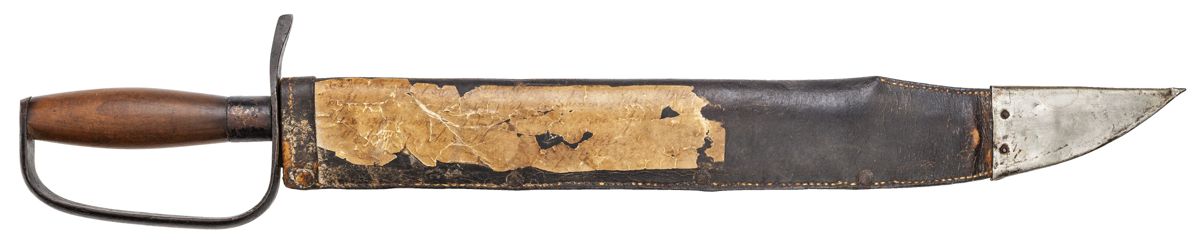
The paper label pasted to the front of the scabbard reads:
“Confederate short sword (indiscernible) / Milledgeville Ga Nov. 24th 1864 on “Sherman’s March to the [Sea]”. / This was never used but similar ones were found on / battle fields in the south. (signed) I. C. Nelson / Capt. Co. d 89th O.V.I.”
The leather scabbard is tipped with a toe made from a single piece of tin. Two iron tacks on each side, hold it in place. Note the quality here; iron, or sometimes lead, rivets are set inside the stitch line, so that the knife cannot cut the threads. This scabbard utilizes four iron rivets.
The belt loop was the obvious weakness in an otherwise, well-made scabbard; note that the throat is of superb quality, having an additional leather band, and a copper rivet in the corner.
This is the belt that originally carried the knife.
Note that the cast iron, one piece clasp has the same japanned coating as the knife’s hilt.
The back of the clasp is flat, unlike the front, which is rounded.
Endnotes
- Confederate Bowie Knives of the Georgia State Arsenal by Josh Phillips.
- Bezdek, Vol. 1 p. 390, Confederate Records: Locations and Professions.
- Confederate Bowie Knives, Melton, Phillips & Sexton.
- Confederate Records, Statement of Governor Joseph Brown, page 351.
- Confederate Records, Statement of Governor Joseph Brown, page 351.
- Confederate Contract dated October 9, 1863. Confederate Business file.
- Confederate Records, Statement of Governor Joseph Brown, page 351.
- March 7, 1863, Hughes, Pendergrass and Tillman contracted for 3,000 sets of infantry accoutrements O.R.
- Smith, Hughes and Co. also produced thousands of cavalry bridles for the Atlanta arsenal O.R.
- Reports of Col. William Hawley, Third Wisconsin Infantry, O.R. Vol. 44, pp. 268-249.
- Dyers’ Compendium.
For more information on Captain Nelson: Isaac Nelson Papers & Diary. Captain Isaac Nelson’s misc. papers & photos, 1840–1921 and Diary, 1863–1865. Call# CWTIColl. USAMHI. Carlisle Barracks. PA.
About the Author Shannon Pritchard has authored numerous articles relating to the authentication, care and conservation of Confederate antiques, including several cover articles and is the author of the definitive work on Confederate collectibles, the widely acclaimed Collecting the Confederacy, Artifacts and Antiques from the War Between the States, and is co-author of Confederate Faces in Color.