
Thomas W. Cofer’s Confederate Patented Revolver
By John Sexton · Originally published May-June 2023 · pp. 51–79
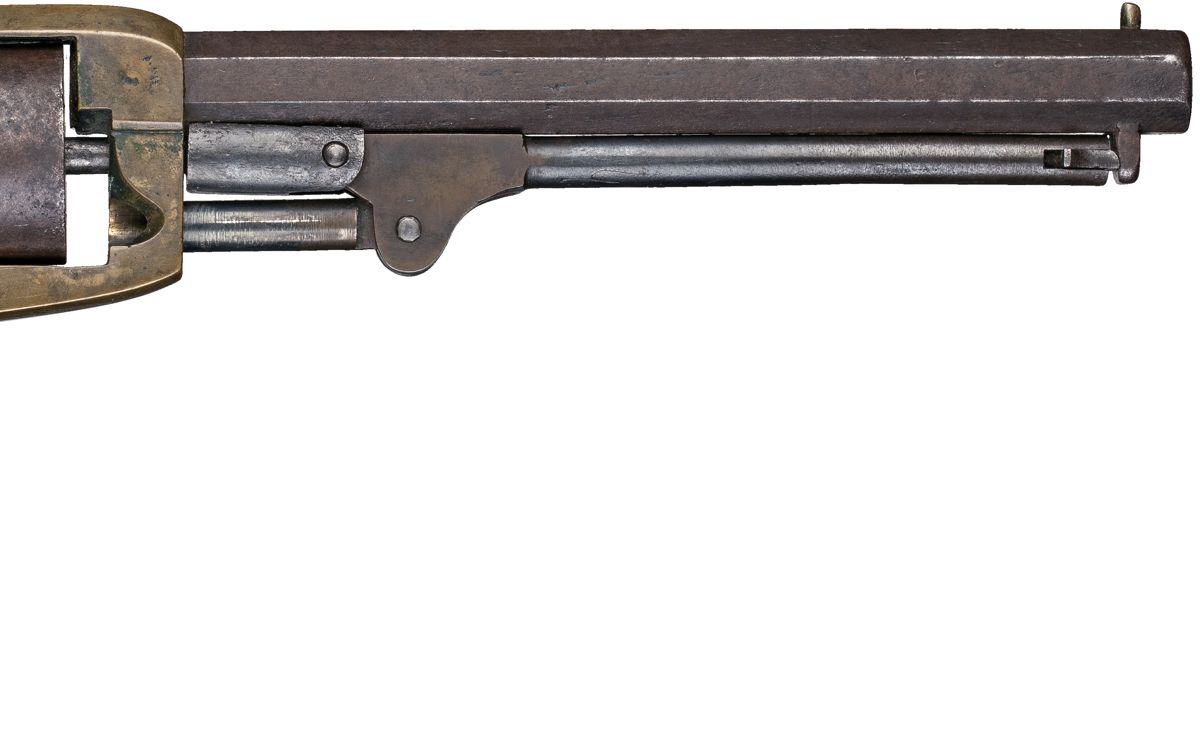
Thomas W. Cofer’s Confederate Patented Revolver By John Sexton
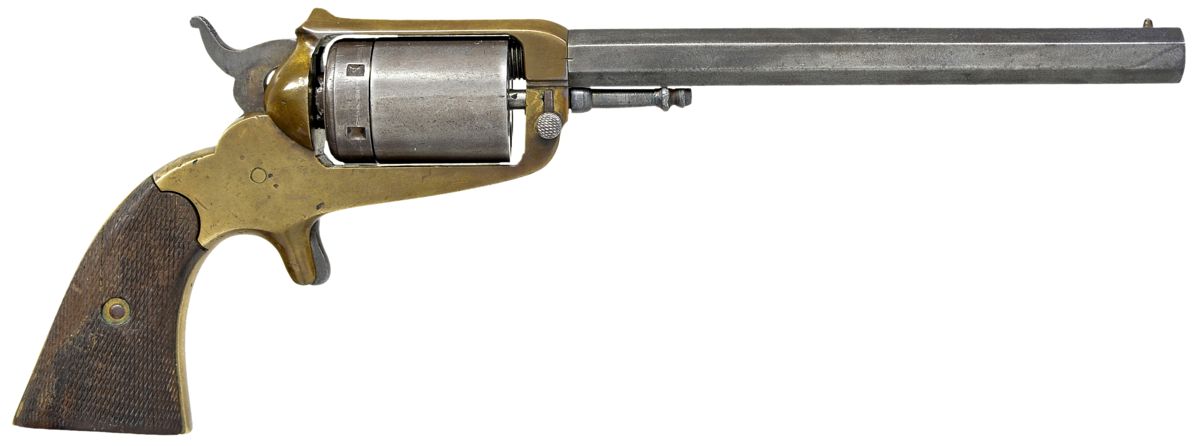
The Cofer percussion revolver is among the true icons of Civil War arms collecting and among the most coveted revolver made in the Confederacy. The brass framed percussion revolver made in Portsmouth, Va., is copied from the solid frame Whitney navy pattern but with a brass frame, no trigger guard and spur shrouded trigger, it is the most distinctive of all Confederate martial revolvers. Contracted by Capt. Edgar Burroughs of the Chesapeake Light Cavalry, Co. I, 5th Virginia Cavalry, who were recruited in neighboring Princess Anne County.
restored and only SN 7 has the original unique patent cylinder. That cylinder had three original cartridges when discovered.
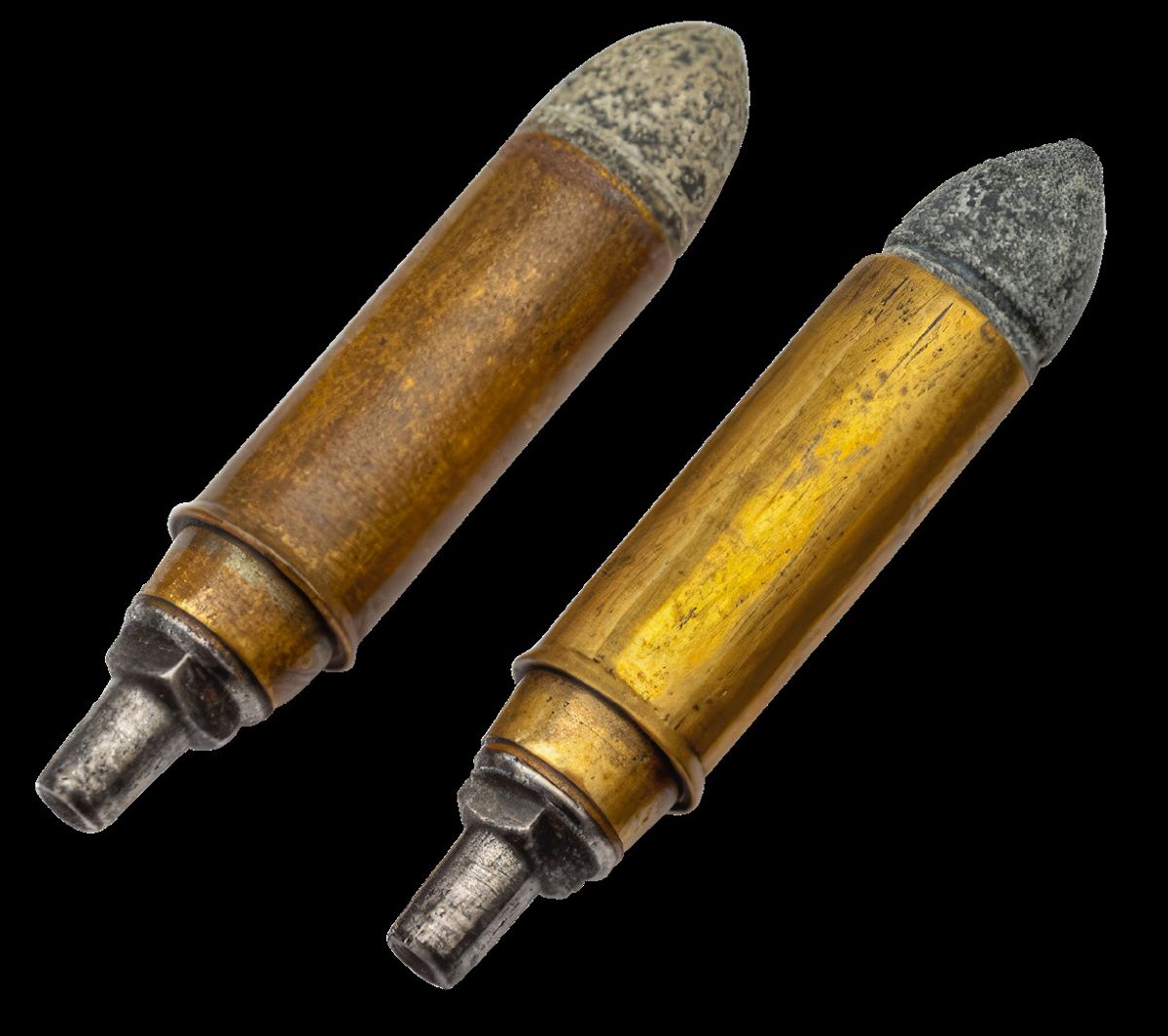
There are two models of Cofer revolvers, the first type utilizes the patent two-piece cylinder and special tapered and flanged brass cartridge that Thomas W. Cofer was awarded Confederate States patent no. 9, August 12, 1861. Cofer was born on March 22, 1828, near Smithfield, Va., and died July 23, 1885. The Cofer is the only Confederate firearms patent. Only two survivors are known of an estimated ten patent cylinder revolvers made. Based on the catastrophic failure of serial number 7 and only the barrel and frame surviving on serial number 1, these were probably not field worthy and standard percussion cylinder revolvers were made to fulfill contract. Since known deliveries are five months apart, it is possible that the January 1862 delivery of seventeen revolvers was the cartridge type, but since cartridges were not mentioned on receipts, most likely all were standard percussion. Cofer marked all his revolvers on the frame: “T. W. COFER’S PATENT,” even though the patent only applied to the patent cylinder and cartridges. The patent cartridge must have been a failure as no excavated cartridges are known from camps or battlefields. The two surviving patent revolvers are both heavily
Thomas W. Cofer’s surviving Confederate patent, number 9, dated August 12, 1861. (Courtesy Cowan’s, a Hindman Company. Private collection.)
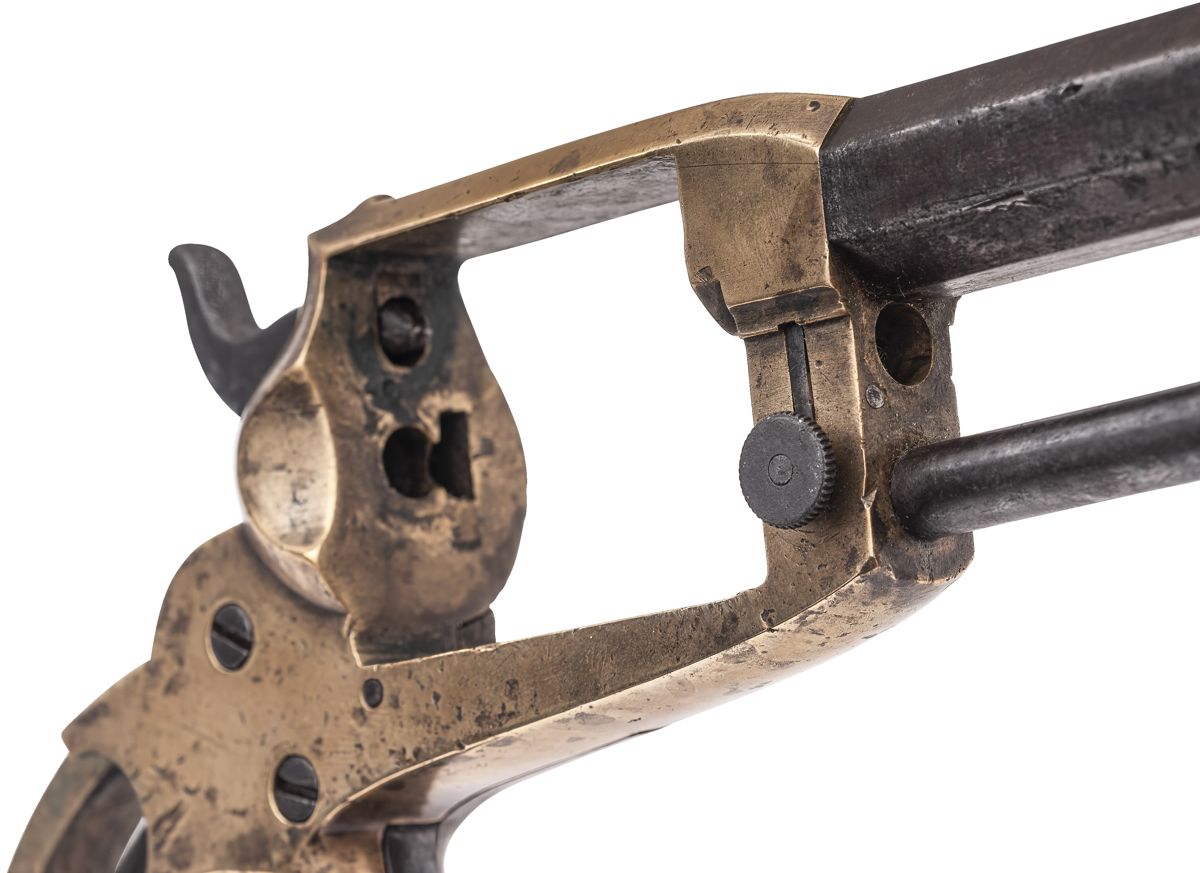
There are sixteen surviving Cofer revolvers of all configurations, one of smaller caliber and size and unknown ignition system which I call a prototype, two are patent cartridge models, and thirteen are percussion. Four survivors are documented as Union captured souvenirs; only one revolver has a documented Confederate history via direct descent from a Virginia officer. That revolver recently sold brought a record price, an incredible $585,000, for Civil War martial pistols. The sale occurred Nov. 6, 2022, at Poulin Auctions in Fairfield, Me. Two other Cofers had broken $200,000 years earlier. One reason for such high prices for this pattern is that only a few survivors are complete and original. Most have varying degrees of restoration as noted when known. Four survivors are in museums, and one has an unknown location since 1934. Percussion revolvers are serialized, or assembly marked, on almost every part including cylinder pin, loading lever, barrel, cylinder, hand, cylinder locking bolt, hammer, frame, and grips. Frames are stamped on the brass top strap “T. W. COFER’S / PATENT.” and barrels “PORTSMOUTH VA.”
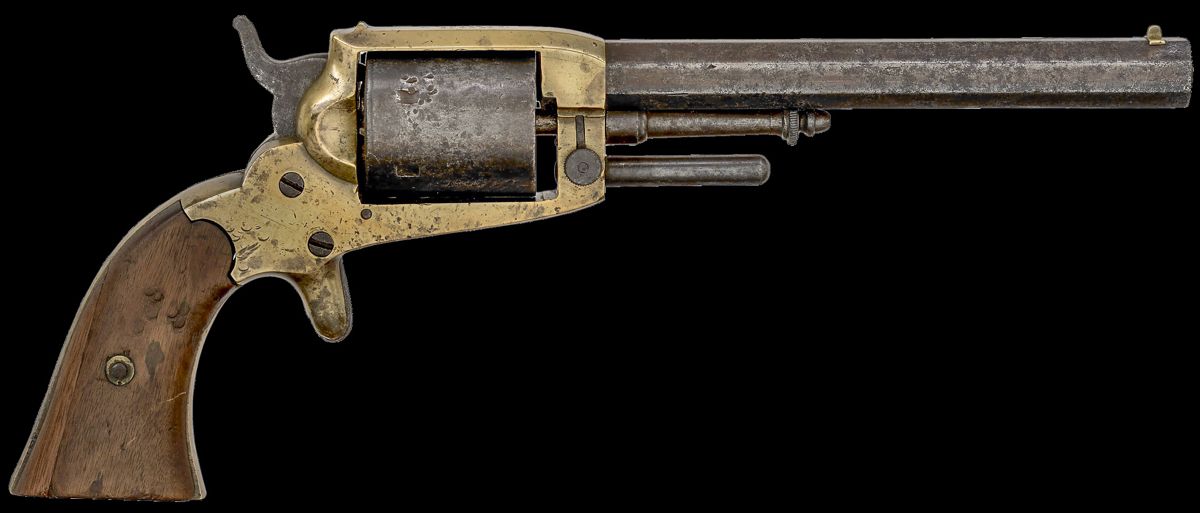
Cliff Young owned this revolver for over 50 years after it was discovered in a house being torn down on Long Island, N.Y. The revolver was found to be in beautiful condition.
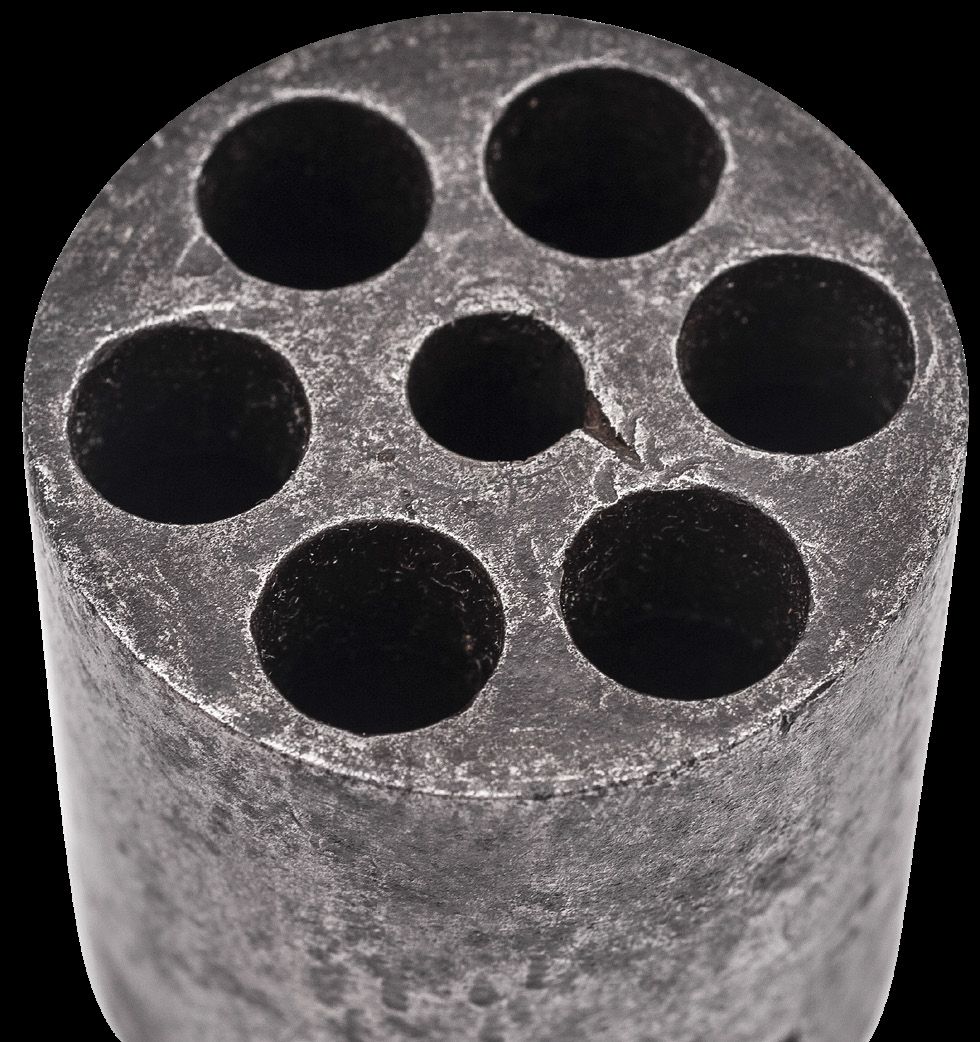
“Prototype” No Serial Number (NSN). Smaller than either the patent cylinder or percussion model and straight bored untapered cylinder. The ignition system is unknown. However, pioneer Confederate revolver collector Cliff Young devised a cylindrical steel cartridge with nipple. It fits cylinder well, but no provision for movement if actually fired. Markings are same as on production models. This oddity is unexplained.
One-piece cylinder using an unknown cartridge (totally different than the patent percussion cartridges used in SN NO. 1 and SN NO. 7.) (Private collection.)
References: Confederate Revolvers [1987], by William A. Gary, pictured on pp. 149-151; “The Legacy of a Tidewater Gunsmith – Thomas W. Cofer,” M. Clifford Young, ASAC Bulletin 72, May 3-7, 1995.
Richmond Dispatch (Richmond, Va.), Wednesday, July 17, 1861, page 3. Same ad published in The New Orleans Crescent (New Orleans, La.), Monday, July 22, 1861, page 4.
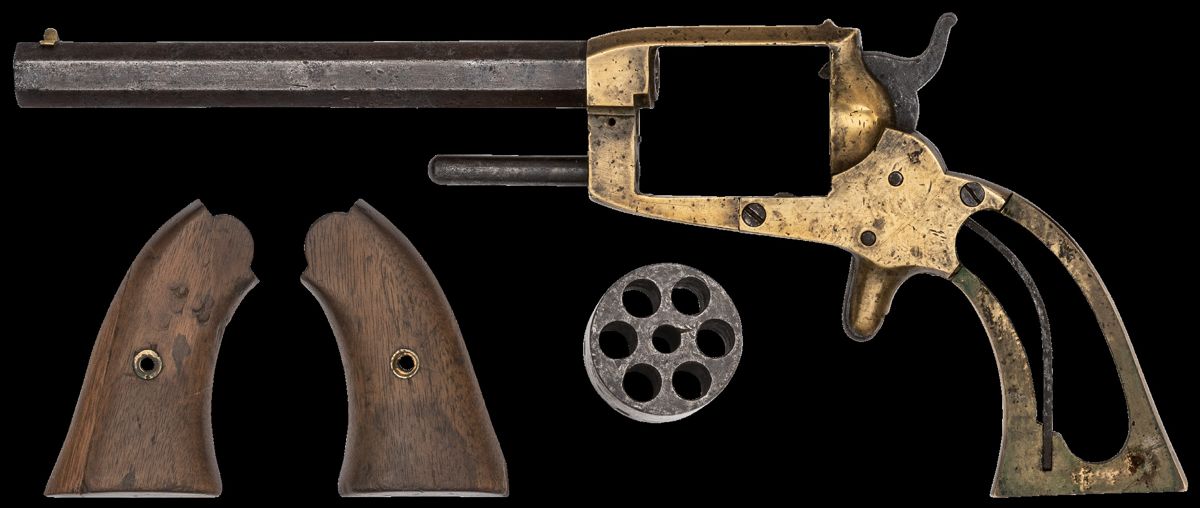
(Courtesy Cowans’, a Hindman Company. Private collection.)
THOMAS W. COFER’S BREECH LOADING FIRE ARMS CONFEDERATE PATENT NO. 9, AUGUST 12, 1861
THE CONFEDERATE STATES OF AMERICA To all to whom these Letters Patent shall come: Whereas Thomas W. Cofer, of Portsmouth, Virginia, has alleged that he has invented a new and useful Improvement in Revolving Fire Arms which he states has not been known or used before his application has made oath that he is a Citizen of the Confederate States, that he does verily believe that he is the original and first inventor or discoverer of the said Improvement and that the same hath not, to the best of his knowledge and belief, been previously known or used; has paid into the treasury of the Confederate States, the sum of Forty dollars, and presented a petition to the Commissioner of Patents, signifying a desire of obtaining an exclusive property in the said Improvement and praying that a patent may be granted for that purpose. These are therefore to grant according to law, to the said Thomas W. Cofer, his heirs, administrators or assigns, for the term of fourteen years from the twelfth day of August one thousand eight hundred and sixtyone the full and exclusive right and liberty of making, constructing, using, and vending to others to be used, the said Improvement a description whereof is given in the words of the said Thos. W. Cofer in the schedule hereunto annexed, and is made a part of these presents. In Testimony Whereof, I have caused these Letters to be made Patent, and the Seal of the Patent Office has been hereunto affixed. Given under my hand at the City of Richmond this Twelfth day of August in the year of Our Lord one thousand eight hundred and sixty-one Specifications annexed to Patent No. 9, granted to Thomas W. Cofer, August 12, 1861. To all whom it may concern: Be it known that I, Thomas W. Cofer of Portsmouth in the County of Norfolk, and State of Virginia have invented a new and improved mode of making many chambered revolving pistols, which may also be applied to firearms and to cannon, and I do hereby declare the following is a full and exact description thereof reference being had to the accompanying drawings and to the letters of reference marked thereon.
The nature of my invention consists in so arranging the chambered cylinder of breech loading pistols, firearms, so that the chambers in the revolving cylinder shall be charged with cartridges or ammunition contained in thimbles, in place of the chambers being loaded with powder and ball as usual, and that the nipples for the reception of percussion caps shall be inserted in a circular plate distinct and separate from the revolving cylinder, yet corresponding with it in diameter and fitting close to its rear end, so that when fitted to, and placed in conjunction with the revolving cylinder, the added plate and cylinder revolve together on the same pivot causing the cylinder to present no changes in appearance, other than that it is lengthened by the thickening of the plate. The drawing Fig. 1, shows the rammer marked A, attached as usual, but this arrangement entirely dispenses with it, and increases greatly the facility of loading. To enable others skilled in the art to make and use my invention, I will proceed to describe its construction and operation.—I take the common revolving chambered cylinder as used by Colt and others, and in the rear end of this cylinder I insert in each chamber a thimble fitting closely and flanged around its outer end to prevent its being driven into the chamber as shown in B, Fig. 2. These thimbles are charged with powder and ball and constitute the cartridge, and have a small hole in their flanged end, by which fire is communicated to the powder. I then take a circular iron plate about one fourth of an inch thick and fit it closely against the chambered cylinder, and mark out recesses in it corresponding exactly with the chambers in the cylinder—these recesses I turn out, or cut down, so that they shall receive and hold the rear end of each flanged thimble as shown in Fig. 3, and the plate marked C, yet fit close against the cylinder D, as shown in Figs. 1 and 2, fitting close, yet separate from it. From the outside of this plate C, communicating with these recesses I screw into the plate nipples for holding percussion caps, so inserted that the hole through the nipple shall be in a line with, and correspond with the hole in the thimble, so as to form a direct communication between the percussion cap and the powder, which is best done by making the vent hole in the thimble in the center of its flanged end.
The cartridges being placed in the cylinder and the percussion caps on the nipples, the recessed end of the plate C is fitted over the flanged thimbles, and the whole cylinder formed of the two parts; the plate, with its nipples and recesses and the chambered cylinder, are then placed in position, and the pivot rod run through them, and the pistol is ready for use. Or the nipples, in place of being screwed into the plate, may be screwed into the thimble, or the thimble, still reserving the flange on it, may terminate in a nipple, as shown in Fig. 4, so that the cylinder may be capped at the same time it is loaded, and the plate will then be fitted on with the ends of the thimbles terminating in nipples, and projecting outwardly as in plate C, Fig. 1. While I have described this invention as applicable to a pistol, it is obvious that the same principle may be applied to firearms generally and even to a cannon, the mode of communicating fire to the powder in the cannon being adapted to the cannon in any known way—Figs. 5 and 6 represent it as applied to a cannon. In such, even the pivot rod for holding the revolving cylinder would pass in through the rear end of the frame, and a small platform placed in a horizontal plane with the bottom of the cylinder would have to be placed on each side of the frame, so that the cylinder, or the pivot rod being withdrawn from it, can be rolled out on the platform in order to be charged; these platforms are represented in the figures last mentioned by the letters M & N. Having described my invention, what I claim and desire to secure by letters patent, “is the divided cylinder D-C, formed of the chambered portion D and plate C in combination with thimbles for holding the ammunition when constructed and used substantially as herein described.” /s/ Thos. W. Cofer Witness /s/ Robt. D. Ward /s/ James S. French
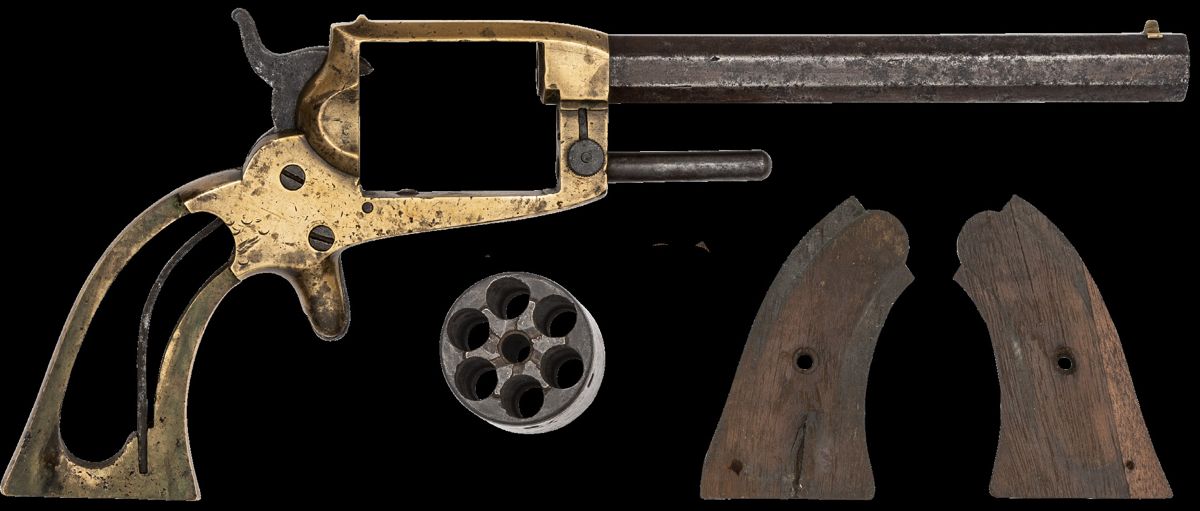
Cofer patent drawing for improved cartridge and cartridge cylinder. Cowan lot 102, April 26, 2016. (Courtesy Cowan’s, a Hindman Company. Private collection.)
“NO 1” (not pictured). Patent cartridge revolver. Only the original frame and barrel survived a fire as Fred Slaton of Nebo, Ky., stated at one of his show displays. Slaton copied the hammer, cylinder, arbor, and grips from SN NO. 7. “NO 1” stamped on brass butt of the grip frame. Stamped on brass top strap “T. W. COFER’S / PATENT.” and barrel “PORTSMOUTH VA.” References: Confederate Long Arms And Pistols – A Pictorial Study [1978], by Richard Taylor Hill and William Edward Anthony [pictured on p. 275 with SN NO. 7 in three views of both guns in their fully restored states]; Confederate Revolvers [1987], by William A. Gary; this gun is pictured on p. 148 in a single photo along with SN NO. 7.
SN NO. 7. Patent cartridge revolver. The revolver survived with its original finish due to a catastrophic failure that broke the frame and blew off the barrel early in its life. This revolver has a wonderful collection history having been part of several of the finest Confederate arms collections in America. Cofer cartridge revolver, SN NO. 7, is one of two survivors. (Courtesy Poulin Antiques & Auctions, Inc.)
Original metallic patented cartridges for the Cofer cartridge revolver found in cylinder of No. 7. (Courtesy Cowan’s, a Hindman Company.)
Top strap marked in two lines: “T. W. COFER’S PATENT. / AUGUST 1861.”
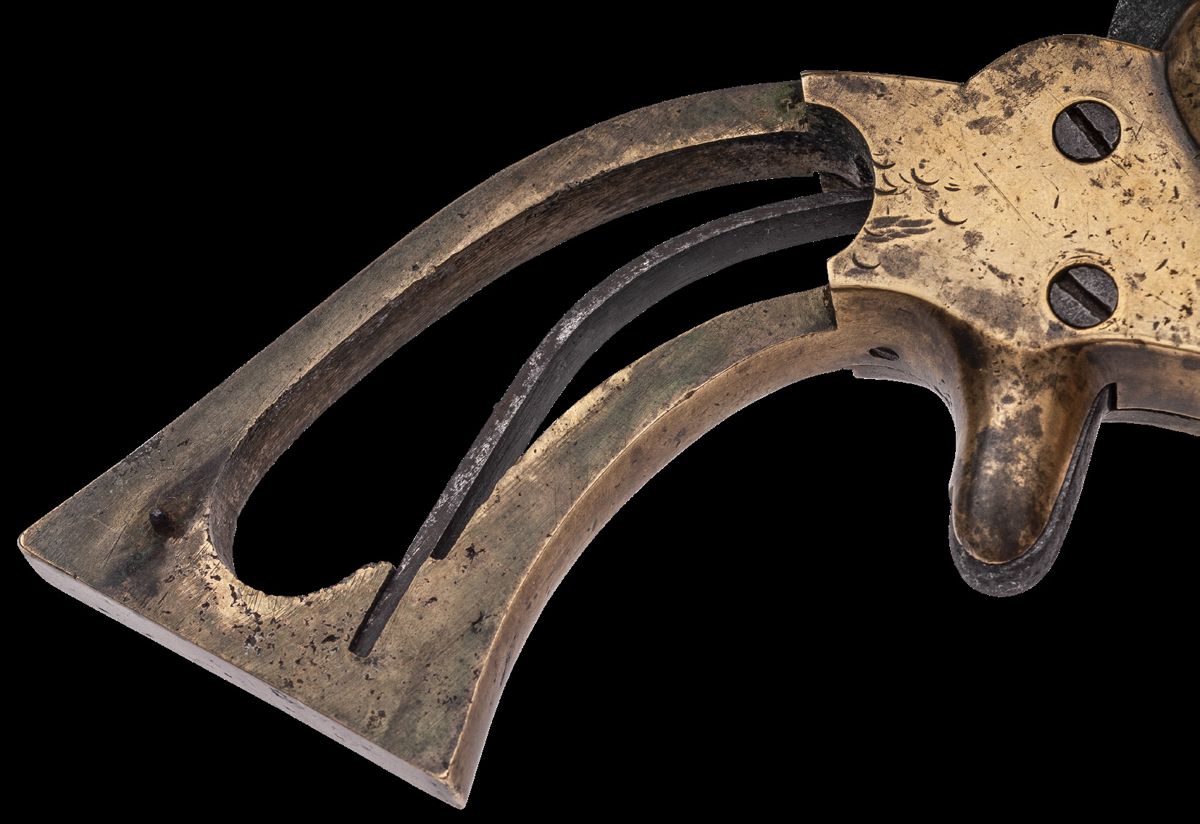
The revolver was beautifully restored by pioneer Civil War historian and collector Berkeley Lewis over 50 years ago.
References: “The Cofer Revolver,” by B.D. Munhall, American Rifleman, August, 1950; Confederate Arms [1957], by William A. Albaugh III, and Edward N. Simmons; [pictured on pp. 23-24 in its unrestored state]; Confederate Handguns [1963], by William A. Albaugh, III, Hugh Benet, and Edward N. Simmons; [pictured on p. 145 is SN NO. 7 in its unrestored state].); Confederate Long Arms And Pistols – A Pictorial Study [1978], by Hill and Anthony [pictured on p. 275 with SN NO. 1 in three views of both guns in their fully restored states]; Confederate Revolvers [1987], by William A. Gary; this gun is pictured on p. 148 in a single photo along with SN NO. 1; both SN NO. 1 and SN NO. 7 are shown in their fully restored states; immediately below the above photograph are views of the restored portions of the two guns, as well as the brass butt straps; “The Legacy of a Tidewater Gunsmith – Thomas W. Cofer,” M. Clifford Young, ASAC Bulletin 72, May 1995.
“NO 7” stamped on brass butt strap of the grip frame.
Restored barrel marked in a single line: “PORTSMOUTH VA” which was copied from standard percussion revolver.
SN 7 grips.
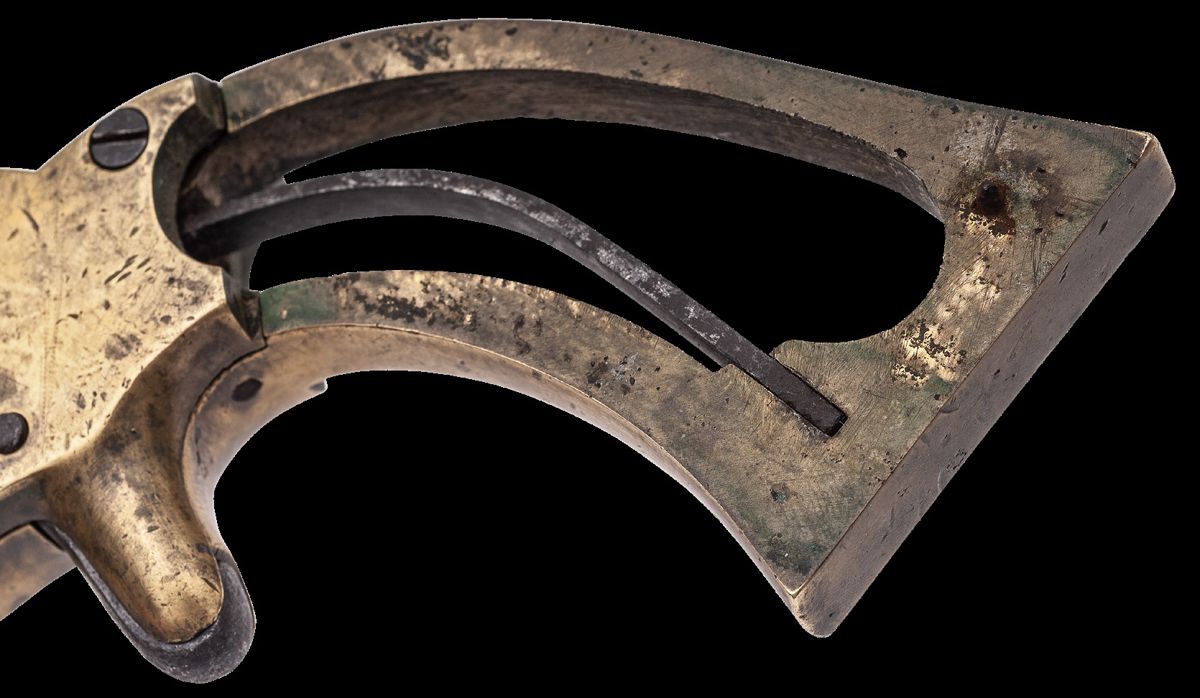
Cofer SN 1 percussion revolver. This hand gun has a long collection history and originally came from Texas collector Harry Brooks’ collection circa WWII. Last sold at James Julia Auctions lot 2197, March 15, 2016, for $149,500. SN 1 is found on most parts of this revolver including cylinder, cylinder pin, loading lever, barrel, frame, and grips. Not visible are eight deliberate grooves cut into the left grip back near the frame. (Courtesy Morphy Auctions.)
T. W. COFER’S. / PATENT. Letters are individually stamped into the top of the brass frame.
References: Pictured in The Texas Gun Collector Magazine, 36, July 1953; Conestoga Auctions, “The William A. Bond Collection,” July 4-5, 1994, lot 565; Arming the Glorious Cause: Weapons of the Second War for Independence; A Photographic Study of Confederate Arms, [1998] by James B. Whisker, Daniel D. Hartzler, and Larry W. Yantz, pp. 94-95.
Serial number 11 stamped on left side of loading arm.
Cofer SN 11. This revolver came from a family in Gettysburg and is possibly a souvenir of that battle. By far the finest percussion example known, and the only survivor to retain much original finish.
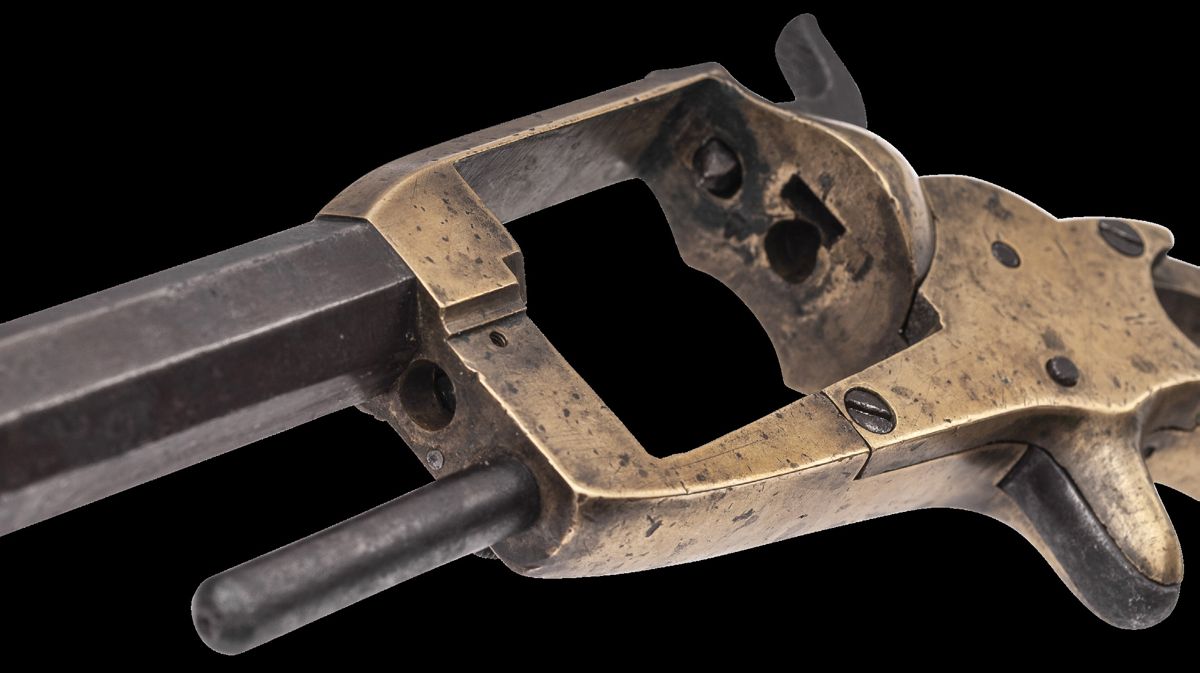
Cofer SN 13 is among the finest survivors, complete and original. It has the best collection history of any Cofer. It was sold by the great-grandson of Joshua P. Melton (1847–1940), who served late 1864 as a 17-year-old in a Virginia Artillery unit. Theodore Dexter sold the revolver in a published catalog on Oct. 29, 1943. William Albaugh sold it to Bill Locke, and it was published in his monumental estate collection text by Frank Sellers in 1973. It has only been in two well-known collections since.
Serial number 13 is stamped on every part (loading lever shown), and assembly number “3” is stamped on the screw heads.
References: Theodore Dexter’s catalog [Oct. 29, 1943]; “The William M. Locke Collection” [1973], by Frank M. Sellers; this gun is pictured in color on page 28, as well as in black & white on page 275 of Confederate Revolvers [1987], by Bill Gary; [this gun is pictured in an oversized view on pages 142-143]; an additional view of this specific gun is on page 148; Conestoga Auctions, “The R. L. Moore Jr. MD Estate Collection,” Jun. 22, 2000, Lot #166.
This revolver is inscribed on backstrap “Jno. D. Anderson,” an officer who was 1st lieutenant in Foster’s Battery, 1st Wisconsin Light Artillery until he resigned on Oct. 17, 1862. On April 21, 1864, Anderson mustered into Company H, 32nd Maine Infantry and mustered out Dec. 12, 1864. On December 13, 1864, he was commissioned as a 1st lieutenant in Company D, 3rd Maryland Infantry.
References: “A Confederate Cofer Revolver From Wisconsin,” by Stanley I. Kellert, The Gun Report, May 1978; Confederate Presentation And Inscribed Swords And Revolvers [1988], by Daniel D. Hartzler; [pictured on p. 133]; Greg Martin Auctions, “The Estate of Stanley Diefenthal,” Feb. 3, 2003, lot 224.
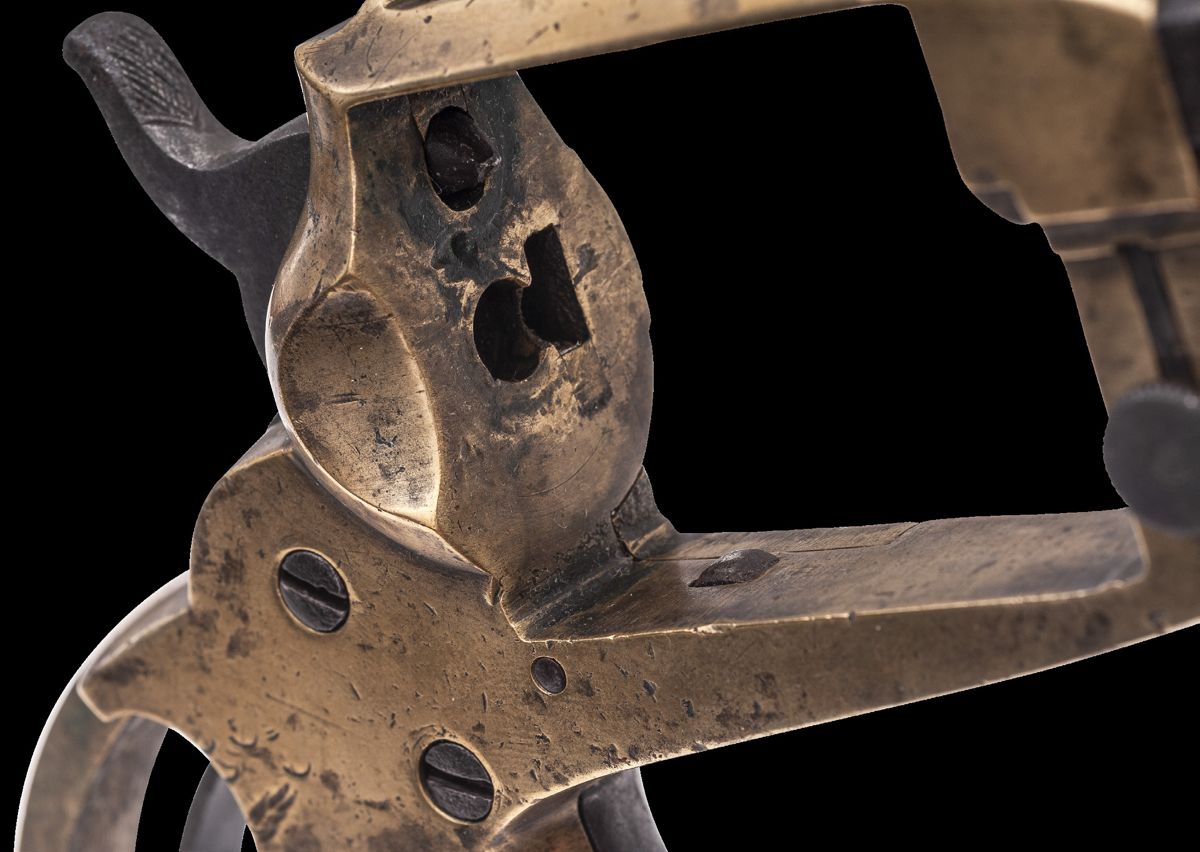
Cofer “F”. The “F” is found on same parts as numbered guns.
This revolver when found was complete and unaltered. It is only Cofer survivor without “PORTSMOUTH VA” on barrel. The barrel stamp was added after 1978.
Lincoln Memorial University Museum, Dr. Carroll Rose Collection. (Photos by Othais McCarthy, candrsenal.com.)
Cofer SN “L” is perhaps the best-known survivor. It was sold by Lawrence Kinney, an antique dealer from Farmington, Me., to Robert Ebber of Freeport, Me., for $20 at an unknown date, but probably around 1950. It last sold at Cowan’s Auction in 2016 for $205,625. This revolver has wonderful ink inscription on its original holster, “July 21 1864 captured from a Rebel Signal officer, S. H. Merrill, 11th Maine Regt.” Simeon H. Merrill entered service as 2nd lieutenant in 1861, and mustered out as a captain in November 1864. The 11th Maine saw service in areas the 5th Virginia Cavalry occupied when this pistol was captured. (Courtesy Cowan’s, a Hindman Company.)
Captain Simeon H. Merrill.
According to the unit history, Merrill “…was known to the regiment as an officer of tried mettle, with fighting experience dating to the Battle of Fair Oaks, where he had commanded most of the companies on the skirmish line and had earned high commendation for the skill and courage he had shown.” When his superiors fell, “…the men of the regiment now looked to him with confidence and obeyed his clear voiced orders without question in the exciting events that followed.” (The Eleventh Maine Infantry in the War of Rebellion, by Hill, 1896. p. 248.) References: Confederate Handguns [1963], by Albaugh, Benet, and Simmons; [pictured on p. 149, as well as on the front panel of the dust jacket]”; Confederate Presentation And Inscribed Swords And Revolvers [1988], by Daniel D. Hartzler; [pictured on pp. 241-242].) “The Legacy of a Tidewater Gunsmith – Thomas W. Cofer,” M. Clifford Young, ASAC Bulletin 72, May 3-7, 1995; Arming The Glorious Cause [1998] by Hartzler et al, [p. 96 pictured with its holster, as well.]
PORTSMOUTH VA stamped on top of the barrel.
This revolver is fitted with a Whitney cylinder and loading assembly which appears original to its time of use. The Whitney cylinder is 1 ¹¹⁄₁₆ inches long. Number 21117 stamped on the Whitney loading lever.
(Richard Steuart Collection, Virginia Museum of History & Culture, Richmond, Va.)
Cofer letter “M” revolver, 13 inches overall, 6 shot, .36 caliber, 7 inch octagon barrel, brass frame, spur trigger, with brass fore-sight. On top of barrel; “PORTSMOUTH VA.” On top of frame “T. W. COFER’S PATENT.” “E.B. GEORGIA” stamped on various parts of gun. “W.I.H.” stamped on butt strap.
Edward B. Georgia was New York soldier who carried this revolver home as souvenir.
References: “The Cofer Revolver,” American Rifleman, by B.D. Munhall August, 1950; Confederate Arms [1957], by Albaugh and Simmons; [pictured on p. 22 in two separate views]; Confederate Handguns [1963], by Albaugh, Benet, and Simmons; [pictured on p. 148]; Confederate Long Arms And Pistols – A Pictorial Study [1978], by Hill and Anthony [pictured on p. 274]; Confederate Revolvers [1987], by William A. Gary; [pictured in two separate views on pp. 148-149].); Confederate Presentation And Inscribed Swords And Revolvers [1988], by Daniel D. Hartzler; [pictured on p. 167].
Cofer SN “N”. The grips on Cofer SN “N” were personalized by Capt. Robert R. Marshall with an elegant carved decoration.
(Courtesy Poulin Antiques & Auctions, Inc.)
Cofer SN “N” was the most expensive Cofer ever sold. It brought $585,000 at Poulin Auctions, Fairfield, Me., lot 3005, Nov. 6, 2022.
N stamp on loading lever.
Robert R. Marshall, captain and M.S.K., was 39 years old on May 10, 1865, when he signed his Parole of Honor. He was 5’8” tall, had grey eyes, with dark hair and whiskers. (Fold3.com)
Cofer SN “N” came from a direct descent of Capt. Robert Rose Marshall (1826–1896), Military Store Keeper, Wood County, Va. His brother Jacob raised his own company which became Co. I 19th Virginia Cavalry. This is the only Cofer known with identification to a Confederate soldier. Purchased in 1999 from family of direct descent of two Confederate officers.
Cofer NSN. Originally published in early texts as SN 59 (transposed with another Confederate revolver in collection), it is a complete survivor with no serial number but with frame and barrel markings found on every known Cofer example. (Metzger-Sanders Antique Firearm Collection, Texas A&M. The collection is one of the largest in Texas with more than 600 rare firearms on display.)
(Metzger-Sanders Antique Firearm Collection, Texas A&M.)
PORTSMOUTH VA stamped on top of the barrel with a single die.
T. W. COFER’S. / PATENT. Letters are individually stamped into the top of the brass frame.
This Cofer NSN revolver’s frame has odd iron block inserted into the frame as part of a restoration that included sideplate, hammer, trigger, loading assembly, grips, and screws. Dixie Gun Works to Fred Slaton 1979.
Cofer NSN. Purchased in a lot of assorted Civil War firearms from an Ohio family based upon Hayes’ “Want Ad” in North-South Trader magazine where he had been running a want ad for a brass frame revolver marked “T. W. Cofer.” Pictured on page 73, The Whitney Navy Revolver, 1857–1866 [2012] by Daniel E. Williams Jr. (Hayes Otoupalik Collection. Photos by Wm. O’Donnell.)
Receipt for sixty-five Cofer revolvers delivered to Chesapeake Light Cavalry, Co. “I”, 5th Virginia Cavalry, signed for by their Capt. Edgar Burroughs (see hand written receipt on the following page), May 31, 1862. The cost was $40 for each revolver. (NARA)
Receipt for first seventeen Cofer revolvers delivered to Chesapeake Light Cavalry, Co. “I”, 5th Virginia Cavalry, Jan. 18, 1862. These are the earliest delivered Confederate made military revolvers. (NARA)
Hand written receipt.
SELECTED BIBLIOGRAPHY Albaugh, William A. III, Confederate Arms, 1957 Albaugh, William A. III, Benet, Hugh Jr., and Simmons, Edward N., Confederate Handguns: Concerning the Guns The Men Who Made Them and the Times of Their Use, pp. 199-204, 1963 The Battalion newspaper, Friday, October 28, 1949. http://newspaper.library.tamu.edu/lccn/sn86088544/1949-1028/ed-1/seq-1.pdf Hill, J.H. The Story of One Regiment: The Eleventh Maine Infantry in the War of Rebellion, Press of J.J. Little and Co., 1896 Hill, Richard Taylor, Anthony, William Edward, Confederate Longarms and Pistols, A Pictorial Study, 1978 Gary, William A., Confederate Revolvers, 1987 Hartzler, Daniel D., Confederate Presentation and Inscribed Swords and Revolvers, 1988 Kellert, Stanley, A Confederate Cofer Revolver From Wisconsin, The Gun Report, May 1978 Munhall, B.D., The Cofer Revolver, American Rifleman, August 1950 Sexton, John “Proprietary Database of Confederate Revolvers” Williams, Daniel E., The Whitney Navy Revolver, 1857–1866, 2012 Young, M. Cliff, The Legacy of a Tidewater Gunsmith – Thomas W. Cofer, ASAC Bulletin 72, May 3-7, 1995 Whisker, James B., Hartzler, Daniel D., and Yantz, Larry W. Arming the Glorious Cause: Weapons of the Second War for Independence; A Photographic Study of Confederate Arms, 1998
About the Author
John Sexton holds the highest designations as certified appraiser with International Society of Appraisers (ISA-CAPP) & accredited senior appraiser with American Society of Appraisers (ASA) specializing in Civil War memorabilia. He authenticates and evaluates other rare and valuable historic items as well. He is coauthor of the book Confederate Bowie Knives (2012) with Jack Melton and Josh Phillips, published by Mowbray Publishing Inc., and author of many periodical articles on Confederate arms. John’s contact information: website: www.civilwarappraiser.com, email civilwarappraiser@gmail.com, cell 770-329-4984.