
A Battle of Williamsburg Trophy – Burger & Brother’s Bowie
By Shannon Pritchard · Originally published November-December 2023 · pp. 48–58
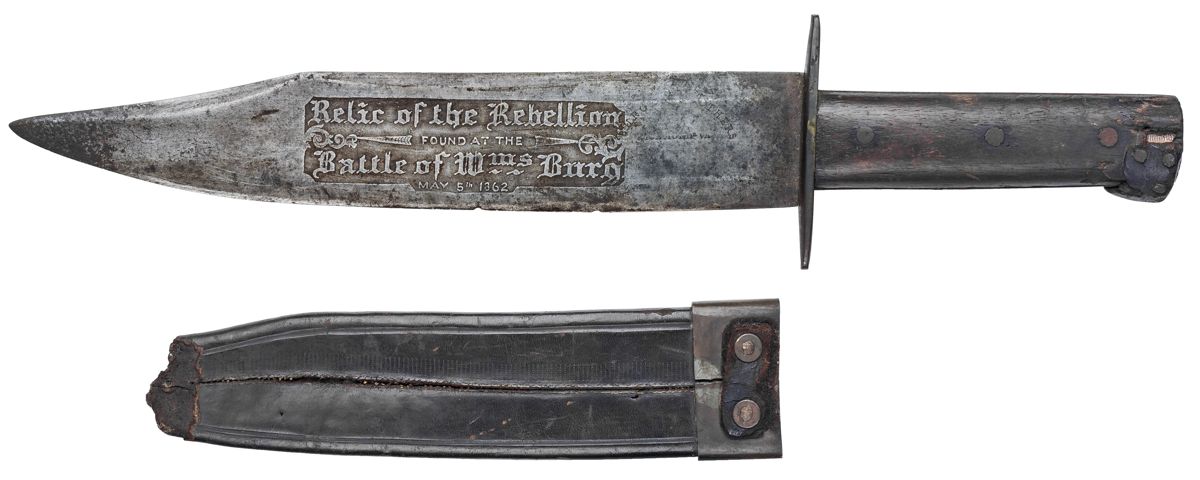
A Battle of Williamsburg Trophy Burger & Brothers Bowie Knife
Every soldier, North and South, needed a knife when they marched off to war; and in the South, it was fashionable, if not practical, to carry a large fighting knife, the bigger the better, judging from war-era photographs. Like the Code Duello, knife fighting was a Southern custom rarely engaged in by those above Mason–Dixon’s line. In truth, relatively little fighting was done with them, North or South, but there are numerous documented cases of Confederates engaging in hand-to-hand combat with knives.
I would like to think that the Burgers and Mr. Boyle were motivated by patriotism; but I am sure, as astute businessmen, they could see there was going to be a more considerable demand for swords than saws.
During the decade before the War Between the States, Bowie knives were in fashion and were widely carried by men all over the country. It is thus impossible to categorize Bowies as Confederate unless they have a documented history of Confederate use or are one of the few that have Southern maker marks or distinctive characteristics. This beautiful Bowie has many classic Confederate hallmarks, but more importantly, it is stamped with the rare “BURGER & BROTHERS” over “RICHMOND – VA” maker’s mark. As such, it is a quintessential Confederate Bowie knife. Prior to the War Between the States, Edward Boyle, Henry R., Lewis, and Peter N. Burger, were in the saw manufacturing business. When the North invaded Virginia, Boyle joined with Thomas Gamble and began producing various types of edged weapons, including knives and swords for private purchase and for the Confederate Government. The Burger Brothers had a much smaller production, but they too, made swords and knives.
Notices for the Burger Brothers, and Boyle & Gamble, Richmond Dispatch. Richmond, Va., Saturday, June 30, 1860, page 3. (Newspapers.com)
Burger & Brother’s advertisement in De Bow’s Review and Industrial Resources, Statistics, Etc: Devoted to Commerce, Agriculture, Manufactures. United States: J. D. B. DeBow., 1861.
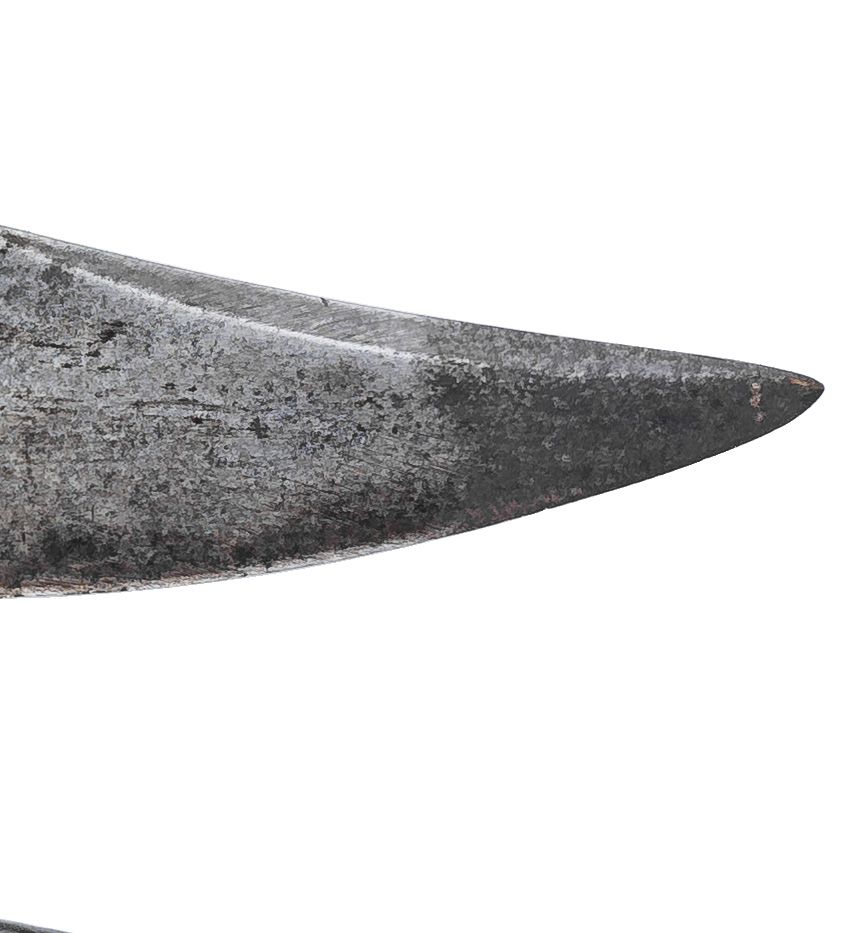
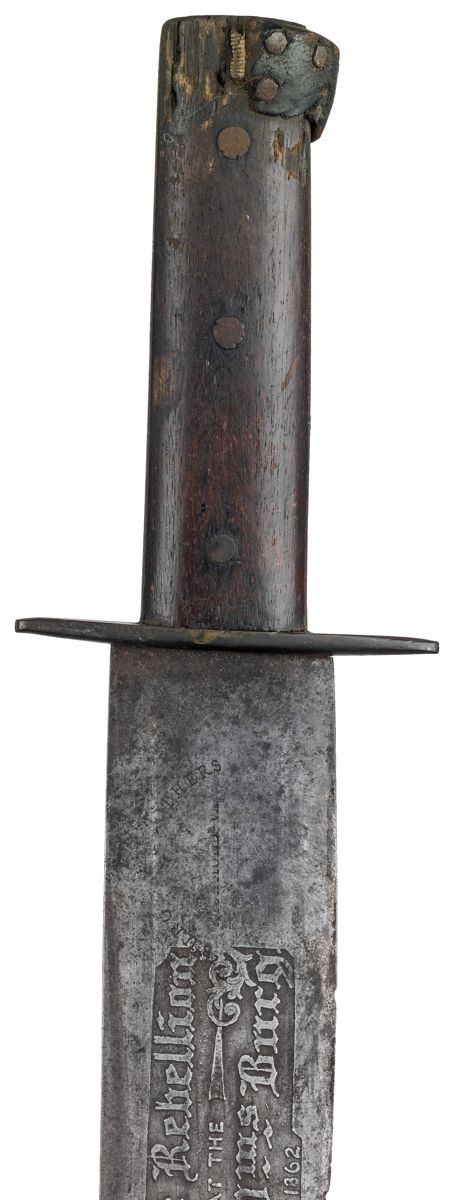
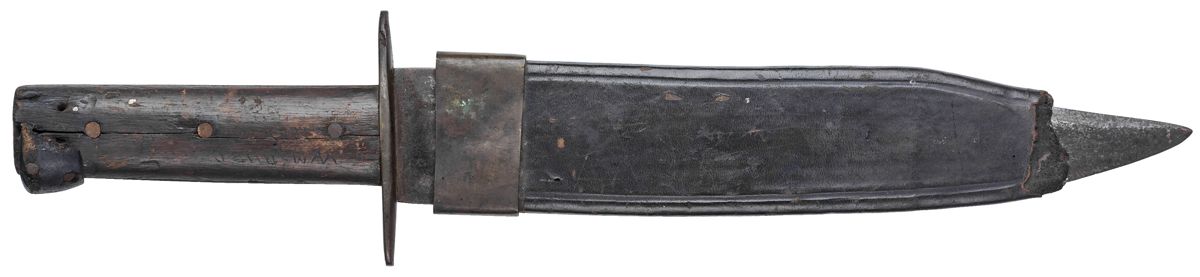
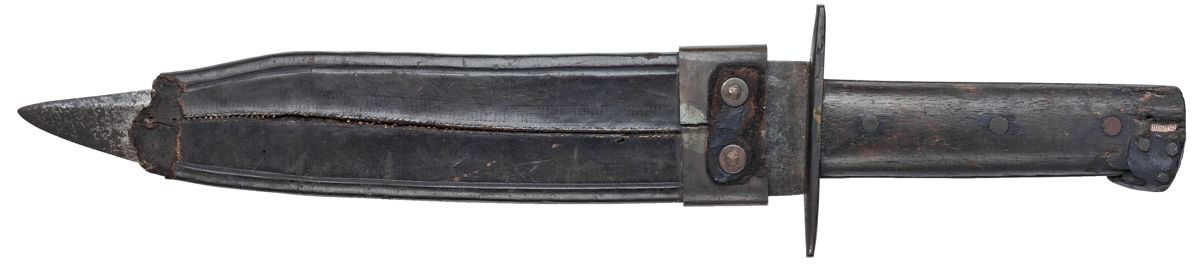
Most Burger & Brothers and Boyle & Gamble products are unmarked; fortunately, they marked enough of each type of weapon for modern collectors to readily identify their unmarked products. Burger & Brother Bowies follow a distinct pattern. The blade is flat without a ridge. The clip point has a false edge; the back is beveled, three iron rivets attach the two-piece wooden slab grips, and the cross guard is beveled brass, or sometimes iron. While these desirable knives are encountered with variations on the above, the knife pictured here has all the desirable signature characteristics and a wonderful Burger & Brothers maker’s mark.
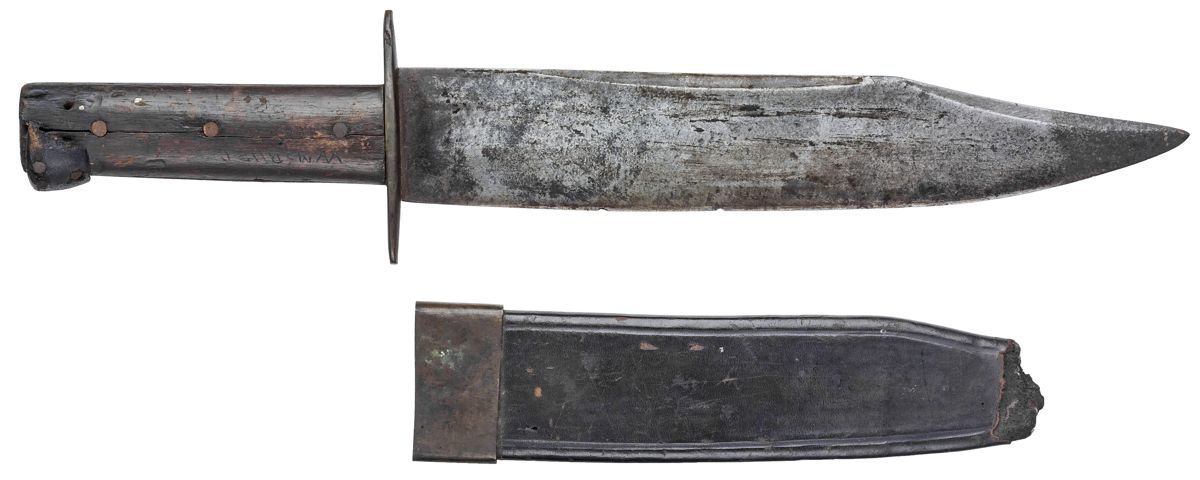
The reverse of the knife and scabbard of this finely etched trophy of the Battle of Williamsburg.
The obverse of the knife and scabbard.
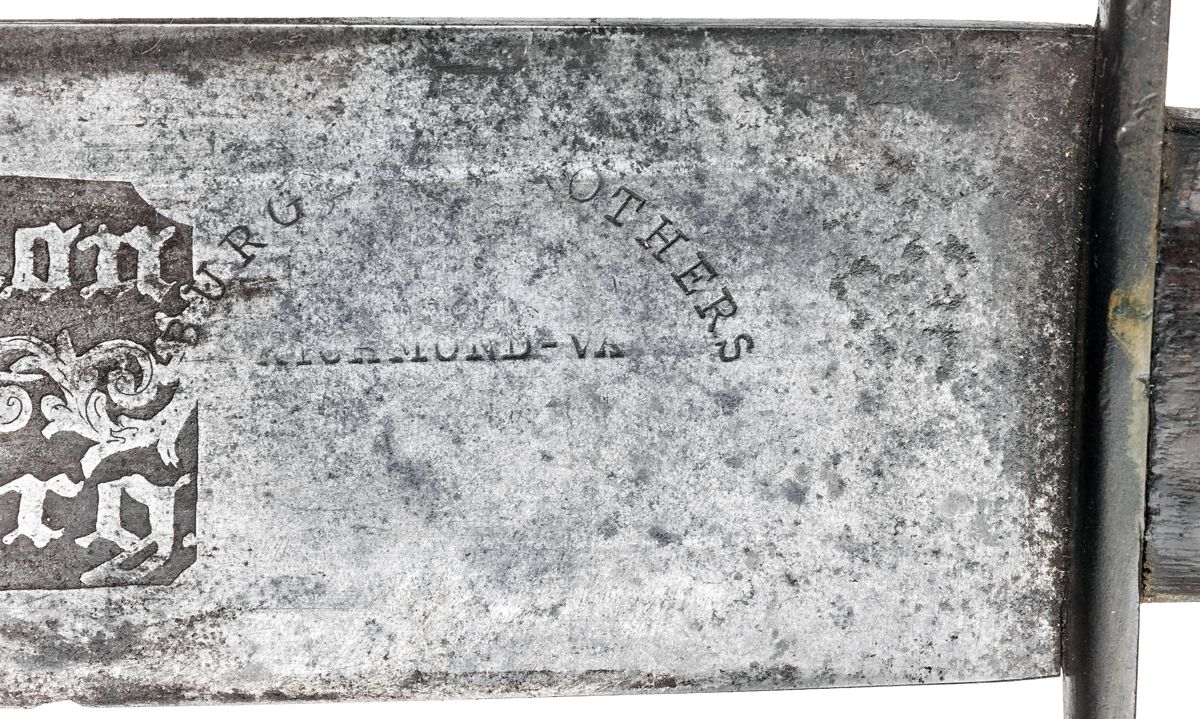
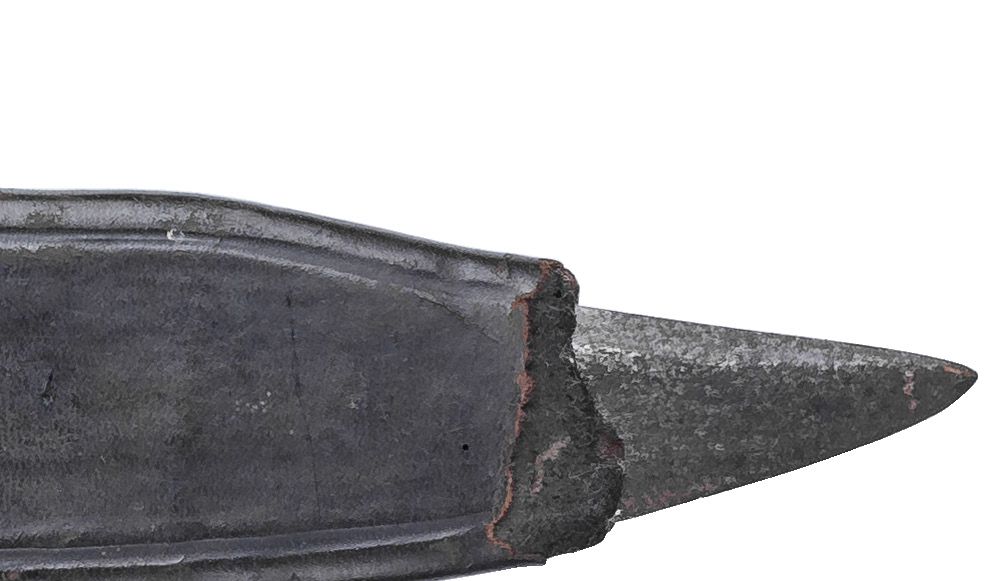
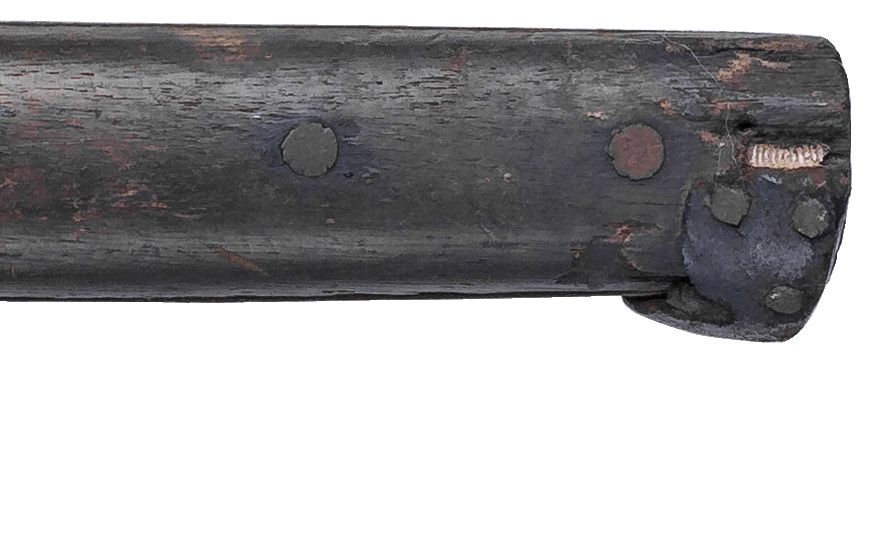
This Bowie knife measures 15 ¾ inches overall and is in very good condition. The leather scabbard is original to the knife, and it too is strong and intact, except for the missing toe and belt. The missing scabbard toe would have been made of brass, like the throat. The remnants of a leather lanyard are fixed around the knife’s pommel; this served two purposes: it prevented the wielder’s hand from sliding off the knife even when wet, and if it should come out of the hand, it remained with its owner. All in all, it is a very practical addition to a Southern soldier’s gear.
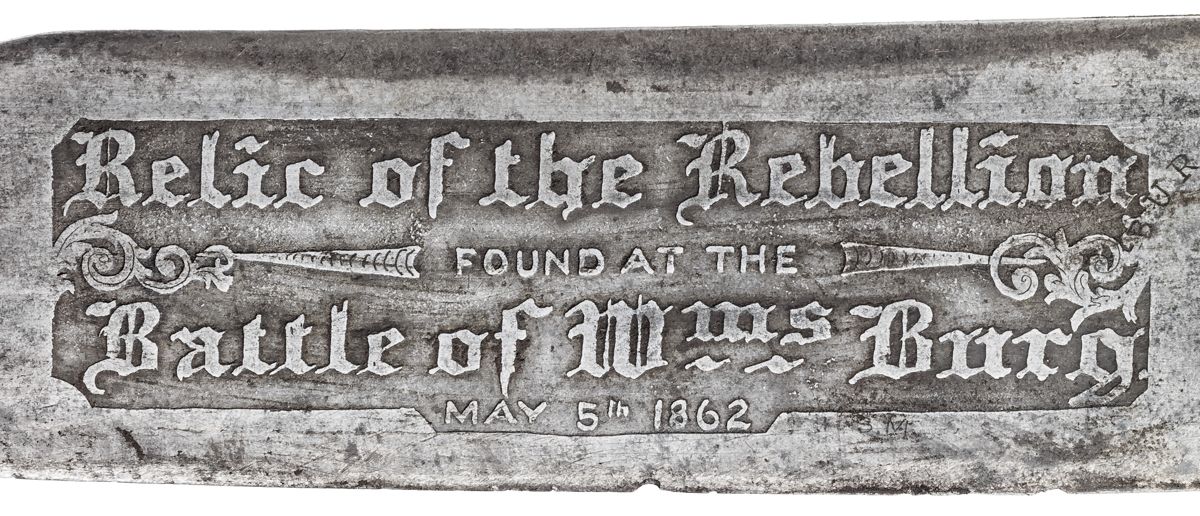
The knife’s new owner had the blade professionally etched upon his return home. His candor in recording it as found, rather than captured, speaks well of his integrity.
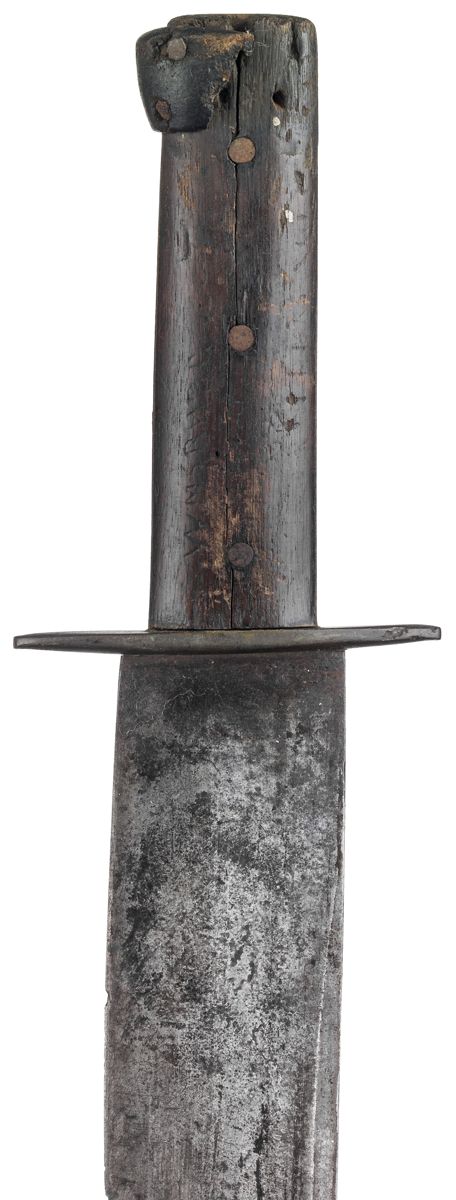
BURGER & BROTHERS RICHMOND – VA stamp on the Williamsburg knife.
The knife features a leather strip attached to the end of the wood grip. This was an addition made by its Confederate owner. This leather strip served a dual purpose. It enhanced the grip of the knife, particularly in wet conditions. The leather’s texture and material properties provided additional friction, reducing the likelihood of the knife slipping out of the owner’s hand during use.
Burger & Brother’s document reads: “$1000. Richmond Va. Nov. 11th 1861. Received of Col. Wharton J. Green of the Department North Carolina Regiment One Thousand Dollars being payment in full for one hun-dred and seventy five Bowie Knives, belts, and scabbards for the use of his regt. [signed] Burger & Bro”
Source: Fold3.com, Confederate Citizens File, Business Name: Burger and Brothers, page 25, fold3.com/image/85287904. As a side note, Colonel Green enlisted in the Confederate service in 1861, and rose through the ranks to lieutenant colonel of the 2nd North Carolina Battalion.
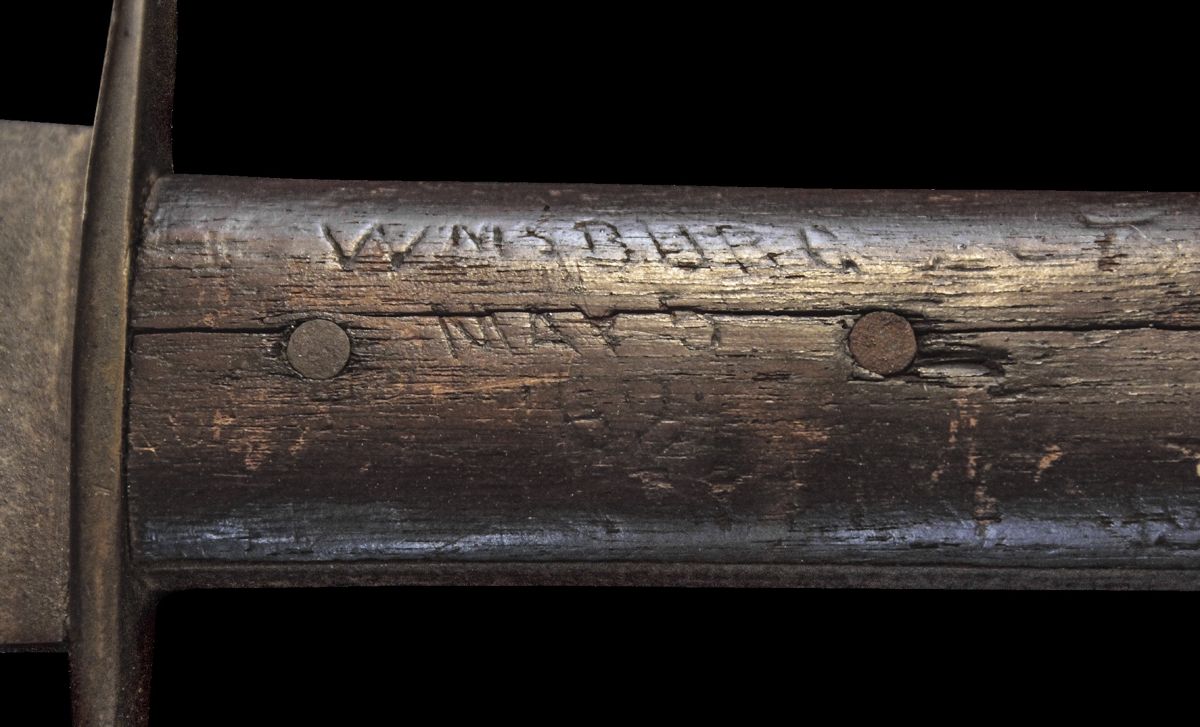
A close-up of the carving on the wood grip reads: “WMSBURG / MAY 5 / 62” in three lines.
The Williamsburg Trophy sheathed in its original leather scabbard.
Note that the reverse originally had a rivetedon, strap-type, belt loop like those found on the company’s D Guard scabbards.
August 8, 1861 receipt for 100 knives at a cost of $6.25 each. The knives were received in Richmond, Va., from Smith Stansbury, Captain of Artillery. Source: Fold3.com, Confederate Citizens File, Business Name: Burger and Brothers, page 38, https://www.fold3.com/image/85287917.
From September 21 to November 25, 1861, Burger & Brothers manufactured circular saws, 100 artillery knives, 63 Roman (artillery) swords, and 120 cavalry lances. They also repaired sabres for the Confederacy. Source: Fold3.com, Confederate Citizens File, Business Name: Burger and Brothers, page 44, https://www.fold3.com/image/85287923.
OVERVIEW OF THE BATTLE OF WILLIAMSBURG
The Battle of Williamsburg was a significant delaying action that took place on May 5, 1862. The battle was fought under the direct leadership of Major General James Longstreet to give Confederate General Joseph E. Johnston’s Army of the Potomac, time to withdraw closer to Richmond; and yes, it was known as the Army of the Potomac at this time. The Union advance was part of Maj. Gen. George B. McClellan’s Peninsula Campaign aimed at capturing the Confederate capital of Richmond, Va. The Peninsula Campaign had been initiated by McClellan with the objective of advancing up the Virginia Peninsula and seizing Richmond. The massive Union Army laid siege against an insignificant force under Brigadier General John Bankhead Magruder at Yorktown, Va. After a month’s preparation McClellan planned an assault on the Yorktown defenses, but the wily McGruder pulled out and marched for Williamsburg on the night of May 3. McClellan’s month of preparation gained naught but time for General Joseph E. Johnston to move his Army of the Potomac from northern Virginia to Williamsburg. The Confederates had constructed a strong series of fortifications known as the Williamsburg Line, anchored by Fort Magruder. These works could be flanked by water; Johnston only intended to hold McClellen here until he could consolidate and move the whole army nearly forty-five miles closer to Richmond at the Chickahominy River. Major General James Longstreet’s troops were tasked with holding Williamsburg Line while the rest of the Confederate Army continued its withdrawal closer to the Chickahominy line. On the afternoon of May 4, Union forces under Major General Edwin Sumner approached Williamsburg and encountered the Confederate defenses. Sumner was reluctant to launch a full-scale assault without further reconnaissance and support. However, Brigadier General “Fighting Joe” Hooker thought the other generals were too timid and decided to attack. Hooker’s Division advanced at dawn on May 5th, and brought on a battle, but “Fighting Joe” soon found that he was unable to advance and was in danger of defeat. McClellan ordered reinforcements to support Hooker and the fighting intensified as both sides committed more troops to the battle. Union forces repeatedly attempted to breach the Confederate lines but were repulsed each time. During the night Longstreet withdrew and continued his muddy march towards Richmond. Private W.C. Watkins, 23rd North Carolina Infantry, wrote of the battle and withdrawal: “wet as rain can make us, with knapsacks and every shred of extra clothing gone, we marched back to the brow of the hill where we first formed in line of battle. Here amid mud and rain we were held in line of battle till 3 a.m. …then twelve miles were tramped, or rather stumbled, through darkness, mud and slush, before halt was made for rest of sleep, the tenacious mire was often knee deep. Shoes were pulled from our feet by it and lost. Pantaloons became so caked and weighted with mud that many, in sheer desperation and utter inability in their exhaustion, to carry an extra ounce, cut off and threw away all below the knees,” and it did not get any better for four more days, until they finally reached the Chickahominy on the evening of May 9th. The “trophy knife” must have been left behind in the dark, or perhaps on a dead Confederate. After the battle, McClellan failed to pursue the retreating Confederate Army aggressively, missing an opportunity to inflict a crippling blow but giving time for the Union troops to scavenge souvenirs. The Confederates had successfully delayed the Union advance, buying valuable time for their forces to regroup and strengthen the defenses of Richmond. The Battle of Williamsburg was a hard-fought engagement that McClellan described as a great victory. In reality, it demonstrated the weakness of McClellan’s leadership. It did not result in a decisive outcome for either side, but the Confederates achieved their goal, to hold McClellan in check. It also served to demonstrate McClellan’s timidity and lack of front line control that would plague the Union Army throughout the Seven Days Battles and beyond.
Sketch of the battlefield and Confederate works in front of Williamsburg, Va., May 5, 1862. (Library of Congress)
The brass counterguard is an elongated oval on this Burger & Brothers Bowie knife.
About the Author Shannon Pritchard has authored numerous articles relating to the authentication, care, and conservation of Confederate antiques, including several cover articles and is the author of the definitive work on Confederate collectibles, the widely acclaimed Collecting the Confederacy, Artifacts and Antiques from the War Between the States, and is co-author of Confederate Faces in Color.