
The French Revolvers of Louis-François Devisme
By Tim Prince · Originally published September-October 2023 · pp. 34–45
The French Revolvers of Louis-François Devisme By Tim Prince
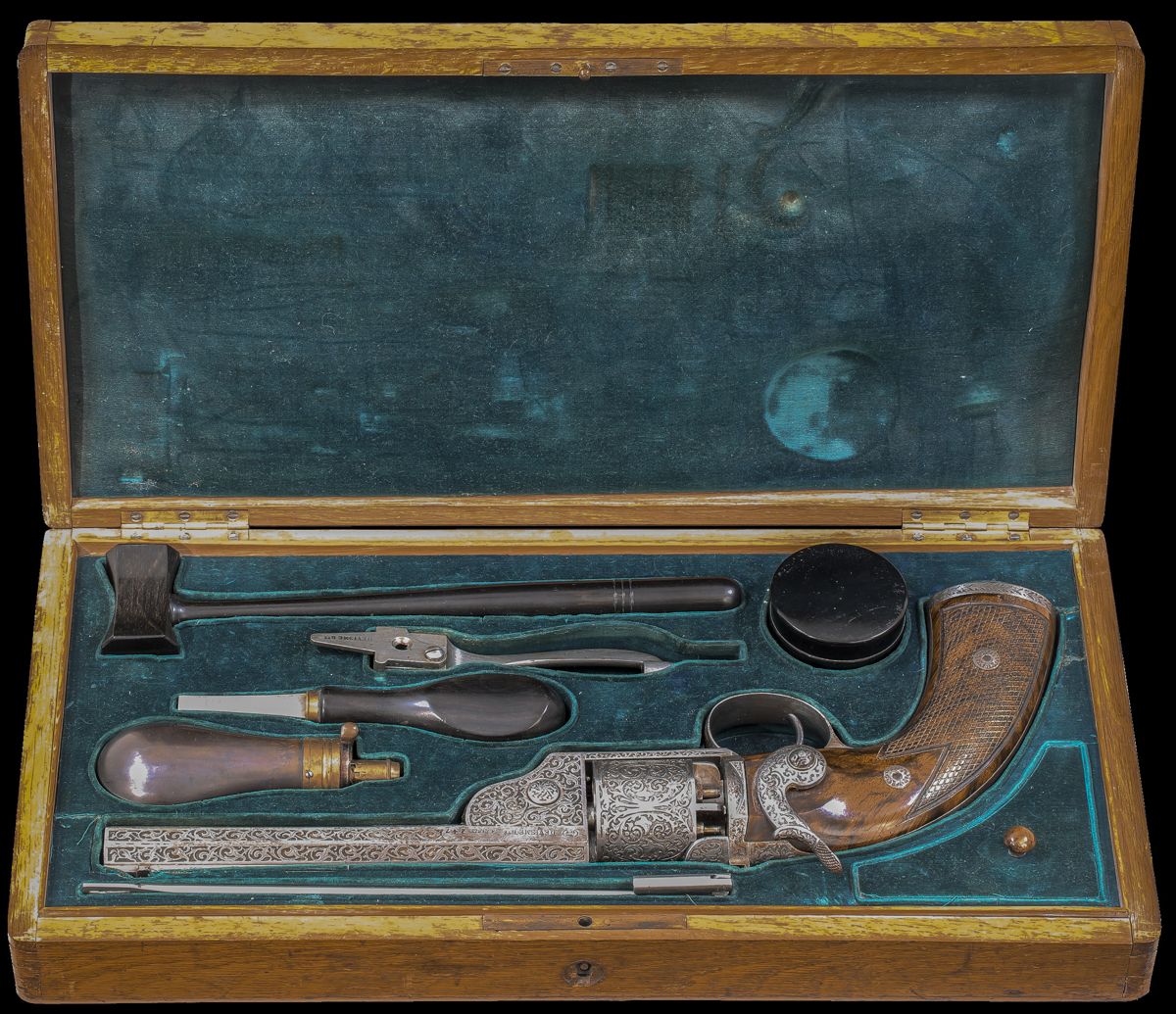
Louis-François Devisme. The engraved Devisme 1854 patent percussion belt revolver removed from its case with all of its accessories. (Tim Prince)
The firearms produced by Louis-François Devisme of Paris are among some of the most highly soughtafter and desirable arms manufactured in France during the mid-19th century. His story is shrouded in confusion and conjecture due to the fact that little quality writing has been done about him and his story in English. Additionally, the fact that his father, F.P. Devisme, also worked in the firearms trade in Paris circa 1834–1859 (Stockel) adds to the confusion. In some cases, the works of the father and son are conflated, and work credited to L.F. Devisme was actually that of his father, F.P. Devisme. Even the dates often cited for Louis-François’ birth and death appear to have been those of his father. Wading through the tangle of misinformation and factual errors has been challenging, and any errors or inaccuracies herein result from my inability to fully divine the facts.
Even a detailed search of available records for France on Ancestry.com did not do much to clarify the situation. F.P. Devisme, the apparent father of Louis-François, appears to have been born in France somewhere between 1804– 1806. As can best be discerned by wading through Heer der Neue Stockel and other sources, F.P. worked with the Parisian gunsmith Deboubert, who worked in Paris at 16 Rue du Helder circa 1812–1830. In 1820 Deboubert received a French patent for primers. Circa 1834, F.P. succeeded to the business of Deboubert working at 12 Rue du Helder. He first exhibited firearms at the 1834 Paris Exhibition of Industry and received silver medals for his designs in 1839 and 1841. These achievements are often incorrectly attributed to Louis-François Devisme. In their groundbreaking work The Revolver 1818–1865, Taylerson, Andrews & Frith (1968) note that Devisme was referenced during the period as being one of the fathers of revolver design. They reference John
French cased relief engraved Devisme 1854 patent percussion belt revolver with all of the accessories. This gun features the more conventional side-mounted cocking spur. Note the ebony hammer, which was used to seal the bullets in the cylinder chambers.
Deane’s 1858 treatise Manual of the History and Science of Firearms, where Devisme is mentioned as producing “conventional revolvers” prior to 1851. They further note that Deane’s work was essentially a plagiarized version of the 1855 Notice sur les Pistolets Tournants et Roulants by T. Anquetil. In both cases, the primary purposes of the writings were to cast doubt upon Colt’s claim to have introduced the first “mechanically rotated revolver.” It is unclear how many years prior to 1851 these Devisme revolvers were being produced, nor what form they may have taken. Interestingly the authors assume the period reference is to Louis-François. Still, as we can see from the timeline, it seems equally possible that these pre-1851 Devisme revolver designs were the work of his father. At least one reference notes that Devisme was producing a double-action revolver circa 1834. If this is correct, it would almost certainly be the work of the elder Devisme, and it would also pre-date Colt’s Paterson design or at least be contemporary with his early design work. In 1850 F.P. Devisme relocated to 36 Boulevard des Italiens. Ironically today, a Chinese restaurant is located at F.P. Devisme’s original location, and a Burger King is located at his subsequent location. Circa 1850, Louis-François appears to have joined his father in the family gun-making business, concurrent with the relocation to their new location. Almost immediately, the Devisme’s received a medal at the 1851 Crystal Palace Exhibition in London for the firearms that they displayed there. It is likely that Samuel Colt first became aware of L.F. Devisme’s work at The Crystal Palace Exhibition, and Colt was impressed enough that he acquired one of Devisme’s percussion revolvers, in unfinished form, for the Colt firearms collection. The pocket-sized percussion revolver of about .28 caliber is well documented in Colt company records. Devisme revolver serial #1485, no doubt, served as a study piece for Colt and his engineers. L.F. Devisme would receive additional medals and awards for his firearms designs in 1855, 1862, and 1867. He received his first patent in 1854 for a percussion revolver, which he also registered in Belgium. He received additional firearms design patents in February 1855, April 1856, March 1857, June and December 1858, and January, May, and December 1859. Stockel also lists a metallic cartridge revolver patent in 1866, but L.F. Devisme was producing metallic cartridge revolvers based upon his 1854, 1855, and 1858 patents nearly a decade before that. In 1858 Englishman R.A. Brooman registered a British patent that was “a communication from L.F. Devisme” as patent number 2990/1858 that protected L.F. Devisme’s design for a hinged frame single action breechloading revolver. Devisme manufactured a wide array of firearms, from sporting arms like rifles and shotguns to innovative revolvers, single-shot pistols, and even a “Flobert” type parlor pistol. He introduced a very advanced centerfire revolver circa 1858-59, based upon his earlier percussion design, and in doing so, manufactured one of the first “striker fired” handguns. This concept is the mainstay of many modern handgun designs offered today. This design allowed for a very low bore axis in the hand, and this meant that the revolver pointed very naturally, was inherently quite accurate, and had less felt recoil than other period designs. In many ways, Devisme’s innovative firearms designs were only the canvas upon which he executed his artistry. Exquisitely engraved examples of Devisme firearms are known, often mounted with silver, with chased patterns and deep relief engraving. Devisme’s aesthetic talent rivaled that of the leading French firearms maker several decades earlier, Nicholas Noel Boutet. For all practical purposes, Devisme became the “Boutet” of the latter part of the 19th century. Ironically, Boutet died in 1833, only one year before F.P. Devisme burst onto the firearms scene with his honorable mention medal at the 1834 Paris Exhibition of Industry. L.F. Devisme’s first firearms patent was received in 1854 for a rather unique percussion revolver, and he received several additional French firearms patents between 1855 and 1869, culminating with his relatively advanced cartridge revolvers. Devisme’s reputation for excellent skill and artistry made his arms highly sought after by the luminaries of his time and equally sought after by the most discriminating collectors of the modern era. His quality and artistry resulted in Devisme arms being acquired by the leading monarchs of the era, including Queen Victoria, and her consort Prince Albert of England, King Louis-Philippe of France, as well as numerous members of the Russian royal household. Some of Devisme’s most famous clients of the era were Confederate leaders, including Generals John Bell Hood, J.E.B. Stuart, and Robert E. Lee, not to mention Confederate President Jefferson Davis. Hood, Stuart, and Lee all owned Devisme-produced swords, while Davis owned one of Devisme’s high-grade large bore percussion big game stalking rifles, which was captured, along with Davis and his entourage, in Irwinville, Ga., on May 10, 1865, by elements of the 1st Wisconsin and 4th Michigan Cavalry. In modern times, Devisme’s arms have graced some of the most renowned firearms collections in the world, from the Metropolitan Museum of Art to the finest collection of highgrade arms ever assembled, that of the late King Farouk of Egypt. The two primary revolver designs that LF Devisme produced were based on his 1854 patent and then his 1858 patent. The Model 1854 was initially a percussion ignition revolver manufactured primarily in “belt” and “pocket” sizes. These guns are often referred to by various authors as the Model 1854, Model 1855, or Model 1854/55. However, all of these are clearly collector terms of convenience, and it is doubtful that Devisme ever referred to these guns by that nomenclature. As the revolver is based upon his 1854 patent, I have opted to use that designation for the pistol. The design was a single-action, five or six-shot percussion revolver with a two-piece frame and barrel design. The primary components of the design were the barrel and topstrap assembly, the frame, which included the grip
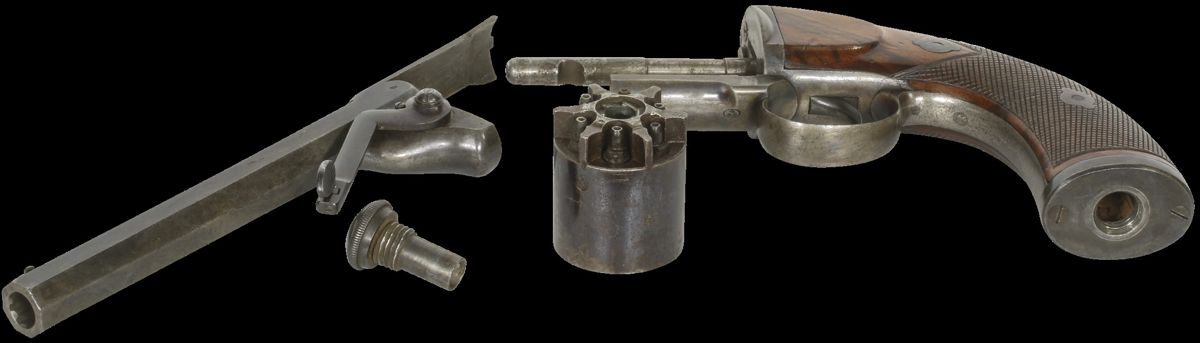
A Devisme 1854 patent percussion revolver broken down into the primary components with the bullet seater removed from its storage location in the butt of the pistol.
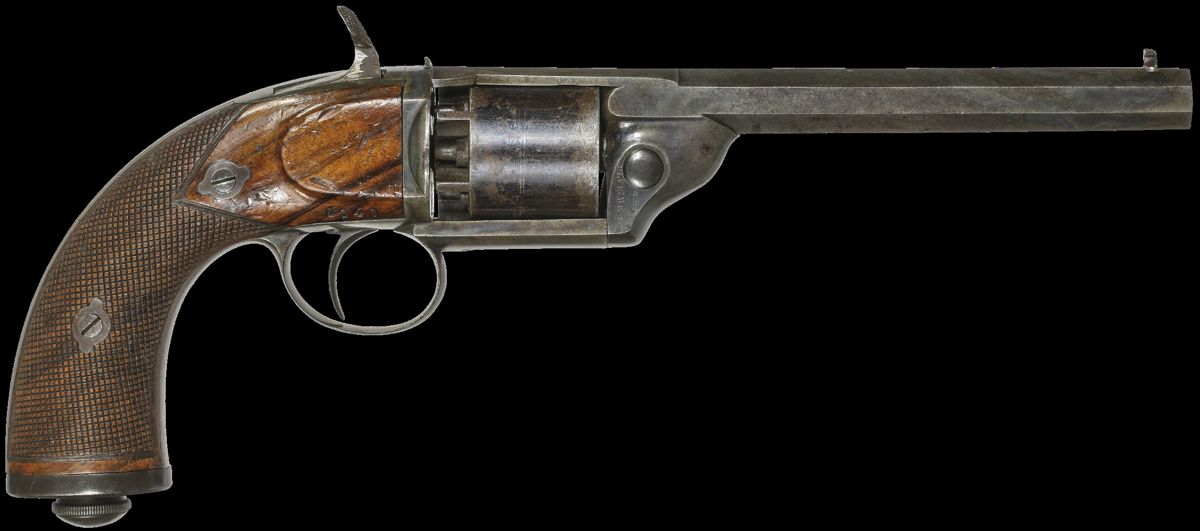
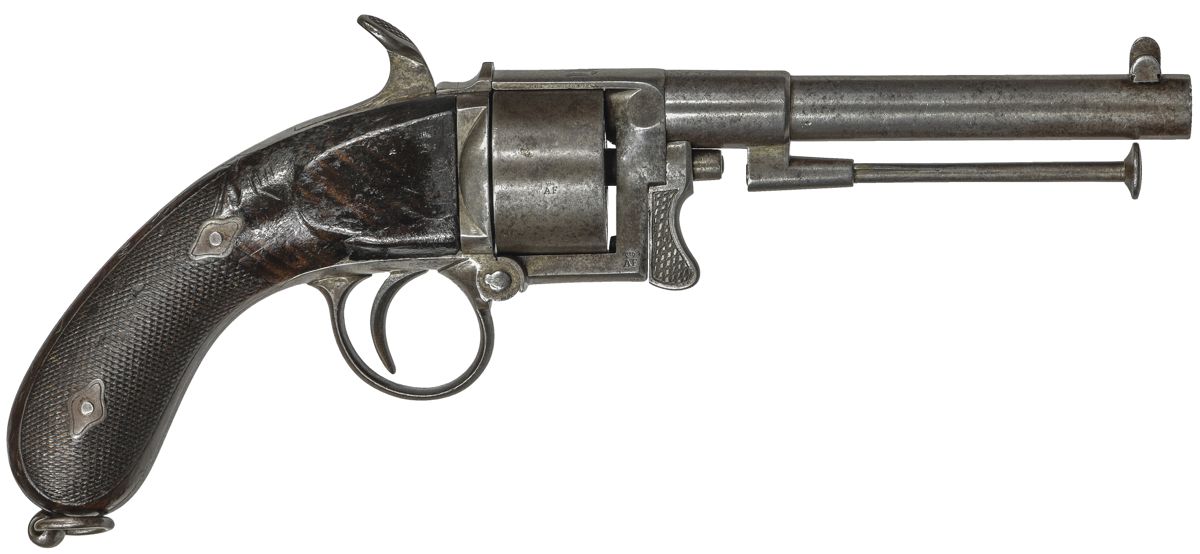
Obverse overall view of an 1854 patent Devisme percussion belt revolver. Note the internal or central cocking spur.
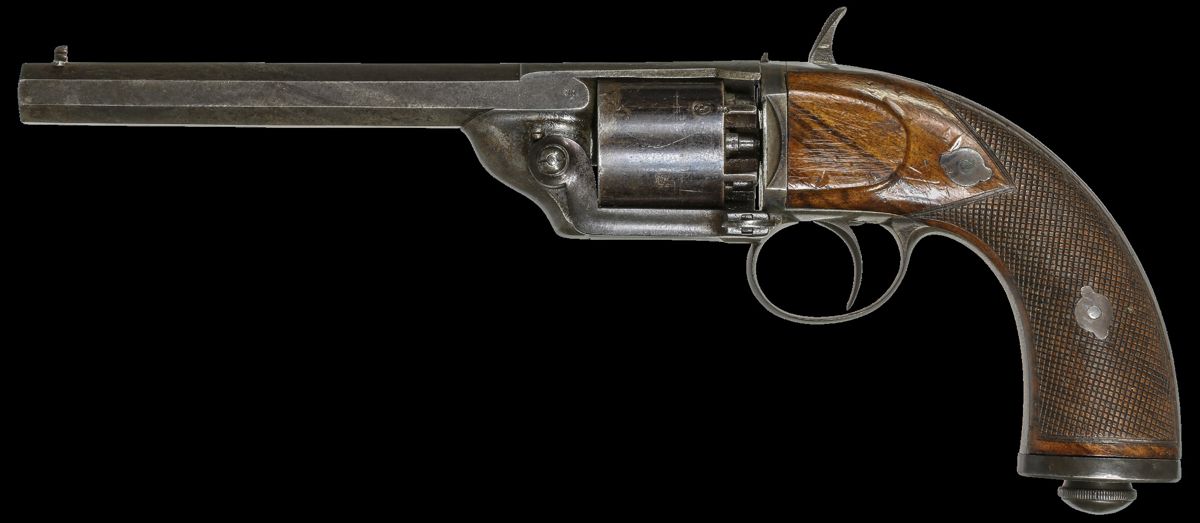
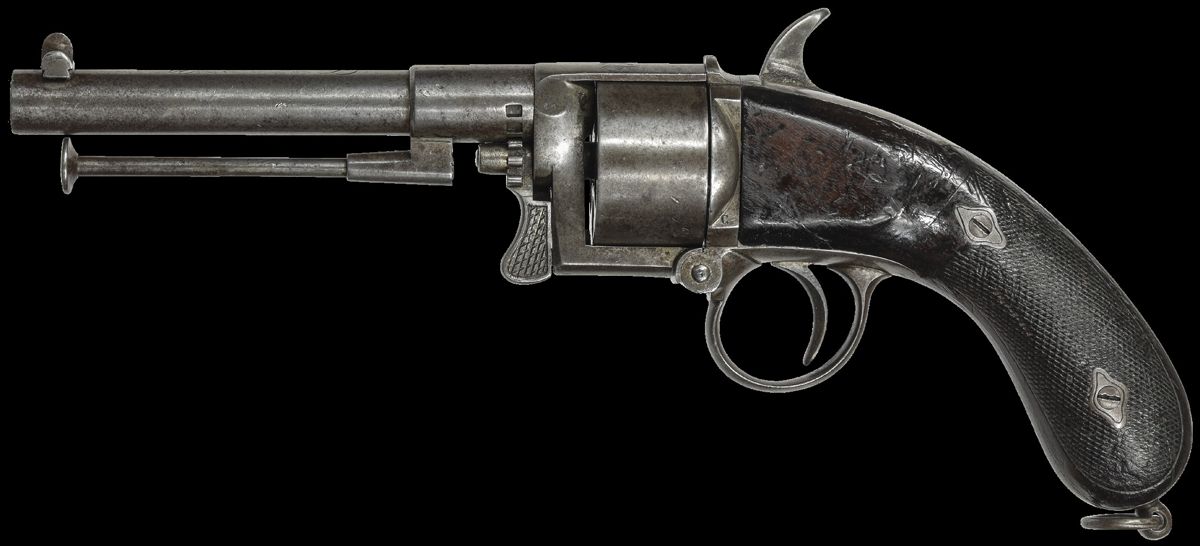
Reverse overall view of an 1854 patent Devisme percussion belt revolver.
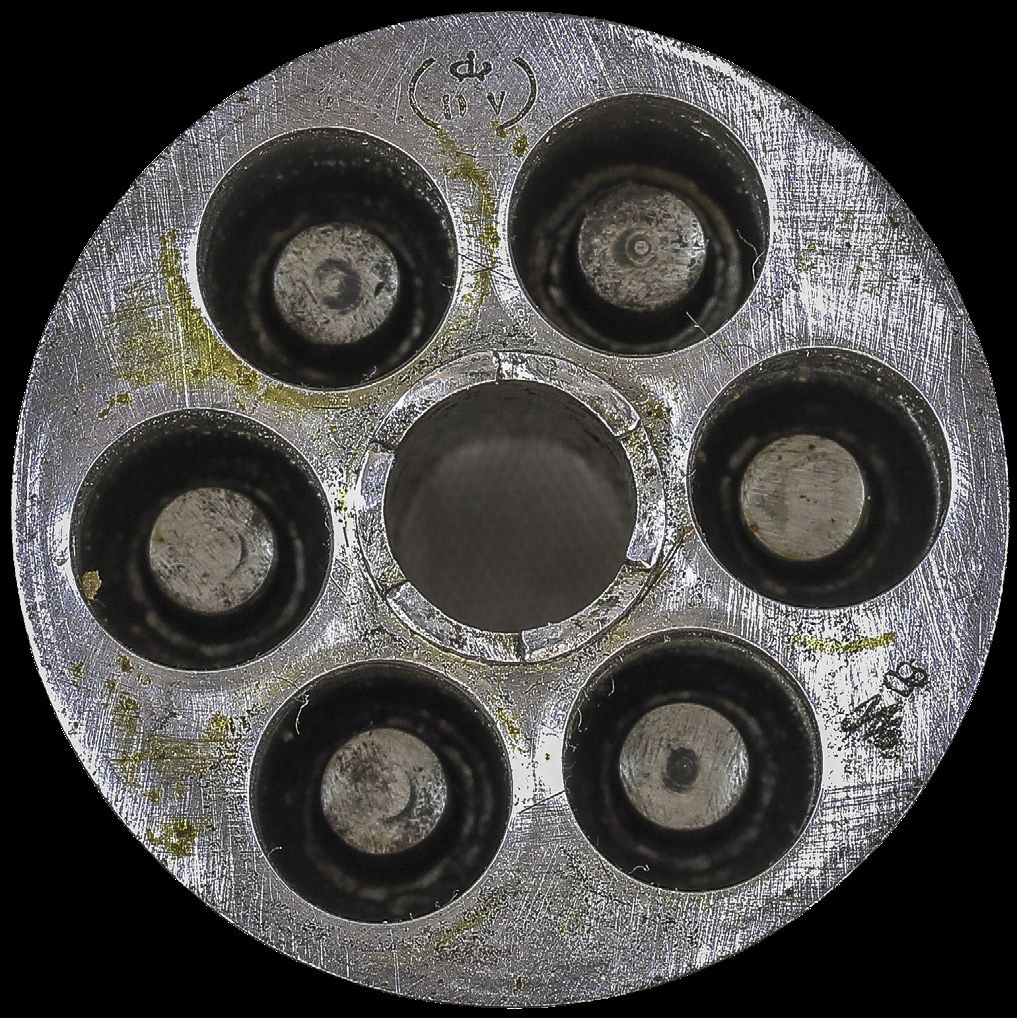
Face of the cylinder of a Devisme 1854 patent revolver, showing the chambers and the tige pillars at their rear.
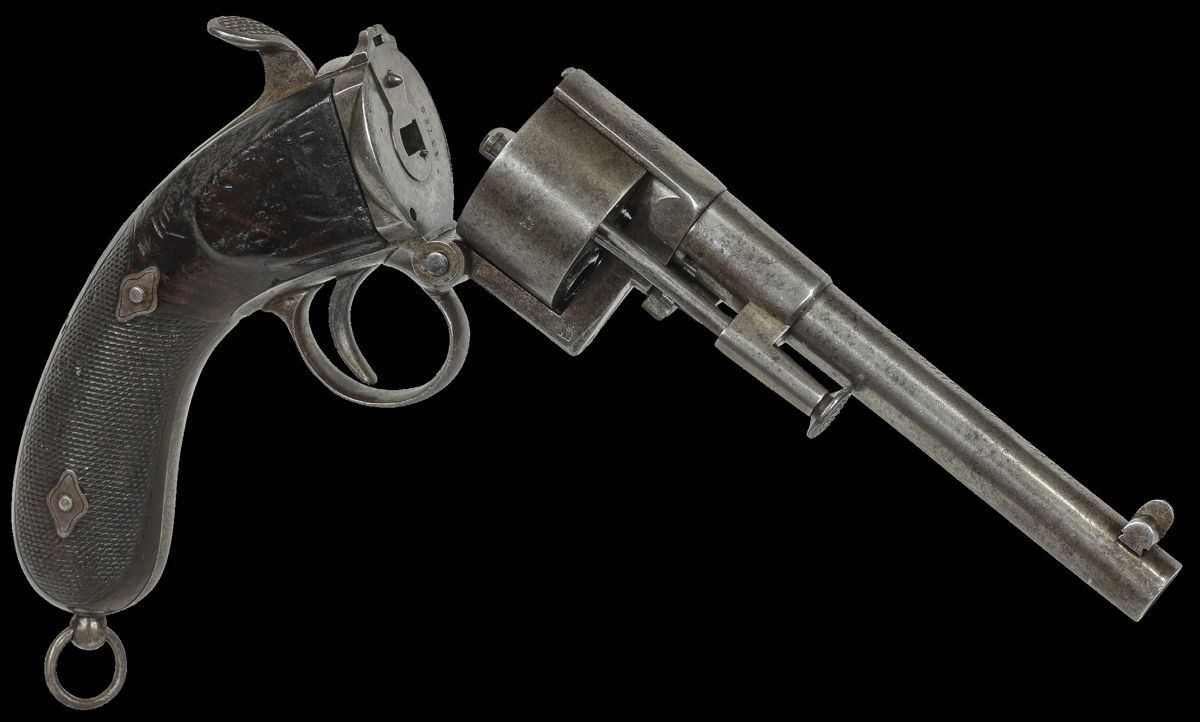
Devisme 1858 patent Tip Up breechloading cartridge revolver, overall obverse view. Note the center-mounted cocking spur, which is inside the frame rather than outside.
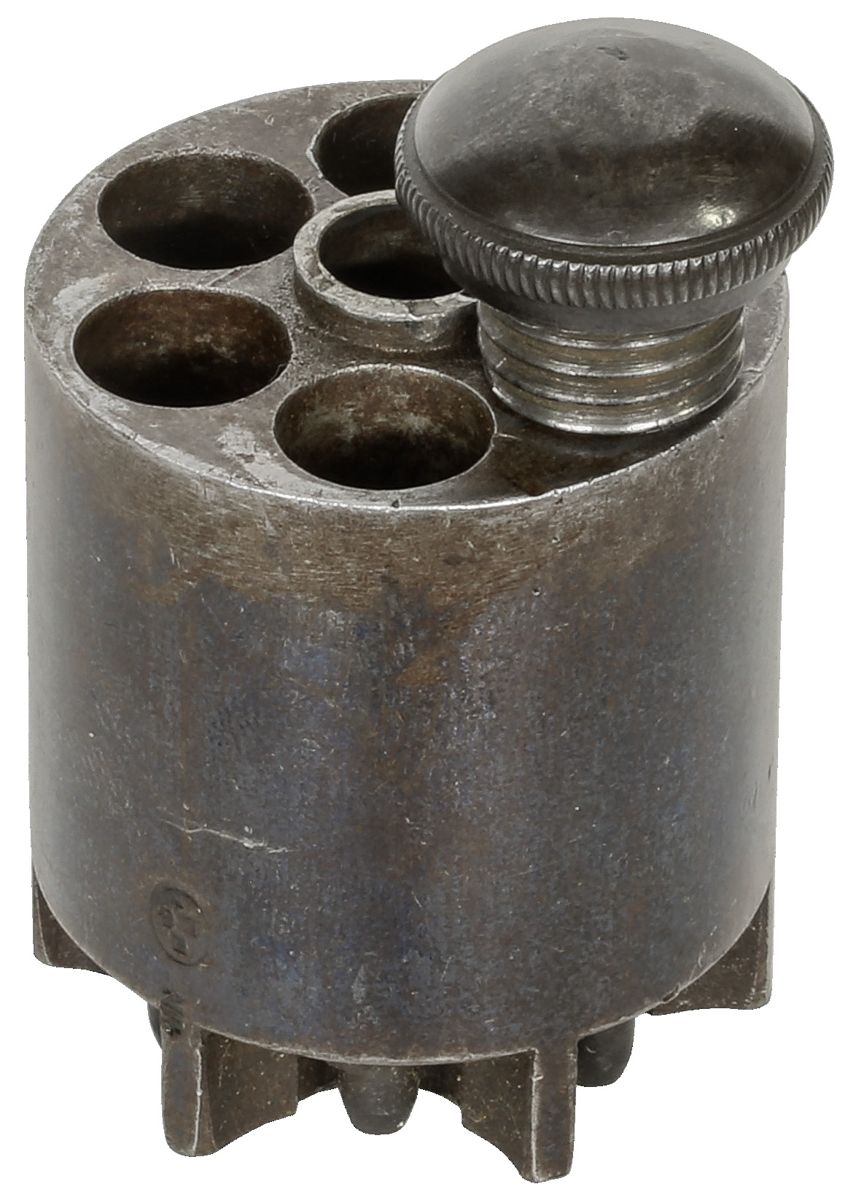
Close up of a Devisme 1854 patent percussion cylinder showing the bullet seater in place in one of the chambers, having been removed from the butt of the revolver.
Devisme 1858 patent Tip Up breechloading cartridge revolver, overall reverse view.
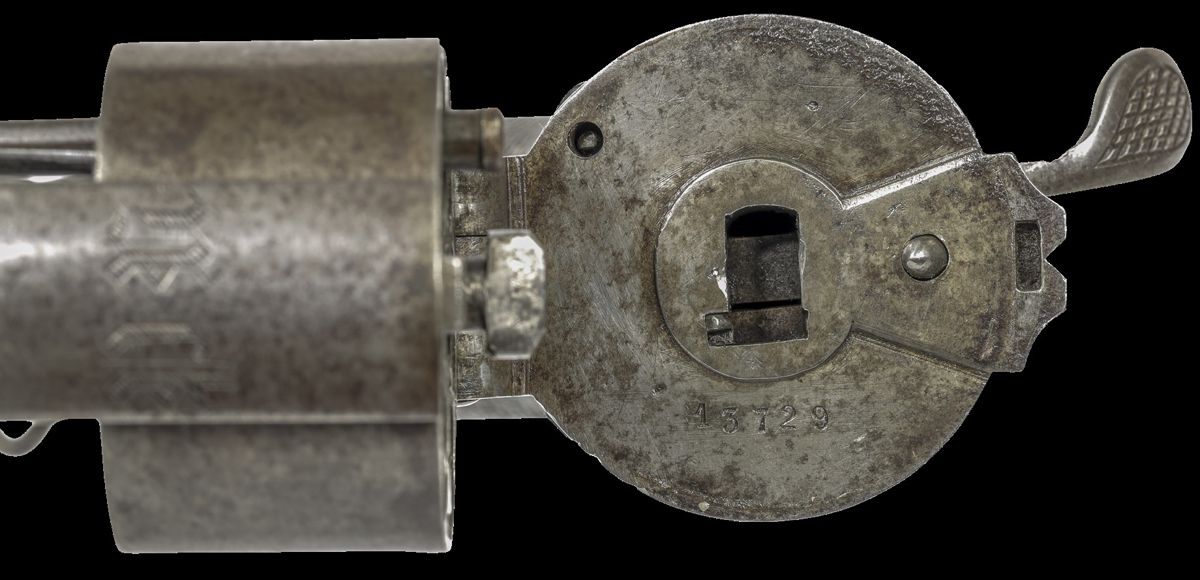
Breech face of the 1858 patent revolver showing the keyway in the breech face and the rotating latch at the end of the cylinder arbor pin that locks the revolver’s action closed.
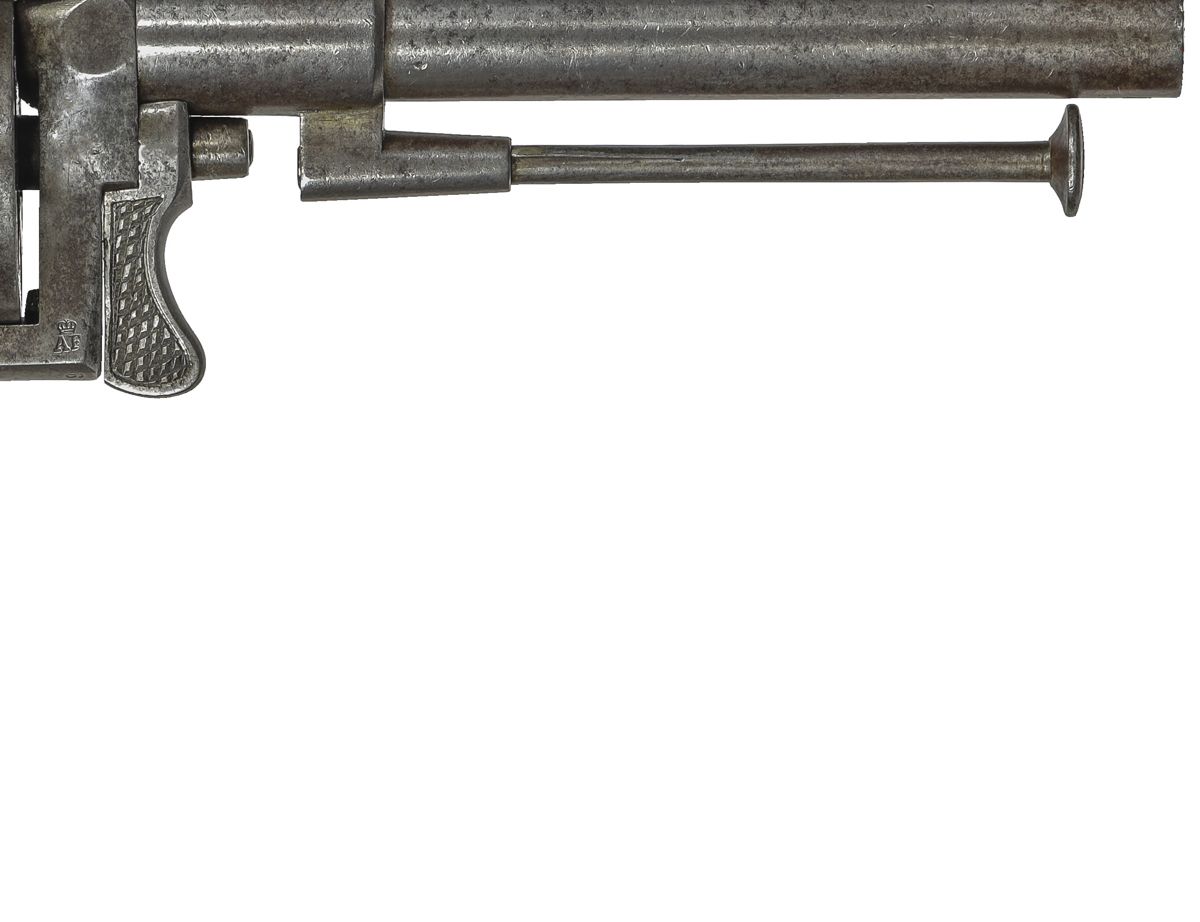
Devisme 1858 patent revolver with the action broken open, ejector rod rotated into position and with the rod extending into one of the chambers.
strap, and the cylinder. The separation of the two major components was accomplished by rotating the takedown lever, mounted along the lower left side of the frame, downward. This rotated a half-round lug on a pin that served as a barrel wedge and disengaged it from a halfround cut in the bottom of the cylinder arbor pin. Once this cam was disengaged, the revolver could easily be separated into the three primary component parts of the barrel and topstrap, grip frame, and cylinder. The gun was then reassembled by reversing the process and locating pins in the topstrap and frame to ensure the correct alignment of the parts. The cylinder incorporated a Thouvenin Tige in each chamber, a feature that is rarely encountered on revolvers but was regularly used in mid-19th century European muzzleloading military rifles. The “tige” or “pillar breech” system was developed by French Army General LouisÉtienne de Thouvenin. It was a direct predecessor to the expanding base bullet concept of Claude-Etienne Minié. The Thouvenin system used a pillar (tige) in the base of the chamber around which the powder charge was deposited. When the bullet was loaded into the chamber, a strong strike with the ramrod or loading tool upon the lead projectile was supposed to seat it upon the pillar and cause the base of the bullet to slightly expand so that it would grip the rifling of the bore effectively. The downside of the design was that the bullet was often deformed to some degree when
Obverse overall of a Devisme 1854 patent revolver in 12 mm centerfire. It is unclear whether this gun was produced as a percussion revolver and then altered to metallic cartridge or if it was manufactured as a cartridge gun. Like many early Colt cartridge conversion guns, percussion guns, cartridge guns, and alterations of percussion guns were apparently going on concurrently at the Devisme premises.
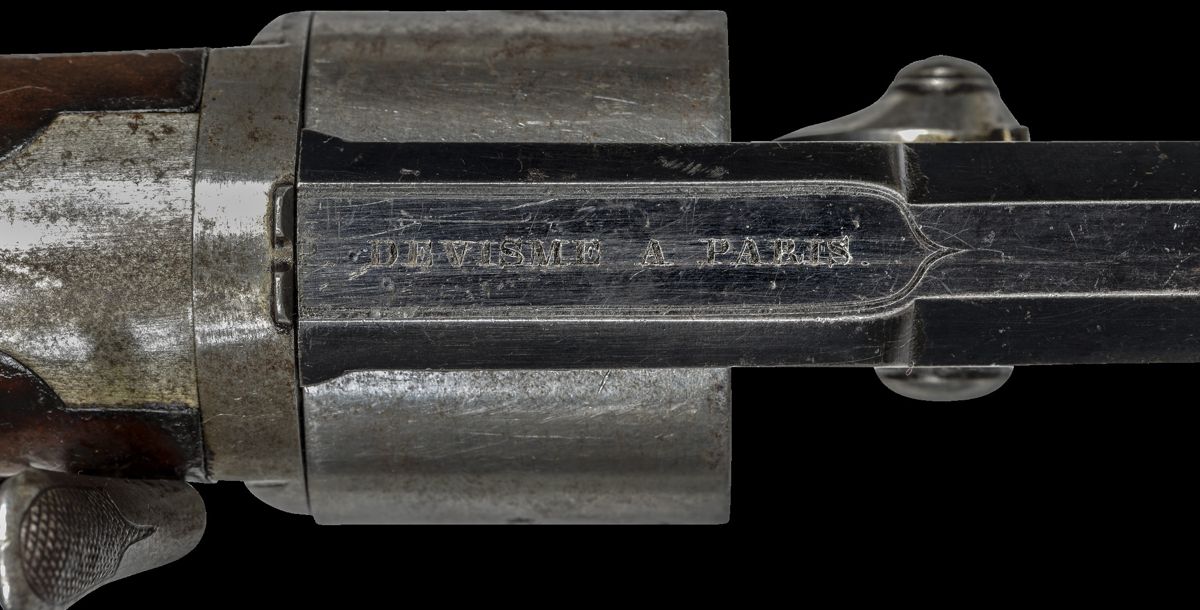
Devisme marking on the topstrap of an 1854 patent cartridge revolver.
Markings on the barrel web of the engraved Devisme 1854 patent revolver. Note the assembly numbers found on the barrel and takedown lever, which are often encountered on Devisme revolvers. Serial numbers are usually found on the butts or grips of the guns.
Reverse overall view of an engraved 1854 patent Devisme percussion pocket revolver.
Closeup of the markings on the engraved Devisme 1854 patent revolver.
struck, reducing its aerodynamic qualities and resulting in inconsistent accuracy. Another problem was that failing to strike the bullet hard enough meant that the base did not expanse sufficiently to grip the rifling, resulting in reduced velocity and more inconsistent accuracy.
and grip the rifling when fired. An interesting feature of the design was that since the tige filled the center of the rear face of the chamber, flash holes had to be cut around the periphery of the tige at the rear of the cylinder to allow the cap flash to be communicated to the powder charge.
In the case of the Devisme percussion revolver, the loading of the cylinder was accomplished by removing it, placing it upright on a flat surface, and pouring in the required amount of powder. A conical lead bullet was then inserted in the chamber mouth, nose up, and a heavy metal bullet seater was removed from its storage location in the butt of the gun and placed in the chamber mount on top of the bullet. The face of the rammer was concave to accept the ogive of the bullet, and the top was large, thick, and weighted. The rammer would then be struck with a loading hammer. The photos of the French-cased Devisme revolver show that it was sold with an ebony loading hammer as part of the cased set. Theoretically, hitting the bullet in that way resulted in seating the bullet firmly against the pillar and expanding the base sufficiently to seal the chamber mouth
Devisme’s 1854 design utilized either a hammer or striker concealed within the frame. Two variants of cocking levers were used during the production of the guns, including a traditional side-mounted cocking spur and a centrally mounted one. The design was similar to a single-action version of the American Pettengill revolver action. Like the Pettengill, the design allowed for a very low bore axis in relationship to the hand, providing several advantages to the shooter. Since it improved the natural pointability of the gun and helped to mitigate recoil, the design theoretically resulted in improved accuracy. As with most single-action revolver designs of the period, cocking the gun rotated and locked the cylinder, indexing a chamber to align with the barrel, and set the mainspring
Part of an album from the workshop of the Parisian gunmaker Louis-François Devisme. (MET, purchase, Arthur Ochs Sulzberger Gift, 2003)
to allow a forceful blow to be delivered to the percussion cap or when the sear is tripped. Future improvements to this system would result in Devisme’s striker-fired system, which was easily adapted for use with both his percussion and later centerfire cartridge cylinders. Sights were simple, with a fixed notch at the rear of the topstrap and a blade front. Like most European and English revolvers of the period, there was some minor variation in barrel lengths and calibers. Still, in general, the belt-sized percussion guns were nominally 10 mm or about .40 caliber with approximately 6-inch barrels, and the pocket-sized guns were nominally about 7.5 mm or about .30 caliber with nominally 4-inch barrels. In most cases, the barrels were octagonal and were rifled with eight grooves, although some six-groove guns are known. As noted, in 1858, Devisme patented his tip-down, breechloading metallic cartridge revolver design. He started to offer his Model 1854 revolvers as cartridge handguns at about the same time, while his 1858 design does not appear to have been made in quantity until the 1860s. Notably, the mid-19th century saw the most advanced self-contained metallic cartridge handgun designs coming out of France. All these designs utilized the bored-through cylinder concept that had been patented in France and England by Eugene Lefaucheux in 1854. This feature was protected by the Rollin White Patent in the United States, but the patent had been applied for by White roughly a year after Lefaucheux had received his patent. Lefaucheux was less concerned about enforcing his patent restrictions than White and Smith & Wesson were, or was simply glad to share his design, as numerous French revolvers were produced during this period with bored-through cylinders, including those by Lefaucheux, Devisme, Perrin, and Pidault & Cordier (better known as the Raphael). The history of modern revolver design and innovation would have been very different had Lefaucheux patented his design in America and allowed numerous makers to utilize the concept in their products. The belt-sized 1858 Devisme revolvers had nominally 6-inch barrels that often varied as much as a ¼-inch to ½-inch in length. The barrels were rifled with four grooves that were slightly wider than the lands. The guns were nominally 12 mm or .44 caliber. While the basic profile and silhouette changed little from the earlier 1854 revolvers, there were major mechanical changes in the front half of the revolver. The new 1858 design used a hinged, tip-down frame instead of requiring the disassembly of the gun for loading and unloading. A flat lever on the front face of the frame could be rotated to the left, which accomplished two actions. First, it rotated a wing-shaped locking lug inside the recoil shield of the frame by 90°, allowing it to pass through a keyway. This released the cylinder arbor from the frame and allowed the barrel and cylinder portion of the revolver to be tipped down via a hinge on the lower front of the frame. The action also engaged a ratchet under the barrel, which rotated an ejector rod mechanism 90° to the right, bringing it from under the barrel to the right side of the frame where it could be used to punch empty cartridge cases out of the cylinder. The revolvers were single action in operation. Most surviving Devisme revolvers appear to have been blued, sometimes with color casehardened frames and cylinders and sometimes with the cylinders left in the white. A small number of nickel-finished Devisme revolvers have been noted, but it is not clear if these guns left the Devisme shop with that finish or if the finish was a later periodapplied one. In some instances, nickel has been noted on cartridge altered Devisme revolvers, which suggests those guns may have been refinished as part of the alteration process. Grips on the earlier Model 1854 revolvers were typically checkered walnut with flat butts and the grips doubling as side plates for the guns. The later 1858 revolvers had bag-shaped, wood grips that were usually checkered. Like any maker of the period, upgraded and enhanced versions of the guns were also available, with engraving always an option. Gold inlays and exotic grips could also be had, with the range of possibilities limited only by the buyer’s imagination and budget. Today many collectors only think of Devisme’s work as a footnote in arms history. If they are familiar with the name and his work, they think of the highly embellished sword that was made for Robert E. Lee or one of the guns that Jefferson Davis had with him when he was captured. However, an examination of his work indicates that he was a very innovative and forward-thinking inventor who produced very advanced and modern handguns during a period when revolver evolution was still very much in its infancy.
About the Author
Tim Prince is a full-time dealer in fine and collectible military arms from the Colonial Period through WWII. He operates College Hill Arsenal, a web-based antique arms retail site. A long-time collector and researcher, he has been a contributing author to two major book projects about Civil War era arms including The English Connection and a book on southern retailer-marked and Confederate-used shotguns. He is the author of over 60 articles on weapons in Civil War News. Tim is also a featured Arms & Militaria appraiser on the PBS Series Antiques Roadshow and serves as a Senior Consulting Specialist to the Arms & Armor department of Cowan’s, a Hindman Company.
The Allure of the Past:
The Hobby of Collecting Antique Firearms Introduction A hobby that allows people to connect with history, artistry, and technology breakthroughs is a fascinating pastime that can also be quite gratifying. Collecting antique firearms is one such activity. Due to the fact that antique firearms are replete with tales from the past and provide a one-of-a-kind look into times gone by, collectors from all over the world regard them as prized belongings. The fascination of antique firearms, the pleasures of collecting them, and the responsibilities that come along with maintaining historical artifacts are discussed in this article.
Uncovering the Past’s Secrets The ability to research different eras and cultures is one of the things that makes collecting antique firearms such an appealing hobby. Each firearm has a history that can be traced back to the historical period in which it was manufactured, the battles it may have participated in, and the owners it has been in over the years. Researching the background and historical context of these firearms not only helps one develop a more profound appreciation for them, but it also brings the human experiences that are associated with them to vivid life.
Craftsmanship and artistic ability Antique firearms are not only tools of war or of self-defense; rather, they are wonderful displays of workmanship and artistry in their respective fields. Gunsmiths in days gone by poured their hearts and souls into the process of designing and making these firearms, and the results were frequently works of art that featured elaborate engravings, woodwork, and metalwork. Collectors can admire the level of skill and attention to detail that was put into these firearms, which elevates them to the status of beautiful things worthy of appreciation.
The Concept of Investment and Value Even though a love of art and history is frequently the driving force behind antique firearm collecting, the fact that these collections can also have great worth as investments shouldn’t be overlooked. When establishing the value of an antique firearm, factors such as its lineage, condition, and historical significance are all very important considerations. As a consequence of this, collections that are kept in good condition have the potential to increase in value over time, which can draw serious investors in addition to devoted hobbyists.
Respect for Traditions and Accountable Stewardship The ownership of antique firearms comes with the obligation of maintaining their condition in addition to the pleasure. Since these items cannot be replicated, it is imperative that collectors take every precaution to ensure that they are preserved in their authentic state. Responsible ownership requires a number of behaviors, including careful handling, frequent maintenance, and proper storage and upkeep of the item. In addition, it is essential for collectors to be informed of the local laws, rules, and regulations pertaining to antique firearms, as the classification of these weapons might differ depending on their age, type, class, and functionality as well as the historical significance of the weapon.
Putting Together a Collection Beginning a collection of antique weapons can be an interesting trip in and of itself. Collectors have the option of specializing in particular time periods, geographic areas, or categories of weapons based on their own personal preferences. These cherished items may frequently be found at antique shops, gun show, auctions, and specialty dealers, which are all great places to look for them. Establishing connections with other members of the collecting community can bring not only helpful insights but also opportunities to acquire one-of-a-kind objects.
Recognizing the Value of the Stories Antique firearms have a value that extends beyond their monetary worth since they come with a history that may be passed down through the generations and told to future generations. It is common for collectors to take delight in relating the anecdotes surrounding the origins of their firearms, which can stimulate conversation and promote a sense of camaraderie among individuals who have similar interests.
Conclusion The adventure of collecting antique firearms is one that brings together art, history, and a burning desire to learn. It provides a glimpse into the past by exhibiting the inventiveness and artistic skill of craftsmen who worked in times long since passed. The fact that these collectors care for and keep these ageless artifacts in good condition helps to ensure that the stories contained within the firearms history will continue to enthrall and motivate future generations. Antique firearms continue to be a captivating and long-lasting pastime for those who are interested in the past for a variety of reasons, including investment potential, historical appreciation, and personal delight.
NRA Antique Firearm Conditions Standards: FACTORY NEW: All original parts; 100% original finish; in perfect condition in every respect, inside and out. EXCELLENT: All original parts; over 80% original finish; sharp lettering, numerals and design on metal and wood; unmarred wood; fine bore. FINE: All original parts; over 30% original finish; sharp lettering, numerals and design on metal and wood; minor marks in wood; good bore. VERY GOOD: All original parts; none to 30% original finish; original metal surfaces smooth with all edges sharp; clear lettering, numerals and design on metal; wood slightly scratched or bruised; bore disregarded for collectors firearms. GOOD: Some minor replacement parts; metal smoothly rusted or lightly pitted in places, cleaned or re-blued; principal letters, numerals and design on metal legible; wood refinished, scratched bruised or minor cracks repaired; in good working order. FAIR: Some major parts replaced; minor replacement parts may be required; metal rusted, may be lightly pitted all over, vigorously cleaned or re-blued; rounded edges of metal and wood; principal lettering, numerals and design on metal partly obliterated; wood scratched, bruised, cracked or repaired where broken; in fair working order or can be easily repaired and placed in working order. POOR: Major and minor parts replaced; major replacement parts required and extensive restoration needed; metal deeply pitted; principal lettering, numerals and design obliterated, wood badly scratched, bruised, cracked or broken; mechanically inoperative; generally undesirable as a collector’s firearm. (https://www.nramuseum.org/gun-info-research/evaluating-firearms-condition.aspx)