
The Guns Custer Did Not Take to the Little Big Horn
By Douglas D. Scott · Originally published September-October 2023 · pp. 3–17
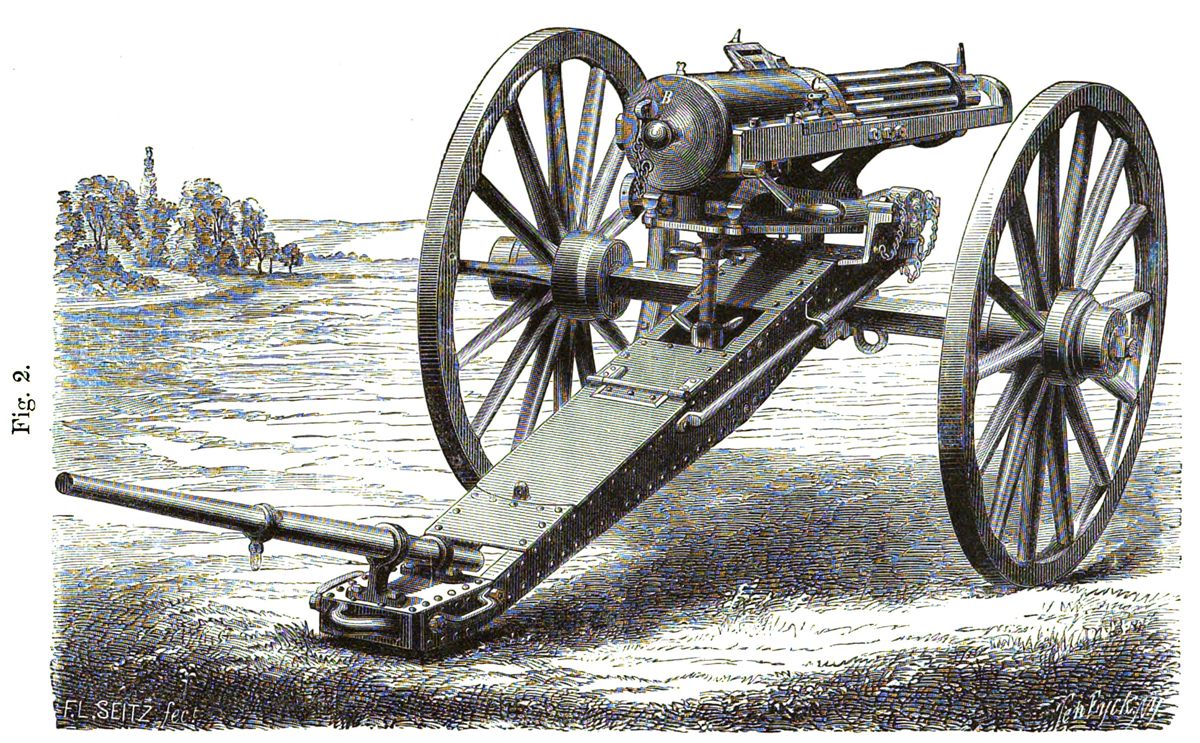
The Gatling gun has a prominent and near legendary place in the history of the development of rapid-fire weapons. The story of the development and use of the Gatling gun, worldwide, has been well told by many.1 One myth surrounding the infamous Battle of the Little Bighorn on June 25 and 26, 1876, is why Lt. Col. George A. Custer refused to take a battery of Gatling guns with him on his fateful sortie into the valley of the Little Bighorn? The question of Custer’s dislike for Gatling guns can be answered by a review of not only his bias against the guns, but through their use and deployment to western forts and stations, as well as on campaigns before the 1876 Sioux Campaign. The first Gatling guns adopted for U.S. service in 1862 were at first percussion ignition, then rimfire .58-caliber. The guns were treated and tested as light artillery pieces. Little or no thought was given to deploying the Gatling as an infantry or cavalry support weapon system as the later fully automatic machine gun became in the twentieth century. Advocating the Gatling’s use with ground troops was not based on experience in the Civil War or the American Indian Wars, but rather on the experiences of John H. “Machine Gun” Parker in the assault on San Juan Hill during the Spanish American War. During the Indian Wars, 1866–1890, Army doctrine considered the Gatling gun as part of the artillery arm and tested it accordingly. An 1874 a board of officers, comprised of Maj. Quincy A. Gillmore, Ordnance, Maj. Thomas J. Treadwell, Engineers, and Capt. Lorenzo Lorian, Third Artillery, convened to look at using Gatling guns for flank defense at fortifications comparing them to the use of infantry or an 8-inch howitzer as defense weapons. The board found the Gatling gun superior “to any species of artillery against troops exposed to view, and therefore a most valuable auxiliary to shell guns.” On March 13, 1874, the board recommended adoption of the Gatling gun as an auxiliary arm for flanking purposes. The guns tested were 1-inch caliber. They also tested the new .45-70 caliber Gatling gun and found it lacking in what we would term range and stopping power today.2
General George Custer. (Library of Congress)
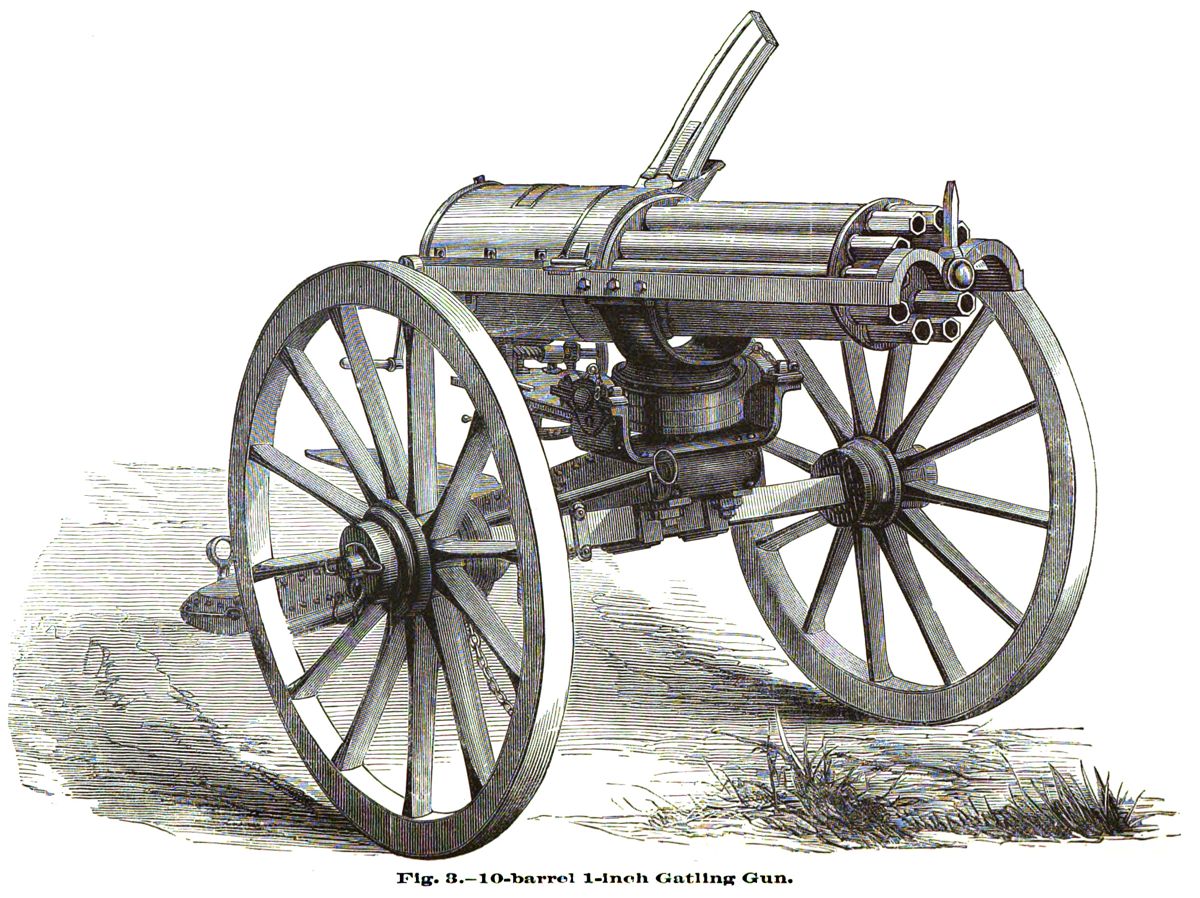
A second board of officers, composed of Capt. Alfred Mordecai, Ordnance, Capt. William Hawley, Third Cavalry, and Capt. Louis Henry Carpenter, Tenth Cavalry, also met in 1874 to “Examine Pack Animal Transport of Gatling Guns with Cavalry.” The board resolved that it was not feasible but did recommend using a light wheeled carriage pulled by one horse as a better method for Gatling guns to keep up with fast moving cavalry units.3 The board also concluded that the 1-inch Gatling was not intended to be a readily mobile gun. The board supported army doctrine in that it was meant as a fortification flank defense weapon. William Franklin noted the ten barrel 1-inch Gatling gun weighed 750 pounds and the carriages and limbers 700 pounds each, respectively. This totaled 2,100 pounds for the 1-inch Gatling gun, carriage, and empty limber. The carriage was considered too light for effective transport of the heavy Gatling gun in rough terrain.4 A majority of Army commanders from generals to regimental officers viewed the Gatling gun as a piece of artillery. Some saw the utility of the gun; most others saw the Gatling as having limited use in western expeditions. Lt. Col. Custer was never enamored of the use of artillery and had not used it in the Civil War to support his cavalry columns. Neither did Col. Nelson Miles, an advocate of artillery use in the Indian Wars, nor Gen. George Crook. None found the Gatling gun to be valuable on field campaigns, and all eschewed them. One of Miles’s main concerns with Gatling guns was that they were too heavy and cumbersome for use in broken western terrain, which was perhaps unfounded, but nevertheless a prominently held view of many commanders. Another objection voiced by Miles was the small caliber (.50-450 grain and .45-405 grain) bullets were too light for ranging the guns. The bullets were not heavy enough to raise a cloud of dust or soil to determine where the bullets were hitting with any confidence at long ranges of twelve or fifteen hundred yards. He thought the 1-inch Gatling was better for that purpose, but it was much too heavy to be used in field situations given its relatively light carriage.5 The long ranges mentioned by Miles mirrored the thinking that the Gatling gun was an artillery piece and not meant for cavalry or infantry close support work. The Gatling gun’s legendary story is largely based on its use in several late nineteenth century battles of some renown, all outside the United States. With the exception of the 1898 Spanish American War, Gatling guns saw little combat action with United States troops on their home soil. In fact, they were used in combat in the United States during the American Indian Wars on only four occasions. The first two were during the Red River War of 1874 in Texas and what is now Oklahoma. The third was at the Battle of the Clearwater in Idaho during the Nez Perce Campaign of 1877, not the Bear Paw or Snake Creek battle as is often erroneously reported; the fourth was during the 1878 Bannock Campaign. Even though the Gatling gun saw little combat, the guns were routinely tested by the Ordnance Department; many were purchased and sent to posts throughout the country between 1862 and 1890. Commanders and troops in the west were well acquainted with the Gatling gun although its field use was limited. In the various annual reports by the Secretary of War to Congress and the annual reports of the Chief of Ordnance to the Secretary of War there are sections enumerating the number of Gatling guns and their caliber as well as ammunition issued to posts and troops in the field. The lists also include Gatling guns and ammunition sent to the states under the Militia Act of 1808 as amended.6 Between July 1, 1873, and June 30, 1877, there were 42 .45-70 Gatling guns, four .50-70 Gatling guns, and seven 1-inch Gatling guns issued by the Ordnance Department and deployed to various arsenals, posts, and stations. Also issued by the Ordnance Department were 6,092,800 .45-70
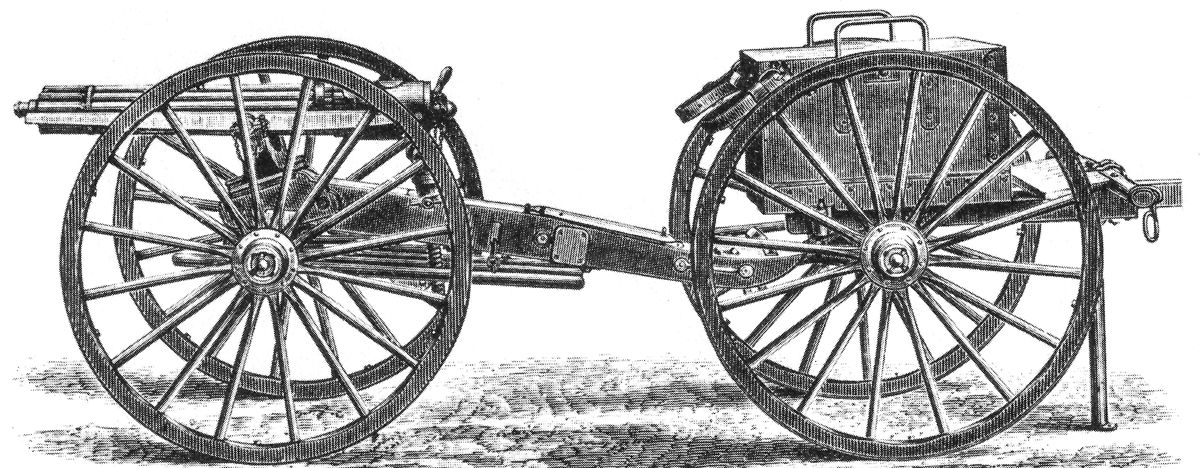
Model 1874 Gatling gun on its field carriage. (Scientific American, Vol. 30, No. 2, 1874.)
…the Gatling gun superior “to any species of artillery against troops exposed to view, and therefore a most valuable auxiliary to shell guns.”

The Gatling gun and limber. Franklin, 1874. Richard J. Gatling patent drawing. (NARA 102278484)
Right: American Breech-loading Small Arms: A Description of Late Inventions, Including the Gatling Gun, and a Chapter on Cartridges. United States: F. W. Christern, 1872, p. 285. Non-excavated 1-inch caliber Gatling gun cartridge. Lead bullet is .980 inch in diameter at the ogive, and the complete cartridge is 3.85 inches long. (Glenn Dutton Collection)
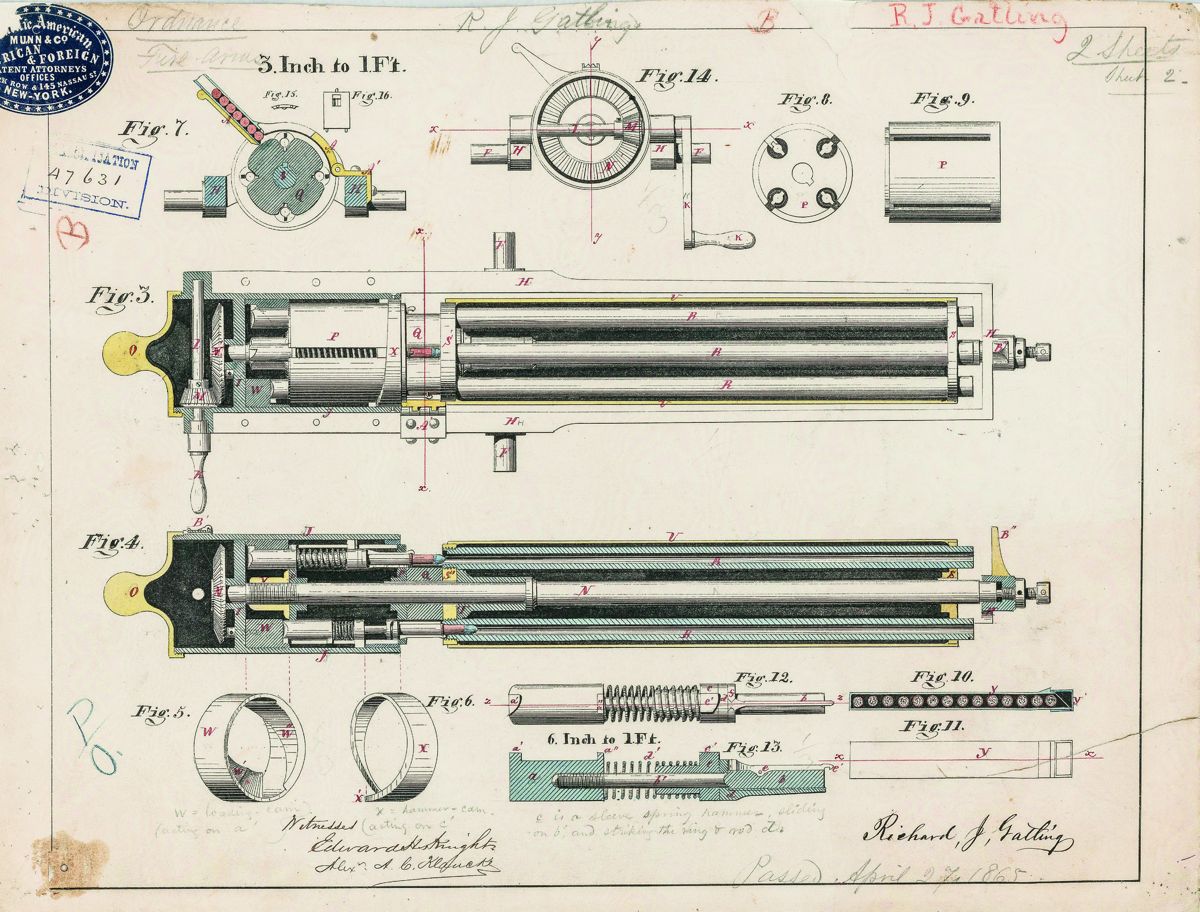
Patent drawing of the Gatling guns spiral action. Each barrel had its own action and firing pin. The hand-cranked barrels rotated clockwise (if this actually were counter clockwise, then the firing and extraction positions would be reversed) with the live round dropped into the action at the 12 o’clock position, chambered (III, IV), fired at about the 3 o’clock position (between V and VI), extracted (VIII) and ejected (IX) at about the 9 o’clock position. Franklin, 1874.
ball cartridges, 3,248,476 .50-70 ball cartridges, 386,700 Martin primed .50-70 ball cartridges, 17,800 1-inch ball cartridges, 18,250 1-inch elongated ball cartridges, and 1,300 1-inch canister cartridges. With the exception of the 1-inch rounds, the .45 and .50-caliber cartridges were meant for shoulder arms as well as the Gatling gun. During that same period the Army issued several states eighteen .45-70 Gatling guns, one 5 barrel, .45-70 Gatling gun, and two 1-inch Gatling guns under the authority of the Militia Act of 1808 as amended. The official total of Gatling guns procured between 1862 and 1877 is 220 of which 62 were 1-inch, 33 were .50-70, and 140 were .45-70. Vaughn K. Goodwin’s research on Gatling guns identified a different total for the same period, although his research noted that no .45 caliber Gatling guns were issued to western forts or troops in the field between 1874 and 1876.7
A 1-inch Gatling gun at Fort A. Lincoln by frontier photographer F. J. Haynes in the fall of 1877 after the summer Sioux Expedition. It is unlikely this gun was ever deployed to the field. The soldiers in the picture are some of the Twentieth Infantry men assigned to Low’s Battery. During the Indian Wars, 1866–1890, Army doctrine considered the Gatling gun as part of the artillery arm and tested it accordingly. Courtesy Montana Historical Society.
Major Marcus Reno.
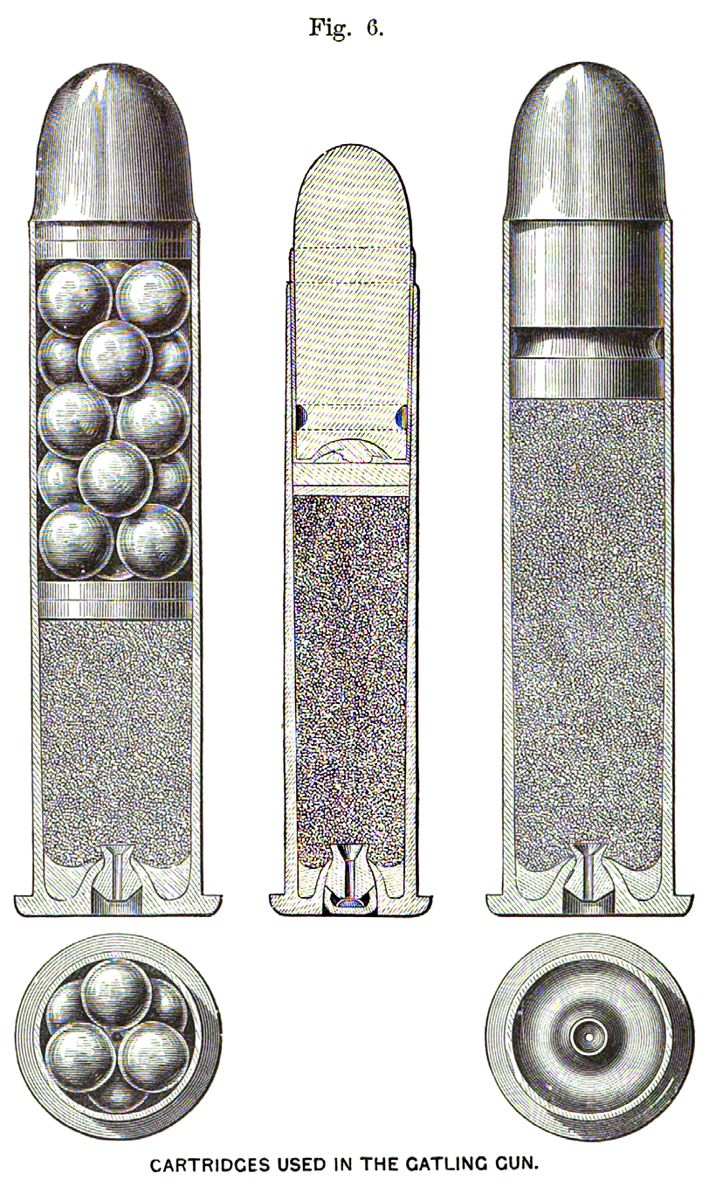
American Breech-loading Small Arms: A Description of Late Inventions, Including the Gatling Gun, and a Chapter on Cartridges. United States: F. W. Christern, 1872, pp. 256 and 261.
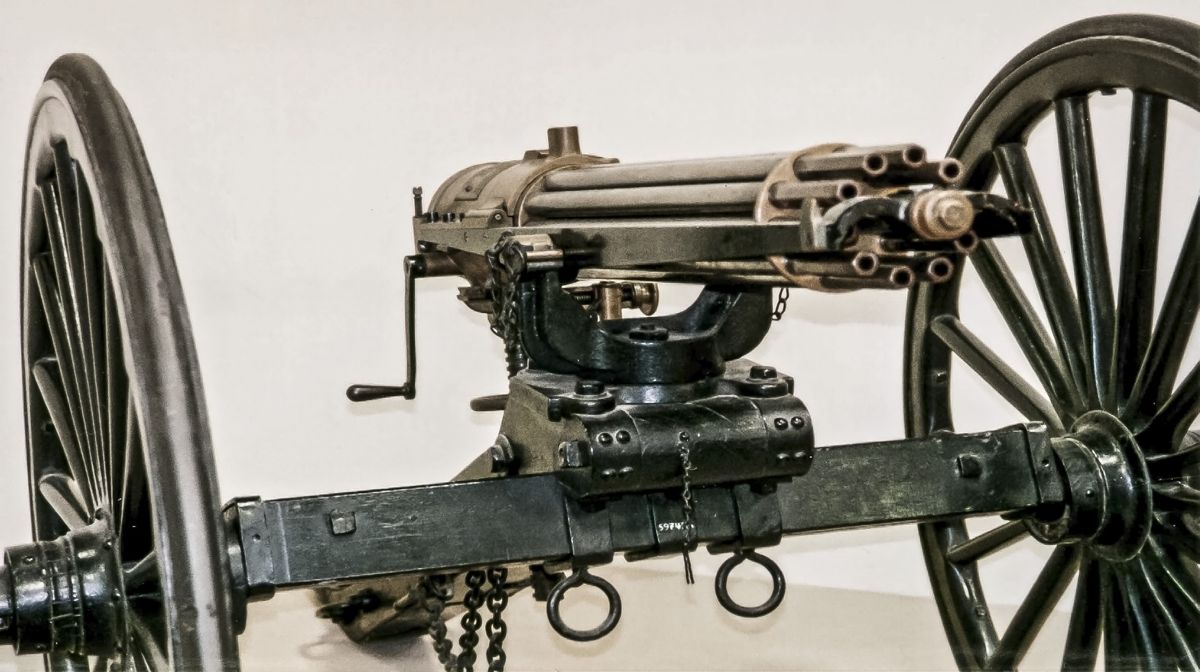
The ledger entitled Armaments of Forts and Batteries for the period 1861–1873 lists Gatling guns located at the Dakota and Montana Territory forts from which troops were drawn for the summer 1876 campaign.9 There were three .50 and two 1-inch Gatling guns at Fort Rice, two .50 guns at Fort A. Lincoln, one .50 gun at Fort Seward, one .50 gun at Fort Ransom, one 1-inch gun at Fort Stevenson, one .50 gun at Fort Shaw, one .50 gun at Fort Ellis, three .50 guns and a 1-inch gun at Fort Sully, and a 1-inch gun at Fort Randall. Up to 1873 there were twelve .50 and five 1-inch Gatling guns located at the Department of the Missouri forts. The question of how many and what caliber Gatling guns were offered to Custer has been debated for many years.10 The definitive answer has always been available, but seldom properly researched and cited. The Chief of Ordnance in the War Department’s Annual Report for 1876 clearly stated that the Gatling gun battery was commanded by 2nd Lt. William H. Low, Twentieth Infantry, and consisted of three .50 Gatling guns. These were most likely the Model 1871 or the Model 1874 .50-70 model. These guns and carriages weighed 426 pounds and the empty limber added another 257 pounds. This totaled 683 pounds for gun, carriage, and empty limber.11 Gen. Alfred Terry. (Brady-Handy Collection, Library of Congress) Regardless of the discrepancy between the numbers acquired, there were at least 40 Gatling guns deployed to western forts associated with fighting Native Americans. There were 29 .50 Gatling guns, nine 1-inch guns, and four with no caliber noted scattered among the western posts from Texas to the Dakotas and from Kansas to California between 1866 and 1877 according to ledger books containing the list of ordnance at posts.8
A point of confusion regarding the type and caliber of Gatling guns in the battery was due to a recollection of Sgt. Hugh H. Hynds. A member of Low’s Battery in 1876, his recollections were recorded in 1926, some fifty years after the campaign. Hynds stated there were two .50 guns and two 1-inch guns, in contrast to the War Department report. It seems likely Hynds suffered from faulty memory some fifty years after the event. Low, his second in command, 2nd Lt. Frank X. Kinzie, and the Twentieth Infantry enlisted men who served as gunners, were stationed at Forts Snelling and Ripley in Minnesota,
A Model 1874 .50-70 Gatling gun. The wheels have the late modification of an added hard rubber tire.
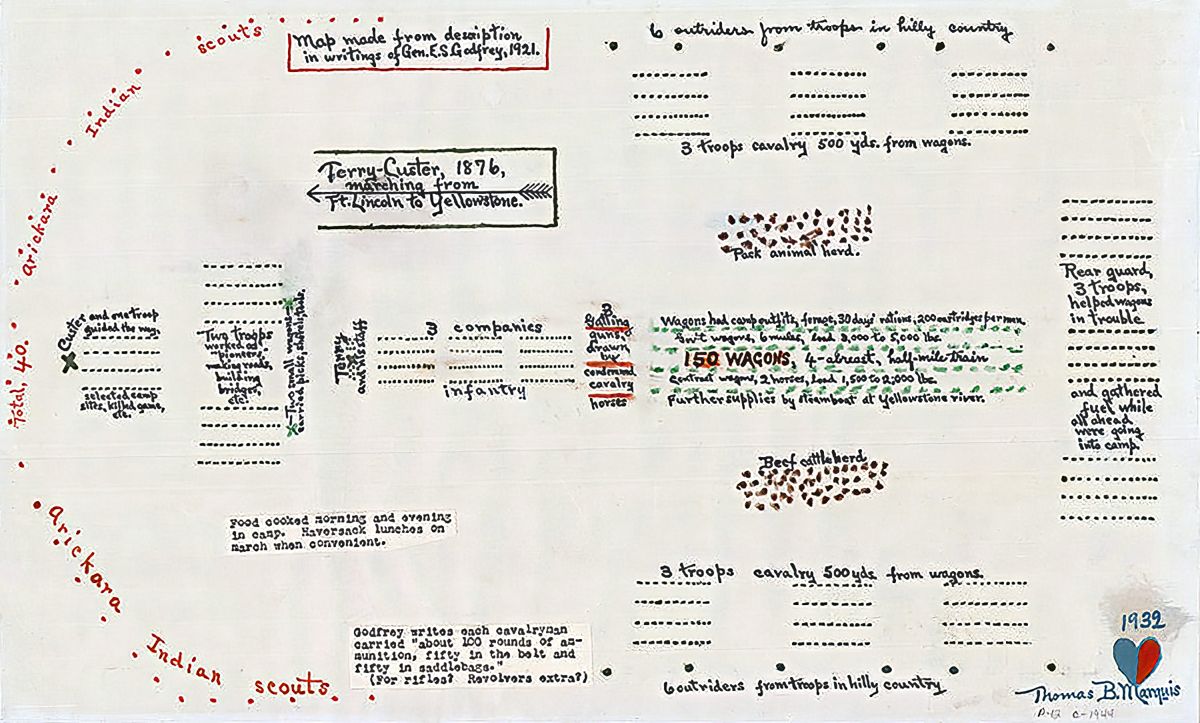
May marching order from Godfrey to Marquis. (LIBI)
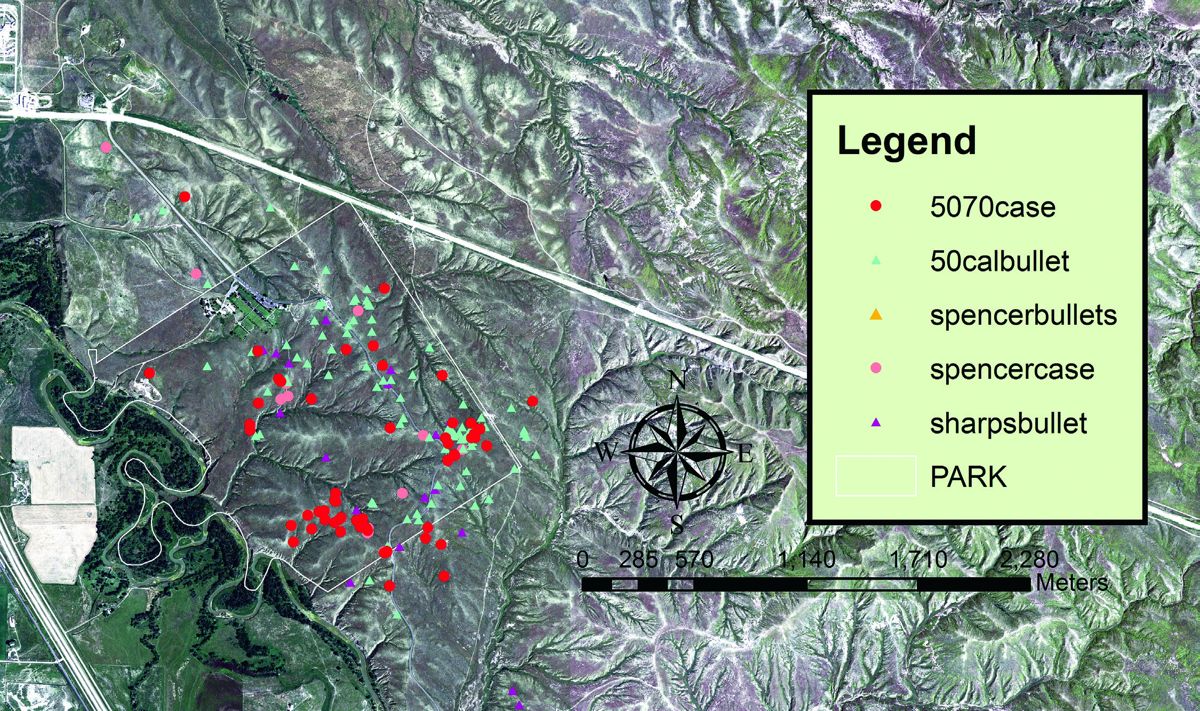
The warriors used a variety of firearms in the Little Big Horn Battlefield at Last Stand Hill, a total of 47 different types. This distribution of .50 bullets and cartridge cases illustrates how the warriors used the local terrain to their advantage in defeating Custer and his five troops.
and Pembina in Dakota Territory. They were ordered to Fort A. Lincoln by special train starting from St. Paul. Low and his men reached Fort A. Lincoln on March 20. Custer issued orders for Low and his detachment to be provided with quarters in the infantry barracks and were to be “organized and drilled for service in the field with a gatling gun battery consisting of four pieces.”12 It is possible that Hynds recalled drilling with four Gatling guns, one or two of which were 1-inch, while the guns that accompanied the expedition were .50. Aside from the Report of the Chief of Ordnance, the Report of the Chief Engineer also stated “a battery of three ½ inch Gatling guns, commanded by Second Lieut. W. H. Low, Twentieth Infantry,” accompanied the expedition under the command of Gen. Alfred Terry.13 None other than Lt. Gen. Philip Sheridan confirmed the battery consisted of three .50 Gatling guns. His report stated Brig. Gen. Alfred Terry with five troops of Seventh Infantry, four troops of the Second Cavalry, twelve troops of the Seventh Cavalry, and three .50 Gatling guns under Lieut. William Low left Fort Abraham Lincoln, now North Dakota, on May 17, 1876. They were to join a column under the command of Col. John Gibbon coming from Fort Ellis,
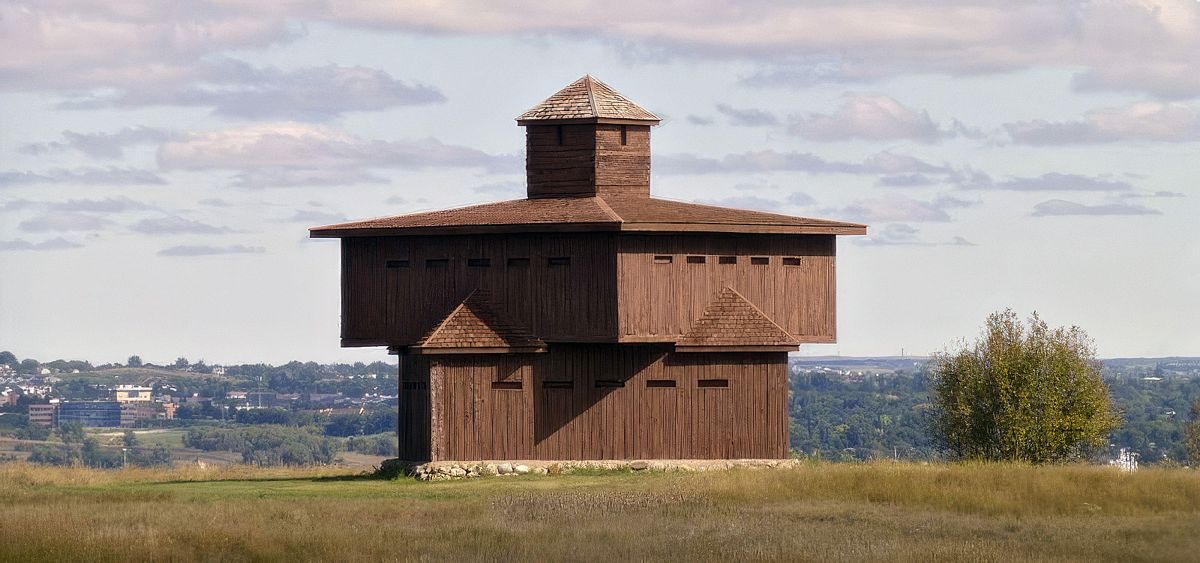
Fort Abraham Lincoln Upper Post Blockhouse. (Photo by John Stanton) Montana, on the Yellowstone River somewhere near where the Powder River joined. A third column under Brig. Gen. George Crook was to join them from the south, but this juncture did not occur until after the Battle of the Little Bighorn.14 When the command marched on May 17, the Gatling gun battery was placed about the middle of General Terry’s column. First was Custer in the lead with one cavalry troop, followed by two companies acting as pioneers making roads, cutting ravines down for passage, or building bridges. Terry and his staff followed with the infantry. The the three Gatling guns drawn by condemned horses followed, then 150 support wagons loaded with extra ammunition, forage, camp equipment, and rations. Flanking companies were deployed 500 yards either side of the main column to protect it against a surprise attack. Custer and his second in command, Maj. Marcus Reno, had some familiarity with Gatling guns accompanying a cavalry scout. While at the Powder River Depot, or supply camp, General Terry sent Reno with six Seventh Cavalry troops on a scout in the Powder River Valley on June 10. His column was accompanied by one of Low’s Gatling guns. On June 15, Terry sent Custer, six Seventh Cavalry troops, and one Gatling gun on a march to scout the Tongue River country.15
Maj. General Philip Henry Sheridan (1831–1888). (Library of Congress)
Reno’s scout was not without incident with the Gatling gun. Lt. Kinzie was detailed to keep the itinerary of the march. He was unable to do so because he was too busy dealing with the gun and its limber. The column passed over rough ground and the gun and limber, drawn by condemned horses, found it difficult to negotiate. Kinzie was required to have his men unhitch the horses, hand carry the gun, and manhandle the carriage and limber across ravines and other rough terrain. At one point while marching down a draw near the Tongue River the gun overturned, breaking the limber tongue, and injuring one man. On the last day of the scout, the terrain was so rough the gun had to be abandoned on a hilltop until it could be brought down with ropes. Surgeon James DeWolf also mentioned the guns in a letter to his wife noting the guns had already injured three soldiers attending them.16
Custer and the Seventh Cavalry were sent to their fate on June 22, 1876, with orders to scout the Rosebud and Little Bighorn valleys. It was at this time that Custer refused to take the Gatling guns. Lt. Low was sent to join Col. Gibbon’s column.17 Why did Custer refuse to take the proffered Gatling guns? That question has been debated by many Little Bighorn researchers over the years. One of the most succinct analyses of the issue was presented by the prominent Indian Wars historian, Don Rickey.18 His research demonstrated the relatively heavy Gatling gun was not easy to transport over rough terrain. He also noted that the guns had no provision for cooling when used in rapid fire, and that the black powder quickly fouled the guns’ barrels and firing pin assemblies which led to frequent jams. Rickey pointed out Custer and other officers of the Seventh Cavalry were familiar with the Gatling gun, and may perhaps have had a biased opinion of the gun based on their experience with the gun associated with their command at the Medicine Lodge Treaty negotiations in Kansas in 1867. There, Custer would not authorize ammunition for practice with the Gatling gun. Another bias many western commanders and other officers had regarding the Gatling was that the gunners were usually infantry or cavalrymen assigned as ersatz artillerymen. They were not familiar with the guns and were rarely fully and properly trained in artillery tactics. Regardless of the artillery type the infantry man turned gunner was generally not proficient with use of the guns. This was the case with the Gatling guns offered to Custer. General Alfred Terry reported in a letter to Lt. Gen. Philip Sheridan on July 4, 1876, that the Gatling guns were offered to Custer but that he refused to take them as they might “humiliate” his efforts to find and deal with the Lakota and Cheyenne.19 Custer believed his unit was equal to the task of subduing the Indians. Simply, he feared, as did other commanders, that artillery in general and Gatling guns in particular would slow down and encumber his fast moving cavalry force. He was also concerned with how the Gatling battery was moved. The horses used to draw the guns and limbers were condemned animals. This does not mean they were broken down and worthless horses, only that they were not suitable for cavalry use. If they were not good enough for the cavalry how could these condemned animals manage to keep up with his rapidly moving light cavalry unit. Custer’s opinion of the Gatling gun was likely solidified by Reno’s experience with the gun accompanying his scout earlier that June.
A metal detecting team sweeps across part of Last Stand Hill where Custer’s body was found. In the middle ground markers for the so-called Keogh sector can be seen and in the background is Calhoun Hill where Custer’s brother-in-law’s remains were found. Custer divided his command and it was spread out over one-half mile negating the effectiveness of the Gatling guns, if he had brought them along. Low was relieved of his Gatling gun battery command and placed in charge of a section of artillery composed of two 10-pdr. rifles and one 12-pdr. gun. Capt. Louis H. Sanger was given command of the three Gatling guns. Brig. Gen. Alfred Terry reported that the camp was well entrenched and perfectly secure with the force assigned to its defense including the Gatling guns. In a report dated August 4, 1876, Maj. Orlando Moore, Sixth Infantry, took at least one Gatling gun on the steamboat Far West when he traveled down river from Rosebud Creek to the Powder River Supply Depot to obtain forage. Lt. Col. Elwel S. Otis reported on October 13, 1876, that he took the section of .50 Gatling guns to Glendive Creek, Montana.20 Although present throughout the Yellowstone and Bighorn Expedition from its beginning, the Gatling guns played no role in any action.
After the Little Bighorn disaster Gibbon and Terry, later joined by Brig. Gen. George Crook’s column, stayed in the field most of the summer pursuing the Sioux and Cheyenne bands. The Gatling guns also stayed in the field, defending the supply depot, and accompanying various scouts in pursuit of the elusive Lakota and Cheyenne warriors and their families.
There is little doubt Custer’s refusal to take the Gatling guns on his fateful scout will continue to be debated by researchers and aficionados for the foreseeable future. The what if’s of the decision; what if he had taken them and used them to support his final deployment, what if they had been captured by the Lakota and Cheyenne, and so on, are just points of hypothetical debates. The fact remains Custer refused to take the Gatling guns. We will never know his reasoning behind that decision, but it is likely rooted in army doctrine of the time that viewed Gatling guns as artillery. Just as likely is Custer’s own exposure to Gatling guns in the field in 1867, and with his and Major Reno’s experiences with having Gatling guns struggle to keep up with two cavalry scout columns less than a week earlier traveling over very similar terrain.
While the expedition was camped at the mouth of the Big Horn River on the Yellowstone River July 2, 1876, Lt.
George Custer and the Gatling gun are icons of our history. Their story will, forever, be intertwined, even though he never used them, and they never fired a shot in combat during the 1876 campaign. Endnotes: Norton, Charles B., 1872, American Breech-Loading Small Arms: A Description of Late Inventions including the Gatling Gun and a Chapter on Cartridges, F. W. Christern, New York; Joseph Berk, 1991 The Gatling Gun: 19th Century Machine Gun to 21st Century Vulcan, Paladin Press, Boulder, Colorado; Paul Wahl and Donald R. Toppel, 1965, The Gatling Gun, Arco Publishing, New York; Larry Don Roberts, 1981, The Artillery with the Regular Army in the West from 1866 to 1890, PhD Dissertation, Department of History, Oklahoma State University, Stillwater; James B. Hughes, Jr., 2000, The Gatling Gun Notebook: A Collection of Data and Illustrations, Andrew Mowbray Publishers, Lincoln, RI; A. B. Feuer, A. B., 1995 Richard Gatling’s Inventive Mind Devised 6-Barrel Mechanical Gun, The Artilleryman 17(1): 4-7; Ernest Teagarden, 2000, The Guns Col. Custer Left Behind as the 7th Cavalry Looked for Indians, The Artilleryman, 21(3):16-19. 2. Use of Gatling Guns as Flank Defense guns at Fortifications, Annual Report of the Chief of Ordnance for the Fiscal Year Ending June 30, 1874, Government Printing Office, Washington, D.C., pp. 35, 43-46. 3. Ibid., pp. 64-66. 4. Franklin, William B., 1874, The Gatling Gun for Service Ashore and Afloat, The Cart, Lockwood, and Brainard Co., Hartford, Conn. pg. 6. 5. Col. Nelson A. Miles to the Adjutant General, September 16, 1876, Letters Received, Department of the Dakota, RG 98, Records of United States Army Commands, NARA; Roberts, 1981, ibid., pp. 60, 70-76. 6. c. f. Annual Report of the Secretary of War, 1st Session, 44th Congress House Documents, Executive Documents 1, Part 2, Volume 3, 1875, Annual Report of the Chief of Ordnance to the Secretary of War for the Fiscal Year Ending June 30, 1876, 1877. 7. Hughes, ibid.: 11; Vaughn K. Goodwin, no date, The Gatling Gun in the U.S. Army, 1866–1903. Photocopy manuscript in possession of the author. 8. Armaments of Forts and Batteries, 1861–1873, Volume 3, RG 156 Entry 113, National Archives and Records Administration, NARA. 9. Ibid. 10. See MacLean, French C., 2016, Sitting Bull, Crazy Horse, Gold, and Guns: The 1874 Yellowstone Wagon Road and Prospecting Expedition. Schiffer Publishing, Atglen, Penn. MacLean’s erroneous assumption that Custer was offered 1-inch-caliber Gatling guns and refused them due to their weight and problems traversing rough terrain is one example of the confusion that exists regarding what type of Gatling guns were with the Yellowstone and Bighorn Expedition of 1876. 11. Report of the Chief of Ordnance for 1876 in Annual Report of the Secretary of War, 1876, 2nd Session, 44th Congress House Documents, Executive Documents 1, Part 2, Vol. 3, Part 2, pg. 700. Also see Noyes, C. Lee, 1995, The Guns “Long Hair” Left Behind. 8th Annual Symposium Custer Battlefield 1.
Historical and Museum Association, June 24, 1994, pp. 7996. Custer Battlefield Historical and Museum Association, Hardin, Mont., for a complete account of the Reno scout and problems with the Gatling gun. H. A. Hynds, 1972, Reminiscences of Sgt. H. A. Hynds, Little Big Horn Associates Research Review VI (Winter), pp. 61-69; Special Order No. 9, March 3, 1876, Fort Abraham Lincoln, Records of United States Army Continental Commands, RG 393, NARA. Report of the Chief of Engineer for 1876 in Annual Report of the Secretary of War, 1876, 2nd Session, 44th Congress House Documents, Executive Documents 1, Part 2, Vol. 3, Part 2, pg. 700. Report of Lt. Gen. P. H. Sheridan, No. 1, Headquarters Military District of the Missouri, New Orleans, Louisiana, November 29, 1876, Annual Report of the Secretary of War, 2nd Session, 44th Congress House Documents, Executive Documents 1, Part 2, 1876–1877, pg. 443. Noyes, 1995:88 shows the likely order of march for Terry’s column including the placement of the Gatling guns behind the wagon train. Report of General Terry, No. 3, Headquarters Department of the Dakota, St. Paul, Minnesota, November 21, 1876, ibid., pg. 461. Noyes, C. Lee, 1995:88-91 identified the issues with finding suitable horses to pull the guns. The only horses available were condemned mounts found at Forts Rice and Abraham Lincoln. In the end three condemned horses were harnessed to each gun In the battery and he discusses the issues with the guns being troublesome on Reno’s scout as well as Injuring several soldiers while trying to move them. Report of General Gibbon, Headquarters Department of Montana, Fort Shaw, Montana, October 17, 1876, pg. 473 and Report of the Chief Engineer, pg. 701, Annual Report of the Secretary of War, 2nd Session, 44th Congress House Documents, Executive Documents 1, Part 2, 1876–1877. Rickey, Don, 1963, Forty Miles a Day on Beans and Hay: The Enlisted Soldier Fighting the Indian Wars. University of Oklahoma Press, Norman, pg. 219. Terry to Sheridan, July 4, 1876, Letters Received, Records of the Adjutant General’s Office, RG 94, Microfilm 666, Reel 273, National Archives and Records Administration, NARA. Report of General Gibbon, Headquarters Department of Montana, Fort Shaw, Montana, October 17, 1876, pp. 465-466, 480, 485. Annual Report of the Secretary of War, 2nd Session, 44th Congress House Documents, Executive Documents 1, Part 2, 1876–1877.
Doug Scott retired in 2006 from the U.S. National Park Service after more than 30 years of with the Department of the Interior. He is currently Adjunct Research Faculty at Colorado Mesa University. Scott specializes in nineteenth century military sites archeology and forensic archeology. He is particularly noted for his expertise in battlefield archeology and firearms identification. He directed the archaeological investigations of the Little Bighorn Battlefield National Monument, and his award-winning book, Uncovering History: Archaeological Investigations of the Little Bighorn Battlefield, summarizes over 20 years of work at the site.