
U.S. Model 1855 Pistol Carbine
Originally published September-October 2023 · pp. 66–71
U.S. Model 1855 Pistol Carbine By Tim Prince
(National Museum of American History)
he U.S. Model 1855 Pistol Carbine was a classic example of the pre-Civil War United States Ordnance Department’s inability to be forward thinkers and look at current and emerging technologies when it came to firearms design. Even though much more advanced breech loading carbines and revolvers, like the Jenks Naval Carbine, the several models of Sharps’ patent carbines, and various Colt’s patent repeating revolvers, were already used by the U.S. military, the Ordnance Department chose to adopt a design that was clearly a step backwards, a single shot, muzzleloading pistol carbine with a detachable shoulder stock. The end result was a weapon that was neither fish nor fowl, either an oversized and ungainly pistol or an overly short-barreled carbine with a shaky attachable stock. The Ordnance Department intended the new weapon would be issued
Tto the cavalry and used as a pistol when mounted and a carbine when dismounted. The gun was to be carried in the typical pommel holsters of the day, with the pistol in one holster and the butt stock in the other. U.S. Secretary of War Jefferson Davis approved the gun on July 5, 1855, along with the rest of the U.S. Model 1855 family of firearms. Since the Federal Government operated on a fiscal year system, the gun was actually adopted five days into fiscal year 1856. This explains why Ordnance Department records show no deliveries into stores of Model 1855 pistol carbines in 1855. Like the rest of the government, the armories maintained their records and bookkeeping on a fiscal year basis. However, they dated parts they manufactured, like locks and barrels, on a calendar year basis. This explains why M1855 Pistol Carbine locks and barrels are found dated “1855” and yet none were delivered that “year” according
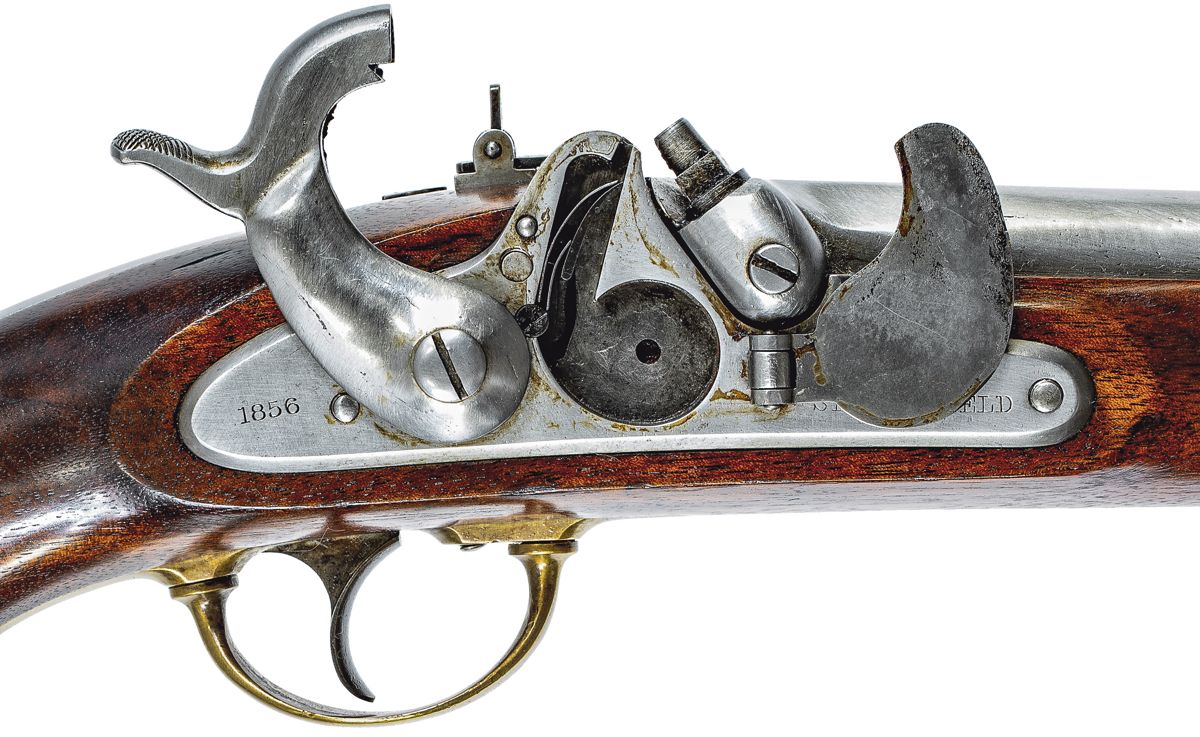
Close up of the pistol carbine lock with the tape primer magazine door open, showing the internal primer feed and tension mechanism.
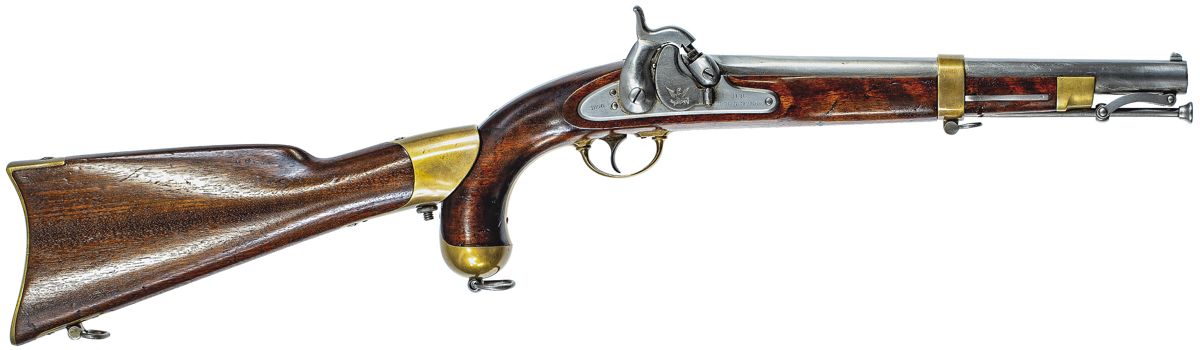
Overall obverse view of a U.S. M1855 Pistol Carbine with buttstock attached. (All photos by Tim Prince)
to the arsenal bookkeeping system. The Springfield Armory produced a total of 4,021 of the M1855 Pistol Carbines for the Ordnance Department during its brief production run. A total of 2,710 were delivered into stores in fiscal year 1856; an additional 1,311 followed in fiscal year 1857. The first issues of the new Pistol Carbine were to a single squadron of cavalry from both the 1st and 2nd US Cavalry Regiments. The guns were far from successful or popular in the field, and no further pistol-carbines were manufactured after fiscal year 1857. In 1858, the pistol-carbine was also tentatively issued to some light artillery units for trials,
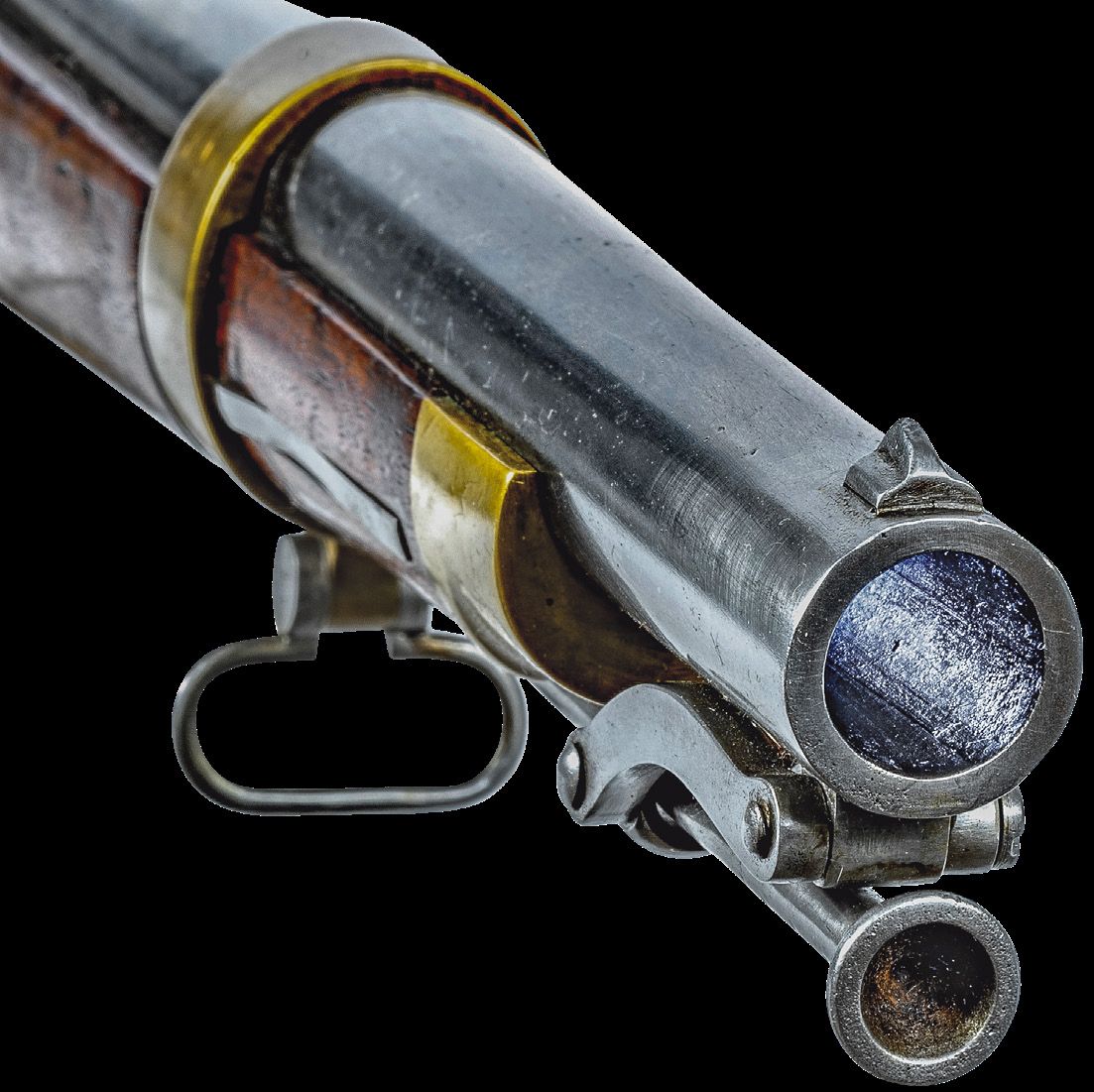
Muzzle view of the pistol carbine, showing the front sight, three-groove rifling, and the swivel ramrod.
with the thinking that it might be a handy weapon for those troops. However, it was not popular or successful in that role either. Eventually, the Ordnance Department finally saw a glimpse of the future and proceeded to issue revolving pistols to the cavalry and undertook additional trials of breech loading carbines. As of October 1860, some 3,022 of the M1855 Pistol Carbines were stored at various arsenals, with only 992 being in the field. The outbreak of the American Civil War created such a pressing need for small arms that most of these pistol carbines were issued, at least on a temporary basis. According to George Moller’s research, eleven different companies of U.S. cavalry were completely, or at least partially, armed with the M1855 Pistol Carbine during the first part of the Civil War. John D. McAulay’s research indicates that as late as the December 31, 1862, quarterly field reports, slightly less than four hundred of the M1855 Pistol Carbines were still in service in the field. The regiments listed in that report, still carrying the Pistol Carbine at the end of 1862, as well as the number of guns that they had during the quarter ending December 31, 1862, include the 9th Illinois Volunteer Cavalry (27), the 1st Indiana Volunteer Cavalry (41), 2nd Kansas Volunteer Cavalry (53), 5th Kansas Volunteer Cavalry (76), 6th Kansas Volunteer Cavalry (61), 4th Missouri Volunteer Cavalry (10), 11th New York Volunteer Cavalry (59), 1st West Virginia Volunteer Cavalry (5), 2nd West Virginia Volunteer Cavalry (66). Eventually, the guns were withdrawn from service as more practical weapons became available. Despite the gun being obsolete from the day it was adopted, as late as 1880 some pistol carbines were still in government stores, as 332 were sold at auction as surplus from the New York Arsenal in that year.
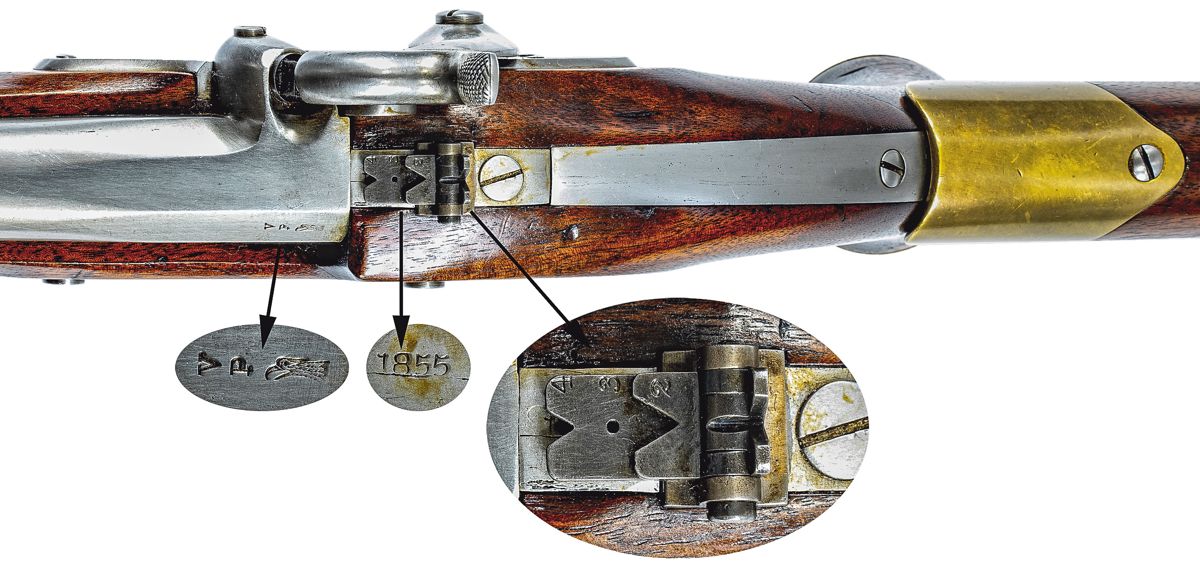
View of the pistol carbine breech area showing the detail of the multi-leaf rear sight, the date on the breech concealed by the sight leaves, and the inspection marks on the angled flat.
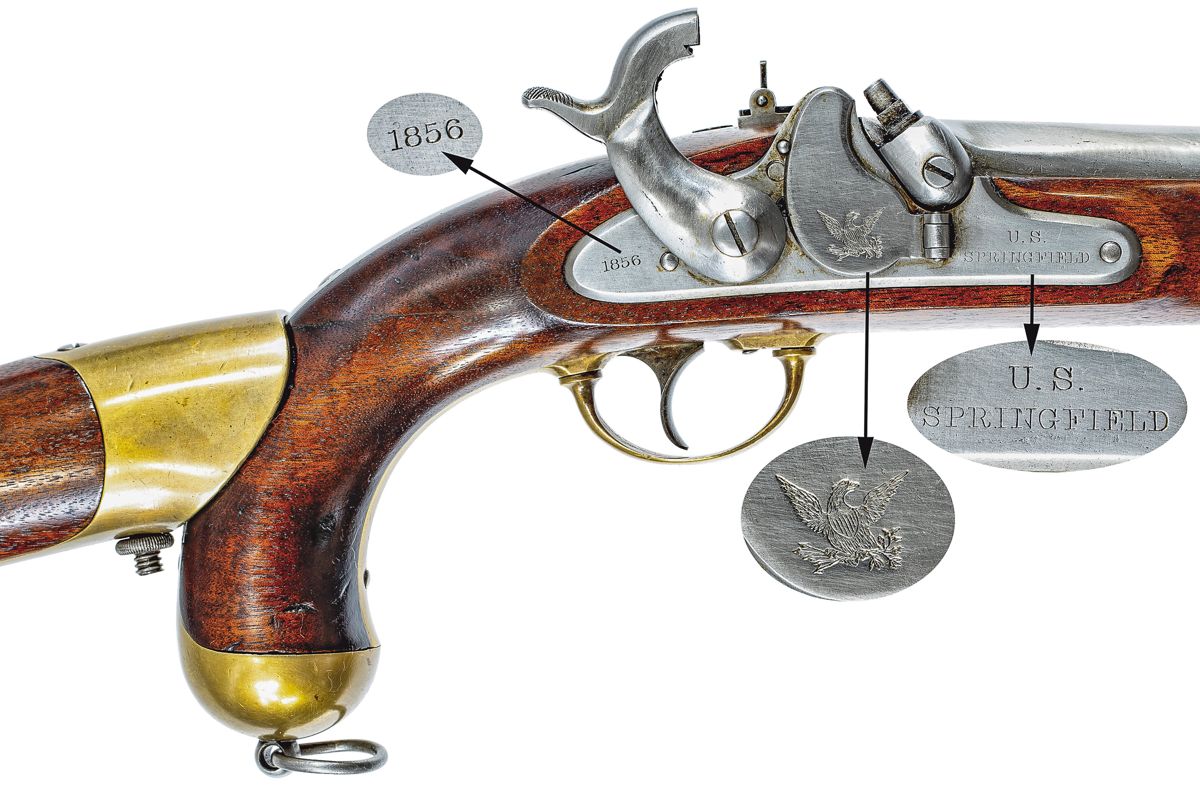
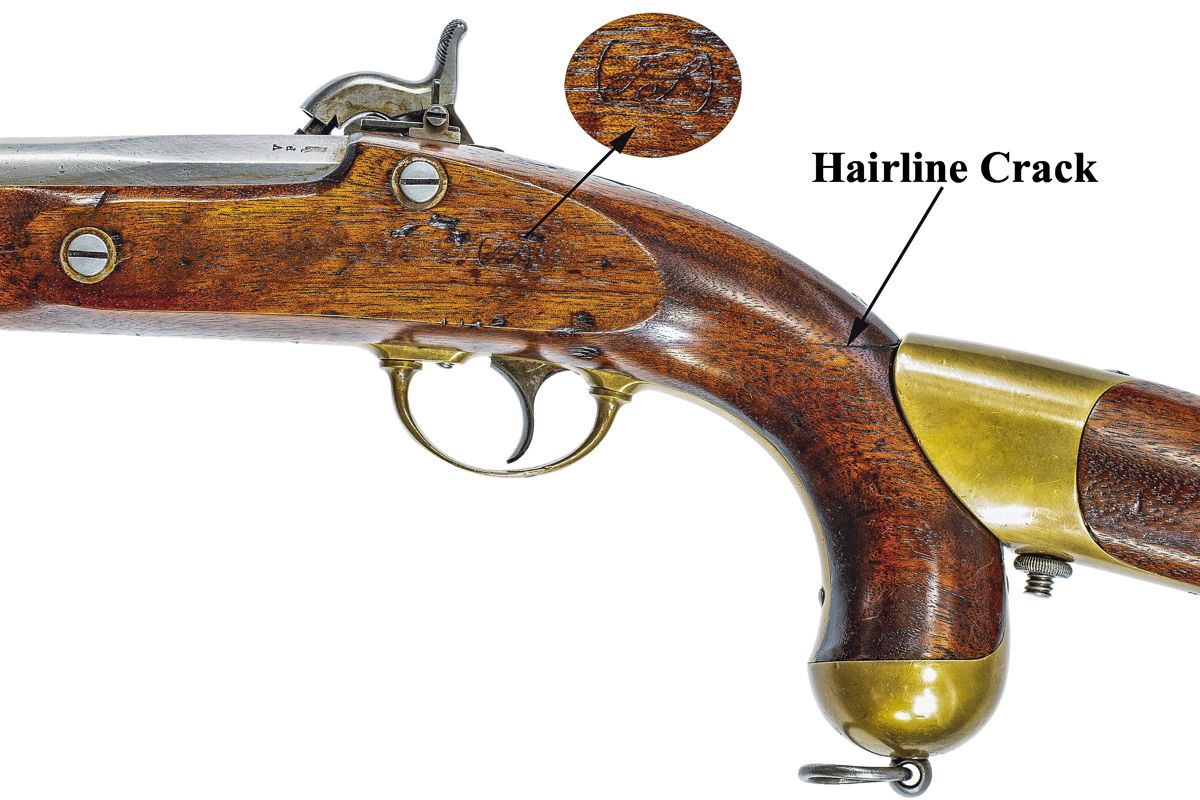
The U.S. M1855 Pistol Carbine has the dubious honor of being the last single-shot percussion handgun issued to the U.S. military, at a time when percussion revolvers were the standard of the day, and metallic cartridge revolvers were beginning to emerge. The gun was just under 18-inches in overall length with a 12-inch, .58 caliber barrel, rifled with the traditional Springfield Armory three groove rifling. The gun used a reduced sized version of the Maynard automated “tape primer” lock that was also used on both the M1855 Rifle and Rifle Musket. Although all previous single-shot pistols utilized a roundball projectile, the new M1855 Pistol Carbine took the expanding base, .58 conical projectile used in the U.S. M1855 Rifle, Rifle Musket, and Carbine. The only substantial difference between the pistol carbine cartridge and the cartridge used in the M1855 rifle and rifle musket was a reduction in the powder load from 60 grains for the longarms to 40 grains for the pistol carbine. Like most arms produced at the National Armories during that time frame, the gun was polished to “National Armory Bright.” It was mounted with brass furniture and had a walnut stock. The butt of the pistol carbine had a large swivel ring, allowing either a lanyard or carbine sling to be attached. A sling swivel was also mounted on the bottom of the single brass barrel band, as well as in the toe line of the detachable buttstock. The pistol featured a captive ramrod retained by a swinging link system, similar to the pattern used on the U.S. M1842 pistol and the earlier M1847 Cavalry Carbine. Why this system was adopted, when it had been universally despised on the M1847 Carbine is somewhat of a mystery. A large iron front sight was installed very close to the muzzle and a multi-leaf rear sight was graduated for use at 100, 200, 300, and 400 yards. The 300-yard graduation was provided via a small peephole in the 400-yard leaf. The iron backstrap was cut to allow attachment of a removable shoulder stock, which was typically numbered to the gun. The guns and stocks were batch numbered from 1-20, with the number stamped into the top rear of the brass butt cap and into the lower part of the buttstock’s brass yoke. Lock markings were the usual U.S. / SPRINGFIELD in two horizontal lines forward of the tape primer magazine, with the traditional U.S. spread-winged eagle motif on the door of the primer magazine. The date of the lock’s manufacture was stamped in a single horizontal line to the rear of the hammer. The left angled breech of the barrel was marked with the usual arsenal V / P / {EAGLE HEAD} proof and inspection marks. The barrel’s production date was stamped into the top of the breech, concealed by the longer range leaves of the rear sight when they were not elevated. Most examples bear the script “JS” cartouche of Springfield Arsenal’s longest working small arms subinspector, James Stillman. At a time when breechloading and repeating percussion firearms were coming into their own, the anachronistic
Close up of pistol carbine lock and grip area with lock markings enlarged.
design of the M1855 Pistol Carbine certainly contributed to its lack of popularity with the troops. The design of the detachable buttstock that did not tightly fit the pistol and tended to wobble when attached, combined with the uncomfortably short length of pull it allowed for, certainly did not make the design any more popular. The small production totals make the guns relatively scarce on the collector market today. Fine condition examples are particularly hard to find. This is because many saw harsh use in trials before the war and more hard use during the first year and half of the conflict. Additionally, regular use of the pistol carbine with the buttstock attached tended to crack or break the pistol’s grip. As the buttstocks were of limited utility in the post-war era when the guns were sold as surplus, the number of surviving guns is somewhat greater than the number of original buttstocks. This means that the scarce original stocks often sell for as much as the pistol itself! All this means that when one of these scarce guns appears on the collector market, complete with an original stock and in fine condition, they rarely remain for sale very long.
Close up of reverse of the pistol carbine stock and grip area, showing the script JS cartouche of James Stillman and the hairline crack in the grip that is found on nearly every example encountered today, even very fine condition pistol carbines like this one.
About the Author
Tim Prince is a full-time dealer in fine and collectible military arms from the Colonial Period through WWII. He operates College Hill Arsenal, a web-based antique arms retail site. A long-time collector and researcher, he has been a contributing author to two major book projects about Civil War era arms including The English Connection and a book on southern retailer-marked and Confederate-used shotguns. He is the author of over 60 articles on weapons in Civil War News. Tim is also a featured Arms & Militaria appraiser on the PBS Series Antiques Roadshow and serves as a Senior Consulting Specialist to the Arms & Armor department of Cowan’s, a Hindman Company.