
Leech & Rigdon Revolvers: Chronolgoy of Manufacture
By John Sexton · Originally published January-February 2024 · pp. 26–53
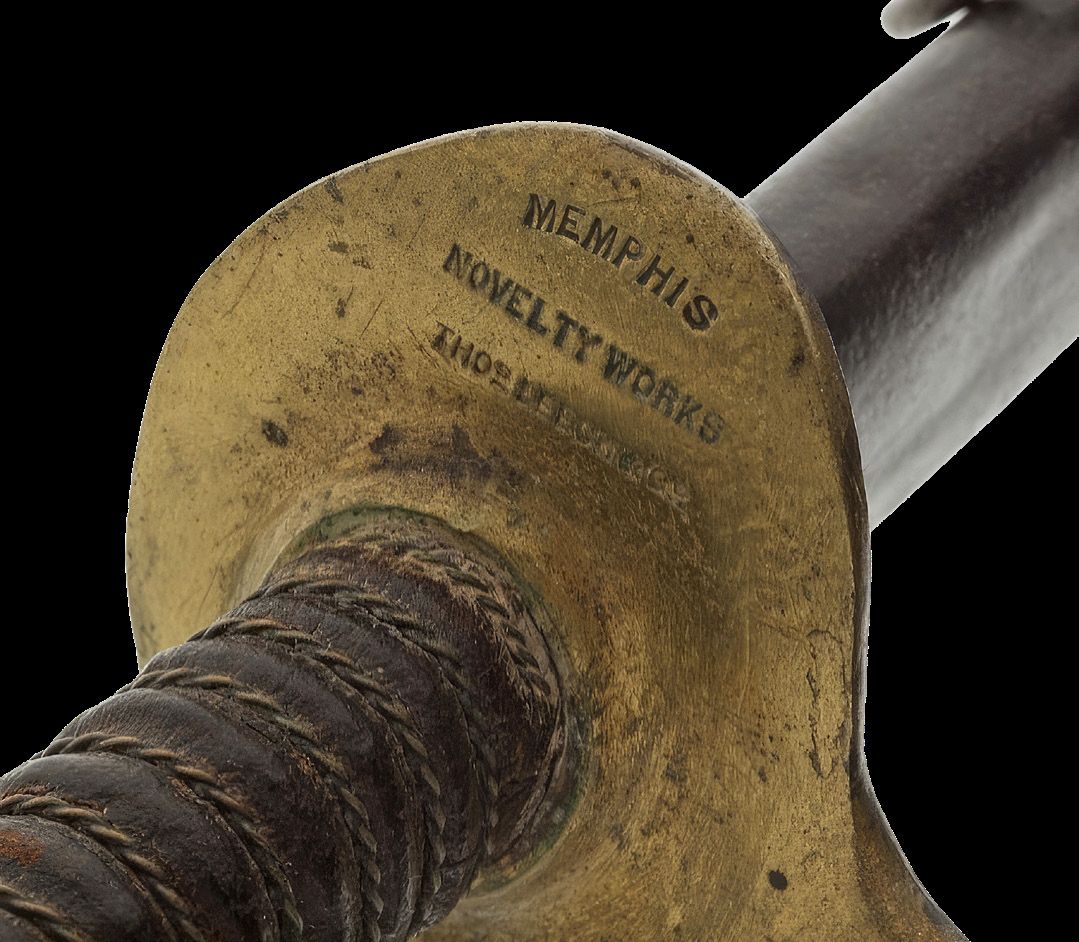
for manufacturing the Shawk & McLanahan brass framed revolvers made 1859–1860. Neither Abel Shawk nor J.K. McLanahan had any experience manufacturing like Thomas Leech. Rigdon is shown as a scale maker in Saint Louis in the 1850 U.S. census. In the 1860 U.S. census for Saint Louis, he is listed as a machinist. In the 1860 Memphis city directory, Charles H. Rigdon is listed as foreman, pressman, and scale manufacturer with an address at a newspaper office. A March 1861 newspaper article tells of his brilliance as an engineer potentially applying steam power to street cars in Saint Louis. In 1861, Rigdon was still in St. Louis but transitioning to Memphis; why else would his name appear in two different city directories for 1860? The Mississippi River made for easy transporting of equipment between the two cities. Did Charles Rigdon supply the equipment for pistol manufacturing or even swords? Several authors have Maker’s mark found on Thomas Leech & Company sabers thought made in 1861 before the move to Columbus. Thomas Leech, as a cotton broker, likely was a good businessman but had no mechanical experience in manufacturing arms. However, Thomas Leech and his Thomas Leech & Co. advertised for copper and brass scrap. Within a month, October 3, 1861, swords, spurs, gun mounts, brass castings of any style, blacksmithing, and repairing machinery and printing presses were being advertised. Leech’s partners or employees with Thomas Leech & Co. during the autumn of 1861 must have had the manufacturing expertise while Leech had the business expertise. Someone had to make the product, and it was not Thomas Leech. Thomas Leech, the businessman, would procure contracts and advances from the Confederate government. Charles Rigdon (1821–1866), a native of St. Louis, was a machinist and engineer. Bill Albaugh makes a compelling hypothesis that Rigdon was involved in manufacturing Shawk & McLanahan pistols in Saint Louis just before the War. Rigdon most likely supplied his machine shop tools
Memphis Daily Appeal, March 15, 1861, reprint of an article from St. Louis paper. Shawk & McLanahan partnership ended in court documents in July 1861.
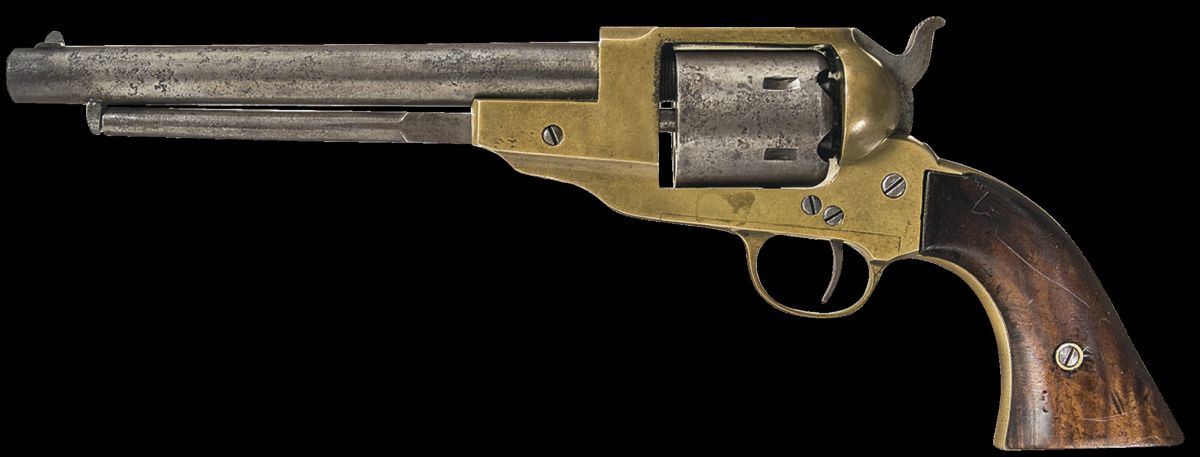
Shawk & McLanahan, SN 37, brass frame revolver was made in Carondelet, Missouri, in 1860. Eight survivors are known. Charles Rigdon is thought to be involved in their manufacture. (Rock Island Auction Company)
proposed this, and it is likely, in my opinion, that Rigdon was indeed involved in sword manufacture as “LEECH & RIGDON” appears on many officer swords. Why did Thomas Leech, run an ad for three months in late 1861 that specifically advertised “printing presses and machinery repair,” in addition to swords, Bowie knives, bayonets, and other brass castings? We know that Charles Rigdon, who was transitioning to Memphis, was listed as a pressman at the Memphis Enquirer office.
Leech & Rigdon are first documented as a company in a March 13, 1862, land record, as purchasers of a Columbus, Miss., tract where pistols were first made. Charles Rigdon’s name was added to newspaper ads alongside “Thomas Leech & Memphis Novelty Works” ads when navy pistols were added on August 29, 1862. These ads ran in the Memphis Daily Appeal through December 18, 1862.
How Rigdon met Leech and started pistol production is unknown. Still, they did have a manufacturing partnership, with little doubt about Rigdon being the mechanical and technical part of the business and Leech being the businessman, making contracts and getting advances from the Confederate government, first for sword production and later for pistol production. Likely, he was already an employee or partner working with Thomas Leech & Co. by September 1861, though his name is not found on any enlisted sabers or Bowie knives. November 21, 1862, Memphis Daily Appeal (published in Grenada, Miss.). Leech & Rigdon did not yet have a contract for revolvers.
August 29, 1862, Memphis Daily Appeal, the first-time revolvers are advertised.
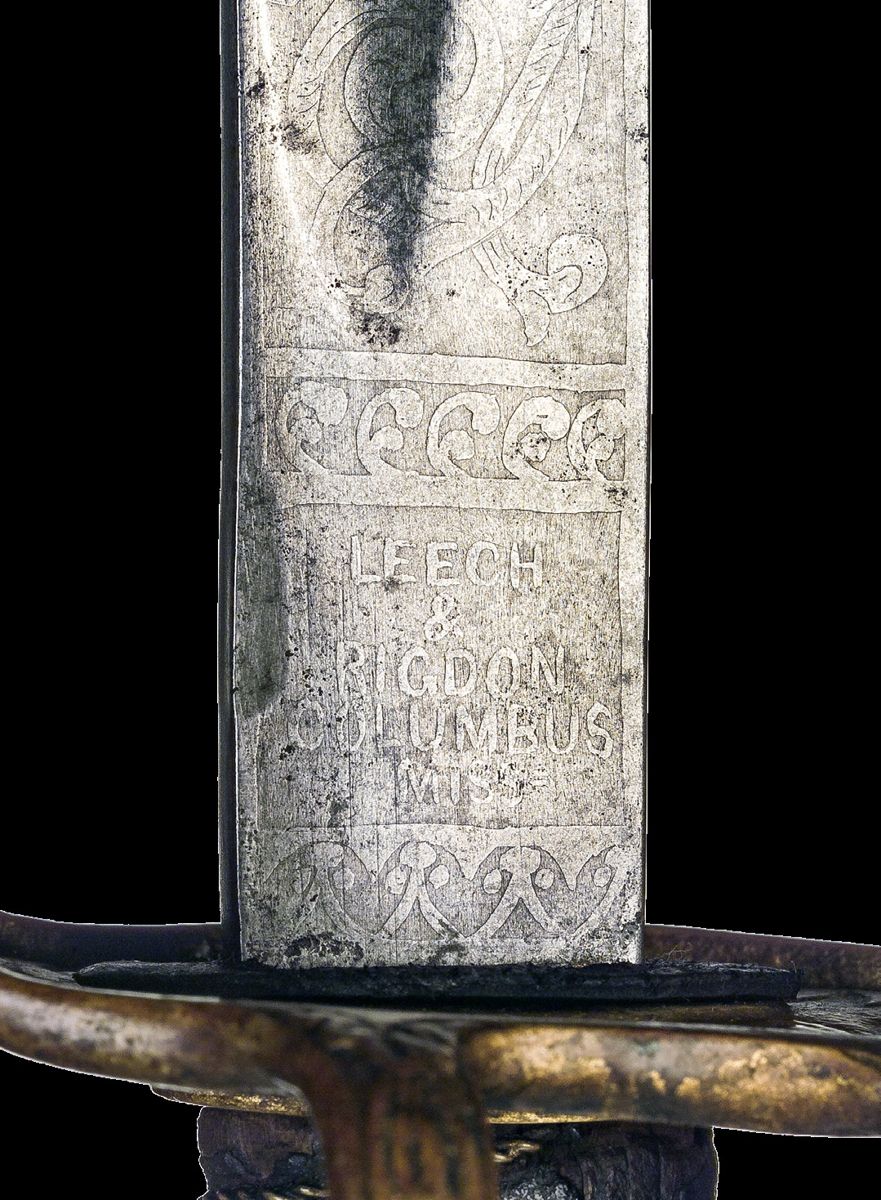
Cavalry Officer’s saber marked “LEECH & RIGDON, COLUMBUS MISS.”
September 29, 1863, Memphis Daily Appeal. February 27, 1863, and March 4, 1863, Memphis Daily Appeal (printed Grenada, Miss).
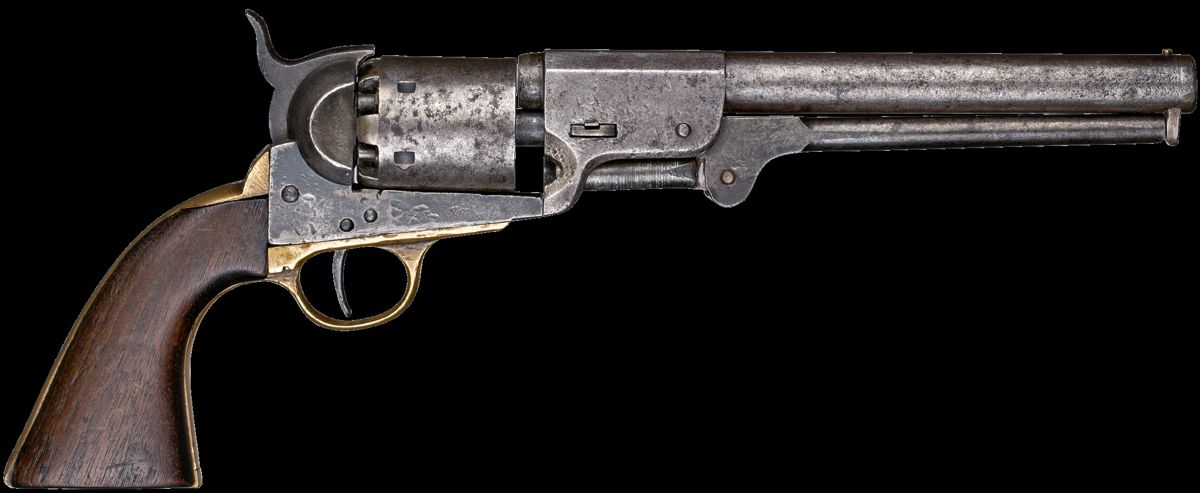
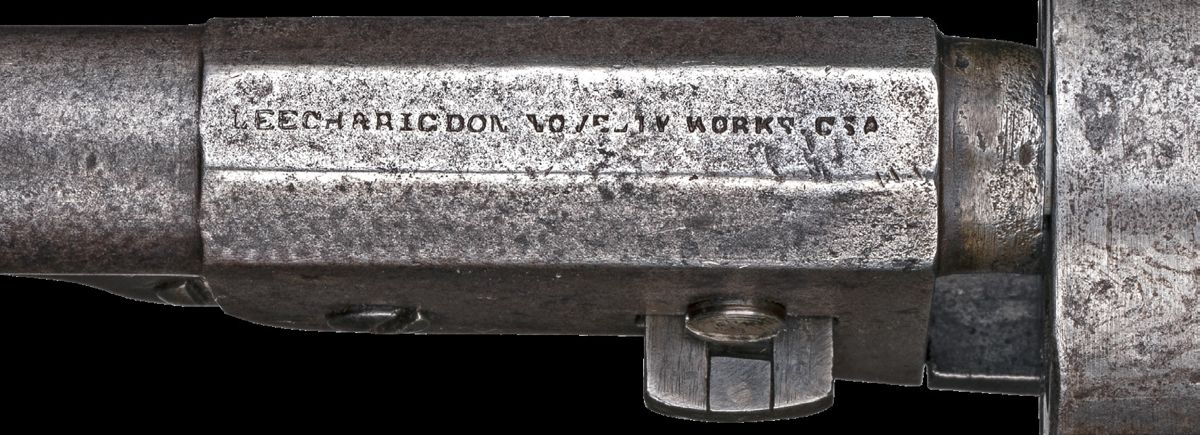
Pistol production had begun. All “Leech & Rigdon” (L&R) pistols and later Rigdon, Ansley, revolvers are copies of the Colt Model 1851 Navy revolver with a round barrel instead of octagonal, the same style other Confederate navy makers, Griswold & Gunnison, Dance Brothers, and Columbus Firearms, used. Leech & Rigdon made modifications (see chart) through their production run, but all were basically the same model. The earliest Leech & Rigdons were marked on the top barrel flat in separate small dies: “LEECH & RIGDON” and” NOVELTY WORKS CSA.” “NOVELTY WORKS CSA” is only found on three survivors, serial numbers (SN) 11 and 15, and an unnumbered example. Leech & Rigdon requested a contract on November 26, 1862, from Columbus, Miss. They are making 25-30 revolvers weekly and have 75 on hand. An ad dated a week earlier stated that 100 were on hand. How many pistols did L&R sell privately before leaving Columbus and setting up a new shop in Greensboro, Ga.? Leech & Rigdon authority Kent Wall suggests that about 350 revolvers were made in Columbus. I believe his estimate is qualified based on the style of markings up through SN 346. Bill Gary suggested only 75 revolvers were Columbus-made, but more data has surfaced since his excellent 1987 text.
Leech & Rigdon requested a government contract for Navy pistols. Currently, 75 were completed, and they were making 25 to 30 a week. Bill Gary estimates Columbus production at the 75 revolvers listed here. Kent Wall estimates 350 with the break with small to large address dies. There are only 23 surviving small die survivors; the highest is SN 346, which may represent Columbus production.
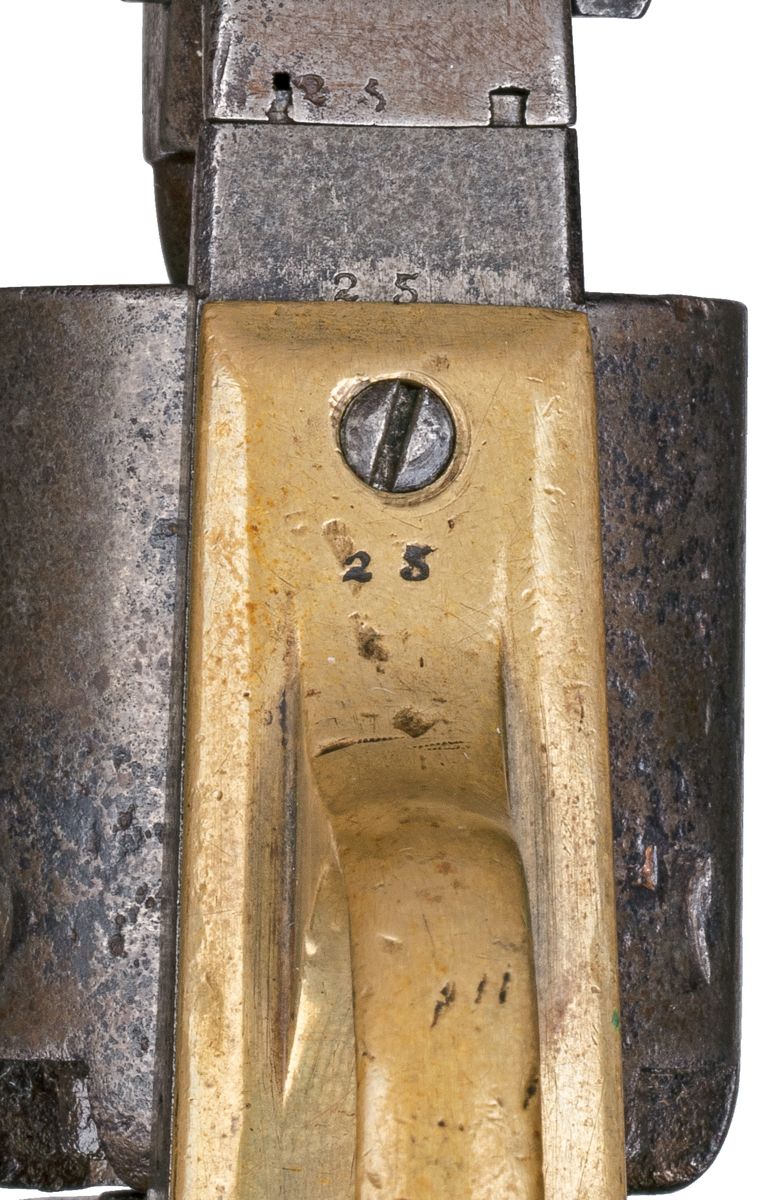
Revolvers were serial numbered on the barrel housing, frame, cylinder, trigger guard, back strap, loading arm, arbor, loading arm catch, and grips. On the earliest Columbus revolvers loading lever screws are also numbered. Leech and Rigdon abandoned Columbus with their machinery by January 1863 due to threatening Union advances. The firm moved to
Leech & Rigdon received $10,000 advance on March 6, 1863, for the manufacture of pistols, Griswold & Spiller were being paid $40 per gun in early 1863. At 25% advance, the contract would have been for 1,000 guns. Thomas Leech would leave the partnership nine months later. He would continue to make some swords in Greensboro. Greensboro, Ga., and soon set up again for manufacturing swords and pistols. Just before leaving Columbus, they sold a steam engine for $2,000 to the Columbus Armory, which later ended up at the Selma Armory. We know Charles Rigdon was involved in steam engine production in Saint Louis, could this have been part of the machinery he took from Saint Louis for his scale manufacturing in Memphis? After the firm moved to Greensboro early in 1863, pistol and sword production continued, though some authors suggest sword production had ended. Sword production did continue, as there are signed Leech & Rigdon officer swords marked Greensboro, Ga. Partnerships with Leech always seem to end in the cotton brokerage business, even those with John B. Leech (thought to be his brother); the same happened between Leech & Rigdon, with Leech leaving a partnership on December 30, 1863, and Rigdon forming a new partnership including Jesse A. Ansley. Rigdon moved to Augusta, Ga., and completed the remaining L&R contracted revolvers. As a new partnership, Rigdon, Ansley & Co. would enter a contract for a probable 1,000 revolvers with distinct 12-stop revolvers. The signatures on a very few guns would be C.H. Rigdon. Most of their guns would be unmarked other than inspection marks and “CSA.” The earliest Leech & Rigdons made before SN 52, including known guns 11, 15, 25, 26, 39, 41, 47, and the one unserialized Novelty Works show similar (continued on page 39)
Receipt for steam engine December 31, 1862, sold by Leech & Rigdon for $2,000 when L&R left Columbus for Greensboro, Ga.
Leech & Rigdon SN 15
“LEECH & RIGDON NOVELTY WORKS CSA” is the earliest and rarest marking to be found on any Leech & Rigdon revolver. Only three survivors are known. SN 15 being the finest and the highest serial number.
SN Ranges
Markings
Cryptic
Inspector
Latch
Safety Pins
Where Made
Dates
1-15
LEECH & RIGDON NOVELTY WORKS CSA
None
None
Ball type
Yes
Columbus
1862
None
None
Ball type
Yes
Columbus
1862
1-144 1-900
Yes
16-156
LEECH & RIGDON (Small font)
305-346
LEECH & RIGDON (Small font)
305-1461
None
None
N, D, J, W, *, ::
372-457
LEECH & RIGDON
N 496-1461
LEECH & RIGDON CSA
N, D, J, W, *, ::
~800-925
LEECH & RIGDON CSA
N, ::
~925-1461
LEECH & RIGDON CSA
N, D, J, W, *, ::
1000-1300
LEECH & RIGDON CSA
N, D, J, W, *, ::
1262-1461
LEECH & RIGDON CSA
N, D, J, W, *, ::
None
1862–1863
Ball type
Yes
Columbus
1862
Pin-ball
Yes
Columbus
1862
Pin-ball
Yes
Pin-ball
Yes
1862–1864 Greensboro
Pin-ball
1863 1863–1864
Pin-ball
Yes
Greensboro
Nov.-Dec. 1863
Pin-ball
No
Augusta
Jan.-June 1864
WH, SC
Pin-ball
No
Augusta
Jan.-March 1864
WH
Pin-ball
No
Augusta
March-Jan. 1864
None
I have studied Confederate handguns for over 40 years and have personally examined more Leech & Rigdon revolvers than anyone. In my database there are currently records of 170 revolvers and another 10 serial-numbered parts. There are several variants and modifications among L&R revolvers, which are detailed in the above chart.
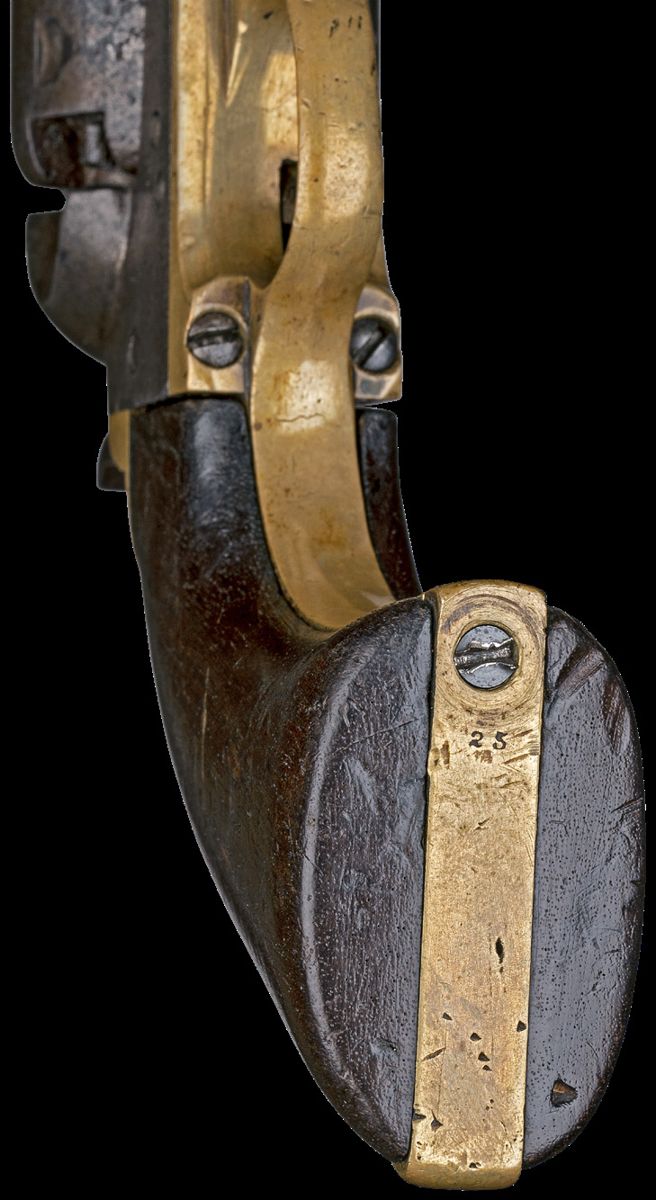
Leech & Rigdon SN 15
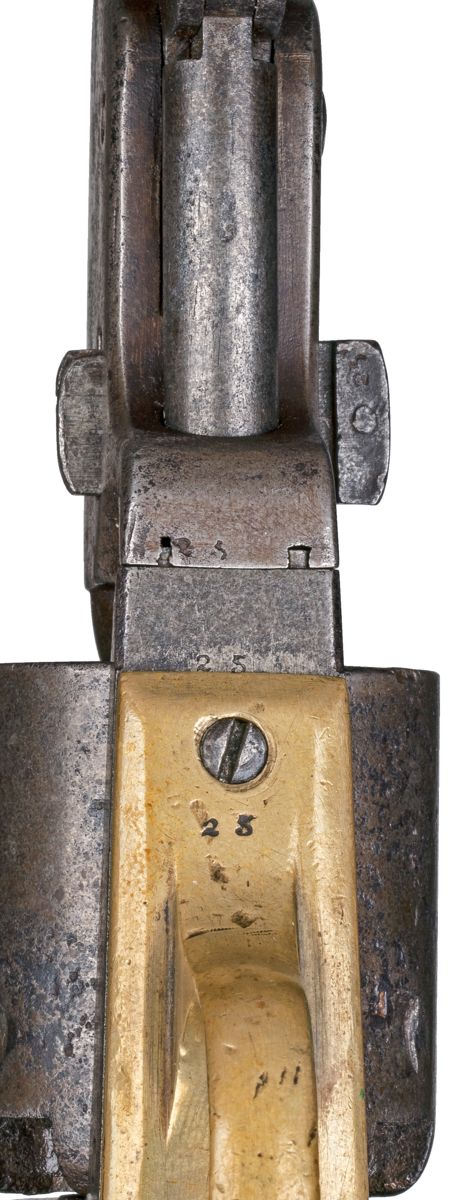
The “NOVELTY WORKS CSA” marking was dropped on the next surviving revolver, SN 25, which just has the small die “LEECH & RIGDON” mark.
SN 15 is found stamped into the bottom of the wood grips which is only noted on a small number of low numbered guns.
Leech & Rigdon SN 25
SN stamped on exterior edge of wedge and is only seen on early Leech & Rigdon revolvers.
Barrel housing worn exposing the two frame pins is observed on several Columbus, Miss., manufactured revolvers.
SN 25 earliest survivor with small “LEECH & RIGDON” barrel marking is heavily worn.
Small “LEECH & RIGDON” marking on SN 26/36.
Leech & Rigdon SN 26/36
SN 26, the barrel is SN 36.
Leech & Rigdon was learning to make a standard production revolver with these earliest survivors. Barrel lengths varied from about 7 ¼ to 7 5/8 inches. The barrel lengths became standard 7.5 inches after SN 60.
Leech & Rigdon SN 59
Ball type loading lever observed on first 300 unaltered revolvers.
SN 59 has the same small die barrel marking, consistent from this survivor forward, with standard dimensions.
Leech & Rigdon SN 59
SN 59 is the first survivor noted with an exact 7.5 inch barrel and has a better finish. All revolvers after SN 52 are well-finished through the end of Thomas Leech and Charles Rigdon’s partnership.
Leech & Rigdon SN 60
SN 60 sold at James D Julia Auction, Ben Michel collection, lot 1114, Fall 2007, for $25,875. (Morphy Auction Company)
SN 60 is fine early survivor with long collection history: Frank Ross Billingslea (1894-1967) Collection 1930’s Theodore Dexter catalog ~1942 William Locke Collection 1973
Leech & Rigdon SN 60
Forging flaw on the frame has been noted on several early survivors.
SN 60 has numbered grips and loading arm screw clearly stamped.
Leech & Rigdon SN 346
Ball-pin type latch was more sturdy than the ball type and is found until end of production. This type was first observed on unaltered guns starting at SN 305.
Thomas Ruddick was a private in the 28th Mississippi Cavalry, mustering out of N.B. Forrest’s cavalry in 1865.
This is the last surviving revolver documented using the original small die barrel marking. Government-contracted revolvers probably started in this serial range. SN 342 is the first revolver with external inspection proof “N” observed on almost every revolver till production ended.
From page 29 characteristics of manufacture and finish. These earliest guns are not “refined;” they show tool marks and inconsistent barrel lengths not seen after SN 52. These earliest examples demonstrate trial and error in perfecting a dependable arm. Early serial range Spiller & Burrs and Griswolds also show this same trial and error. Guns, starting with SN 59 through the end of production, have consistently “polished” metal surfaces no long showing external tool marks (lathe, file, etc.) till several transitional revolvers from L&R to R&A in the 950 serial range. Barrels are also 7 ½ inches with no real deviation. In these eight early revolvers, guns are characterized as shorter and longer barrels with lengths varying from 7-¼ to 7-⅝ inches. A mystery in L&R production is that there are no known surviving revolvers serial numbered from 156 to 305. What happened to all the guns in this serial range? All revolvers made before serial number 156 have the earliest ball-type latch. SN 305 is the earliest revolver with a ball pin, which continued in use until the end of the Leech & Rigdon contract, with the highest number known, 1461. SN 457 is the highest SN with large die “LEECH & RIGDON,” and without “CSA.” There are only seven survivors between SN 372-457; the next survivor, SN 496, has a “CSA” Stamp. Is it possible that the Confederate contract didn’t start until “CSA” was applied? Several theories may be proven later with more data. All large die L&R revolvers have inspection marks, so they are probably government-purchased. External inspection marks start at SN 346, the last small die barrel marked pistol; this may indicate the transition between Columbus and Greensboro production.
Memphis Daily Appeal published in Granada, Miss, Sept. 12, 1862, an ad for (Colt’s patent) Leech revolvers “Novelty Works.” The bottom Memphis Daily Appeal ad is dated Dec. 13, 1862. According to their ad they were manufacturing revolvers at a rate of thirty per week. It is unknown how many revolvers L&R sold before running these ads.
Leech & Rigdon SN 457
SN 457 saw hard use as do most Confederate manufactured/ purchased revolvers.
This particular gun is the highest known SN with the large “LEECH & RIGDON” barrel markings without “CSA” (“CSA” marked guns appear in the 496-1461 range). There are only six guns currently known with this early variant address, (377, 399, 422, 439, 450, and 457).
James D. Julia Auctions lot 4367, October 2016. (Morphy Auctions)
Leech & Rigdon SN 515
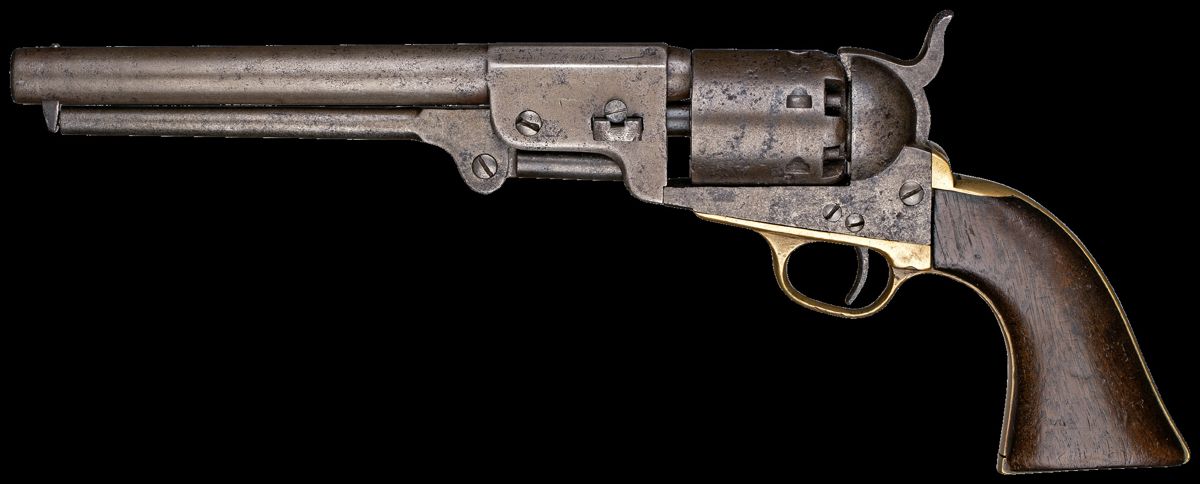
SN 515 was repaired with addition of Rigdon & Ansley 12-stop cylinder. SN 1482 is a transitional Leech & Rigdon made with Leech frame and 12-stop Rigdon, Ansley cylinder.
Leech & Rigdon SN 515
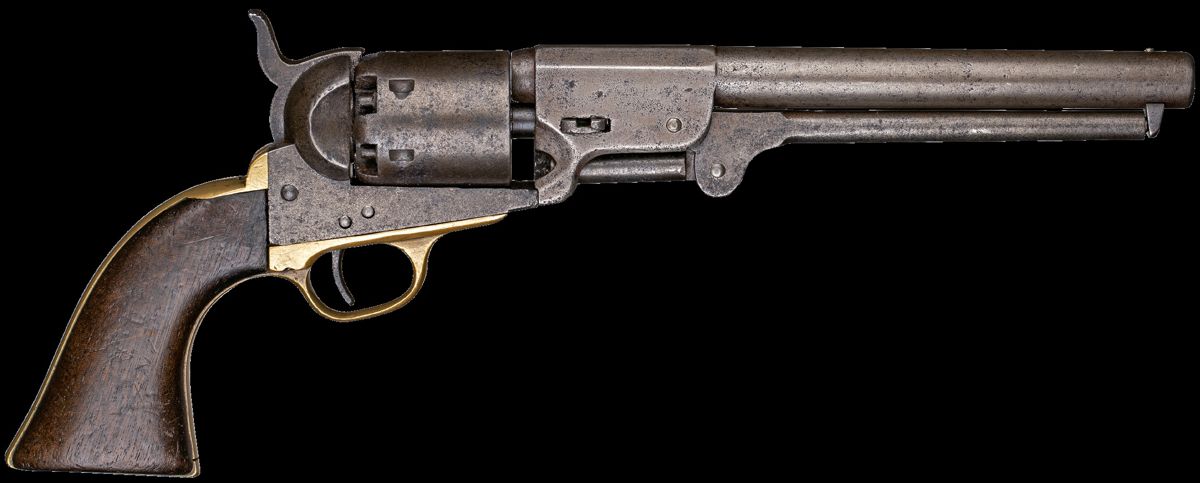
SN 515 is all matching L&R parts except cylinder. Distinctive 12-stop Rigdon, Ansley cylinder was among last made late 1864.
L&R SN 1482 also is found with Rigdon cylinder and is transitional revolver between patterns
Jim Eaton Collection.
Standard production Leech & Rigdon government contract revolvers range from about SN 500 to 1500. The first guns of the production run were made in Greensboro; the last were finished in Augusta, Ga. Barrel markings beginning at SN 472 through 1461 have large die “LEECH & RIGDON CSA.” Inspection stamps found on trigger guards include “D,” “J,” a cross made from four dots, an asterisk, “W,” and the most commonly observed, “N.” “S.C” is found on many revolvers in the SN 1000-1300 range. An inspector mark with a block letter “WH” in a diamond cartouche is found on some L&R revolvers starting as early as SN 1262 and continuing through the end of Rigdon & Ansley production, which have a script “WH.” A few have both “S.C” and “WH” inspection marks. “WH” is for Confederate assistant inspector Wescom Hudgins.
Cryptic inspection marks found on Leech & Rigdon revolvers.
WH inspector’s stamp on SN 1416.
SN 1262 with both “S.C” and “
Leech & Rigdon SN 605
SN 605 is one of three documented Leech & Rigdon revolvers captured on the CSS Tennessee. All three have the 4 dot inspector’s mark in the shape of a cross.
This is a standard model Leech & Rigdon revolver, part of the first L&R 1862 Confederate contract, made in 1863 at Greensboro, Ga. This is among the most iconic of all Confederate revolvers, being universally recognized by most Confederate collectors and scholars. In 1956 Herb Glass Sr. (1916–1970), among the most respected of early antique firearms experts, stated,
It is interesting to note Harrington’s mention of the CSS Atlanta is the only other vessel with a plaque marked pistol noting its capture (LeMat revolver SN 7).
That Leech & Rigdon #605 is, in my opinion, the finest Confederate pistol in existence. It came to me directly from the person who bought it from the Harrington family, and that family is still in existence in Yonkers, NY…Ensign Harrington wound up an admiral and is a nationally known naval hero.
The historic Battle of Mobile Bay took place on August 5, 1864. This was the last important defended Confederate port in the Gulf of Mexico east of the Mississippi River. Early in the war, the Confederates realized they could not protect all their ports and thus selected only the important ones to protect. To the Union, closing this port would be the last step in completing the blockade, for that reason it was especially important, just as it was equally important to the Confederates to defend it. Rear Admiral David G. Farragut led the attack, accompanied by an overwhelming force of naval vessels.
Ensign Purnell Frederick Harrington (1844–1937) was a lifelong navy man, graduating from Annapolis in September 1861 and seeing much service while advancing through the ranks. Harrington wrote a detailed letter to his brother after the Battle of Mobile Bay:
The Confederates had three forts on the bay, so not only was it imperative that the Union destroy the naval forces but also the forts. It was at this battle that Farragut is purported to have given the dramatic order, “Damn the torpedoes, full speed ahead!” The Confederate fleet
Altogether it was a desperate and plucky fight on both sides…So the honor of capturing the finest ram ever built and the finest ironclad ever built belongs almost exclusively to wooden ships. The presence of ironclads did some good I suppose. Immediately after the fight, I went on board the ram. She is like the Atlanta but twice as powerful. Her gun deck was flesh and gore. She threw some of her dead overboard in order to make it appear that she had few hurt.
was far outnumbered, and before the day was out, the only vessel left fighting was the ironclad CSS Tennessee. Despite this, the CSS Tennessee did not flee but engaged the entire Northern fleet. Because of her ironclad armor, she was able to inflict more injury than she received. Completely surrounded and fighting by herself, she was finally reduced to a motionless hulk. It was then, and only then that Admiral Buchanan finally surrendered.
Battle of Mobile Bay, published Dec. 13, 1886 by Louis Prang & Company. (Library of Congress)
Leech & Rigdon SN 605
This gun is in wonderful condition with a rarely seen silver presentation plaque finely engraved with its history “ENSIGN P. FRED. HARRINGTON / U.S. NAVY / U.S.S. MONONGAHELA / Mobile Bay, Alabama / Friday Aug. 5th 1864 / Captured with the Rebel Ironclad / TENNESSEE.”
Leech & Rigdon SN 605
CSS Tennessee in 1865 after her capture at the Battle of Mobile Bay. (NH60335)
Leech & Rigdon SN 899
This standard configuration L&R made at Greensboro, Ga., in 1863, was among the last delivered to the Confederate government NovemberDecember 1863. This is one of the last Leech & Rigdon revolvers with safety pins on the cylinder and a slotted hammer to accept pins. This Leech & Rigdon revolver was purchased directly from the Gilmor family about 1900 by pioneer Confederate collector, author, and historian Richard Steuart (1878–1951). Steuart had a commemorative inscription applied, “Col Harry Gilmor, 2nd MD Cav CSA,” and published this in Magazine of Antique Firearms, Vol. III, No. 1, December 1911.
Harry Gilmor was a famous Confederate commander who penned his memoir while held prisoner at Fort Warren in 1865. Four Years in the Saddle was a best-seller published by Harper, N.Y., in 1866.
This was one of only three Confederate revolvers displayed at the Metropolitan Museum of Art exhibit of Great Colt Revolvers in 1942 and pictured and described in Catalogue of Loan Exhibition of Percussion Colts 1836–1873, published 1942. The revolver was cleaned and burnished, which was the fashion of the Victorian era. (Poulin Antiques & Auctions, Inc.)
Leech & Rigdon SN 899
SN 899 on loading lever catch.
Lieutenant Colonel Harry W. Gilmor of Co. G, 7th Virginia Cavalry Regiment, Co. F, 12th Virginia Cavalry Regiment, and Co. F, 2nd Maryland Cavalry Battalion. (Library of Congress)
L&R stamp is one of the best barrel markings found.
SN’s barrel, frame, and trigger guard all stamped in same style as Colt.
SN stamped on loading arm flat.
N is the inspector’s mark most often found and is normally stamped on each side of the brass trigger guard.
Leech & Rigdon SN 961
No safety pins seen on Charles Rigdon Augusta assembled revolvers from about SN 925.
SN 961, assembled in Augusta by Charles Rigdon, completing L&R government contract, lathe turning marks found on these first revolvers assembled in Augusta.
Penciled SN in backstrap channel.
Front sight mortise drilled through barrel wall into rifling, characteristic to Leech & Rigdon.
Leech & Rigdon SN 961
Rebound in the maker’s mark is often observed in this serial range.
SN on loading arm flat, back strap, trigger guard, frame, barrel housing, and loading arm catch. SN 961 is all original and among the best surviving late 1863/early 1864 manufactured L&R revolvers. This period produced guns made without cylinder safety pins. Serial number 927 is the first example in the database, SN 920 is the highest number still having safety pins. Confederate assistant inspector Wescom Hudgins was made aware when he started his inspections that no safety system had replaced the slotted hammer for Colt-style cylinder safety pins. Hudgins was appointed Assistant Small Arms Inspector January 6, 1864. The lowest serial documented with “WH” inspection cartouche is 1262. The “W” inspection on the trigger guard was first observed on SN 1209, which is also thought to be his mark. SN 961 is an exceptionally fine example of a transitional Leech & Rigdon pistol made without safety pins or capping channel. The revolver has a great collector history, first noted by early Colt authority Jim Servin and later by renowned Confederate authority Bill Albaugh.
Payment for 117 “navy pistols” was delivered on January 4, 1864, at Augusta, Ga. This is the only known receipt for Leech & Rigdon revolvers. Note that $55 is the same rate paid to Griswold & Gunnison for pistols, signed by Military Store Keeper (MSK), Capt. Isadore P. Girardey and Col. George W. Rains, Augusta Arsenal. These revolvers are likely the last revolvers made with Thomas Leech still principal. (Serial numbers ~800-925). (NARA RG 109, Citizens File.)
Leech & Rigdon SN 1031
“S.C” stamp is still crisp under many small tacking marks. Many surviving black powder revolvers have similar nail head marks. Any relic hunter knows there are thousands of such nails found in every campsite. (W. Kerry Elliott Collection)
Leech & Rigdon SN 1031
SELECTED BIBLIOGRAPHY LEECH & RIGDON: Note the mis-transcribed “3” for “1” on the barrel housing and frame. Factory transcription errors are fairly common on Confederate and even Colt revolvers. This is the only error documented in Leech & Rigdon revolvers. This gun was made in early 1864 and was part of an apparent 300 gun contract for South Carolina. Revolver shows little wear with sharp edges and among the best markings of revolvers in the transitional time when Charles Rigdon, Rigdon & Ansley & Company were completing the final 500 revolvers of Leech & Rigdon contract. Leech & Rigdon ended their partnership in January 1864. Rigdon formed a new partnership with other partners known as Rigdon, Ansley & Company. Rigdon finished L&R’s government contract about May-June 1864, and then he started manufacturing his new revolver with distinctive 12-stop cylinders with a total production of about 900 guns. SN 1482 is a transitional revolver utilizing L&R frame with 12-stop cylinder and pin-ball loading assembly. The remaining surviving Rigdon Ansleys utilized a Colt-style loading lever latch. One other change was the addition of a capping channel groove cut into the right-side recoil shield. We will explore Rigdon & Ansley’s 1864–1865 production in the next issue.
• • • • • • • • • • •
Alabama Historical Quarterly, Vol. 40, No. 1-2, Spring and Summer 1978, pp. 17-19. Letter from P.F. Harrington to his brother. Albaugh, William A. III, & Steuart, Richard D. The Original Confederate Colt, the Story of the Leech & Rigdon and RigdonAnsley Revolvers, privately published, 1953. Albaugh, William A. III, Hugh Benet, Jr., and Edward N. Simmons, Confederate Handguns: Concerning the Guns The Men Who Made Them and the Times of Their Use, 1963. Anderson, Cecil W., “The Enterprising Mr. Thomas Leech,” North South Trader Magazine, July-August 1985: pp. 12-18. Gary, William A., Confederate Revolvers, 1987. Graves, Frank, “The Shawk & McLanahan Navy Revolver” Gun Report Magazine, Vol. 55, 2010. Graves, Frank, “The Shawk & McLanahan Navy Revolver” Arms Heritage Magazine, Vol. 3, 2013. Meredith, Edward “Ted,” “Variations of the Leech & Rigdon Revolver,” The American Society of Arms Collectors (ASAC) Bulletin #72, 1995. Sexton, John “Proprietary Database of Confederate Revolvers.” Steuart, Richard D., “Firearms of the Confederacy, 1861–1865,” Magazine of Antique Firearms, December 1911: Vol. III, No. 1. Wall, Kent “Leech and Rigdon Revisited,” ASAC Bulletin #103.
About the Author
John Sexton holds the highest designations as certified appraiser with International Society of Appraisers (ISA-CAPP) & accredited senior appraiser with American Society of Appraisers (ASA) specializing in Civil War memorabilia. He authenticates and evaluates other rare and valuable historic items as well. He is coauthor of the book Confederate Bowie Knives (2012) with Jack W. Melton Jr. and Josh Phillips, published by Mowbray Publishing Inc., and author of many periodical articles on Confederate arms. John’s contact information: website: www.civilwarappraiser.com, email civilwarappraiser@gmail.com, cell 770-329-4984.