
Buffalo City Guards Rolling Block
By John Estok · Originally published July-August 2024 · pp. 3–12
Following their December 4, 1837, loss to the Canadian militia at Montgomery’s Tavern the Upper Canadian rebels retreated southward to Navy Island (Canadian territory) located in the Niagara River 4.5 miles upstream from the falls. Approximately 300 rebels were opposed by 2,000 plus Canadian militiamen on the mainland. By the end of December, a rental agreement was reached between the rebels and a Buffalo businessman and sympathizer for the use of the steamship Caroline. On December 28, the Caroline steamed to Navy Island to offload men, arms, food, and miscellaneous supplies. At midnight on December 29, a small group of Canadian soldiers led by a Royal Navy veteran crossed the Niagara to the island in small boats to neutralize the Caroline. To their chagrin, they found the ship was moored at Fort Schlosser on the American mainland. Undeterred, the small force crossed into American territory, overwhelmed the crew, and relocated them ashore. The Caroline was freed from her moorings and set ablaze with its burning remnants plummeting over the falls. Unfortunately, a man by the name of Amos Durfee, was found dead at dockside with a gunshot wound to the head. In those inflammatory times, years removed from the War of 1812, the local press labeled this as an attack on American s o v e re i g n t y, which resulted in the deaths of dozens of American citizens.
designated the Buffalo City Guard. As for the rebels, they were pummeled by Canadian artillery and forced to withdraw to the American mainland.1 During the 4th of July 1838 celebration, the Buffalo City Guard hosted the Brady Guards of Detroit, who were accompanied by the Boston Brass Band and their famed conductor Ned Kendall. One year later, the Brady Guards returned the favor, and the Buffalo City Guard requested that Francis (Frank) Johnson’s Philadelphia Brass Band travel with them to Detroit.
American r e a c t i o n was swift. Tw e n t y - f o u r hours after an emergency proclamation, Lester S. Levy Sheet Music Collection, five companies John Hopkins University. of twenty men each volunteered for duty. The unit was accepted by the Mayor of Their arrival was described as Buffalo on December 30, 1837, and follows: “At a prearranged signal, Francis Johnson lifted his hand and gave the down beat as the boat docked. The Buffalo City Guards (according to the Detroit Free Press, in full regalia) then began to disembark “in military precision to the tune of ‘Yankee Doodle’ with variations” and a composition immortalizing Buffalo’s hero, Gen. Winfield Scott, which we believe Johnson had composed for the occasion and entitled “General Scott’s Keyed Bugle Slow March.” Then, with “thrilling and powerful combinations blaring forth,” Johnson and his Brass Band came ashore.” Following a number of concerts and a ball, the Brass Band and Buffalo City Guard departed for Cleveland on July 6 where Johnson and his band provided another concert.2
Burning of the Caroline, Oil, Nicolino Calyo, 1847. (Amon Carter Museum of American Art)

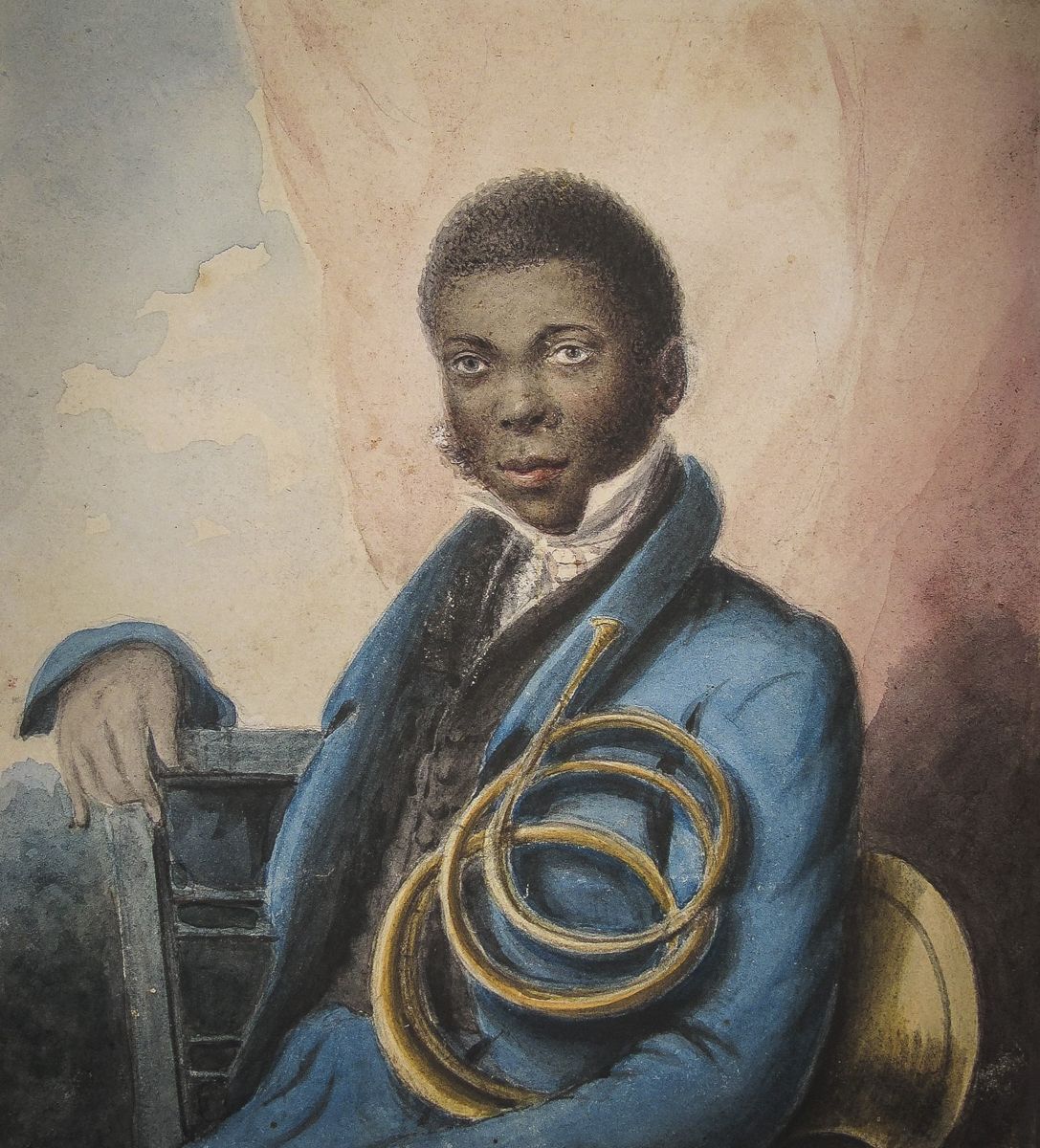
Francis Johnson was a celebrated composer who was the first black American to publish sheet music for sale in the United States. Johnson performed three additional concerts at Buffalo before his passing in 1844.
Watercolor, assumed to be Francis Johnson, artist unknown. (Joseph Muller Collection, NYPL)
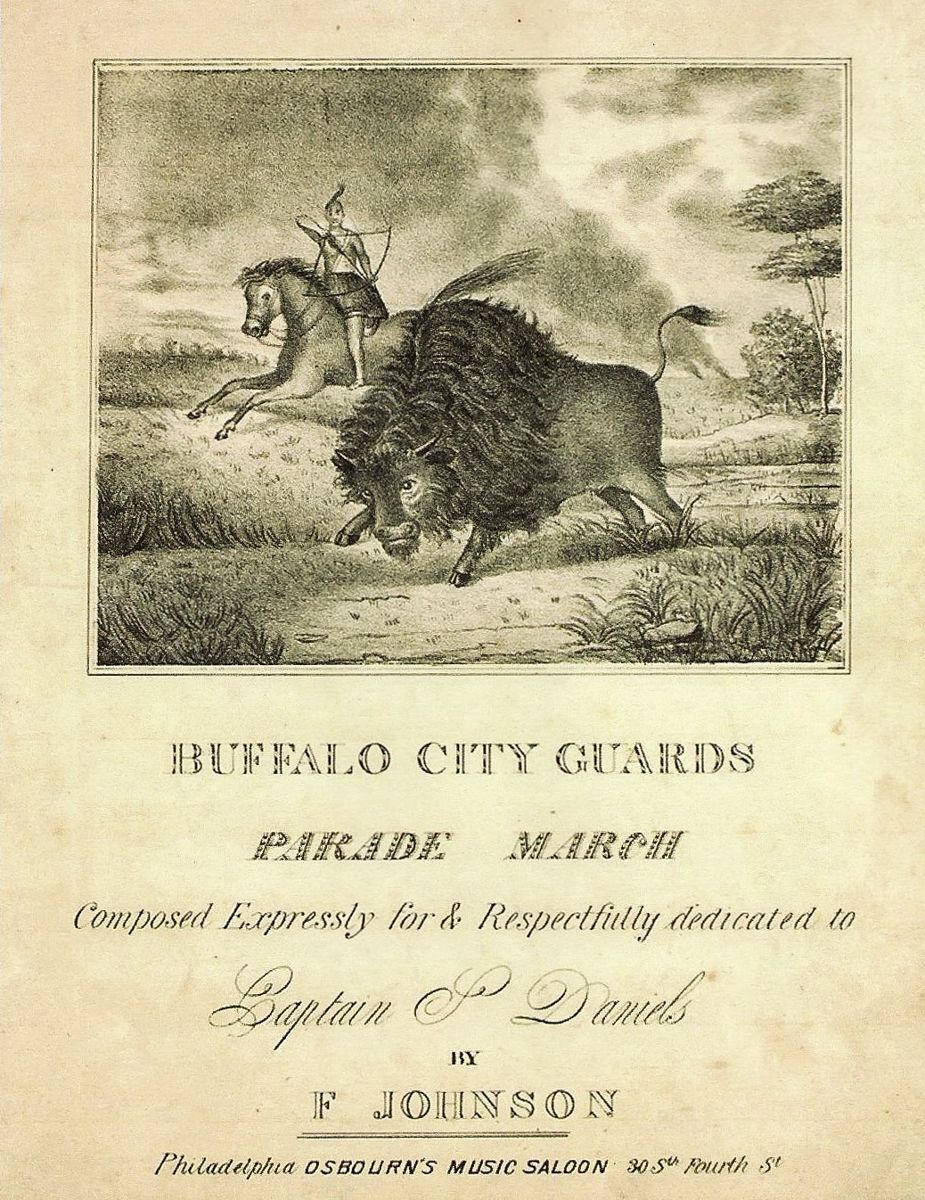
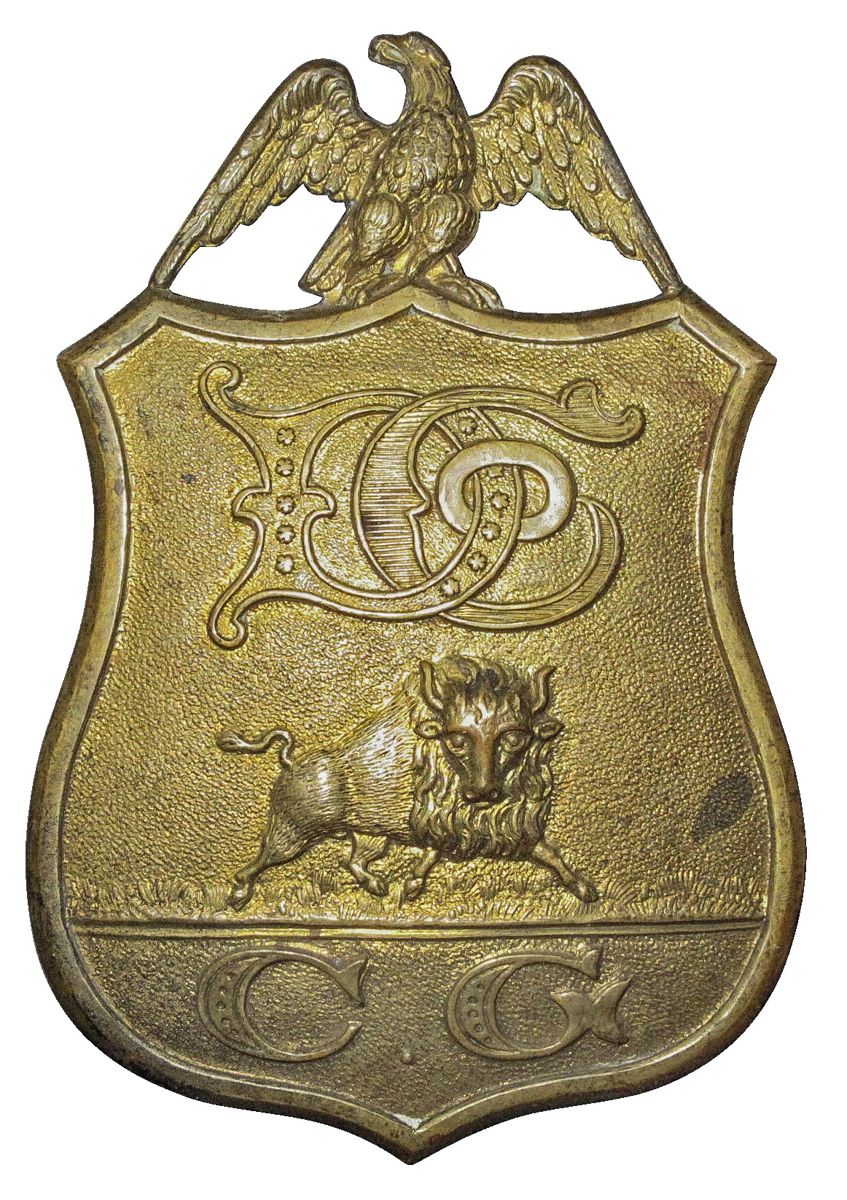
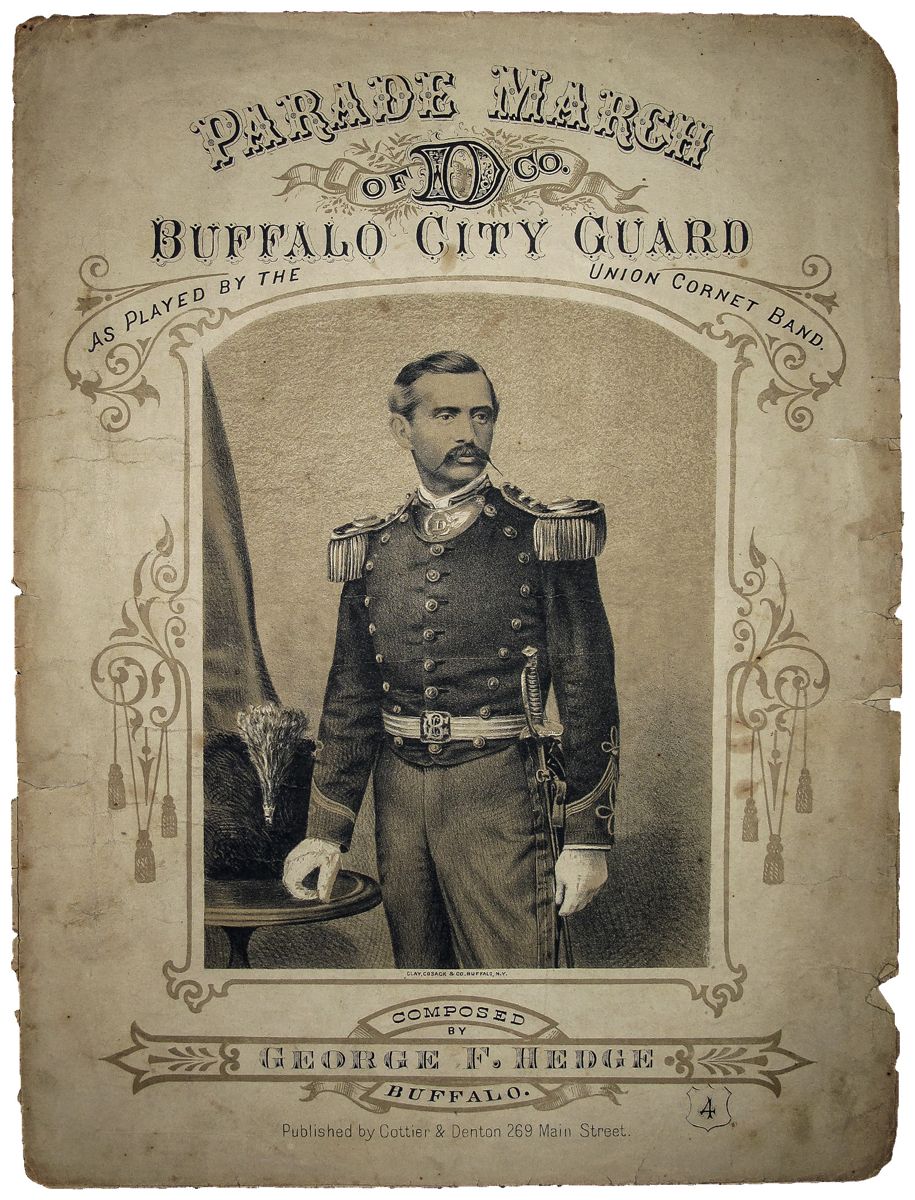
Early Company D Buffalo City Guard Crossbelt Plate. (Author’s Collection and photo) It is surmised that in appreciation, he composed the “Buffalo City Guards Parade March” dedicated to Capt. L. Daniels.3 In 1839, the upper Canadian rebellion was ending, and by 1842 an agreement had been reached between the United States and Great Britain that reduced the animosity that resulted from the “Caroline Affair.”4 In the years that followed, public interest waned to the point that only one Buffalo City Guard company remained, Co. D. By the 1870s, when the New York National Guard was reorganized, Co. D elected not to become a national guard unit but instead continued as a military society. By the 1880s, it was under the command of Adrian Root, a veteran Union army officer.
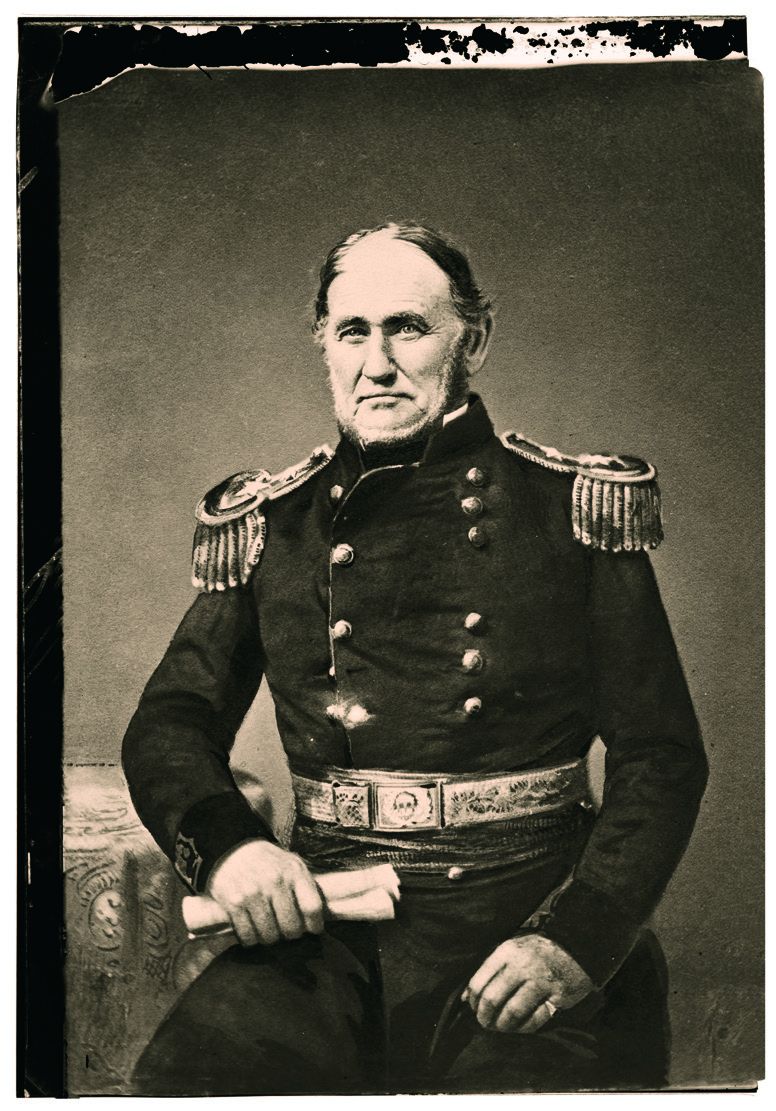
Sheet Music Cover, General Adrian Root. (Author’s Collection and photo)
Root was appointed a lieutenant colonel of the 1st Buffalo Regiment (21st New York Volunteers) in 1861, and commissioned colonel of the 94th New York Volunteer Infantry Regiment in 1862. He was commander of the 94th at Cedar Mountain, Second Bull Run, Fredericksburg, and Chancellorsville. On July 1, 1863, he was in command of the 94th Regt. as well as the 1st Brigade, 2nd Division, I Corps. Wounded and captured during the action, Colonel Root and 150 men of his regiment were personally paroled
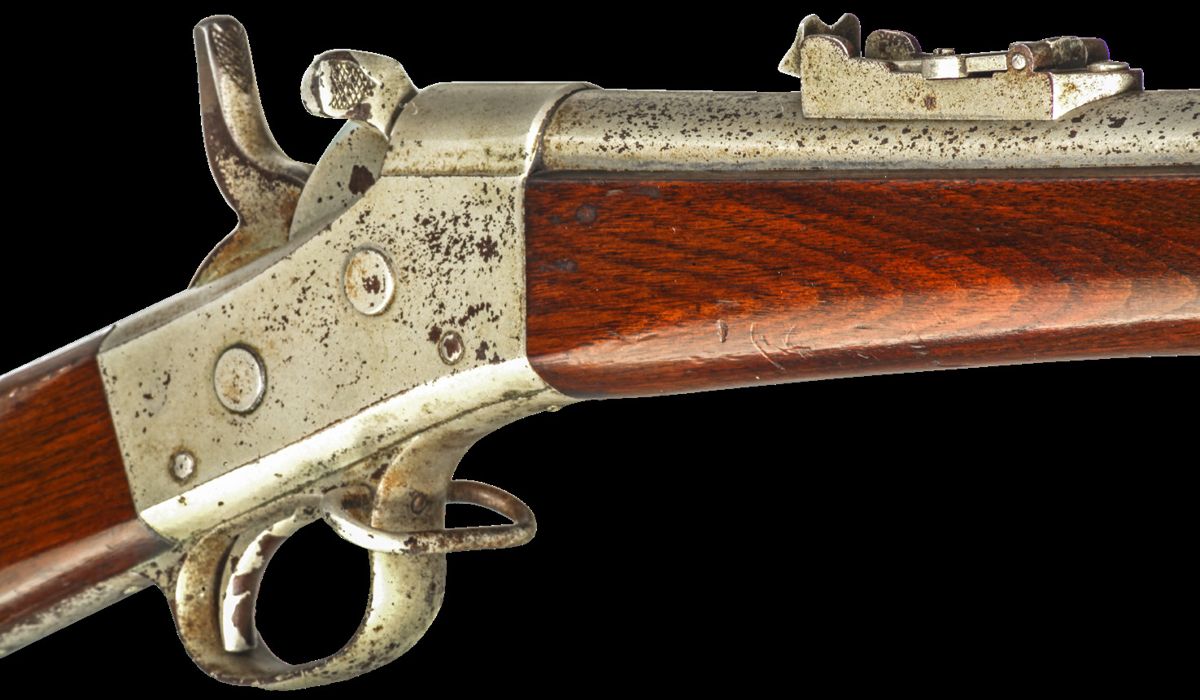
Breech, right side.
Buffalo City Guard rifle, right side.
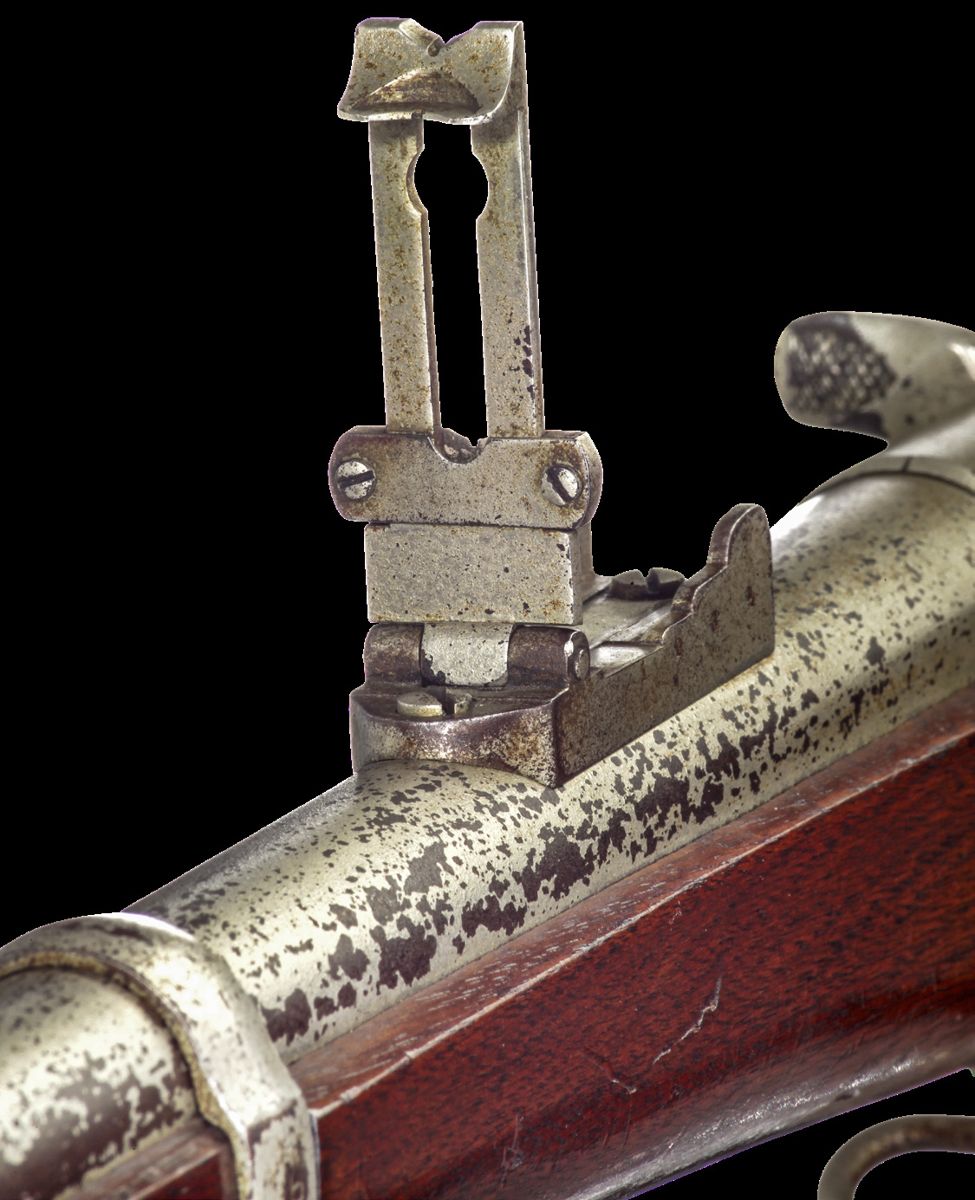
Rear sight, left side.
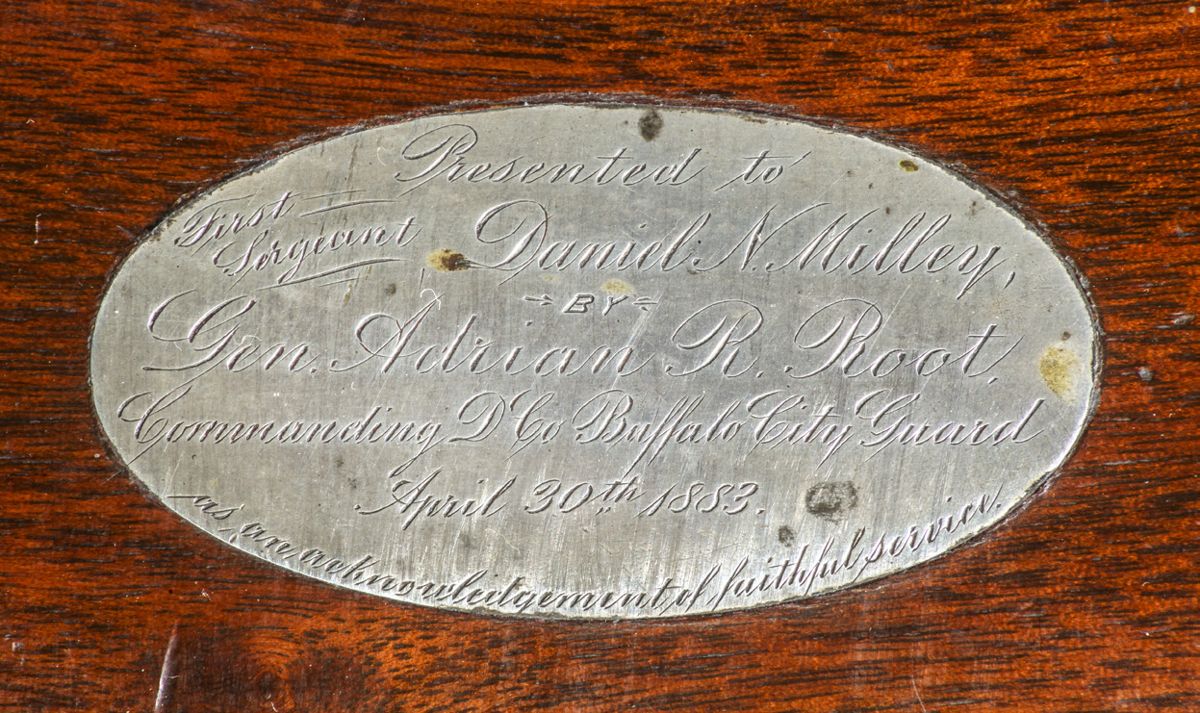
Presentation plate, left side.
Presentation plate, right side.
by Confederate General A.P. Hill to attend to wounded combatants.5 Brevetted a brigadier general in 1865 and a major general of volunteers in 1866, Root returned to Buffalo as a warehouse executive and newspaper editor.6 On April 30, 1883, the subject of this article was presented as reported in this quote from the Buffalo Courier May 1, 1883:
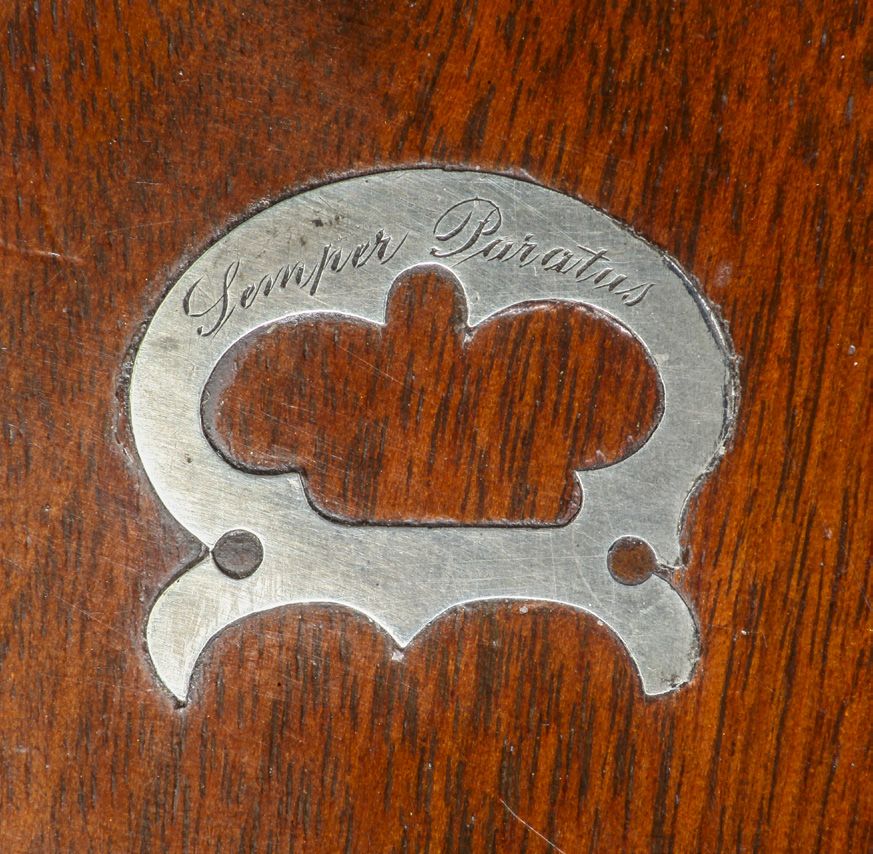
An Elegant Gift The members of D company, Buffalo City guard, had a very pleasant time last evening over a presentation incident, which, to the consternation of the worthy recipient, began in an assumed reprimand and finally ended in his infinite gratification. General Root, commanding D company, some time since authorized the firm of E. Remington & Sons to produce a model rifle to embrace all known improvements as a sample arm for the use of D company. The rifle was received a few days since, and was placed in the hands of Salem LeValley, the well-known gunsmith, for decorative and artistic finish. The wood work was carefully rubbed and polished by hand, the metallic portions nickel plated by the dental manufacturing company and appropriate lettering was executed by Brinkworth. Last evening General Root, with appropriate remarks, presented the rifle to First Sergeant Daniel N. Milley, who has creditably filled a number of positions in the corps and during a service of three years has not missed a drill or weekly meeting. The rifle is of 45-government calibre, weighs nine pounds and two ounces, has a buck horn sight and wind gauge, is gauged up to one thousand yards and is pronounced by Robert Newell [authors note; see medallion photograph] the finest military rifle he has seen. Upon one side of the stock is the letter D in silver, bearing the inscribed motto of the corps, “Semper Paratus” (Always Prepared). Upon the other side is a large silver plate with the following inscription: “Presented to First Sergeant Daniel N. Milley by Gen. Adrian R. Root. Commanding D Co., Buffalo City Guard, April 30th, 1883, in acknowledgment of faithful service.” The members of D company were so well pleased with the rifle that they authorized General Root to order fifty similar rifles for the corps, to be completed for use at parade on the approaching Decoration Day.7
Right side of barrel presentation rifle.
Butt plate.
Buffalo City Guard rifle, left side.
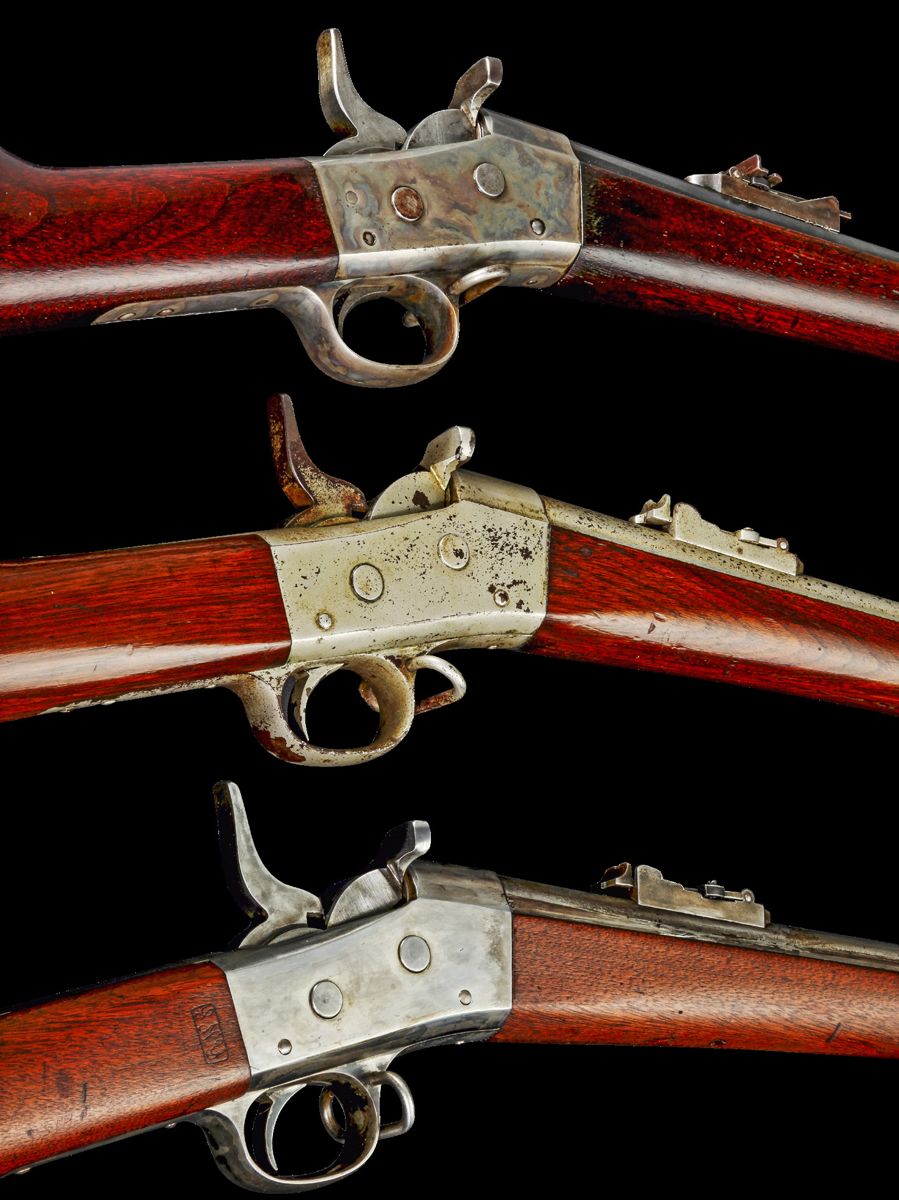
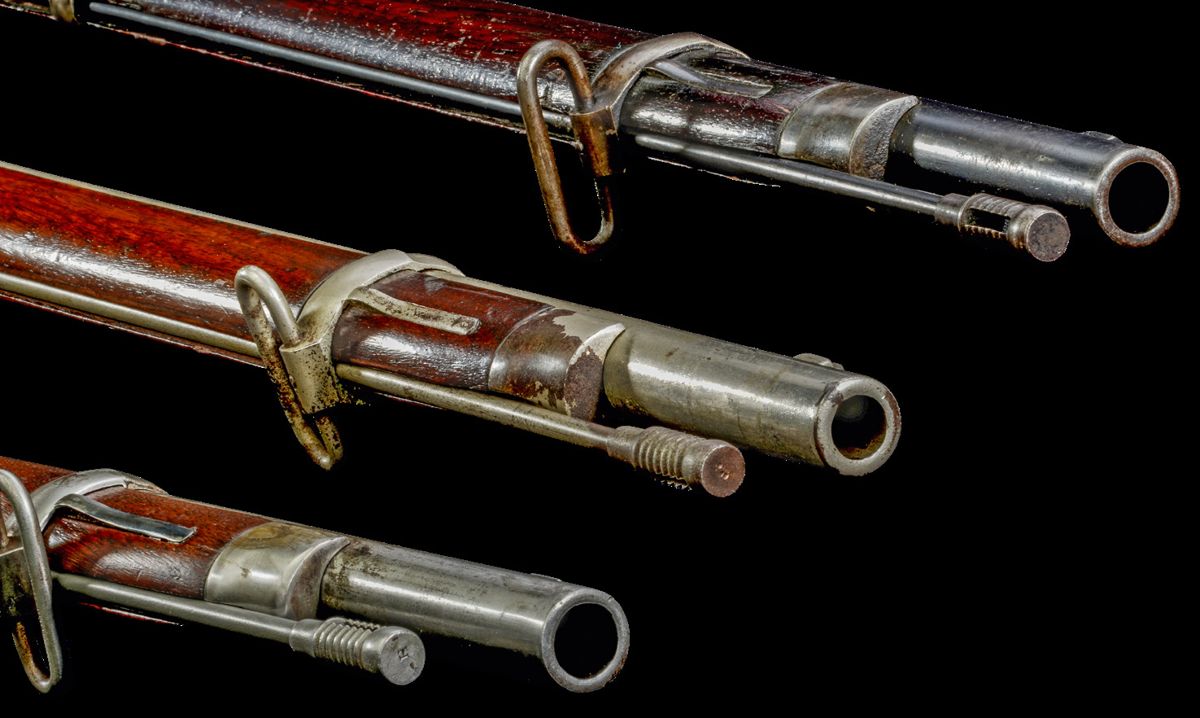
Top: Competition rifle in 50-70. Center: Buffalo City Guard presentation rifle .4570. Bottom: New York State contract rifle .50-70.
As can be seen from the photographs, the passage of 140 years has been kind to this rifle; although the nickel plating is oxidized and frosty, approximately seventy percent remains. The wood still maintains its polish and the bore is excellent. It is made to the same pattern as the New York State National Guard service rifle with one difference: it is chambered for the .4570 cartridge rather than the .50-70 used in the National Guard version. It has the “locking action”8 common to the Remington-Springfield Model 1871 rifle and the New York contract rifle, however, its hammer spur is .25-inch shorter than the first (1871) and second (1873) New York contract rifles. This shorter hammer is common to the 1871 Remington-Springfield rifle and appears on some private purchase New York pattern competition rifles, indicating possible post 1873 manufacturing.9 The “E. Remington & Sons” breech tang stamping is also present. Milley had moved to Buffalo in 1870 and was employed by the leather firm of A. Rumsey & Co. By the late 1880s, he had succeeded Root as commander of Co. D, a position he held until leaving the area in 1894. As an avocation, he was a “wheelman” who competed in the period’s bicycle racing circuit for prize money. He was a member of the Buffalo Bicycle Club and won the city
Top: competition-grade rifle. Center: Buffalo City Guard presentation rifle. Bottom: New York State contract rifle.
94th Regiment New York Infantry Monument, Oak Ridge, Gettysburg.
championship for three consecutive years. He passed away at his home in Beaufort, S.C., in 1931.10 In the 1890s, Scottish immigrants, veterans of the 92nd Regiment of Foot and members of the Buffalo St. Andrews Society Pipes & Drums combined with “D” Company to form the “D” Company Buffalo City Guard Gordan Highlanders. This ensured that the City Guard’s legacy would be maintained until the present day. “D Company” marches on as an acclaimed pipe and drum organization well known in the City of Buffalo and western New York State.
Buffalo Bicycle Club with Penny Farthings, 1887. One of 95 Clubs in the Buffalo area. (Buffalo History Museum)
Left, a .50-70 and a .45-70 cartridge, right. (Authors Collection and photo)
Front, left, of 3.5-inch silver medal presented to Robert Newell; June 4, 1863; by the Citizens of Buffalo. Newell was an Admired Sportsman from Buffalo. (Author’s Collection and photo)
Current drum head emblem of Company D.
Salem Levalley’s Shop, 189 Main St. Buffalo. (Western New York Heritage magazine, pictorial)
A special thank you to B.J. Pino, Bandmaster (retired) Wildcat Regiment Band, for providing insight and material sources regarding Francis Johnson. Sources and Endnotes: 1. 2. 3.
Rea, J.E., Morton, Desmond; “Caroline Affair,” The Canadian Encyclopedia, 2/6/2006. Jones, Charles K., Chronicle of a Black Musician in Early NineteenthCentury Philadelphia; American University Press, 2006. La Brew, Arthur R.; Captain Francis Johnson (1792–1844), Great American Black Bandsman: Life and Works in 2 Volumes, Volume 1, 1994. As per the era, apparently there was some reservation on the part of the Buffalo City Guard’s regarding their engagement of Francis Johnson as hinted by this letter to Lieut. Kearsley, Brady Guards, cited below. Lieut. E. R. Kearsly, Dear Sir: As a detachment of the City Guards will visit Detroit on the approaching 4th, I am requested by Capt. Daniels to write to you concerning the music which we have engaged. It is Frank Johnson’s Band from Philada, being Coloured Gentlemen. It has
Brinkworth engraving, period advertisement.
been thought that your Corps would not like their appearance but as the Band is the best in the Country we shall come with them and have no doubt but we shall visit with as warm a reception as we should with white music. Please write by return mail what your opinion is. Respectfully yours Thos., G. Perkins vigorously shelling us from a wooded elevation beyond. At that moment an aid came up and informed me that I was in command of the Brigade, General Paul having been wounded, I hesitated no longer, but gave the order to the 94th to charge. The gallant fellows sprang over the fence with a cheer, charged across the field in the face of a heavy fire, and occupied the desired position, from which they opened a heavy fire upon the enemy’s battery. I then went to General Robinson, reported my action, and asked for orders. General R. thought it hardly desirable to attempt to carry the enemy’s position, and directed me to recall my men to their original position. Riding to the front, I ordered the regiment back, and was turning my horse, when a shell exploded directly over me, and so near to me as to completely stun me. One fragment tore my cap from my head, and my entire system was so shocked and prostrated that I was unable to keep my seat in the saddle. I accordingly rolled off, in a bewildered frame of mind-and my share in the battle had ended. Two of my men carried me to the rear and drenched me with water. Meantime the enemy pressing the corps in a superior force, succeeded in flanking it on both sides, and forced it to retreat in haste through Gettysburg, to a hill beyond. In passing through Gettysburg, the enemy headed off a portion of the corps, and captured a large number of prisoners, among whom were nearly two hundred of my regiment. While all this was transpiring, I remained helpless and semi-conscious on the field, and was taken possession of by some exultant rebels.
This quote from a publication by La Brew offers some perspective regarding the above correspondence: Frank’s appearance in Detroit and his wonderful deportment lessened tensions for blacks who, since the riot of 1833, had been hesitant in expressing themselves in public events. While other black communities had been celebrating the Emancipation exercises in public demonstrations since 1834, Detroit probably had quasi-private exercise ceremonies with no press notices (it was still a territory not a state in 1834). Thus, its emancipation services of the abolition of slavery in the West Indies were publicly given for the first time in 1839 by black citizens and Johnson’s appearance may have played a positive role in its advent. 4. 5.
Rea, J.E., Morton, Desmond; “Caroline Affair,” The Canadian Encyclopedia, 2/6/2006. 94th New York Infantry Regiment’s Civil War Newspaper Clippings, New York State Museum and Research Center. This quote is from a portion of Colonel Root’s letter to the editors Commercial Advertiser on July 14, 1863, describing this action, General Reynold the Corps Commander having been killed early in the action. Our Division passed on to the left of Gettysburg, and advanced to Wadsworth’s support, the First Brigade forming line of battle upon a wooded ridge, and, by direction General Paul, throwing up hastily constructed breast works of fence rails, &c. These were scarcely completed before we were ordered to move to the right, and having moved about 500 yards, found ourselves under a heavy fire of musketry and artillery. In order to see the enemy, I advanced the 94th in line through the grove to a rail fence, towards which the enemy’s line was advancing through a wheat field. My regiment opened a heavy fire upon the enemy’s line which, soon wavered then broke and hastily retreated. I deemed the moment a proper one for advancing across the wheat field to another fence, whence I hoped to silence, and if possible, capture a battery which was
Eicher, John H., and David J. Eicher, Civil War High Commands: Stanford University Press, 2001. 7. Buffalo Courier, “An Elegant Gift,” Tuesday, May 1, 1883. 8. “Locking action” Upon chambering a cartridge, the hammer moves forward into a non-functioning position, thus preventing the chance of an accidental discharge. The hammer then needs to be pulled rearward to be in battery. 9. George Layman, Remington Rolling Block Military Rifles of the World, Andrew Mowbray Publishers, 2010. Layman states, “… an estimated 170 otherwise conventional New York Rolling Blocks were supplied in .45-70 to the City Guard of Buffalo, New York.” The cited purchase date of 1877 and the amount ordered may be questioned given the presentation date of 1883 for this inaugural rifle and the authorized purchase of 50 additional rifles as expressed in this article. 10. Buffalo Courier-Express, Saturday, February 7, 1931. 6.
About the Author John E. Estok, BA, MPH, DMD, is a retired dentist and a forty-plus-year member of the North-South Skirmish Association. He is an avid collector of 19th-century militaria and an amateur historian.