
Joseph Needham’s Submission #2 – 1867 British Ordnance Trials
By Tim Prince · Originally published March-April 2024 · pp. 40–56
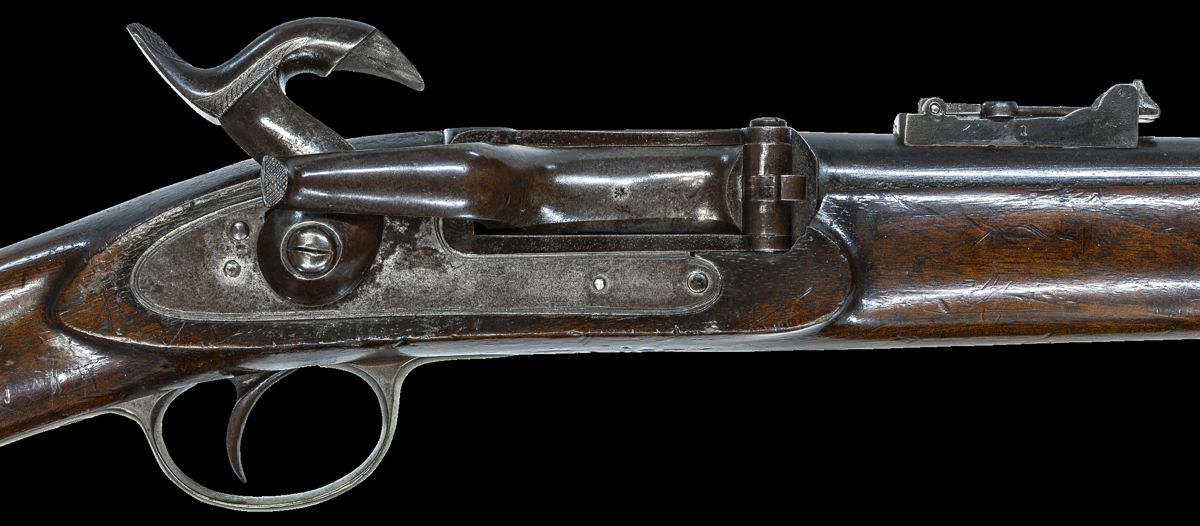
Joseph Needham’s Submission #2
from the 1867 British Ordnance Trials By Tim Prince
In 1867, the British Military’s Ordnance Select Committee held Breechloading Rifle Trials, which are known more colloquially to students of British military arms as the “Prize Competition.” The War Office had established this set of trials for the specific goal of determining the best possible breechloading rifle design to take into service. The prior year, the SniderEnfield system had been adopted as the best method by which existing stocks of muzzleloading Enfield rifles and rifle muskets could be altered to cartridge breechloaders, but it was not clear to the War Department that the Snider system was the best system to adopt for “purpose-built” breechloading rifles. As a result, new trials were ordered. Based upon an examination of the historical record and the features of the extant arm pictured and described in this article, it is my belief that this is rifle Sample #2 submitted by Joseph Needham for the 1867 trials. To understand these trials more fully, it is first necessary to understand the genesis of the trials that preceded them and the thinking within the British War Office as the War Department looked at the feasibility and advisability of adopting a breechloading firearm for general issue. In 1864 the British military decided in principle that it would be necessary to adopt a breechloading rifle for infantry use to remain on par with other military powers around the world. The Prussians had adopted the Dreyse designed Zündnadelgewehr (Needle Gun) in 1841 and some two decades later were already issuing the 2nd generation of that groundbreaking breechloading, bolt action rifle, the Model 1862. In America, breechloading firearms using self-contained metallic cartridges were seeing use in the American Civil War, some of which were also repeating firearms, including the Henry rifle and Spencer rifles and carbines. The British Ordnance Select Committee on Breechloading Small Arms studied the subject of breechloading arms for general issue from 1859 to 1864 and summed up their conclusions on July 11, 1864, with the following statement:
competing designs, as well as numerous lesser tests of specific features and involved ammunition development as well. Most of that complicated story is outside the scope of this article, but it is worth noting that the British military sought to find the “most perfect arm” from a selection of relatively new designs rather than relying on designs already adopted by other powers. The reason for this was that the British felt that no breechloading designs currently adopted were satisfactory for one of two reasons: either the system leaked gas, which was objectionable to those in command and shooting the weapon, or the system did not utilize ammunition considered powerful enough for use as a line infantry rifle. Examples of the first issue were the Prussian Needle rifle and the American Sharps, as both leaked gas from the breech when fired and did not provide any form of positive gas seal. Even the French Chassepot design, which included a rubber obturator to solve the Dreyse needle gun’s gas leakage issue, was not considered a viable option as the rubber gasket failed after repeated firing and had to be replaced, sometimes as often as every thirty rounds. In the case of the second objection, self-contained metallic cartridges like those used with the American Henry and Spencer rifle designs solved the problem of gas leakage as the cartridge casing provided the gas seal, but these cartridges were not considered powerful enough for British military service. The committee clearly wanted a design that was capable of solving both the gas sealing issues and could provide downrange stopping power equivalent to the current issue muzzleloading Pattern 1853 Enfield rifle musket. They also preferred a self-contained cartridge design, rather than one that relied upon external ignition, like many of the “capping breechloader” designs that proliferated in Great Britain and America during the mid-19th century.
With that statement, the beginning of the developmental and testing process that would result in the adoption of the British Snider-Enfield rifle began.
Early, somewhat informal, experimentation by the committee during 1860 and 1861 found that many currently available designs and potential designs were problematic. Two systems that were examined were those by Wilson and Montgomery Storm. The Wilson design, while elegant and simple to operate, was hampered by the fact that it was a capping breechloader and had accuracy issues resulting from the greased wad at the base of the bullet that served to create a gas seal in the chamber. After the first round was fired, this wad was left behind in the breech and, if it were not removed, was subsequently fired out the bore on the next shot, on the nose of the next bullet. This led to erratic accuracy. The Mont-Storm system was also an externally primed capping breechloader, and while the design offered the potential for use as a means of altering muzzleloaders to breechloaders, it too was hampered by less than stellar accuracy. Of the various early tests, only the design submitted by Jacob Snider was considered truly promising.
The journey was fraught with numerous trials and tribulations and involved two major test evaluations of
To discover what design would be the best to start the alteration of existing muzzleloading Enfield rifles and rifle
“The committee, composed of practical officers, unanimously report in favour of arming the infantry with breech loading rifles. The question must be dealt with in two ways – either by ascertaining the speediest and cheapest mode or by determining the most perfect arm to be used by the infantry. We must first adopt the readiest means for converting existing arms of service. Having thus armed the troops, we should proceed to enquire fully and deliberately what form of rifle would be most perfect.”
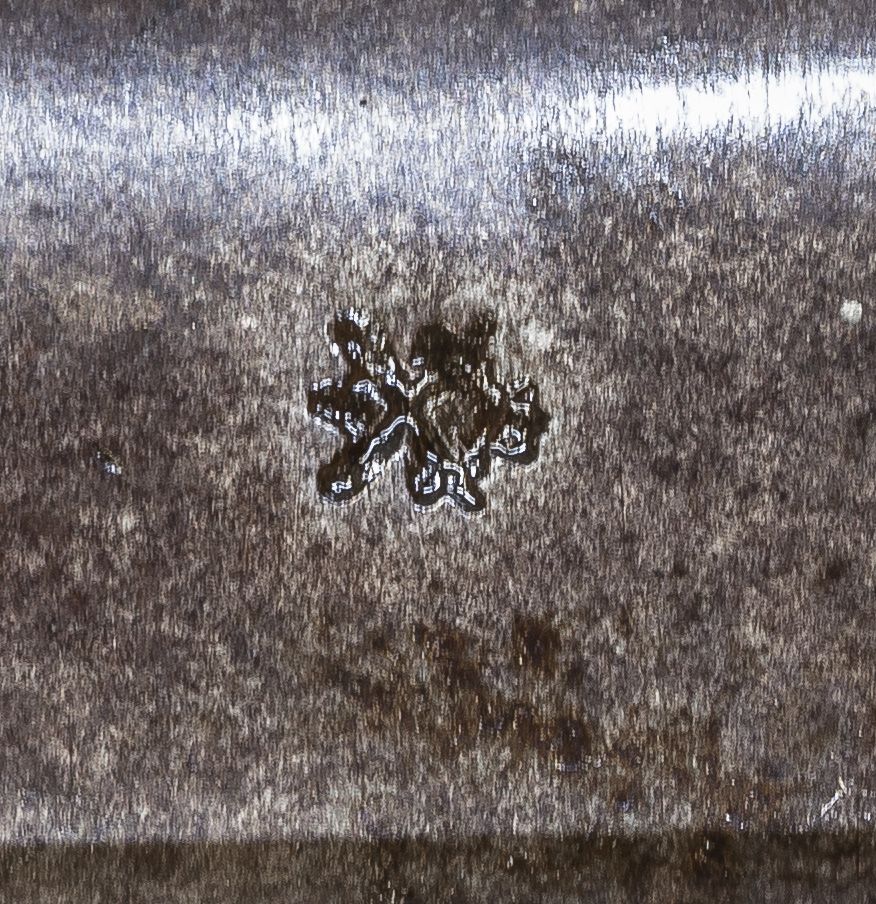
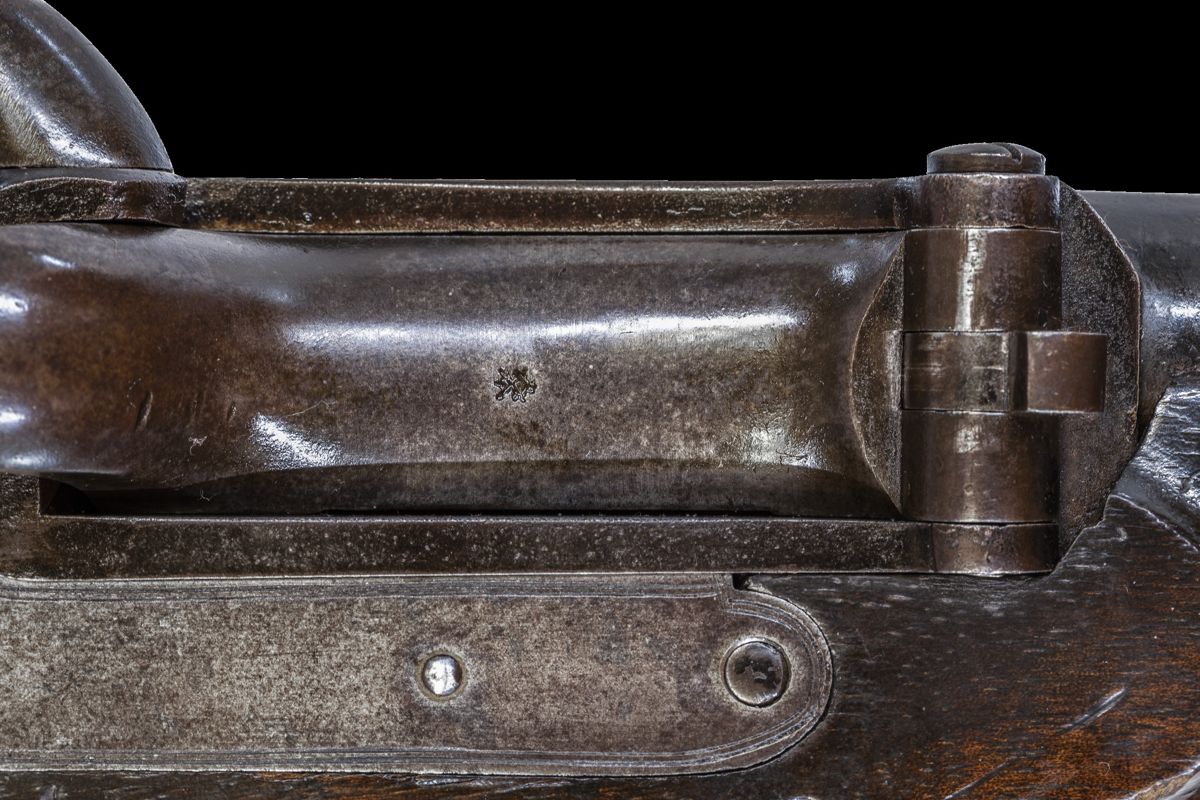
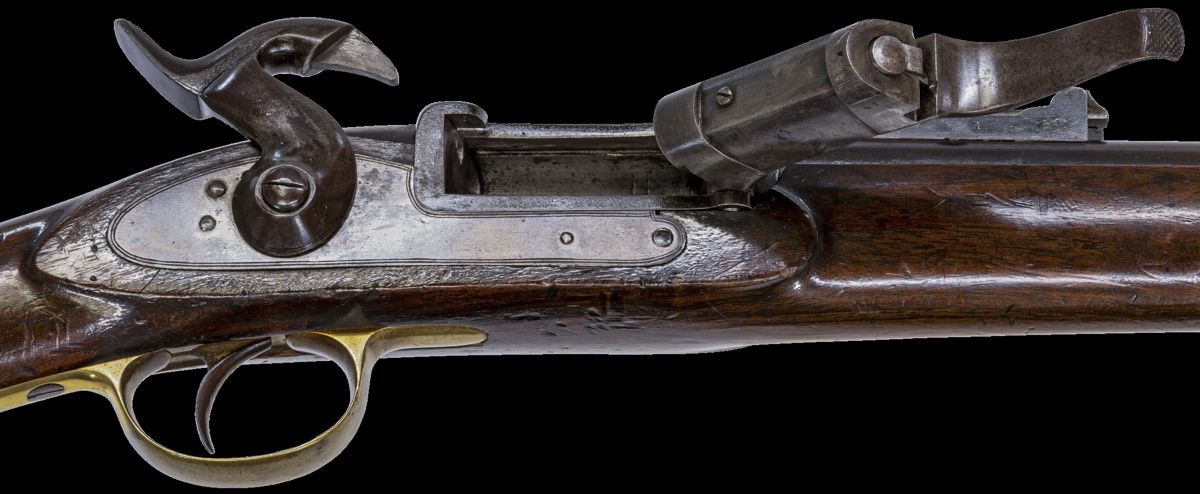
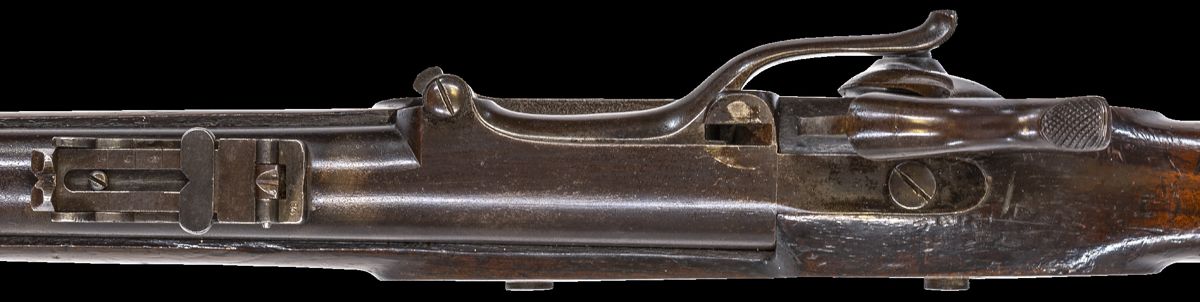
Views of the lock of Needham Submission #2. Note the single Birmingham commercial proof on the breech block door (right). Note also that the sidewalls of the rear sight have been modified to adapt the sight to the ballistics of the .577 Snider cartridge.
muskets to breechloaders, the Secretary of War released a request for trial submissions on August 23, 1864. The request read in part that the War Department sought to “receive communications from gun-makers and others on the subject of the best means of converting the Enfield rifle into a breech-loader.” There were two primary criteria for all designs that were to be submitted, first that the altered firearms “should not be inferior to that of an unaltered arm when shooting” and that the per unit alteration price should “not exceed the cost of £1” Sterling per firearm. To motivate the best and brightest innovators in the field of firearms designs, the winning submission would be awarded the sum of £5,000 for the use of the design, essentially a flat rate royalty payment. The potential to win the large cash award resulted in 43 firearms designs being submitted by the end of September, with a final total of 47 designs submitted by mid-October. A preliminary inspection of the designs and concepts resulted in more than half the submissions being rejected out of hand with no actual testing. A total of nine were selected for full testing and eleven more were designated for “reconsideration” which meant they were analyzed for potential design ideas and improvements to current designs but were not being considered as part of the actual trials. The nine designs that were immediately selected for testing were those submitted by Dixon, Montgomery Storm (Mont Storm), Shepards (a), Westley Richards,
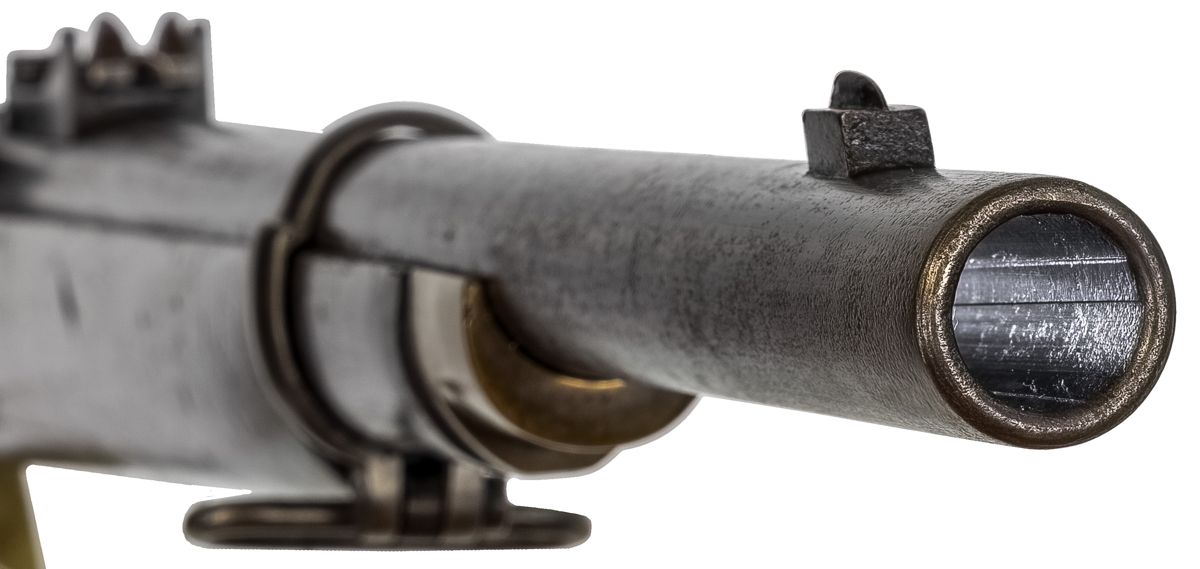
Muzzle of the Needham trials rifle, showing the rifling and Enfield pattern combination front sight and socket bayonet lug.
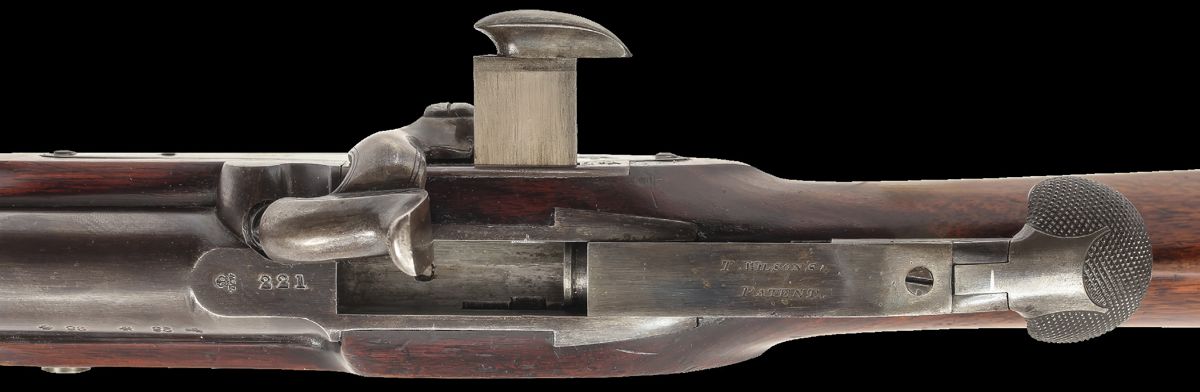
Needham Submission #2 with the action open.
Wilson, Green, Snider, Joslyn, and Shepards (b). Dixon withdrew his design before testing commenced, so the field was reduced to eight possibilities. Of those, the first five designs were “capping breechloaders” and as such the committee was biased against them, preferring a selfcontained metallic cartridge to a percussion ignited one. Of those three designs, the following notes were made: •
#6 Snider’s – New system. Very simple conversion that dispenses with percussion caps.
•
#7 Joslyn’s – First noted in 1861 trials. Hinged breech partially ejects empty cases.
•
#8 Shepards’ (a) – First noted in 1864 trials, breech locks in the centre of the stock. Only original part retained is the barrel.
The other potential designs included submissions by Adams, Clark, Manceaux, Goodman, Benjamin, “Colonel C” (two submissions), Matthew, Wentworth, Storer, and Needham. Most of these designs were rejected as being too complicated, too delicate, or due to gas leakage. The trials began in earnest at Woolwich on February 6, 1865. At that time, the Shepards design was rejected as the cartridges for the gun were so delicate that they
View of the counterpane of Needham Submission #2. Note the standard Enfield pattern sidenail cups (lock screw washers) of typical Birmingham pattern with squared wings.
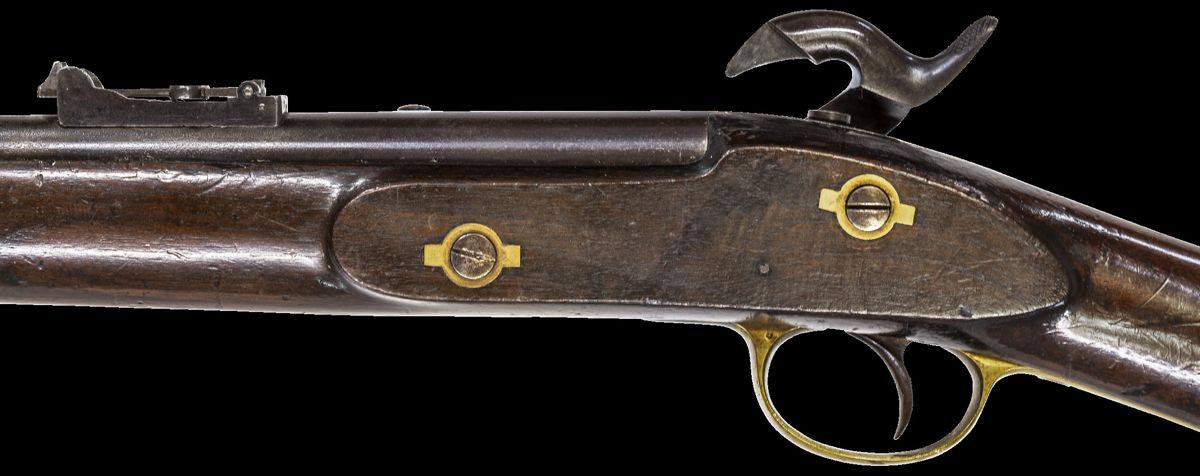
View of Needham Submission #2 showing the standard Enfield pattern triggerguard.
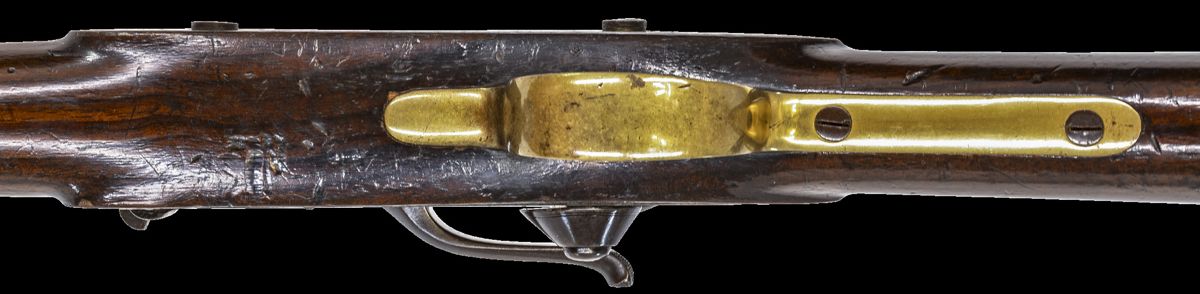
Top view of Needham Submission #2 breech.
fell to pieces when picked up. As such, the design was rejected without firing. Another competitor fell by the wayside as the shipping of the American designed and manufactured Joslyn rifle was held up in New York due to a failure to obtain the necessary export permits. As a result, the Joslyn design was rejected out of hand as well. This meant that the only self-contained cartridge design to remain in the competition was that of Jacob Snider. Considering the committee’s known bias towards the selfcontained cartridge design, it would be fair to say that the committee’s decision was made at this point, for all intents and purposes. The trials did, however, continue with the designs of Green, Wilson, Mont-Storm, Westley Richards, and Snider. When compared to the muzzleloading Enfield, all the guns provided a substantially higher rate of fire, with the submissions firing two to three times faster than the muzzleloader in a comparison of how long it took the guns to fire twenty aimed shots at a 100-yard target. The Enfield required just shy of seven minutes to complete the task, coming in at 6:52. The Green design was the fastest, completing the course of fire in less than 2 ½ minutes with a score of 2:26. The Snider was slightly slower, completing the course of fire in 2:46. Issues with faulty Snider ammunition resulted in some additional time to load and unload; when better quality ammunition was substituted in subsequent trials, the time improved to two minutes flat, making it the fastest of the submissions. However, problems started to arise when accuracy was tested. As the submission requirements specified that the designs had to be equal to or superior to the current issue firearm, the failure of all submissions to achieve the same level of accuracy of the Pattern 1853 Enfield rifle musket was problematic. Based upon rifle accuracy tests conducted by the committee on February 6, 1865, the Enfield achieved an accuracy deviation of 1.64 feet at 500 yards, which was better than all the submissions. The next best accuracy was achieved by the Westley Richards design at 1.81 feet, followed by the Wilson design at 2.10 feet. The Mont-Storm design achieved a deviation of 2.58 feet, the Green design a deviation of 3.59 feet, and the Snider design resulted in a deviation of a dismal 5 feet! Again, as with the earlier speed tests, it was determined that the Snider’s issues were likely ammunition-based. When the ammunition was later redesigned by Colonel Boxer and retested in the Snider, it was capable of exceeding the accuracy of the Pattern 1853 Enfield by achieving a deviation of only 1.06 feet at 500 yards. Initially, the Snider also performed poorly in the reliability testing. In a course of fire of 270 rounds, the Snider had the highest failure rate with eight misfires. The control standard Enfield only had one misfire, as did the Wilson and Westley Richards designs. The Green and Mont-Storm designs suffered no misfires. Again, the issue was resolved when the Snider was tested with newly improved ammunition. In later testing, the Snider fired 5,500 rounds with only a single misfire. The fact that the War
Department put time, effort, and money into redesigning the ammunition for the Snider system indeed suggests that the “fix was in” and the committee wanted Jacob Snider’s submission to be successful. Interestingly, no such effort was made to develop or improve the ammunition of the other design submissions. More interestingly, in the end, and despite the heavy hand of the judges on the scale, the Mont-Storm system was initially adopted as the system by which the British military would alter their existing inventories of Enfields to breechloader. However, the Mont-Storm had a fatal design flaw the committee did not consider. The hinged breechblock flipped forward for loading, and the cartridge was inserted into a chamber in the breechblock rather than a chamber in the receiver of the gun. That meant that the cartridge had to be inserted “backwards,” with the nose of the bullet facing the soldier when it was loaded. When the breechblock was closed, it flipped over, and then the cartridge was correctly oriented. In field trials, the British soldier could not reliably load the Mont-Storm action correctly, and the incorrectly inserted cartridges failed to fire. It was considered that this problem could be overcome with a regimen of intensive training, but this plan was discarded due to a secondary design problem. Durability issues with the combustible skin cartridge used in the design presented a problem that the War Department was apparently not interested in resolving. As a result, after only about 2,000 of the initial 3,000 Mont-Storm alterations were completed, the system was abandoned. The committee then reverted to their original preference, the Snider design, but was concerned about the ammunition issues that had arisen during the initial testing. At this point, Colonel Boxer was tasked with reinventing the cartridge to provide the required reliability and accuracy. This he did and on May 23, 1866, the Snider design was officially recommended by the Ordnance Select Committee as the system by which to alter the existing stocks of Enfield rifles and rifle muskets to cartridge breechloaders. The new design was officially described by the War Department as “Change 1327, Musket Rifled, Pattern 53 Converted to a breechloader on Snider’s principle (Pattern I).” In service, this would be known as the Snider-Enfield MkI. Due to issues with the breeches opening when fired, a change to the machining of the breech recesses was adopted as the MkI*. In 1869, a breechblock locking latch was adopted to resolve that issue further, and the new alteration design was designated as the Snider-Enfield MkII. Additional improvements to the alteration system were subsequently designated as the MkII* and MkII**. Within about two and half years, the existing stocks of Enfields suitable for alteration to the Snider system were used up. As a result, on January 13, 1869, newly made Snider-Enfield MkIII rifles and rifle muskets began to be produced. These were purpose-made breech loaders and were not conversions from muzzleloaders as the MkI and MkII guns were.
This was only the first step on the road to adopting a breechloading cartridge rifle for the British military. Now that a means to alter the existing stocks of arms to breechloader had been adopted, it was time to find that elusive “most perfect” purpose-made breechloading design. In October 1866, only four months after adopting the Snider system to alter muzzleloading arms, the War Office announced a new set of trials to find the best possible purpose-built breechloading rifle. The request for submissions required that the rifle be no longer than 51 inches in length, with a barrel of “uniform weight and length. Weight 4 lb 5 oz, length 35.” The total weight of the gun was not to exceed nine pounds, five ounces, and was to be able to deliver an accuracy deviation of no more than six inches at 300 yards and twelve inches at 500 yards. The rifle had to utilize a Boxer-primed cartridge that used 85 grains of Curtis & Harvey’s #6 powder. Although the caliber of the cartridge was not specified, the basic requirements suggested a preference for the .577 Snider-Enfield cartridge. The rifle also had to be able to mount a bayonet. As with the earlier trials, cash prizes were offered to encourage competition. The awards included £300 to every designer who passed the first stage of trials to help finance the manufacture of six additional experimental rifles, £1,000 if the design was selected for military use, and £600 to the best design that was not adopted. Additional awards included £400 for the best cartridge design and £300 for the best magazine-fed repeating rifle design. As of March 21, 1867, 104 different submissions had been received by the committee. Of those guns, 37 were considered for further testing because they satisfied the design submission criteria and were designated as “Class I.” The balance of 67 was rejected as potential finalists for their failure to adhere to the design specifications and were designated “Class II.” However, many were subsequently studied to “discover any merits” their designs might have had. Of the 37 that passed the initial cursory inspection for adherence to the design specifications, 21 were disqualified for various reasons before they were ever fired, and seven more were disqualified after firing only twenty cartridges. That left only nine contenders, who were officially listed as finalists on March 21, 1867. These designers were then allocated £300 each for producing six test rifles.
Reports from Commissioners. United Kingdom: 1869.
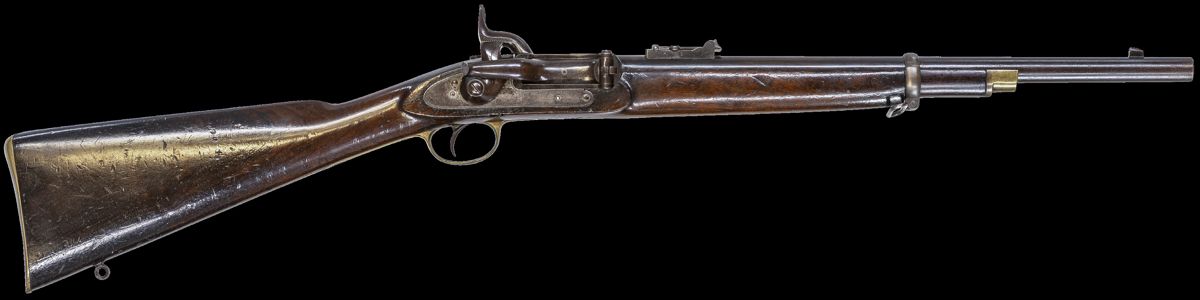
Obverse overall view of Needham Submission #2.
The nine finalists were the designs from Albini-Braendlin, two from Burton (designated 1 & 2), Fosbery, Alexander Henry, Joslyn, Martini, Peabody, and Remington. By the time, the Class II arms were being looked at for their “merits” in July 1867, the group of 67 had grown to 83. The Class II arms were then further sorted into List A, B, and C arms. The arms placed on List A were rejected out of hand, and no further testing was performed. This list totaled 68 guns, one more than the original number of guns designated as “Class II.” Four arms were placed on List B and were considered as “warranted a further examination but were subsequently rejected.” The arms placed on List C included eleven arms that were “set aside for further consideration.” Interestingly, testing Class I submissions against a Snider Enfield resulted in somewhat embarrassing results. In general, the Snider was more accurate and fired as quickly or more quickly than the new submissions. In fact, none of the new submissions could achieve the accuracy standards set in the submission proposal. In the end, the 1867 trials resulted in the conclusion that, for the time being, no submission was significantly superior to the Snider-Enfield then in service, and in the end, a new rifle would not be adopted until 1871, when the Martini-Henry (Peabody) design would be adopted. It appears that the most important discovery that came out of the 1867 trials was that the reduced caliber Henry projectile with a longer bearing surface provided substantial ballistic advantages over the .577 Snider cartridge; when the new Martiniand Henry rifle was adopted, it would be in the .577450, reduced caliber chambering.
Needham, Nos. 2 3 – No. 2 is too short and withdrawn by Mr. Needham. No. 3 was rejected as being in an unfinished state.
The point of the long discussion of the various arms submitted for testing in these trials is to provide the background information for the rifle shown here, which appears to be one of Joseph Needham’s submissions for the 1867 trials. Needham had submitted a “needle rifle design” during the first set of trials, which selected the Snider system. This time, he submitted three sample rifles, all apparently based upon his 1867 U.S.
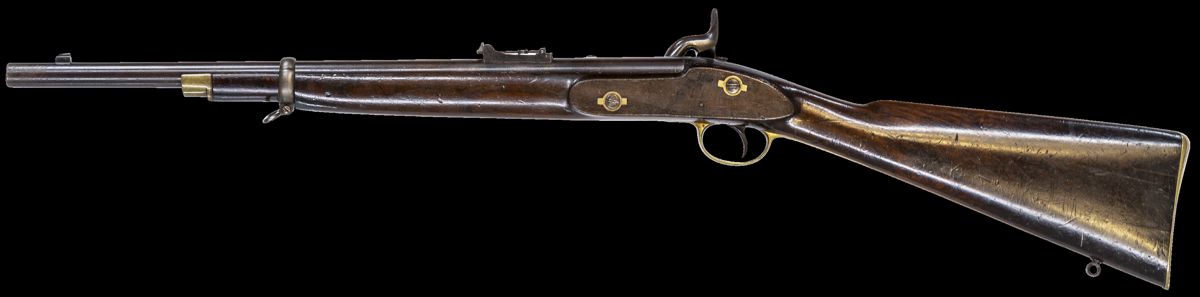
Reverse overall view of Needham Submission #2.
Lock area of the Joseph Wilson capping breechloading action.
Top view of the Joseph Wilson capping breechloader with the action open.
Lock area of a Mont Storm Enfield rifle.
Patent #64,999 design. The description of his system is quoted from the portion of the Select Committee’s report regarding the Class II, List C guns “Systems Retained for Further Consideration.” It reads as follows: “Needham – This rifle is adopted for the Boxer central-fire cartridge. The barrel is prolonged at the breech by a cylinder opened at the right side. The breech is closed by a block opening out laterally on a vertical pivot at the forepart of the open cylinder. The extractor is a lever of the first order on the vertical pivot and is worked by the action of opening the breech. A piston passed through the action of the breech block, and is forced forward by a peculiar wedgeshaped hammer, worked by a common lock. The hammer also answers the purpose of a locking bolt, and prevents breech being blown open
Action of the Montgomery Storm system open, showing the reversed chamber that confounded British infantrymen when loading the guns.
Remarks: 20-6-67, trials for accuracy and rapidity of fire all shot by Mr. Needham. The cartridges were easily extracted after firing. 12 shots in 59 seconds, without accident or delay.”
is .80-inch. This is very close to the standard Enfield rifle musket front sight and socket bayonet lug positioning of nominally 1.4 inches for the muzzle-to-stud distance with an exterior diameter of nominally .79-inch.
The above report specifically deals with Needham’s entry #1, as his #2 and #3 entries are described earlier in the report where guns rejected out of hand prior to testing are described. The report provides a brief account of these two rifles as follows, Needham, Nos. 2 and 3 – No. 2 is too short and withdrawn by Mr. Needham. No. 3 was rejected as being in an unfinished state.
These dimensions suggest that Needham intended the rifle to accept the standard British military socket bayonet in keeping with the design specifications for the trials. The breechblock is 2.5 inches in length and opens by swinging outward and toward the muzzle, as is typical of all Needham action breechloading firearms. A traditional military-style sling swivel is attached to the single barrel band, and a sporting-style sling ring is mounted in the toe of the stock about 2.25 inches from the butt. The gun is finished with a browned barrel, color casehardened lock, breechblock and receiver, brass furniture and a single steel barrel band. The triggerguard, buttplate, and sidenail cups are standard Enfield furniture, as is the barrel band. The stock appears to be the standard Italian walnut specified for the muzzleloading Enfield rifles and rifle-muskets. The bore is rifled with three narrow lands and broad grooves.
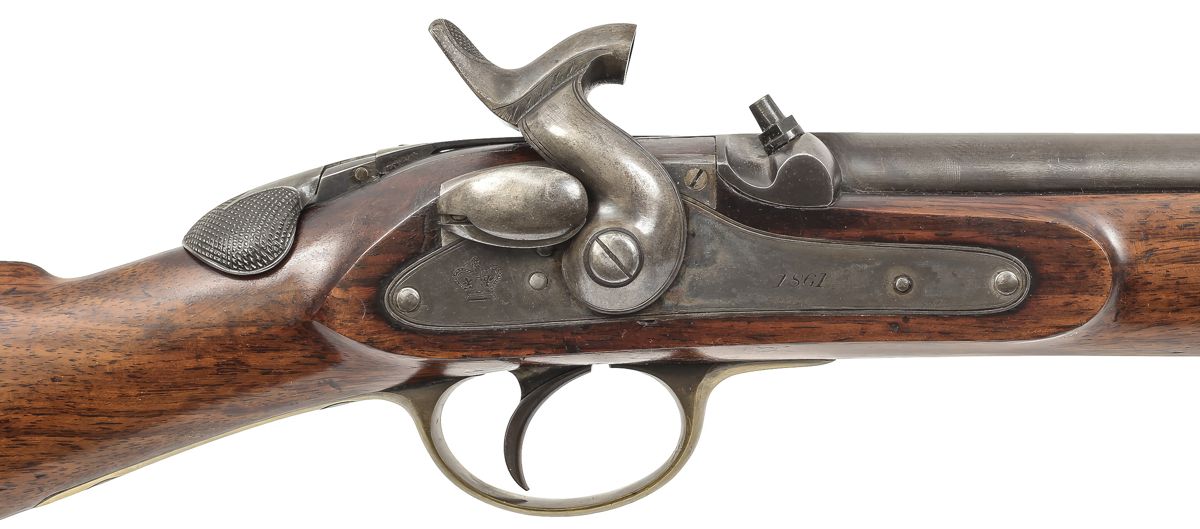
The Needham design pictured here is, in my opinion, his sample No. 2, which was “too short.” The gun is built with modified Enfield pattern parts and could well have been created by modifying an Enfield. The gun is unmarked externally with the exception of a single post1813 Birmingham proof mark on the breech chamber’s door. Internally, the gun is marked inside the lock and on the bottom of the barrel with the initials J.N., which clearly indicates Joseph Needham; over them is the number 2, almost certainly indicating sample number 2. It is worth noting that at least some rejected submissions in the trials were noted as having not been proved. In the case of the submission by Tronchon the report noted that it was “Too short and having no proof marks was not fired…” The rifle has a 21.75-inch round barrel secured by a single barrel band and an overall length of 38 inches. While the 38-inches overall length meets the requirement that the gun was not to exceed 51 inches in length, the barrel itself is nominally 13 inches short of the trial’s specifications, no doubt the reason for the “too short” comment and out-ofhand rejection. The gun is chambered for the .577 Snider cartridge. The stock is 32.125 inches in length, and the length of the pull is 14 inches. The rear sight is a modified Pattern 1853 Enfield military ladder sight. There is a combination Enfield style front sight and socket bayonet lug located 1.5 inches from the muzzle, and the exterior muzzle diameter
While Needham’s design was rejected by the British military, the survival of this trials rifle tells an interesting story that is very much at odds with the story normally associated with Needham’s designs. The design was never accepted by the British military and never really caught on or became a commercial success, but it did see some limited success in the hands of opponents of the British government. Some 5,000 obsolete U.S. Model 1861/63 Contract rifle muskets were altered to the Needham system in the late 1860s for use by the Irish Nationalist Fenians during their second ill-fated attempt to invade Canada in May 1870. The goal of the invasion was to protest the English rule of Ireland and to try to force the English to allow Irish autonomy and Home Rule. The irony that they were armed with rifles altered with an English-invented design that had also been submitted for British military trials is one that is not lost on many arms historians.
About the Author
Tim Prince is a full-time dealer in fine and collectible military arms from the Colonial Period through WWII. He operates College Hill Arsenal, a web-based antique arms retail site. A long-time collector and researcher, he has been a contributing author to two major book projects about Civil War era arms including The English Connection and a book on southern retailer-marked and Confederate-used shotguns. He is the author of over 70 articles on weapons in Civil War News and Military Antique Collector. Tim is also a featured Arms & Militaria appraiser on the PBS Series Antiques Roadshow and serves as a Senior Consulting Specialist to the Arms & Armor department of Cowan’s, a Hindman Company.
homas Leech and Charles Rigdon ended their partnership in December 1863. Charles Rigdon continued pistol manufacture under a new contract with new partners in Augusta, Ga., signed January 1, 1864. Rigdon also agreed to complete the existing March 1863 Leech & Rigdon (L&R) contract. L&R made their last revolver in December 1863; Rigdon, Ansley & Co. (RA) continued the production, still marking revolvers “LEECH & RIGDON CSA.” The last L&R revolver documented made by the Thomas Leech partnership is serial number (SN) 920. The lowest SN made by the new Rigdon Ansley firm is SN 927.
Trevolvers. Albaugh had documented only 112 total L&R and RA revolver SNs. The additional 170 SNs in my database with more detailed measurements and characteristics allow this chronology to concisely fit with dates of manufacture. Albaugh reported in his 1963 text a letter from Chief Ordnance Officer Col. Josiah Gorgas letter, February 22, 1864, two months after Leech and Rigdon had dissolved their partnership, addressed to Captain Wescom Hudgins, Assistant Inspector of Small Arms. It said in part:
During this transition, Rigdon abandoned using safety pins on cylinders with slotted hammer faces to attach to pins so the hammer would not accidentally fall on the cap, causing an accidental ignition. There had never been inspection complaints concerning Greensboro production of revolvers; why Rigdon stopped using safety pins is unknown, but after Hudgins started inspections, a new safety system began with distinctive 12-stop cylinders. These new 12-stop revolvers were made under the January 1864 Rigdon Ansley contract starting at SN 1500. Charles Rigdon would finish over 500 “LEECH & RIGDON” marked revolvers by the Spring of 1864. He would manufacture an entire production of about 850 12-stop RA revolvers in the last eight to nine months of 1864; the highest SN of an authentic RA revolver is 2359. The new firm of “Rigdon, Ansley & Co.” had a government contract to produce Colt-style navy revolvers from January 1, 1864, with three new principals along with Charles Rigdon. They were Jesse A. Ansley, Andrew J. Smith, and Charles R. Keen. Like Thomas Leech in the earlier partnership, these new partners were merchants and businessmen, not mechanics or engineers. Charles Rigdon alone was the driving force in manufacturing revolvers. Bill Albaugh published transcriptions and summaries of correspondence and reports documenting much of the chronology in his pioneering early texts, his last in 1963 Confederate Handguns. Albaugh did not have my more extensive database with over 100 Rigdon Ansley revolvers and 180 L&R surviving
An 1862 document signed by Jesse A. Ansley, John U. Ansley MSK, and Col. George W. Rains, who took delivery of most Rigdon Ansley revolvers at the Augusta Arsenal. (NARA, RG 109, Publication No. M346, Document No. 281)
projects into the bore; the dimensions of the cone to be the same as Colt’s; the cylinder must be case hardened, and Colt’s lever catch substituted as soon as possible for the pin now used. All other defects you may observe must be corrected under your instruction.” All Rigdon Ansley revolvers have the proposed changes starting after SN 1490.
Augusta Daily Constitutionalist, June 17, 1864, page 3. “Sir:—You will please proceed as soon as practicable to Athens, Ga., and take charge of the inspection and improvement of arms manufactured by Cook & Bro.; you will also visit Augusta, Ga., as often as may be necessary for the purpose of inspecting and improving the pistols manufactured by Rigdon, Ansley & Co. Upon receiving arms from either of the above mentioned parties you will cause them to be turned over to Col. G. W. Raines, Commdg. Augusta Arsenal, at the same time furnishing the contractors with a certificate, in which will be set forth the number of arms received, the price to be paid, the date of contract, and the number stamped upon each arm, and these certificates to be presented by the contractors to Col. G. W. Raines, and held by him as vouchers for the settlement of their accounts. You will forward to me a monthly report showing the number of arms received and rejected; also giving a statement of the principal causes for rejection. In the event of any changes from the present construction of the arms suggesting themselves you will submit a report in relation thereto. In the pistols made by Rigdon, Ansley & Co., the use of the safetypins has been abandoned without introducing a substitute for them; the parties propose the use of another set of check notches in order to prevent the cylinders revolving, when the hammer is not upon the cap. It is important that some means of securing the soldier from danger should be immediately determined upon; you will therefore urge the parties to hasten to completion the pistol thus altered which they propose to submit. In the pistol made by Rigdon, Ansley & Co., additional attention is required to prevent ringboring, and in bringing the cylinder chambers to the true caliber; and rifling is hardly deep enough; the front sight
Charles H. Rigdon (1821–1866), a native of St. Louis, was a machinist and engineer. Albaugh makes a compelling argument that Rigdon was involved in manufacturing Shawk & McLanahan pistols in Saint Louis just prior to the Civil War during 1859–1860. Rigdon most likely supplied his machine shop tools for manufacturing the Shawk & McLanahan brass framed revolvers and for Leech & Rigdon in Memphis, Columbus, Miss., Greensboro, Ga., and later Augusta. Neither Shawk nor McLanahan had any experience with manufacturing like Thomas Leech or Jesse Ansley. Rigdon is always listed as an engineer or mechanic in city directories and newspaper articles. A March 1861 newspaper article tells of his brilliance as an engineer potentially applying steam power to street cars in Saint Louis. Rigdon chaired a meeting on January 1, 1865, of Augusta “Mechanics & Artisans” meeting with the Augusta quartermaster hoping to change the law conscripting desperately needed skilled workers in the manufacture of war materials. Military-aged factory workers had to be part of local defense forces or militias. The “Rigdon Guards” Co. D, local 2nd Georgia militia, were Rigdon Ansley pistol factory workers deployed to the field with several casualties at the Battle of Griswoldville on November 22, 1864. The Griswold & Gunnison pistol factory was destroyed, ending production there. Somehow, production continued in Augusta as Wescom Hudgin was in Augusta on at least three dates after the battle, the last being January 27, 1865, and he had no other business as small arms inspector there. Jesse A. Ansley (1826–1902) was a native Augusta merchant, best known for his son, born in 1865, who developed Ansley Park in Atlanta, and his home became the governor’s mansion. His company, J. A. Ansley & Co., did substantial business with the Confederate government throughout the war, even while he was the principal of a pistol manufacturing company. Lt. John U. Ansley (1835– 1891) was Jesse’s brother and MSK (Military Store Keeper) at Augusta Arsenal. The J. A. Ansley Company, 300 Broad Street, Augusta, address is used on the original documents for the pistol firm. All four principal names appear on a contract for the pistol factory leasing water power from the Augusta Canal Company on March 13, 1864.