
The World War II M1a1 Paratrooper Carbine
By Jack Bell · Originally published March-April 2024 · pp. 27–38
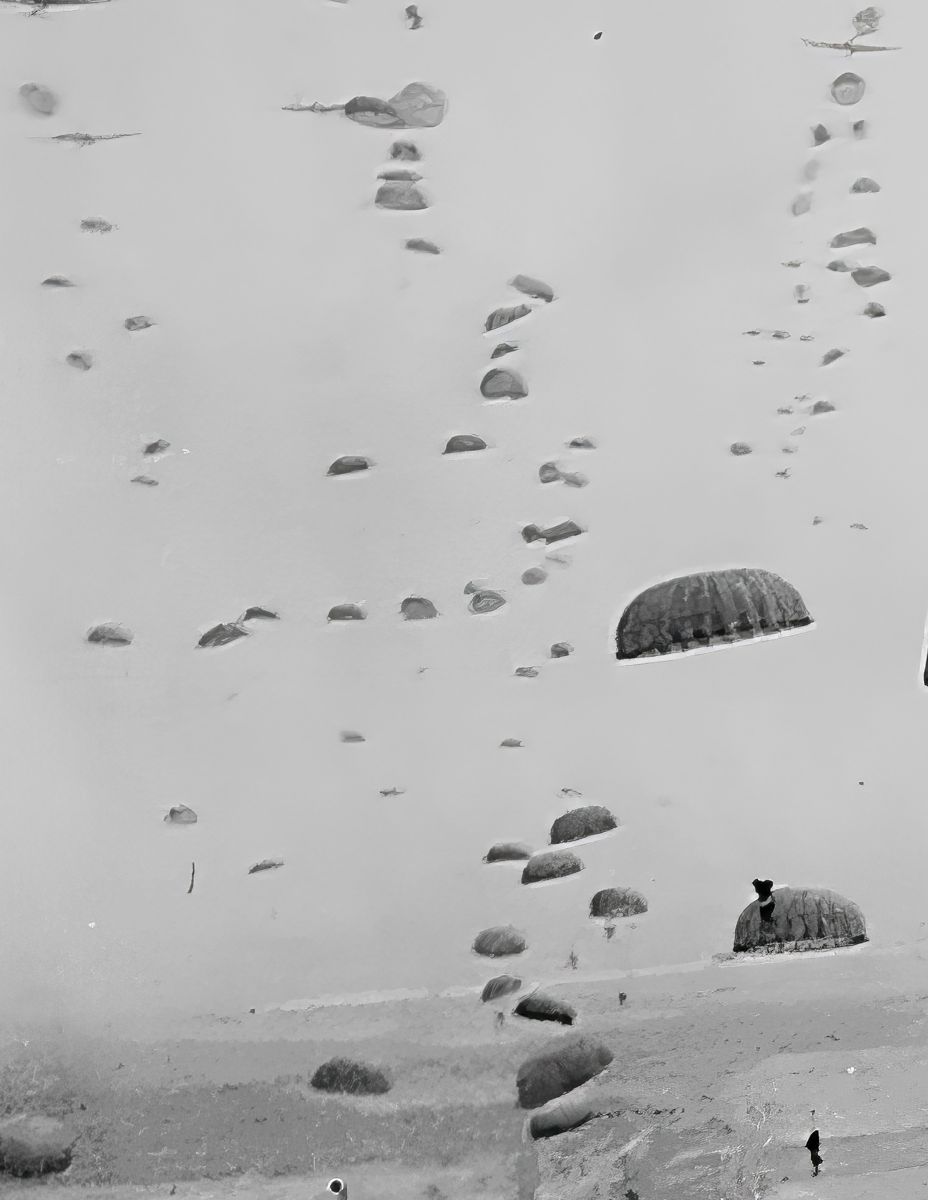
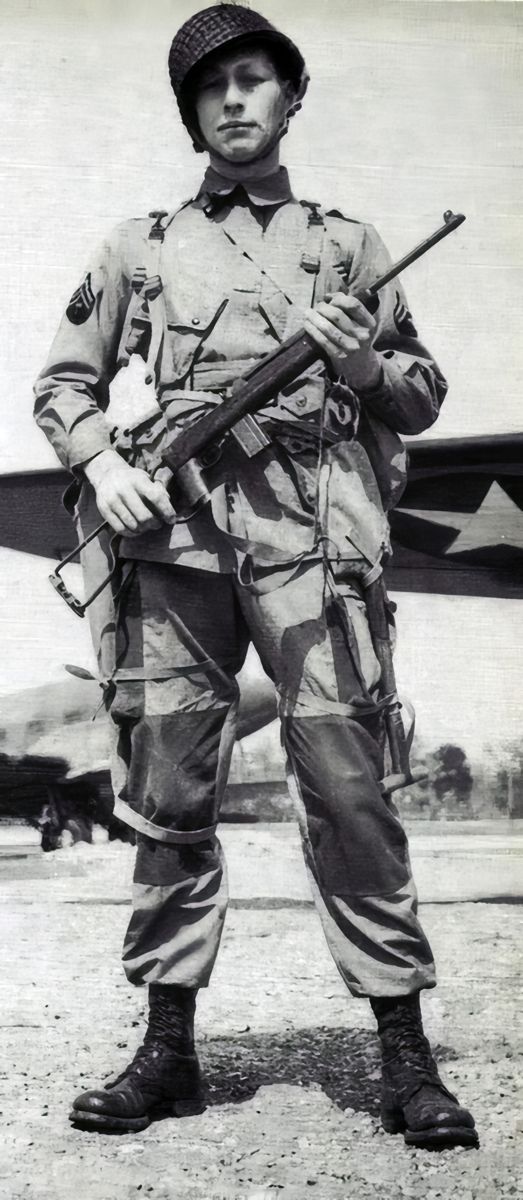
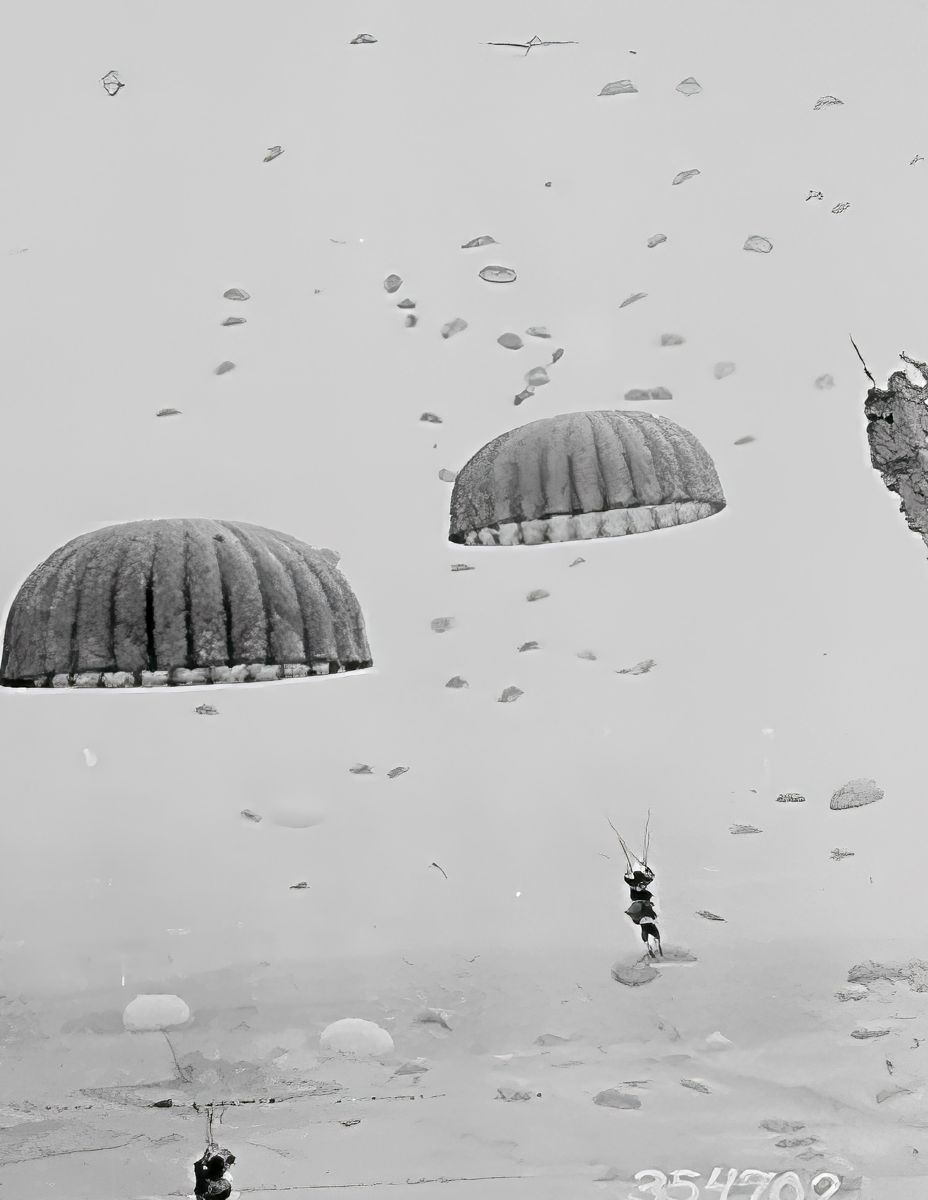
The M1A1 Carbine is probably the most popularly collected World War II American military gun. It is not one of the rarest. The Inland Division of General Motors, the sole World War II manufacturer of M1A1s, made more than 140,000 before the end of World War II.1 Because it was designed for U.S. Army paratroopers, its caché puts it in a unique collectible category. It is important to note that the only difference between the M1 Carbine and the M1A1 Carbine is the wood stock. The barrels and firing mechanisms of both are identical. The barrel numbers and dates between the two carbines are intermixed. Inland made two basic models of the M1A1 Carbine, both semiautomatic. The Model 1943 had a flip rear sight, a “flat” bolt, and a “high wood” stock. It was manufactured between November 19422 and October 1943. Production in late 1942 was limited to about 4,000, during November. The 1943 production was about 66,000. The Model 1944 corrected several problems, provided an adjustable sight, a round bolt, and a “low wood” stock to minimize the wood splitting around the receiver slide. The 1944 model production was over 69,000. The irony of the paratroopers using the M1A1s is that in preparation for D-Day operations, paratroopers apparently had some choices of weapons. Many opted to take the M1 Garand rifle instead of the M1A1 Carbine. This was probably due their desire for a weapon with greater stopping power and range than the smaller cartridge of the M1 Carbine and M1A1 Carbine.3 In a personal conversation with Forrest Guth, one of the original “Band of Brothers,” he told the author he decided to jump with a loaded M1 Garand strapped inside his parachute harness. Dick Winters, the famous leader of the “Band of Brothers” wrote in his book that he jumped with an M1 Garand in his leg bag. He reported that his leg bag and those of all others in his “stick”4 were ripped off when they jumped from the aircraft, and he landed with only his M3 knife as a weapon.5 In today’s collectors’ market, more than half the surviving World War II M1A1 Carbines are not authentically original.6 The reasons are complicated: C
Each M1A1 Carbine had between 78 and 81 component parts. The M1 Carbine had almost the same number of identical components.7
C Some post-war M1A1 Carbine conversions were done to make them automatic (M1A2s). No original 1943 Models or 1944 Models were manufactured to fire automatic.
C Continued post-war use of the M1A1 guns, by both the U.S. and by foreign governments, resulted in a massive reduction in surviving guns for the collectors’ market.
C As noted above, the barrels and firing mechanisms were interchangeable with over six million M1 carbines made during World War II. Legitimate field repairs would often result in World War II and post-war components from other M1 Carbine manufacturers.
C During and after World War II, U.S. Government arsenals and contractors modified many 1943 Model and 1944 Model M1A1s, resulting in some components originating from other M1 Carbine manufacturers.
C Many repair parts were made by Inland and other manufacturers of M1 Carbines to support field repairs. At the end of the war, these were transferred to the Springfield Arsenal or sold off as surplus. Some components were made post-war by some foreign governments.
C After the war, Inland turned over all its machinery and components for making M1A1 Carbines to the U.S. Government’s Springfield Armory. The Springfield Armory was reported to have made an additional 3,545 M1A1s in 1945 and 3,773 in 1946.8 These guns are marked differently, particularly the wood stocks.
C Because of the chronically great demand for the M1A1s, many non-original M1A1s have been made to generally look like original World War II M1A1s. Some have been made with original M1 Carbine barrels but with some or all post-war components made by the Springfield Arsenal or foreign governments, or by private suppliers.
The efforts for a collector to identify the status of an M1A1 Carbine should be based on the collector’s goal for acquiring the weapon. If the desire is only for an M1A1 Carbine that looks like an original (as a reenactor), the requirement will only be appearance. For a collector wanting an authentic M1A1 Carbine, whether World War II or later, the folding stock, barrel, and firing mechanism will have to be manufactured by Inland and rebuilt by a U.S. Government arsenal. For a “purist” collector looking for an original authenticated airborne M1A1, the challenge will be far more daunting, and a consultation with a genuine M1A1 Carbine expert may be necessary.9 In the section below, some defining characteristics of each M1A1 model are listed.10
Original 1943 Model (including the 1942 production) C C C C C
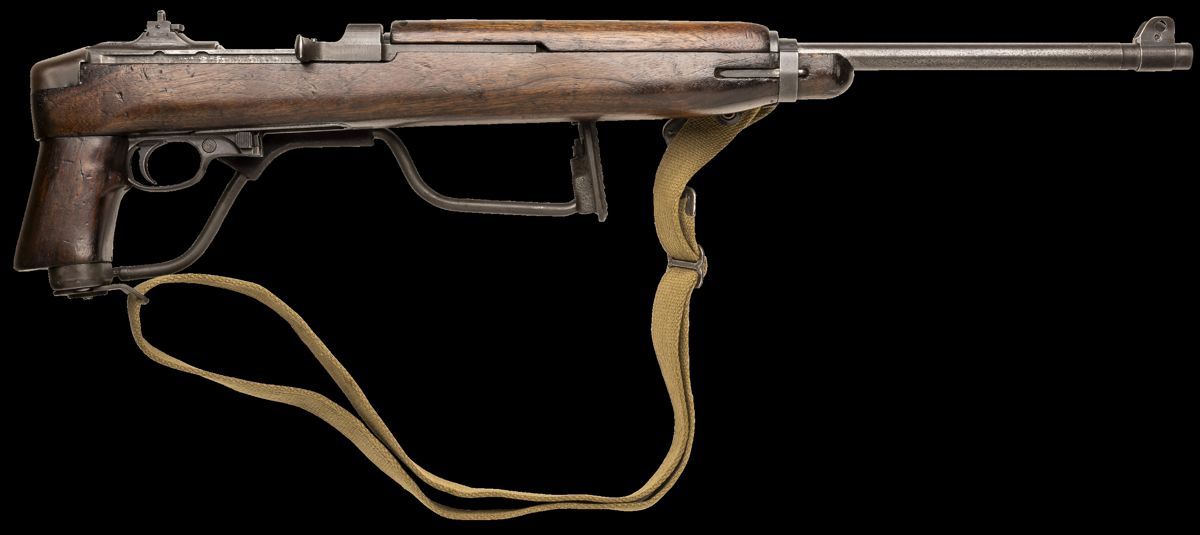
Flat bolt. “High wood” stock. “OI” stamped in the floor of the stock well. Flip rear sight. Hand guard with only two rivets (stamped “OI”).
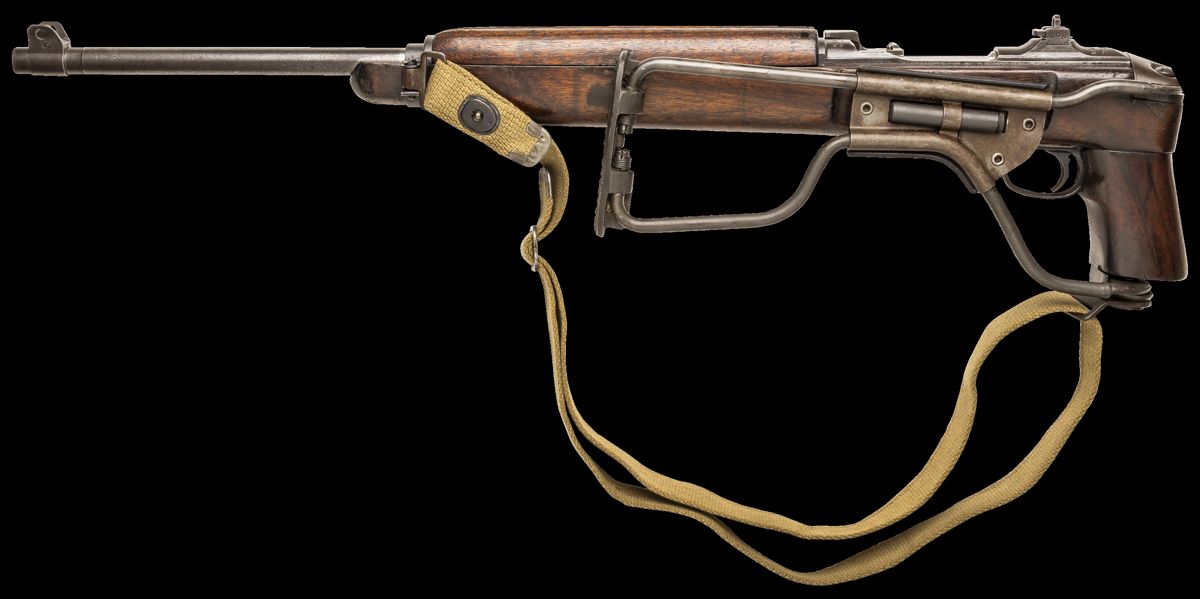
Authentic original Model 1943 M1A1 Carbine, serial number 91068, barrel dated November 1942. (Right side view)
Original Model 1943 M1A1 Carbine; barrel dated November 1942. (Left side view)
C C
C C
For some 1942 production versions, the safety button will be cross-checked, a transition from the 1942 M1 Carbine production. The bottom of the pistol grip will have both an ordnance escutcheon and “OI” (“OverlandInland”) stamped in. These are sometimes difficult to see with the metal folding stock in place. The rear of the pistol grip or rear of the butt of the wood stock will have a capital P in a circle stamped to confirm that the gun was proofed. Any capital P, inside a circle or not, that is on the side or front of the pistol grip is a proof mark of an arsenal rebuild. The barrel band will be a Type 1 or Type 2.
Original 1944 Model C C C C C C
C C
C Round bolt11 “Low Wood” stock. Adjustable rear sight.12 “OI” stamped on the floor of the stock well.13 “RIA” may be stamped on the bottom of the latewar pistol grip or in the stock well.14 “OI” stamped on the inside of the hand guard. Later production models, both World War II and post-war, will have four rivets on the hand guard. The bottom of the pistol grip may have the ordnance escutcheon and/or the “OI” stamped in. No 1944 Model was noted with a circled capital P on the rear of the pistol grip or wood stock butt. Any capital P, inside a circle or not, on the side or front of the pistol grip is a proof mark of an arsenal rebuild, not original production. The barrel bands will be Type 2, or for post-war production, a Type 3, designed to mount a bayonet.15
World War II and post-war U.S. Arsenal Rebuilds C C
C May include some 1943 and 1944 Models with post-war modifications. All arsenal rebuilds will have the initials of the arsenal stamped on the left rear side of the stock. Post-war contractors or private rebuilds may not be marked. May have a toggle safety switch.
Post-War and Private Markings M1 Carbine Stocks Some Springfield Arsenal production will have “SA” stamped on the stock and on some components. These are post war. Reproduction metal folding stocks have four differentiating characteristics; the butt plates will be either unmarked or poorly marked: the rivets on the leather cheek plate will be riveted flat instead of curled over; the leather cheek pad may be black instead of dark brown; the rivets may be marked with “7/4.” The stocks may not be made of walnut or might be crudely cut from M1 Carbine stocks, with crudely made pistol grips, often without any markings. The left side of the stock where the indentation for the folding stock is located is often not sharply defined and sometimes sanded out. Some post-war manufactured components by foreign governments are not well marked but have entered the U.S. for the collector’s market. The demand for M1A1s continues to increase. This is probably driven by the popularity of two movies, Saving Private Ryan (1998), and The Band of Brothers mini series (2001). As a result, prices on original Model 1943 and Model 1944 Carbines are often beyond the reach of starting collectors. The Carbine Collectors Club web site has excellent detailed photographs of various components of the M1A1 for those interested in acquiring an original M1A1 Carbine.
Endnotes: 1.
Data in this article is from the Inland Division of General Motors and the U.S. Government’s Springfield Arsenal, plus two books: The M1 Carbine III, by J.C Harrison, and A Collector’s Guide to the M1 Garand and the M1 Carbine, by Bruce Canfield. 2. For some reason, reports of the starting date vary among different sources. Some say October 1942, others say late 1942, and some say November 1942. It appears to be November 1942. Reports also vary on the number of M1A1 Carbines produced in 1942. Some sources say 4,300, only in November. Some say 3,200 in November and 3,000 in December. 3. The M1 Carbine was manufactured by 10 different manufacturers, including Inland. 4. A “stick” defines the number of parachutists on a single plane for a single jump. 5. Winters, D. and C.C. Kingseed, Beyond Band of Brothers, 2006, p. 80. 6. Harrison estimated that less than 1 in a 1,000 M1A1s would be original and exactly as produced (p. 163). 7. Data reported by the Carbine Collectors’ Club. 8. Ibid. 9. One “purest” collector thought an M1A1 Carbine he had purchased had an incorrect firing mechanism component made by Saginaw (another GM subsidiary making M1 carbines). Consulting an expert, he learned that during the month the gun was produced, Inland ran short of the components and got lateral support from Saginaw, another GM subsidiary. To have replaced it with an Inland component would have eliminated the original production authenticity of this particular gun. 10. Because of the lateral support methods and urgency of production, there is no absolute certainty that a specific originally manufactured M1 Carbine or M1A1 Carbine will fit all the characteristics of the model. Even production numbers of M1A1 Carbines appear somewhat uncertain. 11. Some early 1944 Models might have flat bolts during the transition to round bolts. 12. Some early 1944 Model guns may have flip sights as they transitioned to the adjustable rear sights. 13. There is some uncertainty about the use of the “RIA” markings on some 1944 Models, and post-war stocks. Some reports had speculated that “RIA:” stands for “Royal Typewriter Inland.” 14. See footnote above. 15. Earlier production of the M1A1s assumed the user was equipped with an M3 fighting knife, not the later M4 bayonet. Some Type 3 barrel bands have been documented
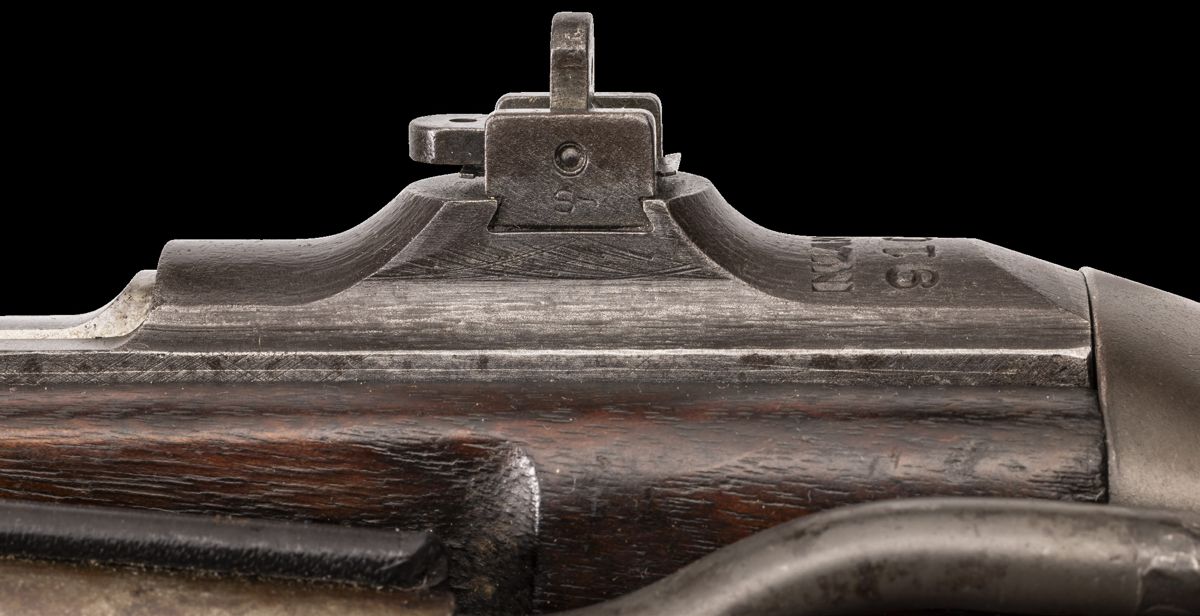
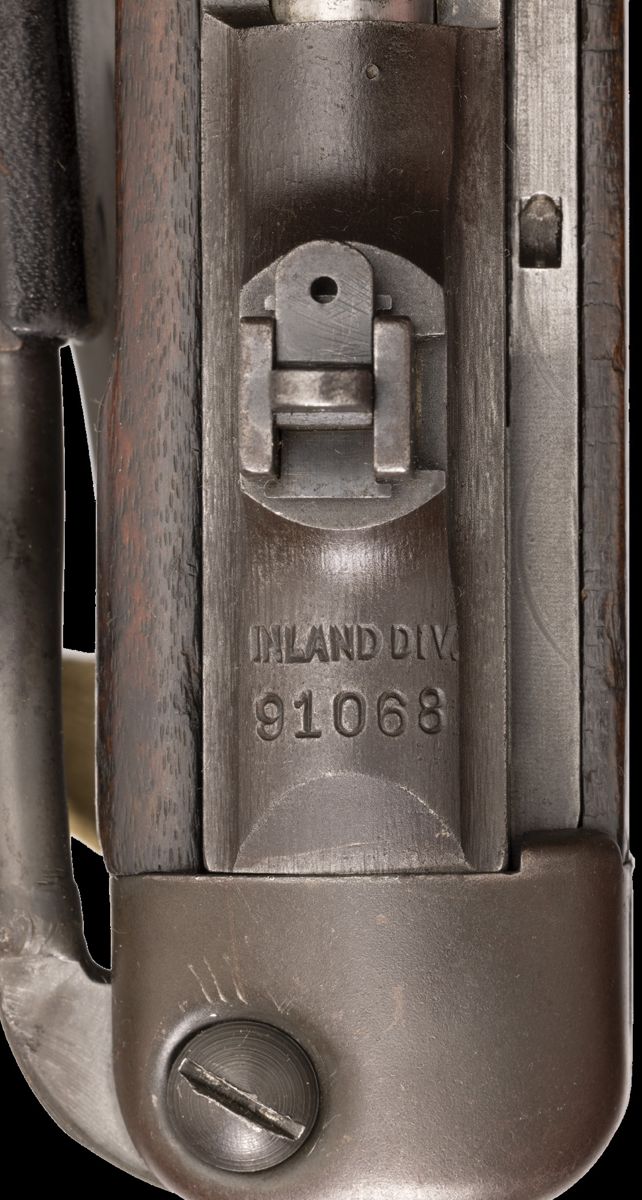
Inland Division stamp and serial number stamping aft of the rear sight.
as surfacing very late in World War II, but it’s not clear if any were on M1A1 Carbines.
About the Author Jack Bell, a Marine Corps Vietnam veteran, has just completed a book with his son, Weapons and Equipment of American D-Day Paratroopers. It features the M1A1 Carbine and other weapons and equipment used in the famous D-Day operations. Earlier, he wrote a technical book, Civil War Heavy Explosive Ordnance, which is still selling 20 years later. As a senior executive at the Department of Defense, he also served in both Afghanistan and Iraq.
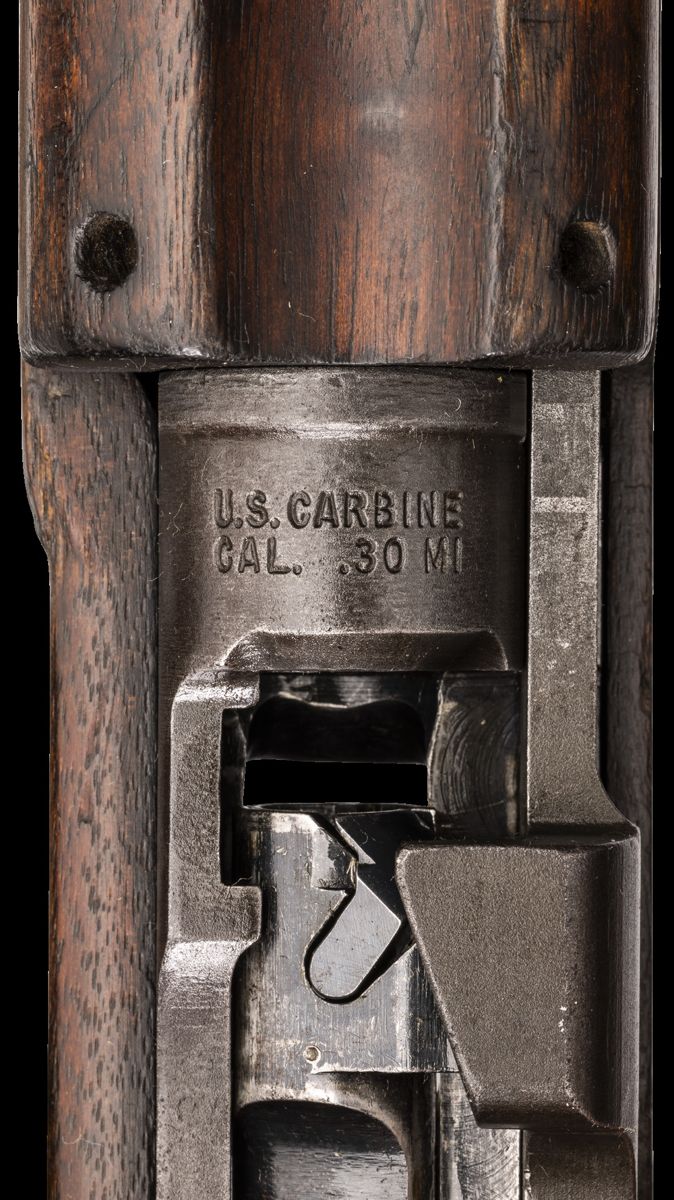
Stamping for M1A1 Carbines forward of the bolt.
Top side view of the flip rear sight.
Side view of the rear flip sight for the Model 1943 M1A1 Carbines showing the “S” stamp on the left side.
The “high wood” stock for the Model 1943 M1A1 Carbines.
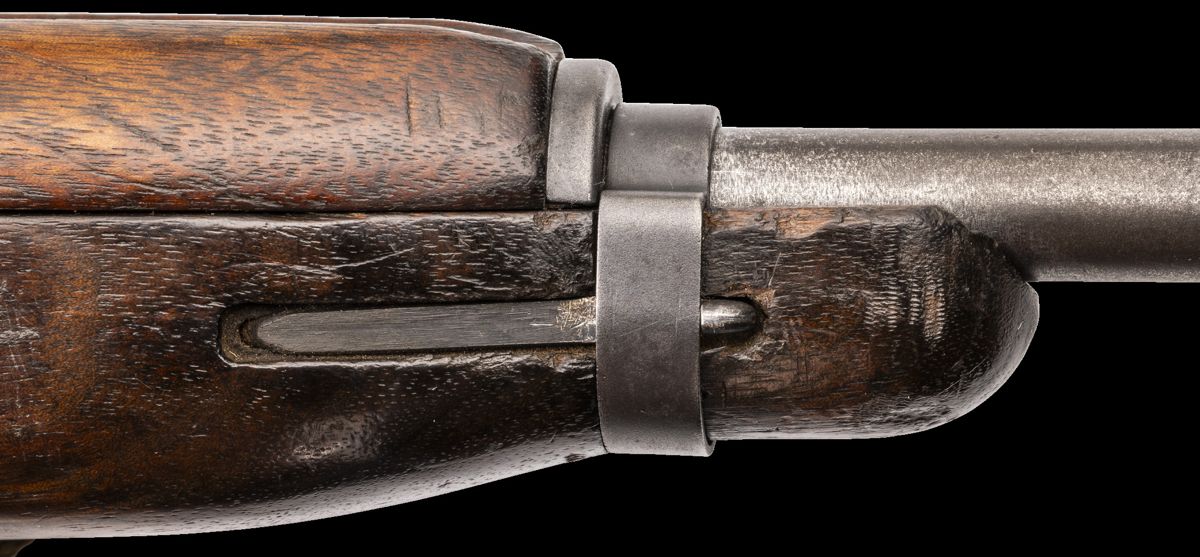
The Type 1 barrel band for early Model 1943 M1A1 Carbines.
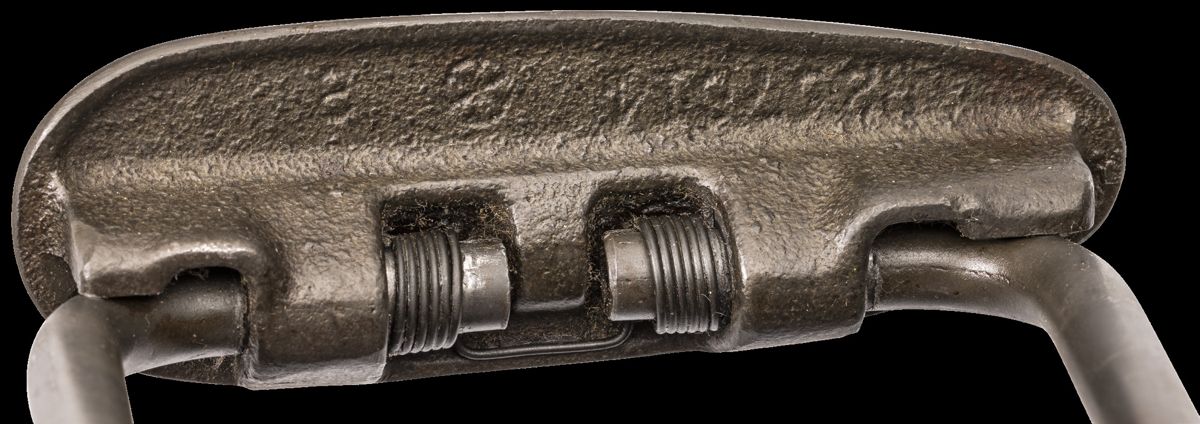
The metal folding stock butt plate for original M1A1 Carbines. These numbers are always clearly cast into the metal (not stamped or fuzzy, as seen in reproductions).
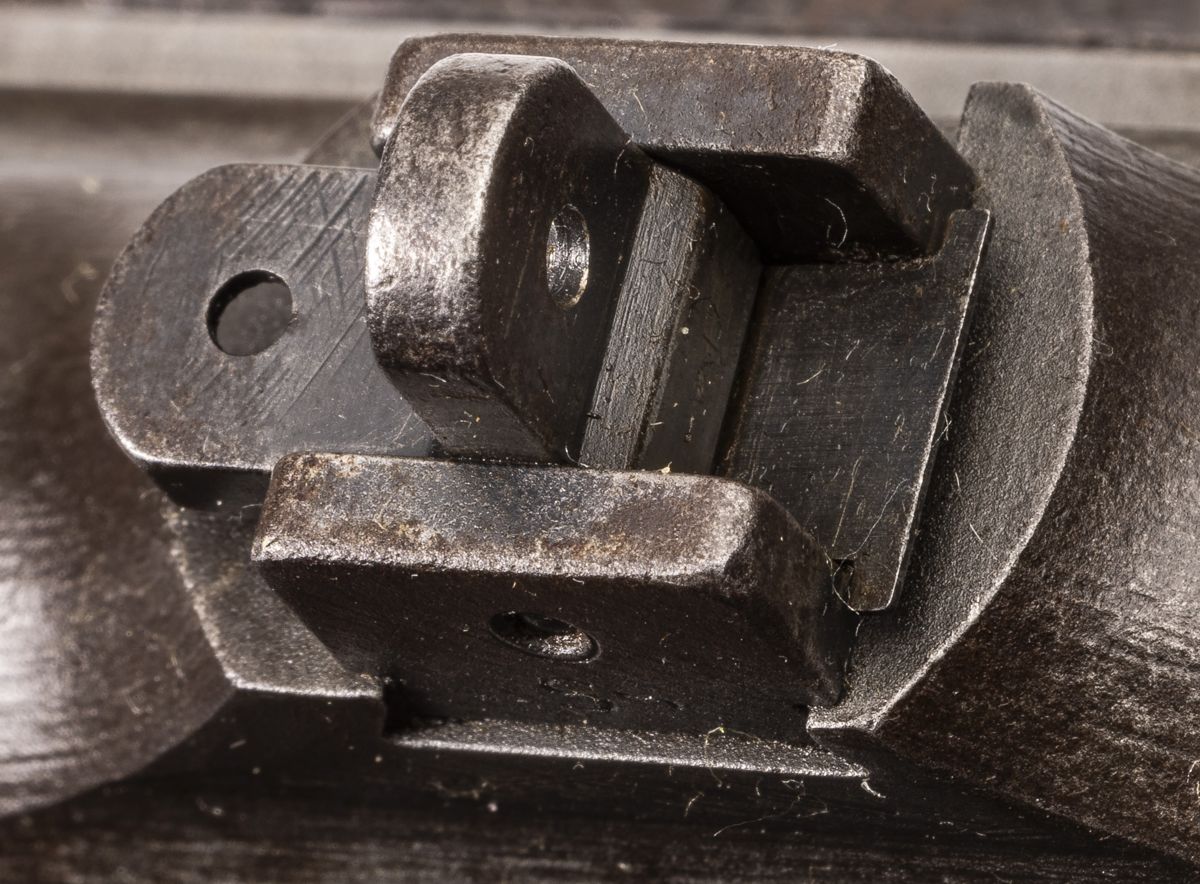
Front oblique view of the rear flip sight for the Model 1943 M1A1 Carbine.
For the Model 1944 Carbines, the flip rear sight was replaced by an adjustable sight; later Model 1944 and post-war carbines were fitted with a Type 3 barrel band that had a bayonet lug. The photograph shows the Model 1943 configuration.
Images of the stampings of the barrel markings showing the manufacturer and the manufacture date of the barrel. (This applies to M1 Carbine and M1A1 Carbines as well.)