
Columbus Firearms Revolvers
By John Sexton · Originally published May-June 2024 · pp. 30–57
Columbus Firearms
Revolvers By John Sexton
Columbus Firearms Company revolvers are among the rarest and most desirable of all Confederate survivors, especially maker-marked examples. William Albaugh gives a great account of the manufacturer’s history in his 1963 Confederate Handguns. Louis and Elias Haiman were principals in a large sword manufacturing firm and began their pursuit of manufacturing Colt-style Navy revolvers in April 1862. Production did not begin, however, until May 1863. It ended in February 1864 when the Confederacy took over the factory but the government could never get pistol production going and instead used the few workers for repairing other arms. Louis Haiman had good mechanical and business savvy. In the early war he filled a niche as the firm could make the edged weapons and accoutrements so badly needed by the newly formed Confederate army in large quantities. No other Southern firm turned out cavalry sabers and bayonets in such quantities and so early as L. Haiman & Brother. Haiman produced over 100 sabers per day through mid-1862. The Haiman sabers are the most common of all survivors and were long known as “Dog River” sabers, until a single marked example turned up in 1990. That saber is held by a descendant of Louis Haiman. The sabers were made as fast and efficiently as possible. There are several variations dependent on the availability of raw materials. The vast majority, however, share the same characteristics.
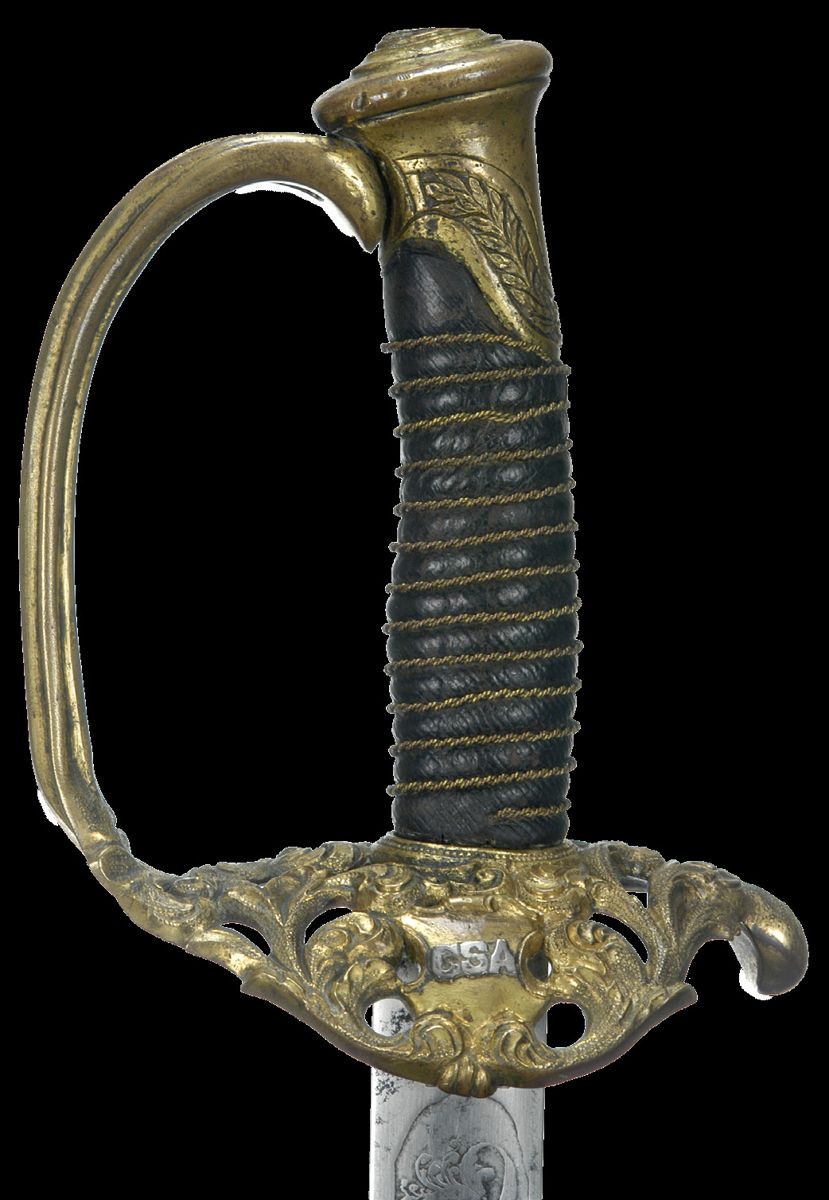
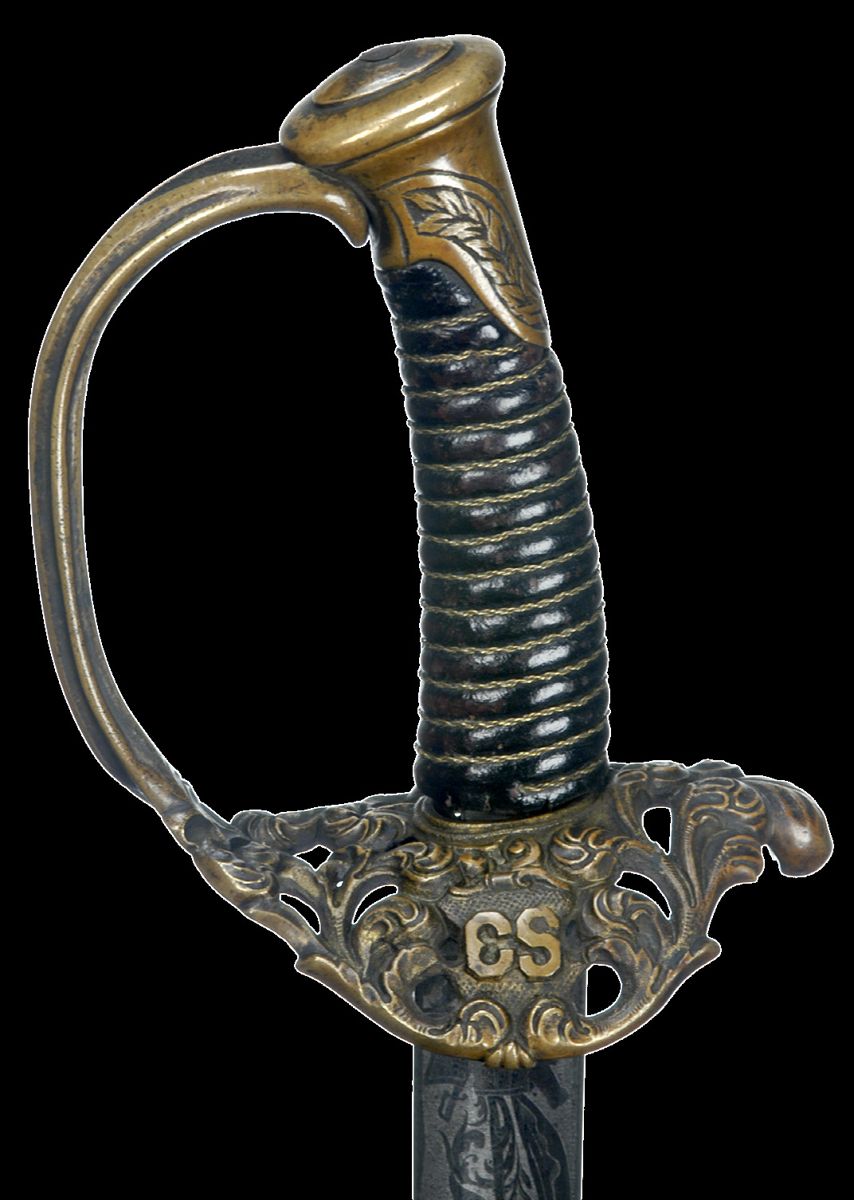
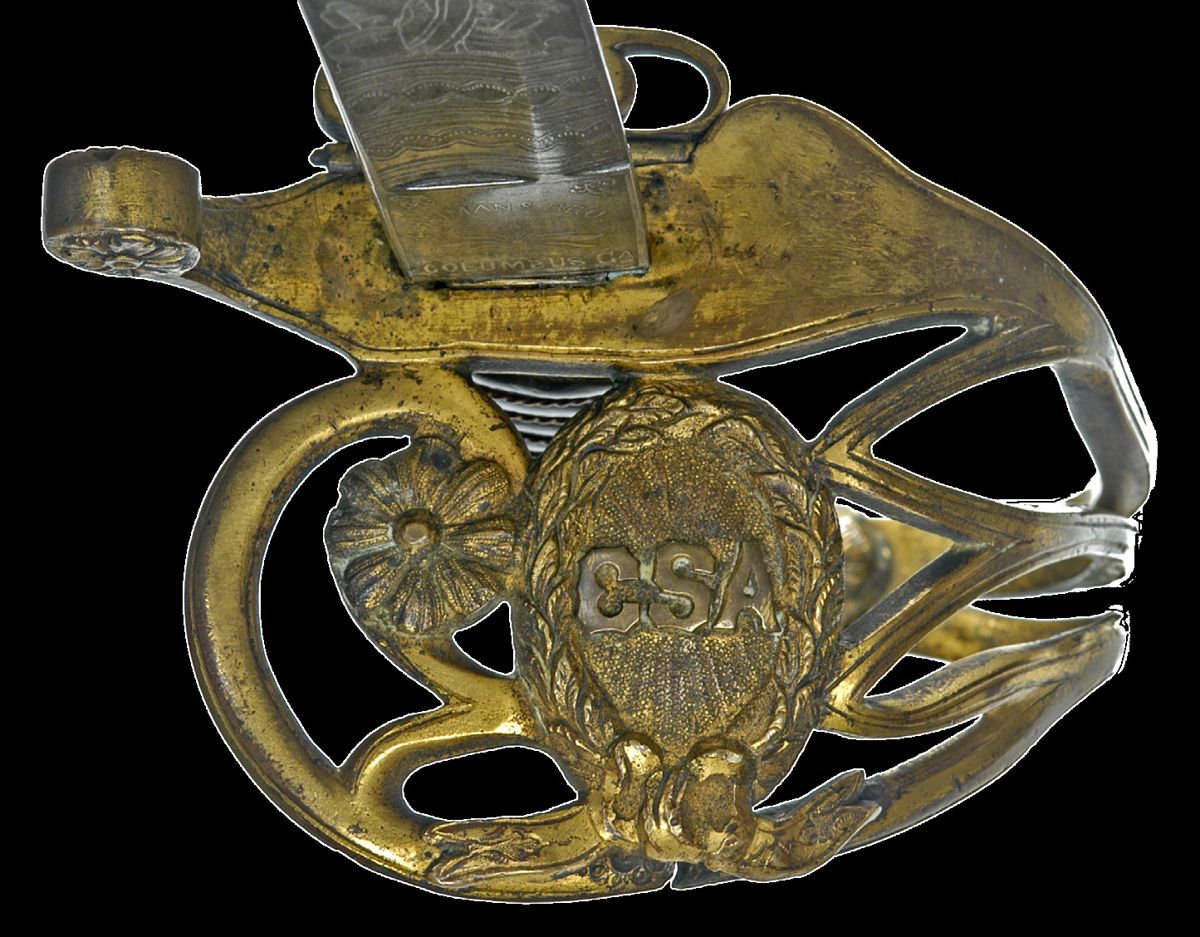
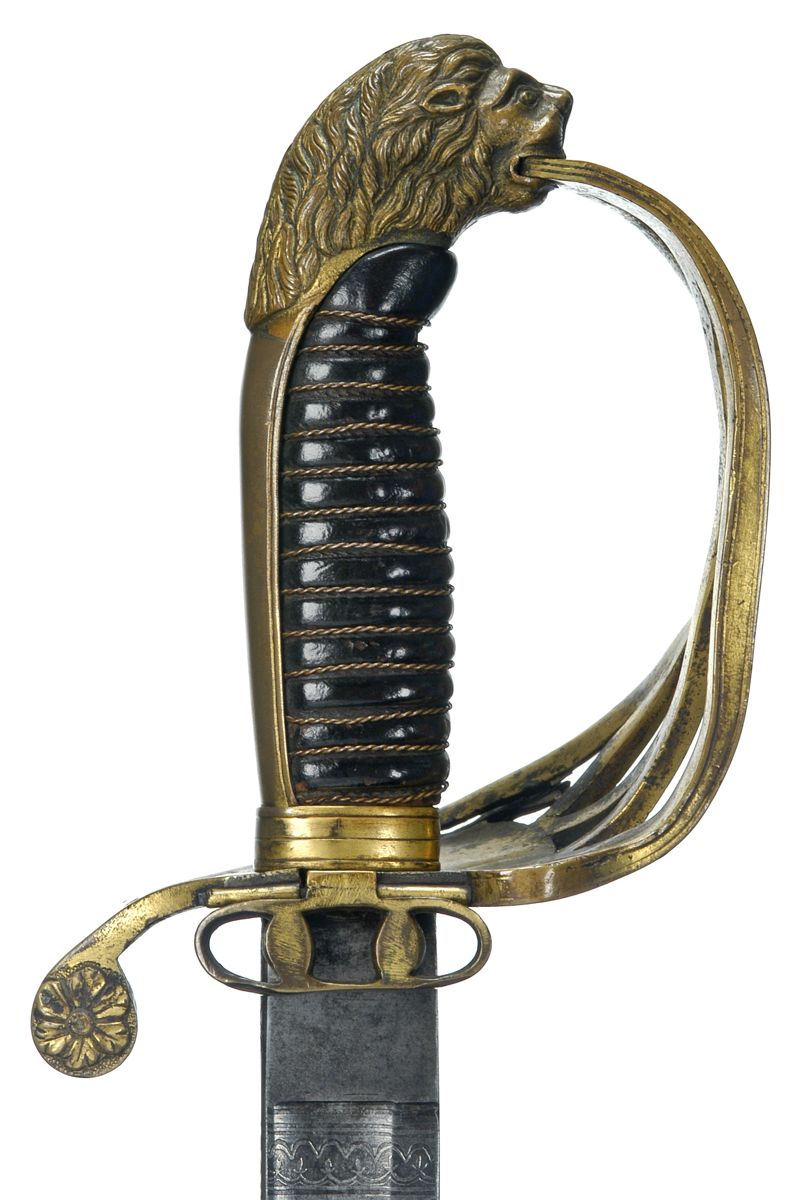
These heavy cavalry pattern sabers have a 35-inch forged blade, 1840 pattern brass hilt, and brass scabbard rings. The scabbard is lap seamed and lead soldered sheet iron with a flat soldered iron drag, flat soldered scabbard throat collar, and leather covered grip with a heavy single iron wire wrap. Haiman officer’s sabers are among the finest and most unique patterns known among Confederate sword manufacturers. They made two variants of staff & field officer swords with their unique hilt design; one has a raised relief cast “CS”, the other has an applied silver “CSA.” They also made company-grade foot officer swords. Their copy of the U.S. Model 1850, must have been the Southern regulation pattern as many Confederate manufacturers followed their lead. Haiman’s highest grade sword, most often given to general officers, had a lion pommel cap. On September 11, 1862, Haiman & Bro. obtained a government pistol contract. Like so many other Confederate revolver manufacturers, they did not realize the difficulty of producing large quantities of pistols. Haiman obviously had high expectations based on newspaper articles stating they had received a contract for 10,000 Colt navy revolvers. Haiman did not start production until May 1863, eight months later.
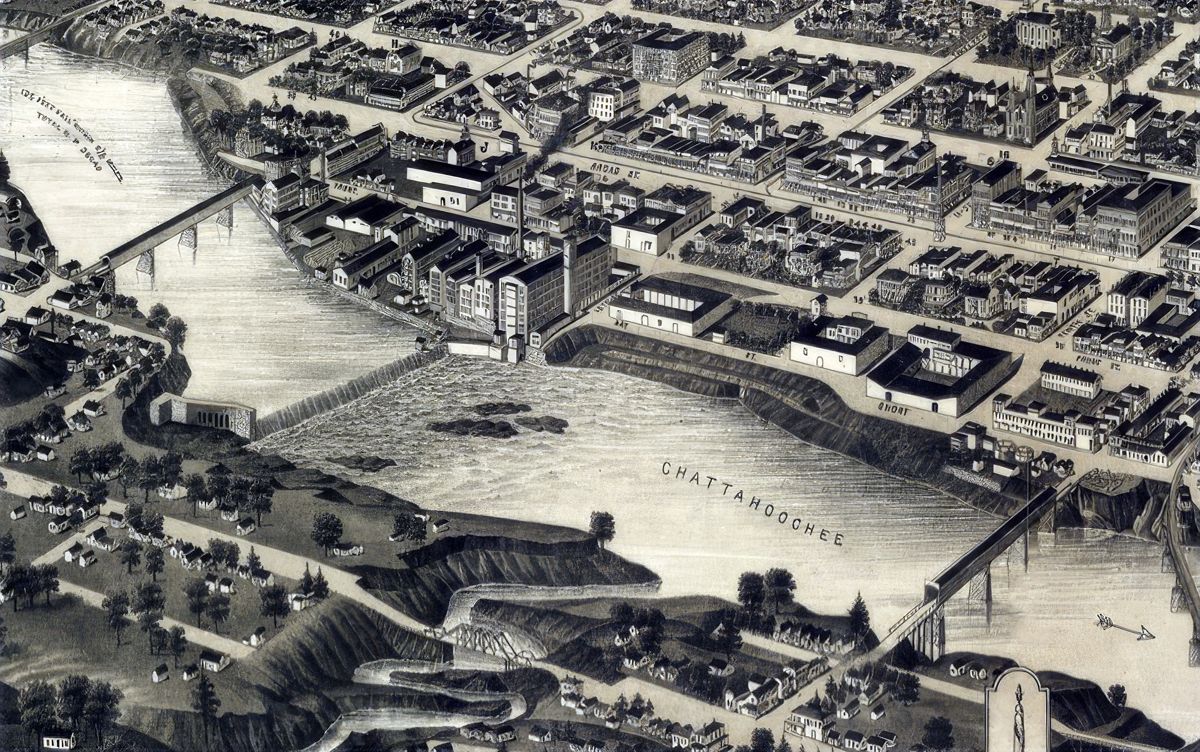
The Battle of Columbus hinged on control of the two covered bridges that connected Girard, Alabama, to Columbus, Georgia, across the Chattahoochee River in order to prevent access to Columbus, Confederates set fire to the lower bridge (right). (Wikipedia Commons)
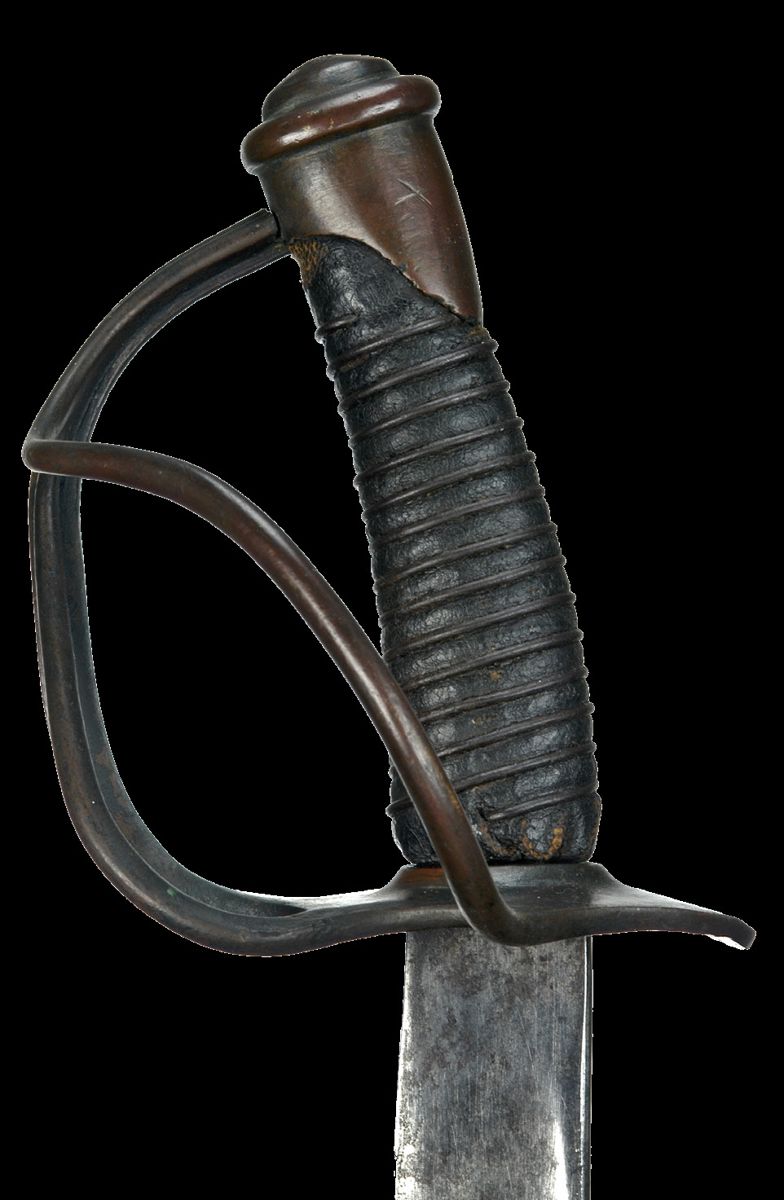
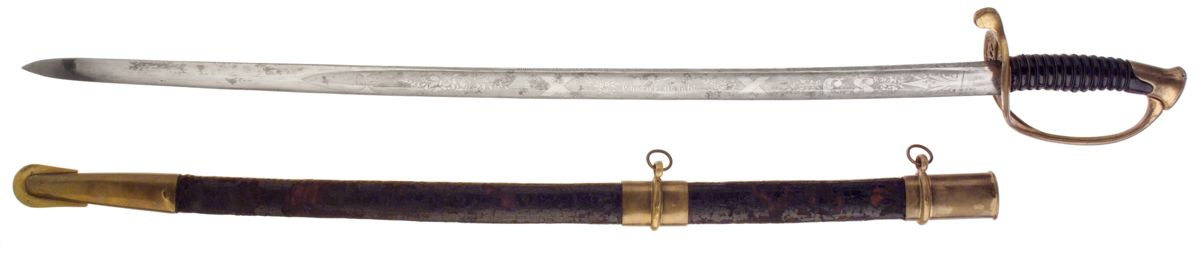
Classic Haiman slightly cocked cavalry hilt with a leather grip wrapped with a single iron wire.
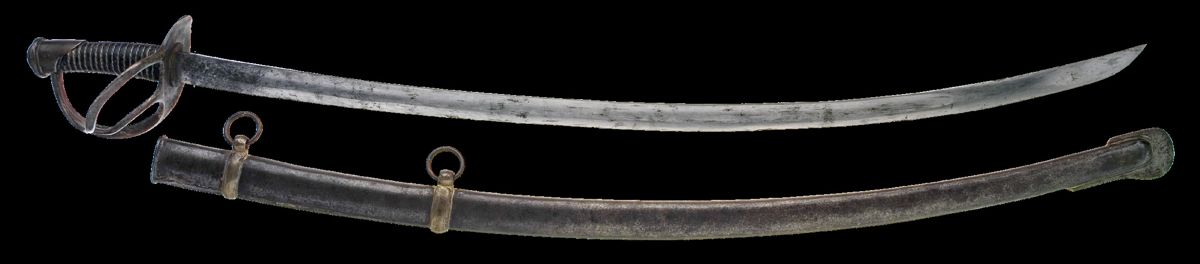
The firm shipped 600 sabers and 600 belts to MSK Richmond in one week during May 7-14, 1862.
These heavy cavalry pattern sabers have a 35-inch forged blade, 1840 pattern brass hilt, and brass scabbard rings. The scabbard is lap seamed and lead soldered sheet iron with a flat soldered iron drag, flat soldered scabbard throat collar, and leather covered grip with a heavy single iron wire wrap.
By August 17, 1861, Haiman was ready for war; by war’s end their enterprise had grown to the largest saber manufactory in the South. Their high-quality officer’s swords are among the finest made in the Confederacy and among the earliest.
The two hilt versions of Haiman Staff & Field Officer swords.
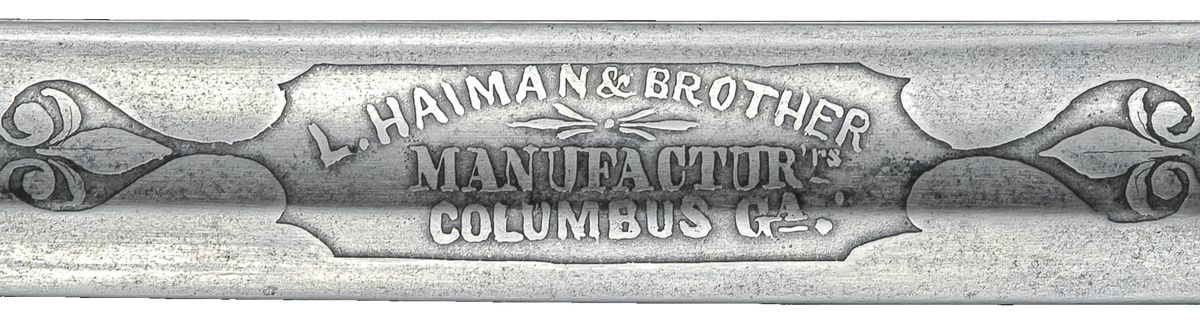
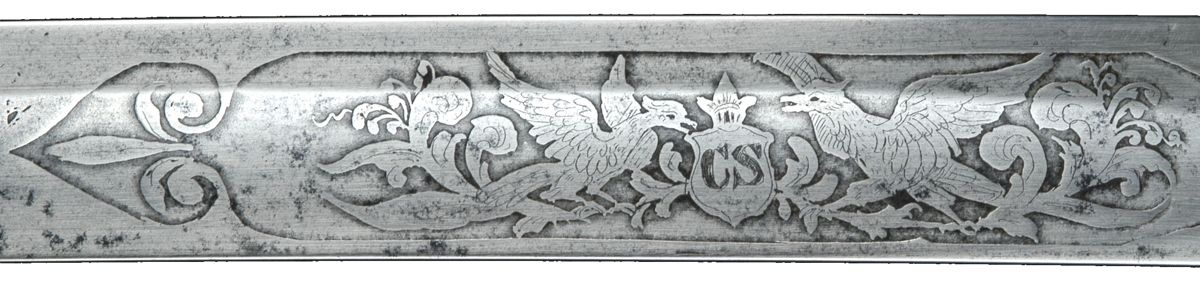
The typical maker’s marks on staff and field officer swords. Since almost all Haiman swords were all decorated by hand, no maker’s mark was ever exactly the same.
Alpheus Baker (May 28, 1828 – October 21, 1891) Haiman general officer’s sword; of the five presented to generals, all are slightly different. This survivor was presented to Brigadier General Alpheus Baker by his friends in Eufaula, Ala., after his promotion to general in March 1864.
Haiman etched blades are never the same. “DEO VINDICE” was a common theme, along with flags, and an interesting variety of animals and birds. Below are etchings from Brigadier General Alpheus Baker’s sword.
Haiman is estimated to have made about 100 pistols. Only three survivors are documented as being complete, and fully original, pistols made by Haiman and the “Columbus Firearms Company.” These are serial numbers (SN) 23, 34, and 46. Two additional revolvers, SN 67 and 94, are also Haiman products made with major Colt components incorporated.
(L. Haiman & Bros NARA, Citizens Files)
The Confederate government bought the factory in early 1864 and completed very few revolvers, all from inherited “assembled revolvers” that came with the factory’s purchase. Albaugh stated in Confederate Handguns that he believed that any governmentproduced firearms made with Columbus Firearms Co. equipment would be marked with Haiman’s typically tiny serial number dies. He was correct, even though no known examples had been discovered before 1963.
Haiman Foot Officer swords vary in quality. The highest grade is shown by this example presented by Captain Edgar G. Dawson to Charles Wright of Georgia’s Terrell Artillery. It has heavily gilded hilt and scabbard mounts, and a polished and brightly etched blade. The maker’s mark shown here is the rarelyseen stamped version.
The government pistol factory apparently started their numbering at SN 1, with no Columbus Firearms Company markings. Documented surviving serial numbers known are 16, 39, 46, and 467. SN 467 appears to be an anomaly in numbering. Note that “468” is found on the loading arm of Columbus Firearms Co. SN 46 at the Virginia Museum of History & Culture. The reason for the odd 400 range serial numbers on these two revolvers is unknown. Neither the government nor Haiman made anywhere near that many revolvers. In an October 1864 report, Major James Harding stated he had “some 200 assembled pistols” inherited from Haiman, but he classified all the major components as “worthless” (barrels, frames, and cylinders). I estimate no more than 100 revolvers government were made. Survival of the major Confederate revolver producers, Griswold & Gunnison, Spiller & Burr, Leech & Rigdon, and Rigdon, Ansley & Co., together had a total production of about 7,500. There are some 900 survivors documented today; that is about a 12% survival rate. Based on that average survival rate and currently documented nine Columbus Firearms Co. & Confederate Pistol factory survivors, there is a statistical probability of other survivors. If only 100 revolvers were made in Columbus at Haiman & government factory combined, at least a few more survivors should be out there to be found. I feel certain this article will bring out at least one or two additional survivors that are not marked other than with Haiman’s tiny serial numbers and other unique manufacturing characteristics..
with great accuracy. The company have a large number of the various parts of the pistol shaped out, which will be finished and put together so soon as the new buildings, which are now being erected just above the sabre manufactory are ready to receive the workman, which will be within a short time.” Only two original surviving later “Columbus Firearms Co” pistols are in the database, SN 67 and SN 94; both have 2-line barrel markings identical to SN 46 and no cylinder markings other than serial numbers. SN 67 has a Colt replacement cylinder. The SN 67 published photographs are only good at best. If the current caretaker of SN 67 would like to contact me, I would appreciate updating it in the database. Maj. James Harding moved from Charleston to Columbus to command The Columbus Pistol Factory, March 21, 1864. He made very few pistols and had much frustration with the lack of tools, machinery, and skilled labor. His first letters and reports were upbeat, but by October 26, 1864, he was frustrated and believed no pistols were going to be made, as noted in summarized sections of his five-page letter to Col. Josiah Gorgas, Confederate Chief of Ordnance.
Columbus Firearms Company pistols show a chronology of manufacture through the five documented survivors. Only the first two survivors, SN 23 and 34, have the threeline address marked on their cylinders. By the time SN 46 was made, cylinder address marking had been dropped and the company name was being added to the barrel. The final two revolvers, SN 67 and 94, both have a 2-line “Columbus Firearms Co” mark on their barrels. There is also a “Columbus GA” mark only observed on revolvers with cylinder address. SN 94 is the only “Columbus Firearms” marked octagonal barrel. It is possibly a refit and reworked Colt navy barrel done by Haiman. Several 1863 newspaper references mention the first Columbus Firearms revolver. On April 30, 1863, Savannah Daily News reported: “HAIMAN’S REPEATER.—We have had shown us yesterday a beautiful repeating pistol, the first out by the Columbus Firearms Manufacturing Company. We take the liberty of naming it Haiman’s Repeater, as Colt is a Yankee and in Yankee land making the same style of pistol to fight us with… It is handsomely mounted with polished brass, and the barrel and other parts are beautifully blued. The revolving machinery works quick and exact and quite easy…it is the same pattern as Colt’s celebrated navy repeater, which forces a ball a long distance
The Savannah Daily News April 30, 1863; this article was picked up and run by the Columbus Times.
Columbus Pistol Factory revolver SN 16 has the same tiny serial number die stamps as all other documented Columbus-made revolvers. Serial number 67 has identical “67” markings. The 467 is an anomaly, [4]68 is also found on one part of maker marked SN 46 in the Virginia Museum of History & Culture. This full octagonal barrel example is one of three noted; SN 94 is fully octagonal and has the 2-line barrel address. (See images below) Maj. James Harding was the commanding officer of the newly purchased Confederate pistol factory in Columbus, Ga. When he arrived, he had no employees and no way to manufacture significant components of the revolver, cylinders, barrels, and frames. He reported having enough small internal components for about 600 revolvers. He lamented in several letters that
The order assigning James Harding to the “pistol factory” in Columbus. (Page 145/188 NARA)
“One years work would yield 3600 pistols at a cost of $306,00000. It appears to me that the last named amount invested in cotton, transfered to Europe, would purchase a much greater number of pistols, and of a better quality than shown by the foregoing estimate, to say nothing of a great savings in time.”
Comparison of the same font SN dies with SN 46. From left to right are pistols [4]67; Haiman SN 46, and SN 46 at the Virginia Museum of History & Culture.
Harding had only eight workmen and a good foreman who had moved from the Macon pistol factory to repair arms. The firm manufactured no pistols but did finish an unknown number of previous Haiman guns that came with factory’s purchase. The difficulties of manufacture were so vast the commander of the pistol factory, James Harding, suggested investing the same amount of money in cotton and selling it in Europe, the Confederacy could buy higher quality revolvers for less money and in a more timely manner. “The components for some 600 pistols (of the smaller components such as keys, rammers, hands, split springs, sears, etc. a much larger number had been made) had been made by Haiman & Bro. and from these components, some 200 pistols had been assembled, by dint of hammering and filing. The remaining components were purchased for the Government by a board of officers appointed by yourself. The smaller components, such as are mentioned above, can be worked up, but the larger, such as cylinders, lock frames and barrels are with few exceptions worthless.” It is obvious from Harding’s letter, that few if any assembled guns were usable “as found.” He obviously was able to salvage some. We can hypothesize that the 200 unfinished “assembled” guns eventually comprised the government’s production effort and included the surviving four government pistol factory weapons. The first example was not documented until recently, though at least one, SN 16, was suggested as being made in Columbus by Confederate revolver collector Don Bryan (1934–2022) in 1992. We compared SN 16 with marked SN 23 at the time, but we did not measure or compare to the marked SN 46 at the Virginia Museum of History & Culture which would have proven a manufacturing parallel, with identical serial number die font, etc. Harding is at wit’s end with a lack of machinery or workman. “The men transferred to me by Maj. Humphreys were literally ‘butchers & bakers & candlestick makers.’ There was not one man among them, a machinist, or finisher, and with these men it is necessary, to make tools.” “The tools purchased from Haiman (with the exception of the milling tools, nearly all of which can be made serviceable) were in nearly every case are of no value.” Harding further laments that he has a workforce of only eight men and can manufacture no pistols but has cleaned and repaired about 400 guns.
January 13, 1865, Harding to Burton, pistol production “…as pistols seem to be as far off as ever.” (NARA)
“Since April 1st last with an average daily force of eight (8) men, there have been cleaned & repaired to the present date 400 small arms, and the capacity of the shop is greater now than it has been heretofore, there having been lately added, a slugging machine, & buffing wheels for barrels.”
“Having been assigned to the command of this city, I have the honor to make the following report of property captured and destroyed… Haiman’s Pistol Factory: This establishment repaired small-arms, made locks, and was about ready to commence making revolvers similar to Colt army.”
James Harding to Burton, March 8, 1865, reports the factory is finally up and running, “Mr. Copeland now gives his full attention exclusively to the design of tools & machinery & inspection of work. This arrangement works well. This month we will turn out some pistols, and I hope to send you a sample by the 20th of the month.” Columbus fell a week later before any pistols could be made. This ended Confederate revolver manufacture before it could finally start. Bvt. Brig Gen. Edward Francis Winslow, 4th Iowa Cav. commanded troops during the Battle of Columbus on April 16, 1865. He destroyed the ironclad CSS Jackson as well as the arsenal, the armory, and many factories. He wrote in his very lengthy April 18, 1865, report:
Winslow’s report echoes Major Harding’s letter of March 8th that pistol production was about to begin in earnest. The production of Confederate Columbus revolvers ended in 1865, but fakers have made many examples to fill the needs of collectors who could never find one.
FA K E S
These revolvers are so desirable that many fraudulent examples have been documented for over 75 years. Bill Gary, in his excellent 1987 text, states that three revolvers listed in Albaugh’s 1963 Confederate Handguns are suspect. He is correct; one fake appears to have a written collection history dating back to 1947. One seller of that gun, Tom Haas Sr., (1919–2004), threatened to “kick my ass” if I continued giving my opinion that the marked Columbus Firearms pistol he was selling was fraudulent. That was 30 years ago. I told Tom, who was an extremely knowledgeable gunsmith and dealer, that the revolver was so different from any documented original example, it wasn’t possibly original. He told me his gun was unquestionably real, and the original pistols used as examples had to be fakes. That’s the way it used to be with authentication. Dealers/collectors would say, “it’s real because I said so” without any qualification or documentation. Everybody has an opinion, but only qualified opinions hold up to scrutiny (and in court). Three of the four original “Columbus Firearms Co” guns all sold for well over $100,000, dating back to the 1990s. The fourth example will not be sold anytime soon, we hope, as it is part of the Virginia Museum of History & Culture collection.
James Harding to Col. James H. Burton, March 8, 1865. (NARA)
Creative fakers have gone so far as to produce a false ledger detailing a few hundred Haiman revolvers supposedly made with either iron or brass frames, as well as inscribed and presentation revolvers. I used to see these frauds selling for more than $10,000 back when an average Confederate revolver was half that. At least one fake has resurfaced in public auction in the last ten years and sold for about $1,000. The fakes have scared even serious collectors, and maybe this article will help collectors understand that there are many more fakes than authentic examples. The last public auction of a marked survivor was in 2015 by James Julias Auctions. SN 23 went on the block and had no bidding. It was purchased after the sale by a knowledgeable dealer for $150,000.
The NRA museum was kind enough to allow us to use photographs of a revolver I vetted for them in 2019 which is one of many fakes of the same genre with a 2-line barrel marking and 3-line cylinder marking. Director and curator of NRA Museums Philip Schreier wrote a good article for December 2019 American Rifleman telling of the recently donated fraudulent pistol SN 89. Several of the better known fake Columbus revolvers have ‘CS” stamped on the trigger guard, emulating the mark found on the bestknown published example, SN 46, at the Virginia Museum of History & Culture.
COLUMBUS FAKE SN 89
Incorrect sans serif SN dies, and unbeveled frame to barrel interface not found on originals.
Fraudulent markings found on NRA Museum study example SN 89.
COLUMBUS PISTOL FACTORY SN 16 This revolver is virtually identical to Columbus Firearms revolvers SN 23, 34, and 46 other than a total lack of maker markings. The same tiny die stamped serial numbers match the Haiman examples, as do measurements, milling marks, and other internally observed manufacturing characteristics. It is the lowest known serial number of any Columbus Pistol Factory revolver made in 1864.
The same tiny serifed SN die fonts were used throughout both the Columbus Firearms Company and Confederate Pistol Factory production runs. They are a key signature indicating the firm’s manufacture.
In total, the pistol factory produced very few guns with possibly less than 100 completed revolvers. There are no inspection records currently known, so we may never know the actual production.
HAIMAN’S COLUMBUS FIREARMS COMPANY SN 23
An example of the same tiny serial die stamping found throughout both Haiman and government production.
Columbus Firearms SN 23 is a complete and original survivor. All parts are numbered as they would be on a Colt navy. Haiman copied the Colt navy but used the dragoon style round barrel instead of Colt’s original octagonal navy.
The barrel is stamped “COLUMBUS GA.”

SN 23 has a long collection history. Starting with Harry Brooks, Dallas, Texas; it was pictured in The Texas Gun Collector, Issue 36, July 1953; then owned by Jackson Arms; William A. Bond, Vernon, Texas. December 1959; Conestoga Auctions, Lot #566, July 5, 1994; Don & Kathlee Bryan Collection; James D Julia Auctions, March 15, 2016. SN 23 retains the original blue finish in protected areas.
The SN 23 cylinder is marked in three lines: “COLUMBUS FIREARMS / MANUF CO / COLUMBUS GA.” A small serial number “23” is stamped below the maker’s mark.
HAIMAN’S COLUMBUS FIREARMS COMPANY SN 34
Views of only other completely original Columbus Firearms Co. revolver with 3-line addressed cylinder and “COLUMBUS GA” marked barrel.
Courtesy the Lincoln Memorial University Museum, Dr. Carroll Rose Collection. (Photography of SN 34 by Othais McCarthy, candrsenal.com.)
Small SN 34 die fonts on the barrel, frame, trigger guard, and back strap.
“COLUMBUS GA” marked barrel.
Like SN 23, SN 34 is the only other original Haiman revolver with the 3-line cylinder address and single-line “COLUMBUS GA” barrel marking. The next surviving pistol, SN 46, has no cylinder marking other than a SN. The 2-line address was placed on the barrel.
HAIMAN’S COLUMBUS FIREARMS COMPANY SN 46
SN 46 is all original. The manufacturer’s marking is placed on the barrel in 2-lines. There are no markings on the cylinder other than its SN. There is a duplicate SN 46 with a full octagon barrel in the collection of Hayes Otoupalik in Missoula, Mt., which is no doubt another Confederate governmentproduced revolver from the Columbus Pistol Factory. (Virginia Museum of History & Culture, 1990.100.17)
COLUMBUS PISTOL FACTORY SN [4]167
This revolver has the same tiny serial number die stamps as all other documented Columbus-made revolvers. Serial number 67 has identical “67” markings. The 467 is an anomaly, [4]68 is also found on one part of maker marked SN 46 in the Virginia Museum of History & Culture. This full octagonal barrel example is one of three noted; SN 94 is fully octagonal and has the 2-line barrel address.
This revolver has long Texas collection history last sold at Poulin Auctions in 2019. (Courtesy Poulin Antiques & Auctions, Inc.)
SE L E C T E D B I B L IO G R A P H Y: p Albaugh, William, Confederate Arms, 1959. p Albaugh, William A. III, Hugh Benet, Jr., and Edward N. Simmons, Confederate Handguns: Concerning the Guns The Men Who Made Them and the Times of Their Use, 1963. p Anthony & Hill, Confederate Longarms and Pistols, 1978. p Edwards, William, Civil War Guns, 1962. p Fuller, Claud E., Steuart, Richard, FIREARMS OF THE CONFEDERACY. The Shoulder Arms, Pistols and Revolvers of the Confederate Soldier, including the Regular United States Models, the Imported Arms and Those Manufactured within the Confederacy., 1944. p Gary, William A., Confederate Revolvers, 1987. p Hartzler, Dan, Confederate Presentation & Inscribed Swords and Revolvers, 1988. p National Archives, archives.org. p Sexton, John “Proprietary Database of Confederate Revolvers.” p Steuart, Richard, The Story of the Confederate Colt. Army Ordnance, Vol. XV, pp. 88-93 September/October 1934. p Steuart, Richard D., “Firearms of the Confederacy, 1861–1865,” Magazine of Antique Firearms, December 1911: Vol. III, No. 1. p Whisker & Yantz, Arming the Glorious Cause, 1998.
About the Author
John Sexton holds the highest designations as certified appraiser of personal property with International Society of Appraisers (ISA-CAPP) and accredited senior appraiser with American Society of Appraisers (ASA) specializing in Civil War memorabilia. He authenticates and evaluates other rare and valuable historic items as well. He is coauthor of the book Confederate Bowie Knives (2012) with Jack W. Melton Jr. and Josh Phillips, published by Mowbray Publishing Inc., and author of many periodical articles on Confederate arms. John’s contact information: website: www.civilwarappraiser.com, email civilwarappraiser@gmail.com, cell 770-329-4984.
Columbus Iron Works, operated by Haiman during the Civil War. Front Avenue between Eighth and Tenth Streets, Columbus, Ga. (Library of Congress)