
Odyssey of a “pickett’s Charge” Vet’s Militia Frock Coat
By Steven Knott · Originally published May-June 2024 · pp. 14–27
Odyssey of a “Pickett’s Charge” Vet’s Militia Frock Coat By Steven Knott
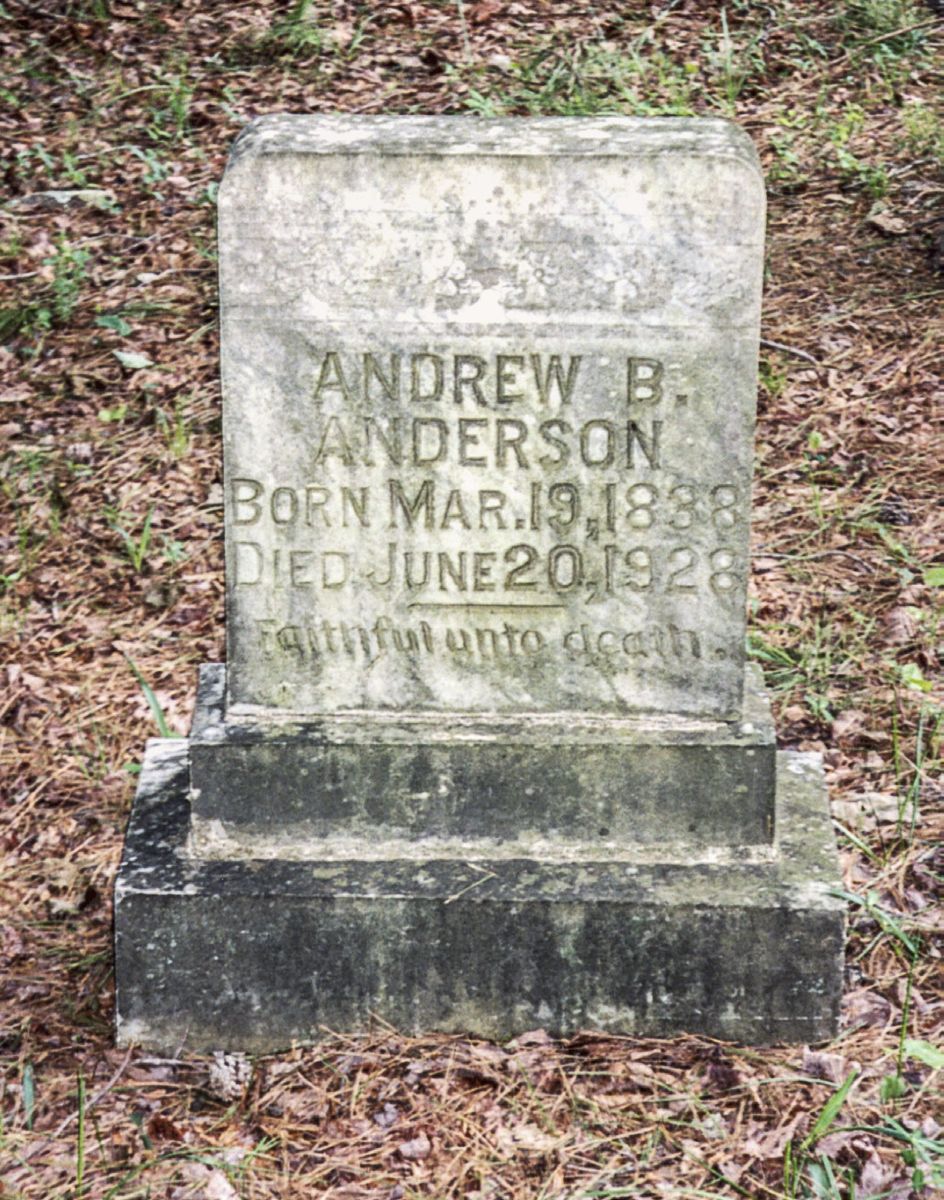
In 1960, a hopeful collector and an elderly woman traveled down a rural dirt farm lane near the small town of Halifax in Virginia’s southern Piedmont. Their destination was the “Double Branch” farm, where the octogenarian, Sallie, retrieved a blue enlisted man’s Virginia Militia frock coat hanging inside the stable. She then escorted the collector to the family cemetery located just beyond the tobacco barn. Standing in front of the gravestone of Andrew B. Anderson, Sallie informed the collector that the uniform belonged to Andrew, who served in the Civil War. Before departing the farm, the collector completed the transaction and paid Sallie ten dollars for the frock coat. The visit went undetected by the owner of “Double Branch,” Sallie’s cousin and the grandson of Civil War soldier Andrew. Moreover, the absent uniform was not missed as the attention of Anderson family members became distracted due to the impending and contentious sale of the farm in 1961. Andrew Broadus “Broad” Anderson, born in 1838, grew up at the “Double Branch” and worked the farm under the able supervision of his mother, Lucy Ann Farmer Anderson, his father having died when Broad was an infant. He joined the 69th Regiment of Virginia Militia in 1859 and served as a private in the company commanded by his older brother, Captain John W. Anderson. His newfound military vocation was likely in response to John Brown’s attempted slave insurrection at Harpers Ferry the same year; widespread apprehension throughout the South prompted a call to arms, and the ranks of state militia regiments swelled with new recruits. Broad obviously acquired the blue Virginia Militia frock coat upon his enlistment in the 69th regiment. A period photograph of his brother, Captain Anderson, shows him wearing an officer’s version of the identical frock coat. In the wake of Virginia’s decision to secede from the Union, Broad enlisted in Company C of Montague’s Battalion on July 10, 1861, at the Union United Methodist Church in Halifax County. Like so many other 1861 volunteers, he proudly entered Confederate service wearing his militia uniform. Five months later, the battalion was incorporated into the newly minted 53rd Virginia Infantry Regiment. Company C of Montague’s Battalion became Company F in the new regiment, and Broad was elected first sergeant. Promoted to second lieutenant in May 1862, it is impossible to know how long Broad wore his blue militia frock coat prior to earning his commission, though the problematic color suggests it may have only been for a short period. A photograph taken following his promotion clearly depicts him wearing a lieutenant’s gray uniform of regulation Confederate pattern. The 53rd Virginia Regiment, attached to Brigadier General Lewis A. Armistead’s Brigade, witnessed its first significant combat at Seven Pines when committed to action on the second day of the battle on June 1, 1862. Though they had now “seen the elephant,” the men of the regiment experienced a much greater trial by fire exactly one month later when they spearheaded General Robert
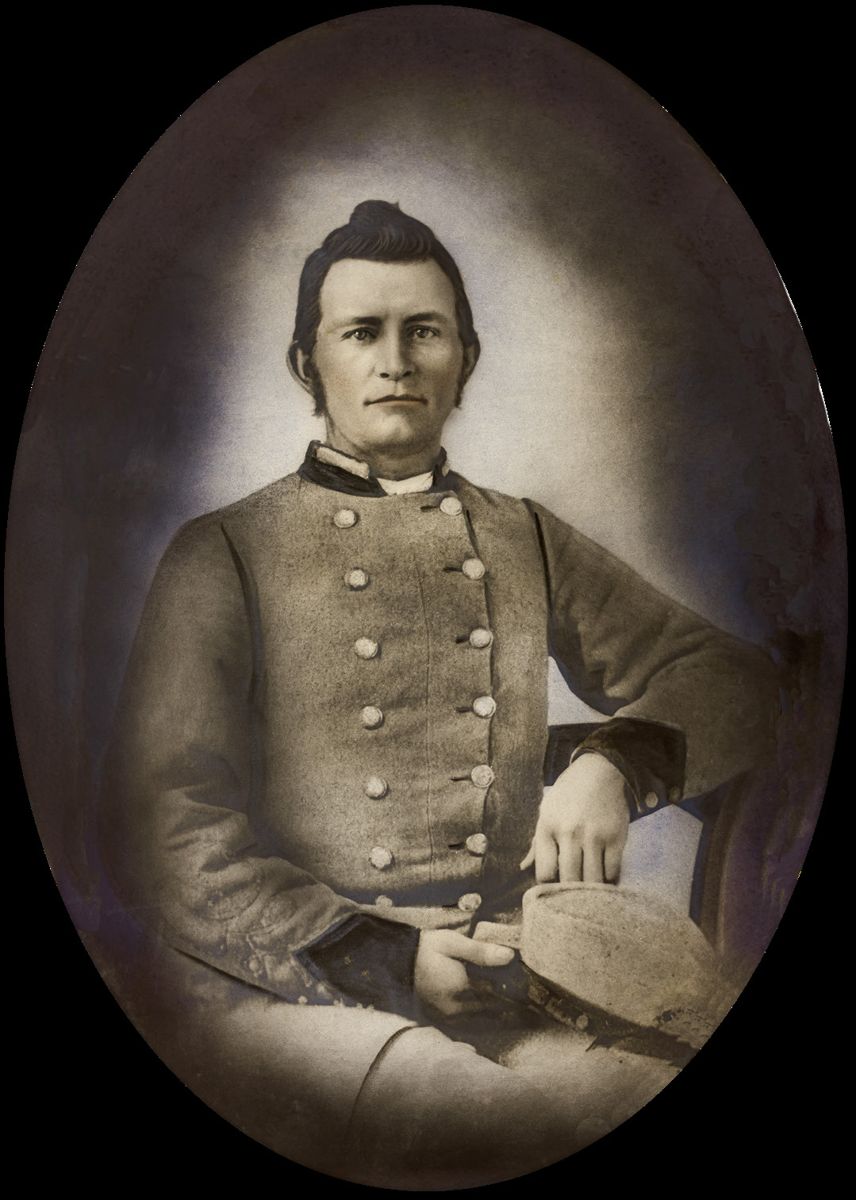
2nd Lieutenant Andrew Broadus Anderson, Co. F, 53rd VA Infantry. This photo was taken upon earning his officer’s commission in May 1862. (Author’s collection) E. Lee’s ill-fated attack against strong Federal defenses on Malvern Hill. The Virginians performed valiantly, but they were inevitably pinned down on the hill’s slope beneath the muzzles of massed Union artillery. Consequently, the 53rd Virginia suffered casualties of three killed, 27 wounded, and six missing, regimental losses that would only be eclipsed at Gettysburg. Following the Seven Days battles, the 53rd Virginia saw slight action at Second Manassas, South Mountain, and Sharpsburg. Soon after, Armistead’s brigade was reassigned to Major General George E. Pickett’s Division following the reorganization of the Army of Northern Virginia in October 1862. Broad was promoted to first lieutenant on January 13, 1863, and then departed on some leave through the end of February. Following his return, Pickett’s Division participated in Lieutenant General James Longstreet’s campaign against Suffolk, Virginia, in April and May. Absent from the great victory at Chancellorsville, Pickett’s veterans rejoined the army in time for the June 1863 invasion of Pennsylvania. Unfortunately for the Virginians, General Lee’s bold offensive would culminate in the greatest battle of the war at Gettysburg and an appointment with destiny from which many of them would not return.
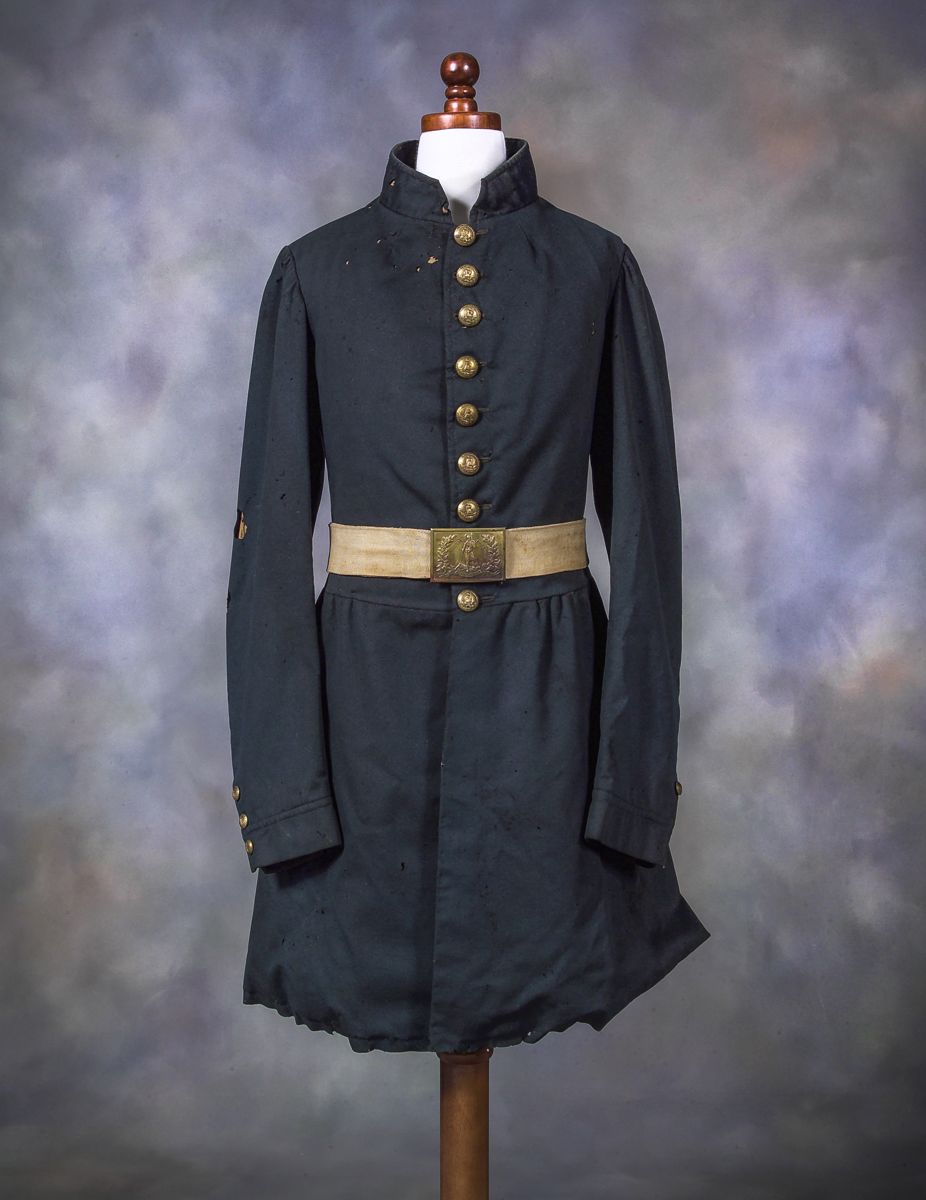
Front view of Anderson’s rare blue Virginia Militia frock coat. He wore this frock coat while serving in the 69th Regiment of Virginia Militia prior to the Civil War and after entering Confederate service in July 1861.
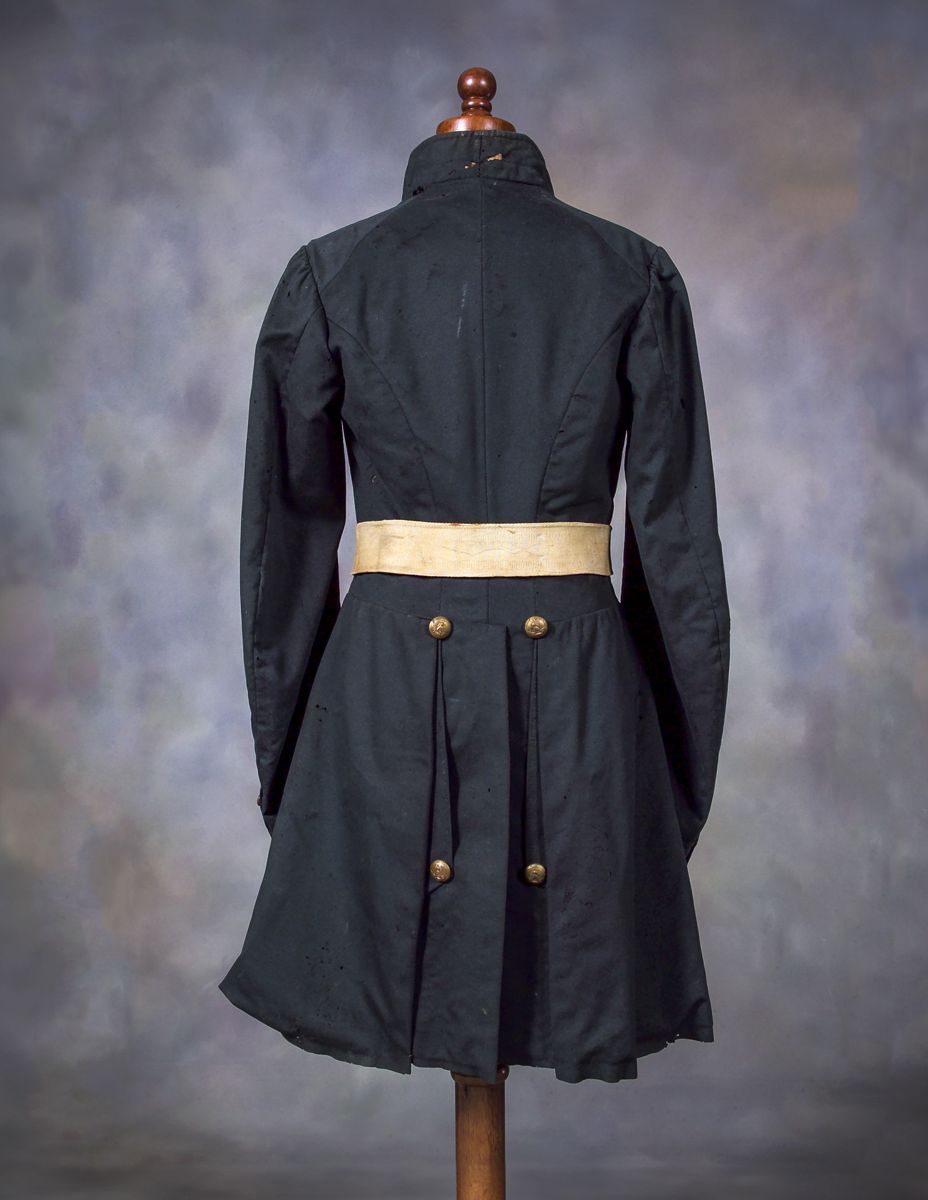
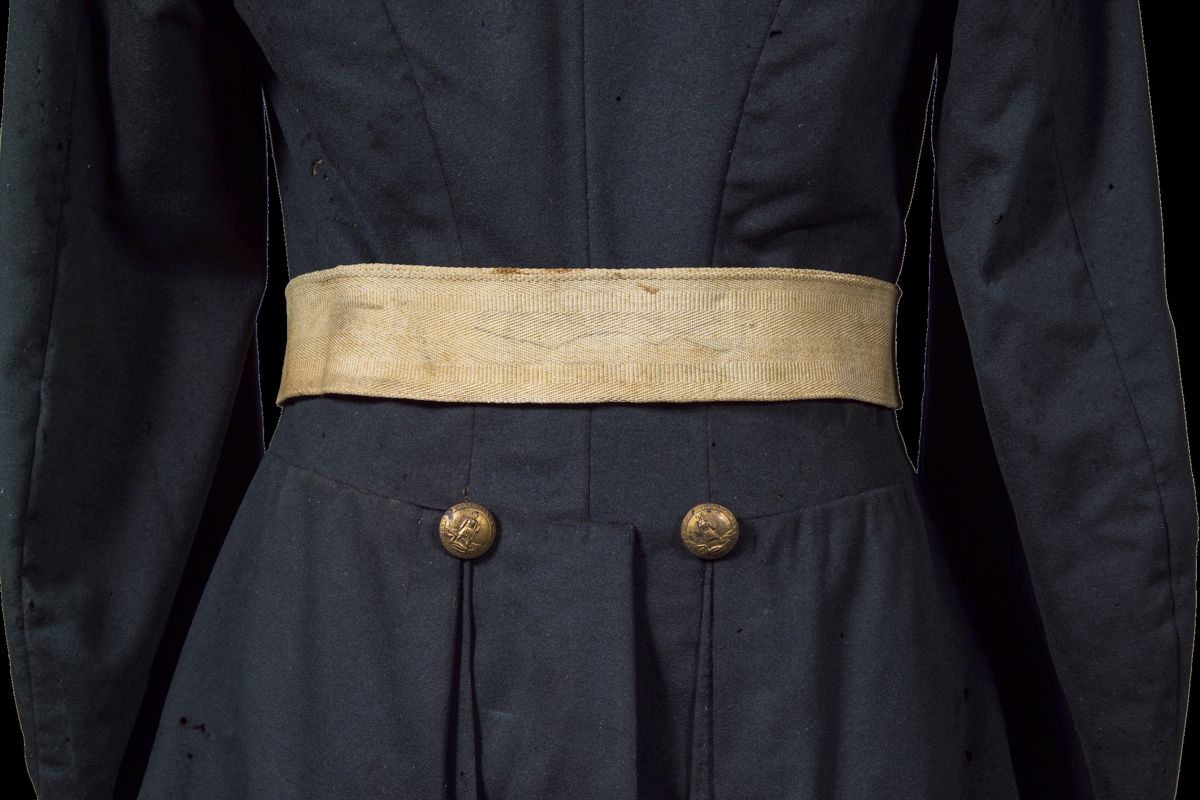
Reverse view of Anderson’s Virginia Militia frock coat. (Photos of uniform by Scott Finger)
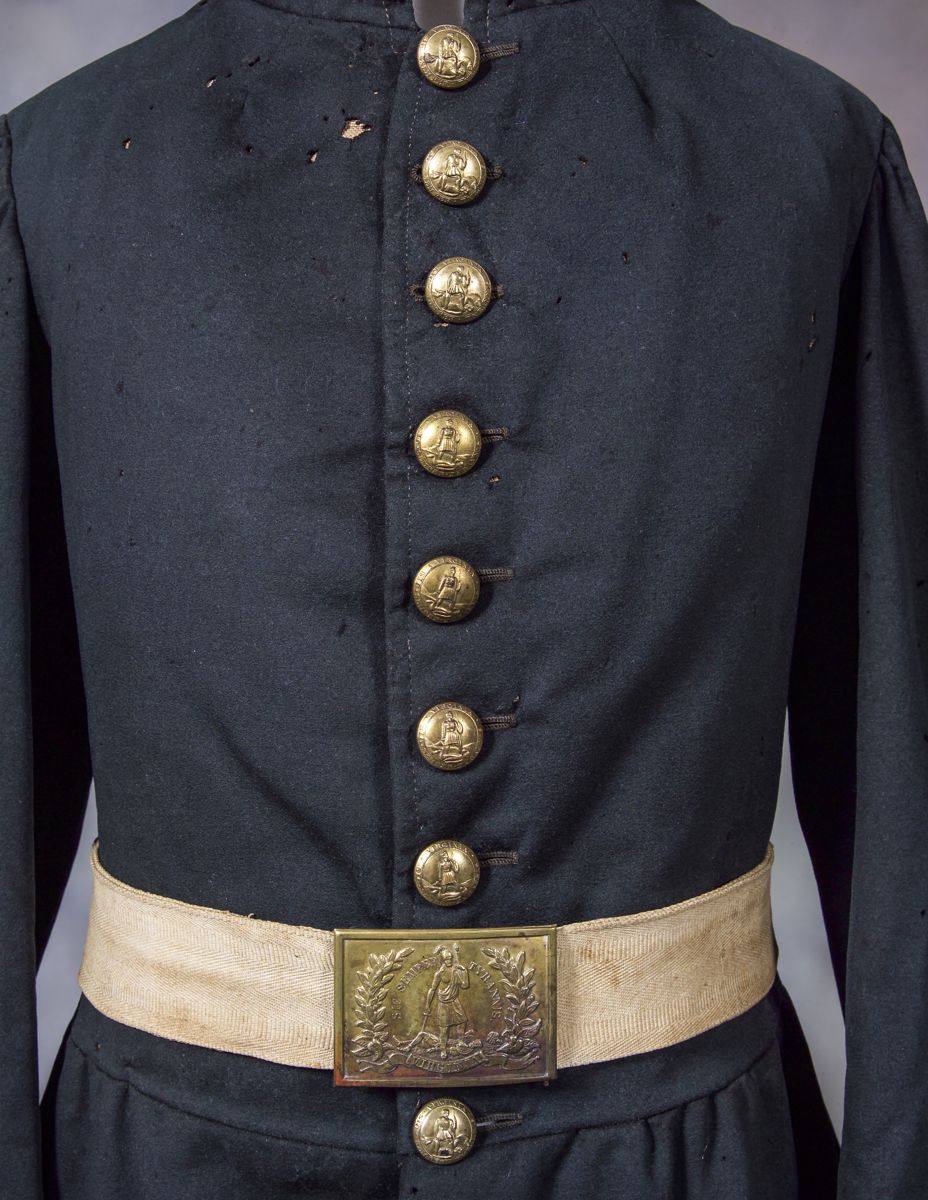
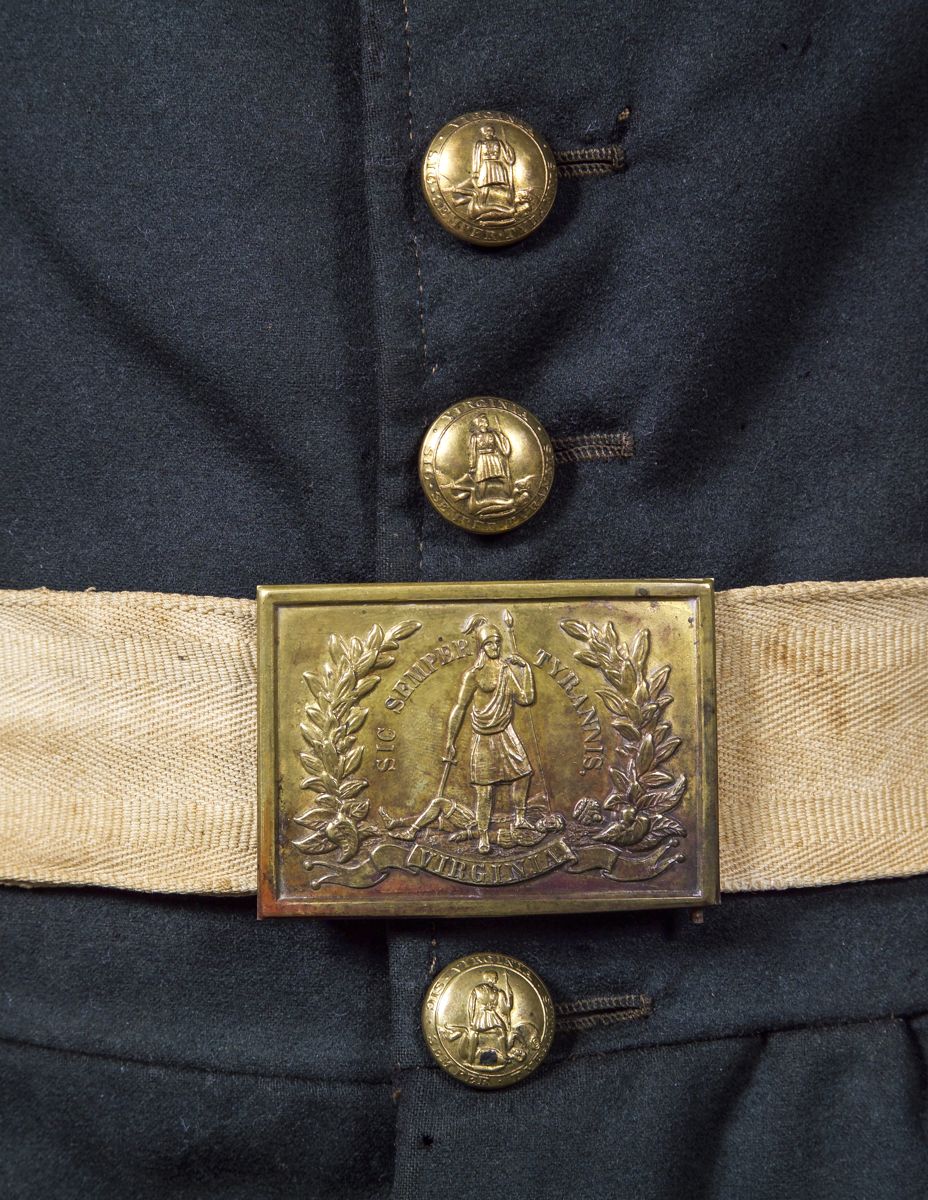
Detail of the Virginia Militia plate, white cloth belt, and front coat buttons. The buttons are original to the uniform and made by Hortsmann & Allien and Scovills & Co. The belt is the correct type worn with this uniform, but it did not belong to Anderson.
Detail of the right sleeve and Virginia State Seal cuff buttons.
Detail of the rear skirt buttons.
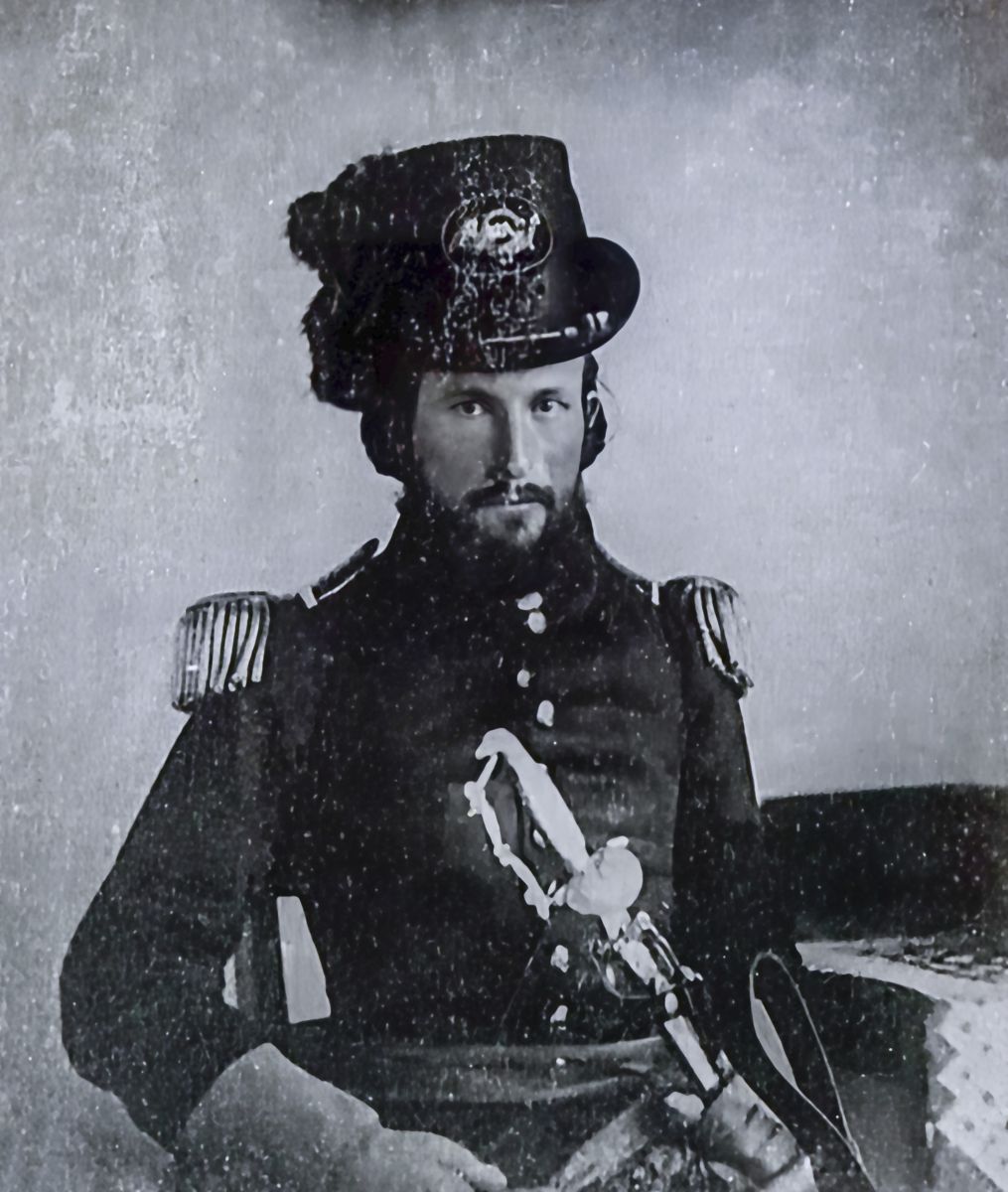
Captain John W. Anderson, 69th Regiment of Virginia Militia. A.B. Anderson served in his older brother John’s militia company prior to the Civil War. This image shows the officer’s version of the rare blue Virginia Militia uniform. John Anderson served in the 3rd Virginia Cavalry during the Civil War and died in Elmira prison camp, New York, in October 1864.
Broad commanded Company F during the Gettysburg campaign. As such, he had a front-row seat for one of the most famous events of the war: “Pickett’s Charge.” Having aggressively assailed the Federal Army of the Potomac during the first two days of the battle, victory still eluded Lee. Consequently, on July 3, he decided to hurl three divisions against the Union center, to be supported by an unprecedented preliminary artillery bombardment. The 53rd Virginia was positioned in the center of Armistead’s Brigade for the assault. Armistead personally conversed with the 53rd Virginia’s colorbearer, Sergeant Leander C. Blackburn, challenging him to plant his colors on the Federal works, and then shared a swig of spirits with the sergeant from his flask. Sergeant Blackburn would be the first of ten colorbearers to fall advancing the battle flag of the 53rd Virginia across nearly a mile of intervening fields. At one point, every member of Company F was knocked to the ground when an artillery shell exploded in their ranks; yet those who were not killed or wounded regained their feet and pressed on towards the objective. Despite the valor of the soldiers, the charge proved forlorn. An estimated 150 to 300 Confederates, including General Armistead – penetrated the Union line at “The Angle,” but they lacked sufficient strength to carry the day for Lee. Broad made it to the stone wall of “The Angle,” arriving a dozen yards to the right of General Armistead, but he was shot down before crossing, probably by a soldier of the 69th Pennsylvania Infantry. The Federal bullet entered below his left shoulder blade, exited his side below the armpit, and then carried away most of his left biceps muscle. Two of his soldiers pulled him out of the melee and assisted him back to Seminary Ridge. The charge cost the 53rd Virginia its highest losses of the war: 34 killed, 44 wounded, 57 wounded and captured, and 78 captured unwounded, casualties totaling 46 percent of those present for duty on July 3. The Virginians also lost their regimental colors within “The Angle,” as well as their
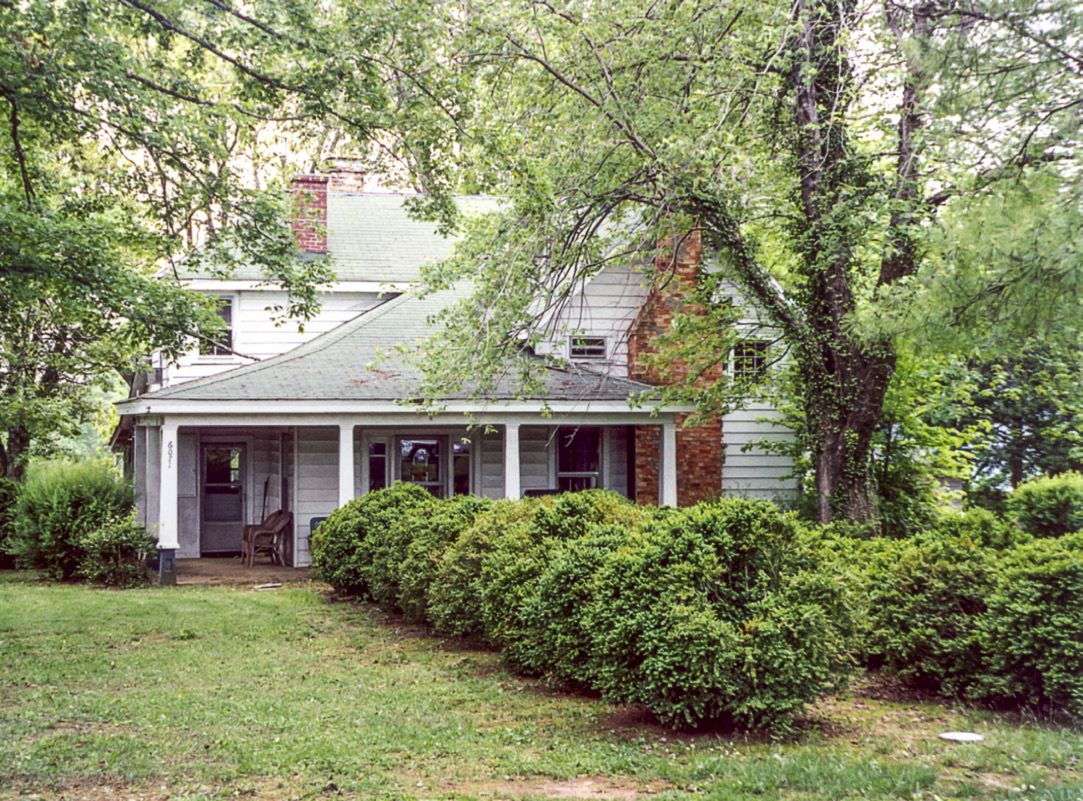
Front view of the Anderson “Double Branch” Farm house taken in 2008.
gallant brigade commander, General Armistead, who was mortally wounded. Severely wounded, Broad was transported by wagon as far as Staunton during the army’s retreat to Virginia. At Staunton, he was sent by rail to Richmond and admitted to General Hospital Number 9 on July 16, 1863. The following day, he was transferred to the Confederate General Hospital in Danville, Virginia, located near his home in Halifax. Consequently, on July 18, he was granted permission to convalesce at the family’s “Double Branch” farm. Though he would never regain full use of his left arm, Broad’s recovery progressed well enough to marry Sallie Elizabeth Wood on August 20, 1863. Duty necessitated a short honeymoon, as Broad returned to his regiment on August 27. Despite his debilitation, he again assumed command of the company. Broad soldiered on through 1864 and 1865, seeing action with the 53rd Virginia at Chester Station, Drewry’s Bluff, Petersburg, and Five Forks. Inevitably, the regiment’s men laid down their arms following Lee’s surrender at Appomattox on April 9, 1865. The final months had taken their toll; just eight officers and 78 enlisted men remained in the ranks at war’s end. Broad was paroled with permission to retain his private property of one horse and equipment, two blankets, and a haversack. He then rode home to Halifax County. Broad spent the remainder of his life on the “Double Branch” farm, having inherited the property following the death of his mother in 1867. His brother John never returned from the war; captured in 1864 while serving with the 3rd Virginia Cavalry Regiment, he died at Elmira prison camp of chronic diarrhea. Broad and Sallie Elizabeth had eight children to continue their legacy. The Confederate veteran died at age 90 in 1928. He remains on the farm still, buried in the family cemetery. He never returned to Gettysburg. Broad’s militia frock coat remained in the hands of the collector who first purchased it from octogenarian cousin Sallie until 1981, at which time he sold it to another collector. The uniform subsequently passed through the hands of a third collector until purchased by antique dealer Shannon Pritchard in 2001. A known stickler for verifying claimed attributions, Shannon followed the chain of custody and tracked down the first collector to verify the coat’s provenance. This individual fortunately remained among the living and could relate the story of old Sallie and the 1960 visit to the “Double Branch” farm. The now elderly gentleman even guided Shannon to the farm and showed him the grave of Andrew B. Anderson pointed out by Sallie. The original collector also provided Shannon with copies of two postwar letters written by Broad that he received with the frock coat in 1960. Satisfied regarding the provenance, Shannon sold the uniform to a fourth collector in 2001. In 2007, the fourth collector returned Broad’s frock coat to Shannon for sale on consignment. It was at this time that the author, who is Broad’s great, great grandson, became aware of the uniform’s location. Much astonished, the
Second grave marker placed on Anderson’s grave by the author in 2008. (Author’s photo) Anderson’s grave located on the “Double Branch” Farm, Halifax, Virginia. (Author’s photo)
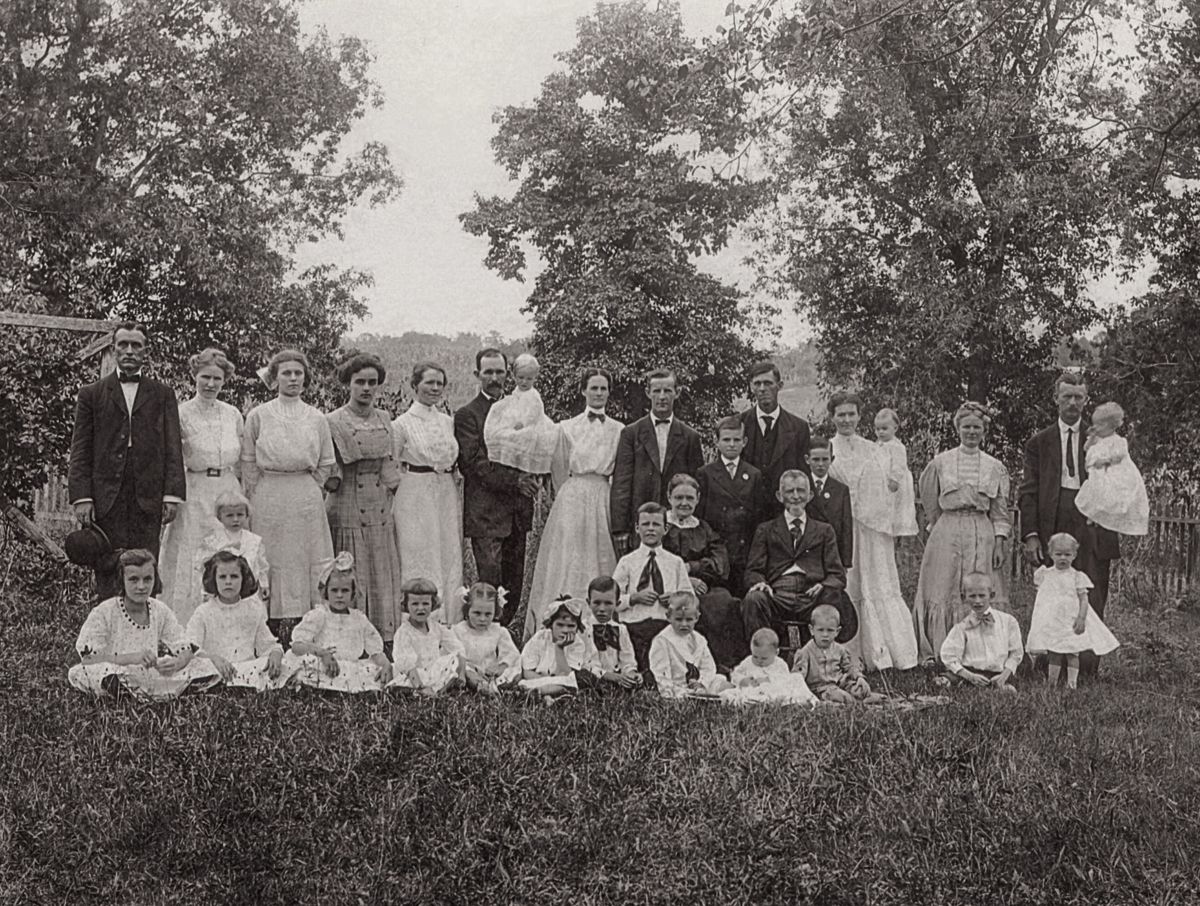
A.B. Anderson (seated right center) and wife Sallie Elizabeth’s large family at the “Double Branch” Farm in 1910. Anderson’s atrophied left arm, resulting from his Gettysburg wound, is visible in the photograph.
View looking north along “The Angle” at Gettysburg. According to Union 1st Sergeant Frederick Fuger, General Armistead crossed the stone wall in front of the remaining two guns of Cushing’s battery. Today this location is in front of the 72nd PA Infantry monument. Anderson stated that he reached the wall a dozen yards to the right of Armistead, thus placing him at the spot shown in the bottom left of this photo. Severely wounded by a bullet that entered below his left shoulder blade, exited his torso, and carried away most of his left biceps muscle, Anderson never crossed the wall and retreated with the aid of two of his soldiers. (Author’s photo)
Period engraving of Pickett’s Charge by Alfred Swinton from a pencil sketch by Alfred Waud. The Parrott rifle depicted in the image is incorrect; Cushing’s battery fielded 3-inch ordnance rifles. (Library of Congress)
B-52D bomber dropping ordnance over North Vietnam. (Author’s collection)
General Anderson on the B-52 flight line at Andersen Air Force Base, Guam, during Linebacker II in December 1972. (Author’s collection)
USAF Distinguished Service Medal awarded to General Anderson for commanding the 57th Air Division during Linebacker II. Reverse of General Anderson’s Distinguished Service Medal has his name inscribed.
Lt. General Andrew Broadus Anderson Jr., USAF. General Anderson, great-grandson of Civil War A.B. Anderson, commanded 153 B-52 bombers of the 57th Air Division during Operation Linebacker II in December 1972. His bombers flew 729 sorties and dropped 15,237 tons of ordnance on targets in Hanoi, North Vietnam. (Author’s collection)
author called immediately to purchase the frock coat, but at a price significantly higher than the original ten dollars. The astonishment came because the author had been searching for this uniform among the numerous branches of the large Anderson family for over 25 years. The quest, much complicated by the vagaries of strained relations among relatives of three generations, degenerated into an endless refrain of “I know for a fact they have Grandpa Broad’s Civil War coat in that branch of the family.” Little did anyone realize that no one in the family had possessed the uniform for nearly fifty years.
Staff of the Strategic Air Command (SAC) and as Director for Operations (J3), Joint Chiefs of Staff. As a young boy and teenager, prior to attending The U.S. Military Academy at West Point in 1944–1948, he often played and worked at the “Double Branch” farm, in close proximity to the grave of his Civil War namesake.
Andrew Broadus Anderson’s frock coat is now on display in the Gettysburg National Military Park Museum. Les Jensen, a respected authority on American military uniforms and a curator of the West Point Museum, described the uniform as a “fine example of an early war Virginia enlisted frock coat made by a tailor from quality goods.” The frock coat is rare because just a handful of prewar Virginia Militia regiments, including the 69th, wore blue uniforms, while the vast majority of the state’s militia donned gray uniforms. The artifact does exhibit moderate moth damage, a period repair to the inside lining of the skirt, and is missing two buttons on the left sleeve. The extant buttons are all original to the coat and marked “Horstmann & Allien NY” and “Scovills & Co. Extra.” The white belt did not belong to Anderson, but it is the correct original type worn with this uniform. Significantly, Jensen added that the uniform is the “only [known] surviving example of a dark blue Virginia private’s frock coat. As such, it is a unique and highly important survivor of the American Civil War.”
Anderson, William H. Interview with the author, Richmond, VA, January 12, 2002. Anderson was a teenager when his grandfather, A.B. Anderson, died in 1928; he recorded his grandfather’s accounts of the Civil War and “Pickett’s Charge” in a notebook.
As an interesting postscript, Broad’s great grandson, also named Andrew B. Anderson, served in the military as well. Attaining the rank of U.S. Air Force lieutenant general, he flew combat missions in the Korean War as a junior officer and later served in B-47 bomber squadrons. Anderson commanded the 410th Bombardment Wing, flying B-52s from Sawyer Air Force Base, Michigan, in 1970–1971. The following year, as a newly minted brigadier general, he was hand-selected to command the 57th Air Division. Based at Andersen AFB, Guam, this unit employed 153 B-52 bombers during Operation Linebacker II in December 1972 and flew 729 sorties over an 11-day period, dropping 15,237 tons of ordnance on 18 industrial and 14 military targets in Hanoi, North Vietnam. General Anderson also served as Chief of
SELECTED BIBLIOGRAPHY:
Compiled Service Records of Confederate Soldiers Who Served in Organizations from the State of Virginia, Fifty-Third Infantry (Company F, Andrew B. Anderson). Washington, DC: National Archives and Records Administration. Gregory, G. Howard. 53rd Virginia Infantry and 5th Battalion Virginia Infantry. Appomattox, VA: H.E. Howard, Inc., 1999. Hess, Earl J. Pickett’s Charge – The Last Attack at Gettysburg. Chapel Hill, NC: University of North Carolina Press, 2001. Jensen, Leslie D. Written Evaluation of the Virginia Militia Frock Coat of Andrew B Anderson, 2001, on file at Gettysburg NMP. McCarthy, James R. Linebacker II: A View from the Rock. Washington, DC: Office of Air Force History, 1985. Memorial Article for Lt. Gen Andrew B. Anderson, USAF, Cullum No. 16597-1948. West Point, NY: West Point Association of Graduates, 2016. Nanzig, Thomas P. 3rd Virginia Cavalry. Lynchburg, VA: H.E. Howard, Inc., 1989. Register of Militia Officers, 1828 – 1857 (69th Regiment of Virginia Militia). State Government Records Collection, Miscellaneous Reel 986. Richmond, VA: Library of Virginia.
About the Author Capt. Steven W. Knott, USN (ret.) currently serves in the U.S. Army War College Office of Outreach and Advancement where he conducts strategic leadership educational programs for senior executives from government and the private sector at historic battlefields in the United States and Europe. He is a former faculty member and academic chairholder in the war college’s Department of Military Strategy, Planning, and Operations. Capt. Knott is the author of The Confederate Enfield (revised edition 2019) and Captured and Collected: Confederate Reissued Firearms (2019). He retired from the U.S. Navy following 28 years of service in 2012. He commanded Helicopter Combat Support Squadron 8, based in Norfolk, Va., in 2002–2003. Earlier in his career, he conducted several deployments to the Mediterranean Sea and Arabian Gulf, as well as led helicopter support for the recovery of wreckage from the crash of TWA Flight 800 in waters off Long Island, N.Y., in 1996.