
An Original Pair of Leech & Rigdon Spurs
By Shannon Pritchard · Originally published November-December 2024 · pp. 7–17
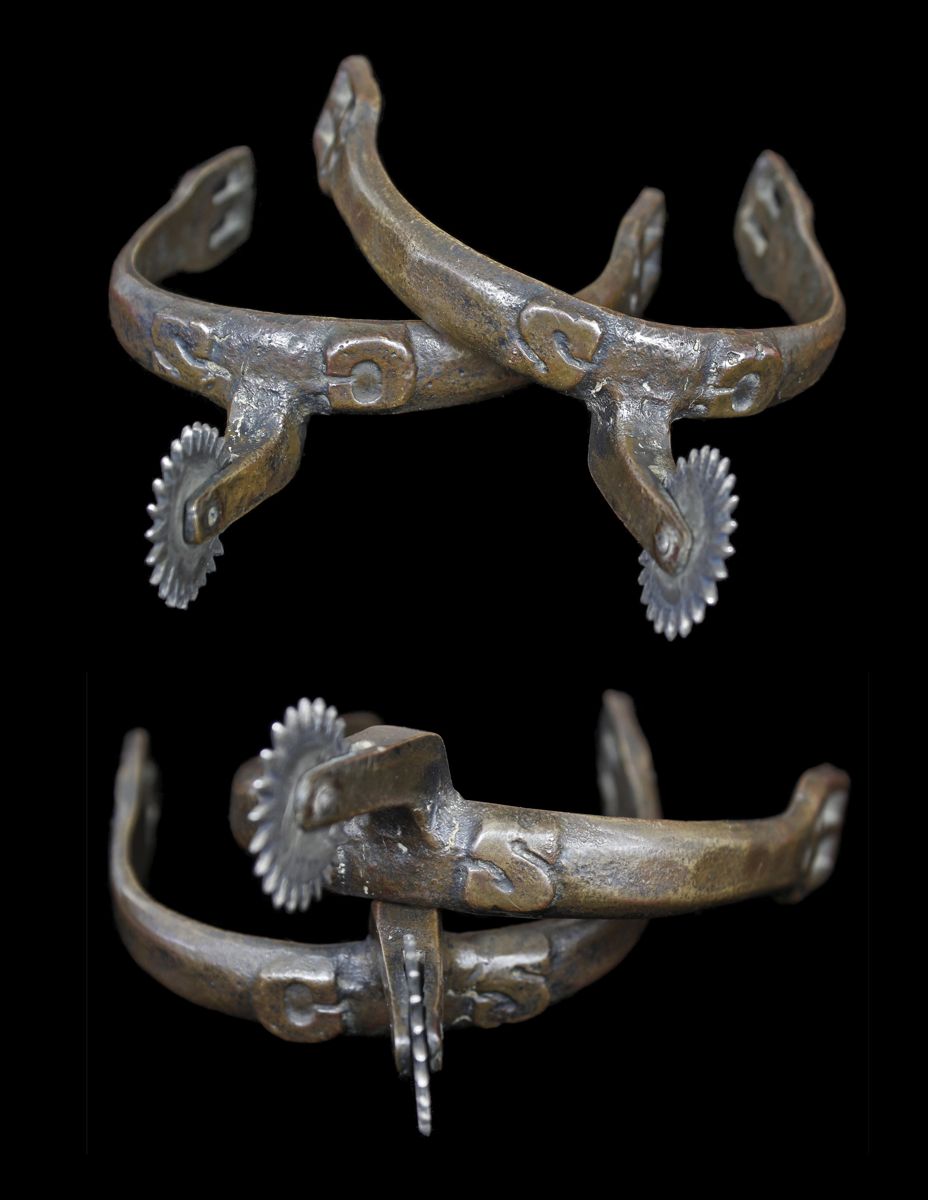
An Original Pair of
Leech & Rigdon Spurs
The ‘hammered’ look can be seen here, especially on the right spur.
The non-excavated pair of spurs displayed here was crafted by the renowned firm Thomas Leech & Company, more commonly known as the Memphis Novelty Works. Thomas S. Leech, a prominent figure in Memphis, Tenn., arrived in the city in 1854 with ambitions to establish a cotton dealership. His venture was backed by partners: his brother John B. Leech, Thomas Harrison, and the distinguished Sir Arthur Forwood and Sir William Bower Forwood of Liverpool, England. Together, they launched the firm Thomas Leech & Co., Cotton Brokers, operating from 35 Front Row Street in Memphis. As war became imminent, Leech and his partners began to expand their business to include war material. The military items they produced were sold under the name “Memphis Novelty Works, Thomas Leech & Co.” This enterprise quickly expanded to include a wide array of items essential for the Confederate war effort, including swords, spurs, side knives, belts, buckles, and pistols. In 1862, Leech formed a new partnership with Charles H. Rigdon, rebranding the venture as Leech & Rigdon.
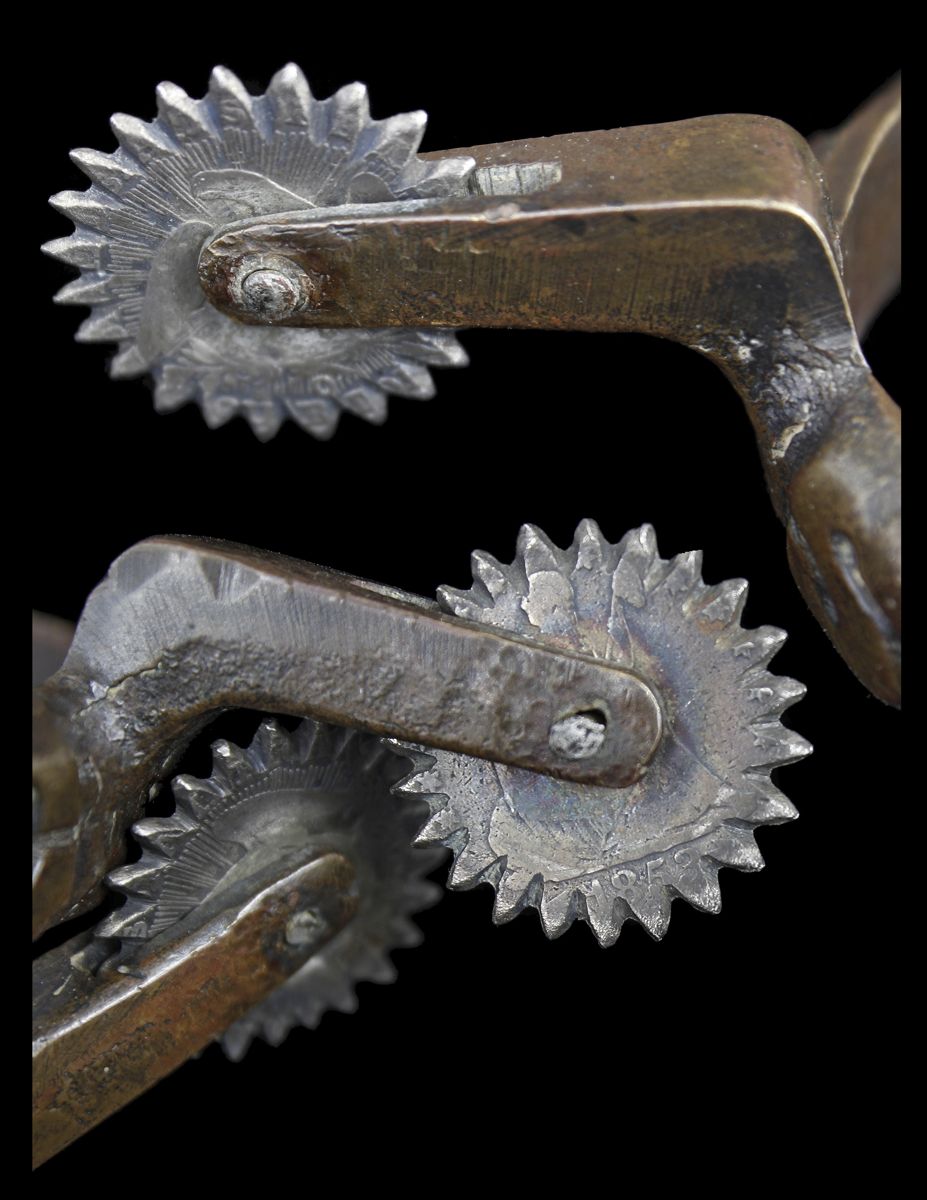
By March 1863, the partnership had parted ways with the Confederate arsenal, choosing instead to move their operations to Goldsboro, Ga. The spurs in question are a remarkable piece of history, featuring silver rowels crafted from a pair of 1853 New Orleans “seated” liberty coins. The spurs were made by first creating a sand mould from a flat spur pattern. They were then cast flat in brass and hammered around a rounded anvil to shape them. The shank was then split and a rowel inserted and pinned.
These spurs stand as a testament Memphis Dailyto the Appeal (Memphis, Te ingenuity and adaptability of Leech & Rigdon during one of the most tumultuous periods in American history.
The year 1862 was a pivotal one for Leech & Rigdon. The capture of Forts Henry and Donelson in the early spring signaled the fall of Tennessee into Union hands, prompting Leech & Rigdon to relocate their operations. They moved their business to Columbus, Miss., establishing a factory adjacent to the Confederate Briarfield Arsenal. The relentless threat of Union forces, particularly General Sherman’s advance, forced the Confederate government to relocate the arsenal to Selma, Ala., later that year. Leech & Rigdon followed, continuing their work in Selma for a brief period.
Memphis Daily Appeal (Memphis, Tennessee), Wednesday, Nov. 30, 1859, page 1.
Memphis Daily Appeal (Memphis, Tennessee), Tuesday, Oct. 29, 1861, page 4.
Memphis Novelty Works Ad
Leech & Ridgon document, signed by W. R. Hunt, Ordnance Officer, dated Oct. 27, 1862. One of the line items is for “400 Pr Spurs & Straps @ 175.” (NARA)
Leech & Ridgon document, received at Columbus, Miss., dated Dec. 6, 1862. One of the line items is for “400 Pr Spurs & Straps @ 175.” (NARA)
Notice the ‘hammered’ look of the heel band. This is from hammering it around the round end of an anvil.
Note the “American Eagle” on the silver rowel. Below note the “Seated Liberty” and 1853 mint date on the silver rowel.
About the Author Shannon Pritchard has authored numerous articles relating to the authentication, care, and conservation of Confederate antiques, including several cover articles and is the author of the definitive work on Confederate collectibles, the widely acclaimed
Collecting the Confederacy, Artifacts and Antiques from the War Between the States, and is co-author of Confederate Faces in Color.
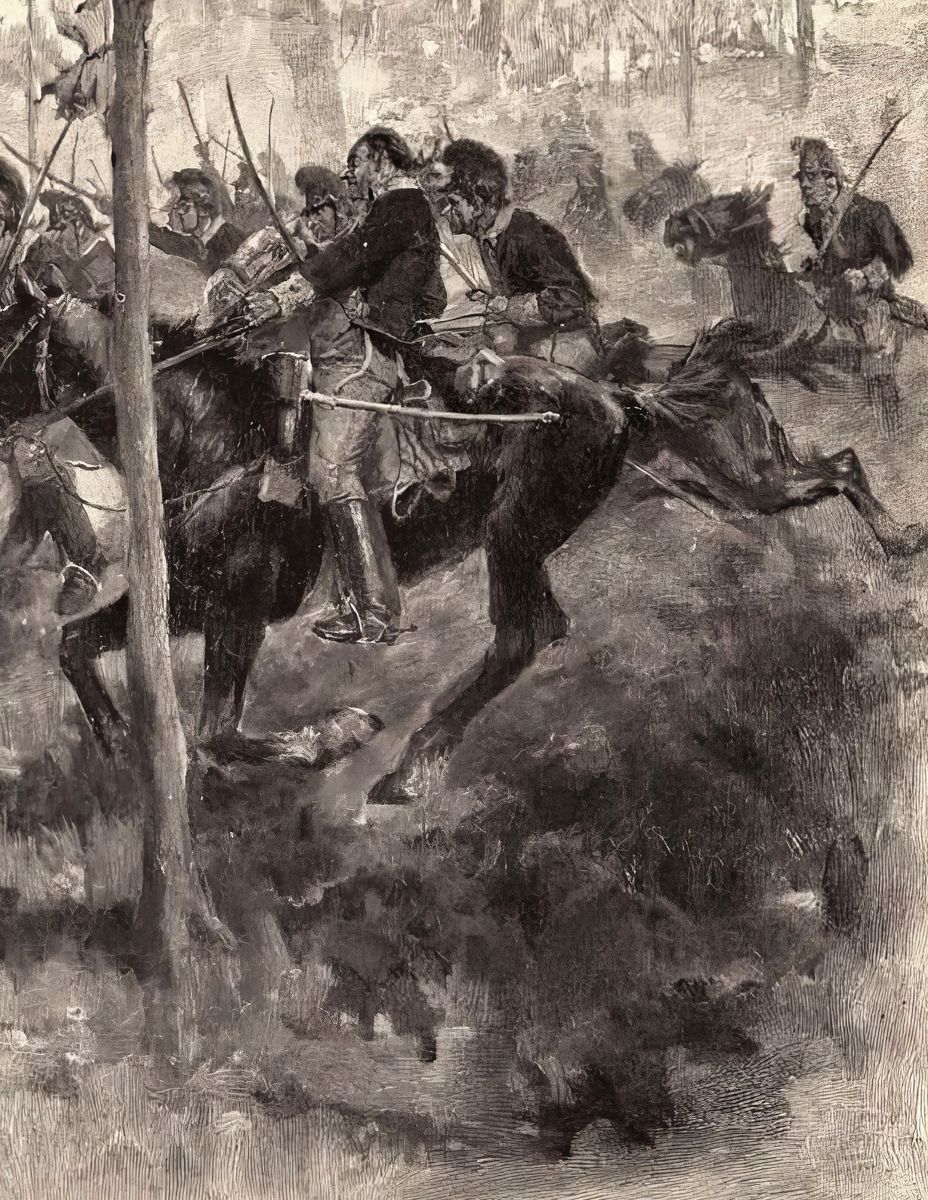
Introduction During the 1990s, Meryl A. “Mac” McGee recovered Revolutionary War artifacts at Camden, SC. A concentration of material was found on the southeastern spur of Hobkirk Hill, where heavy fighting occurred on April 25, 1781, when the British garrison sallied out, attacked the Continental Army, and forced the Americans to withdraw well north of the town. Among the relics was a coin silver heartshaped badge, the subject of this article. When General Nathanael Greene took position on Hobkirk Hill, a sand ridge one mile north of eighteenth-century Camden, he wanted the British to attack because the Southern Continental Army was not strong enough to besiege or attack the town. The Continental regiments were positioned on the hill in a formation that had the 1st Virginia slightly advanced on the western end of the battle line. The 2nd Virginia was posted on the right flank beyond the 1st Virginia. What is now Broad Street was the border between the 2nd Virginia and the 1st Maryland. Two 6-pounder cannon went between the Virginians and Marylanders. East of the 1st Maryland was a circa 150 yard gap because the ground at the foot of the steep hill was a boggy morass at the time. The gap was covered by another 6-pounder. At the battle line’s east end, the 2nd Maryland was aligned nearly 60 degrees to the main line in case the British assaulted closer to Broad Street. The British achieved some surprise when they marched out of Camden and approached east of the American position. The attack column was led by the Volunteers of Ireland, a Provincial regiment recruited in Philadelphia and New York for the British service. When the column was discovered by the advanced troops and a firefight began, the Volunteers climbed up the slope and attacked the 2nd Maryland. At the time, the 2nd Maryland’s left flank was in the air, and the Irish hit it as the Continentals were trying to reorient their front to face the threat while also engaging the Redcoats. After a brief but very intense exchange of musketry, the Marylanders fell into disorder and withdrew after their commander was mortally wounded. The Irish pursued to the top of the ridge, then began moving west, rolling up the American line. Much of this heavy fighting took place just north of where the silver badge was found.
Finding The badge was found near Camden’s Rectory Square, an area that is now a residential zone. “There were quite a few musket balls and buck-shot found immediately by the medallion, plus a variety of 18th century military material including both French (.69
caliber) and British (.75 caliber) musket balls as well as number of buckshot.”1 The Rectory Square area is where the Kings American Regiment engaged the advanced Americans led by Captains Robert Kirkwood and Perry Benson. Kirkwood had been serving as the immediate reaction force for Captain Perry Benson’s Company, Second Maryland, posted to Kirkwood’s front as the Maryland Brigade’s frontal picket line. The pickets were attempting to slow, if not stop, a British infantry column moving across the American battleline’s front, seeking a point to attack the Continental regiments positioned on Hobkirk Hill. Together they covered General Nathanael Greene’s left front from what is now Broad Street east to Little Pine Tree Creek. The southern end of this position might also be construed as being occupied by Captain Robert Kirkwood’s Delaware Company during the fluid situation at the start of the battle.
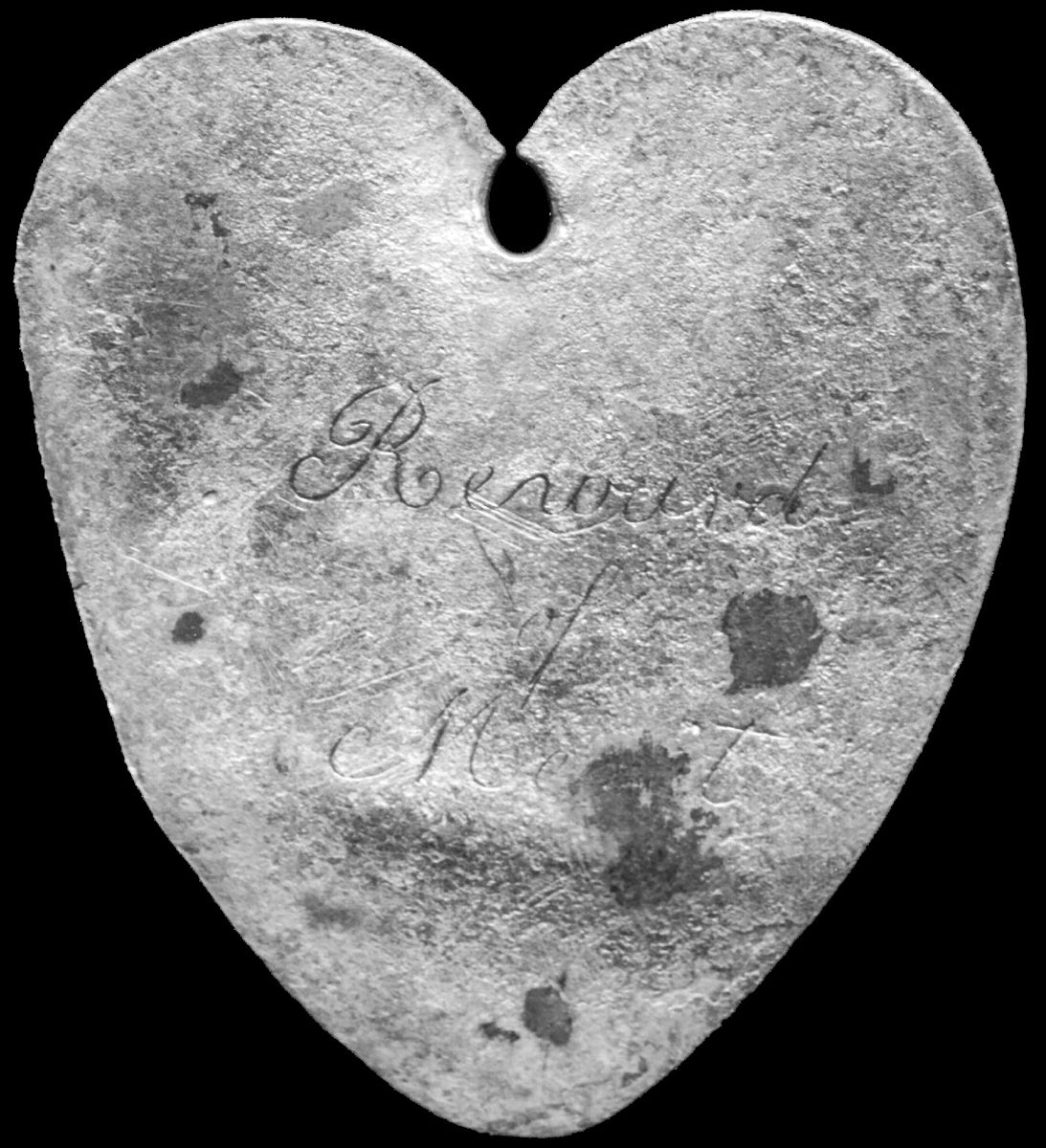
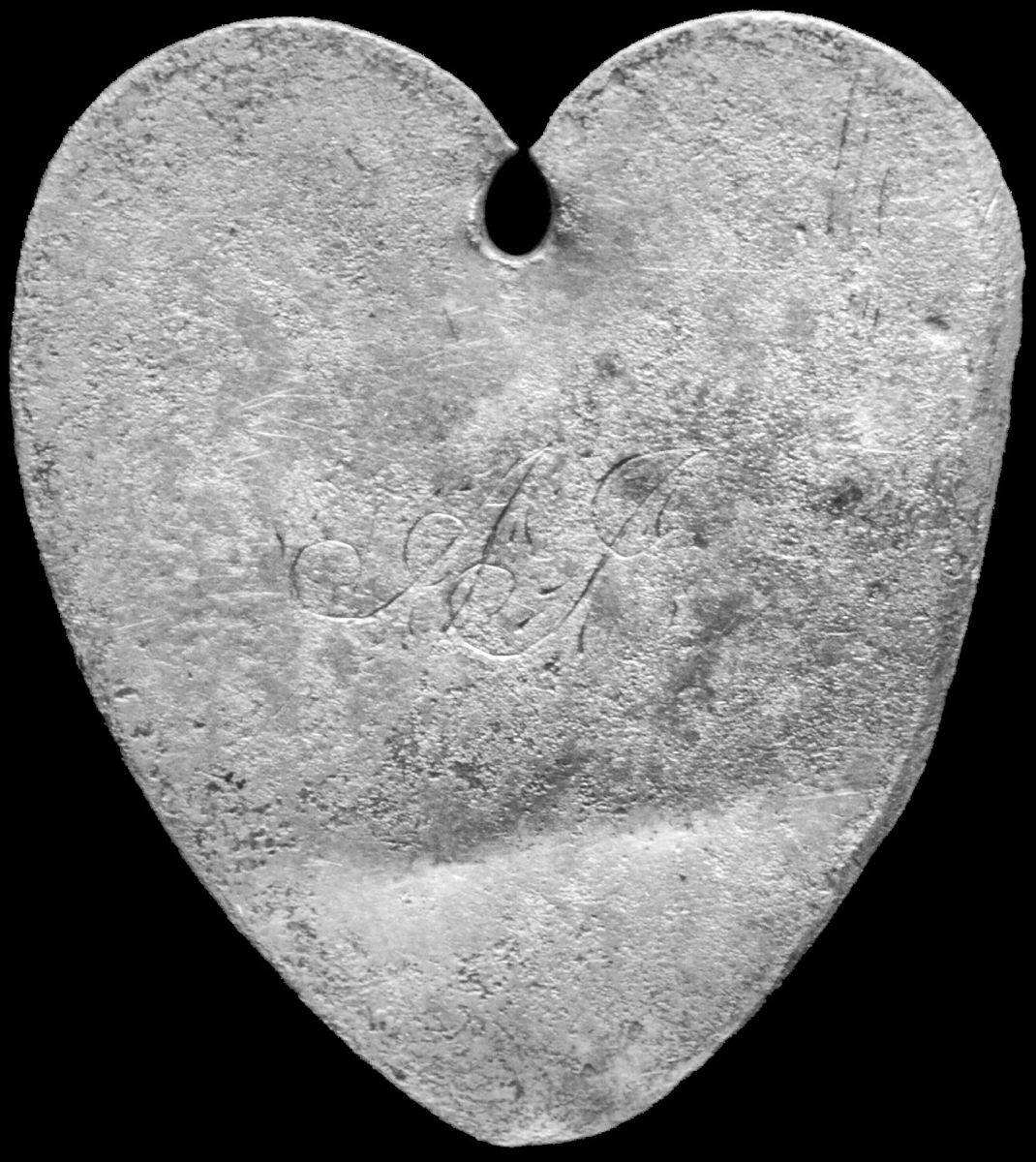
Description The “Reward of Merit” is a heart-shaped, silver badge designed to be hung from a ring or ribbon. The point of attachment was a small opening in the dip between the two upper lobes of the heart. The heart is 1 ⁹⁄₁₆ inches high by 1 ⅜ inches across at its widest point. It is the same thickness as an Austrian taler, the eighteenth-century coin from which our word dollar is derived. The heart shape is somewhat irregular, indicating it was neither cast nor stamped but rather carved from an existing coin, perhaps the taler, which is slightly larger than the badge. The method of creating the shape suggests it was probably a onetime creation, made specifically to reward a single individual. There is some damage to the rear edge on the left side, as if someone had shaved off some metal after it was made. On what is presumably the front, the words “Reward of Merit” are in three lines. The back has two initials, A and I (or J). The wording is well executed cursive script. The capitalized “R” of reward and “M” of merit are both about ³⁄₁₆ inch in height. The other letters are ³⁄₃₂ inch high. The “of” between the two lines is somewhat off center to take advantage of the elongated “f” that extends up to the right from just above the gap between the m and e of merit to the left side of the a in reward.
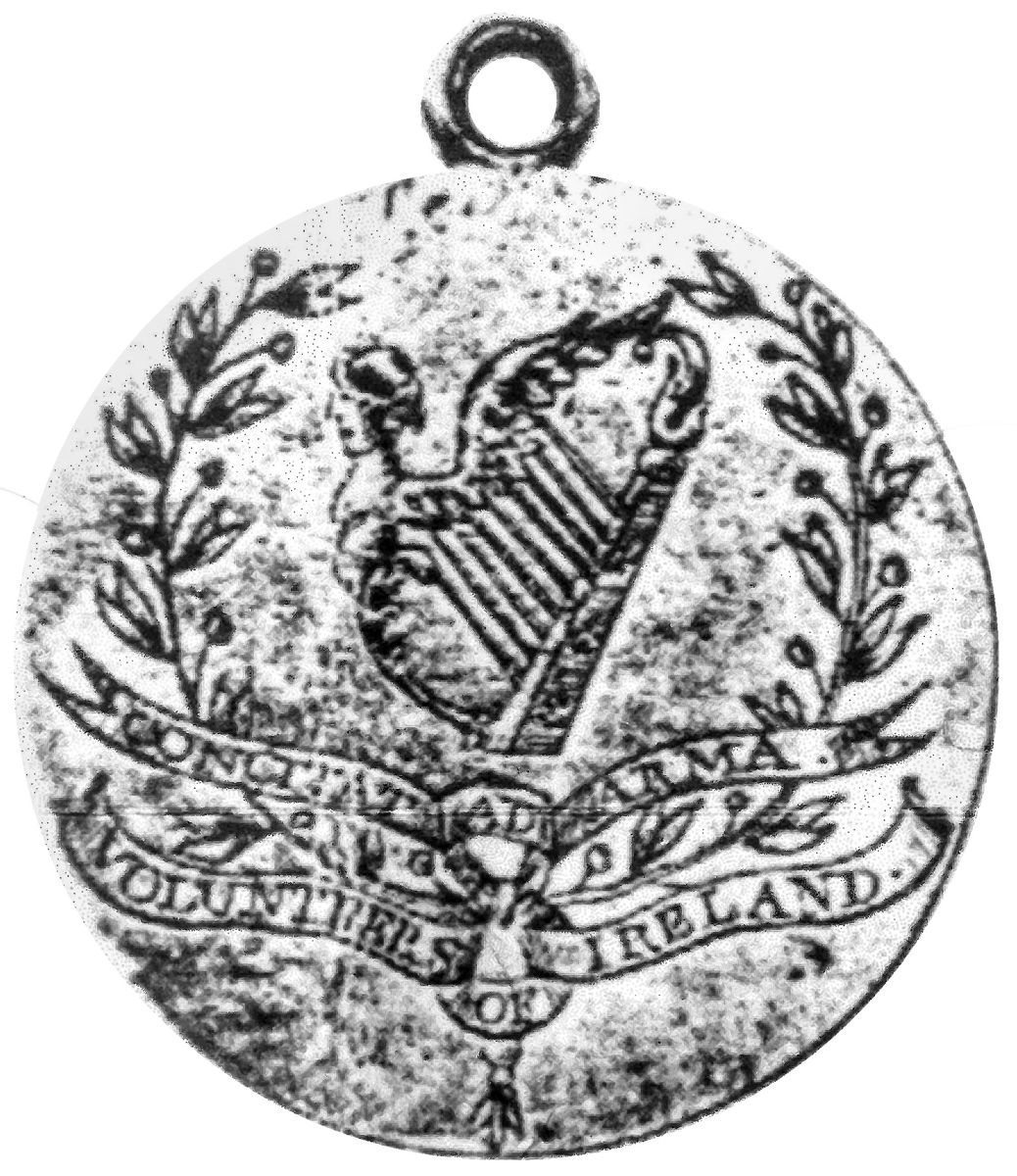
Obverse. A harp between crossed laurel sprays tied with a double ribbon, the top one with forked terminals engraved CONCITATE AD ARMA And the lower one engraved VOLUNTEERS OF IRELAND.
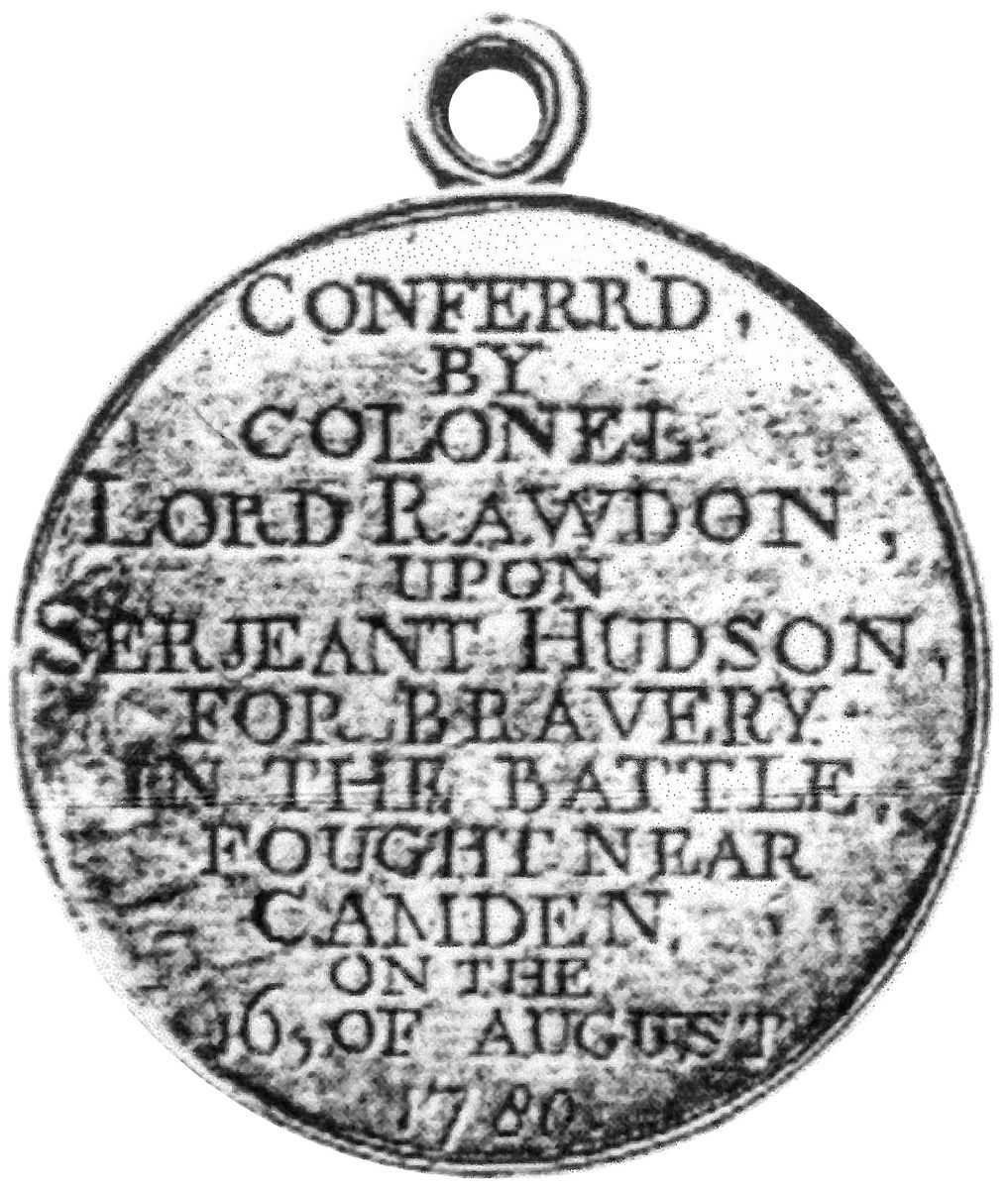
Reverse. CONFERR’D BY COLONEL LORD RAWDON UPON SERJEANT HUDSON FOR BRAVERY. IN THE BATTLE FOUGHT NEAR CAMDEN ON THE 16, OF AUGUST 1780.
Reward of Merit
AJ