
Silver Reward of Merit Badge
By Lawrence E. Babits, Ph.D. · Originally published November-December 2024 · pp. 18–21
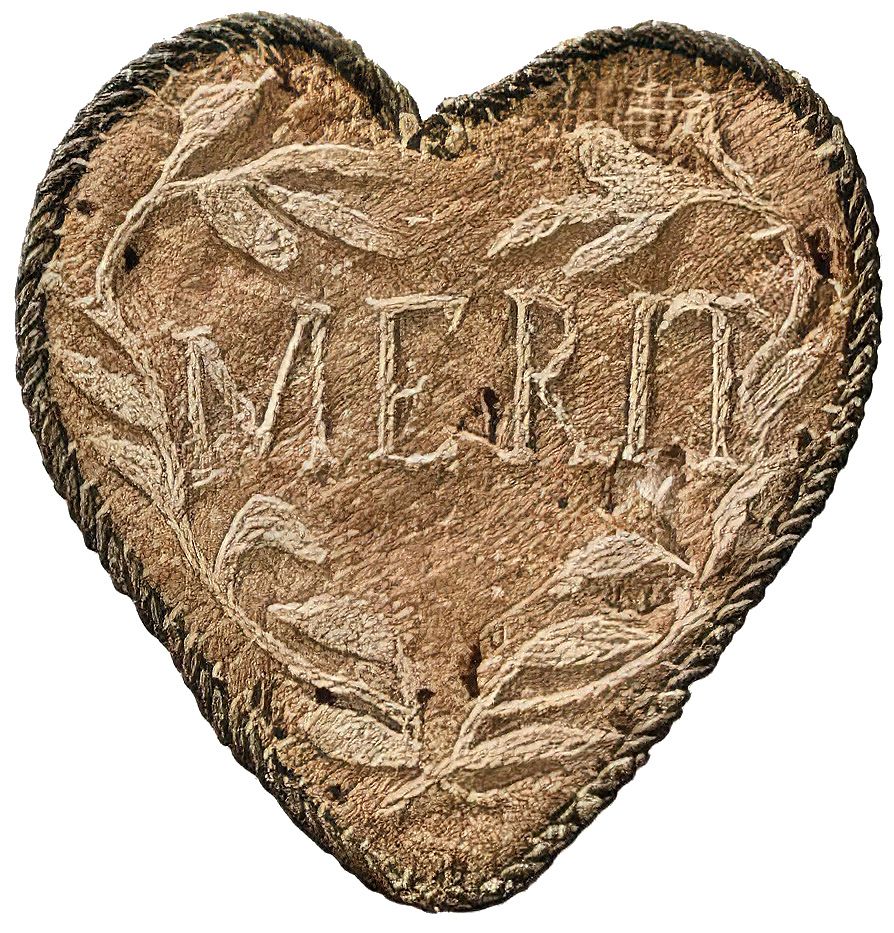
Continental Army Merit Badges The Continental Congress issued eleven medals, and, occasionally, swords to American officers. These were rewarded for exemplary conduct in battles. Among the recipients were George Washington, for forcing the British out of Boston, Horatio Gates, for the Saratoga victories, Anthony Wayne for capturing Stony Point, New York, Henry Lee for Paulus Hook, Daniel Morgan for the Cowpens, William Washington and John Eager Howard for Eutaw Springs, and Nathanael Greene. Senior officers received gold medals while the junior officer medals were silver. The Continental Army issued two awards to soldiers. These were authorized August 7, 1782. The most famous was the heart-shaped cloth badge designed to be worn on the soldier’s arm. Only three of this cloth badge were awarded. At least one is still extant and on display at New Windsor Cantonment, Vails Gate, New York.
intended for those who had served a certain number of years and who were “enlisted for the war” as they show five and six years service. The variations suggest that unit commanders were given some leeway in time served to qualify for the award. In REVWARAPPS Southern Campaign pension files, only seven soldiers mentioned receiving the badge of merit. One included the award document in his pension application. They came from Massachusetts, New York, New Jersey, Maryland, and Virginia. Significantly, these men all served in Northern Army units, First Massachusetts, 2nd New York Artillery, New Jersey Battalion, Hazen’s Regiment (2), the Corps of Invalids, and the 13th Virginia. One, Oliver Cromwell, (S34613) was “of color.” The Badges of Merit went to David Jewet, a fifer in the first Massachusetts Regiment, who “faithfully served the United States Six years & four months and being inlisted for the War,” June 9, 1783. (David Jewett, 32896).
A second, the “Badge of Merit,” was to reward soldiers for their service. So far as is known, this award was only on paper by which the soldier was authorized to have the award. It seems to have been
In 1783, in the “Temple of Virtue” on Temple Hill, General George Washington ordered officers to gather stories of gallantry and faithful service by enlisted men. Candidates were selected for the Badge of Military Merit, the inspiration for the modern Purple Heart.
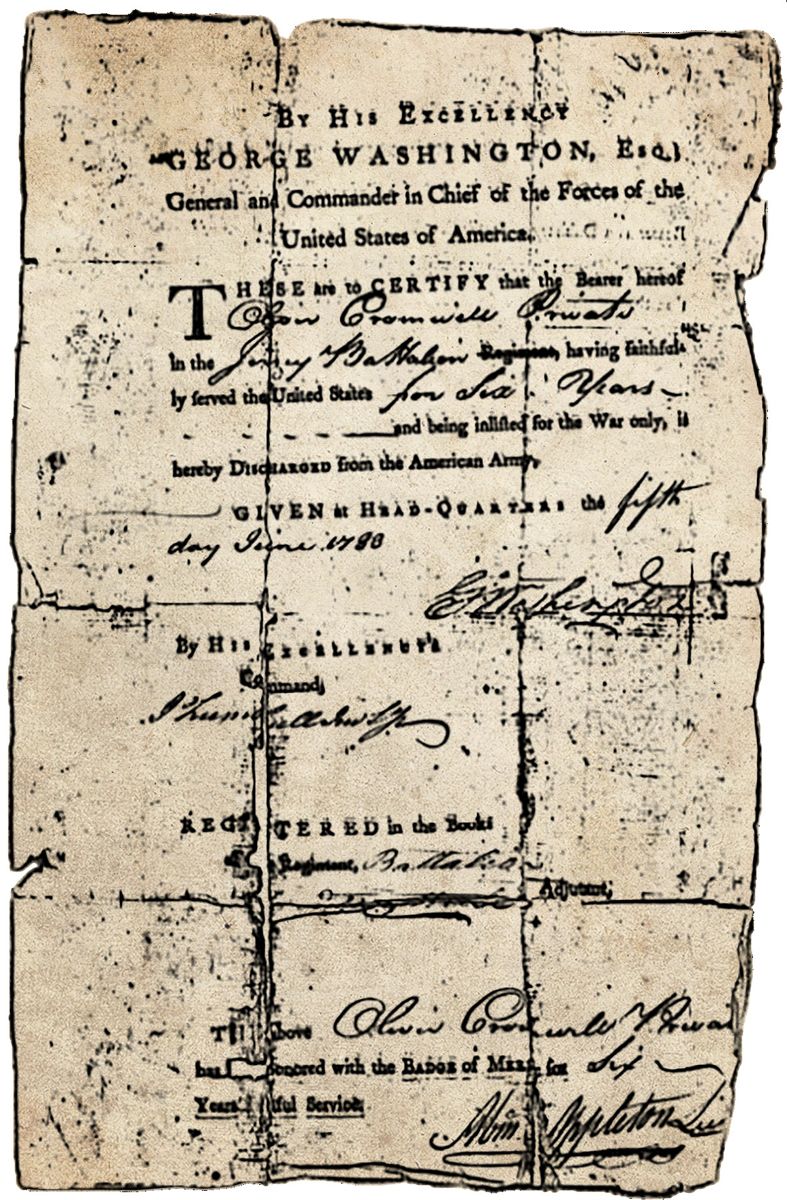
Badge of Merit Documentation. (Oliver Cromwell, S34613, pension application)
Transcription of Oliver Cromwell’s Badge of Merit BY HIS EXCELLENCY GEORGE WASHINGTON, Esq. General and Commander in Chief of the Forces of the United States of America. THESE are to CERTIFY that the Bearer hereof Oliver Cromwell Private in the Jersey Battalion, having faithfully served the United States for Six Years and being inlisted for the War only, is hereby DISCHARGED from the American Army. GIVEN at HEAD-QUARTERS the fifth day June 1783 /s/ G Washington By HIS EXCELLENCY’S Command /s/J Trumbull Jun S’y REGISTERED in the Books of the Battalion [illegible signature] Adjutant. THE above Oliver Cromwell Private has [been] honored with the BADGE of MERIT for Six Years faithful Service.
/s/ Ab’m Appleton Lieut
Oliver Cromwell, Private in the Jersey Battalion, “faithfully served the United States for Six Years,” June 5, 1783. (Oliver Cromwell S34613). Nathaniel Price Gunner in the 2nd, or New York, Artillery Regiment, who, “faithfully served the United States from 1st Feb’y. 1777 until the present period and being inlisted for the War,” June 9, 1783. (Nathaniel Price S40295) Alexander Ferrioll, soldier in “General Hazen’s Regiment having faithfully served the United States six years & seven months and being inlisted for the War,” June 30, 1783. (Alexander Ferrioll S43551). Martin Madder, soldier in the “late 13th or Colonel Gibson’s Regiment of Virginia having faithfully served the United States six years five months & fourteen days and being inlisted for the War,” August 14, 1784. (Martin Madder VAS460). Peter Collins, Soldier in “the Invalid Regiment, having faithfully served the United States Six years and being inlisted for the War,” June 11, 1783. (Peter Collins VAS3083). Corp’l. James Heaton, “from the State of Maryland in the General Hazen’s Regiment, having faithfully served the United States five year six months and being inlisted for the War,” June 13, 1783. (James Heaton W7716). The original Purple Heart, designated as the Badge of Military Merit, was established by George Washington—then the commander-in-chief of the Continental Army—by order from his Newburgh, New York, headquarters on 7 August 1782. Postwar badges were also known. Mecklenburg Country, North Carolina, held July Fourth celebrations at which veterans were honored. “It was customary at our 4th of July celebrations to invite the surviving Soldiers of the Revolution to attend, appropriate badges were provided for them upon which was inscribed in large figures 1776.” (Thomas Walker, W6397, pension application, supporting statement of William Davidson dated 1856). Walker had been a wagon master who also served in the ranks.
The Initials “AI” or “AJ” The initials on the heart’s back side were written in well-formed script as A I. In the eighteenth century, an “I” could be either an “I” or a “J.” Since the units involved in fighting around the find site were known and their muster rolls have survived, it was possible to conduct a search for a soldier whose first and last names used the two or three letters. Two states and a British Provincial regiment provided potential candidates because their men participated in the April 25, 1781, fighting on Hobkirk’s Hill east flank. These were the Delaware Regiment’s Kirkwood and Jacquett companies, the Maryland Line, especially the Second Maryland Regiments, and the British Provincial Regiments, and the Volunteers of Ireland, King’s American Regiment, New York Volunteers, and South Carolina Royalists. Virginia Continentals were on the western side of the battlefield and not considered.
Script initials edited for clarity.
The pre-Camden Delaware Regiment was devastated at Camden; enough men survived to form two companies. Peter Jacquett led one company that served in the 2nd Maryland. The other company was under Capt. Robert Kirkwood who led one half of the Delaware survivors is a light infantry company. A search of the Delaware Regiment’s muster rolls, especially for Kirkwood’s fairly well documented company, was conducted using both the Delaware Archives, Military, volume I:115-118, and Henry Peden, Revolutionary Patriots of Delaware 1775– 1783, (Westminster, Md: Family Line publications, 1996). The initials did not turn up in the archival version of Delaware fall 1780 muster roll. Peden reported seven men with these initials, none of whom served in the south; most were militiamen. A search through the Maryland muster rolls
(Maryland Archives XVIII) revealed 14 soldiers and an officer whose initials were AI or AJ. At least ten were eliminated as not serving at Hobkirk’s Hill due to earlier enlistment expirations, northern theater regiments, or death. One served at Yorktown. Another was a sailor. Archibald Johnson was a promoted to corporal in January 1780, then sergeant during June 1780. He was in the First Maryland. There were two Aaron Jones. One died in February 1779. The other Aaron Jones was in the Fifth Maryland through Camden, then placed in the 3rd Company, First Maryland, during the reorganization at Hillsborough. The 3rd Company was composed of the 5th Marylanders who survived Camden. He is more likely to have been placed in the Second Maryland during the April 25 engagement as his ultimate service was under William Reiley, a 4M officer after Jan. 1, 1781 (Steuart 1969:123) and old Second Brigade officers tended to serve in the First Maryland even if assigned on paper elsewhere. One Sergeant, Adam Jamison, later became an officer. He had served as Commissary of Issues and was present with the army during the Spring and Summer 1781 campaigning. He was also nominally assigned to the 5th Maryland, a regiment that existed only on paper. Most officers assigned to the Fifth can be shown as actually serving in the Second. Jamison could well have been at Hobkirk’s Hill, and, more importantly, if he served in a line company for an engagement when being commissary of issues was of secondary importance, he could well have been near the find site. Private Abram, or Abraham, Irvin (or Irvine, Irwin), is another possible owner of the medal. He was in the 2MR, enlisted (perhaps reenlisted) Feb. 17, 1777, and was shown as a POW in June 1779. The possibility of reenlisting can be shown as he was identified as a Somerset County Independent Company private who enlisted on March 20, 1776. When the 1776 enlistments ran out in December, many men returned home; some tried to enlist enough men to qualify as officers. If Irvine did try recruiting, he was unsuccessful and reenlisted in February, effectively serving from March 1776 to January 1783. He returned and was in the 7th Company (and thus 2nd Bn) 1st Maryland during the fall of 1780. The 2nd Bn, 1MR companies were put into the 2nd Maryland during the spring of 1781. He was still serving in January 1783. Irvin’s service record shows he was paid a $100 bounty for reenlisting on March 17, 1779. During 1778, he was at White Plains and then Fishkill, N.Y. Along with the rest of the 2nd Maryland, he wintered at Wilmington, Del., when he was in Archibald Anderson’s Company. He was sick in the hospital at Trenton, N.J., on Sept. 9, 1778, and again on Jan. 16, 1779, at Middlebrook. When the Maryland and
Delaware Division went to the Southern Theater in 1780, he marched with the Second, survived Camden, and went into the reconstituted First Maryland until the Second Maryland was reformed in March 1781. He received $80 on Aug. 21, 1784, as his remaining balance due him. After searching possible Americans who served at Hobkirk’s Hill, a search through the Volunteers of Ireland muster rolls and other documents turned up a sergeant who received a medal for his actions at Camden, but no other possibilities (M.J. Clark 1981). The medal was awarded to Sergeant Hudson was presented by the regiment’s colonel, Francis Rawdon. The only possible candidate from the Volunteers muster rolls is Sergeant Joseph Hudson who is shown as on command from Rawdon’s Company during the April-June 1782 muster roll. What is interesting is that he was in Captain William Blacker’s Light Infantry Company. On musters rolls covering from February 24 through June 1781, he was listed as “sick in Charlestown.” He also appears in Monroe’s Company from October 25 to December 25, 1781. The rolls, including the 1780 Battle of Camden, were not included in Clark. It is suggested that after his performance at Camden, when he might well have been in the Light Infantry Company, Hudson was first posted to Monroe’s Company, then to Rawdon’s following the British retrenchment in their coastal garrisons after the Sept. 8, 1781, Battle of Eutaw Springs. It is an interesting coincidence that Blacker’s Light Infantry was the unit that initiated contact with the Americans. When they were first discovered by the pickets, they immediately attacked heading north and engaged the 2nd Maryland in the precise area where the Reward of Merit was found.2 It may well be that the Hudson Medal is not the only one, just the only known survivor. Sergeant Roger Lamb, 23rd Foot, remarked in describing the Battle of Camden, that
“In all the various engagements which the safety, the honour, the interests of the empire have demanded, the Irish soldier has seldom, if ever, lagged behind in the career of glory. On the present occasion Lord Rawdon was so well pleased with the conduct of his regiment [the Volunteers of Ireland] that he ordered a silver medal to be struck off, and presented to several of his men who signalized themselves in the action.”3
Acknowledgments I am indebted to the late Mac McGee for his willingness to share the photographs. Any additional information about badges awarded to Southern Campaign soldiers will be welcomed. Please contact the author via email at mail@MilitaryAntiqueCollector.com. Endnotes 1.
Meryl A McGee, personal communication, September 29, 1997
Murtie J. Clark, Loyalists in the Southern Campaign, 1981 III:272,285, 287, 316; Oliver Snoddy, The Volunteers of Ireland. The Irish Sword – The Journal of the Military History of Ireland. III, Winter 1965: 147-152
Roger Lamb, An Original and Authentic Journal of Occurrences during the Late American War, Dublin, 1809:306
Revolutionary War pension applications from the National Archives, Old Military Records, were downloaded from REVWARAPPS Southern Campaign, a transcribed compilation of pension application posted on line by William Graves and Leon Reed.
About the Author Battlefield archaeologist Larry Babits earned degrees from Maryland and Brown leading to a teaching and research career at Washington and Lee, Armstrong State, and East Carolina. He has been reenacting since 1961 with an interruption whilst serving in B Company, 1st Bn, 21st Infantry (Gimlets) during 1963–1966. A retired rugby player, referee, and coach, he is now working on finishing Nathanael Greene’s 1781 Southern Campaign focusing on Hobkirk’s Hill, Augusta/Ninety Six, and Eutaw Springs. Along the way, he continues researching the Revolutionary War’s private soldier and shooting with the N-SSA’s First Maryland Blackhats.