
The Colts of Horseshoe Ridge
By Franklin Kalinowski, Ph.D. · Originally published November-December 2024 · pp. 27–39
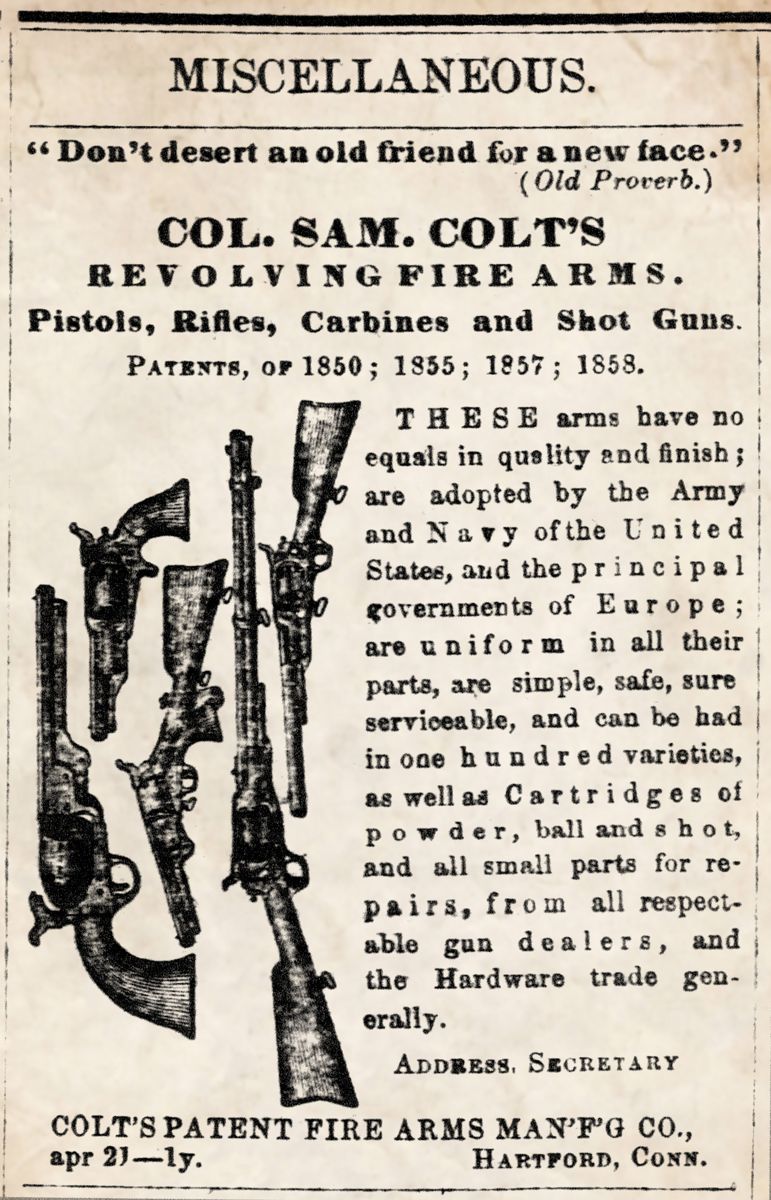
Between November 1861 and February 1863, the United States government purchased 4,613 Colt New Model 1855 revolving rifled muskets. Of these, 3,726 came directly from the Colt factory with 37 ½ inch barrels, and 957 were purchased from private dealers (various barrel lengths). As a percentage of the hundreds of thousands of weapons used by the Federal Army, these Colts represented only a small fraction of the long arms issued. Yet, a good argument can be made that the Colt Model 1855 revolving rifle contributed to the Union victory in far greater significance than their numbers might suggest.
Colt rifles at a section of the battlefield known as Horseshoe Ridge.
Part I – Chickamauga The summer of 1863 had not gone well for the Confederate States of America. In the east, General Robert E. Lee had been stopped at Gettysburg and in the west, Union General Ulysses S. Grant had seized Vicksburg and forced the surrender of an entire Confederate army. If a decisive Northern victory could
There was nowhere that the Colt revolving rifles played a larger, more determinative role than at the Battle of Chickamauga on Sept. 20, 1863. At a critical moment, the Colts provide the firepower that held the extreme right of the defensive line and helped stabilize the Union position. Appreciation of their importance requires an understanding of the heroic sacrifice of a regiment of Union soldiers and their
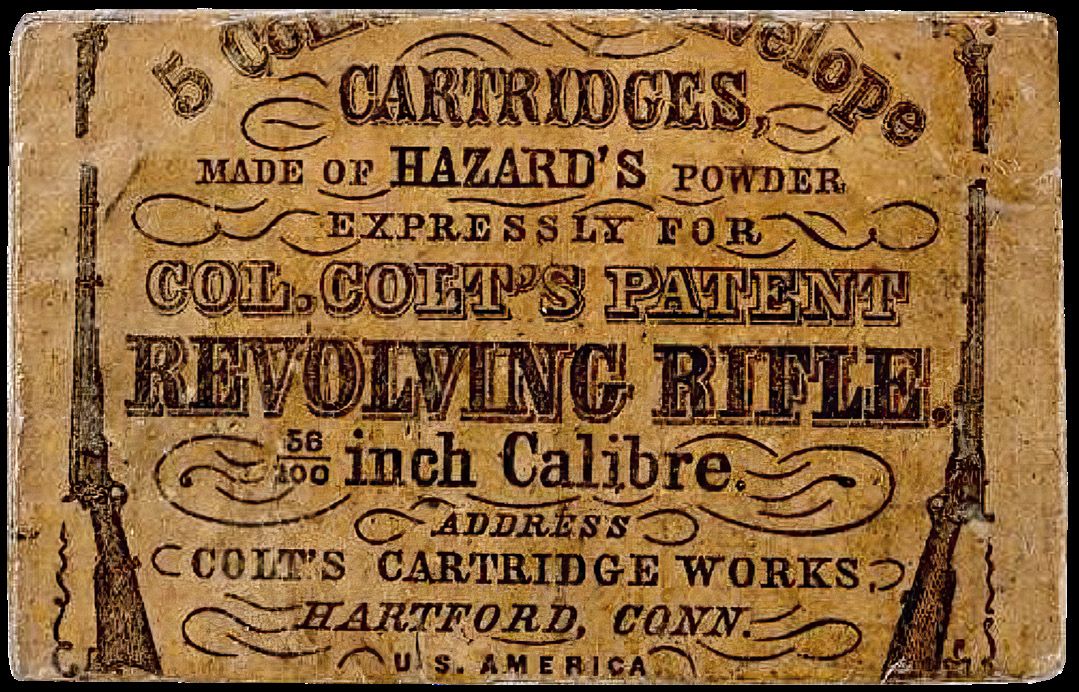
Colt revolving rifle .56 caliber paper cartridge. Overall length 1 ⅞ inches. Conical bullet diameter .583 inches. Manufactured by Colt Cartridge Works.
Newspaper advertisement for Colt firearms on June 5, 1861, in the Raleigh Register.
Pack of paper cartridges for the Colt revolving rifle. (Cowan’s Auctions)
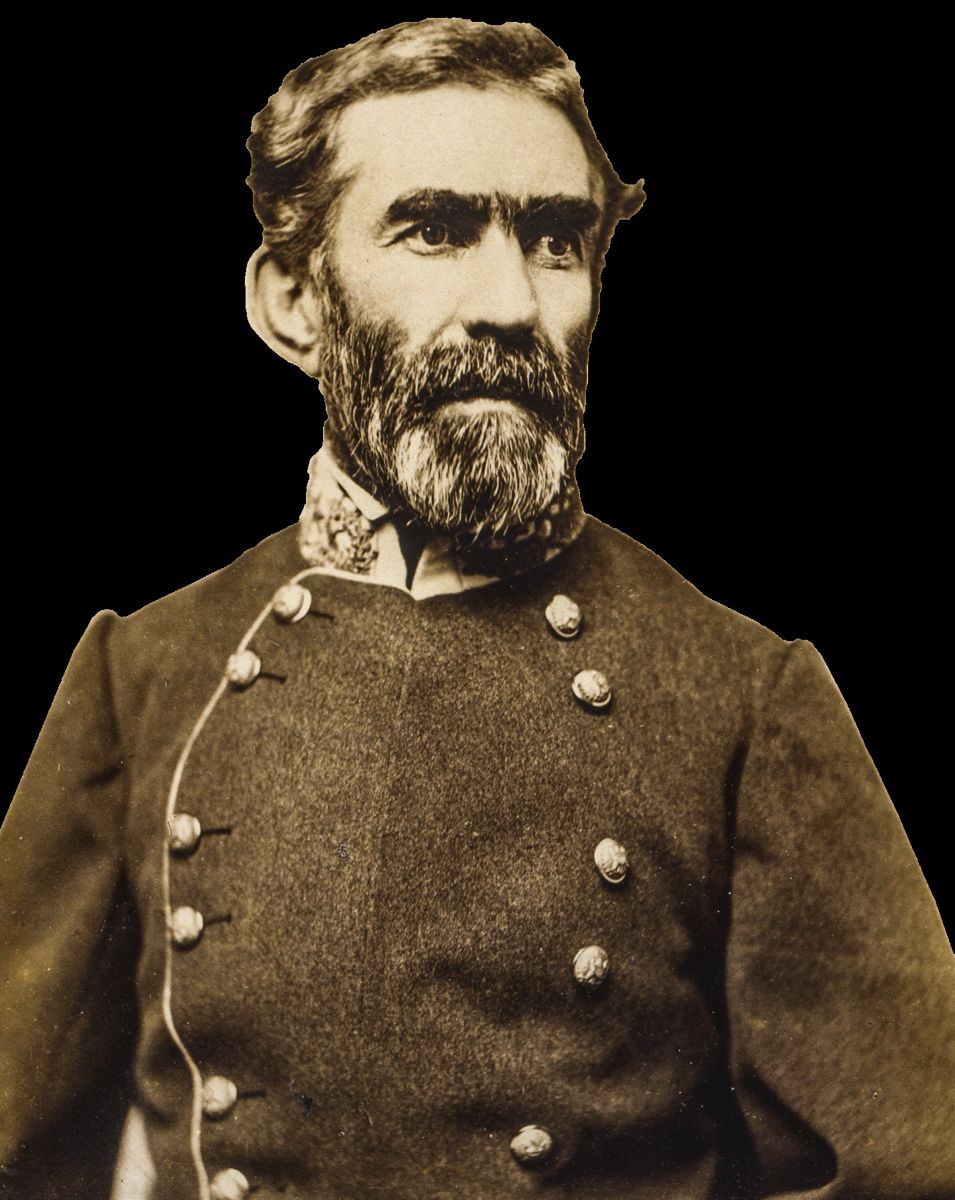
be gained in the central states of Tennessee and Georgia, it was possible the Confederacy would be forced to capitulate before the end of the year. Given this setting, the Confederate states needed a military victory to offset Gettysburg and Vicksburg, and re-establish their aggressive momentum. The Union needed a victory to end the war. For each side of the conflict, the Battle of Chickamauga would be critical. Taking the initiative toward ending the conflict, President Abraham Lincoln directed Major General William Starke Rosecrans to push his Army of the Cumberland south from their location following the battle of Stone’s River (Murfreesboro) toward the city of Chattanooga and crush Confederate General Braxton Bragg’s Army of Tennessee. At the outset of the campaign, events favored Rosecrans’ Federal forces.1
Brig. Gen. Braxton Bragg. (Library of Congress)
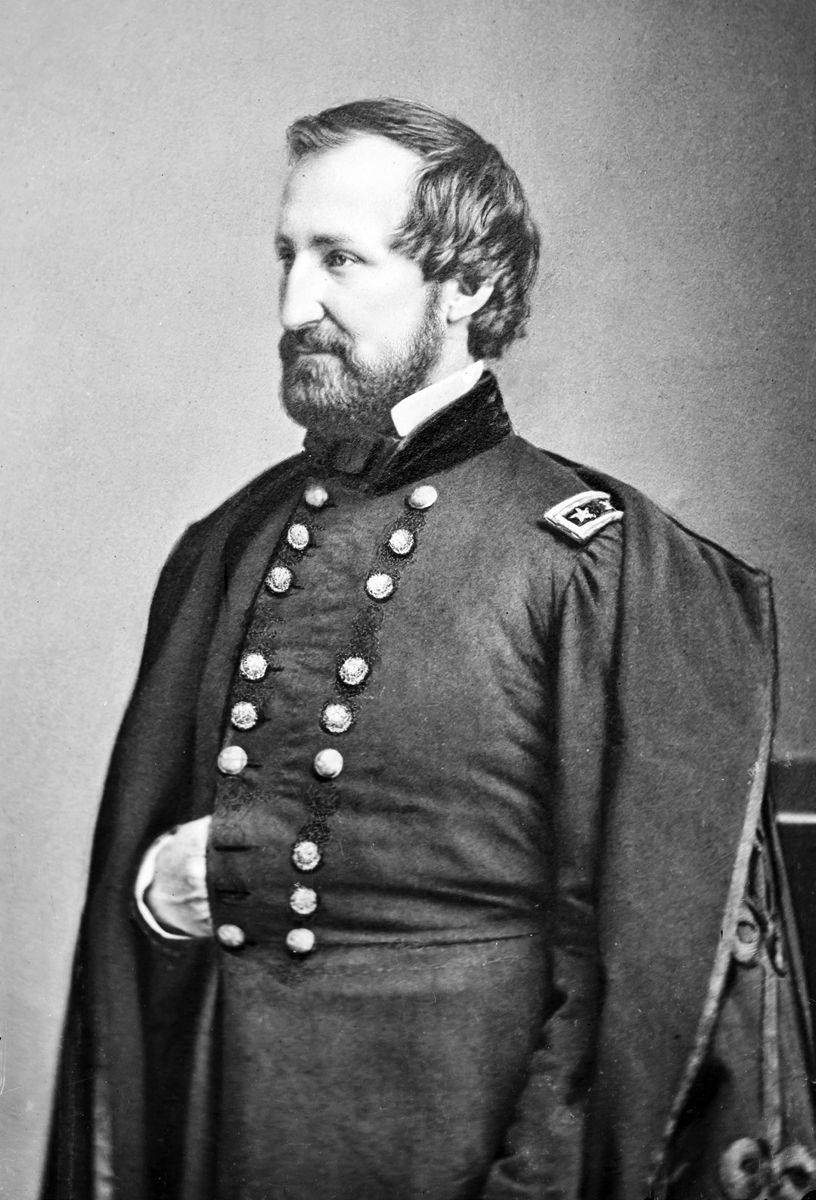
A well-executed flanking maneuver forced Bragg to abandon his position at Tullahoma, Tennessee, and withdraw inside the city of Chattanooga. Rosecrans then decided to repeat the operation and flank Bragg out of Chattanooga and into northern Georgia. In so doing, the Yankee general made three critical mistakes. First, Rosecrans divided his army and separated his three corps, leaving them dangerously exposed to being attacked in detail. Second, Rosecrans misread his opponents intentions, believing that when Bragg
Maj. Gen. William S. Rosecrans. (Library of Congress)
withdrew from Chattanooga he was pulling back deep into Georgia, when in fact, the Rebel general was simply regrouping outside of the city for an assault. Third, Rosecrans seriously miscalculated the size of the army he was confronting. As he moved in on Chattanooga, Rosecrans felt confident he had the Confederate Army of Tennessee significantly outnumbered. He was wrong. Before the battle began, Braxton Bragg received important reinforcements. Major General Simon Bolivar Buckner brought a corps of Confederate soldiers from Knoxville south to augment the Army of Tennessee, and Joseph E. Johnston reassigned two divisions from the Department of Mississippi to aid Bragg. Perhaps most importantly, Major General James Longstreet had been dispatched from Robert E. Lee’s Army of Northern Virginia and sent by rail to Bragg’s assistance. With Longstreet were two divisions of Rebel infantry under the commands of Lafayette McLaws and John Bell Hood. These Southern troops, some of the finest fighters in the Confederate Army, arrived in north Georgia just as the clash of armies began. For one of the rare moments in Civil War history, a major battle would take place where the Confederate forces outnumbered those of the Union.2
to the rear of the entrenched Federals. In so doing, a large opening in the defenses was created along the LaFayette Road. As Southern luck would have it, James Longstreet chose exactly that time and that place to attack with eight brigades of crack Rebel infantry. The result was complete chaos for Rosecrans’ army.3
The full scale Battle of Chickamauga began on Sept. 19, 1863, when Confederate cavalry troops under the command of Nathan Bedford Forrest crossed Chickamauga Creek and ran into Union troops from Rosecrans’ Army of the Cumberland trying to make their way out of McLemore’s Cove southeast of Chattanooga, Tennessee. As the fighting intensified, contact between the two armies rolled down the LaFayette Road as Federal troops trying to move north came under assault from Confederates crossing the stream and attacking from the east. Later historians would characterize the fighting on Sept. 19 as a giant zipper closing from north to south. At the end of the day, the Federals still maintained control of the road from just south of the MacDonald farm, past the Kelly, Poe, Brotherton, Brock, and Viniard cabins to Lee and Gordon’s Mill. During the night, the Union Army attempted to fortify its defenses while Confederate commander Braxton Bragg planned his next move.
The Confederates poured through the hole in the Union position and the rout of the Northerners began. Federal units collapsed and scattered as jubilant Rebels rushed to extend their breakthrough. Here and there, an occasional Yankee unit attempted some resistance, but it was clear that a Confederate victory might soon become a Union catastrophe. Stunned and panicked Union soldiers stampeded west and north in a pellmell attempt to escape the onslaught from their front, flank, and rear. What the Federals needed was a leader and a place to organize a halt line
The Confederate strategy for the second day was to launch an all out assault along the entire Federal position. The attack was scheduled to begin at sunup with a heavy strike in the north followed by a rolling engagement down the line of contact along the LaFayette Road. At 11 a.m., the turning point erupted. With the left of the Federal line hotly engaged and the center reasonably quiet, Rosecrans sent a confused and contradictory order to a division commander occupying the breastworks in front of the Brotherton house to fill a gap in the line that did not exist. The petulant Union general responded by pulling his three brigades out of their position and moving them
Horseshoe Ridge, 1:15 p.m. Kershaws First Assault. (From David A. Powell and David A. Friedrichs, The Maps of Chickamauga (El Dorado Hills, CA: Savas Beatie, 2009), maps used with permission of the author.)
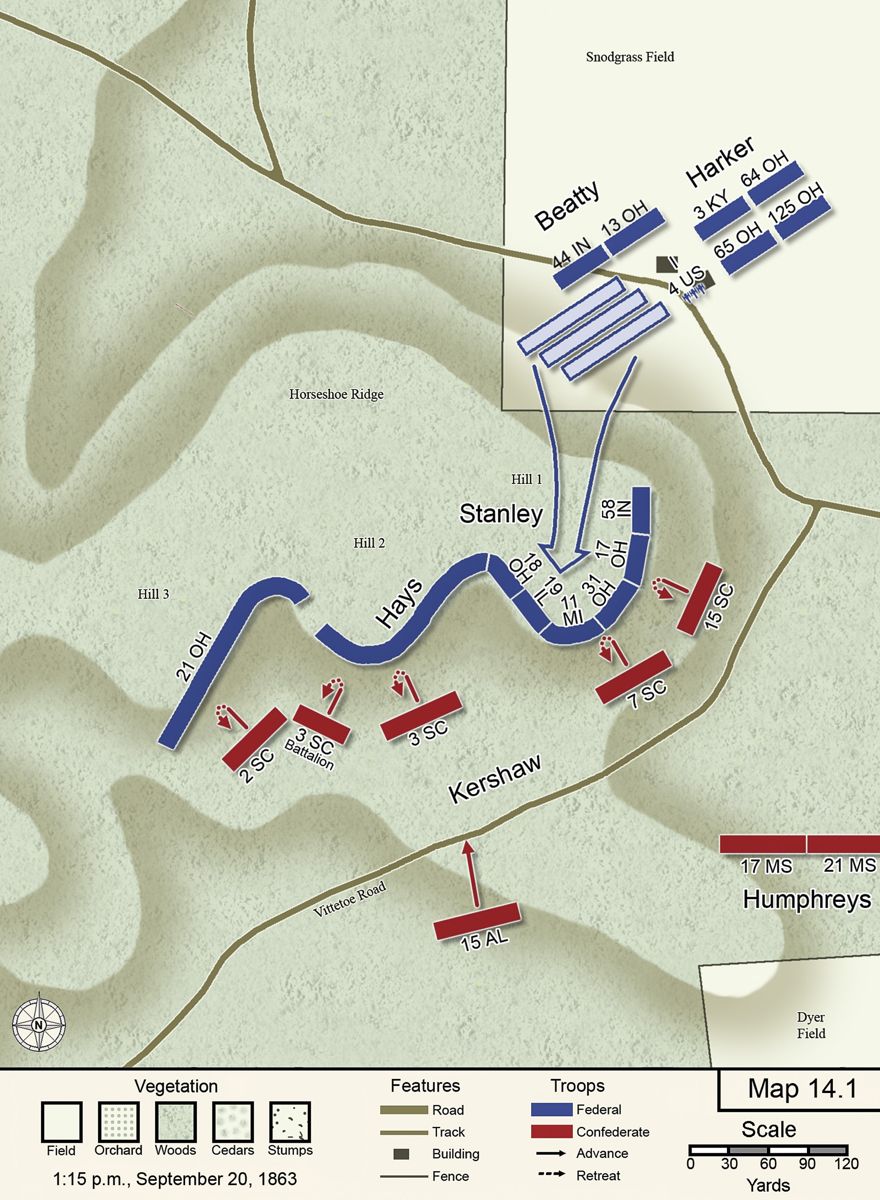
to slow the Confederate juggernaut long enough to allow the Army of the Cumberland to get inside Chattanooga. The man was Major General George H. Thomas and the line he established was a defensive front that ran perpendicular to the LaFayette Road—east to west— from the Union salient in the Kelly Field, across a hill and farmstead owned by George Washington Snodgrass, to a ridge composed of three distinct but irregularly shaped outcroppings which, for reasons lost to history, became known as Horseshoe Ridge.4
There, Union General George Thomas was steadfastly holding on to the only point separating Braxton Bragg’s Army of Tennessee from the defenses of Chattanooga. To check the impending assault, Thomas began to gather what forces were available to fortify Snodgrass Hill in the hope that position could support his Kelly Field defenses. The problem for Thomas was that Snodgrass Hill was itself vulnerable to a flank attack from the south and west. A solid halt line required a further extension of the Union defenses to include the three outcroppings of Horseshoe Ridge which, for clarity’s sake, have become known over the years as Hill 1, to the immediate south of Snodgrass Hill; Hill 2, to the south and west of Hill 1; and Hill 3, to the west of Hill 2. These three sections of Horseshoe Ridge would be the key to holding the entire defensive line of the Army of the Cumberland.
Major General George H. Thomas. (Library of Congress)
Part II – Horseshoe Ridge By the afternoon of Sept. 20, 1863, the Army of the Cumberland was in a desperate situation. Its commanding officer, two of its corps commanders, several division commanders, and numerous other soldiers, had quit the field of battle and were heading north toward Chattanooga by whatever route they could find. The major point of resistance to the onrushing Confederates was an arched salient around the Kelly Field at the northern end of LaFayette Road and McLemore’s Cove.
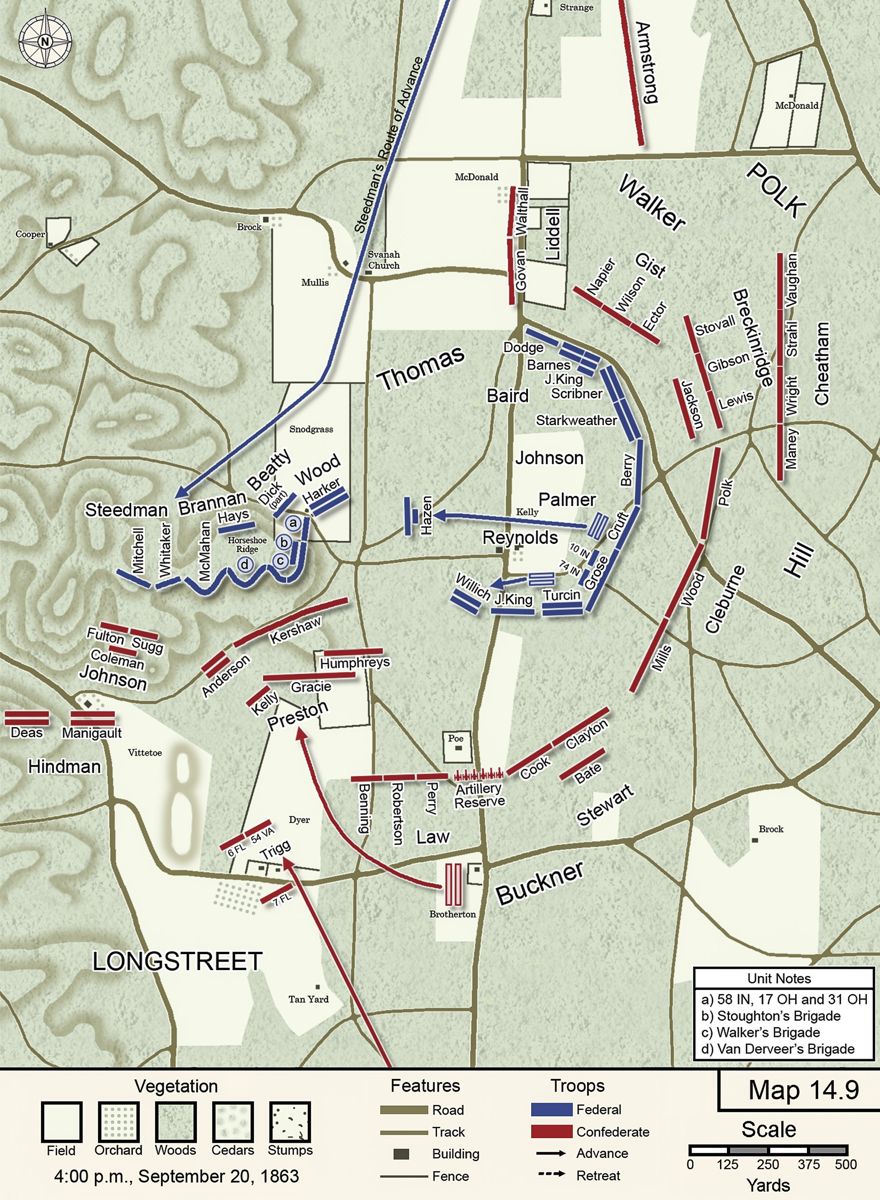
Kelly Field to Horseshoe Ridge, 4 p.m. (Powell and Friedrichs, The Maps of Chickamauga)
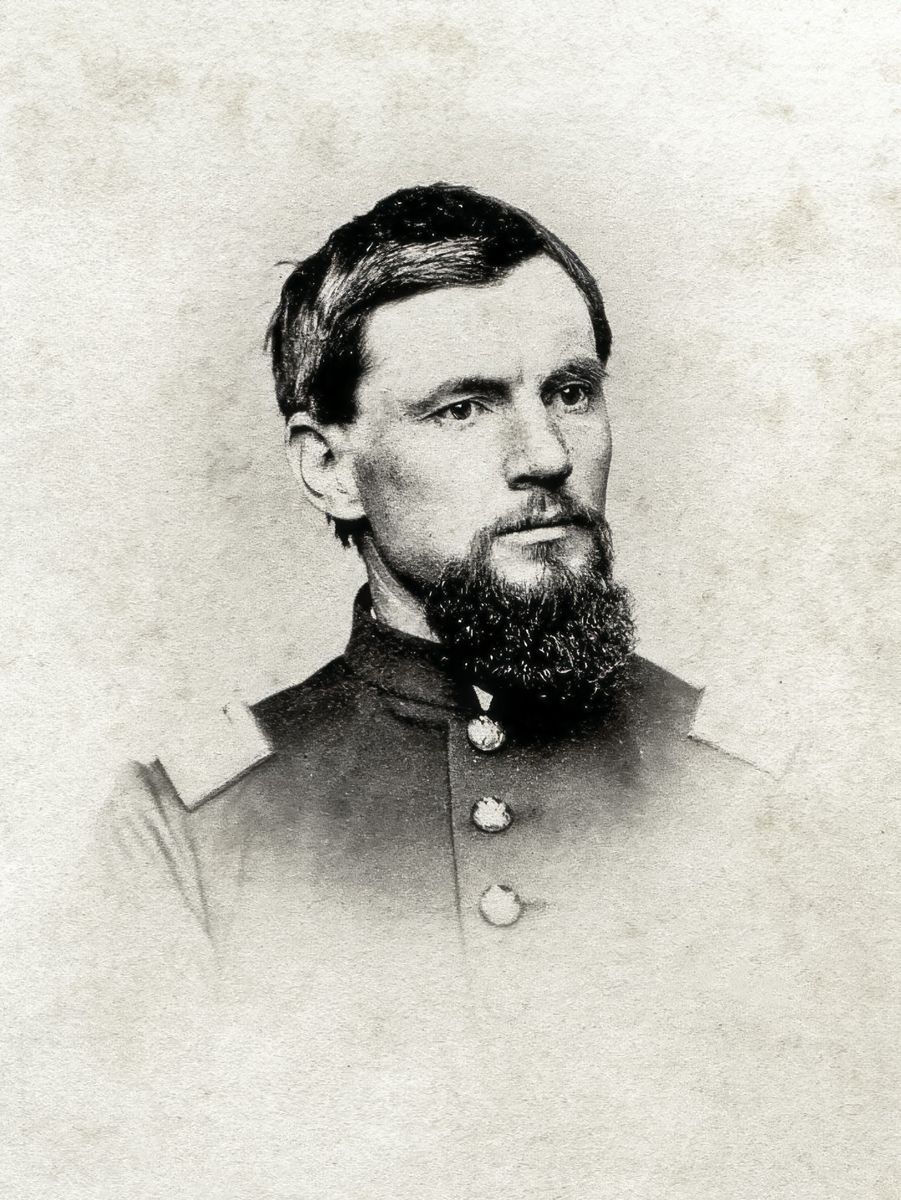
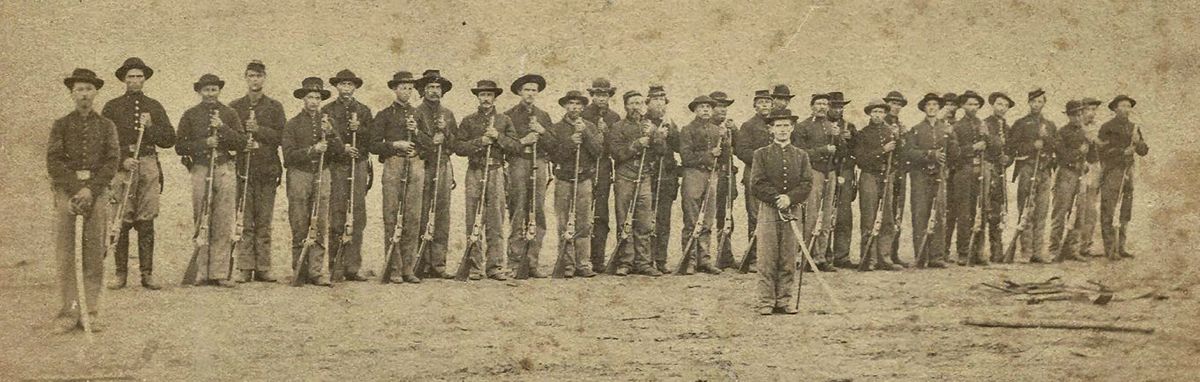
The regiment selected to hold the extreme western end of the Horseshoe defenses—the right flank of the right flank—was the 21st Ohio Volunteer Infantry. According to the regimental historian, Captain Silas S. Canfield, the choice of the 21st was “opportune if not Providential” since four months earlier on May 26, in Nashville, the regiment had turned in their Springfield muzzle loading rifled muskets and been issued Colt New Model 1855 revolving rifles. Eight companies had received these .56 caliber Colts but companies A and B had been given .577 Enfield rifled muskets.5 As the 21st Ohio Regiment moved into its position on Hill 3, each soldier with a Colt rifle had ninety-five cartridges for their weapon.6 They would need more. Facing south, there were no Union troops to their right (west). The 21st Ohio Regiment was the end of the Federal defensive line. Fully aware of the opportunity open to them, the Confederates moved to attack Horseshoe Ridge as soon as an adequate force was available. By one o’clock, Confederate General Joseph R. Kershaw of McClaws’ Division of Longstreet’s Corps threw his brigade against the ridge. Hoping to turn the flank of the Federal position, two of Kershaw’s regiments charged up Hill 3 in a sustained and heavy Rebel
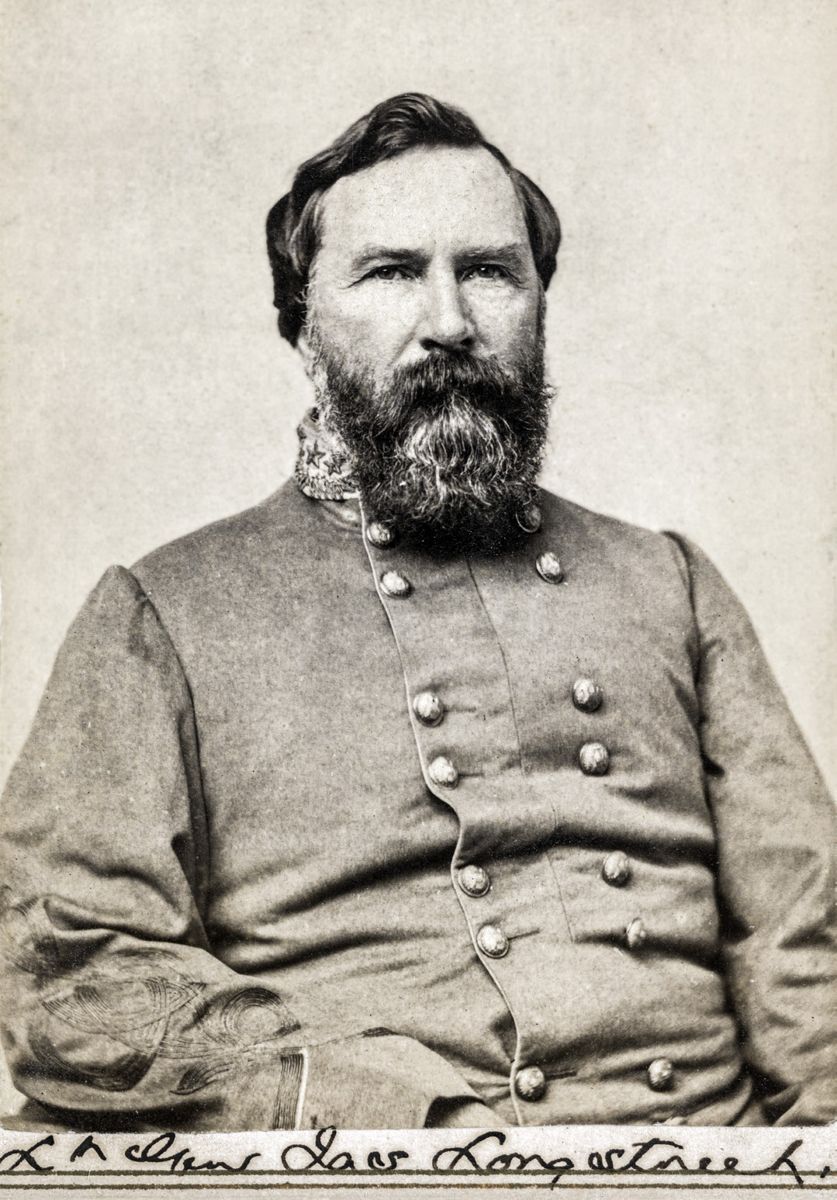
Lieutenant General James Longstreet.
assault targeting the 21st Ohio.7 They were met with devastating fire from the Ohioan’s Colts. It has been estimated that a Union soldier could fire all five cylinders of his revolving rifle in nine seconds. This means the Colts of the 21st Regiment could let go over 1,600 rounds in that brief amount of time. This first Confederate assault on Horseshoe Ridge staggered, halted, and recoiled back down the hill. In his history of that day, Canfield left no doubt of the cause and consequences of that defense. Referring to the Colt revolving rifles, Canfield wrote, “[W]ithout them, it is hardly possible the regiment could have repulsed the first charge made on it at Chickamauga, in which case, the enemy would have gained General Thomas’ rear, which would have resulted in the dispersion or capture of his corps.”8 No less an authority than James Longstreet has concurred in this opinion, stating, “It was evident that with this position gained I should be complete master of the field.”9 Without the Colts, Longstreet takes Horseshoe Ridge. If Longstreet takes Horseshoe Ridge, Thomas is decimated. After driving Kershaw’s soldiers down Hill 3, the 21st Ohio made the ill-considered move of following them in an apparent counterattack. This counterattack had a significant effect when Lieutenant Colonel Dwella Stoughton, the 21st Ohio’s commanding officer, was shot in the right shoulder socket and had to be taken to a field hospital. He was replaced by Major Arnold McMahan who would lead the regiment for the remainder of the battle.10 In his after action report, McMahan stated his thoughts on the Confederate attempts to take Horseshoe Ridge, “[A]though superior in numbers, he was unable to endure the repeated volleys of our superior arms, (Colt’s revolving rifles).”11 Ohio Lieutenant Wilson Vance described the effect of the 5-shot Colts: “At first the charging Johnnies, reaching the proper distance and receiving a volley from the regiment, returned the same and then started on the keen jump, expecting to reach us before we could reload. Before they advanced ten paces… they would get another volley, and while they were pondering upon this circumstance, still a third, then they would scarcely get their backs turned [to retreat]… before the fourth would catch them, and [then] on a dead run, the fifth came singing about their ears.”12 Every member of the 21st Ohio who reported on that day’s fighting credited the Colt revolving rifles as the decisive factor in the regiment’s ability to hold the Federal position on Horseshoe Ridge. The observations of Captain Isaac Cusac of Company G regarding the Confederate assaults are typical, “Again and again did they attempt to drive us from the ridge, but we were not to be moved by lead nor demon-like yells, but we lay close to the ground, and with our Colt’s Revolving Rifles repelled and repulsed every he looked around at the single row of Northern troops and asked in amazement, “Where are your men?” One of the Ohioans responded, “Here they are,” gesturing to the thin line of his comrades. “My God!” said the Confederate. “I thought you had a whole division here.”15 Such was the intensity of the Colts’ firepower. Firing with a fury, the Union soldiers held onto the crest of Hill 3. Soon the Colts began to overheat. Some cylinders jammed from the accumulated black powder fouling. It was later reported that some members of the 21st Ohio urinated on the cylinders of their Colts to loosen the powder fouling and reduce the heat of the metal.16 Most disconcerting for the Yankees, their supply of ammunition began to run low. The cartridge boxes of the killed and wounded were searched and any available cartridges were redistributed. As their .56 caliber, solid based Colt cartridges became expended, some Federals resorted to other options. It was discovered that with some effort, the .577 Enfield bullet could be forced into the Colt cylinder and fired. This bullet
Major Arnold McMahan, 21st OVI, 1862. (MOD)
attack.”13 Sergeant John Bolton observed, “The enemy charged us repeatedly with a determination bordering on desperation, with a force vastly superior to our own in numbers at this point, but with the aid of the Colts rifles they were repulsed each and every time with heavy loss….” Lieutenant John Mahony of Company K later wrote, “The fire from our Colt’s revolving rifles taking them in the flank, was more than they or any other man could endure, and they went back.”14 Determined to dislodge the Yankees, the Confederates brought additional units into the action. Their next attack would consist of a coordinated assault across the entire Federal defensive front from Snodgrass Hill up to and past the position of the 21st Ohio on Hill 3. A few minutes before 2 p.m., the attack began. While two Southern brigades wheeled around Hill 3, Confederate General Patton Anderson sent his Mississippians against the 21st. The fighting was as intense as any other time in the American Civil War. One terrified Mississippi soldier panicked, threw down his weapon, and ran through the Union ranks to surrender. Recovering his composure,
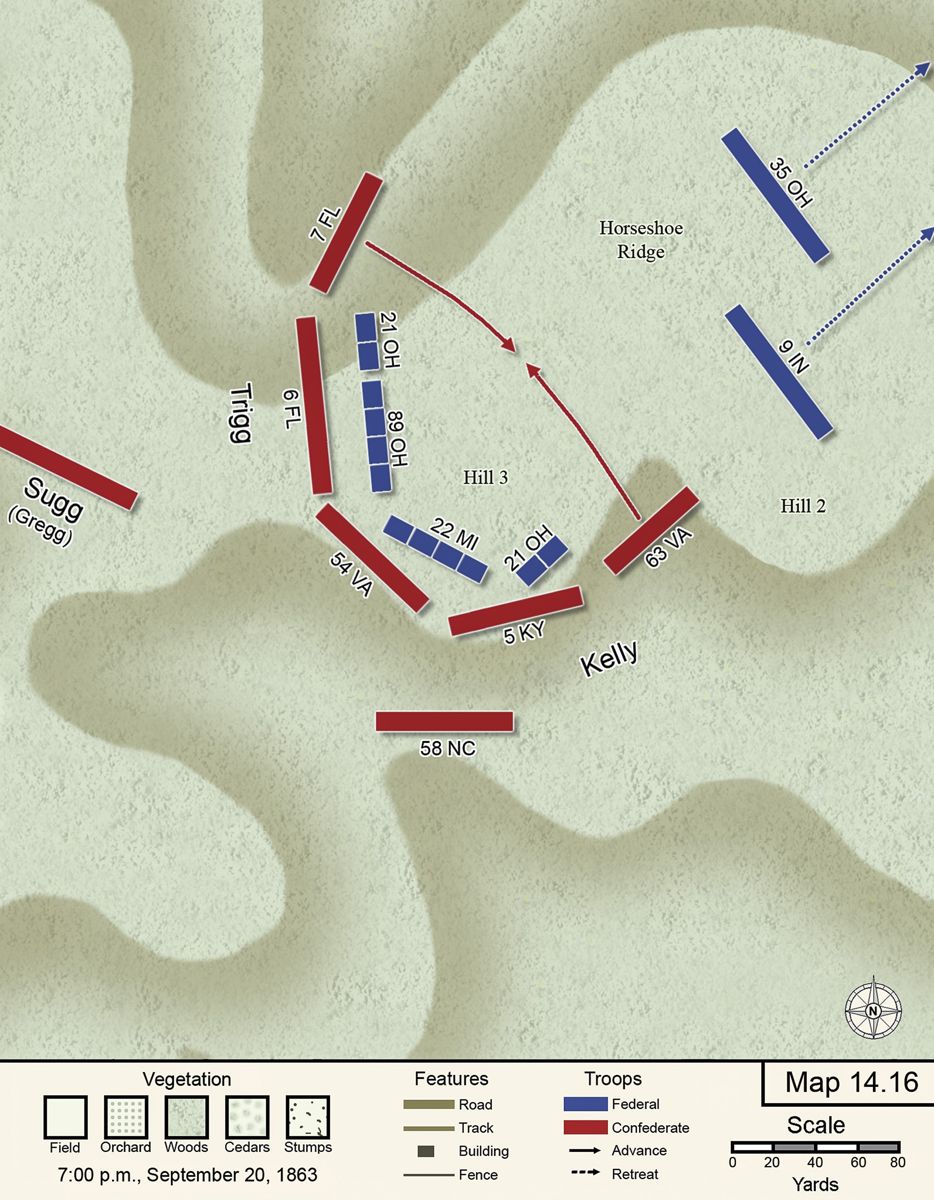
Capture of three regiments 7 p.m. (Powell and Friedrichs, The Maps of Chickamauga)
Colt Model 1855 revolving rifle as issued. This example is serial number 4909 and has been authenticated issued to Company G, 2nd United States Sharpshooters (Berdan’s Sharpshooters). (Author’s collection)
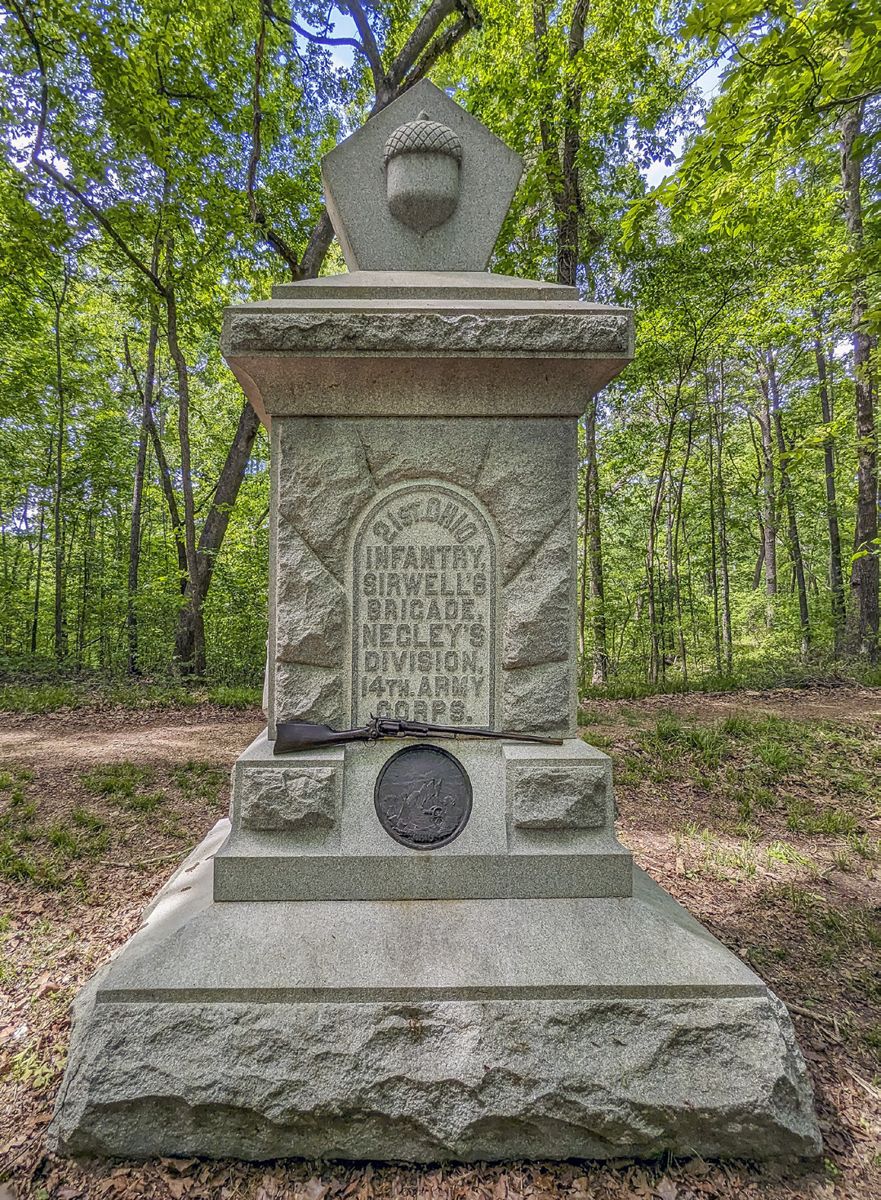
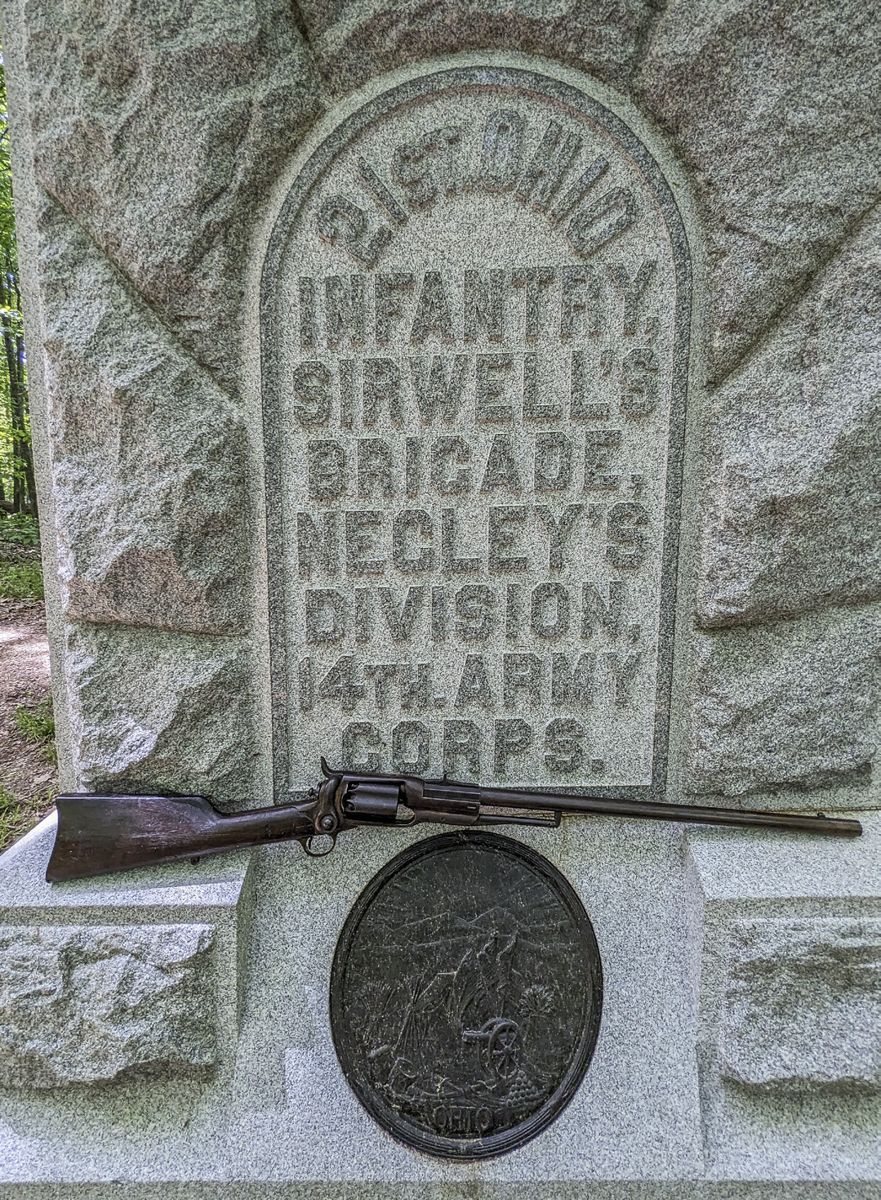
Monument to 21st Ohio Volunteer Infantry, Horseshoe Ridge. (Photo by author)
Colt revolving rifle 5119 resting on base.
Unknown unit pose with their Colt revolving rifles. (David K. Parks Military Antiques)
substitution resulted in many of the Colts’ muzzles splitting from the increased pressure. After the war, Corporal Abel Comstock of Company C recounted the incident. “The dead and wounded were searched for cartridges, and Enfield and Springfield cartridges were used by taking the paper from the ball, but the caliber being larger than the balls we used, many of our guns were burst at the muzzle.” As a further expedient, some soldiers found that by attaching their socket bayonets, the ends of the Colts could be temporarily adapted to the firing of the larger bullets.17 The end was drawing near for the defense of Horseshoe Ridge. The 21st Ohio and the other Union regiments had, however, achieved their main mission. They had bought time. Back in Chattanooga, Rosecrans was establishing some order in the Army of the Cumberland and beginning to man the defensive perimeter surrounding the city. At 5 p.m. he sent a message informing Thomas he could begin pulling his troops out of the Chickamauga site and back toward Chattanooga. As the man who would become forever known as “The Rock of Chickamauga” began selecting units in the Kelly Field salient to withdraw, on the other end of Horseshoe Ridge, the 21st Ohio Regiment, with virtually empty Colts, was about to face yet another assault. The last unit to move in on the 21st was a brigade of Florida Confederates under the command of Colonel Robert C. Trigg. One of those regiments, the 7th Florida Infantry, slowly maneuvered around Hill 3. With leveled muskets, the Floridians surrounded the Ohioans who had no choice but to lay down their Colt rifles and surrender.18 Twelve officers and 104 enlisted men in the 21st Ohio Volunteer Infantry became prisoners of war. They were transported to Atlanta where the officers, Arnold McMahan among them, were transferred to Libby prison in Richmond, Va. The enlisted men were sent to several prison camps in the South, including the infamous enclosure at Andersonville, Ga.
The 21st Ohio Regiment had been fighting almost constantly for six straight hours. They had faced and repulsed attacks by no fewer than eight Confederate regiments. According to McMahan, they had fired 43,550 rounds of ammunition. In killed, wounded, and captured, they had suffered almost fifty percent casualties, but they had prevented a Union defeat from becoming a Union catastrophe. Considering all the facts, it is impossible not to agree with the assessment of noted historian Peter Cozzens that the performance of the 21st Ohio was “the most distinguished service rendered by any single regiment at Chickamauga.”19 The Civil War would continue for twenty more months after Chickamauga and thanks in no small part to the men and Colts of the 21st Ohio, the war would end with a Federal victory. In the 161 years since Chickamauga, however, one perplexing question remains inadequately answered: What became of the Colts of Horseshoe Ridge? In this article’s closing section, we will attempt a response to that issue.
PART III – Captured and Collected With some imagination we can picture what Horseshoe Ridge looked like in the days immediately following the battle. The trees were probably clipped short from bullets and artillery shells. The leaves were burning and the ground was torn up from horses, wagons, and shells. The cries of the wounded could possibly still be heard. Dead soldiers and horses were no doubt everywhere. The stench must have been horrific. Also present in this flotsam of war were the accoutrements of the combatant armies; uniforms, cartridge boxes, boots, and, of course, guns. A distinguishing feature of the Chickamauga battlefield is that it was one of the few sites in the western and central theaters of war that the Confederate forces occupied after the fighting was over.
Excavated Model 1855 Colt revolving rifle. (James D. Julia Auctions)
Horseshoe Ridge at the Chickamauga battlefield. (Hal Jespersen)
They would have had access to Horseshoe Ridge and could comb the ground looking for anything that might be useful in their subsequent campaigns. Especially valuable would have been firearms they could possibly recondition and reissue to Confederate soldiers who badly needed them. In 2019, Captain Stephen W. Knott published an interesting book titled, “Captured & Collected” Confederate Reissued Firearms, that describes the process whereby the Confederate Army gathered weapons from battlefields, sent them to various armories for reconditioning, marked them as once again fit for service, and reissued them to Southern units.20 These reconditioned firearms represented the second biggest source of weapons for the Confederate Army, second only to arms imported from foreign purchases. Although Knott’s study focuses on the “cleaning and repair” process in the Eastern theater of conflict, he does point out that at least 15,000 arms were recovered from the Chickamauga battlefield by Southern soldiers and civilians.21 It is almost certain Horseshoe Ridge was meticulously examined for dropped and surrendered Colts. The questions are; how many Colts were left behind by the 21st Ohio Regiment, and what was the condition of those Colts recovered by the Confederates?
A Confederate soldier wearing a homespun shell jacket, holding a Colt Model 1855 Revolving rifle and a civilian hat that hasn’t seen much use yet. He is posed with an inverted belt with a D-guard Bowie knife and a U.S. Model 1816 .69-caliber musket bayonet, which is incorrect for the Colt rifle. (Liljenquist Family Collection of Civil War Photographs, Library of Congress)
Confederate soldier in uniform and cap covered by havelock with a captured Colt Model 1855 revolving rifle. (Liljenquist Family Collection of Civil War Photographs, Library of Congress)
Unidentified North Carolinian wearing homespun Confederate coat with North Carolina state seal buttons visible. He proudly holds a Model 1855 Colt revolving rifle. (Liljenquist Family Collection of Civil War Photographs, Library of Congress)
Supplemental number 148 stamped on cylinder.
Colt 5119 right side. (Photos by author)
Tang serial number 5119.
Original SN 5119 and supplemental number 148 stamped on bottom of the barrel.
Colt 5119 left side.
The 21st Ohio Volunteer Infantry entered the Battle of Chickamauga with 25 officers and 517 “men with rifles.” How many of these rifles were Colts is a figure open to some debate. A record of serial numbers compiled when the Colt revolving rifles were issued on May 26 at Nashville lists 324 numbered Colts. Major Arnold McMahan disputes this figure. In a report he wrote after his release from Libby prison, McMahan claims his regiment had 342 Colts.22 Reputable arms historian John McAulay has written the regiment entered Chickamauga with 347 Colt revolving rifles.23 In this article, McAulay makes the important additional observation that the Colts of the 21st Ohio came from the same group of weapons previously issued to the Berdan Sharpshooters. Prior to being shipped to Nashville, these revolving rifles were stored in the Washington Arsenal in the Federal capital after being turned in by the 1st and 2nd Regiments of the United States Sharpshooters in June 1862. It is impossible to know with certainty exactly how many Colt Model 1855 rifles were on Horseshoe Ridge during the Battle of Chickamauga. All we can say is the 21st went into battle with somewhere between 324 and 347 Colts. How many of these were lost can be roughly estimated. McAulay puts the number at 167.24 Using figures from the National Archives Record Group, it is known that three months after the battle, on Dec. 31, 1863, the 21st Ohio Infantry had 174 Colts on hand.25 Some of these may have been resupplied guns issued to the
Colt revolving rifle, serial number 5196, has a supplemental number on the cylinder and underside of the barrel next to the original serial number. The number font on Colt #5196 / #58 is clearly the same as on Colt #5119.
unit after Chickamauga, but if we subtract the 174 Colts that remained with the unit from the 324 to 347 Colts carried into the battle, then McAulay’s estimate of around 167 Colt Model 1855 rifles lost on Horseshoe Ridge seems reasonable. A significant percentage of these were, no doubt, found and turned in by the Southerners. The condition of these Colts probably varied considerably. As confirmed by several sources, the muzzles on many of the Colts had split from the use of larger caliber bullets. There is also reason to believe that immediately before their surrender the soldiers of the 21st Ohio were ordered to render inoperable the Colts that would soon be the possession of the Rebels. The best way to damage the Colts was probably to pull the cylinders and cylinder pins, throw them away, and possibly also break the stocks of the rifles. When the Confederates searched Horseshoe Ridge, they would have found parts of Colts scattered about; here some frames and barrels with burst muzzles, there some cylinders and cylinder pins, perhaps some broken stocks lying about. These parts were quite possibly gathered up, sent to Atlanta, and then forwarded to the Confederate armory at Macon, Georgia, where they were reassembled, reconditioned, and reissued. This explanation of events could be supported with evidence from an actual surviving Colt Model 1855 revolving rifle known to have been issued to the 21st Ohio Volunteer Infantry. Fortunately, an example of such a Colt exists. Bowling Green State University in Bowling Green, Ohio, is the depository of the records of the 21st Ohio Volunteer Infantry. Stored in their archives is a file titled “Numerical Record of Colt Revolving Rifles.” This is the original list of Colt serial numbers distributed to the 21st Ohio that allows us today to know with some certainty which specific guns were on Horseshoe Ridge. One of those Colts, serial number 5119, is presently available for inspection and analysis. As issued, this weapon was of the standard pattern for this model. This is not, however, the gun’s present configuration. Colt 5119 has had the barrel shortened to 24 inches and the forestock has been removed. The stock and butt plate are original to the gun with the stock showing signs that at some time it was repaired. The cylinder pin and cylinder have the most note worthy elements. These two items are from different Colt revolving rifles but have obviously been with 5119 for a long time. The most intriguing feature is the presence of an auxiliary or supplemental serial number found on the cylinder and underneath the barrel next to the Colt’s original serial number. This number “148” is larger and of a different font than those found on any Colt firearm. The purpose of this additional number is apparently to pair or match up the frame and barrel with the new/replaced cylinder
“Numerical Record of Colt Revolving Rifles,” highlighting Colt 5119. (Courtesy Bowling Green State University Archives)
from a different revolving rifle. They might also have been used as inspector’s marks verifying this weapon’s acceptance as a reconditioned arm fit for service. Similar supplemental cylinder/barrel numbers have been observed on other Colt revolving rifles (for example Colt #5196 / #58). Whatever their precise meaning or intent, the fact that the range of numbers extends to at least 148 argues against the changes to these Colts being done by a private gunsmith on an individual basis. The reconditioning and repair of these Colts was part of an organized, coordinated, Supplemental number and presumably official 148 stamped on cylinder. process. We can now reasonably conjecture what happened to the Colt revolving rifles of the 21st Ohio. Some number of them—perhaps as many as 174— managed to get through the Confederate lines and remain part of the regiment’s armory. Some other number—most likely around 167—were captured and collected by Southern soldiers and civilians after the battle. These guns, and parts of guns, were sent to one of the Confederate arsenals where the barrels were cut down to remove the burst and split muzzles, replaced cylinder pins and cylinders were found from other Colts either from the battle site or from other revolving rifles from other regiments, matched up with different frames and barrels, and assigned an auxiliary or supplemental number to attest to the new pairing.26 These reconditioned Colts then switched sides in the American Civil War and went on to serve in the Confederate Army. Colt 5119 was likely one of these reconditioned rifles, and it can now be acknowledged as having a war record extending from Berdan’s Sharpshooters to the 21st Ohio to the army of the Confederate States of America. Endnotes 1.
The major sources for information on the Battle of Chickamauga are Peter Cozzens, This Terrible Sound, The Battle of Chickamauga (Urbana and Chicago: University of Illinois Press, 1992) and Glenn Tucker, Chickamauga: Bloody Battle in the West (New York: Smithmark Publishers, 1961). Estimates of troop strength when the battle began are Union at 57,840 and the Confederates with about 68,000. See Cozzens, 534.
Five members of the 21st Ohio Volunteer Infantry pose with their Colt Model 1855 revolving rifles.
The offending Union officer was Brigadier General Thomas J. Wood. Details of this incident are found at Cozzens, Chapter 20, and Tucker, Chapter 23. On the naming of Horseshoe Ridge, see Cozzens, 418. Silas S. Canfield, History of the 21st Regiment Ohio Volunteer Infantry in the War of the Rebellion (Toledo, OH: Vrooman, Anderson & Bateman, 1893), 95. Cozzens, 419. On the timing of the first attack, see Cozzens, 424. See also Canfield, 116, 130, and 136. Canfield, 95. The War of the Rebellion: The Official Records of the Union and Confederate Armies in the Civil War (OR), Vol. XXX, Series 1, Pt. II, 289. Cozzens, 431; Canfield, 130. Canfield, 130. Captain William (Wilson) Vance, “On Thomas Right at Chickamauga,” Blue and Gray (The Patriotic Publishing Co.), Vol. 1, No. 1, January 1893. Canfield, 136. Ibid., 143 and 138. Cozzens, 436. Canfield, 120. Cozzens, 436. Canfield, 146. Cozzens, 436. Tucker, 367. Cozzens, 505. See also Tucker, 368. Captain Stephen W. Knott, “Captured & Collected” Confederate Reissued Firearms (Gettysburg, PA: The Horse Soldier, 2019) Ibid., 77. Arnold McMahan Papers, Bowling Green State University Archives. It is possible McMahan transposed his numbers and meant to say 324 Colts. John D. McAulay, “Col. Colt’s Revolving Rifle in the Civil War,” The American Rifleman, March 2004. Ibid. John D. McAulay, Civil War Breech Loading Rifles (Lincoln, RI: Andrew Mowbray, 1987), 18. Other regiments at Chickamauga at least partially armed with Colt revolving rifles included the 21st Michigan Regiment. See Tucker, 292. Also carrying Colts were the 22nd and 51st Illinois and the 15th Missouri. See McAulay op. cit.
About the Author As an early adult, Franklin (Frank) Kalinowski supported himself as a house painter and carpenter while working to earn a B.A., M.A. and Ph.D. in political science and environmental studies. He has always been a dedicated hunter and fisherman. His professional career comprised teaching positions at colleges and universities in Delaware, Vermont, upstate New York, Colorado, New Orleans, and North Carolina. He is the author of one book and numerous academic articles on American political thought and environmental politics. Throughout all of these years, Frank maintained a keen interest in Civil War history and the collecting of Colt percussion revolvers. This avocation led him to regularly attend gun shows and meetings with his good friend and fellow collector, Henry Walton. Colt revolving rifle serial number 5119 was in Henry’s collection for more than 70 years. When Mr. Walton died in 2023, Henry’s daughter, Jill Snow, was gracious enough to pass on Colt #5119 to Frank—a kind gift for which he is enormously grateful. Now retired, Franklin Kalinowski can be reached at FKalinowski44@gmail.com.