
Colt Military Service Pistols—models 1900 to 1911
By Theodore F. Mayer, DDS · Originally published January-February 2025 · pp. 35–47
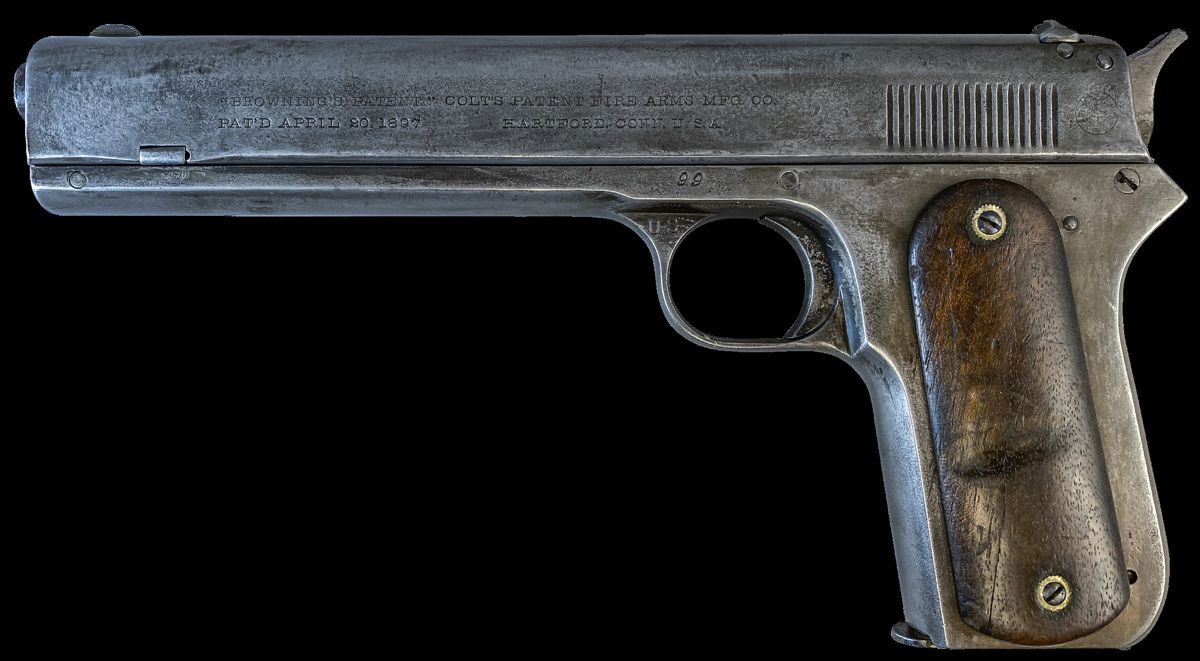
Model 1900 First Army Contract The Army placed an order for 100 Model 1900 .38 automatic pistols to be used in field testing shortly after Colt’s began their commercial production in February 1900. In three separate shipments in May and June 1900, Colt’s delivered 100 automatic pistols, serial numbered 11, 12, 59, 60, 87-157, and 183-207, to the U.S. Army for field tests in the Philippines, Cuba, Puerto Rico, and the continental United States. An interesting fact to remember is that adopting this firearm for use in the service primarily centered around its suitability for use on horseback by the U.S. Cavalry.
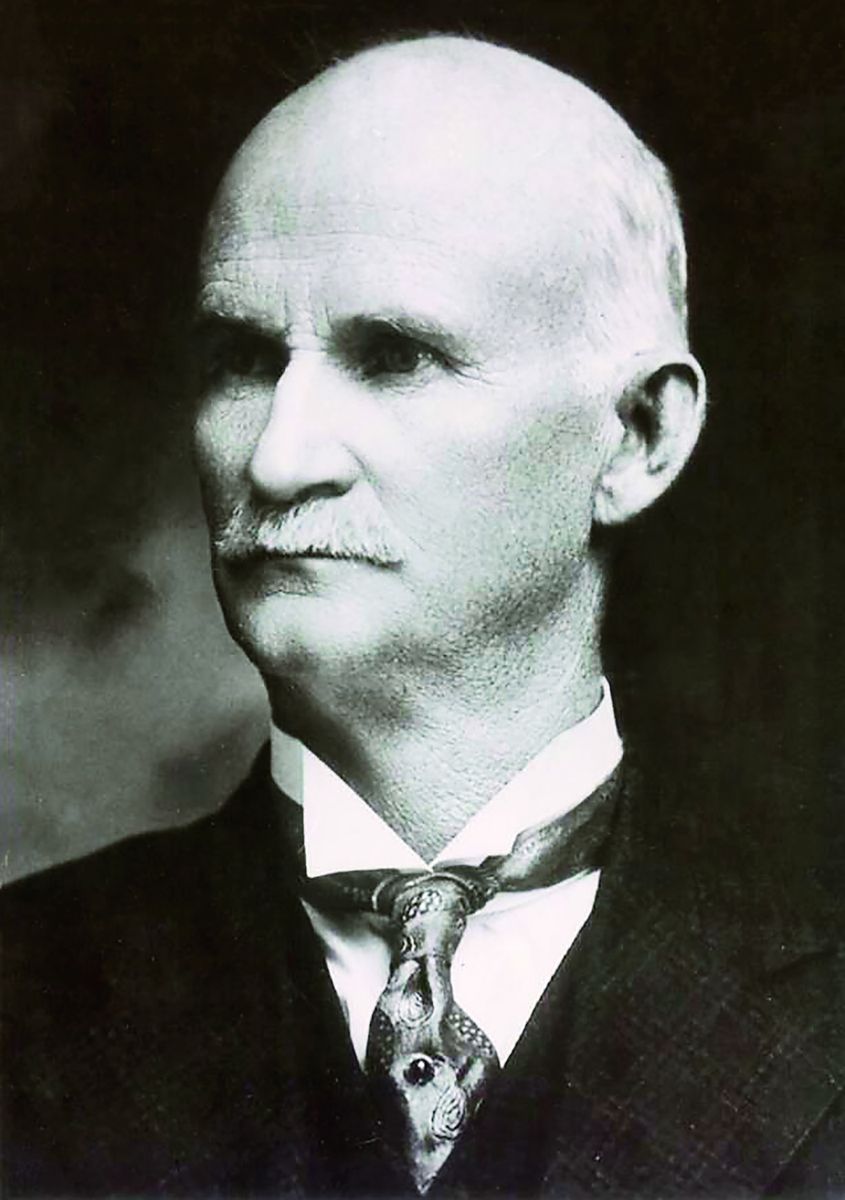
John M. Browning (1855–1926).
Model 1900 SN 99 First Army Contract.
Model 1900 Second Army Contract Two hundred additional Model 1900 .38 automatic pistols, serial numbered 1501 to 1700, were shipped in late December 1900 through early February 1901 for trials.
Model 1900 SN 1582 Second Army Contract.
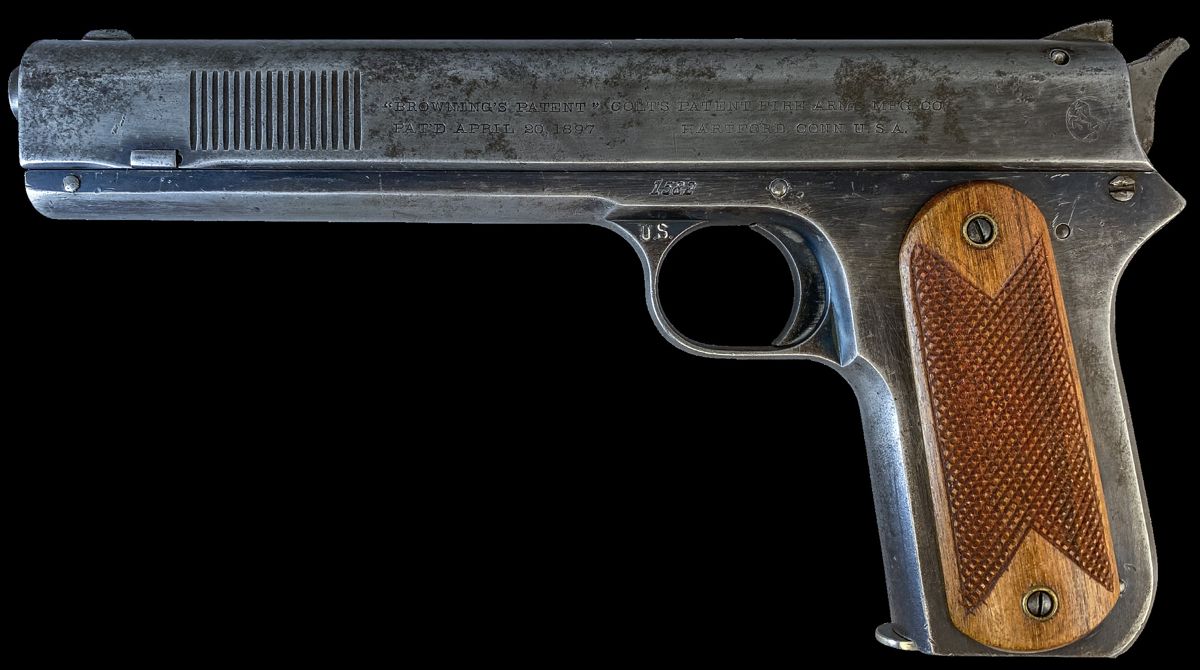
A few noticeable changes from the first army contract included thicker, often checkered, grips and frontal rather than rear plunge milled slide serrations. These were easy fixes to a few of the criticisms concluded from the first U.S. Army contract pistols. The informal trials in 1900 through 1902 of the 300 Model 1900 pistols yielded constructive criticism, some of which was addressed in the Model 1902 military. One objection concerning the small .38 caliber was not easily addressed without major retooling by Colt’s, whereas other criticisms were addressed more easily with modifications
Model 1900 SN 1663 Second Army Contract.
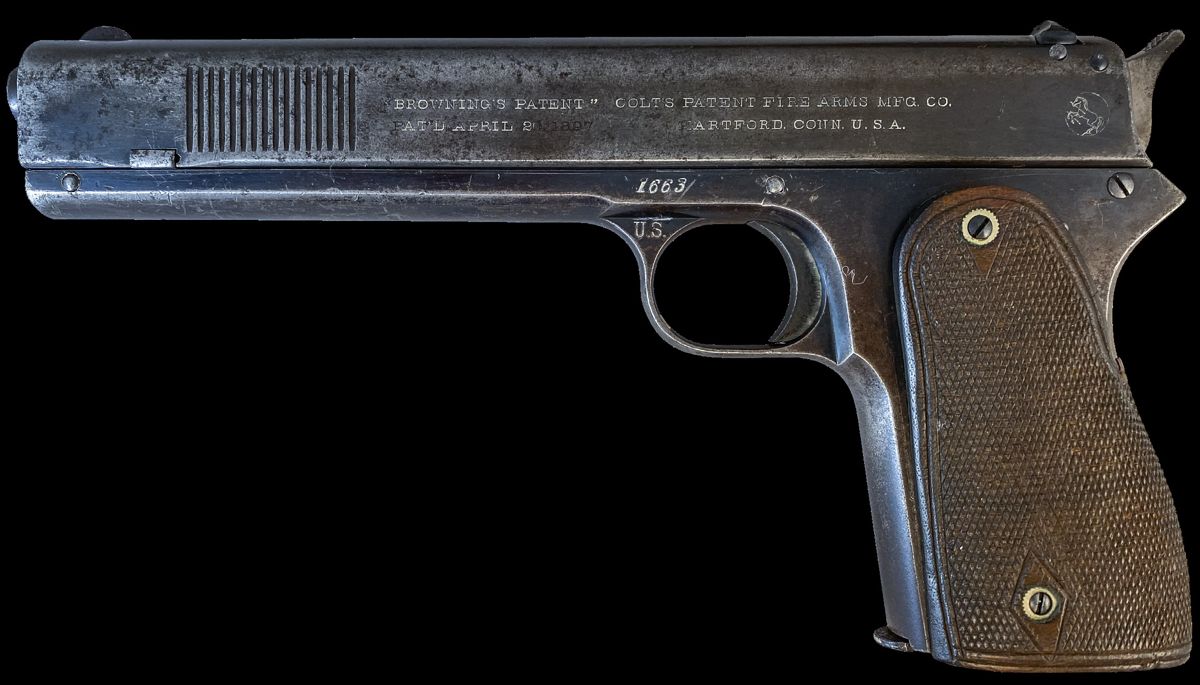
in subsequent models. Additional objections to the Model 1900 reported from the Philippines and the cavalry included a small ejection port, a short grip, an unsafe firing pin, a requirement for two hands to get it into action, sight safety inadequacy, slide serration location, slide serration pattern, grip angle, and balance. Although the Model 1900 had satisfactory action, greater endurance, higher rate of fire, and greater accuracy than the service revolver, the board of officers concluded that “the automatic pistols are not sufficiently developed to warrant their adoption in place of the revolver.”
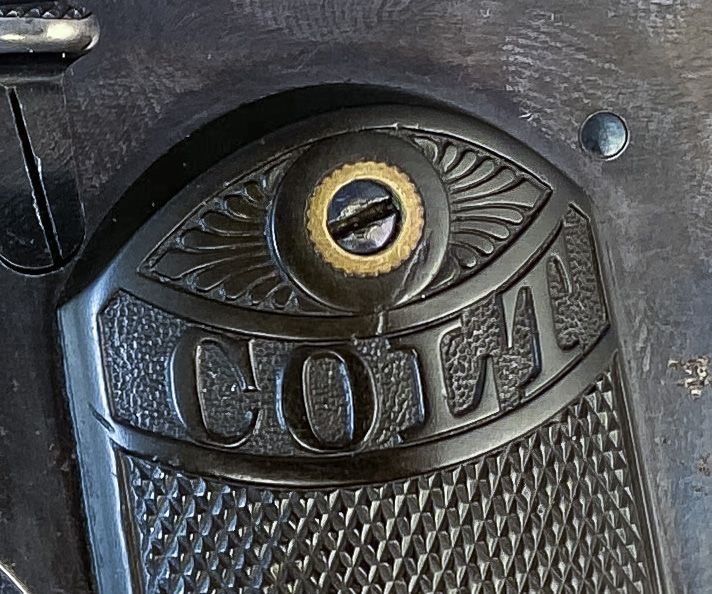
Model 1900 U.S. Navy Contract The U.S. Navy ordered 250 Model 1900 .38 automatic pistols, serial numbered 1001 to 1250. These were shipped in October and November 1900. My current belief is that the Navy did not have formal trials. Although purportedly for trials, most “USN” marked pistols from this order that I have viewed are in fine condition, and no Navy trial conclusions are known to me. The board of officers at Springfield Armory tested the improved model 1902 Military and ordered 200 pistols for testing and field trials. These were serial numbered 15001 to 15200 and shipped in July 1902. The improvements designed to overcome the Army’s criticisms of the Model 1900 included the following modifications: checkered hard rubber grips instead of wood, front crosshatched serrations instead of plunge milled, slide hold open, ease of field stripping with a concave takedown plug instead of the convex takedown plug, increase magazine capacity from seven to eight rounds, longer squared off grip, lanyard loop, shorter inertia firing pin, a new rear sight, and eliminated original sight safety. Colt created the Model 1902 Military pistol for the military market hoping the government would select it for purchase and issue to the troops. Although there were few written notes of specific details in the 200 Model 1902 Military pistols field trials, the U.S. Cavalry again objected to both an automatic pistol and the small .38 auto caliber. To address concerns about an increased caliber, Browning developed a .41 caliber automatic pistol based on the Model 1902 Military design, but the increased power of the .41 caliber cartridge proved troublesome and made the prototype prone to breakage. Browning also used a shorter barreled .41 caliber like the commercial Colt 1903 Pocket Hammer with a 4.5-inch barrel, but the more powerful .41 cartridge overtaxed this design. Both the inventor and Colt’s had their work cut out for them before the U.S. government would adopt an automatic service pistol.
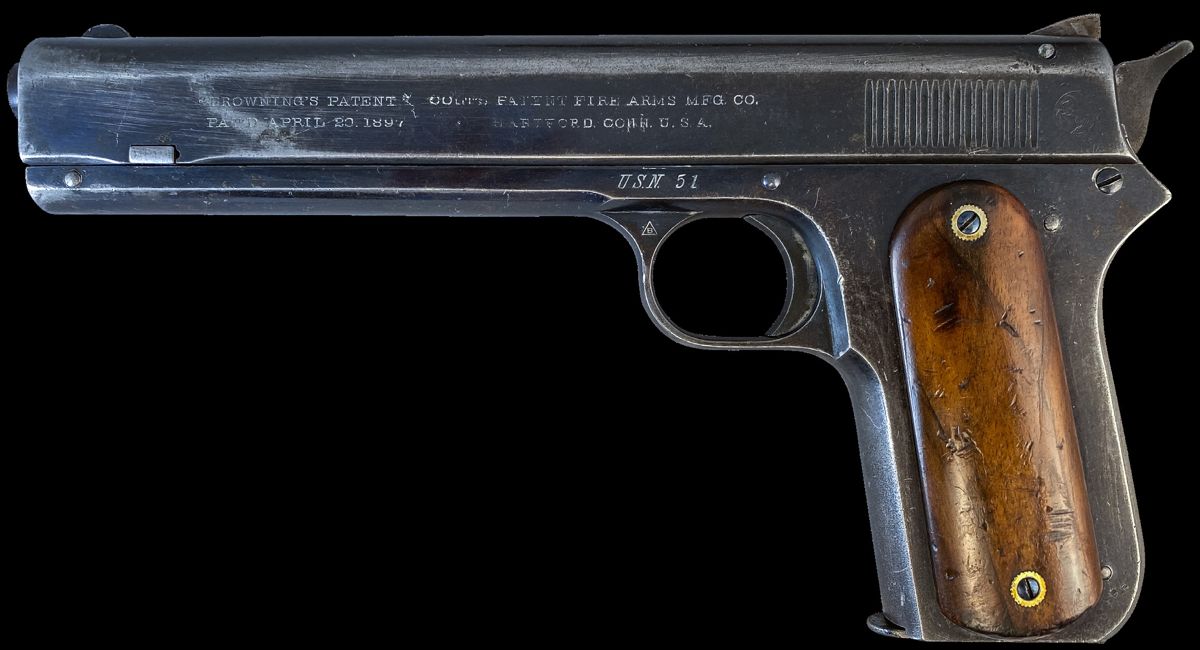
Model 1900 SN 1051 Navy Contract.
Model 1902 Military SN 15037.
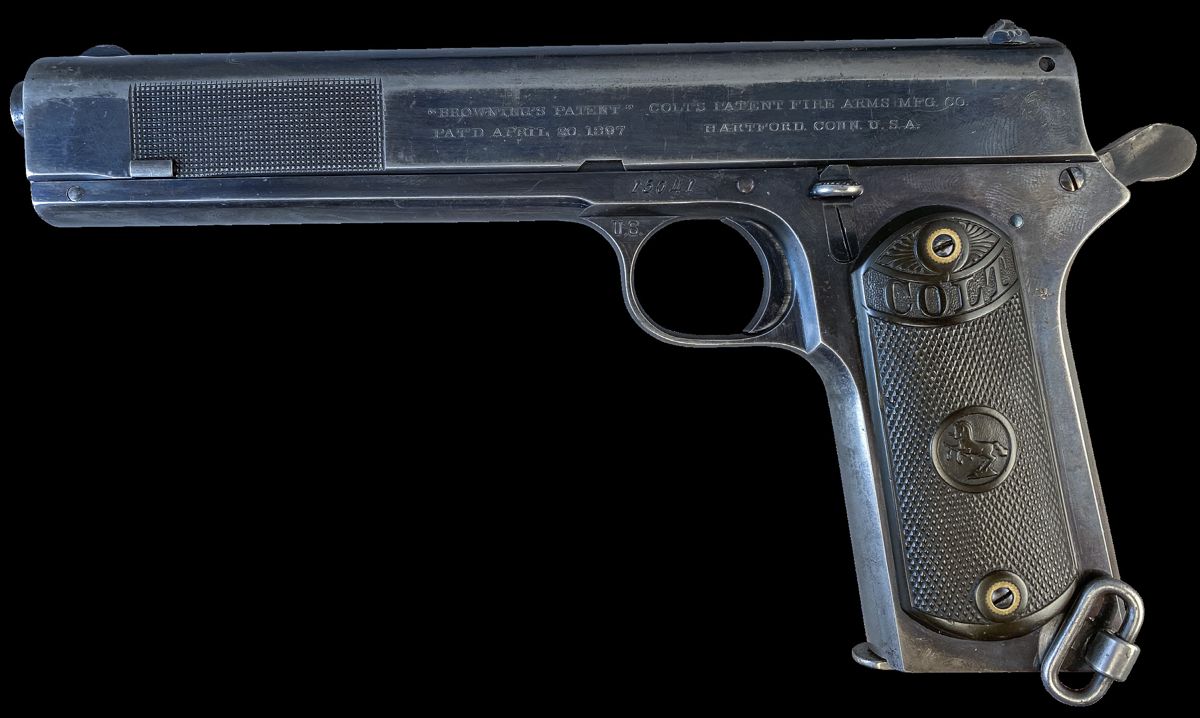
Model 1902 Military SN 15041.
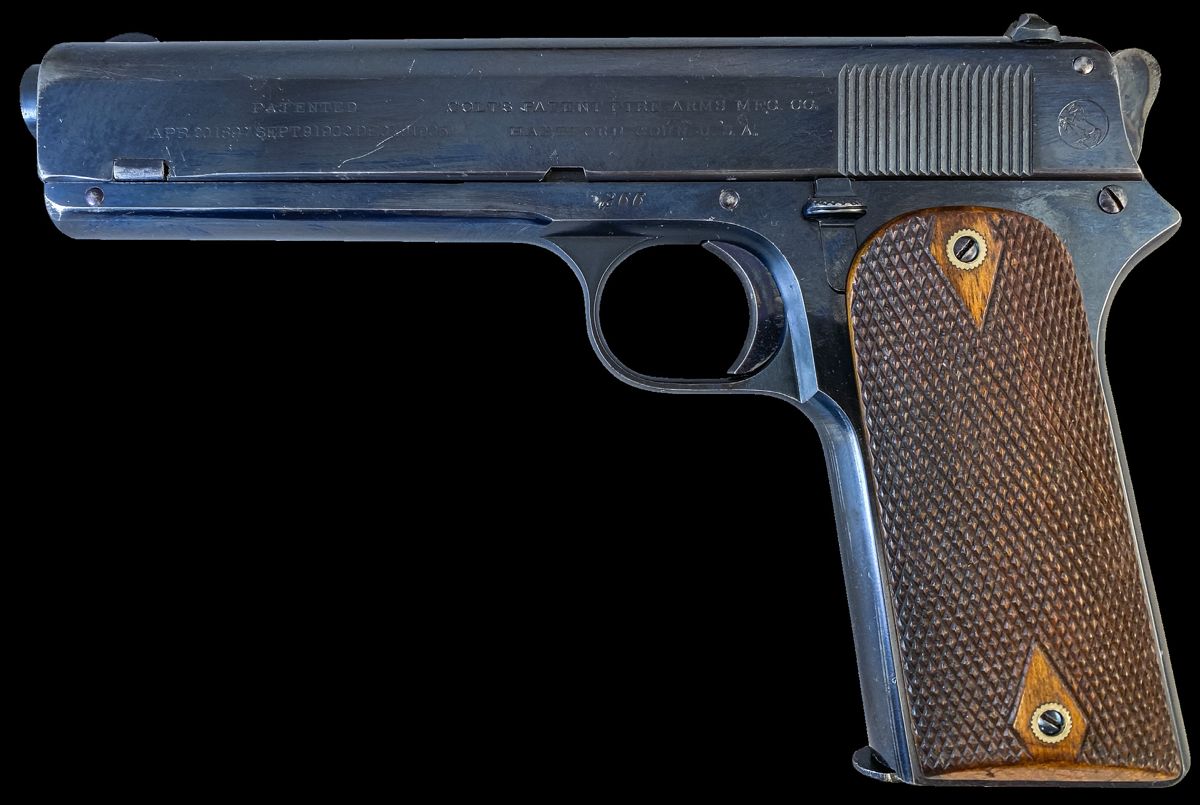
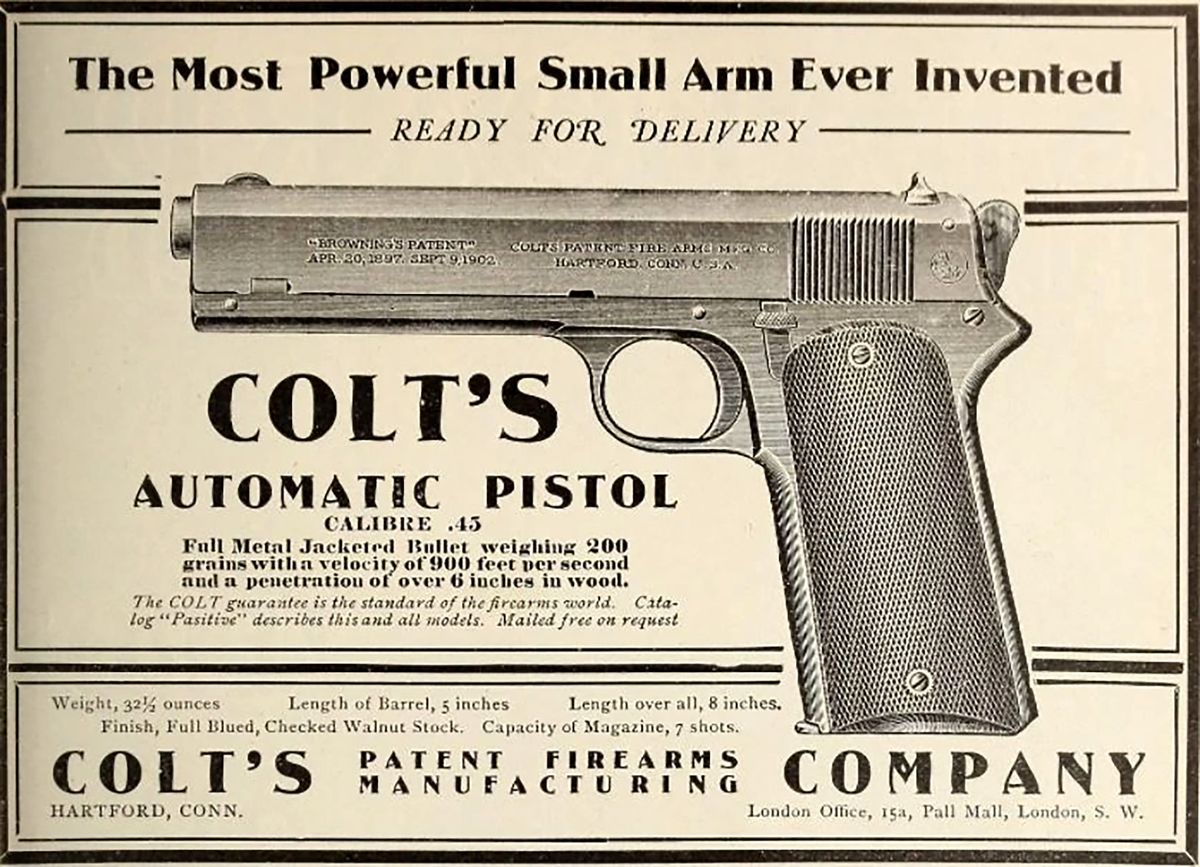
Model 1905 In 1904 the War Department selected Captain John T. Thompson, Ordnance Department, Springfield Armory, and Major Louis A. LaGarde, MD, Surgeon Medical Department, to settle the question of caliber. A total of 11 tests were conducted on human cadavers at Bellevue Hospital, N.Y., and Philadelphia Polyclinic Hospital. Additional experiments were conducted on beef cattle and horses at Chicago’s Union Stockyards. The board concluded that a military pistol or revolver should have a caliber not less than .45. With the requirement for the larger and more powerful .45 caliber, Browning and Colt embarked on a project to design and manufacture a new pistol using the new .45 auto cartridge. These pistols became known as the Model 1905. Although Colt likely collaborated with the ordnance department during and after the development of the Model 1905, it was not until formal trials were announced in 1906 by General William Crozier, Chief of Ordnance, that Colt’s, along with other pistol
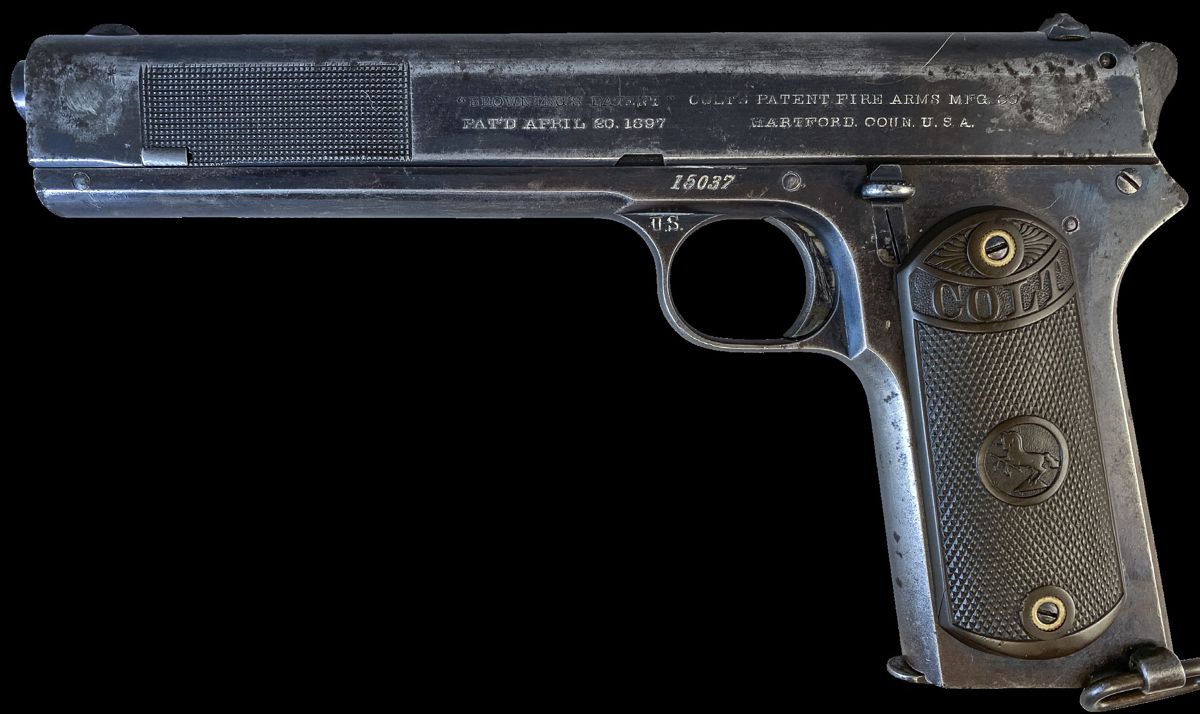
Model 1905 SN 266.
manufacturers, officially submitted pistols and revolvers to the Ordnance Department for trials that commenced in 1907. The first few Colt pistols submitted were similar to the Model 1905 .45 and performed satisfactorily. After consideration by the board, both the Savage and Colt automatic pistols possessed enough merit that warranted further tests under service conditions. Before field trials, certain changes were requested, including an automatic safety, a spur hammer, a larger ejection port, and an indicator for a loaded chamber. Thus, the Model 1905 with the requested modifications was produced for field trials in 1907.
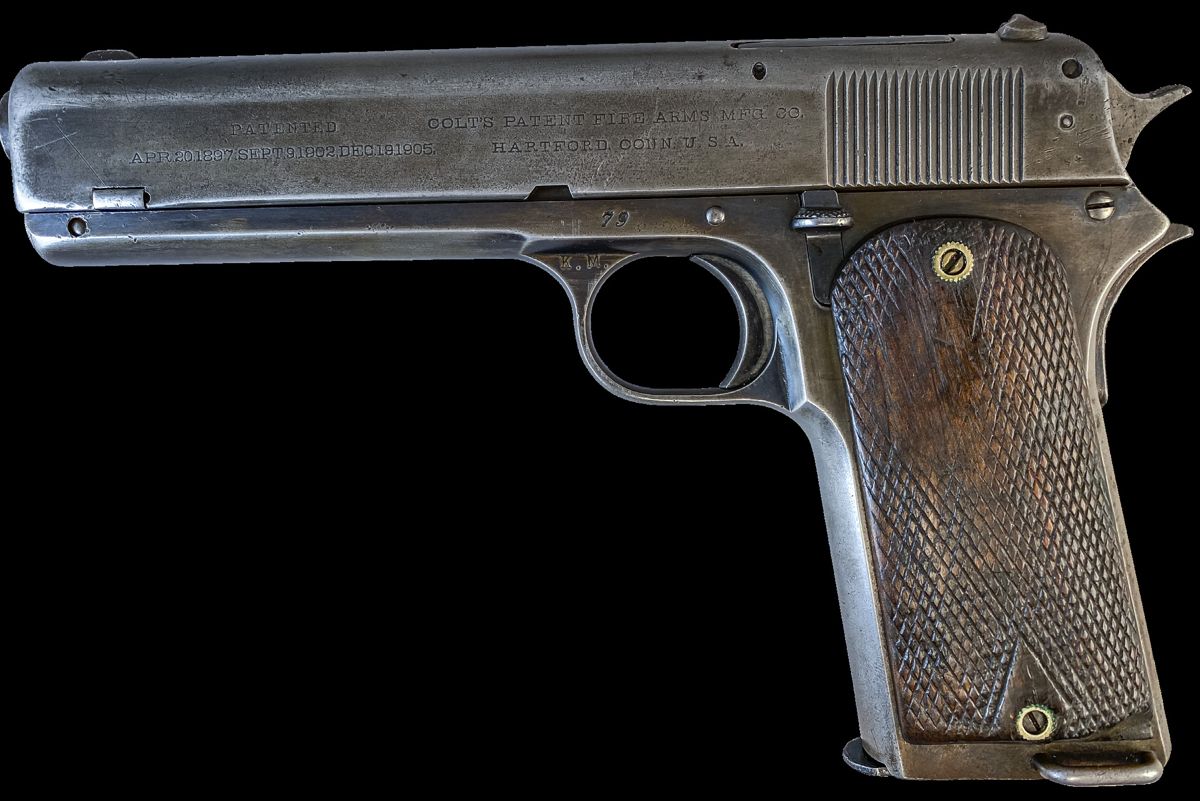
Model 1907 Two hundred Colt .45 pistols, serial numbered 1 to 200, were shipped to Springfield Armory in March 1908 for field trials. Colt listed these 200 pistols as “Colt Modified Automatic Pistols Model 1905;” they appear in Ordnance records as “Model of March 1907,” but both here, and more commonly, are referred to as “Model 1907.” Serial numbers 1 to 65 went to the 10th Cavalry, Philippines; serial numbers 66-130 to the 2nd Cavalry, Iowa; serial numbers 131-195 to the 4th Cavalry, Minn.; serial numbers 196-200 to the School of Musketry, Calif. Later an additional five pistols, serial numbered 201 to 205, were shipped to the Chief of Ordnance, General William Crozier, for presentation. Field trials were disappointing. Again, the board deemed them not suitable for mounted cavalry.
Model 1907 SN 79.
In 1909, Colt submitted a request to the Ordnance Department for an altered Model 1907, which included modified sears, extended grip safety, a spur hammer, and an enlarged ejection port. With these modifications, Colt reissued these Model 1907s for field trials that continued through 1909. These modified second variation pistols performed better than the original Model 1907 variations but were still unsatisfactory for adoption by the Ordnance Department.
Model 1909 In 1909, John Browning designed a new prototype pistol, the Model 1909, serial numbered 1 to 22. The slide was designed to dissemble from the front, used only one barrel link instead of two, had a barrel hood to guide the cartridge and prevent jamming, and had a relocated magazine release. The Model 1909 was demonstrated and tested by an Ordnance board in 1909 into early 1910. These trials resulted in a more positive judgment, the board stating that the Model 1909 possessed merits justifying its adoption and issue. John M. Browning’s genius and Colt’s research were taking a positive turn toward the army accepting their automatic pistol as the U.S. service weapon.
Model 1909. Photo credit Charles W. Clawson.
Model 1910 Colt presented this new pistol, serial numbers 1 to 9, in early 1910 with the following modifications: a slanted grip frame, internal extractor, lanyard loop, and a return to the triple leaf firing system spring. Ordnance approved the Model 1910, but the Service Boards consisting of Cavalry, Field Artillery, and Infantry officers concluded that, in the hands of inexperienced soldiers, there was a danger of accidental discharge. Although reliable, accurate, and convenient, the Model 1910 required a device that would allow keeping a cartridge in the chamber without the fear of an accidental discharge, especially for cavalrymen. Colt went to work correcting these faults found in the Model 1910.
Model 1910. Photo credit Charles W. Clawson.
Model 1911 By March 1911 Colt had manufactured nine pistols, serial numbers 1 to 9, with the following differences from the Model 1910: strengthened underside of the barrel, enlarged mechanical safety plate, solid enlarged slide lock, smaller side recesses on the grip frame, enlarged grip screws without escutcheons, and a changed grip safety blocking surface. On March 15, 1911, Colt’s officers, John M. Browning, and craftsmen met with the Board of Ordnance and a U.S. Navy representative at Springfield Armory to examine and test the Model 1911. The pistol functioned flawlessly in the endurance test for 6,000 consecutive rounds. The ordnance report of March 20, 1911, states, “The Board therefore recommends the Colt Caliber .45 Automatic Pistol of the design submitted to the Board for test be adopted for use by foot and mounted troops in the military service in consequence of its marked superiority to the present service revolvers, and to any other known pistol, of its extreme reliability and endurance and of its fulfillment of all essential requirements.” After 11 years of design, invention, modification, and manufacture, the Colt Automatic Pistol was adopted by the United States service.
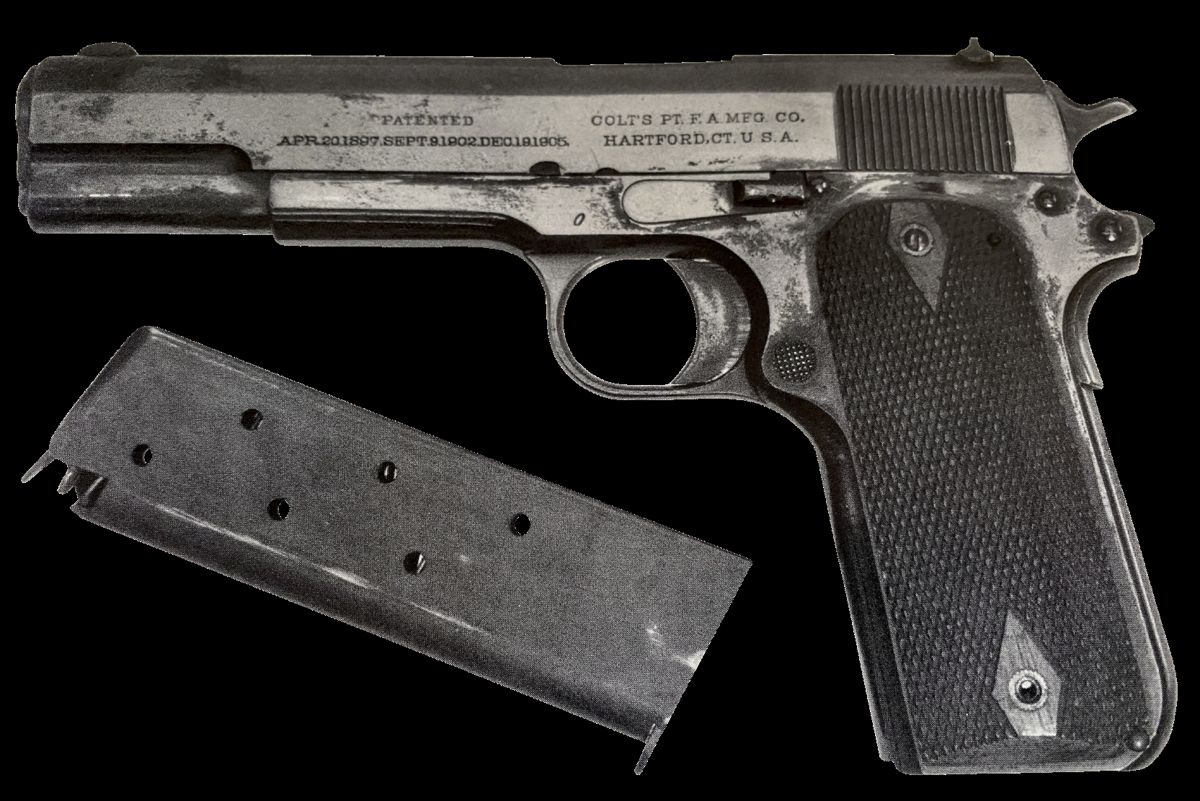
Model 1911 SN 66000.
Sources: Bady, Donald B., Colt Automatic Pistols, Borden, Alhambra, CA, 1973 Clawson, Charles W., Colt .45 Service Pistols, Clawson, Fort Wayne, IN, 1993 Goddard, William H.D., The Government Models, Mowbray, Lincoln, RI, 1988 LaGarde, Louis A., Gunshot Injuries, Wood, NY, 1914 Potocki, John, The Colt Model 1905, Mowbray, Lincoln, RI, 1998 Sheldon, Douglas G., Colt’s 38 Automatic Pistols, Sheldon, Willernie, MN, 1987
Originally printed in Winter 2023, The Rampant Colt magazine with permission from the author.
About the Author Pistol and Revolver Shooting. By Himmelwright, Abraham Lincoln Artman. Macmillan Company, 1915, pp. 211-212.
Ted Mayer is a long time Colt Collector’s Association member, an avid firearm researcher and collector, and has received several show awards for his Colt displays.