
Little Cannon, Big Bang
By Joel R. Kolander · Originally published March-April 2025 · pp. 3–16
or most of us, our first encounter with the Civil War came in our earliest social studies classes. We later find, of course, that many of those precursory lessons were dramatic oversimplifications, as simple and bright as childhood birthday ribbons.
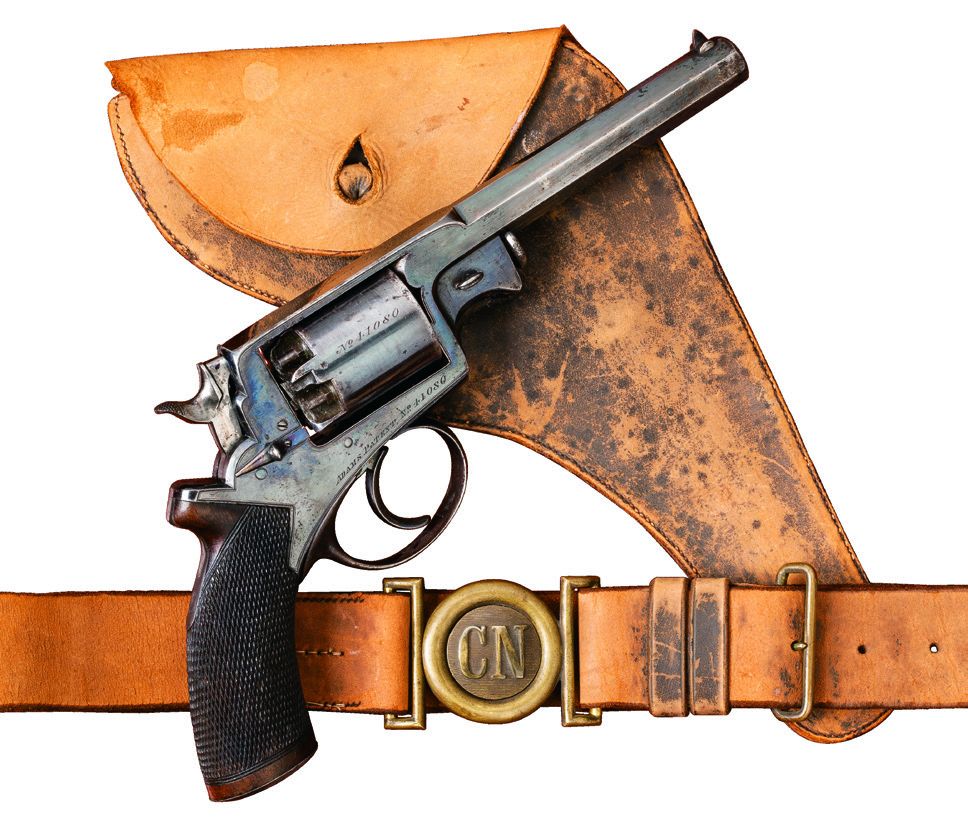
Photo courtesy of Rock Island Auction Company.
However, history is seldom simple and never singular. Far from a single, sleek ribbon, history is a complex tapestry of interwoven strands, rich and vibrant, nuanced, and with patterns to be seen from afar. One oversimplification that bears such inspection is the oft-touted industrial might of the North. Such lessons focus primarily on railroads, telegraph lines, small arms, but often neglect the subject of field artillery.
Behind the 8-Ball
Prior to the war, only two of the nation’s seven cannon foundries were located south of the Mason-Dixon line: little Bellona Foundry and the highly efficient Tredegar Iron Works of Richmond, which would produce roughly half of all Confederate cannon. Such a shortage of cannon production was glaringly apparent to the highest ranks of the Confederate government and military; fighting a war without adequate artillery would be tactically disastrous. Simultaneously, a call went out for government foundries and arsenals, as well as production by private firms. Four Confederate government arsenals were established but starting operations at the commencement of a war put the new facilities in a most unenviable position. They were critical to the war effort, but the new foundries, both private and government-backed, lacked even the most basic elements. Molds did not exist, the copper and tin necessary to make bronze was in short supply, and no existing Southern cannon foundries had begun using the Rodman method of cooling newly poured cannon
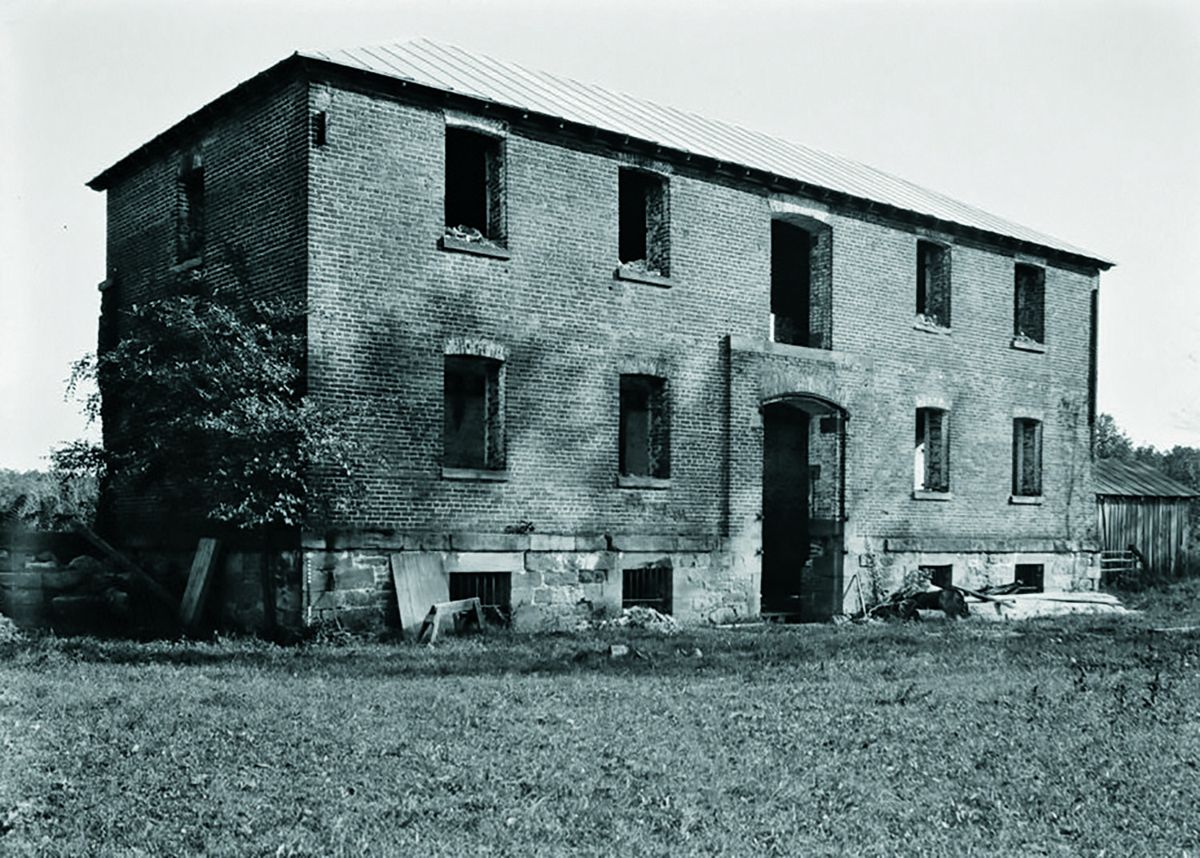
Bellona Arsenal, workshops. Chesterfield County, Va. (Library of Congress)
from the inside out. Freshly christened arsenals were behind the 8-ball, indeed, but with no small amount of pluck, they pressed on. One arsenal formed at the behest of Jeff Davis was the Confederate States Arsenal at Columbus, Ga., (aka the Columbus Arsenal). This is not to be confused with the Brierfield Arsenal (also known as Briarfield) in Columbus, Miss., nor the neighboring Columbus Iron Works. The
Columbus Iron Works began making cannon for the army in the summer of 1861, but by June 1862 it had been leased to the Confederate Navy. They increased the staff, leased more land, and promptly began producing machinery for ships. The Confederate Army was still desperately short of cannon and the South was being substantially out-produced by the North. In 1862, the North produced 493 cannon, and the South a scant 54.
Tredegar Iron Works. (Library of Congress)
The Columbus Arsenal
1047
The birth of Columbus Arsenal coincided with the April 1862 fall of New Orleans. After the city was taken, the Baton Rouge Arsenal found itself perilously close to Union forces, so the whole operation was moved to Columbus, Ga., where it became the Columbus Arsenal. By March 1863 the new foundry was finished, and by May production had begun with a possible output of two guns each week, according to period newspapers.
Chap. XXXIII.] CORRESPONDENCE, ETC.-CONFEDERATE.
urgently recommend to the Department the consideration of this subject, and that measures be immediately taken to improve our field artillery. The contest between our 6-pounder smooth bores and the 12-pounder Napoleons of the enemy is very unequal, and, in addition, is discouraging to our ar
I require immediately, for a particular purpose, four 12-pounder Napoleons, and I request that they may be furnished to me without delay. Many of the inferior guns are now at Staunton, sent back by me when in the valley. I would also recommend, for particular purposes, that some 20 and 30 poun I have the honor to be, with great respect, your obedient servant, E. E. LEE, General.
[Indorsements. ]
Chief of Ordnance: December 9,1862.
See the latter part of this letter as to the four 12-pounder Napoleons. J. A. S. [SEDDON], Secretary of War.
December 10,1862.
These guns were to be bronze, 12-pounder Napoleons, per the direction of Confederate Chief of Ordnance Josiah Gorgas, a man long credited with reinforcing rebel infrastructure and directly addressing the weapon shortage. He gave notice to all Confederate arsenals on November 13, 1862, a full six months prior to production beginning at Columbus. It read:
I respectfully inclose copy of circular sent to all our arsenals, showing that I have already, some time ago, given orders which will meet the views of General Lee. Eecently Messrs. J. E. A. & Co., of the Tredegar Works, have been directed to work night and day to prepare guns of this description. I hav J. GOEGAS,
Colonel and Chief of Ordnance. [Inclosure.]
Circular.]�Bureau of Ordnance,
Richmond, November 13, 1862.
Until further order, no artillery will be made except the following caliber: Bronze.—Light 12-pounder or Napoleon guns, caliber 4.62.
Iron.—For field battery of maneuver, 10-pounder Parrotts, banded, caliber 2.9. For field battery of reserve, 20-pounder Parrotts on 12-pounder carriages, caliber 3.67. For siege, guns, 30-pounder Parrotts on 18-pounder siege*carriages, caliber 4.2. Yery respectfully, J. GOEGAS,
Colonel and Chief of Ordnance.
Headquarters Army of Northern Virginia,
Camp near Fredericksburg, December 5,1862. Hon. James A. Seddon,
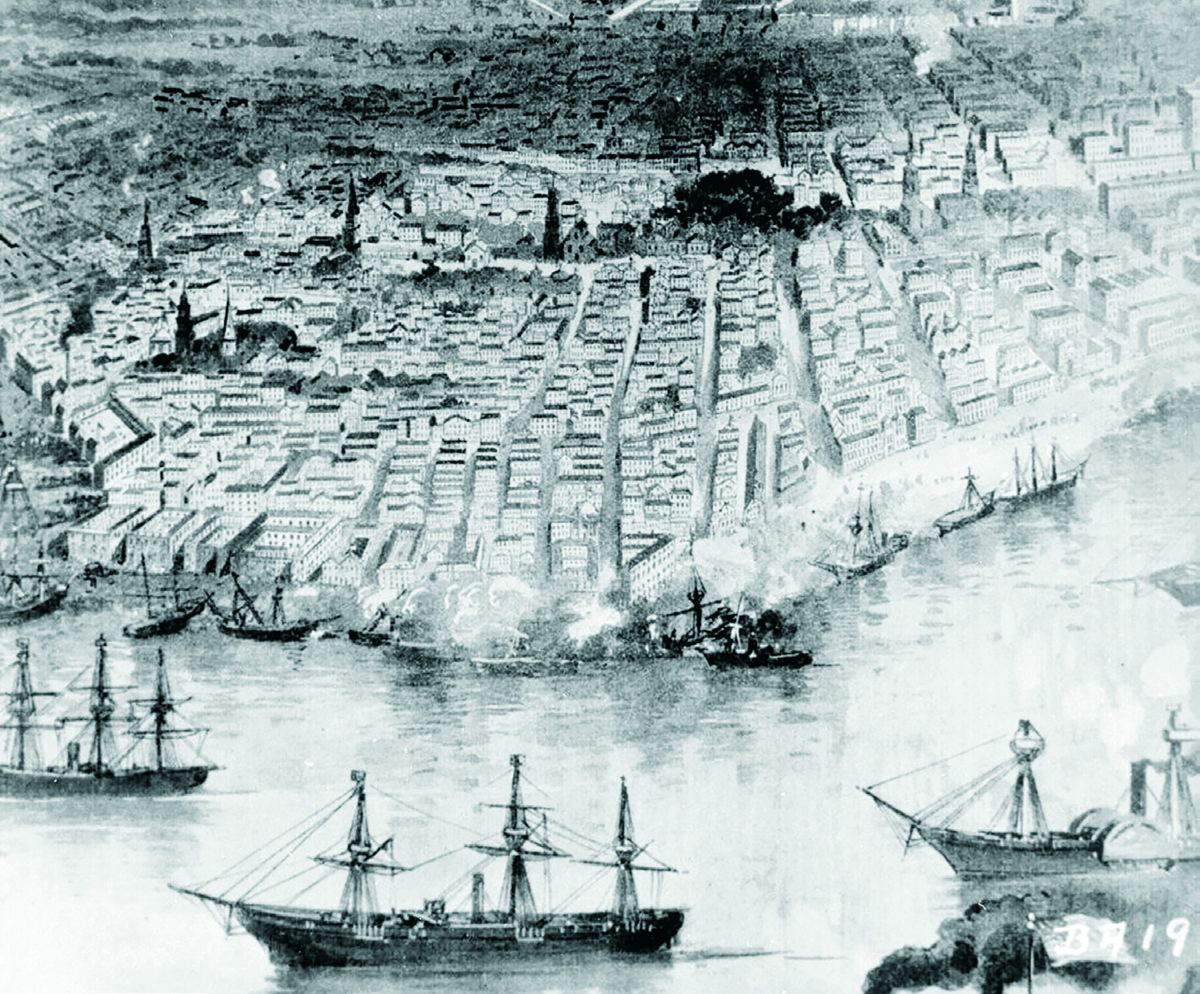
The fall of New Orleans, 1862.
Secretary of War: Sir : I have the honor to acknowledge your letter of the 4th instant, and to express my thanks for your prompt attention to my requisitions. I fear I was not sufficiently explicit in my recommendations in reference to the cavalry. My proposition was to attach, temporarily, the
Compared to their Northern counterparts, who at that time had been focusing production on Napoleons since mid-1861, it was a step slowly taken, but a step in the right direction nonetheless. With no existing records, Columbus’ overall production numbers differ among scholars. The agreed estimations, based on known markings, seem to range between 60 and about 80. As of several decades ago, there were just over 30 surviving examples, with more than 20 populating the Gettysburg battleground. Two others are at the Rock Island Arsenal Museum, leaving very few in private hands. The survival of almost three dozen guns is quite a feat considering the relative productivity of the Columbus Arsenal. On top of that level of rarity, comes the subject of our story: a bronze, Confederate Arsenal 9-pounder.
Confederate Chief of Ordnance Josiah Gorgas.
Source: The War of the Rebellion : a Compilation of the Official Records of the Union and Confederate Armies, Series I, Vol. XXI, page 1047.
As Rare As it Gets
Yes, you read correctly, an American 9-pounder cannon. Any reader of this magazine is likely well-acquainted with the fact that while 9-pounder guns saw use in Europe, they are quite an anomaly in America, aside from a brief flirtation with the idea that resulted in almost 30 being purchased in the 1830s. The 9-pounders provided less mobility than a 3-pounder rifle or the then-obsolete 6-pounder field gun and less firepower than the 12-pounder Napoleons. The relative lack of both mobility and oomph doomed them in the U.S., making any 9-pounder about as rare as hens’ teeth. The Columbus 9-pounder is the only known surviving example of its type. Moreso, this cannon shouldn’t even exist. The Gorgas notice specifically ordered that the South’s precious raw materials be reserved for very specific models of artillery, and not only were 9-pounders absent from that list, they weren’t even in use by the Union or Confederate militaries. Why did the Columbus Arsenal take it upon itself to create these small Napoleons? One could speculate that it was due to a lack of available bronze. After all, in early 1863 Robert E. Lee notably sent almost every bronze 6-pounder from the Army of Northern Virginia to Tredegar Arsenal to be melted down and recast as 12-pounder Napoleons. He had even written Confederate Secretary of War James A. Seddon the previous December. (See report on the following page) The South was hurting for metal, and the situation wasn’t getting better. By November 1863, the Union had captured the Ducktown, Tenn., copper mines, and, by the following January, Tredegar was producing its Napoleons out of iron. Somehow, Columbus seems to have avoided this lack of bronze. Whether they utilized a source other than Tredegar or their comparatively low production numbers helped stretch their supply is outside the scope of this article. Columbus continued producing 12-pounders throughout 1864, totaling almost half
Robert E. Lee. Confederate Secretary of War James A. Seddon.
1047 Chap. XXXIII.] CORRESPONDENCE, ETC.-CONFEDERATE. urgently recommend to the Department the consideration of this subject, and that measures be immediately taken to improve our field artillery. The contest between our 6-pounder smooth bores and the 12-pounder Napoleons of the enemy is very I require immediately, for a particular purpose, four 12-pounder Napoleons, and I request that they may be furnished to me without delay. Many of the inferior guns are now at Staunton, sent back by me when in the valley. I would also recommend, I have the honor to be, with great respect, your obedient servant, E. E. LEE, General. [Indorsements. ] Chief of Ordnance: December 9,1862. See the latter part of this letter as to the four 12-pounder Napoleons. J. A. S. [SEDDON], Secretary of War.
Source: The War of the Rebellion : a Compilation of the Official Records of the Union and Confederate Armies, Series I, Vol. XXI, pp. 1046-1047
December 10,1862.
I respectfully inclose copy of circular sent to all our arsenals, showing that I have already, some time ago, given orders which will meet the views of General Lee. Eecently Messrs. J. E. A. & Co., of the Tredegar Works, have been directed to work nigh J. GOEGAS,
Colonel and Chief of Ordnance. [Inclosure.] Circular.]�Bureau of Ordnance, Richmond, November 13, 1862. Until further order, no artillery will be made except the following caliber: Bronze.—Light 12-pounder or Napoleon guns, caliber 4.62. Iron.—For field battery of maneuver, 10-pounder Parrotts, banded, caliber 2.9. For field battery of reserve, 20-pounder Parrotts on 12-pounder carriages, caliber 3.67. For siege, guns, 30-pounder Parrotts on 18-pounder siege*carriages, caliber 4.2. Yery respectfully, J. GOEGAS, Colonel and Chief of Ordnance. Headquarters Army of Northern Virginia, Camp near Fredericksburg, December 5,1862. Hon. James A. Seddon, Secretary of War:
Sir : I have the honor to acknowledge your letter of the 4th instant, and to express my thanks for your prompt attention to my requisitions. I fear I was not sufficiently explicit in my recommendations in reference to the cavalry. My proposition was to
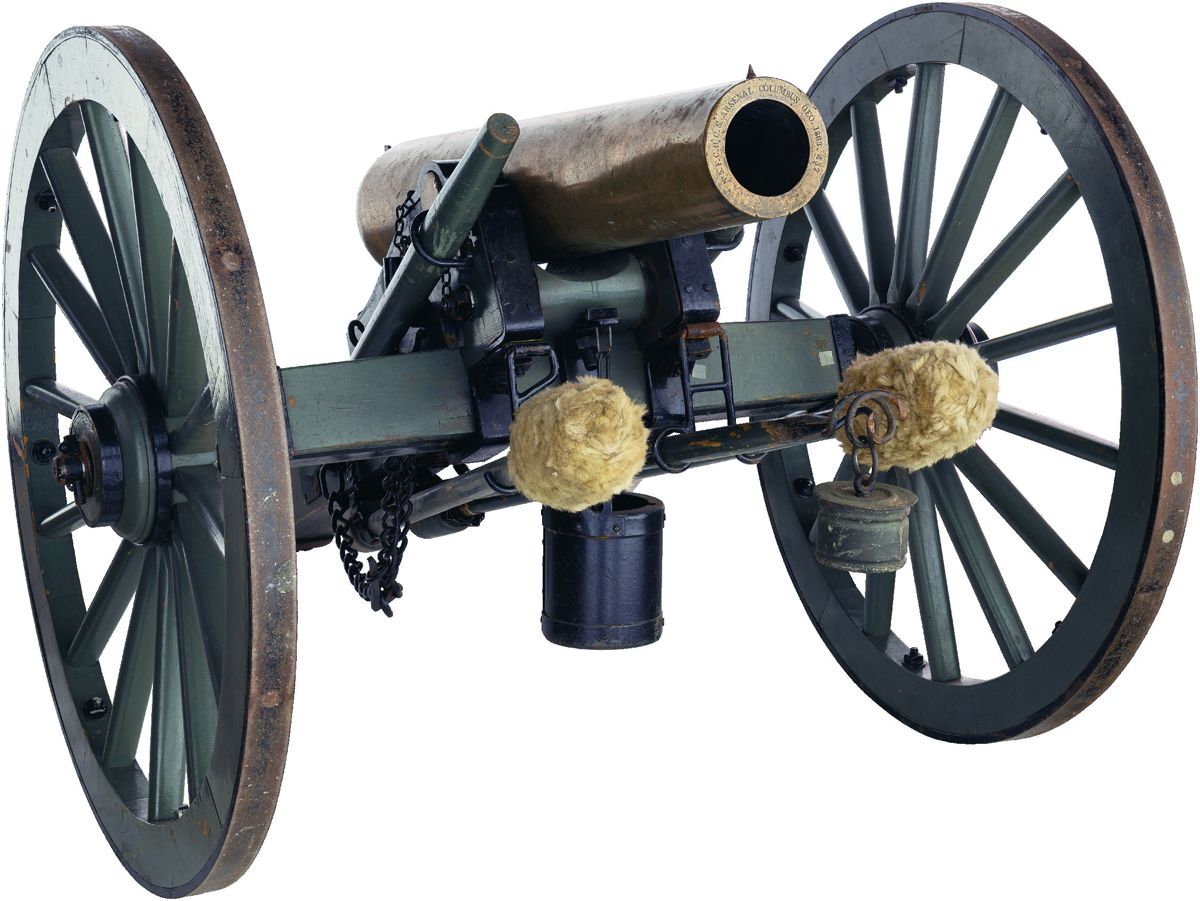
Left: Its muzzle reads, “No. 5 F.C.H. C.S. ARSENAL COLUMBUS GEO. 1863. 437,” (for weight of the tube in pounds) and right rimbase number is “71.” This cannon was inspected by Maj. Frederick Clinton Humphreys.
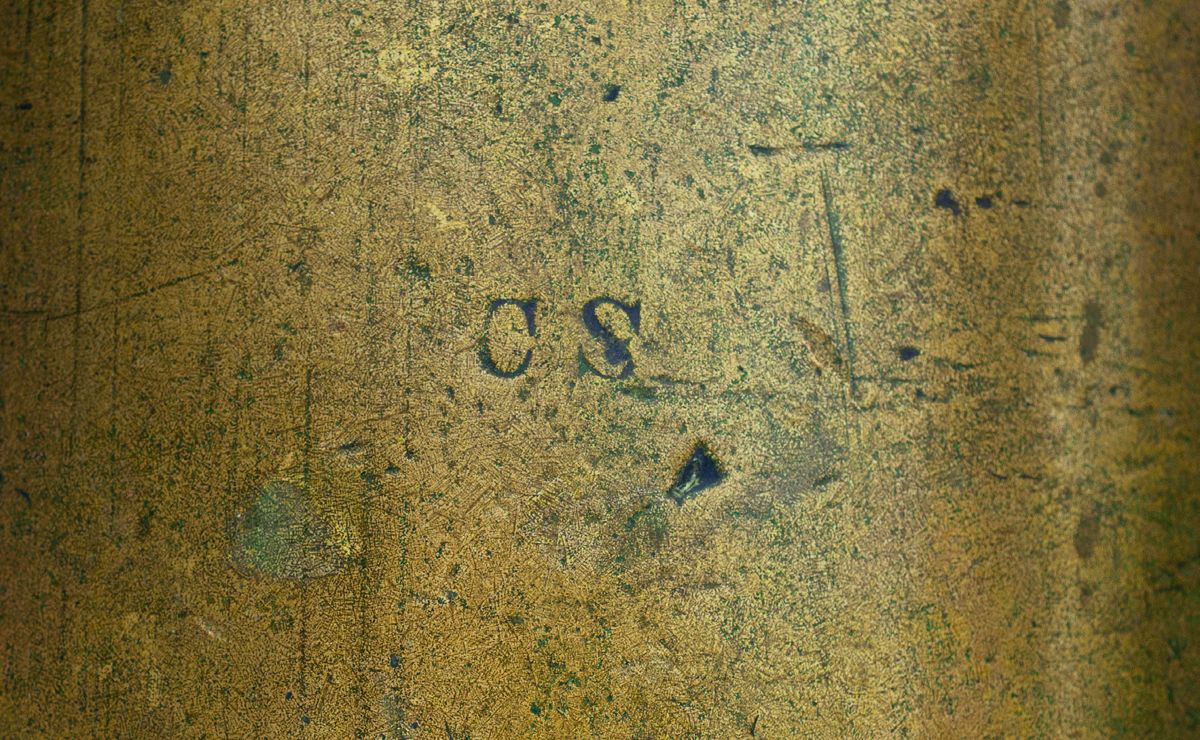
CS stamp on top of the barrel.
of its production. Consider the following: their maximum production capacity was said to be two per week, the earliest known 1864-dated Columbus cannon is #26, and the last known Columbus cannon is 1864-dated cannon #52. This means that at least 26 bronze Napoleons were cast by Columbus in 1864; even at maximum production, that would take 13 weeks. How they maintained their bronze supply a full year after the Confederacy’s top foundry had run out certainly flies in the face of the C.S.A.’s widespread supply issues. This bronze 9-pounder simply shouldn’t exist and here’s why: • • • •
It was a size not in use. The orders from the Chief of Ordnance Gorgas. Confederate bronze was in short supply in 1863. Smaller, or obsolete, cannon were being melted down.
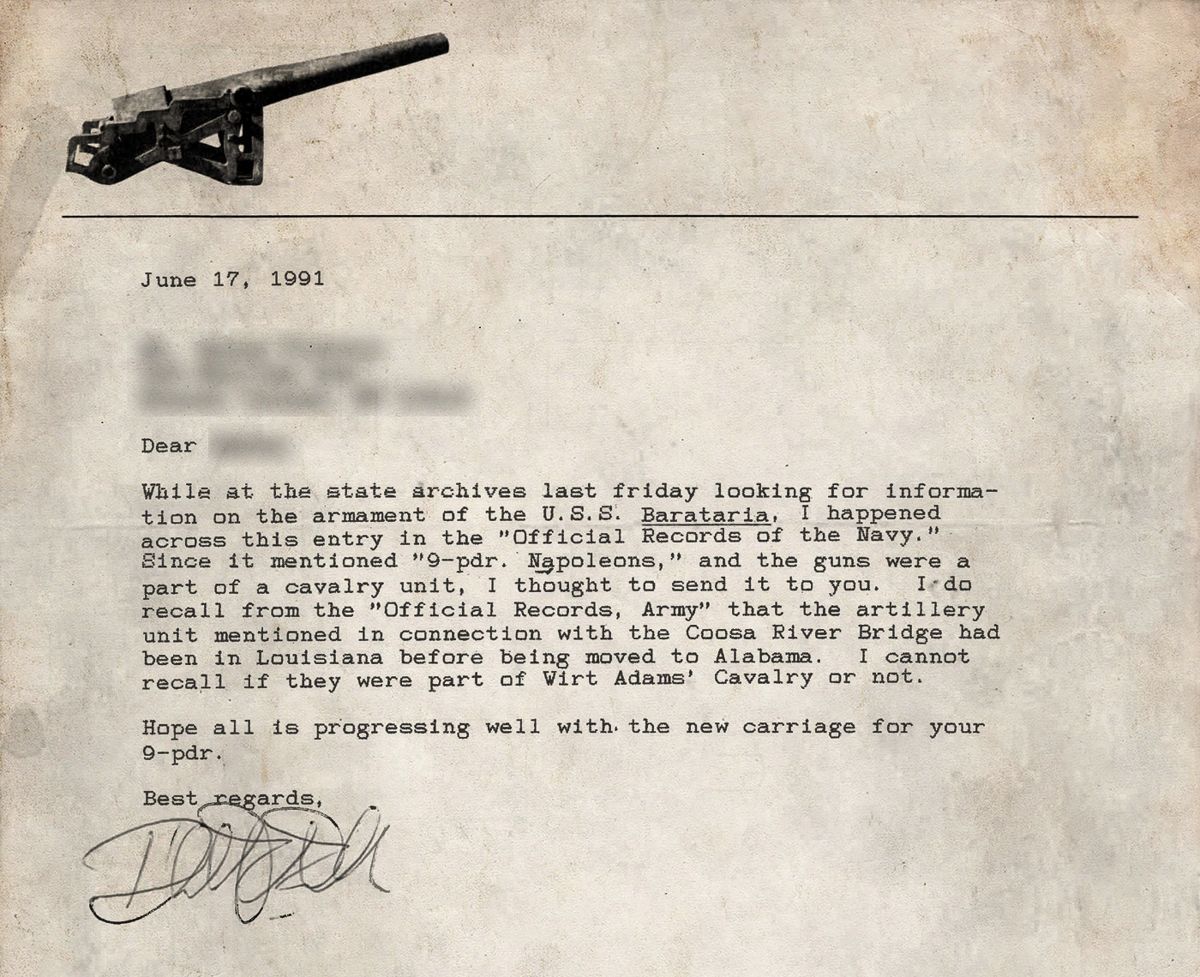
Letter dated June 17, 1991, regarding “9-pdr. Napoleons,” as part of the armament of the USS Barataria.
As if that odds-defying survival wasn’t enough, 9-pounder No. 5 also avoided being destroyed in war or becoming a battlefield sentinel like so many of its Columbus counterparts. Based on its muzzle number, historians presume there were at least four other 9-pounders made (the numbers were separate from those of the 12-pdr. Napoleons), but they have yet to be seen. This gun has been known and featured in books since the 1970s, and with nearly five decades for other examples to make themselves known, serial No. 5 may truly be the last of its kind.
Documenting its Path
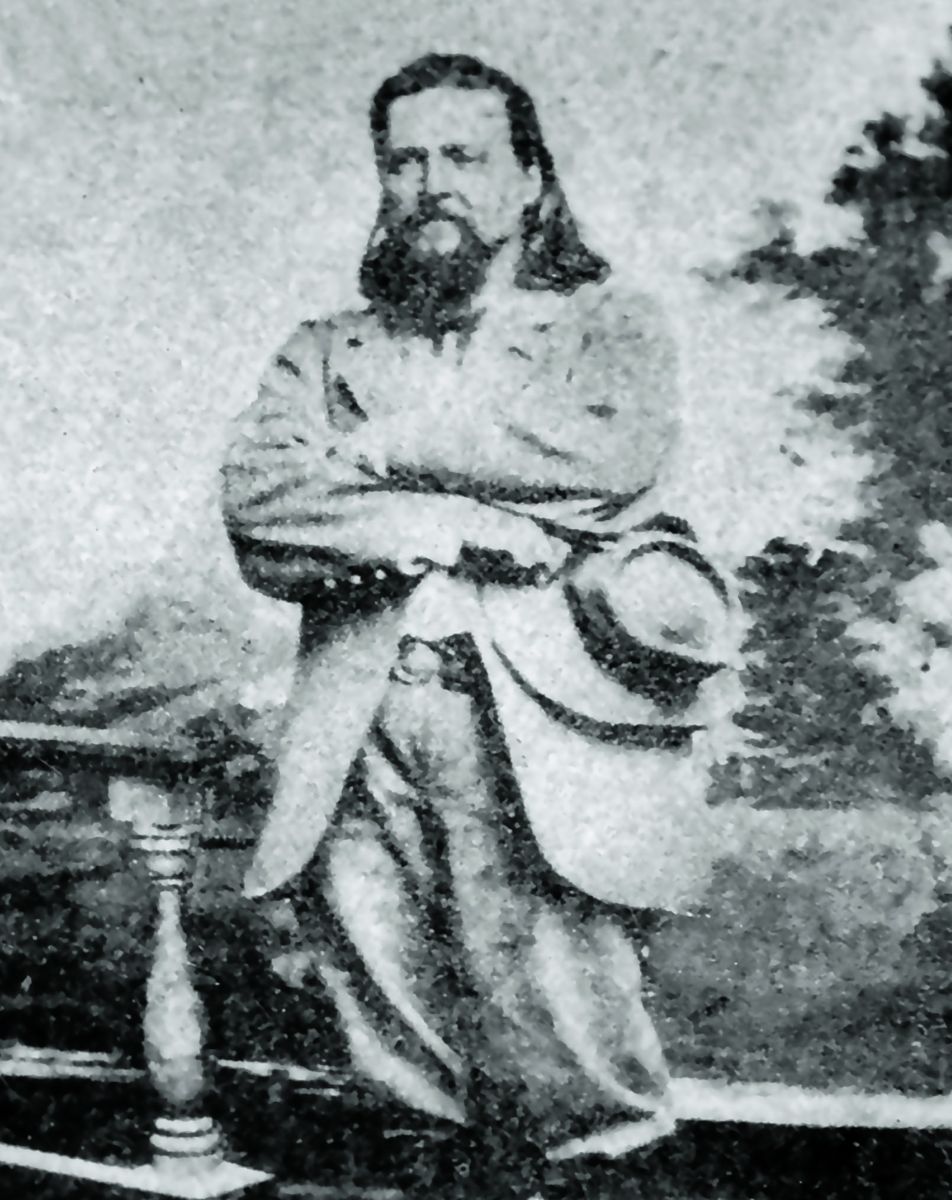
While past publications indicate that no records exist of these 9-pounders in service, online archiving now can make such records available. Two 9-pounder Napoleons were recorded under the command of Colonel John S. Scott, 1st Louisiana Cavalry, in eastern Louisiana in early 1864. They
Colonel John Scott, C.S.A.
were in the battery of a Captain W.P. Barlow, and Col. Scott indicated in a June 19, 1864, report of his attacking several Union gunboats that, “From my experience since here I have but little hesitation in saying that with guns of a proper caliber gun-boats can be made very scarce, particularly tin-clads. My 9-pounder Napoleon guns I consider a complete failure, and but little or no service, the carriages being too light.” The next mention is dated September 15, 1864 when Acting Chief of Artillery Phillips from the Department of Alabama, Mississippi, and Louisiana wrote the following to Major John Rawle, then the Chief of Artillery for the District of North Alabama. “MAJOR: Your communication asking for two guns, with ammunition and equipments complete, for the defense of Coosa bridge has been received and referred to Major McCall, chief of ordnance, who shipped you this morning two 9-pounder Napoleon guns, with 260 rounds shell and 90 rounds canister for same, and directs that you make requisition for the equipments, which will be furnished at Selma. You will direct the officer who takes charge of these guns to exercise care and economy in the use of the ammunition, as no more can be had for this caliber of gun, and the guns will become useless so soon as the ammunition sent you is expended. I have the honor to be, major, very respectfully, your obedient servant, JOS. PHILLIPS, Acting Chief of Artillery.”
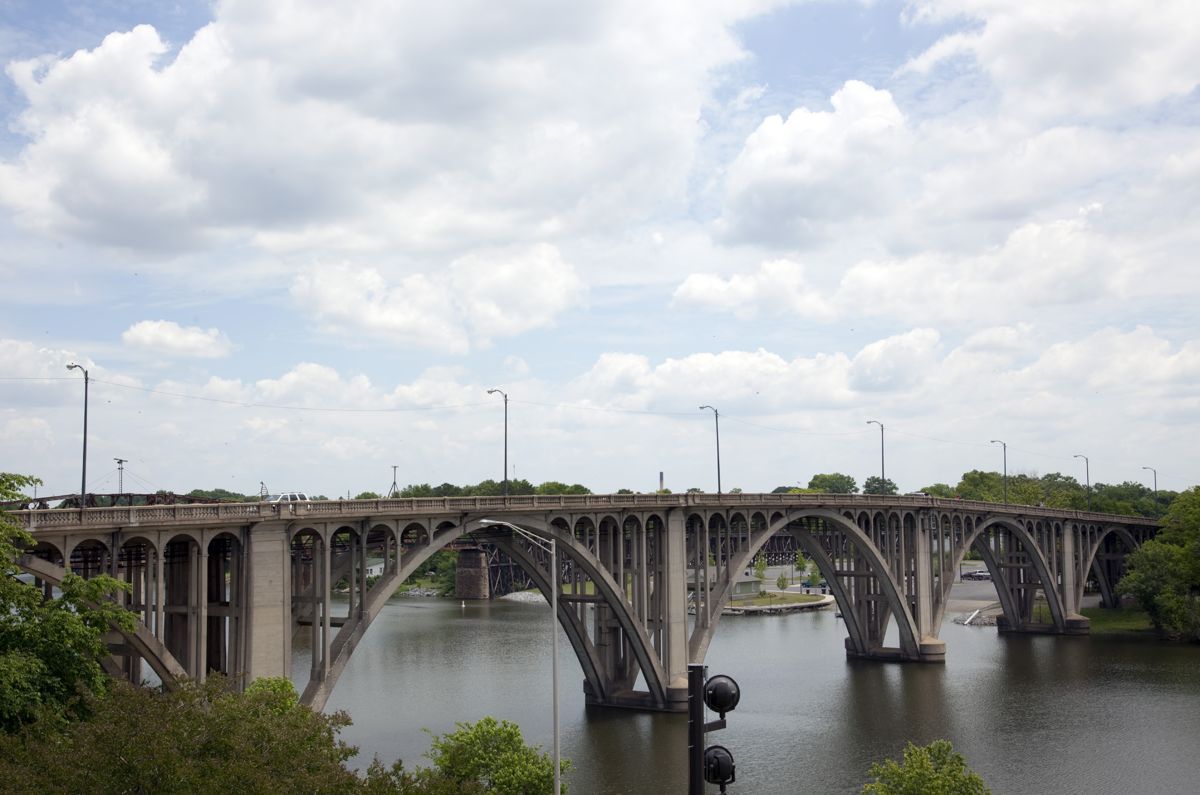
Colonel Scott just months earlier, thus making them available to Major Rawle. Phillips’ letter was sent not even a fortnight after Atlanta had fallen to Sherman, so the Confederates were hurriedly preparing to make Uncle Billy’s life as difficult as possible. Cities were being fortified, batteries installed, blockhouses built, rifle pits dug, and redoubts erected. This 9-pounder was part of those preparations at what documents call the “Coosa Bridge.” Unfortunately, the location of the Coosa Bridge where the two 9-pounders were sent is not specified in Phillips’ letter to Rawle, nor in other documents mentioning the bridge’s fortifications. However, consulting several collector and historical groups has yielded a possible location. Statements range from very near the current-day location of the U.S. Highway 280 bridge between Harpersville and Childersburg, Ala., where the ruins of a fort are known to exist, to another area about 6 miles west (as the crow flies) on land along the Coosa currently owned by the Ernest C. Gaston Power Plant. There, a marker placed by the Alabama Historical Association states that several forts and earthworks were constructed under the command of Major W.T. Walthall to help protect the Alabama-Tennessee River Railroad as it crossed the Yellow Leaf Creek. Like most Confederate assets in the area, it fell during Wilson’s Raid. In 2021, the little rebel cannon that shouldn’t have been, waiting for a battle that never was, made a direct hit at auction. The 9-pounder with its carriage, original limber, limber chest, cannon balls, and archival documents surpassed its high estimate at Rock Island Auction and brought an astonishing $661,250.
About the Author
Given the scarcity of 9-pounder bronze guns, and that Rawle and Barlow had both served under Scott, these are likely the same 9-pounders rejected by
Joel Kolander has served as the Interactive Production Manager for Rock Island Auction Company since 2013. He has a deep passion for reviving forgotten histories, hunting, and all things firearm related.
Coosa River Bridge in Gadsden, Ala., 2010. (Library of Congress)