
42nd Alabama Colonel’s Leech & Rigdon Belt
By Shannon Pritchard · Originally published May-June 2025 · pp. 3–12

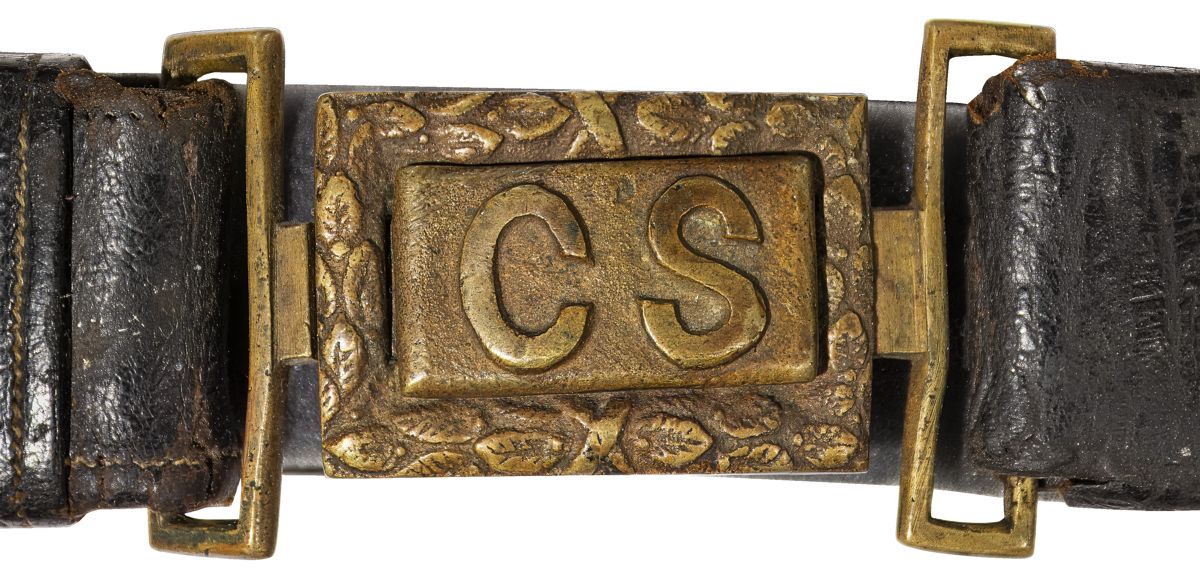
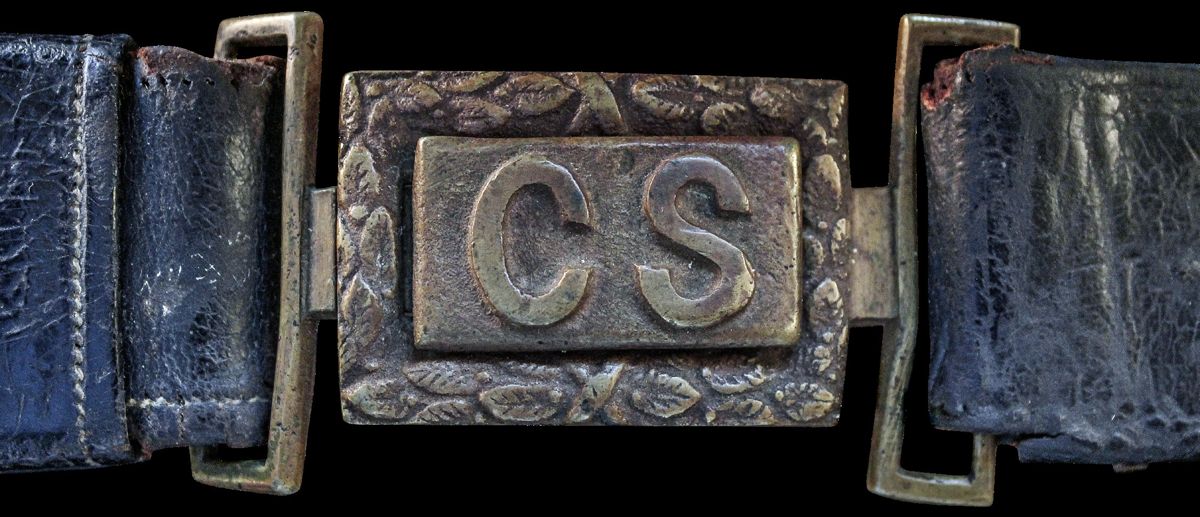
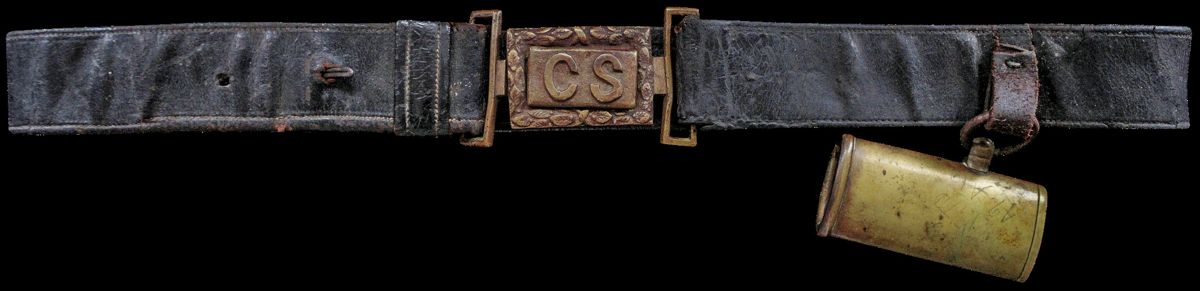
The maker of this officer’s sword belt was the Leech & Rigdon firm. Thomas S. Leech moved to Memphis, Tenn., in 1854 to establish a cotton dealership. It was financed by his partners: his brother John B. Leech, Thomas Harrison, Sir Arthur Forwood, and Sir William Bower Forwood of Liverpool, England. Leech opened business as Thomas Leech & Co., Cotton Broker, at 35 Front Row Street in Memphis. As war became imminent, Leech and his partners expanded their business to include war material. The military items were sold under the name of “Memphis Novelty Works Thomas Leech & Co.” Under this name, Leech manufactured swords, side knives, belts, buckles, and pistols. Leech later formed a partnership with Charles H. Rigdon and renamed the partnership Leech & Rigdon in 1862.
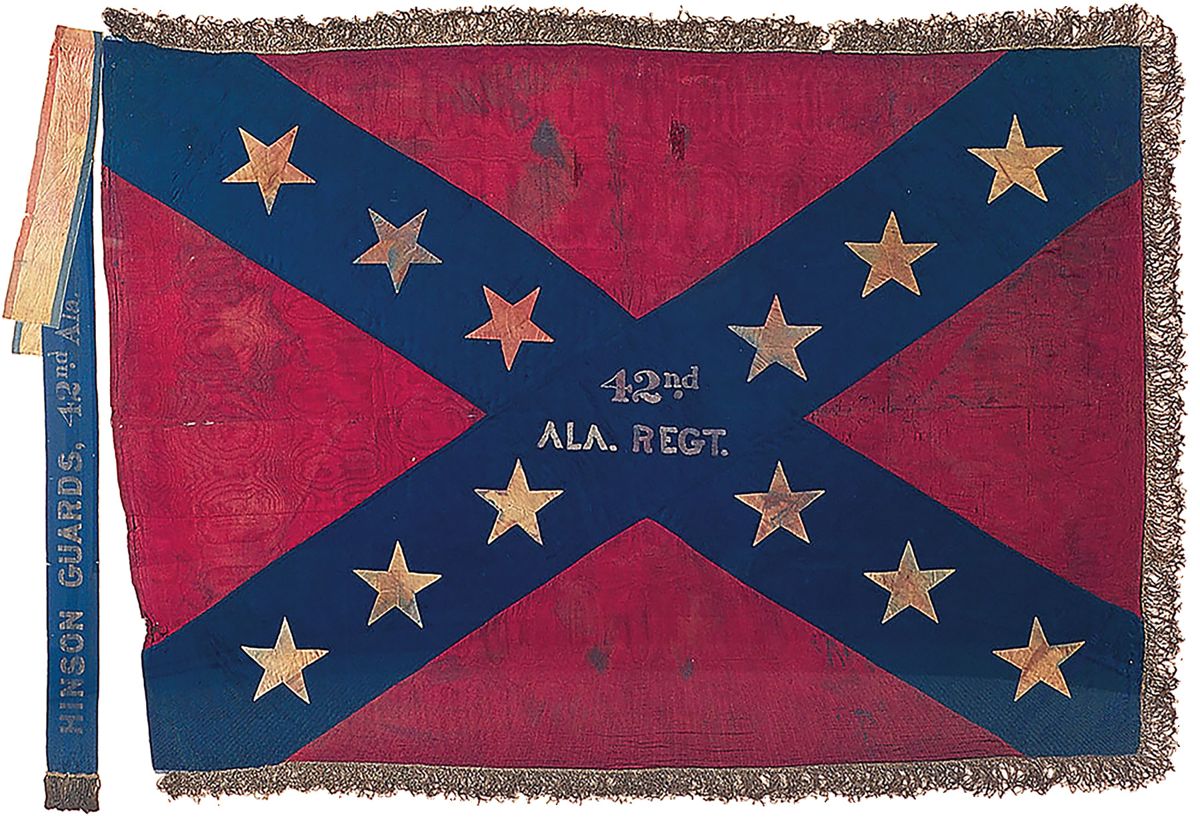
42nd Ala bam
Regim a Infantry ental Batt le Flag.
SON G Note “HIN
UARDS,

42nd Ala.”
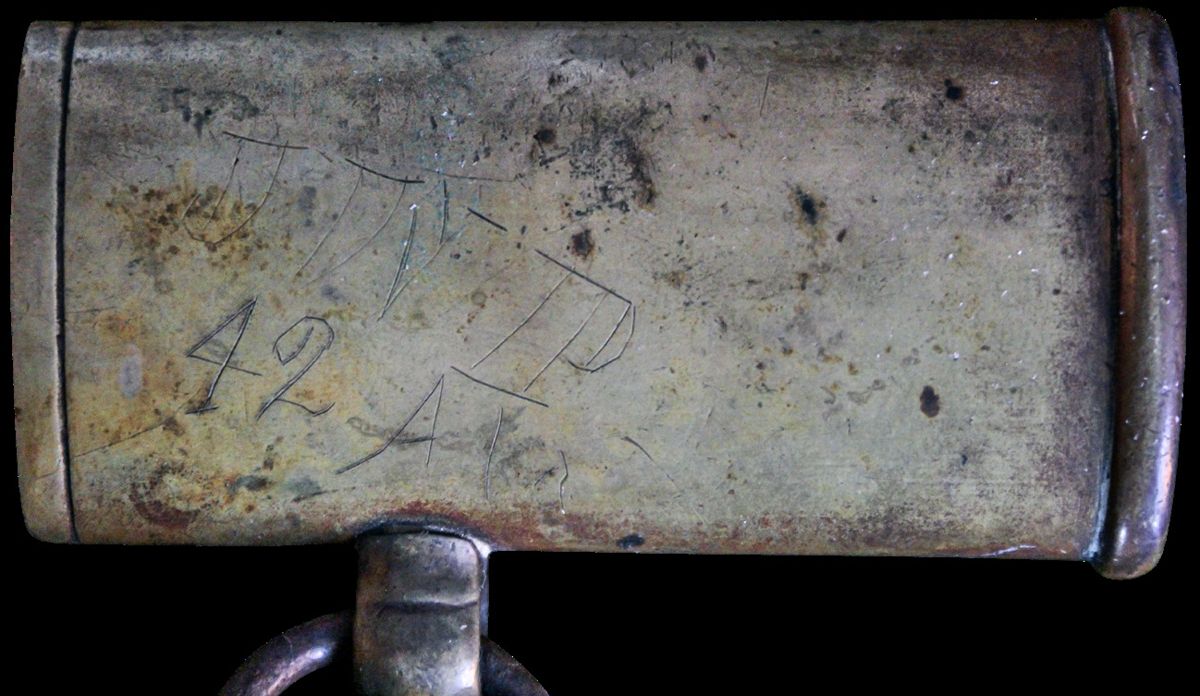
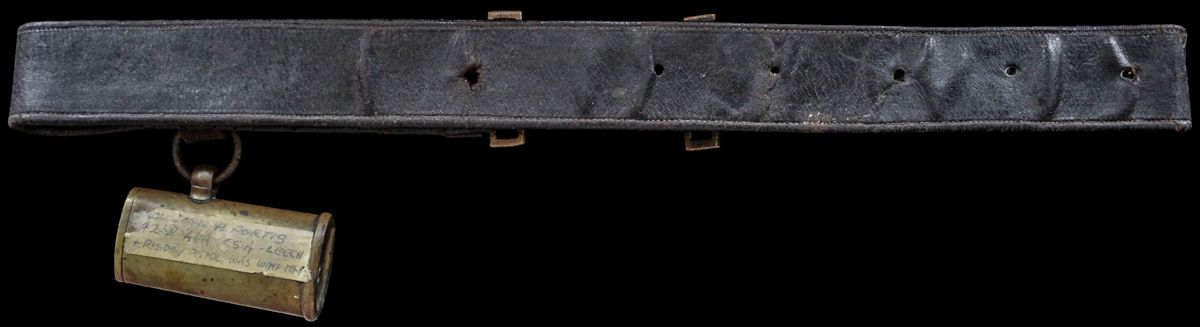
This ultra-rare, rectangular two-piece sword belt buckle is undoubtedly on its original unaltered belt. It is part of a group of Portis’ items, which include the 42nd Alabama Infantry’s battle flag. The regiment was led by Colonel John Wesley Portis; his son, Earnest A. Portis, served under him. The belt had the top mount of Colonel Portis’ L & R sword attached to it by a leather thong fastened by a brass wire loop. This attachment is not original; an old collector did it to keep the mount and belt together. The mount is deeply engraved with the Colonel’s initials: “JWP 42 AlA” on one side; a piece of modern masking tape is stuck to the other side of the mount, stating that his L & R revolver was with it. With the capture of Forts Henry and Donelson in the spring of 1862 and the subsequent fall of Tennessee into Union hands, Leech and Rigdon relocated their business to Columbus, Miss., and built a factory adjacent to the Confederate Briarfield Arsenal.
Later in 1862, with Sherman threatening Mississippi, the Confederate Government decided to relocate the arsenal to Selma, Ala. At that time, Leech and Rigdon began focusing on producing the Leech and Rigdon revolvers instead of swords and belts. No doubt they still made some, but the majority of their sword sales probably occurred between November 6, 1861, and June 18, 1862.
John Wesley Portis was the son of Ira David Portis and Mary Anne Goodwin, who came to Suggsville, Alabama, from North Carolina, where John Wesley was born on September 9, 1818. When he was seventeen, John’s father sent him to the University of Virginia for his education in law.1 He practiced law and represented Clarke County in the Alabama legislature in 1843 and 1844, and from 1844 to 1858 was a trustee of the University of Alabama. He was a practicing attorney in Suggsville, Clarke County, Ala., when the War Between the States began in 1861.
Portis immediately left his practice and home and enrolled in the “Suggsville Grays” as a private. He was elected a second lieutenant before the Suggsville Grays became Company D, 2nd Alabama Infantry Regiment. The regiment was organized at Fort Morgan, Ala., at the mouth of Mobile Bay, in April 1861. For nearly a year, the regiment garrisoned Fort Morgan, serving as infantry and artillery. In March 1862, it was ordered to Fort Pillow, Tenn., where it shortly disbanded when the men’s term of enlistment expired. In May 1862, the 2nd Alabama was reformed as the 42nd Alabama at Columbus, Miss., under the command of Colonel John W. Portis. Portis assigned his old Fort Morgan company, the Hinson Guards, as his color company.2 Portis was described as ‘a good and true man.’ The patriarch of a large family, in addition to his wife Rebecca, his household included four girls and three boys. His oldest son, 18 year old Earnest, joined him in the 42nd Alabama as a 2nd lieutenant.3 They drilled and trained through the summer at Columbus.4 Leech and Rigdon had moved from Memphis and had relocated in Columbus about the same time and it was probably there, during the spring or summer of 1862, that Colonel Portis acquired his Leech &
Rigdon sword, sword belt, and revolver, as well as a Leech & Rigdon sword for his son Earnest, which also survives. In September, the 42nd, along with the 37th Alabama and 7th Mississippi regiments, was in Maury’s Division of the Army of the West. The following month, the 42nd marched to Corinth, Miss., with 700 men. With the approach of fall, an advance was made by the Confederate armies; Lee marched into Maryland, Braxton Bragg and Kirby Smith marched to Kentucky, and further south, Earl Van Dorn and Sterling Price marched on Corinth with 22,000 men.5 On September 11, Colonel Portis received orders directing him to move his regiment “on the morning of the 13th instant,” and “report your command to General Maury, who will assign it in Moore’s brigade.”6 General John C. Moore’s Brigade consisted of the 42nd Alabama, under Colonel John W. Portis, the 15th Arkansas, under Lieutenant Colonel Squire Boone, the 23rd Arkansas under Lieutenant Colonel A.A. Pennington, the 35th Mississippi, under Colonel T.S. Barry, and the 2nd Texas, under Colonel William P. Rogers. Bledsoe’s Missouri Battery, under Captain Hiram Bledsoe was attached to the brigade as well.
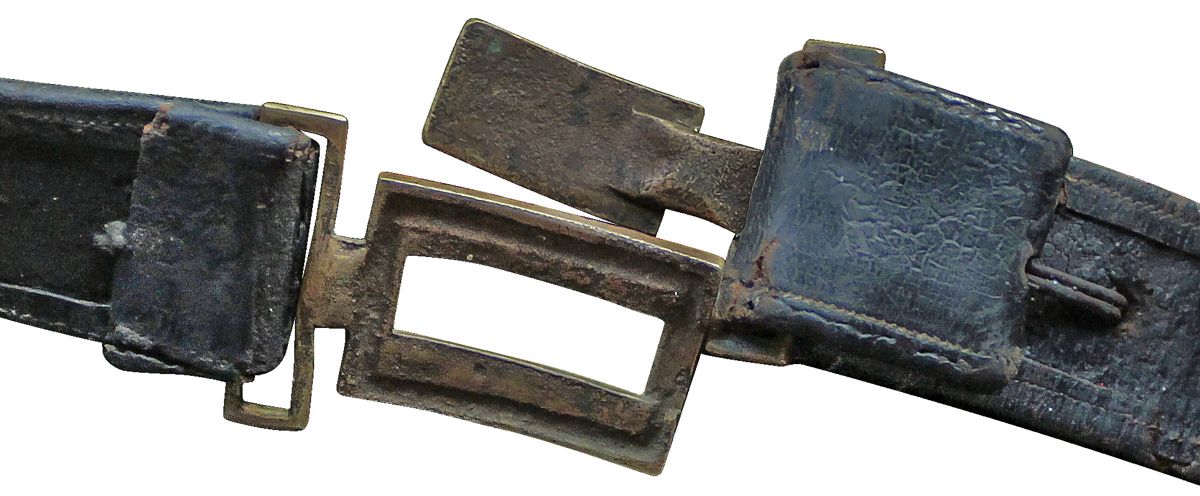
Enlargement of the CS Leech & Rigdon two-piece belt and buckle. This selection has been reversed for clarity.
Unidentified Confederate Captain wearing a CS two-piece Leech & Ridgon belt and buckle.
Fighting began October 3, 1862, and the Federals were pushed back into their prepared defenses at Corinth. Before dawn on October 4, 1862, Confederate artillery began bombarding the Union-held town, with Federal cannons responding. The Confederate left assaulted and captured Battery Powell, driving the exhausted Union defenders back into the very streets of Corinth, with heavy fighting taking place near the railroad junction and the Tishomingo Hotel. The Confederates were eventually forced out of the defensive works. At the same time, an assault by the remainder of Maury’s Division focused on Battery Robinett, one of the main positions of the College Hill Line held by Union troops. Despite extremely heavy musket and artillery fire, elements of John Moore’s Brigade, especially the 42nd Alabama, the 35th Mississippi, and the 2nd Texas, prepared to assault Battery Robinette. There had grown a great rivalry between the 2nd Texas and the 42nd Alabama in the preceding weeks. Texan J.L. Mayo wrote of the rivalry between the Texans, commanded by Colonel Rogers, and the Alabamians, commanded by Colonel John W. Portis. “The Alabamians were fresh (new) then, while the Texans felt as Veterans.” Captain George Foster, of the 42nd Alabama Regiment, declared “They shan’nt’ beat us to those breastworks and they didn’t” “While Col. Rogers was with us the order to charge sounded, and the brigade sprang to its feet. Col. Rogers, unsheathing his sword cried, Forward Texans! Our gallant Captain, raising his sword, echoed, Forward Alabamians!” The 42nd Alabama and the 2nd Texas violently assaulted Battery Robinette and briefly occupied a part of it until a counterattack killed or captured most of the Confederates who had advanced that far. Even the Yankees reported the charge “audacious, and the daring was sublime.”7 Both Confederate regiments were decimated; Rogers was dead and Colonel Portis was severely wounded. The failure to hold Battery
Robinett ended the major fighting, and Van Dorn quickly determined to withdraw. The 42nd had 348 killed and wounded, a terrible 50% loss. The wounded Colonel Portis spent September/ October 1862 at Suggsville, Ala., recuperating before rejoining his command. In the spring of 1863, he found the 42nd Alabama in Mississippi, where they suffered the privations and surrender of Vicksburg. The colonel was paroled on July 10th and returned to Suggsville. I don’t know exactly when he came back in to service, as the record does not survive, but in August 1864, he was present in Baker’s Brigade, Clayton’s Division, S.D. Lee’s Corps. Bakers Brigade, Liddell’s Division, Army of the Gulf, surrendered at Citronelle, Ala., June 1865. He was paroled the following day. After this, he returned home and resumed the practice of law. Clarke County, Ala. Historian T.H. Ball indicates that a significant portion of the data in his 1882 History of Clarke County came directly from Colonel John W. Portis. In 1882, he was Postmaster at Suggsville and was engaged to some extent in merchandising. Endnotes 1. 2. 3.
Office of the Univ. Registrar of UVA states he attended 1835-36 and 1836-37 and lists his home as Alabama and DOB 9/9/1818. 42nd Alabama Flag Streamer. U.S. Census Office, 1860 Census of Cahaba County, Alabama, depicting data of John W. Portis and family. Military Service Record of Earnest A. Portis from NARA Microfilm Collection M861, Record Group 109, Complied Records Showing Service of Military Units in Confederate Organization, rolls 398-401. R. A. Lambert, “In The Mississippi Campaigns,” Confederate Veteran, (1929): 37, 292. Mississippi Encyclopedia. OR, 17.1, (Washington, D.C. U.S. Government Printing Office, 1880-1901), 700-701. Confederate Veteran Magazine.
About the Author Shannon Pritchard has authored numerous articles relating to the authentication, care, and conservation of Confederate antiques, including several cover articles and is the author of the definitive work on Confederate collectibles, the widely acclaimed
Collecting the Confederacy, Artifacts and Antiques from the War Between the States, and is co-author of Confederate Faces in Color.