
An Arms Chest Packing Slip M1884 Springfield
By Charles and Michelle Pate · Originally published May-June 2025 · pp. 26–31

d r a u al G on i t a aN
Of th m a b a e Al By Charles and Michelle Pate
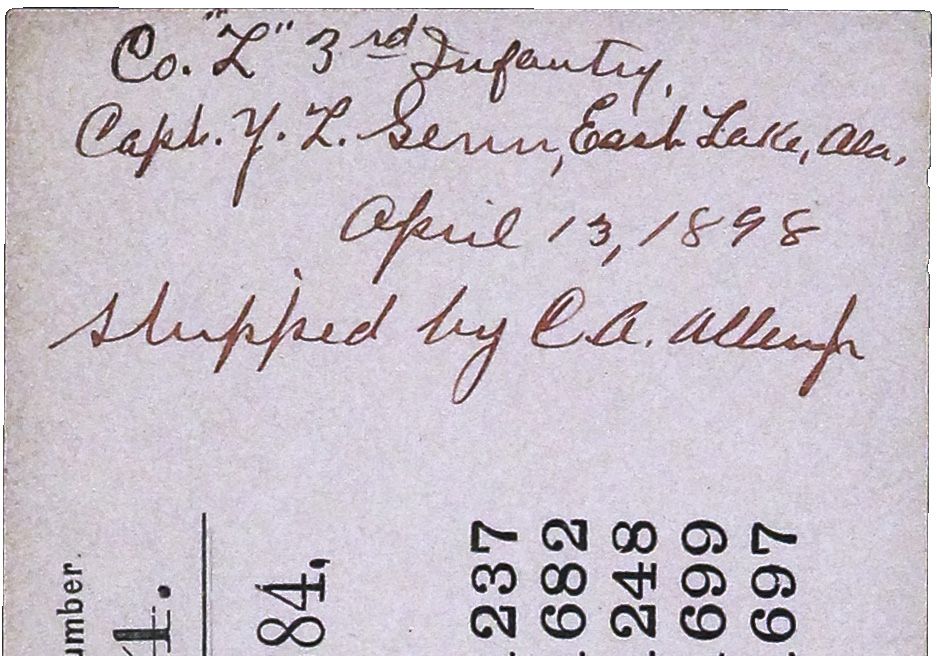
Collecting historical artifacts is often a “local” thing; at least it is with us. We like objects associated with our original home, Alabama, or Virginia, where we now live. Sometimes you find something that accomplishes that objective, and is also interesting in other aspects. That was the case for us when we found the Model 1884 Trapdoor rifle pictured here. Number 501201 is certainly nothing special in condition. Except for some interesting markings most collectors would not even look at it twice. We did more than just look at it twice; we bought it because it is documented as an “L” Company, 3rd Alabama Infantry rifle. Furthermore, the documentation providing this provenance is an original Springfield Armory arms chest packing slip showing number 501201 and 24 other rifles were packed in chest #17554 on August 20, 1890. Multiple copies of these slips were printed and used at various points in the distribution and issue processes, but they are rarely found today. The Alabama association is from a hand-written annotation on the packing slip in red ink stating the rifles in this arms chest were shipped to Capt. Yancy L. Senn, “L” Company, 3rd Infantry, East Lake (which is near Birmingham), Ala.
Army’s call for soldiers for the Spanish-American War. It was formed from the First Colored Infantry Battalion of Alabama State Troops, which was itself made up of earlier units. When the 3rd Infantry was first organized, the soldiers believed they were to be led by colored officers, but the state conferred with the U.S. War Department and the two governments decided to use experienced white officers instead. This led to some men leaving, but more than enough remained for the battalion to be mustered into U.S. service in early June 1898. Over the next two months additional companies were added, with the final company being mustered in on August 5, 1898. The 3rd Alabama did not leave the continental U.S. They were trained in Mobile and then moved to Camp Shipp, near Anniston, Ala The regiment had a good reputation while in Mobile, but they ran into trouble with the white troops of the 3rd Tennessee and 2nd Arkansas when they received passes and went into the white business district. They avoided a physical confrontation in that case but other racial incidents occurred. The following is quoted from Kenneth H. Robinson’s history of the regiment:
Yancy Senn, the Clerk and Register of the Chancery Court in Birmingham had enlisted in the Alabama National Guard on July 21, 1893, and by March 30, 1897, he was a 1st lieutenant in the 2nd Alabama Infantry. He was promoted to Captain, “L” Company, 3rd Alabama Infantry (Colored) when that regiment was organized in April 1898. The 3rd Infantry was created in response to the U.S.
Several copies of the packing slip were packed in the shipping crate with the rifles and were used for accountability purposes. They also give a good indication of when the rifles were manufactured, since the arms were placed in shipping boxes soon after their final inspection. This slip is annotated, probably by the regimental ordnance clerk, to show shipment to the “L” Company, 3rd Alabama Infantry, Company Commander.
The “Battle of Anniston” From September 1898 the buildup of tensions between the men of the regiment, the citizens of Anniston, and the soldiers of the 3rd Tennessee and 2nd Arkansas had reached a boiling point. The continued harassment came to a head on November 24th in what local papers termed the “Anniston riots,” or the “Battle of Anniston.” The exact details of who started the altercation is unclear however, what is known is that on the night of the 24th a group of men from the third and the local colored population, estimated to be anywhere from 50 to 200 strong, was alleged to have assembled in town and soon encountered the provost guard of the 2nd Arkansas. In the ensuing exchange of gunfire one member of the Third Alabama was killed (Corporal James Caperton of Company B) and one of the Second Arkansas (Private Gildart) would die of his injuries, additionally, at least eight others were wounded from both the soldiers and the local population. The provost guard of the 2nd Arkansas quickly fell back from the mob, and the local citizens and soldiers in town soon broke into the nearby Armory and obtained guns and ammunition. As soon as word of the trouble in town reached the camp, General Frank T. Royal, commanding, dispatched two companies of the 3rd Tennessee Infantry and two companies of the 2nd Arkansas Infantry, to the town; and all soldiers found in town were taken back to camp under guard. The mayor of Anniston also took the additional step of having all the saloons in town closed for the night and next day. Back at Camp Shipp, the guard around the camp were doubled for the next several days, and all passes were immediately revoked. Unlike the Brownsville Affair or the Scottsboro Boys incident, the men of the 3rd Infantry who took part in this incident do not appear to have suffered direct repercussions and we are not aware of any additional incidents. The troops remained at Camp Shipp until the regiment was mustered out on March 20, 1899. Apparently it was not a totally peaceful existence, however, for four men were discharged by general courts-martial, three were murdered, and an astounding 88 deserted.
The meaning of the “S. P. No. 83” butt plate marking is unknown but is most likely another rack number.
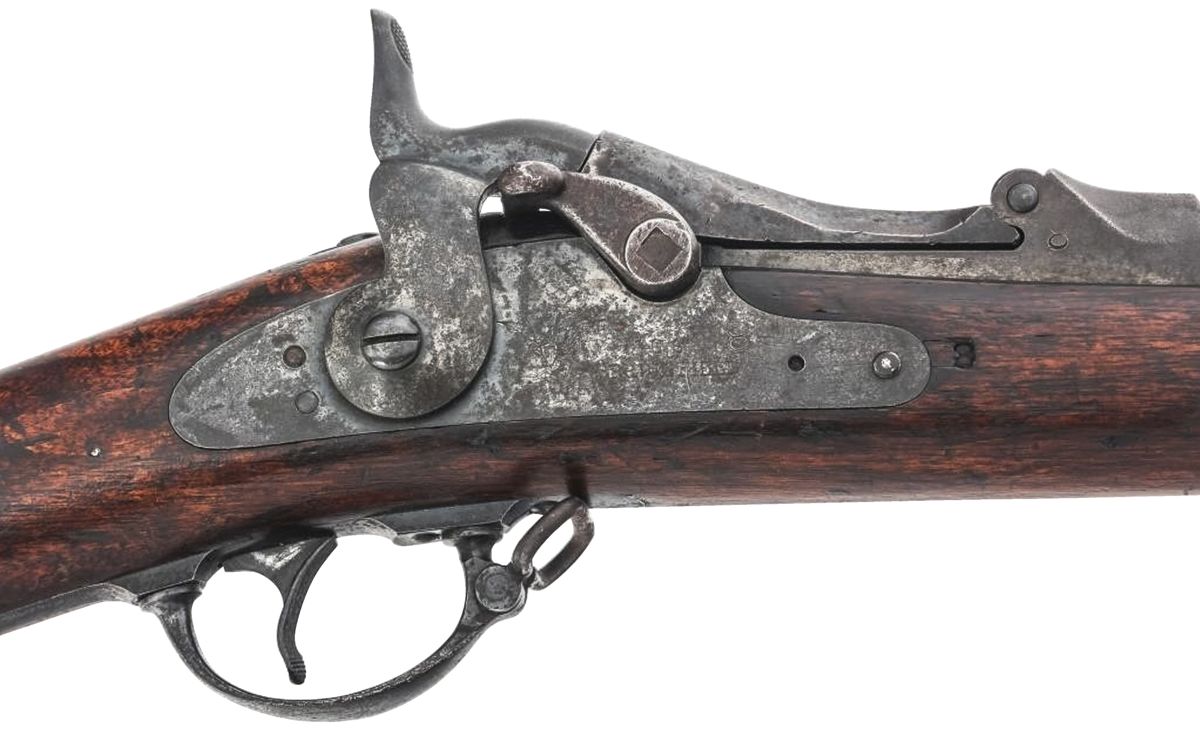
Model 1884 “Trapdoor” Rifle #501201 is far from “collector grade” in condition if one does not consider its documented provenance.

This view of the lock plate gives a good indication of the rifle’s condition, note the “8” under the receiver.
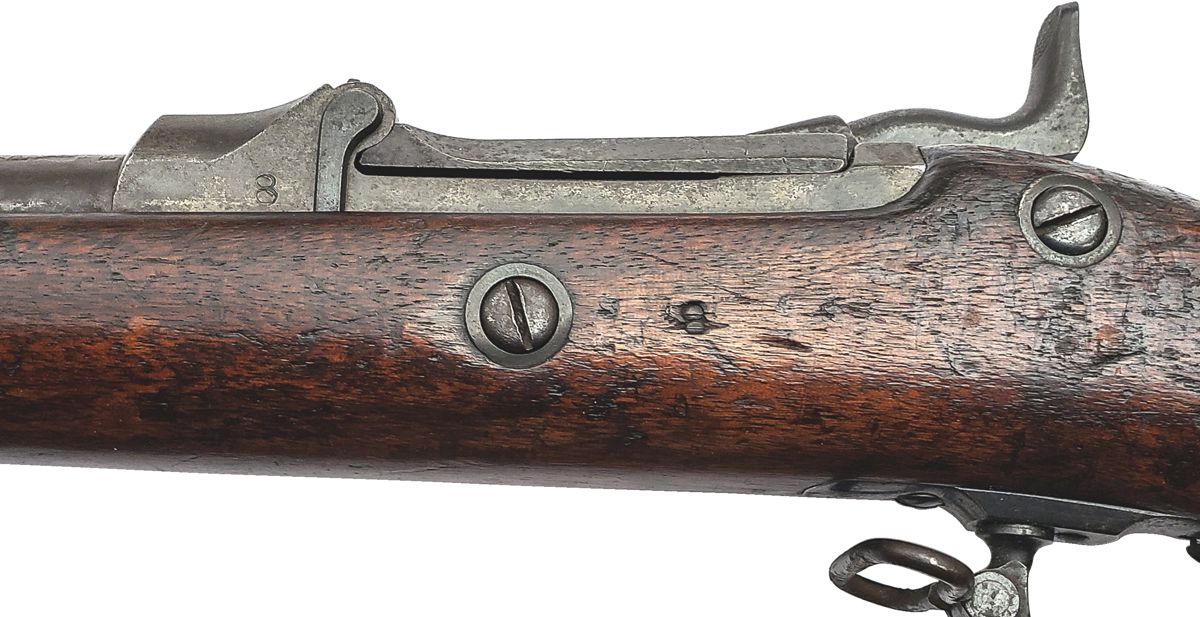
More “8” markings. Why it was necessary to mark the receiver and both sides of the stock is another mystery.
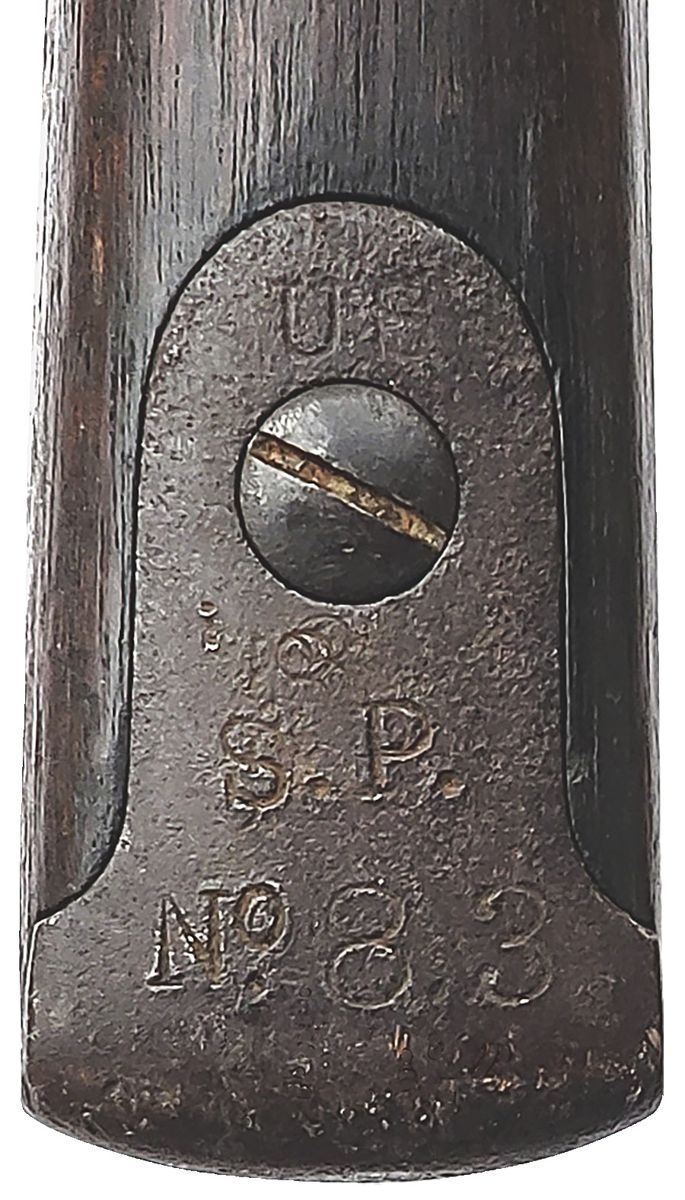
Number 501201 certainly saw a lot of use but not abuse and remains in firing order. Judging from the marking applied to it, it apparently saw subsequent service in multiple organizations, most likely some in the State of Alabama and, possibly, a VFW or American Legion post. There is a large “15” on the upper tang below the serial number. The butt plate is marked “No 83” under an “S.P.” (State Police, perhaps?). Both sides of the stock were marked with an “8” and that number also appears on the left side of the receiver. To use an old and tired (but still valid) expression, if this old gun could only talk.
About the Authors Charles attended Colbert County High School in Leighton and, in 1967, received a BA degree from the University of North Alabama in Florence. He had an early interest in writing and was encouraged to further develop his skills by his high school
English teacher and his favorite UNA professor, but the Vietnam conflict and military service intervened. Charlie served for twenty years in the U.S. Army in a variety of assignments. He was a pilot flying intelligence collection missions in Vietnam. After the war, he served as a project manager in intelligence system research and development. He received an MS in Management Information
Systems from the American University in 1977. Charlie retired from the Army in 1987 and continued his project management and systems engineering career with TRW, a large aerospace firm. After 16 years with TRW, Charlie again retired in 2003 and since then has concentrated on U.S. military small arms research and writing, and to date has published five books and over 200 articles.
Michelle graduated from James Madison University in 1997 with a BS in Anthropology and later returned to school to earn an AS in Nursing from Northern Virginia Community College. After spending eight years working for TRW/Northrop Grumman as an analyst she began her nursing career with Inova Health System in 2005. In 2012 Michelle transitioned to a role with Inova’s electronic medical record training team which allowed her to utilize her background in both technology and nursing. She is in her 20th year with Inova and is currently working as an eLearning
Developer. In her spare time, Michelle is an avid genealogist and enjoys assisting her father, Charles, by conducting biographical research for his articles.
One of the mystery markings on #501201, the “15” on the upper tang is probably a rack number and may indicate that it was issued to the soldier numbered 15 on the company roster. Soldiers were listed in the Company Descriptive Book with the non-commissioned officer in the order of their rank (the Company First Sergeant would be listed first). Then the privates would be listed, and numbered, in alphabetical order.
Fort Fisher items wanted e Provenanc a Must!