
The Confederate Ch1 Stamp: A Reappraisal
By Capt. Steven W. Knott, USN (Ret.) · Originally published September-October 2025 · pp. 46–53

The Confederate CH1 Stamp: A Reappraisal By Steven W. Knott
“We consider it a good principle to explain the phenomena by the simplest hypothesis possible.” – Occam’s Razor, William of Ockham these two inspection marks remain highly prized among collectors of British firearms acquired by the South for use in the Civil War.1
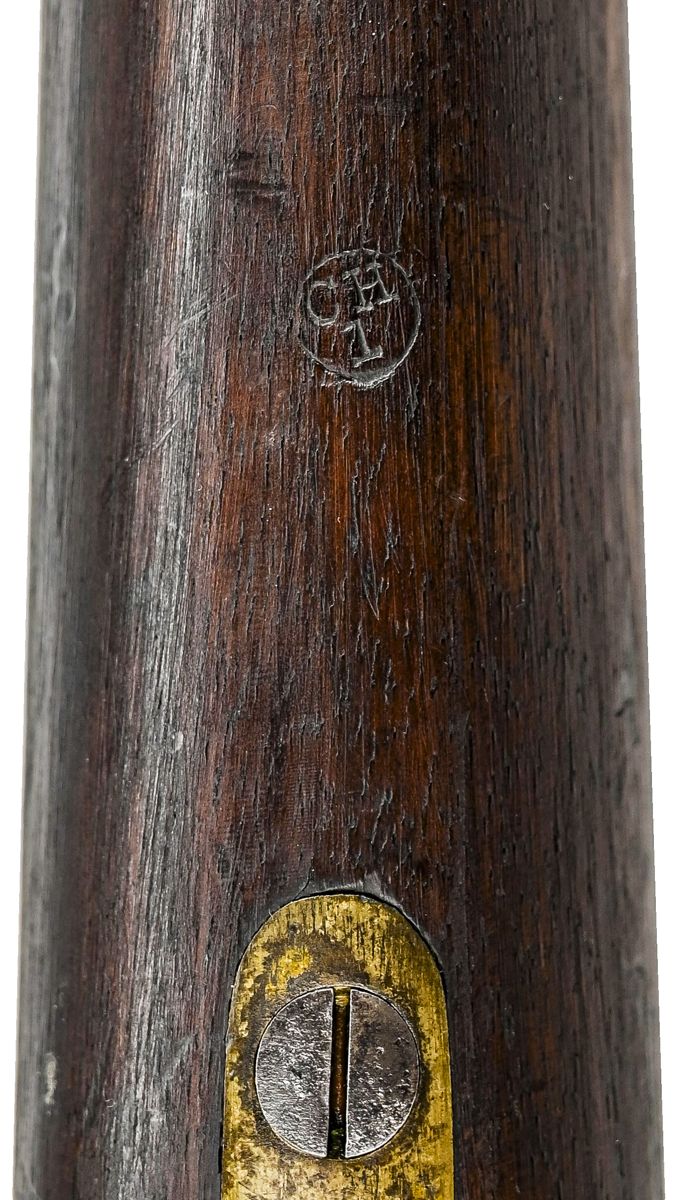
he CH1 inspector’s/viewer’s stamp is found on military firearms procured in Great Britain by Confederate purchasing agent Captain Caleb Huse and state agents from North Carolina, South Carolina, and Georgia. The stamp, typically located on the comb of the stock forward of the butt plate tang, is the inspection cartouche applied by a privately contracted local viewer to ensure the quality of arms purchased by the Southern agents. The CH1 stamp is generally, but not universally, found on Pattern 1853 rifle-muskets manufactured by J.E. Barnett & Sons of London. Of note, viewer John Southgate’s JS-Anchor stamp and the enigmatic CH1 cartouche enjoy the strongest Confederate affiliation, so guns bearing either of

Current consensus attributes the CH1 cartouche jointly to London-based viewers Isaac Curtis and Charles Hughes. One highly respected source asserts “Evidence is conclusive that the ‘CH’ / ‘1’ within a circle is the mark used by viewers Curtis and Hughes. We believe the ‘CH’ indicates the actual viewers’ names Curtis and Hughes, rather than Confederate agent Caleb Huse.” The attribution is based on two invoices from outfitter S. Isaac, Campbell & Company, to manufacturer Barnett & Sons, which detail payments to viewers Curtis and Hughes for inspection services. Dated January 11 and May 26, 1862, these documents reveal that Curtis inspected arms on nineteen occasions between September 1861 and January 1862, while Hughes worked on 32
T Two invoices from S. Isaac, Campbell & Company to manufacturer J.E. Barnett & Sons detail payment to viewers Isaac Curtis and Charles Hughes for inspection services. The attribution of the CH1 stamp jointly to both Curtis and Hughes derives from these two invoices. (South Carolina Confederate Relic Room and Military Museum)
Inspection certificate dated September 28, 1861, and signed by viewer Isaac Curtis. This and other certificates show Curtis inspected “2nd hand Long Rifles Pattern 51” for Barnett & Sons during the two months prior to Caleb Huse ordering the CH1 stamps. These documents specify that the guns “are approved, accepted, and marked by me.” Curtis obviously “marked” these Pattern 1851 rifle-muskets with another cartouche, clearly indicating that he possessed and used his own viewer’s stamp. (South Carolina Confederate Relic Room and Military Museum)
days between October 1861 and May 1862.2 Recording 38 total workdays, these invoices also show that the two viewers worked together on thirteen days, Hughes alone on nineteen days, and Curtis alone on six days.3 Moreover, an Isaac, Campbell & Company purchase invoice shows that Confederate agent Caleb Huse ordered “2 Stamps Initials CH1… for viewers of rifles” on November 6, 1861, directly linking the stamp to Southern activities.4 Another reference book concurs “the initials probably stand for the two inspectors Curtis and Hughes” and adds the CH1 cartouche “was for a long time believed to be the stamp of Caleb Huse – but that is purely a collector fairytale.”5 Connecting the CH1 stamp to both Curtis and Hughes is problematic for three reasons. First, the author can find no other example of a nineteenth or twentieth-century martial firearm inspection stamp that denotes multiple inspectors; in reviewing compilations of American and British stamps/cartouches, including those of sub-inspectors and final inspectors, the two or three letters depicted are the initials of a single inspector or viewer. To do otherwise contradicts established inspection convention and defeats the purpose of identifying accountability in the case of a weapon’s failure or shoddy workmanship. [If a reader knows of an example of an American or British inspection stamp corresponding to more than one person, please let me know via the publisher]. Isaac, Campbell & Company invoice shows that Confederate agent Caleb Huse purchased “2 Stamps Initials CH1…for viewers of rifles” on November 6, 1861, directly linking the stamp to Southern activities. The invoice specifically states “Per order of Capt Huse” and is annotated or signed at the bottom “Approved Caleb Huse.” (South Carolina Confederate Relic Room and Military Museum)
Second, Isaac Curtis employed his own viewer’s cartouche and had inspected arms for Barnett & Sons for at least two months prior to Huse ordering the CH1 stamps. Seven viewer’s certificates survive from September and October 1861 that show Curtis inspected a total of 925 “2nd hand Long Rifles Pattern 51.” Significantly, these documents specify that the guns “are approved, accepted, and marked by
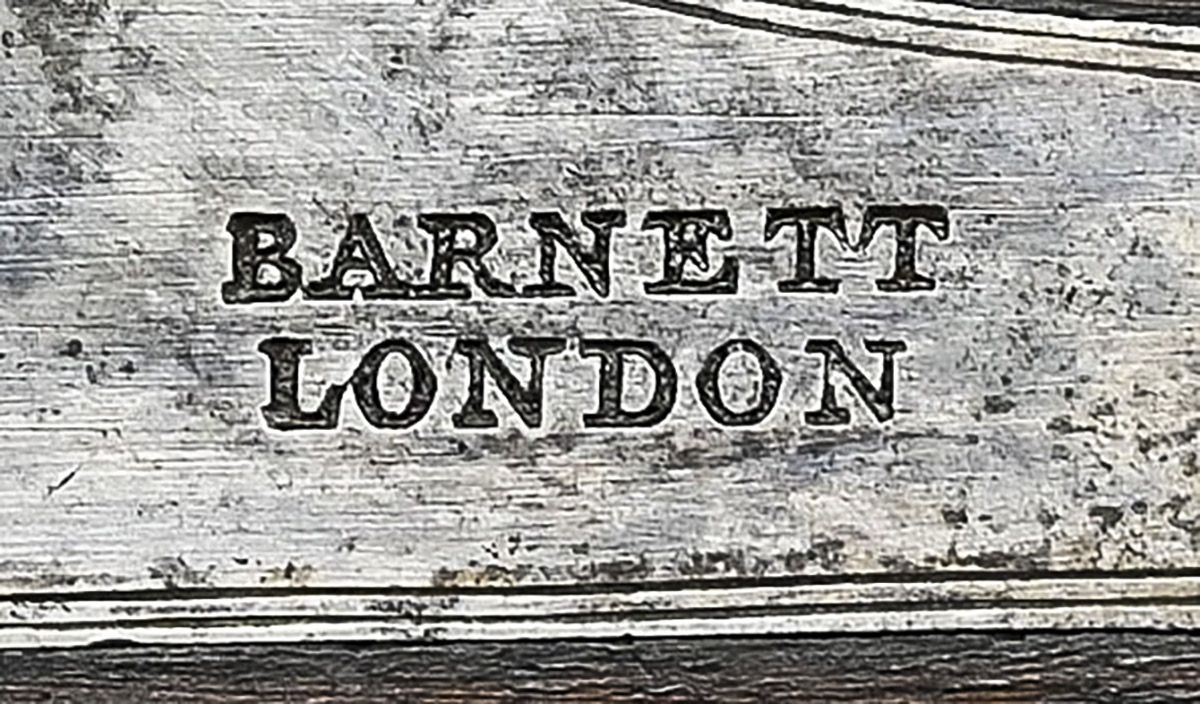
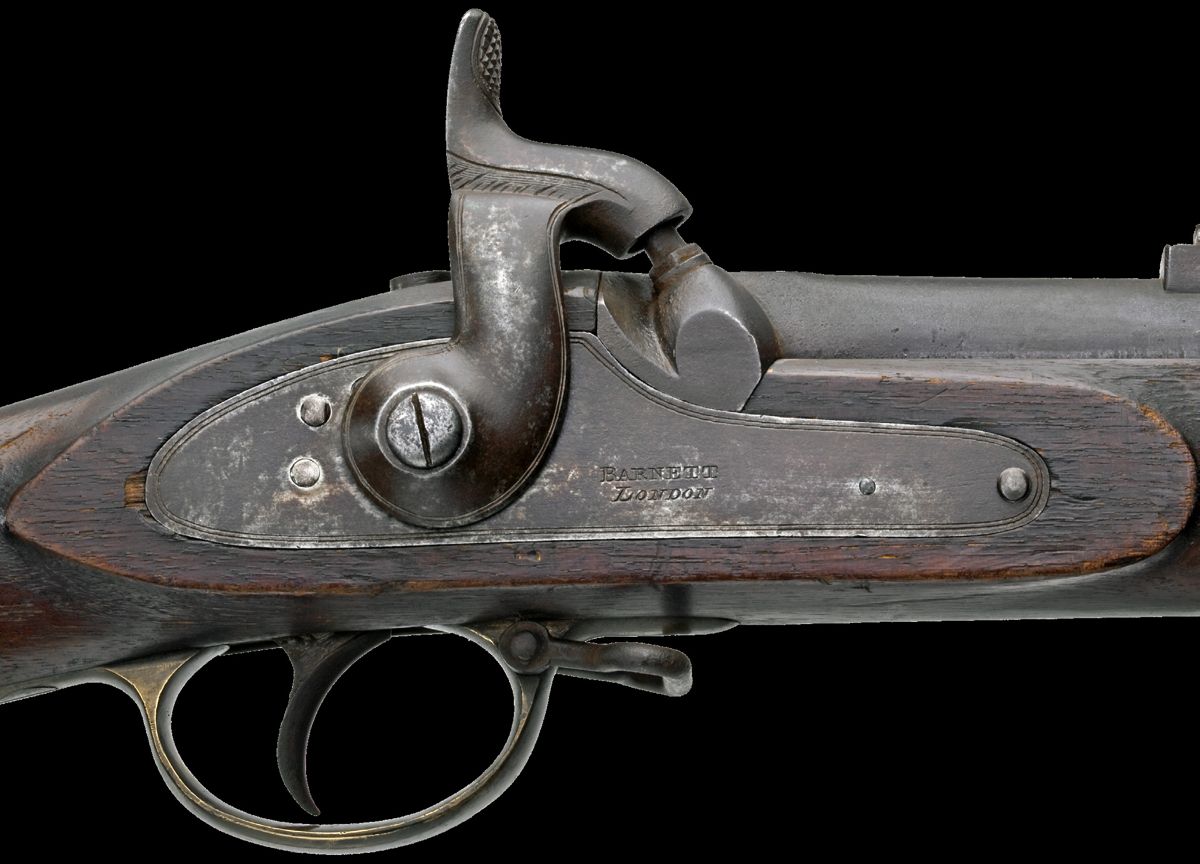
The BARNETT / LONDON lock marking of gunmaker J.E. Barnett & Sons. The CH1 stamp is generally, but not universally, found on Pattern 1853 rifle-muskets manufactured by Barnett & Sons. (Megan Lee Miller, The Horse Soldier)
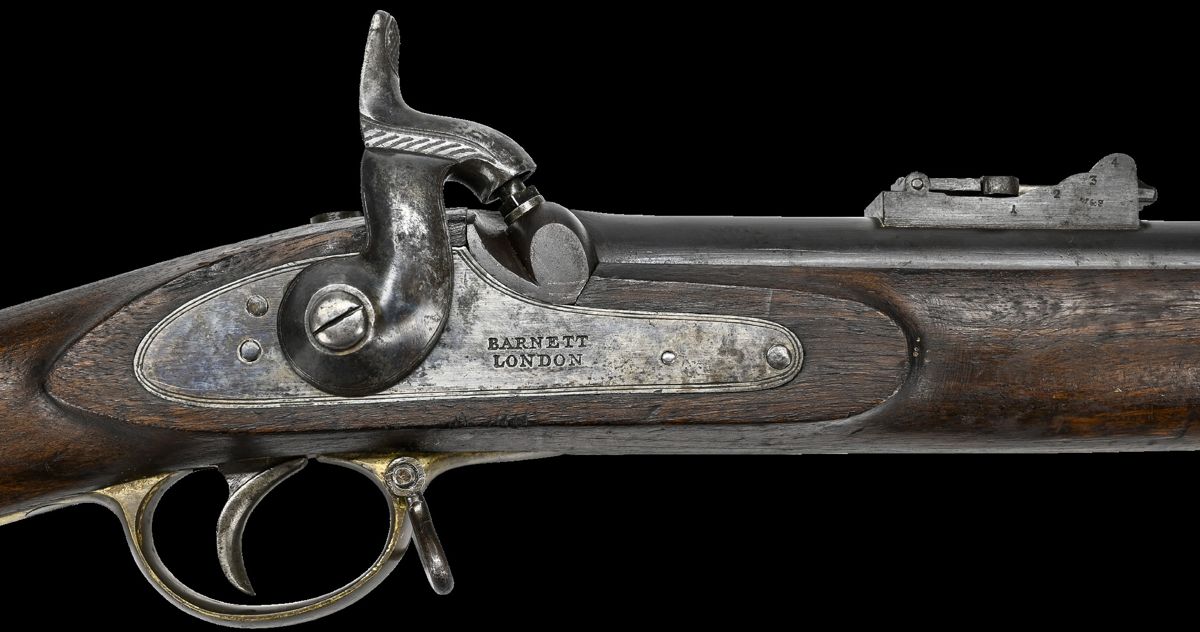
J.E. Barnett & Sons Pattern 1853 rifle-musket with a CH1 stamp. The stamp, typically located on the stock forward of the butt plate tang, is the final inspection cartouche applied by a contracted English viewer to ensure the quality of arms purchased by the Confederacy. (Megan Lee Miller, The Horse Soldier)
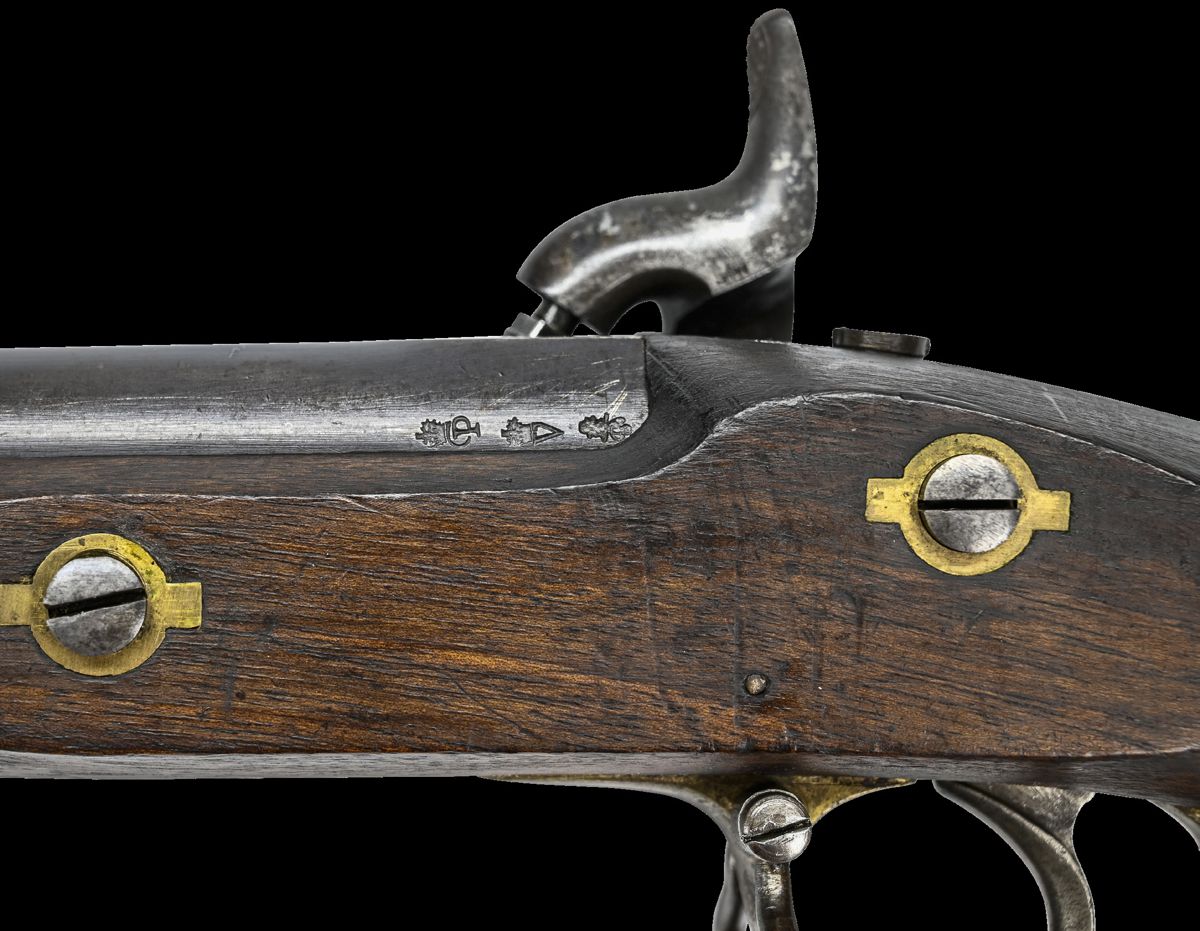
Standard barrel viewer and proved stamps found on a London made Pattern 1853 rifle-musket. The gunmakers based in Birmingham used a different series of barrel markings. (Megan Lee Miller, The Horse Soldier)
“N.C” property mark found on Pattern 1853 rifle-muskets purchased by North Carolina. Agent John L. Peyton ordered the guns he acquired to “be stamped with the letters N.C.” The North Carolina P1853 is perhaps the rarest of all Confederate Enfields. (Jack W. Melton Jr.)
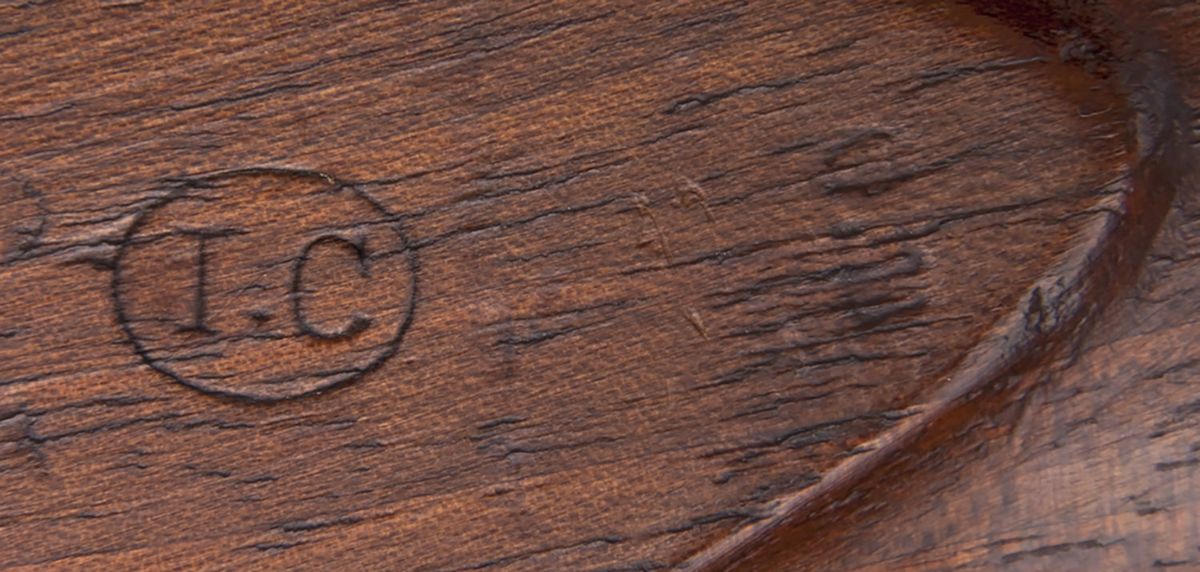
me.”6 Curtis obviously “marked” these Pattern 1851 rifle-muskets with another cartouche since the CH1 stamps had yet to be ordered, clearly indicating that he possessed and used his own viewer’s stamp. This cartouche is likely the “I.C” within an oval found on Pattern 1851 and Pattern 1853 rifle-muskets, as well as Pattern 1853 short rifle derivatives.
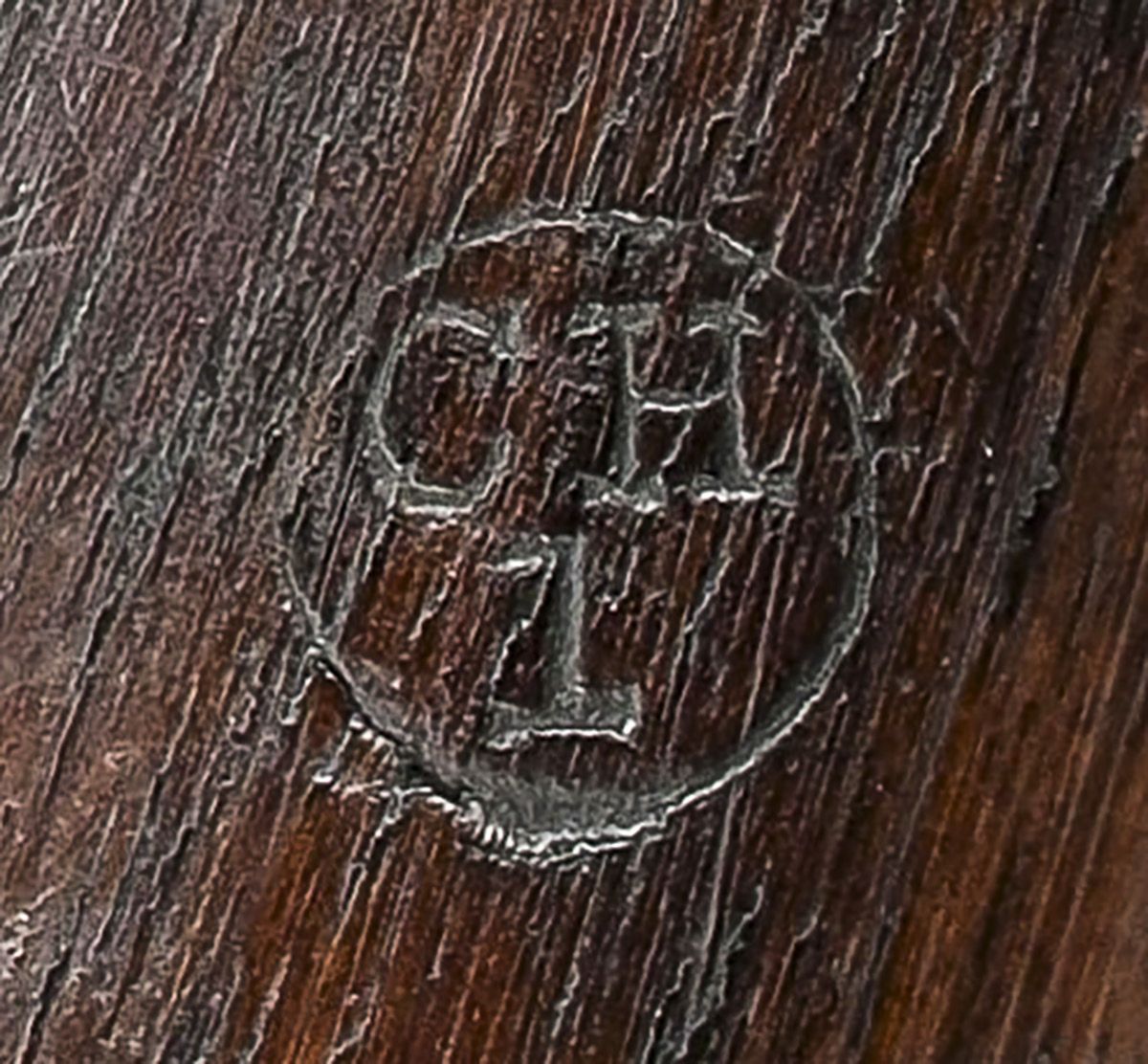
The enigmatic CH1 stamp. This example is found on the Pattern 1853 rifle-musket pictured on the previous page. (Megan Lee Miller, The Horse Soldier)
Third, the meaning of the “1” in the CH1 stamp has not been satisfactorily explained. Some have suggested that it indicates a first-class arm, but this is not possible as the CH1 cartouche appears on second-class Pattern 1851 rifle-muskets, rifled Pattern 1842 muskets, and obsolete Brunswick rifles. Others have surmised that the number represents the “1st team of viewers,” perhaps to bolster the joint attribution to Curtis and Hughes.7 The philosophical principal of Occam’s Razor asserts that when faced with competing explanations for the same phenomenon, the simplest explanation is most often correct by an overwhelming margin. Consequently, a reevaluation of the basic facts regarding the CH1 stamp, while assessing these through the lens of Occam’s Razor, might reveal a more logical deduction for the perplexing cartouche. The salient observations include: 1. The purchase invoice for the two CH1 stamps specifically states “Per order of Capt Huse” and is annotated or signed at the bottom “Approved Caleb Huse.”8 The simplest attribution for the “CH” would be to Caleb Huse. 2. The attribution of “CH” to Huse in turn provides a simple, logical, and best explanation for the “1”: Number 1 is the inspector. Since Huse was not a viewer, then “1” must be the gun inspector. And there was an obvious precedent for using numbers to denote specific
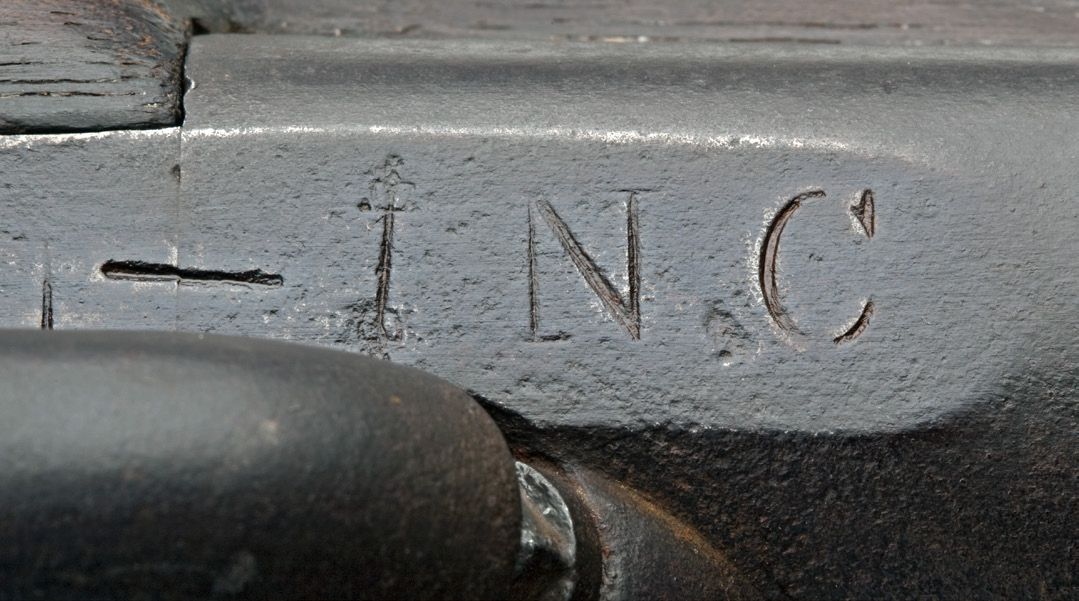
Close up of the BARNETT / LONDON stamp on the J.E. Barnett & Sons Pattern 1853 rifle-musket. (Jack W. Melton Jr.)
J.E. Barnett & Sons Pattern 1853 rifle-musket purchased by agent John L. Peyton for the State of North Carolina. Contrary to published claims that Peyton purchased 2,000 guns, correspondence between the agent and Governor Zebulon B. Vance dated January 15, 1863, specifically states that Peyton acquired “1,760 long Enfield Rifles.” (Jack W. Melton Jr.)
viewers readily available to Huse in 1861. The British Army system used for inspecting military firearms at the time assigned numbers to identify individual viewers; for example, Crown E1 and Crown B3 in the British system indicated inspector number 1 at Enfield and inspector number 3 at a Birmingham manufacturer, respectively. “The purpose of the number was so that the viewer could be identified in the event of later failure being attributed to that stage of manufacture for which he had vouched satisfaction.”9 Note that the number system is specifically designed to assign accountability to an individual inspector.
English viewers hired by Huse adopted personal cartouches to mark guns sold to American agents (and other commercial or export buyers), thereby rendering the requirement for stamps supplied by Huse unnecessary. Lastly, the current resistance to associating the CH1 stamp with Caleb Huse in reference books, dealer consensus, and among the collecting community appears unwarranted if pursuing the simplest
- The order of two CH1 stamps reflects the volume of work required in the arms inspection process. Typically, American and British inspectors routinely employed assistants; the viewer/inspector could not inspect and stamp all the guns personally.10 British military percussion arms authority William O. Adams has forensically identified three distinct JS-Anchor stamps used by viewer John Southgate and his assistants—an interesting indication of the substantial workload and requirement for multiple inspector stamps.11 As such, it is logical the two CH1 stamps were for inspector 1 and his assistant. 4. The pay invoices reveal that Charles Hughes was paid less than Isaac Curtis for viewer services.12 This indicates that he was either Curtis’s assistant or a second inspector with less experience.
All observed North Carolina Enfields bear the “CH1” stamp. Interestingly, North Carolina agent John L. Peyton reported to the governor in December 1861 that the “C.S. govt. had a contract which I was enabled to have extended” and acknowledged the assistance of “Capt Huse C.S. Artillery” in having the guns inspected and shipped. (Jack W. Melton Jr.)
Given these observations, Occam’s Razor dictates the simplest explanation for the CH1 stamp is that the cartouche denotes inspector number 1 working for Caleb Huse. This conclusion in turn indicates Huse initially adopted an inspection system modeled after the British Army. In imitating the British example, Huse’s “CH” therefore supplanted the “E” for Royal Small Arms Factory at Enfield or “B” for a government contracted gun-maker in Birmingham. Regrettably, it is impossible to determine the identity of inspector number 1, but if Charles Hughes was not Isaac Curtis’s assistant, he remains a viable candidate. Huse obviously abandoned this system after introducing the CH1 stamp because no CH2, CH3, CH4, etc. marked firearms This “I.C” within an oval stamp is likely the viewer’s cartouche of Isaac Curtis; it is found on are known to exist. The likely Pattern 1851 and Pattern 1853 rifle-muskets, as well as Pattern 1853 short rifle derivatives. explanation for this is that the (Jack W. Melton Jr.)
explanation. William of Ockham’s philosophical maxim—or logical razor used to divide competing hypotheses—clearly reveals that it is much less probable that the CH1 stamp simultaneously represents two viewers; if confronted with a defective mainspring or failed barrel, might they not simply point at each other? Endnotes Russ A. Pritchard, Jr. and Cleveland A. Huey, The English Connection (Gettysburg, PA: Thomas Publications, 2014), 112-115 and Steven W. Knott, The Confederate Enfield, Revised Edition (Gettysburg, PA: The Horse Soldier, 2019), 13-22; 31-42; 45-49. 2. Pritchard and Huey, 107; 110; 113-114. 3. S. Isaac, Campbell & Company pay invoices dated January 11 and May 26, 1862, Colin J. McRae Papers, South Carolina Confederate Relic Room and Military Museum. 4. S. Isaac, Campbell & Company purchase invoice dated November 6, 1861, Colin J. McRae Papers, South Carolina Confederate Relic Room and Military Museum. 5. Marc Schwalm and Klaus Hofmann, European Arms in the Civil War (Woonsocket, RI: Andrew Mowbray Inc., 2018), 42-43. 6. S. Isaac, Campbell & Company viewer’s certificates dated September 25, September 27, September 28, September 30, October 1, October 2, and October 3, 1861, Colin J. McRae Papers, South Carolina Confederate Relic Room and Military Museum. 7. Pritchard and Huey, 114. 8. S. Isaac, Campbell & Company purchase invoice dated November 6, 1861, Colin J. McRae Papers, South Carolina Confederate Relic Room and Military Museum. 9. C.H. Roads, The British Soldier’s Firearm 1850 – 1864 (Livonia, NY: R&R Books, 1994), 70. 10. Anthony C. Daum and Charles W. Pate, U.S. Military Arms Inspector Marks (Woonsocket, RI: Andrew Mowbray Inc. Publishers, 2016), 6-8. 11. Email correspondence between William O. Adams and the author, July 15, 2006. 12. S. Isaac, Campbell & Company pay invoices dated January 11 and May 26, 1862, Colin J. McRae Papers, South Carolina Confederate Relic Room and Military Museum. 1.
About the Author
Capt. Steven W. Knott, USN (ret.) currently serves in the U.S. Army War College Office of Outreach and Advancement where he conducts strategic leadership educational programs for senior executives from government and the private sector at historic battlefields in the United States and Europe. He is a former faculty member and academic chairholder in the war college’s
Department of Military Strategy, Planning, and Operations. Capt. Knott is the author of The Confederate Enfield (revised edition 2019) and Captured and Collected: Confederate Reissued Firearms (2019). He retired from the U.S. Navy following 28 years of service in 2012. He commanded Helicopter Combat Support Squadron 8, based in Norfolk, Va., in 2002– 2003. Earlier in his career, he conducted several deployments to the Mediterranean Sea and Arabian Gulf, as well as led helicopter support for the recovery of wreckage from the crash of TWA Flight 800 in waters off Long Island, N.Y., in 1996.