
Major General William Mahone’s Sword
By Shannon Pritchard · Originally published July-August 2026 · pp. 22–36
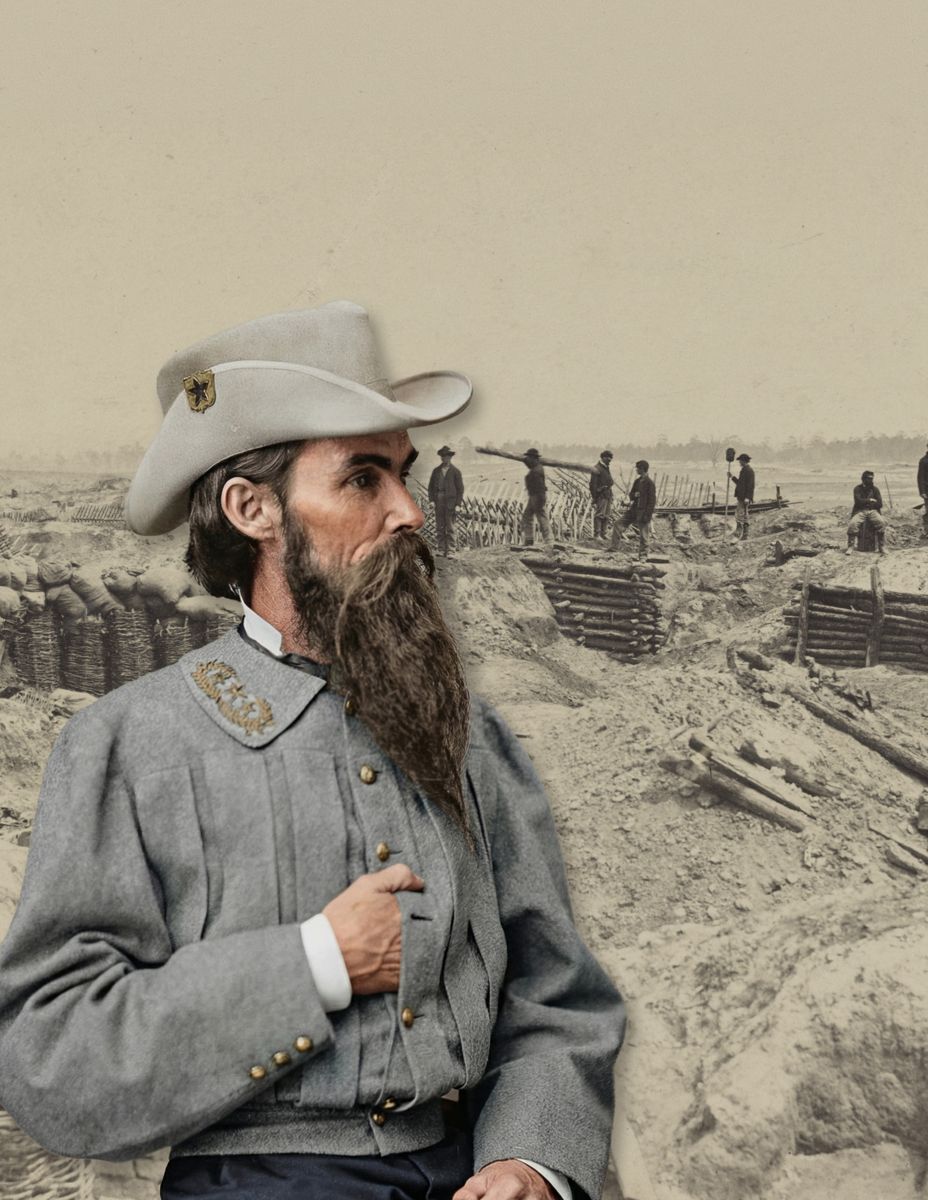
Major General
William Mahone’s Sword By Shannon Pritchard
William Mahone was born in Southampton County, Virginia, to Fielding Jordan and Martha Drew Mahone on December 1, 1826. Little “Billie” Mahone grew up in his father’s well-known Mahone’s Tavern, located in Jerusalem,1 Southampton County, Virginia. It was built about 1796 and is a two-story, three-bay, gable-roofed, wood-framed structure with exterior gable-end chimneys that still stands. In 1831, like nearly every building in Courtland, it became a refuge and gathering place for local citizens during Nat Turner’s Rebellion.2 Billie was only five years old when 55 of his neighbors were slain by an insane black man named Nat Turner. He probably understood little, but he surely felt the tension. Yet he was known throughout life as the black man’s friend.3 He was 33 when the insane John Brown slew his fellow men. In 1840, Southampton was 55% black, and 25% of them were free.4 Billie worked in his father’s tavern and carried the mail5 before attending the Virginia Military Institute, where he excelled in engineering, graduating in 1847. Always an overachiever, he continued studying engineering and taught at the Rappahannock Military Academy until he was hired as an engineer by the Orange & Alexandria Railroad, not as a train engineer, but as a survey/construction engineer. By late 1860, early 1861, he was the President, Chief Engineer, and Superintendent of the Norfolk & Petersburg Railroad, which ran through Jerusalem. He, his wife, and three children were living in Petersburg when Virginia refused Abe Lincoln’s order to provide troops to subjugate her sister states.
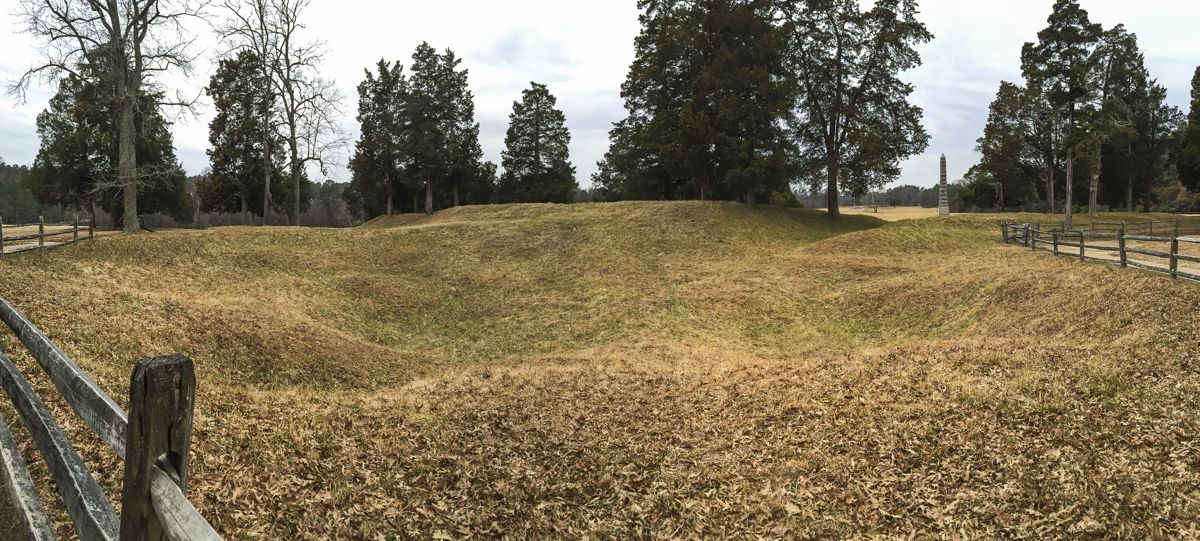
would have likely destroyed it had not the wounding of Longstreet detained him. Richard Anderson took Longstreet’s Corps, and Mahone advanced to the leadership of Anderson’s Division in the reorganization following the battle. At the Spotsylvania, North Anna, and Cold Harbor Battles, Mahone performed exceptionally well at the division command level, which he held for the rest of the War. In the span of 40 days, Grant lost about 55,000 men killed or wounded, while Lee suffered about 33,000 casualties.8 However, Grant could replace his losses with conscripts and impressed foreigners,9 many of whom could not speak English. The Federal Army had gradually, by sacrificing as many men as General Lee had in his Army and constantly moving around Lee’s right, forced the Army of Northern Virginia into siege lines protecting Petersburg. Though General Mahone had performed well at all levels and at all times, his crowning achievement, and that for which he is most remembered, was his performance at Petersburg, Va., on July 30, 1864, which earned him the sobriquet “The Hero of Petersburg” and a major general’s star. A month earlier, on June 25, 1864, under the command of Major General Ambrose Burnside, the 48th Pennsylvania Regiment, made up of Schuylkill County coal miners, began digging a tunnel in a ravine hidden from Confederate view. After nearly a month of digging, they completed 586 feet of tunnel that had a 75-foot crosswise gallery at the end that ran under the Confederate lines. This cross tunnel was filled with four tons of powder. On July 30, the “Petersburg Mine” was exploded, to the amazement of both armies. The explosion opened a chasm 170 feet long and 30 feet wide, clearing the way to Petersburg and the long-hoped-for defeat of the Army of Northern Virginia. A 110-pound Virginia Gamecock rushed three of his brigades of Virginians, Alabamians, and Georgians towards the breach, while Bushrod Johnson’s men and Confederate artillery blasted away at the attackers, effectively keeping them trapped in the Crater. All the while, Federals continued to pour more men into the maelstrom. Mahone’s men did not advance into the crater; instead, they fired and threw shells into the writhing mass of men, now so thick that hardly could a shot miss. Nearly 3,800 Union soldiers were shot down, and the Confederate losses were nearly 1,500; most of these were blown up or buried in the initial explosion. Though General Grant had approved the attack, General Burnside served as his scapegoat for his role in the debacle and was removed from command.
“Presentation of a Sword to Major-General Mahone.” (Richmond Dispatch (Richmond, Va.), Wednesday, March 22, 1865, page 3.)
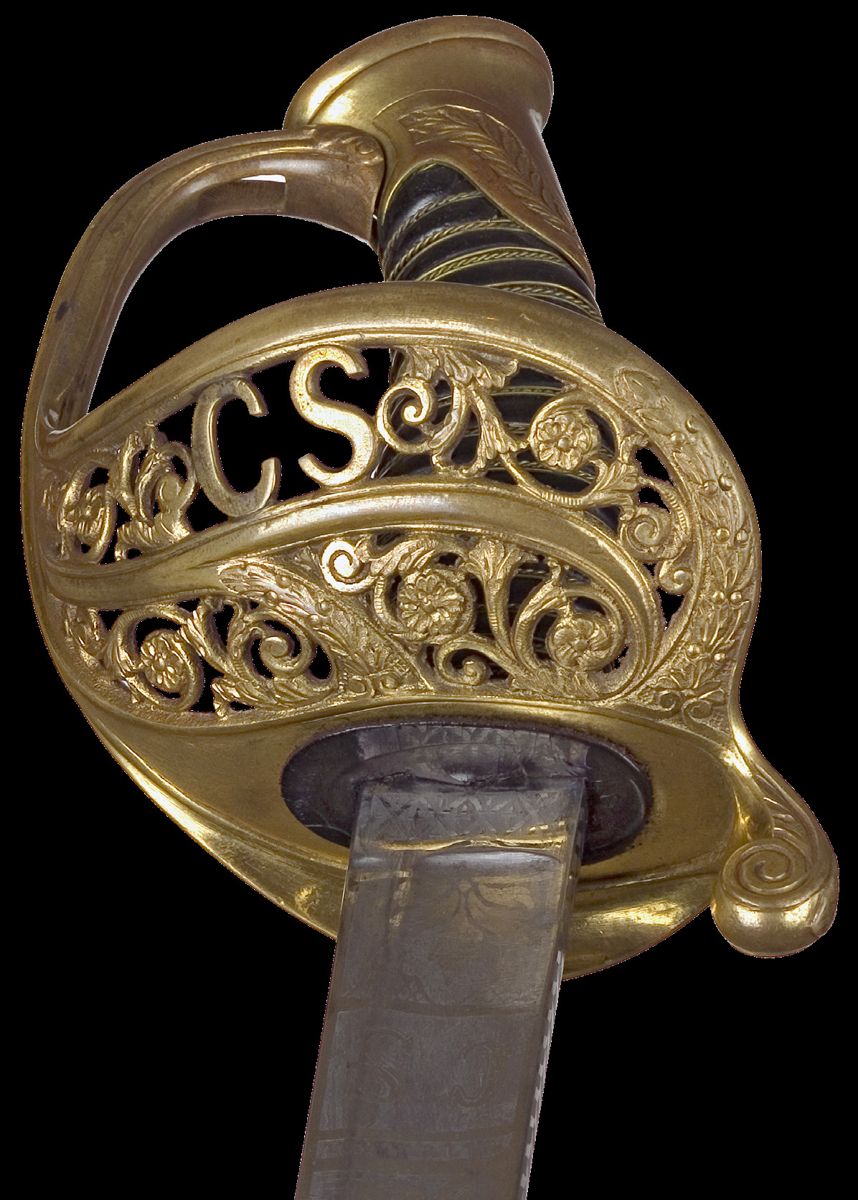
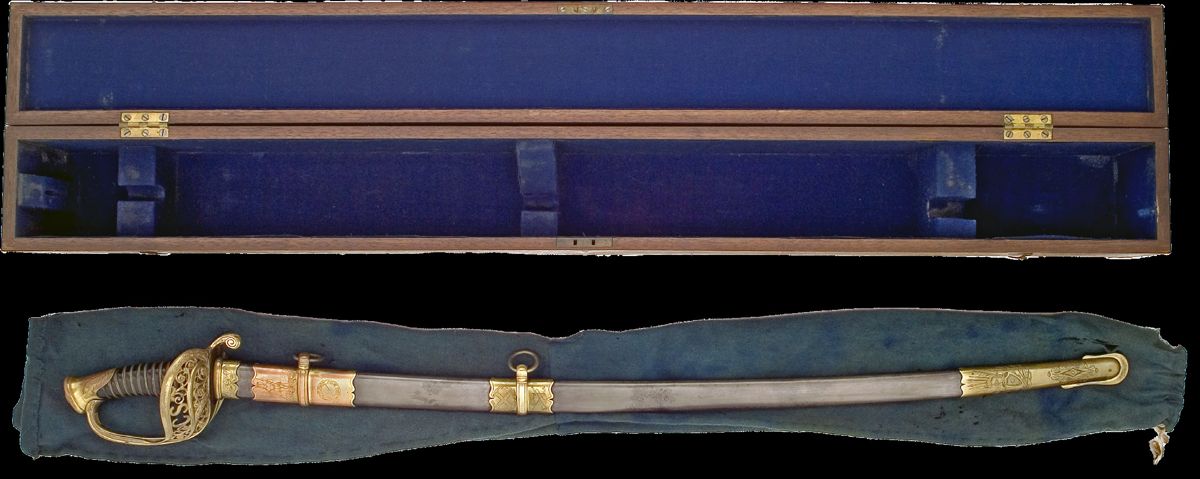
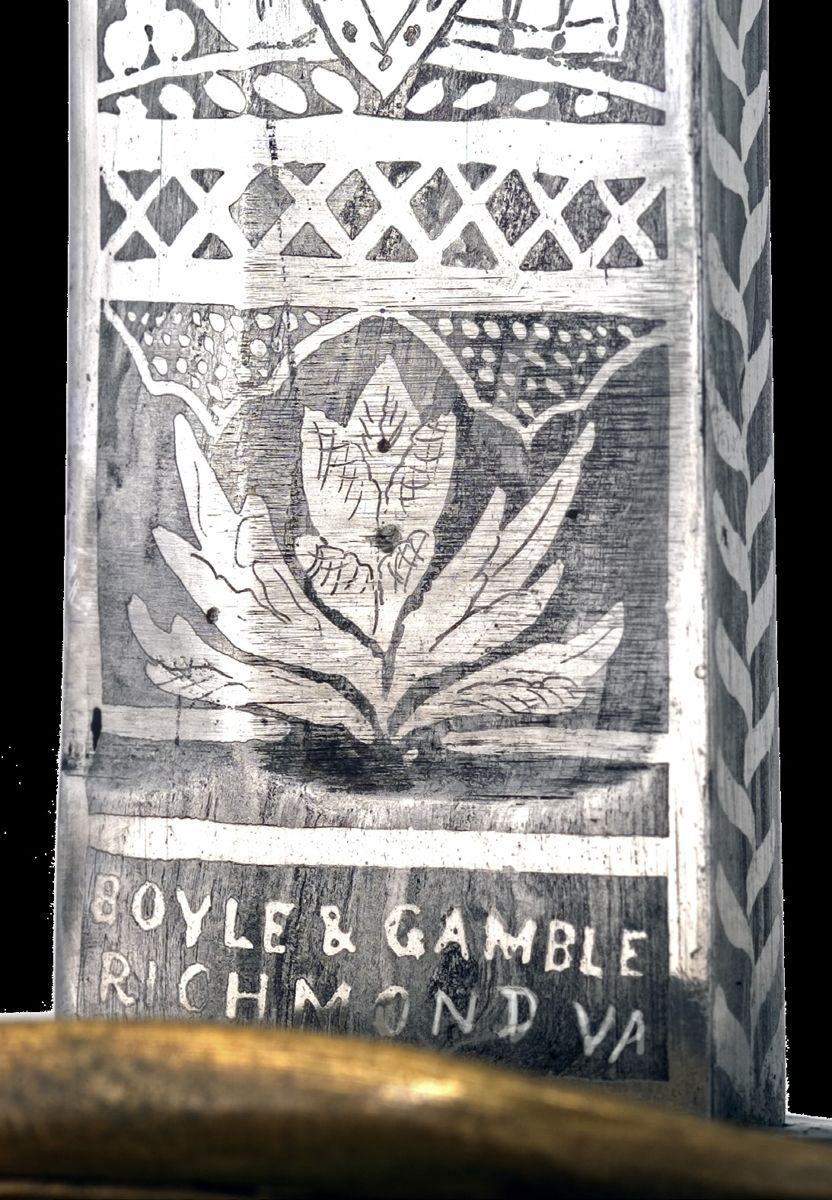
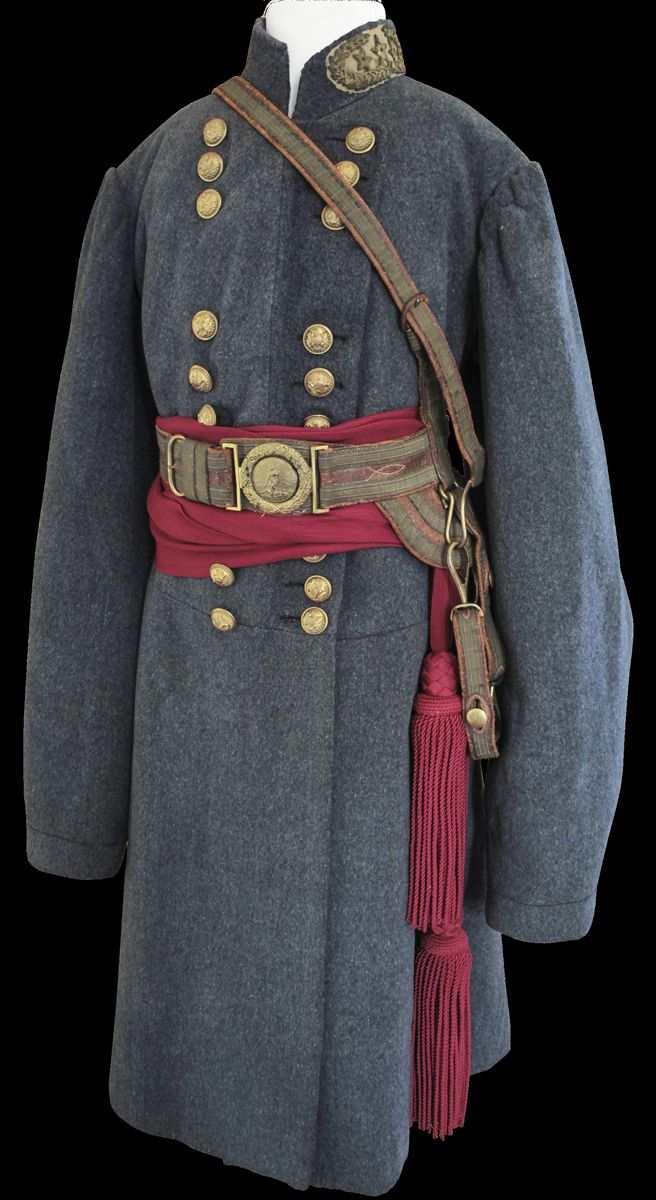
Mahone, on the other hand, whose leadership and timing turned the tide of the battle and whose forces inflicted heavy casualties on the Union troops, was celebrated as the “Hero of Petersburg” and given a promotion to major general dating to the day of the battle, though he had been acting major general for some time.10 He finished the War remembered as one of Lee’s finest commanders. The people of Petersburg viewed him as their savior, in honor of which they commissioned a beautiful presentation model Confederate Staff & Field Officer’s sword, complete with sash and a Virginia General Officer’s Sword Belt. These were ordered from the Richmond sword-making firm of Boyle & Gamble. Edwin Boyle and Thomas Gamble were prewar saw makers, but even before the first shots were fired, they were on their way to becoming the most prolific providers of officers’ swords, both plain and etched, in the Confederacy. They also made knives, bayonets, enlisted cavalry swords, and belts to go with them, and even such mundane things as axes, curry combs, and shoe hammers. The firm made swords for retail sale as well as government contracts. The company also supplied their highest quality officer’s swords to jeweler and military outfitter, Mitchell & Tyler, located on Main Street in Richmond, Va. It is unknown when exactly the cased presentation sword, sash, and General Officer’s sword belt were ordered, but they were presented to Major General William Mahone on Saturday, March 19, 1865, near the front in Chester, Virginia.11 “The presentation took place in the presence of a large assemblage of officers, soldiers, citizens, and ladies, who gathered together to witness the pleasing event.”12
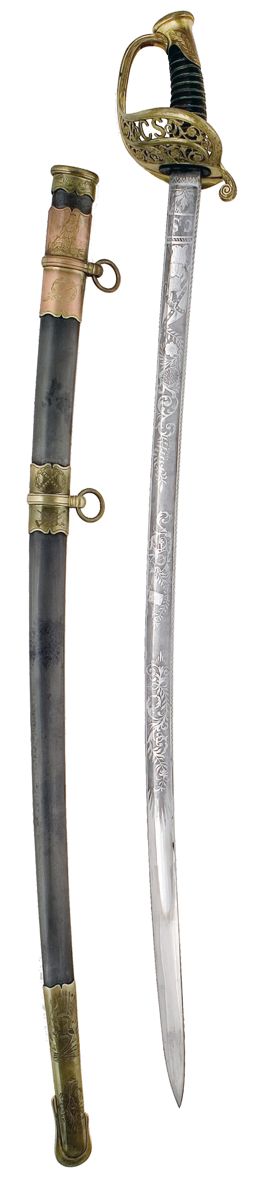
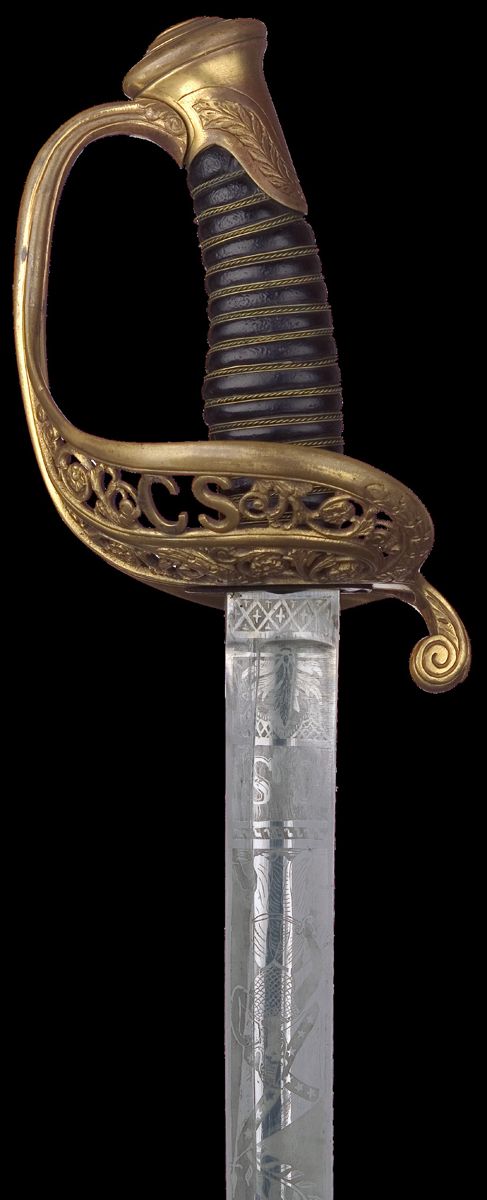
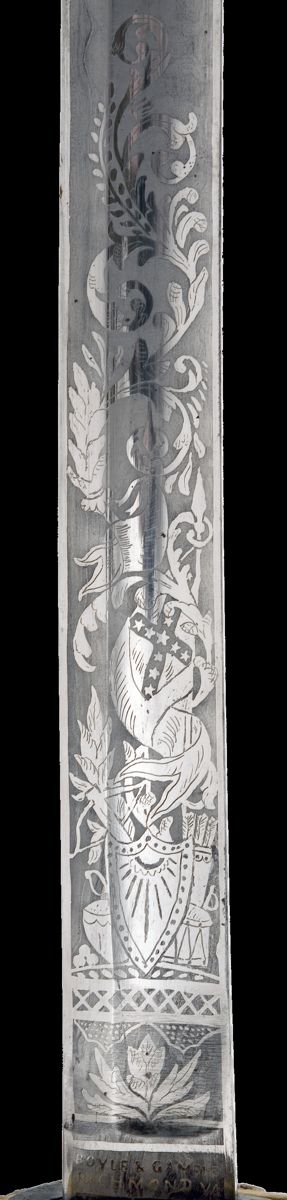
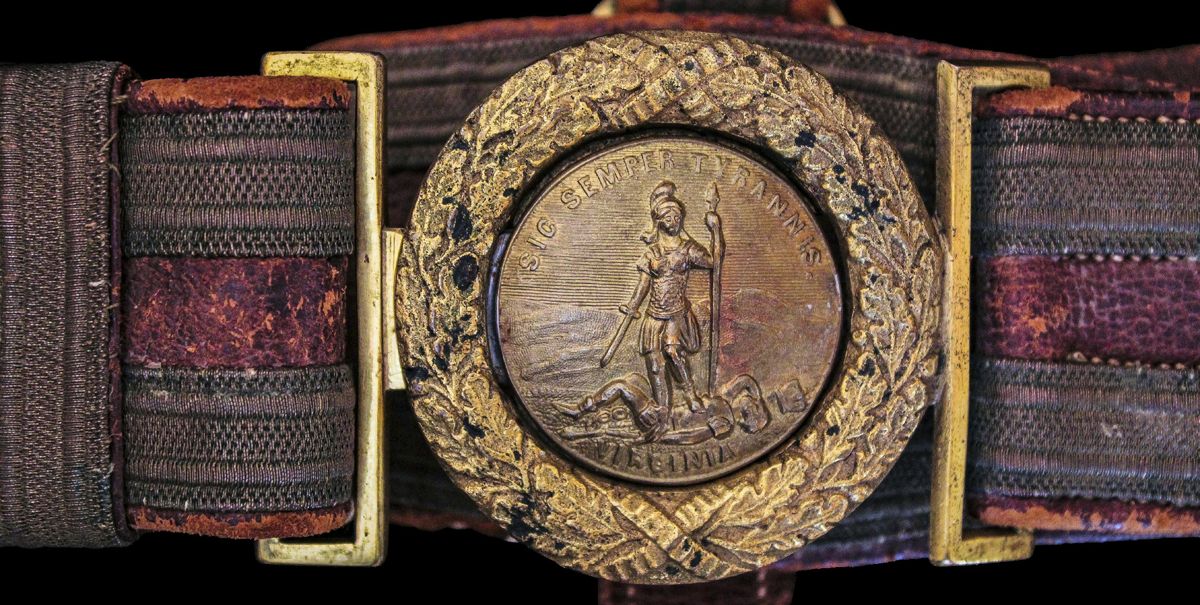
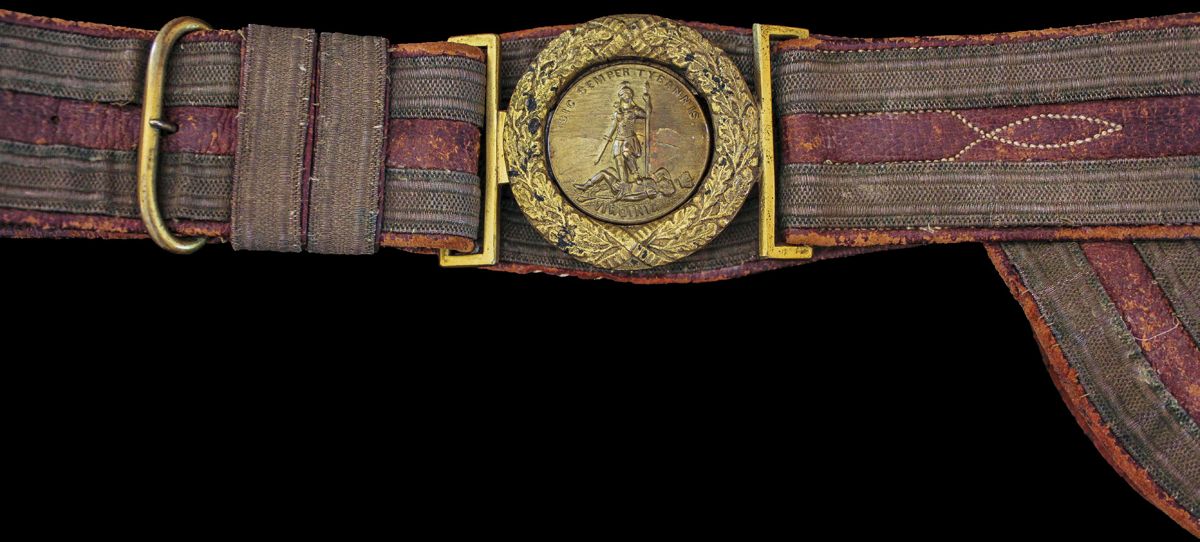
The paper first noted that, during the 1864 campaign, from the time Mahone took over the division until the Battle of Burgess Mill on October 27, 1864, Mahone’s Division had put 17,704 of their enemies hors de combat, while suffering only 5,248 casualties.13 However, it did not note that the “enemies” could easily replace those losses, the Confederacy could not. Then the crowd listened attentively as David May, Esq. made the presentation of the sword, a “fit emblem of the times”14 in “appreciation of your skill, energy and gallantry.” After delivering the “brief but graceful address,”15 the General accepted the gift for “the Division I have the honor to command” and made a reply that expressed profound “gratitude of highest appreciation,” after which the troops marched by in “beautiful order and returned to the trenches.” The sword is indeed beautiful, and bears the etched panel on the reverse of its blade that reads, “IN APPRECIATION OF HIS SKILL ENERGY AND GALLANTRY IN DEFENSE OF THEIR CITY DURING THE CAMPAIGN OF 1864 PRESENTED TO MAJOR GENERAL WILLIAM MAHONE BY THE CITIZENS OF PETERSBURG VA.” The sword was presented in a black walnut case with blue lining and accompanied by a beautiful General Officer’s Sword belt with a distinctive twopiece Virginia State Seal buckle that depicts Virtus (Virtue) standing on a defeated Tyranny’s neck. A blue wool case made from the leg of Federal uniform trousers and a red, worsted sash was included with the group. The Ames U.S. Model 1850 Staff & Field Officer’s Sword is of the finest quality. The hilt follows the standard Ames pattern, and Boyle & Gamble substituted a C for the U. The grip is leather-covered wood, wrapped by three strands of gilt brass. The sword’s 33.5 inch, slightly curved blade has a stopped fuller. The blade’s etching is truly a frosty stunner. Not only does it have the decorative presentation mentioned above, but it is signed BOYLE & GAMBLE, over RICHMOND, VA. The frosty etched blade features vine-andflower foliate patterns common to higher-grade B&G etchings. It also has some very rare and some unique B&G designs, including the artist’s rendering of Virtus holding a 13-star Army of Northern Virginia Battle Flag, a panoply of arms that harken back to the medieval era with arrows, shield and crossbow, surmounted with the “Stainless Banner,” the Confederate Second National flag, and another panoply with flags and artillery. All of this above a large, horizontal CS. The sword’s iron scabbard is another unique work of art. The brass mountings feature the Virginia State Seal; a laurel wreath pierced by a sword; the Confederate Battle Flag embraced within the laurel wreath; a panoply of drum, bayonet, and bugle; and the drag, decorated with a knight in armor surrounded by the tools of his trade: lances, club, shield, and arrows. The sword belt, which was undoubtedly supplied by Boyle & Gamble, also closely follows the U.S. 1851 regulations, which specify red leather and gilt embroidery for general officers.16 It is complete with hangers and a cross shoulder support. The belt is fastened by a gilt twopiece interlocking tongue and wreath bearing the Virginia State Seal on the central disc, which is surrounded by an oak wreath. Mahone did not have long to display these beautiful tokens of honor, nor to savor the day. Eleven days later, his division was pulled from the Petersburg trenches on April 2, 1865. After a fighting, starving, fighting retreat, in which Billy Mahone’s Division remained one of the most organized and disciplined in the Army of Northern Virginia, they laid down their arms and surrendered their hopes of a free country on April 9 at Appomattox Court House. Years later, Mahone would write about “what I saw and heard” during that terrible retreat. He wrote this to specifically address what he thought were inaccuracies in how the surrender was being portrayed by “Lost Cause” historians like Jubal Early. In the text, he describes the chaos of the retreat but emphasizes that his division remained a cohesive fighting force while others “melted away.” And he addresses his decision to hold the line at Cumberland Church, arguing it was his division’s stubbornness that prevented the total envelopment of the army on April 7th. Lee told the survivors of so many hard-fought battles to go home and rebuild the South in his farewell address to the army. As always, Mahone followed Lee’s directions. By 1872, the Mahones were living in Petersburg, and he was employed as receiver for the AM & O Railroad, but the panic of
1873 put an end to that avenue to a future. When Mahone tried to purchase the railroad, he was beaten again by the northerners when a group of Philadelphians purchased the line. His unblemished military career opened the door to entering politics. He lost the 1877 Virginia Governor’s race, but was elected to the U.S. Senate in 1880 as a Republican, which no doubt caused many hard feelings among his old soldiers. Consequently, he lost his seat to a Democrat in 1886. He ran for governor again in 1889, but he had alienated too many Virginians with his support for Republicans. He died on October 8, 1895, at 68 years old. He is buried in Blandford Church Cemetery, less than two miles from his most famous battle.
This 1887 photograph, taken on the battlefield of the Crater near Petersburg, Virginia, features former Confederate General William Mahone, identified at the lower center by his long white beard, standing beside members of the 57th Massachusetts Regiment. The assembly occurred almost 20 years following the significant events of July 30, 1864, when Union engineers blew a massive mine beneath the Confederate defensive line, creating a profound, bowl-shaped depression in the ground. The 57th Massachusetts was one of the initial Federal troops to enter the newly created abyss, only to become ensnared by its high walls and subjected to intense Confederate gunfire. Mahone, at that time a brigadier general, orchestrated a rapid counteroffensive that subdued the Union troops ensconced behind the Crater, resulting in the capture of numerous soldiers from the 57th. His actions during combat distinguished him within the Confederate Army and led to a promotion to major general shortly thereafter. This postwar image depicts survivors of the 57th Massachusetts adorned with reunion insignia on their lapels, standing next to the very individual whose forces had confronted them on that fateful day. At the time this portrait was taken, Mahone’s military renown had been succeeded by an extensive career in public service. He had recently concluded his tenure in the U.S. Senate as a prominent figure in Virginia’s Readjuster movement, and he would shortly attempt an unsuccessful campaign for the governorship as a Republican in 1889. (Library of Congress)
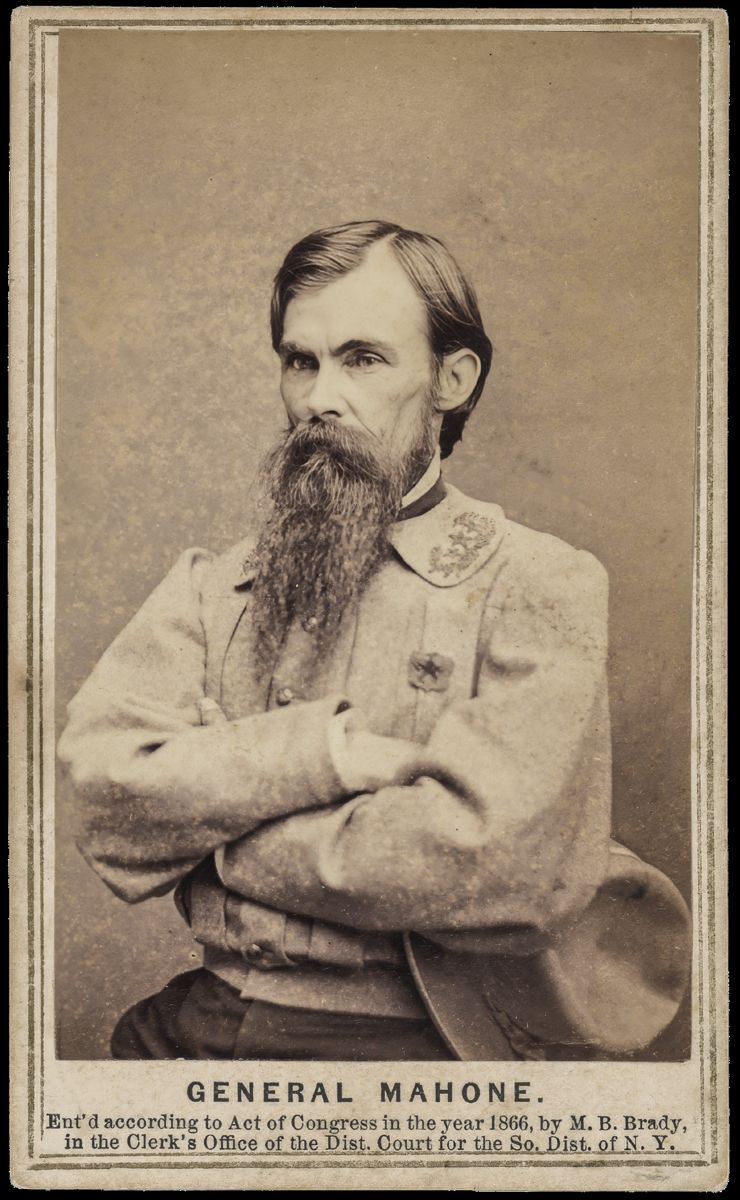
Wartime ambrotype of General William Mahone from life, taken in 1864. (Heritage Auctions)
Endnotes: 1. 2. 3.
Known as Courtland today. “National Register Information System.” National Register of Historic Places. National Park Service. Primarily for his broad support for restructuring the state’s pre-war debt while improving infrastructure and increasing funding for schooling, particularly for blacks. Antebellum Southampton County, Virginia, 1840–1860. Richard Tyler Kanak. The Confederate General. O.R.
The Confederate General. Cold Harbor, Gordon Rhea, p. 393. “The Impressment of Foreign-Born Soldiers in the Union Army,” Journal of American Ethnic History, Vol. 38, No. 3. Richmond Times Dispatch, August 5, 1864. Richmond Enquirer, March 22, 1865. Richmond Daily Dispatch, March 22, 1865. Ibid. Richmond Enquirer, March 22, 1865, p. 2. Ibid. “Russia (red) leather, with three stripes of gold embroidery on both sides.”
About the Author Shannon Pritchard has authored numerous articles relating to the authentication, care, and conservation of Confederate antiques, including several cover articles and is the author of the definitive work on Confederate collectibles, the widely acclaimed Collecting the Confederacy, Artifacts and Antiques from the War Between the States, and is co-author of Confederate Faces in Color.
Massive crater left behind after the explosion in the Battle of the Crater at Petersburg, Virginia. Union soldier seated. (Wikimedia Commons)