
Portrait of Texas Ranger Samuel H. Walker
By Jack W. Melton Jr. · Originally published July-August 2026 · pp. 17–21
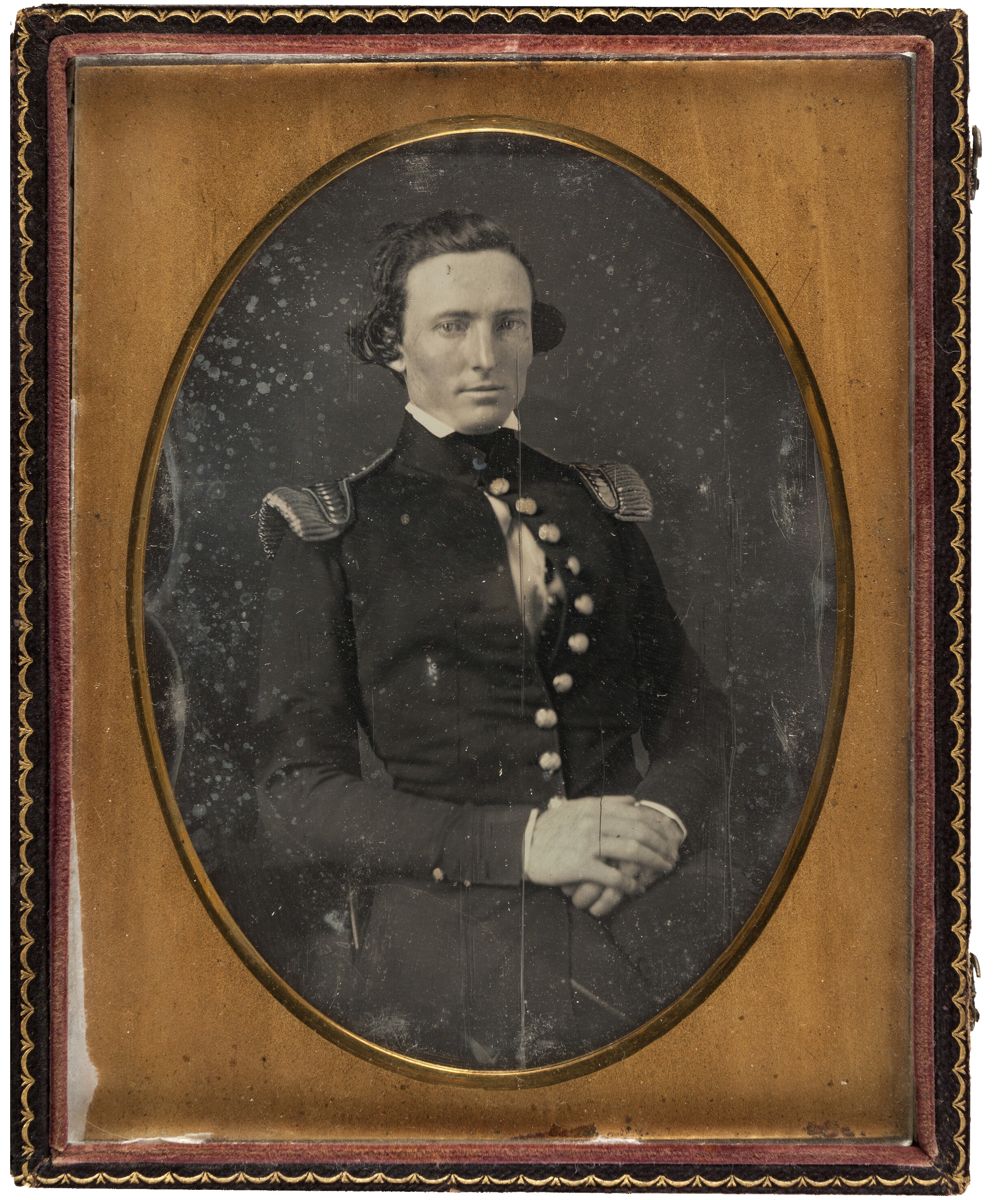
Samuel H. Walker half-plate daguerreotype, circa 1847. The oval image measures approximately 3.75” x 4.75” (case 5” x 6”). In this striking daguerreotype, Captain Samuel H. Walker, only thirty years old, wears the uniform of a captain in the United States Regiment of Mounted Riflemen: a dark blue wool tailcoat bearing unusual epaulettes, with the buttons of his white undervest conspicuous at the throat. Walker would die in battle only months after sitting for this portrait. According to our research, this is the only daguerreotype of this famous Ranger in private hands.
Samuel Hamilton Walker (1817–1847) was a Maryland native, born February 24, 1817, at Toaping Castle, Md. By the time he faced the camera he had already lived an outsized life. He had soldiered in the Second Seminole War in 1836, where, as Philip Schreier notes in his 1998 Man at Arms study “Walker’s Walkers,” he likely had his first exposure to Samuel Colt’s repeating arms in their earliest combat trials. From Florida he followed the sound of gunfire west to the Republic of Texas, taking service under Colonel John Coffee “Jack” Hays and earning a reputation for fearlessness among the Rangers on the Comanche frontier. He also rode with the ill-fated Mier Expedition of 1842, survived the notorious Black Bean episode by drawing a white bean, and was imprisoned at Castle Perote, from which he eventually escaped. Walker became the first popular hero of the Mexican War for his daring ride to carry intelligence to General Zachary Taylor prior to the battles of Palo Alto and Resaca de la Palma in May 1846. That reputation, and his proven record with Hays’s Rangers, brought him to the attention of the War Department. On May 19, 1846, Congress authorized a new unit, the Regiment of Mounted Riflemen, raised at Jefferson Barracks, Missouri, and armed with the Model 1841 percussion rifle. President James K. Polk commissioned Walker a captain in the regiment, and he was assigned to command Company C. From the winter of 1846 into the spring of 1847, he was on detached service in Washington, New York, and Maryland, recruiting men and securing equipment for his company. It was almost certainly during this eastern trip that his portrait was taken. It was also during this eastern trip, in January 1847, that Samuel Colt wrote to Walker asking for his endorsement of the Paterson revolver. Colt at that point was a bankrupt man without a factory, and a government contract was his one hope of recovery. Schreier, drawing on Paterson’s Sam Colt’s own record, documents a lively exchange of letters between the two men in which Walker urged Colt to
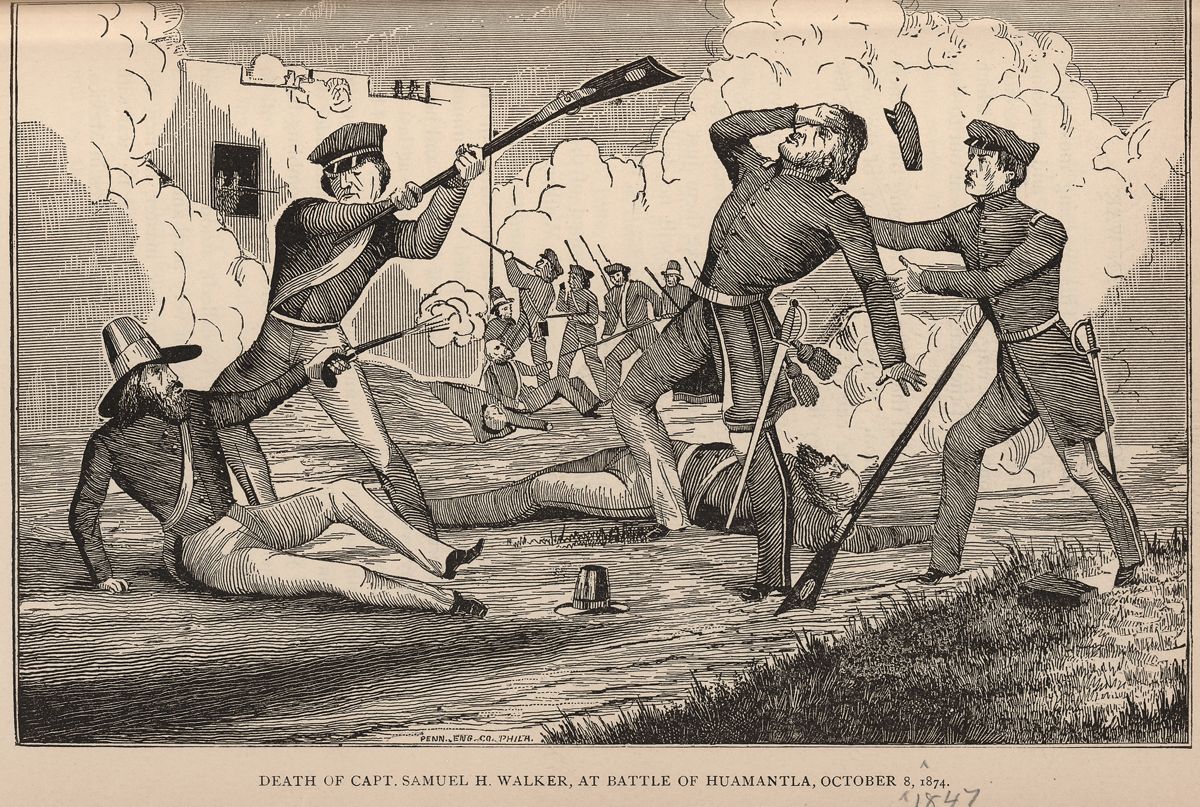
A print of the death of Captain Samuel H. Walker at the Battle of Huamantla on October 8, 1847. This print depicts the moment in which Captain Walker received his mortal wound to the forehead while the battle ensues around him. On October 13, 1847 Oswandel wrote about receiving the news of Captain Walker’s death and highlights his campaign from following General Taylor’s route, to joining General Scott at Vera Cruz and marching to Perote Castle where he was stationed to keep the guerrillas at bay, and he also participated in the battles of Las Vegas and La Hoya along the National Road. This lithograph is from the book Notes of the Mexican War 1846-47-48, revised 1885, illustrated, by J. Jacob Oswandel, page 347. (Garrett Collection. The University of Texas at Arlington Library, Special Collections.)
enlarge the pistol to .44 caliber, add a trigger guard, stiffen the frame, and fit a permanent loading lever. Walker even submitted a design for the front sight. The result was the massive Colt Model 1847 Army revolver, known ever since as the Colt Walker: 15.5 inches overall, a nine-inch barrel, weighing roughly four and a half pounds, and charged with sixty grains of black powder, more than twice the load of any other revolver of the period. Until the introduction of the .357 Magnum in 1935, it remained the most powerful repeating handgun in the world. Walker, acting as the army’s agent, secured the order for 1,000 pistols, the contract that launched Colt’s Hartford factory and, with it, the modern American firearms industry. The relationship between the two men was not without friction. Schreier recounts that Colt pressed Walker repeatedly to come to New England and help shepherd the guns past the Chief of Ordnance, General George Talcott, whose inspectors were slowing delivery at every turn. Walker declined, even offering at one point to inspect the pistols himself in the field. A revision to the contract forced Colt to supply a flask and mold with each pistol rather than each pair, compounding his expenses. By the spring of 1847, as Walker and his new company sailed from New Orleans for Veracruz, the promised revolvers were nowhere in sight. Colt ultimately delivered a presentation set to Taylor and Hays around the first of June. Walker’s own pair did not ship until late July. By Schreier’s account, a letter from Walker to his brother James, dated October 5, 1847, and written from Perote, confirms that the pair had finally reached him. He told James that not an officer who had seen the revolvers failed to speak of them in the highest terms. On the same day, in an act of personal ritual, Walker walked to the courtyard flagpole at Perote and retrieved a dime he had hidden there years earlier as a prisoner, a promise to himself kept. Walker was detailed on May 27, 1847, to duty with the First Pennsylvania Volunteers at Perote, the same fortress where he had once been a prisoner, and set to work countering guerrilla activity along the Veracruz to Jalapa road. On October 5, 1847,
The death of Captain Samuel Walker, at Huamantla in Mexico. (Library of Congress)
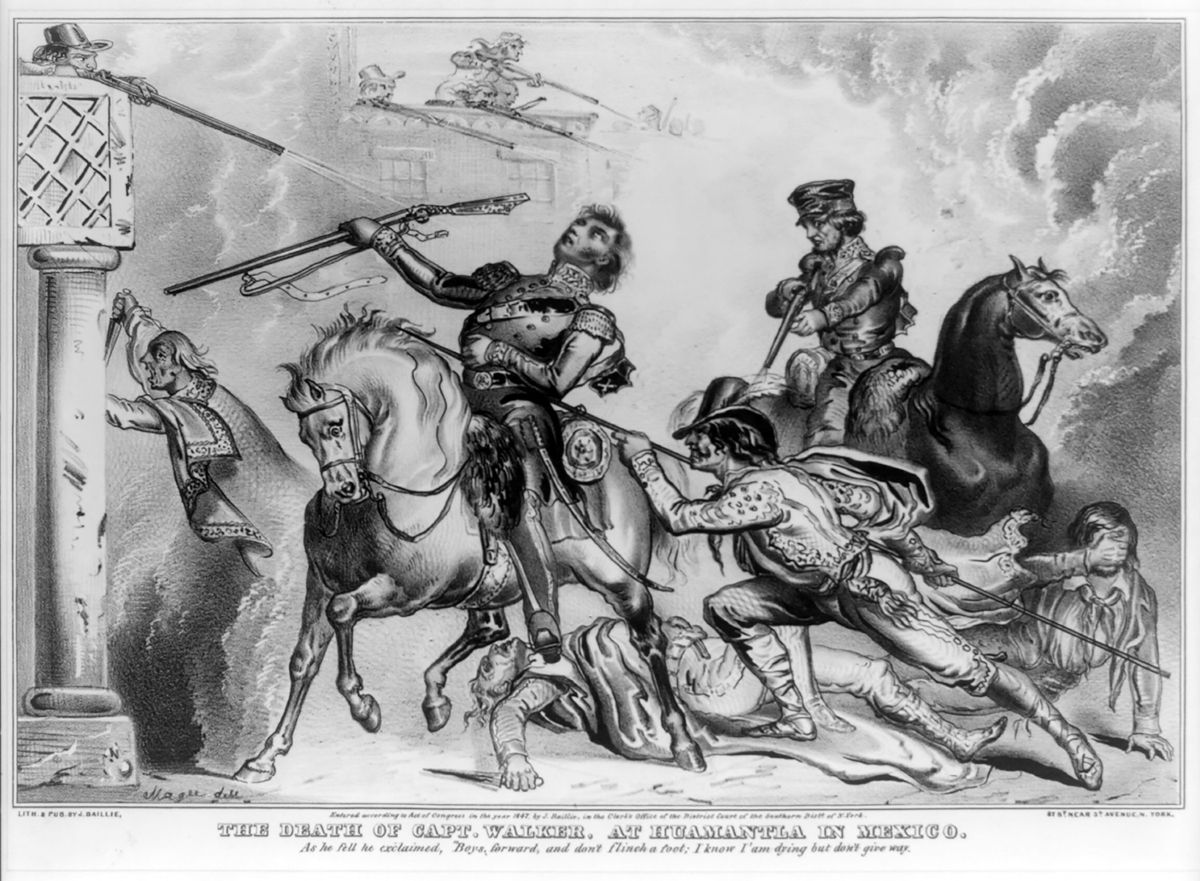
he marched out under Brigadier General Joseph Lane, escorting a supply train toward Mexico City. Informed of a Mexican force at Huamantla, about 100 miles east of the capital, Lane ordered an attack. On October 9, 1847, with Walker’s Mounted Riflemen in the lead, Walker learned from a field hand that the town was lightly held. Without pausing for orders, he ordered his roughly 200 mounted men to charge. They dashed into Huamantla at a gallop and overran a battalion of Mexican lancers and a battery of artillery before the guns could be brought to bear. Lacking fuse or primers, Walker is said to have turned the captured pieces around and fired them by discharging his new Colts into the touchholes. A determined Mexican counterattack followed. While fighting on foot from the concealment of a doorway, Walker was struck by a round fired from an escopeta, the short Mexican carbine, and killed. Schreier argues from the primary evidence that the old legend of Walker being run through by a lance is wrong, ironic as that legend may be for the man who helped father the modern revolver. When Lane’s main column reached the town and learned of Walker’s death, his troops sacked Huamantla in retaliation, an episode Schreier calls one of the worst American atrocities of the war. Walker was thirty years old. He was first interred behind a stone wall at the edge of Huamantla, later moved to Hacienda Tamaris, and returned to Texas in 1848. On April 21, 1856, the twentieth anniversary of San Jacinto, he was reburied with full honors in the Odd Fellows Cemetery in San Antonio, where he rests today. The story of Walker’s own pair of Colts did not end with his death. For most of the twentieth century, collectors, historians, and even Colt himself disagreed on which surviving revolvers were the actual pistols in Walker’s hand at Huamantla. Three guns carried credible claims: commercial Walkers numbered 1009 and 1010, long in the possession of the Walker family in Maryland, and number 1020, once mated to 1019, which had come into Colt’s own collection by way of a letter from a Captain Bedney McDonald of the 3rd U.S. Artillery. McDonald wrote to Colt in 1860, thirteen years after Walker’s death, claiming the pistol he was returning had been Walker’s personal sidearm. Because Colt kept no factory records tying serial numbers to specific recipients on the Walker Model, he accepted McDonald’s claim at face value, and for decades SN 1020 was displayed as the Walker presentation revolver, including in R.L. Wilson’s 1961–62 Wadsworth Atheneum exhibit “Samuel Colt Presents.” Schreier’s research at the National Archives reopened the question. Adjutant General’s Office correspondence shows that two generals and a battery of colonels were tasked at the insistence of the Walker family in Maryland with gathering and returning Walker’s personal effects. More decisively, a letter from Private George Myers of Walker’s company to Walker’s mother states that just before he died Walker gave his revolvers to a young soldier named William Ashbaugh, and that Lieutenant Thomas Claibourne then took them from Ashbaugh and saw them returned east. The Claibourne papers at the University of North Carolina corroborate the account. Schreier also notes that McDonald, who was not present at Huamantla, left the Army shortly after the battle, prospected unsuccessfully in California, and was later convicted of falsifying his military pension records. On the weight of that evidence, Schreier concludes that revolvers SN 1009 and SN 1010, the pair long held by the Walker family, are in fact the true Walker’s Walkers, a judgment already endorsed by the NRA Gun Collectors Committee when it awarded Silver Medal #152 to SN 1010 in 1975 and Silver Medal #294 to SN 1009 in 1990. The daguerreotype is housed in its original leather embossed case lined with embossed velvet. Wear is limited to vertical abrasions and minor areas of spotting. Hinges and clasps remain in fine operating condition. The image of Samuel H. Walker has been published in numerous books and magazines, including The Highly Irregular Irregulars, by Frederick Wilkins; The Art of the Gun: Magnificent Colts, Selections from the Robert M. Lee Collection, by Robert M. Lee and R.L. Wilson; and The Peacemakers, by R.L. Wilson.
Sources
Philip Schreier, “Walker’s Walkers: The Colt Walker Revolvers of Captain Samuel H. Walker, Texas Ranger,” Man at Arms, No. 3, 1998. Additional source material drawn on by Schreier and referenced above includes Parson’s Sam Colt’s Own Record; Serven and Belden, A History of the Colt Revolver; R. L. Wilson, The Arms Collection of Colonel Colt; letters of George Myers and Lieutenant Thomas Claibourne (University of North Carolina); and Adjutant General’s Office correspondence, National Archives. Regimental and biographical details on Walker drawn from the Handbook of Texas Online and the lineage history of the 3rd U.S. Cavalry Regiment. Jack W. Melton Jr. is a publisher, photographer, and military historian specializing in American arms, accouterments, and material culture, with a particular emphasis on the Civil War era. He is the owner of Historical Publications LLC, publisher of Civil War News, Military Antique Collector, and The Rampant Colt magazines. His work centers on historical firearms, edged weapons, artifacts, and the research, photography, and interpretation of significant military collectibles.