
Saratoga in Bronze: A British Cannon Marked by Surrender
By Jack W. Melton Jr. · Originally published July-August 2026 · pp. 57–64
Acaptured British bronze gun in the Smithsonian carries its history on its own surface — an inscribed record of the surrender that brought France into the Revolution.
The inscription is cut cleanly into the bronze in formal block lettering:
SURRENDERED / BY THE / CONVENTION / OF / SARATOGA / OCTR 17 1777. Few Revolutionary War objects state their case so plainly. The barrel does not need a museum label or a printed caption. The metal carries the record itself. The piece is in the collection of the Smithsonian National Museum of American History (catalog AF.32854, accession 69413, record ID nmah_414696). The museum identifies it as a British bronze cannon, made in England in 1775 by Jan Verbruggen, with a barrel measuring 37 inches in length and 7 ⁵⁄₁₆ inches in maximum diameter. What is not in dispute is the maker, the date, the surrender, and the inscription that gave the barrel its second life as a national trophy.
Verbruggen and the Royal Brass Foundry The maker’s name carries weight in artillery circles. Jan Verbruggen, a Dutch master founder, was brought to Woolwich in 1770 with his son Pieter to take over the Royal Brass Foundry. The Verbruggens introduced solid casting and horizontal boring, replacing the older method of casting bronze barrels hollow around a core. Their first guns passed proof in April 1774. By 1775, the foundry was producing high-quality bronze ordnance for the British army, and one of its specialties was the new light 3-pounder gun: a small, mobile bronze field piece with a 37-inch barrel that the troops nicknamed the “grasshopper” for the way it jumped on its carriage when fired. The first twenty grasshoppers were sent to Lieutenant General John Burgoyne’s army for the 1776 and 1777 campaigns in Canada and northern New York. Roughly three-quarters of the Verbruggen light threes produced between 1775 and 1782 went
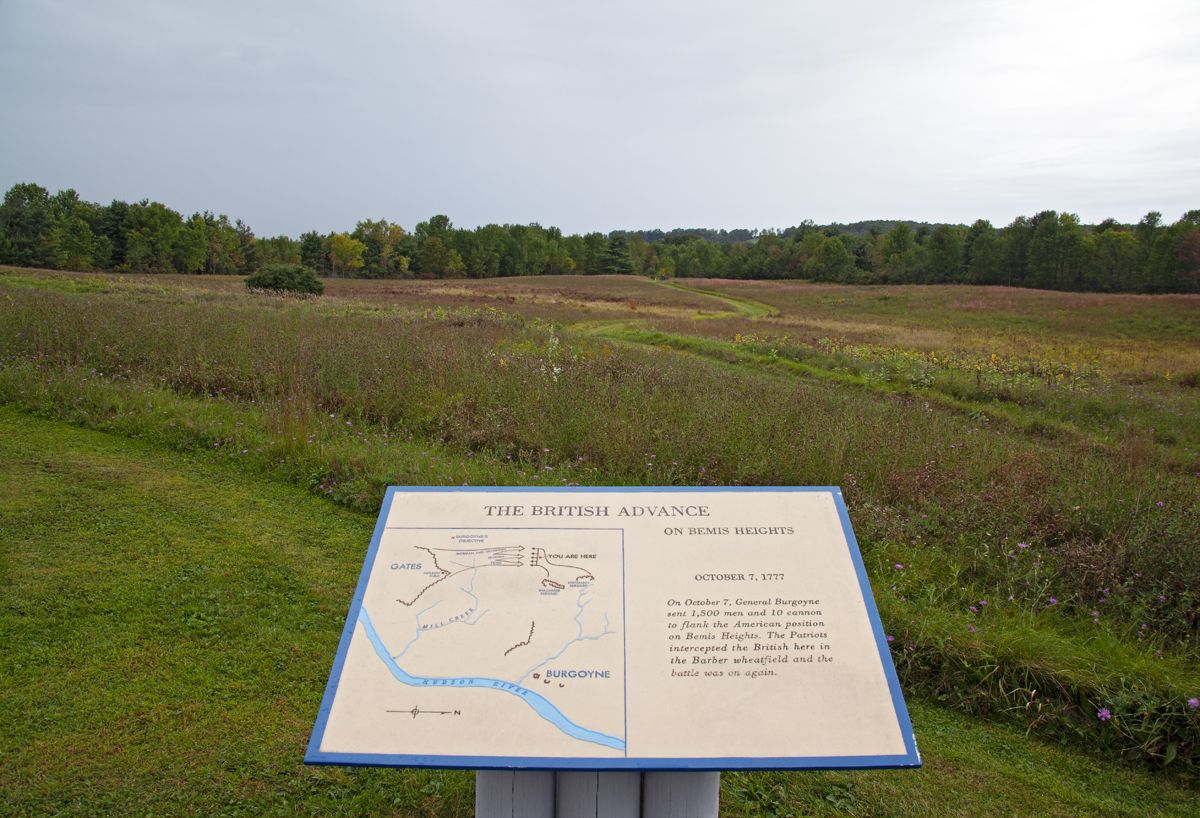
Saratoga Battlefield showing the location of the British Advance on Bemis Heights, October 7, 1777. (Jack W. Melton Jr.)
to British forces in North America, and many of them ended up as captured American trophies after Saratoga, Cowpens, and Yorktown. The Smithsonian piece sits squarely inside that production story. A bronze field gun was an expensive piece of ordnance in 1775. Bronze barrels resisted bursting better than iron, took finer casting detail, and held value as both weapon and trophy. Iron was the workhorse of fortress and naval ordnance; bronze was the metal of mobile, prestige field artillery. Capturing a bronze gun was therefore not just a tactical gain. It was the seizure of visible imperial investment, and it could not be quietly replaced.
The Northern Campaign of 1777 The cannon’s path to Saratoga ran through one of the most ambitious British strategic plans of the war. In the summer of 1777, Burgoyne pushed south from
Canada along the Lake Champlain–Lake George– Hudson River corridor, intending to drive a wedge between New England and the rest of the colonies. The plan depended on cooperation from British forces in the south. That cooperation never came. Sir William Howe was committed to a campaign against Philadelphia, and Sir Henry Clinton’s relief column from New York started too late and stopped too far short, turning back after burning Kingston in mid-October. Burgoyne’s column slowed under the weight of its own equipment and supply train as it pushed through forest roads, wet ground, and stiffening American resistance. Two engagements decided the campaign. At Freeman’s Farm on September 19, 1777, Burgoyne held the field tactically but at a cost his army could not afford. At Bemis Heights on October 7, American troops under Major General Horatio Gates broke key British positions, including the Breymann Redoubt. Benedict Arnold, leading from the front and still well before his later treason, was wounded in the leg in that final assault. Burgoyne pulled back to the heights above the village
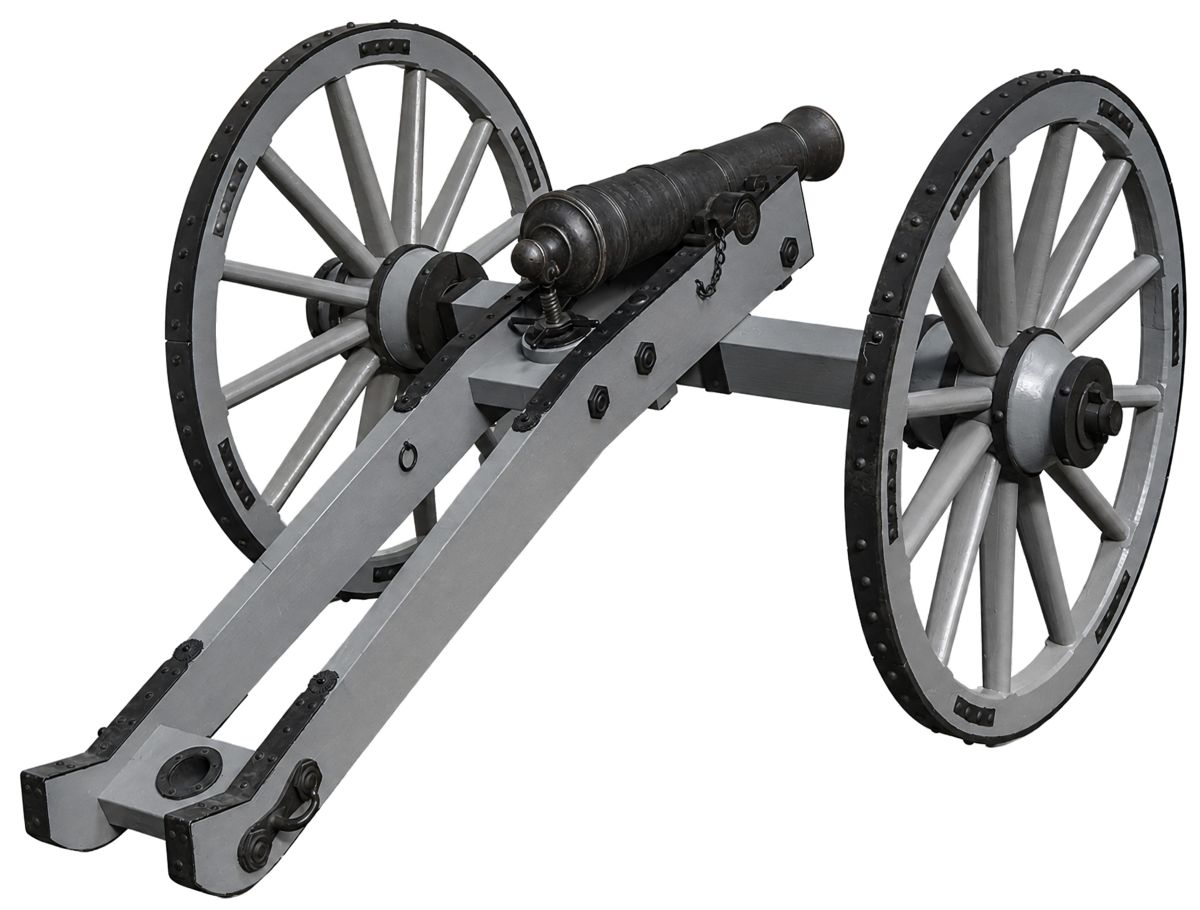
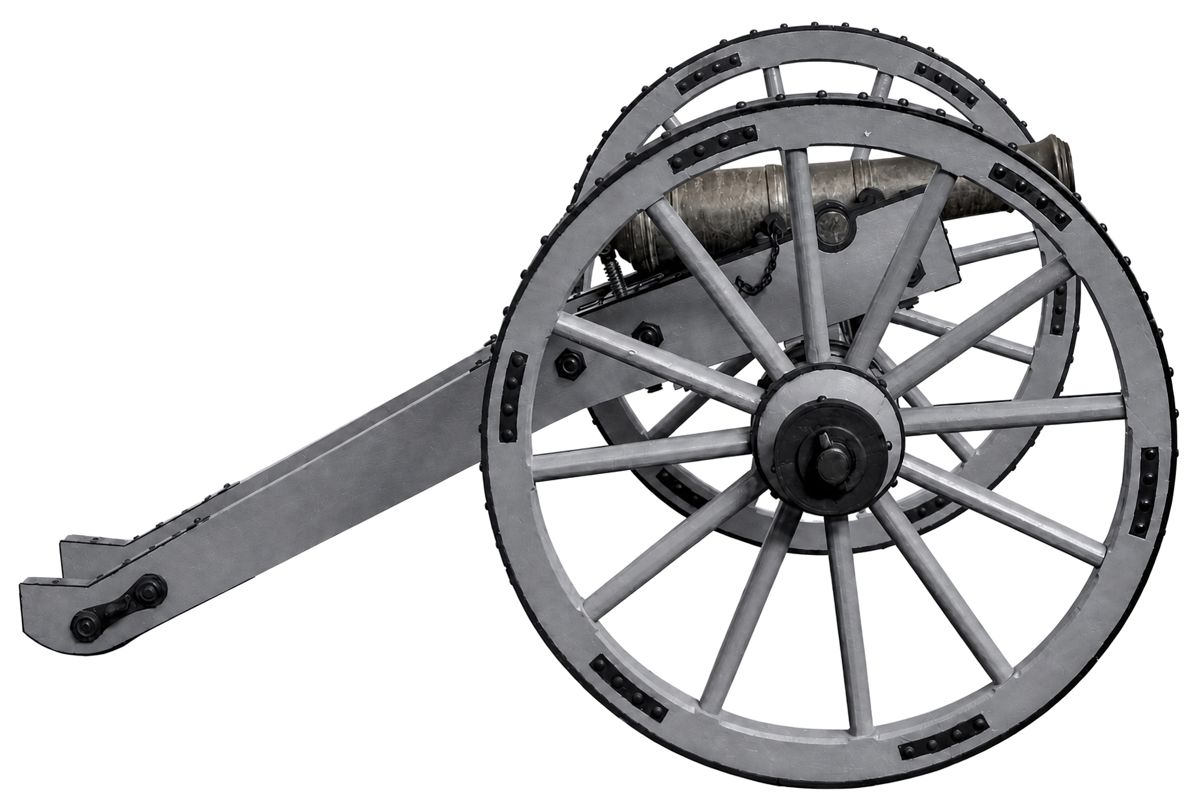
Three-quarter view showing the barrel, trunnions, wheels, axle, and carriage geometry. (All cannon photographs courtesy of the Smithsonian National Museum of American History)
of Saratoga—modern Schuylerville. Rain, hunger, casualties, desertion, and growing American numbers closed the encirclement. By the night of October 13, Burgoyne’s officers had agreed to negotiate. The Articles of Convention were signed on October 16, 1777. The formal surrender ceremony took place the following morning, October 17, with the troops marching out of their entrenchments that afternoon to ground their arms at the river.
The Convention and the Word on the Barrel The inscription is precise in its language. It does not say captured or taken. It says Surrendered by the Convention. That choice of word does real historical work. Burgoyne did not surrender unconditionally. The Articles of Convention allowed his army to march out with the honors of war. Article I directed the troops to march “to the verge of the river where the
Front view of the cannon on its carriage.
Above right: Detail of the Saratoga surrender inscription on the British bronze cannon:
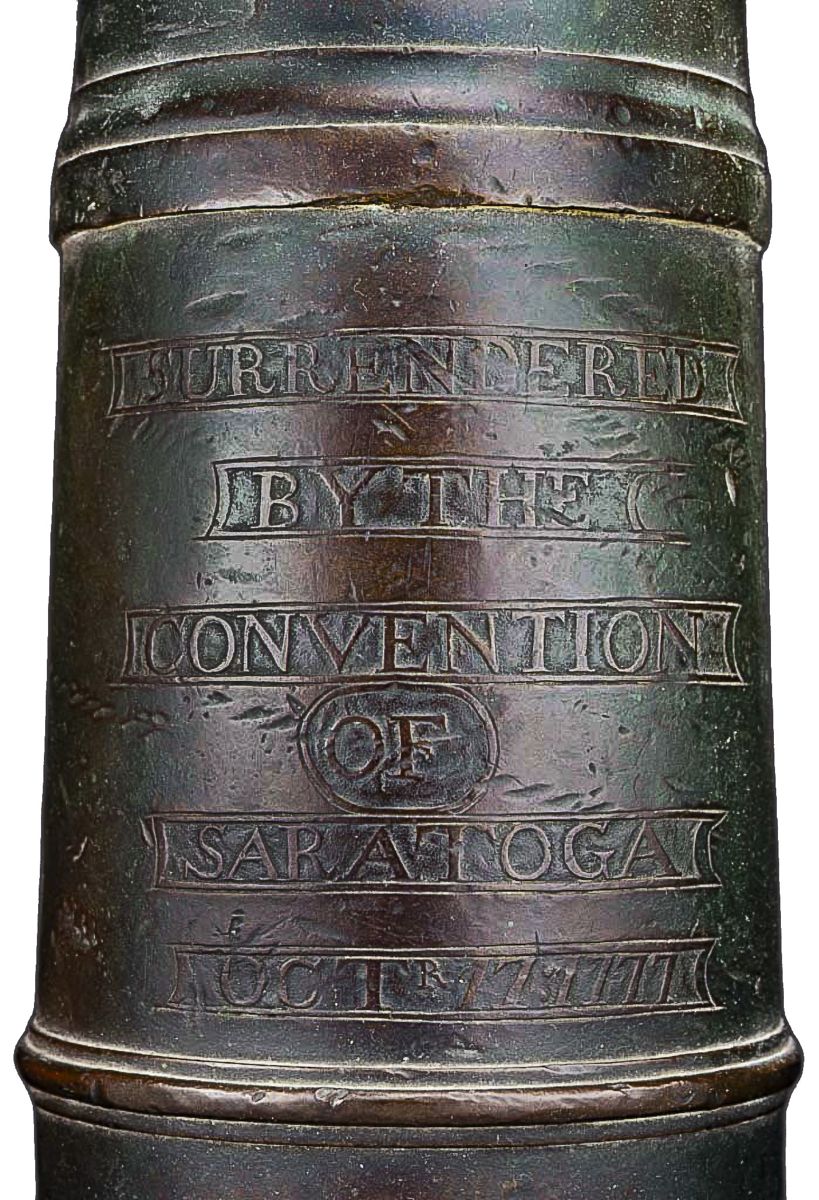
“SURRENDERED / BY THE / CONVENTION / OF / SARATOGA / OCTR 17 1777.”
old fort stood”—the bank of the Hudson at Old Saratoga, where Fort Hardy had once stood — and there pile their arms by word of their own officers. The face-saving distinction mattered to eighteenth-century military etiquette. Article II provided that the army would be transported home from Boston on the condition that the men not serve again in North America for the duration of the war. Burgoyne handed his sword to Gates, and Gates returned it. The terms did not survive long. The Continental Congress refused to ratify the Convention, citing British failure to provide officer rolls and broader concerns about whether Britain would honor the agreement. Burgoyne’s roughly 5,900 British, German, and provincial soldiers—known almost immediately as the Convention Army—were marched first to Cambridge, Massachusetts, and later to Charlottesville, Virginia. Most remained on American soil until the war ended in 1783. None of that political and diplomatic tangle changed what had happened at the river on October 17. The arms and the artillery were left behind.
Reading the Object The barrel itself rewards close examination. Period bronze guns carry foundry marks, weight stamps, gunner’s measurements, royal cyphers, and decorative moldings around the breech, reinforce, chase, and muzzle. Wear patterns at the vent indicate firing service. Tooling marks on the bore can reveal the boring and finishing work of the foundry. The trophy inscription itself—its layout, depth, and lettering style—is a separate later layer of intervention, not part of the original casting. A trained eye can usually distinguish original Woolwich foundry work from engraving added years after.
reconstructed, or display-grade carriages. Wood does not survive two and a half centuries of service, storage, and exhibition without replacement. Unless documentation proves original association, the safe assumption is that the bronze tube is the primary artifact and the carriage is interpretive support.
Trophy and Memory Captured artillery has carried a particular kind of weight in American military memory from the very start, and Saratoga’s trophy guns belong to the earliest layer of that tradition. Other Saratoga cannon survive at West Point, the Albany Institute, and Saratoga National Historical Park, several of them engraved with surrender inscriptions added in the years after the battle. The Albany Institute notes that one of its trophy guns received its surrender inscription at West Point some years after the surrender itself. That suggests the Smithsonian barrel may have been part of the same broader trophy program rather than engraved at the riverbank in 1777. Whether the inscription was cut at the river, at Albany, at West Point, or somewhere else later is a question for ordnance research, but the inscription itself is the surviving testimony.
The carriage on which the barrel rests should be evaluated separately. Many surviving eighteenth-century cannon sit on later,
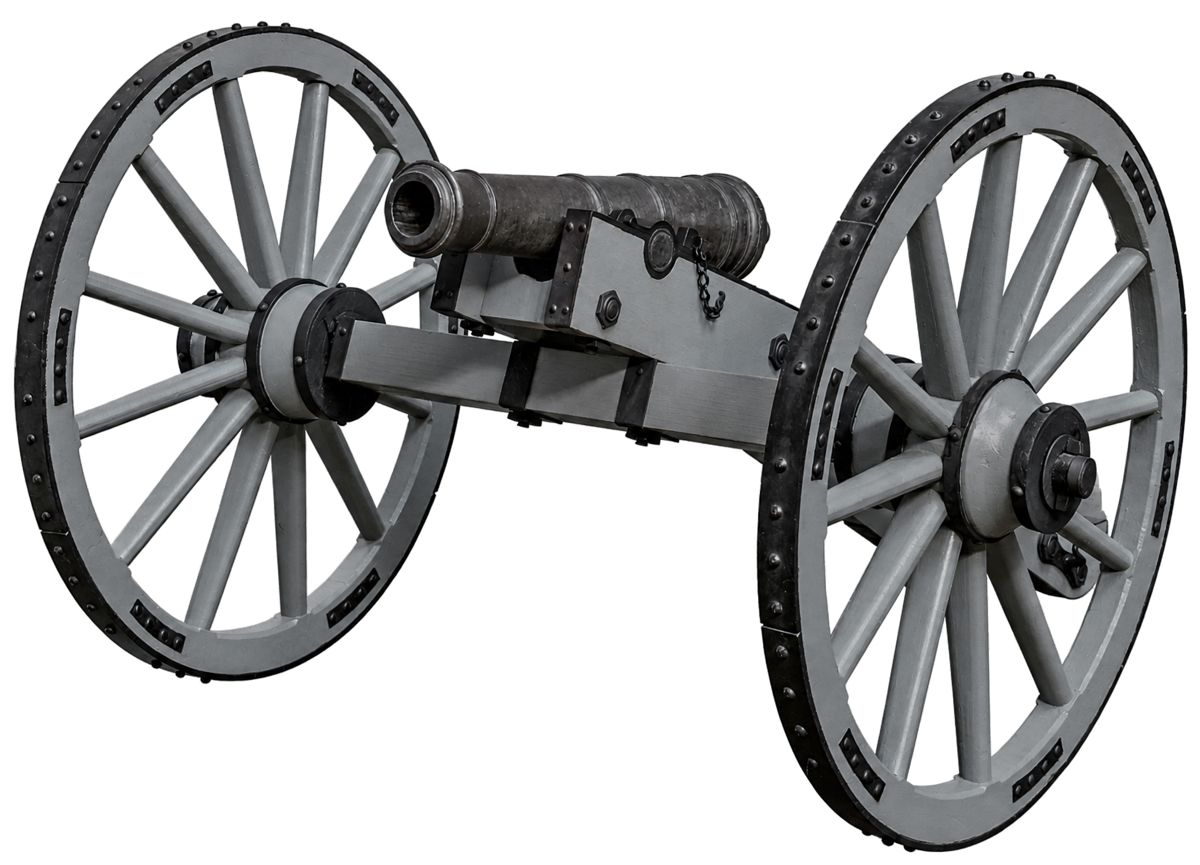
Side view of the Saratoga cannon.
The political consequence of the surrender ran far beyond the Hudson. Word of Burgoyne’s defeat reached Paris in early December 1777. By February 6, 1778, France had signed the Treaty of Amity and Commerce and the Treaty of Alliance with the United States. French money, supplies, naval power, and ultimately troops shifted the balance of the war. The Smithsonian barrel is a material remnant of the victory that made that alliance possible.
For the Collector and Reader For Military Antique Collector readers, the Saratoga cannon is a useful reminder that artillery deserves the same close study collectors already give to firearms, edged weapons, and accoutrements. Cannon are too often treated as decorative props in town squares and courthouse lawns. In their own time they were among the most expensive, most carefully accounted, and most strategically valuable items in any army. Their capture mattered. Their inscription, when present, fixes them in a documented event. The Smithsonian record is restrained, and any responsible description should match that restraint. The piece is a British bronze smoothbore cannon, made in 1775 at Woolwich during Verbruggen’s tenure as Master Founder, associated with the Convention of Saratoga of October 17, 1777, and preserved with a surrender inscription. Beyond that, the exact pounder classification, the specific service history before capture, and the post-surrender custodial chain are subjects for further research rather than confident statement. What the artifact does support, on its own surface, is the link between a foundry on the Thames, an army in northern New York, and a treaty signed in Paris. A bronze barrel three feet long is enough to carry that connection.
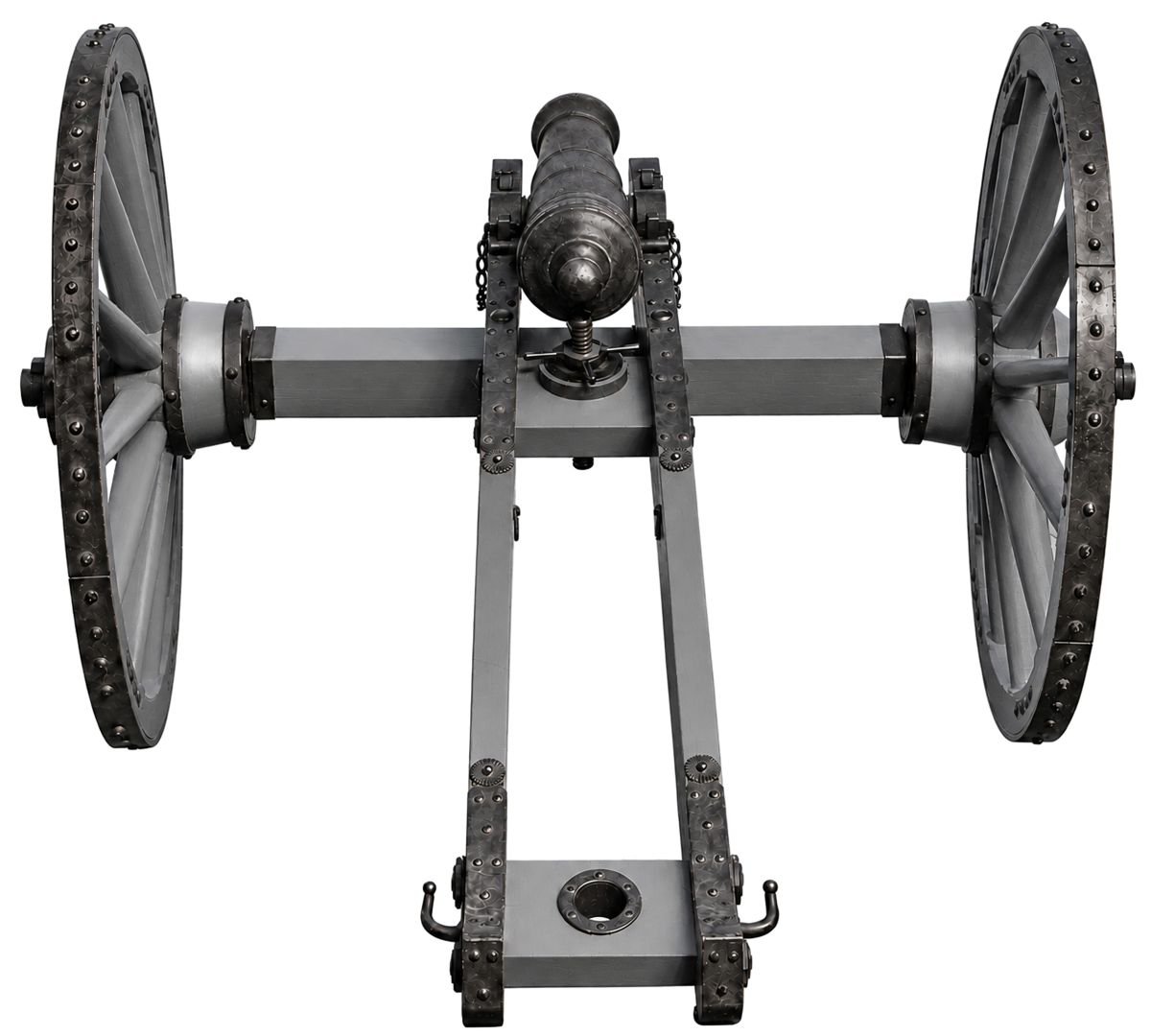
Rear view of the cannon and carriage.
Sources
•
Primary object records and source pages used for this article:
•
• •
•
•
Smithsonian National Museum of American History, British Cannon, object nmah_414696: https://americanhistory.si.edu/collections/object/nmah_414696
National Park Service, Surrender Cannon Becomes a Permanent Part of Park’s Collection: https://www.nps.gov/sara/learn/news/surrender-cannon-becomes-a-permanent-part-of-park-s-collection.htm
National Park Service, A History of the Verbruggen 3-lb Gun and Its Use in North America 1775–1783: https://www.nps.gov/articles/000/a-history-of-the-verbruggen-3-lb-gun-and-its-use-in-north-american-1775-1783.htm
American Battlefield Trust, Articles of Convention between Burgoyne and Gates: https://www.battlefields.org/learn/primary-sources/surrender-burgoynes-army-gates-saratoga
Chickamauga with Quinton Kick, at Chickamauga NMP (Free to BGES members) August 1, 2026 The Philadelphia 1777 Campaign Part II: An Active and Bloody Fall with Mike Harris & Gary Ecelbarger, from Philadelphia, PA August 12–16, 2026 1862 Maryland Campaign: South Mountain, Antietam & More with Kevin Pawlak, from Martinsburg, VA August 19–23, 2026
•
Yale Avalon Project, Articles of Convention Between Lieutenant-General Burgoyne and Major General Gates, October 16, 1777: https://avalon.law.yale.edu/18th_century/burgoyne_gates.asp George Washington’s Mount Vernon, Battle of Saratoga: https://www.mountvernon.org/library/digitalhistory/digital-encyclopedia/article/battle-of-saratoga Library of Congress, American Revolution and Founding Washington: https://www.loc.gov/free-to-use/american-revolution/
Jack W. Melton Jr. is a publisher, photographer, and military historian specializing in American arms, accouterments, and material culture, with a particular emphasis on the Civil War era. He is the owner of Historical Publications LLC, publisher of Civil War News, Military Antique Collector, and The Rampant Colt magazines. His work centers on historical firearms, edged weapons, artifacts, and the research, photography, and interpretation of significant military collectibles.
Hood’s 1864 Tennessee Campaign, Part II: Battle of Nashville, Lyon’s Raid, & Retreat from Nashville with Hal Litchford, from Franklin-Nashville, TN August 26–30, 2026
Revolutionary Williamsburg & Yorktown with Bert Dunkerly, from Williamsburg, VA October 17, 2026
From Fort Lee to Trenton and Princeton, 1776–1777 with Gary Ecelbarger & Bill Welsch September 23–27, 2026
The Vicksburg Campaign with Tim Smith, from Vicksburg, MS November 11–14, 2026
George Washington’s Final Battle-Monmouth Cradle of the Revolution: Boston Courthouse and The Jersey Campaign, June 1778 with Gary Ecelbarger & Scott Patchan, from to Lexington & Concord with Mark Malloy & Rob Orrison, from Boston, MA Princeton, NJ November 5-8, 2026 September 9–13, 2026
Fall 1862 Kentucky Campaign: Richmond, Lexington, Munfordville, and Perryville with Lee White, from Richmond, VA September 30–October 4, 2026