
The Drum That Beat the Lexington Alarm
By Richard H. Holloway · Originally published July-August 2026 · pp. 41–45
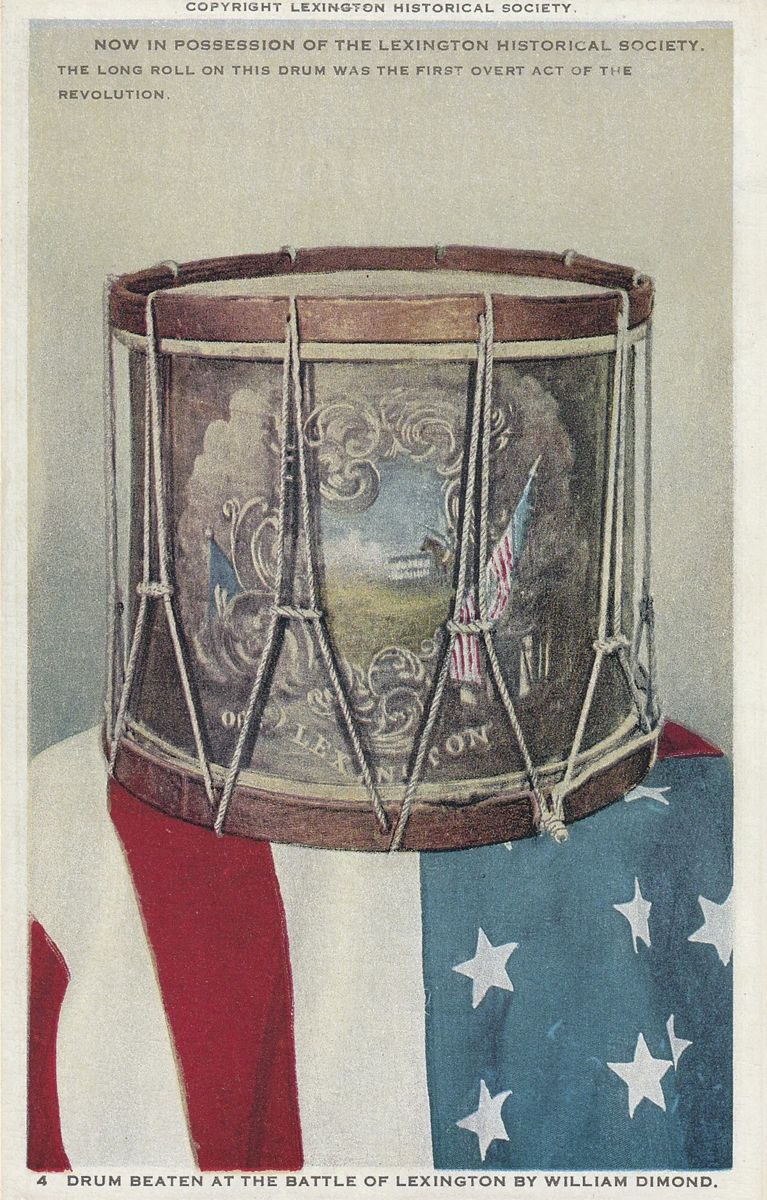
William Diamond was nineteen years old, trained in military drumming, and not the childlike “drummer boy” of popular memory. His rope-tension drum survived April 19, 1775, and survives still, though the painted decoration seen today belongs to the centennial era rather than the morning of the battle.
Shortly before dawn on April 19, 1775, William Diamond, a nineteen-year-old wheelwright’s apprentice, stood near Lexington Battle Green (or Lexington Common) with a rope-tension drum slung at his side and waited for an order. Captain John Parker, already suffering from the consumption that would kill him before the year was out, had received word that the British column was close. Parker called for Diamond to beat the alarm. The roll that sounded from that drum summoned the Lexington militia back to the Common and became one of the defining sounds of the American Revolution.
painted scheme is what visitors see today. That distinction matters for collectors. It is the same problem that runs through American military material culture from cartridge boxes to swords: surviving objects often pass through patriotic moments that leave their own marks. Centennial repaints, retouched inscriptions, replaced straps, and Victorian display modifications can all become part of an artifact’s history. None of that disqualifies the object. It does mean an honest description has to separate what is 1775 from what is 1875. The drum spent years after the war at the
The drum survives. So did Diamond. He continued in military service after Lexington, served in the Boston lines, was connected with the Trenton campaign in December 1776, served in Rhode Island in 1777 under Colonel Josiah Whitney, and appeared again on Continental rolls in 1780 and 1781. After the war, he returned to civilian life, worked as a wheelwright and farmer, married Rebecca Simonds in 1783, raised six children, and eventually moved north to Peterborough, New Hampshire. He died there on July 29, 1828, at the age of 73, and was buried in the town’s old cemetery on Old Street Road. The drum he beat at Lexington is in the collection of the Lexington Historical Society and is displayed at Buckman Tavern. Surviving militia drums from April 1775 are about as rare as American military objects get. Surviving militia drums attached by name and documented service to a specific drummer, a specific company, and a specific morning are rarer still. For a 250th-anniversary story, Diamond’s drum is the kind of artifact that justifies close attention.
The Object as It Survives Anyone who studies Diamond’s drum has to begin with an awkward but important fact: the drum on display today does not look exactly as it looked on April 19, 1775. Published accounts from the Lexington Historical Society and Freedom’s Way National Heritage Area state that the original instrument was plain brown and unvarnished, a working militia drum rather than a parade piece. After the Commonwealth of Massachusetts acquired it in the nineteenth century, the drum was decorated for the 1875 Centennial Celebration of the battle. That
William Diamond’s drum, the rope-tension snare drum beaten on Lexington Common at the order of Captain John Parker on the morning of April 19, 1775. The drum was originally plain brown and unvarnished; the painted decoration visible today was applied for the 1875 Centennial of the battle. The drum is held by the Lexington Historical Society and displayed at Buckman Tavern. Photograph circa 1898 to 1931. (Courtesy of the New York Public Library, Miriam and Ira D. Wallach Division of Art, Prints and Photographs, public domain.)
Massachusetts State House in Boston. In the early twentieth century, Lexington State Representative Edward C. Stone petitioned for its return to the town where it had been used. The request was approved, and on April 19, 1903, the 128th anniversary of the battle, the drum was formally turned over to the Lexington Historical Society in a public ceremony. It remains under the Society’s care and is now on view at Buckman Tavern.
William Diamond, Not a Child Drummer
Parker’s illness also matters. He was suffering from consumption in April 1775 and died in September. The drum was not a ceremonial flourish on Lexington Common. It was military communication. In darkness, confusion, smoke of battle, and open ground, a drum carried an order farther and more reliably than a shouted command.
How a Rope-Tension Drum Was Made
Popular accounts often call Diamond a drummer boy. The term is familiar, but it is misleading if it suggests a small child with sticks. Diamond was born in Boston on July 21, 1755. By the morning of the battle, he was nineteen years old and only a few months short of twenty. He had moved to Lexington as a youth and was apprenticed in the wheelwright’s trade. Local accounts also state that he learned military drumming from a British soldier, which helps explain why Parker relied on him when the company had to be assembled quickly.
The rope-tension snare drum Diamond carried belonged to the standard family of eighteenth-century infantry signaling instruments used by British, French, German, and later by American forces. It was not a toy, and it was not light. A working military side drum of the period had a wooden shell, top and bottom counter hoops, animal skin heads, hemp or other natural-fiber cordage, leather braces or ears for tensioning, and gut snares stretched against the lower head.
Once the Boston Tea Party happened, Captain Parker had a finite amount of time to train his Minute Men. For Diamond, that meant not only learning the drum calls away from the troops and later training with the troops so they could learn and to respond to each drum calls. Additionally, Parker had to learn what to command Diamond to do. Then to drill with the militia until they were familiar enough to properly deploy as directed from the beats. It was best to shorten the normal drum signals into those most needed. Assemble (into two ranks), advance, load/fire, rally, and withdraw.
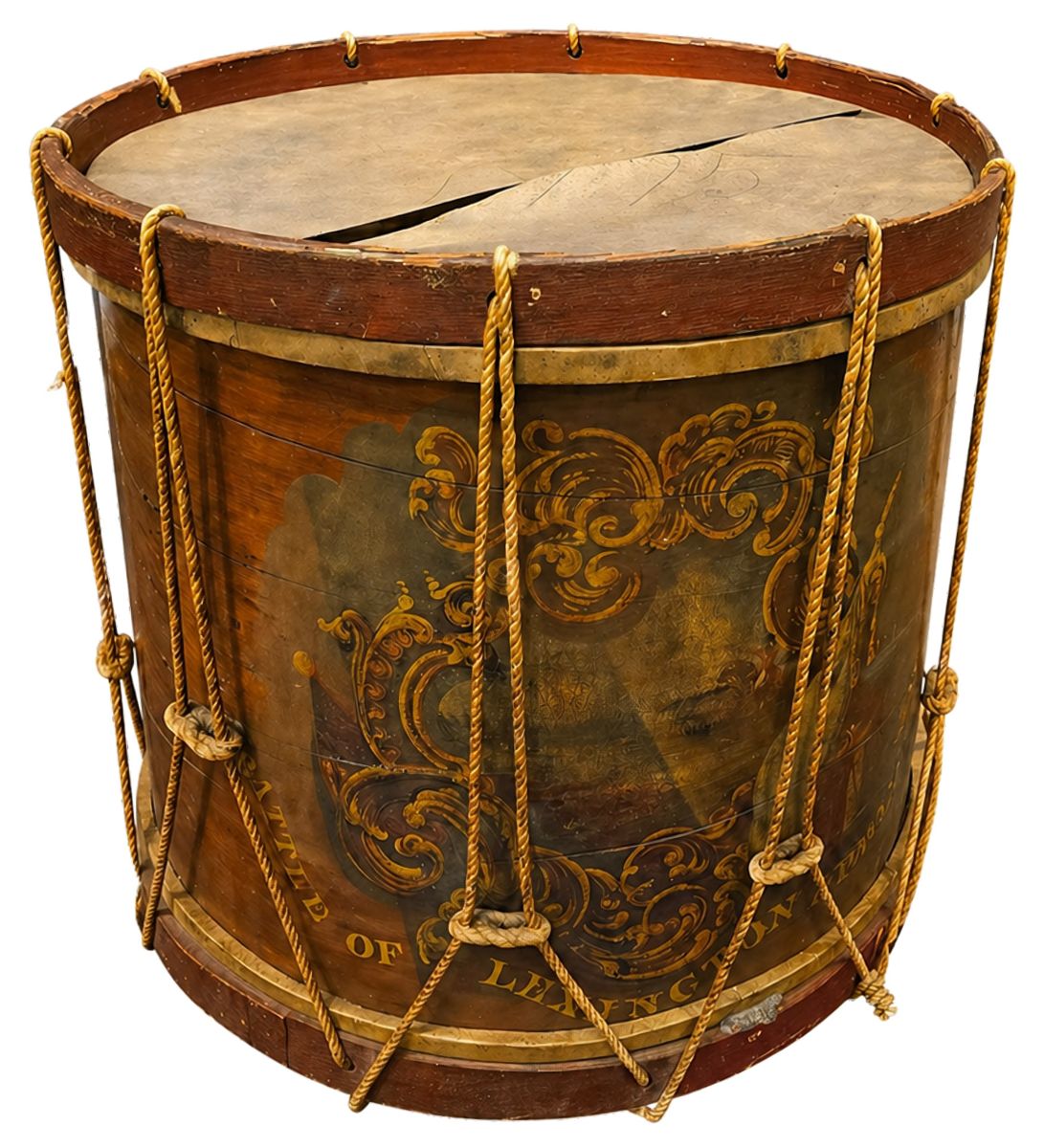
The rope system was the key. A continuous cord passed between the upper and lower hoops. Leather braces, sometimes called ears, were drawn down along the rope to increase tension on the heads and raise the pitch. Across the lower head, gut snares vibrated when the batter head was struck, creating the sharp buzz that allowed the side drum to cut through voices, marching feet, and musketry. A leather sling carried the drum at the player’s side so the head sat at an angle suitable for traditional grip.
Material varied by That training maker and national mattered. practice. Period Eighteenth-century references cited by military drumming drum historians note was not improvised. ash, rock maple, and A drummer in a oak among the woods militia company used or recomor subsequent mended for drum Continental regiment shells. Red-painted was expected to counter hoops were Last Survivor of the Battle of Lexington.— know a practical The venerable Jonathan Harrington, of Lexington, the last survivor of the common on English vocabulary of memorable conflict of April 9th, 1775, died recently, in the 96th year of his and American milicalls, each with a age. Though but 17 years of age, he was connected with the Provincial tary drums. A vent specific purpose: militia, and at the battle of Lexington played the fife for one of the companies hole in the shell the General, the in that engagement. (The Liberator (Boston, Massachusetts), Friday, April 7, allowed air moveAssembly, the Troop, 1854, page 3.) ment as the heads the Retreat, the vibrated. The drum’s Tattoo, and the urgent alarm or long roll that called diameter and depth were often close, commonly men immediately to arms. A drummer who could in the neighborhood of 15 to 17 inches, giving the not deliver the proper beat clearly was as useless in instrument the deep, carrying voice associated with the field as a musket without a flint. eighteenth-century field music.
Every element was a compromise between volume, tone, weight, and durability. A drum had to survive damp weather, summer humidity, freezing rain, river crossings, and the hard handling of men on campaign. Ropes stretched, skins slackened or tore, and snares broke. A drummer cared for his instrument much as a gunner cared for a piece of artillery or an infantryman cared for his musket. On surviving period drums, collectors look for wear around rope holes, rubbing along hoops, evidence of replaced cordage and ears, skin-head repairs, and stress or crazing in the wood shell.
Lexington Common, Before Sunrise The sequence of events on the morning of April 19, 1775, is one of the most closely studied hours in American military history, though details still vary by source. General Thomas Gage’s expedition, numbering roughly 700 to 750 regulars under Lieutenant Colonel Francis Smith, had crossed from Boston the previous evening with orders to seize or destroy military stores believed to be at Concord. Paul Revere and William Dawes carried the alarm toward Lexington, while other riders helped spread the warning through the countryside.
upon, but if they mean to have a war, let it begin here,” belongs to later tradition and should be treated as attributed rather than as a verbatim field order. Parker’s own deposition stated that he ordered his company to disperse and not to fire. That distinction is important. Lexington was not an ordered militia volley against the British column. It was a confused encounter in which a shot of uncertain origin triggered uncontrolled British fire. Eight Americans were killed on or near Lexington Common: John Brown, Samuel Hadley, Caleb Harrington, Jonathan Harrington Jr., Robert Munroe, Isaac Muzzey, Jonas Parker, and Asahel Porter. Ten more Americans were wounded, and one British soldier was wounded. The action lasted only a few minutes. The regulars re-formed, cheered, and continued toward Concord, where the day would take a different turn at the North Bridge. Later that day, Parker rallied some of his surviving men and struck the returning British column along the road back to Boston in the action now
By midnight, the alarm had reached Lexington. Parker initially mustered his militia on the Common, then dismissed the men when the British did not immediately appear, ordering them to remain close enough to assemble again at the drum. Some men went home. Others waited at Buckman Tavern across from the Common. Shortly before sunrise, the final warning reached Parker: the regulars were nearby. Parker called for Diamond. The drum brought the militia back from the tavern and surrounding houses. Most modern estimates place the Lexington company on the Common at roughly 70 to 80 men, with some recent work suggesting about 81. They formed in ranks near, but not blocking, the road to Concord. Major John Pitcairn’s advance force, made up of British light infantry, came onto the Common and confronted them. The famous line attributed to Parker, “Stand your ground. Don’t fire unless fired remembered as Parker’s Revenge. That second engagement has received renewed attention through historical and archaeological work by Minute Man National Historical Park and its partners.
be evaluated: construction, materials, hardware, decoration, wear, and provenance, in that order.
What to Look For in a Militia Drum
The shell is the place to start. Many period shells were bent hardwood, with a lapped and tacked or nailed seam and internal stay hoops to help maintain shape and strength. Later drums and modern reproductions may show different construction, including plywood or machine-uniform plies visible at the rim. The bearing edges where the heads sit should show wear consistent with natural skin heads, not modern plastic. Counter hoops should be examined for ropehole wear, paint history, and age-consistent abrasion.
Surviving Revolutionary-period American drums are uncommon, and many drums that appear in private collections or at auction are later militia instruments from the 1780s, 1790s, or nineteenth century. A wartime drum should be evaluated as any other piece of period military equipment would
Rope, leather, and snares were consumables, so original cordage should never be assumed. What can survive is evidence of the original system: the angle and spacing of the rope holes, wear from the braces against the rope, and the placement of the snare gates, anchors, or strainers. Decoration is
Diamond survived the morning, and his drum came off the field with him. He continued in military service through multiple enlistments and eventually returned to an obscure civilian life. In that respect, his story is not unusual. The survival of his drum is.
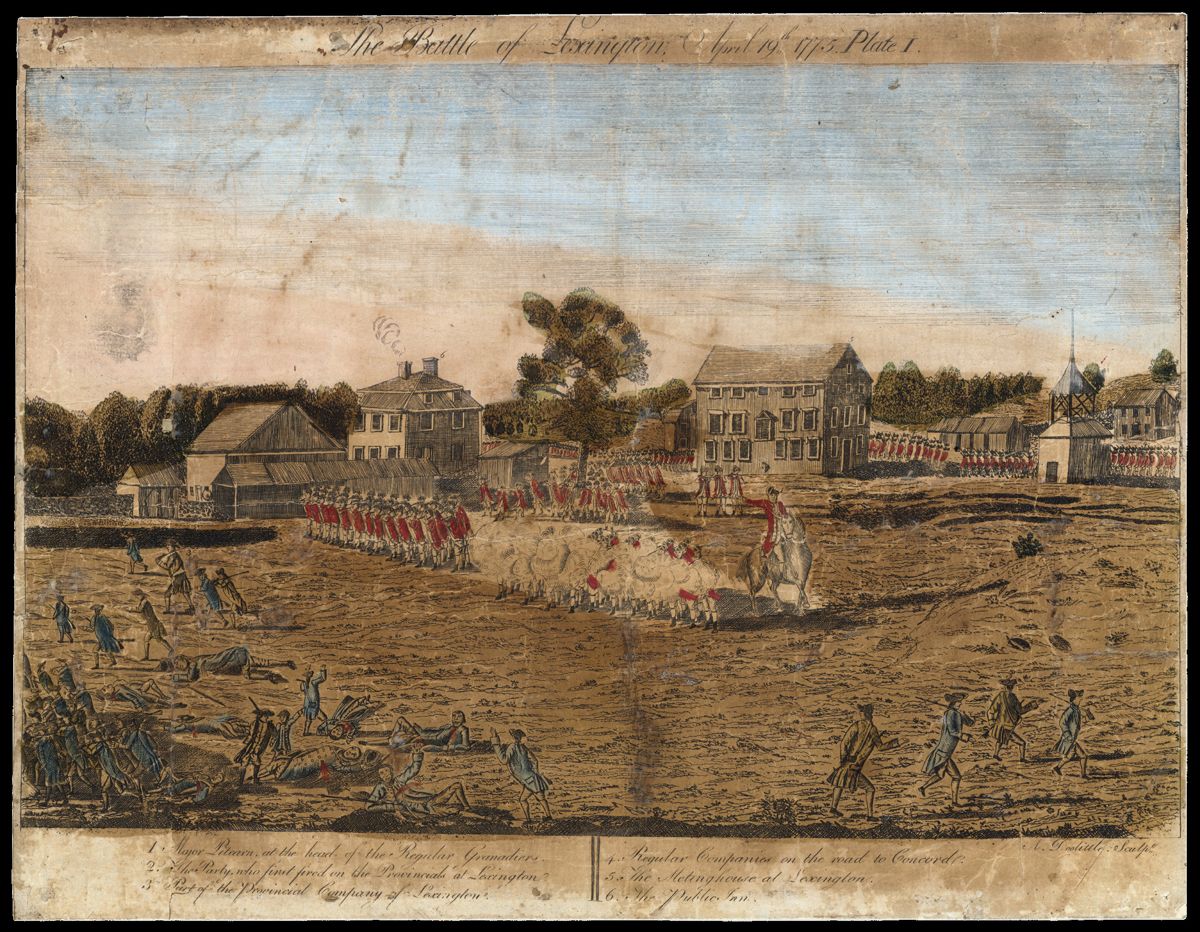
Plate I, “The Battle of Lexington, April 19th. 1775,” engraved by Amos Doolittle of New Haven, Connecticut, after drawings made on the ground by Ralph Earl. Doolittle and Earl visited Lexington and Concord in early May 1775 and interviewed eyewitnesses. The numbered key identifies Major John Pitcairn at the head of the British grenadiers, the party who first fired on the provincials, the Lexington company, and the British column on the road to Concord. (Courtesy of the New York Public Library)
where caution matters most. Eagles, stars, regimental numbers, battle dates, and patriotic inscriptions can be original, later, commemorative, or invented. Diamond’s drum, now wearing 1875 decoration over an earlier instrument, is the most public reminder of that problem. Provenance is the closing argument. A drum with a name carved into the shell, a unit attribution painted on the hoop, and a battle date applied somewhere visible still needs documentary support before those marks can carry value. Family records, pension files, town histories, institutional accession records, and period inventories are the kinds of corroboration collectors should ask for. Diamond’s drum has the advantage of continuous public custody and a long paper trail, which is why it sits where it sits.
•
• • • • •
What the Long Roll Still Means The 250th anniversary of Lexington and Concord has brought renewed attention to the small physical objects that survived April 19, 1775. Most of what the men carried that morning is gone. The muskets are mostly lost or unidentifiable. Clothing, shoes, cartridge boxes, and other ordinary equipment wore out and disappeared. What survived in unusual quantity was documentation: depositions gathered by Massachusetts authorities, local records, family histories, and the contemporary visual record created by Amos Doolittle after drawings and eyewitness information gathered with Ralph Earl. Diamond’s drum is one of the few three-dimensional objects from that morning still capable of explaining how the event functioned militarily. It is small, older than the United States, and visually complicated by its centennial paint. Yet the point remains clear. A militia company was not moved by sentiment alone. It moved by orders, and in 1775 those orders were often carried by drumbeat. Diamond’s drum gave Parker a practical voice on Lexington Battle Green. Two hundred and fifty years later, that voice is still recoverable. The drum that carried it is still in Lexington, under institutional care, not far from the ground where it first sounded.
Source Notes Primary object records, biographical sources, and contemporary visual documentation used for this article: •
Lexington Historical Society and Freedom’s Way National Heritage Area, “William Diamond’s Drum”: https://freedomsway.org/staging/6553/things/
•
•
william-diamonds-drum/ Lexington Minute Men, “William Diamond, Drummer, Captain Parker’s Lexington Company”: https://lexingtonminutemen.com/wp-content/uploads/2025/06/William-Diamond.pdf Lexington History Museums, FAQ on the Battle of Lexington: https://www.lexingtonhistory.org/faq Lexington History Museums, “Celebrations” exhibition, William Diamond’s Drum: https://www.lexingtonhistory.org/exhibitions/celebrations-cvs American Battlefield Trust, “Buckman Tavern”: https://www.battlefields.org/learn/articles/buckman-tavern Minute Man National Historical Park, National Park Service, “Parker’s Revenge”: https://www.nps.gov/places/parker-s-revenge.htm Connecticut History / CTHumanities, “News From Lexington: Contemporary Views of the Opening Battles of the American Revolution”: https://connecticuthistory.org/news-from-lexington-contemporary-views-of-the-opening-battles-of-the-american-revolution/ Historic Drumming, “Drum Construction”: https://www.historicdrumming.com/history-of-the-snare-drum/rope-tension-drum/drum-construction/ Wikimedia Commons, Objects associated with the American Revolution, including NYPL images of Diamond’s drum: https://commons.wikimedia.org/wiki/Category:Objects_associated_with_the_American_Revolution
Editorial Notes Age corrected and retained. Several modern public-facing sources call Diamond “16,” but the July 21, 1755 birth date, gravestone/pension evidence, and 1781 age listing support that he was 19 on April 19, 1775, not 16. The drums used by the Lexington militia were, in fact, locally sourced. On November 7, 1774, the town voted to purchase two drums for the militia. This could mean there was possibly another drummer in the assemblage. The only other known musician on the field with the militia that day was Jonathan Harrington, age 16, whose mother woke him up that morning to meet on the green that April morning.
Richard H. Holloway, a Louisiana native, formerly a Senior Editor for America’s Civil War and Civil War Times magazines. In addition to numerous articles, he wrote biographies of Richard Taylor, Hamilton Bee, and William R. Boggs for Confederate Generals of the Trans-Mississippi (Univ. of Tennessee Press). Holloway is a member of the Western Theater Historians Association. He was previously an archivist for the Louisiana State Archives and a curator for the Louisiana National Guard. Holloway can be contacted by email at noblepelican@gmail.com.