
General Meade’s Presentation Sword
By Adam Fleischer · Originally published March-April 2026 · pp. 22–32
General Meade’s Presentation Sword By Adam Fleischer
General George Meade, circa 1861, holding the exact sword presented to him by the “Citizens of Philadelphia.” (Image Courtesy Gilder Lehrman Institute)
Abstract This article examines the early military career of George Gordon Meade and the ceremonial sword presented to him by the citizens of Philadelphia in 1847. It details Meade’s formative service as a young officer, his actions in the Mexican-American War, and the historical and artistic significance of his presentation sword—one of only two known examples in private hands today.
Early Life and Education George Gordon Meade was born on December 31, 1815, in Cádiz, Spain, the eighth of ten children of Richard Worsam Meade and Margaret Coats Butler. His grandfather, George Meade, was a prominent Philadelphia merchant and land speculator, while his father, enriched through Spanish-American trade, lost his fortune supporting Spain during the Peninsular War. The family returned to the United States in 1817 in modest circumstances.1 Following his father’s death in 1828, Meade attended schools in Philadelphia, Washington, and Baltimore. On July 1, 1831, he entered the U.S. Military Academy at West Point. Although intelligent and capable, he disliked military regimentation, accumulating 168 demerits—barely short of expulsion—but graduated in 1835, ranking 19th in a class of 56. He was commissioned a brevet 2nd lieutenant in the 3rd U.S. Artillery.2
Early Military Service and Resignation Meade participated in the relief of Fort Brooke in Florida in January 1836 during the Second Seminole War. His subsequent service was interrupted by illness, minor escort duties, and routine postings. In October 1836, he resigned his commission. Before his resignation, he had improved his engineering abilities as an assistant surveyor on the Long Island Railroad, a skill that would define his later military career. For nearly six years, he worked on land, coastal, and river surveys.3 In 1842, he reentered the army as a second lieutenant in the newly formed Corps of Topographical Engineers, which oversaw government boundary and mapping operations.4
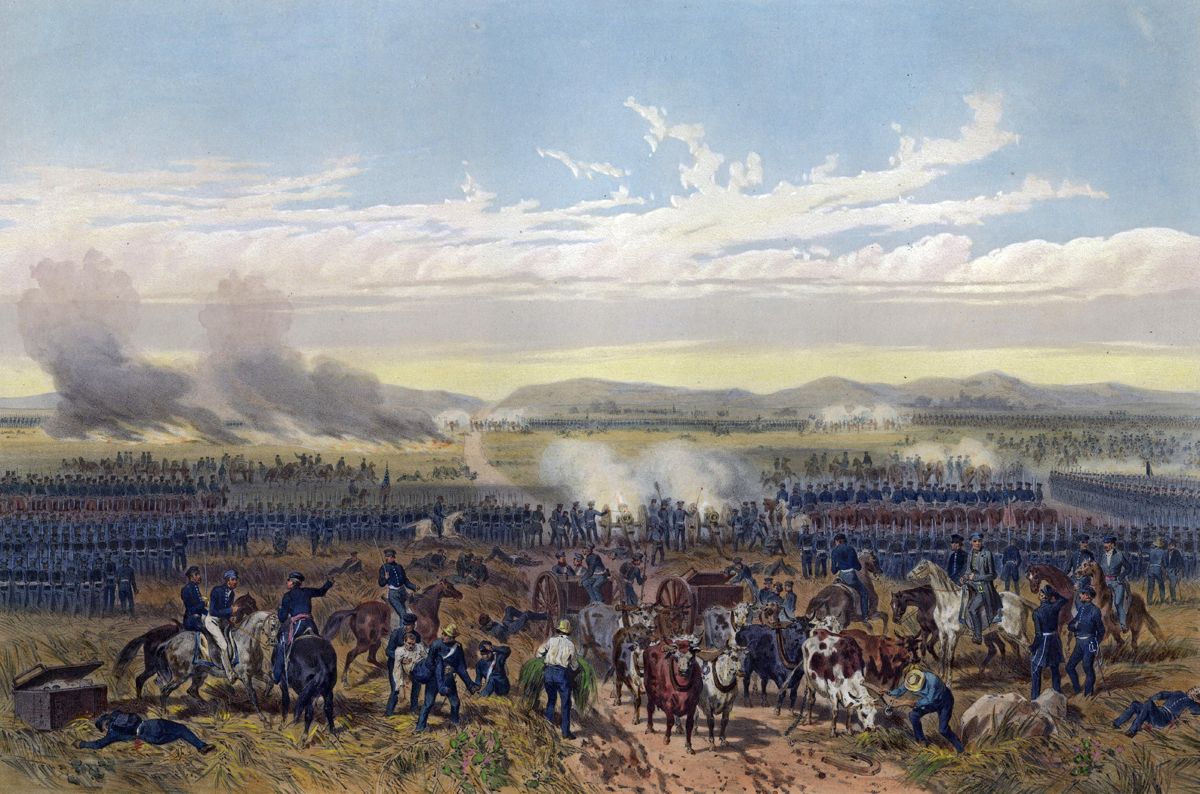
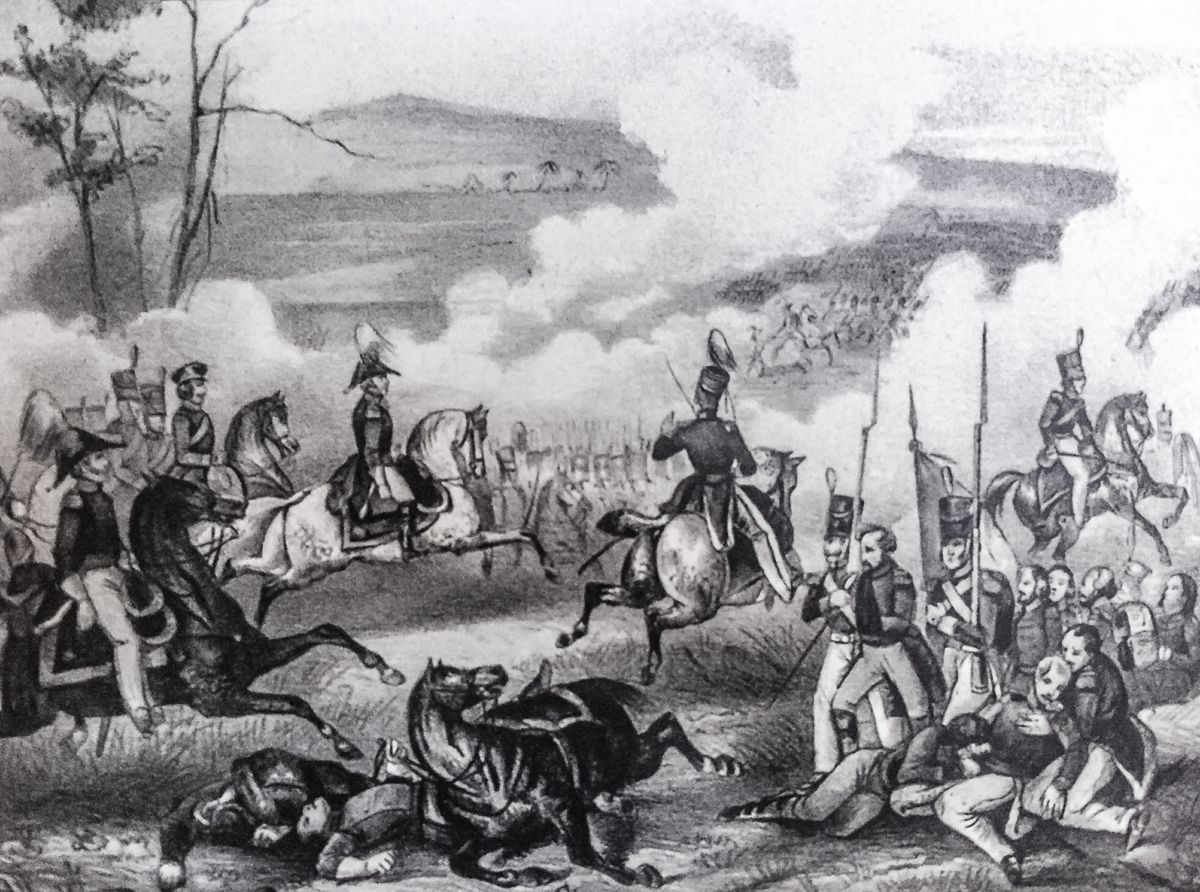
Battle of Palo Alto near Brownsville, fought on May 8, 1846 in the Mexican-American War. View from behind the U.S. lines towards the Mexican positions in the south. (Public Domain)
The Mexican War: Service Under General Taylor
In September 1845, Meade was assigned to the staff of General Zachary Taylor at Corpus Christi, Texas, serving as his only topographical engineer. He scouted and mapped the Nueces River, plotted routes to the Rio Grande, and helped establish Camp Texas, often working in advanced positions exposed to enemy patrols. With the outbreak of hostilities in 1846, Meade demonstrated exceptional competence at the Battle of Palo Alto. He later wrote:
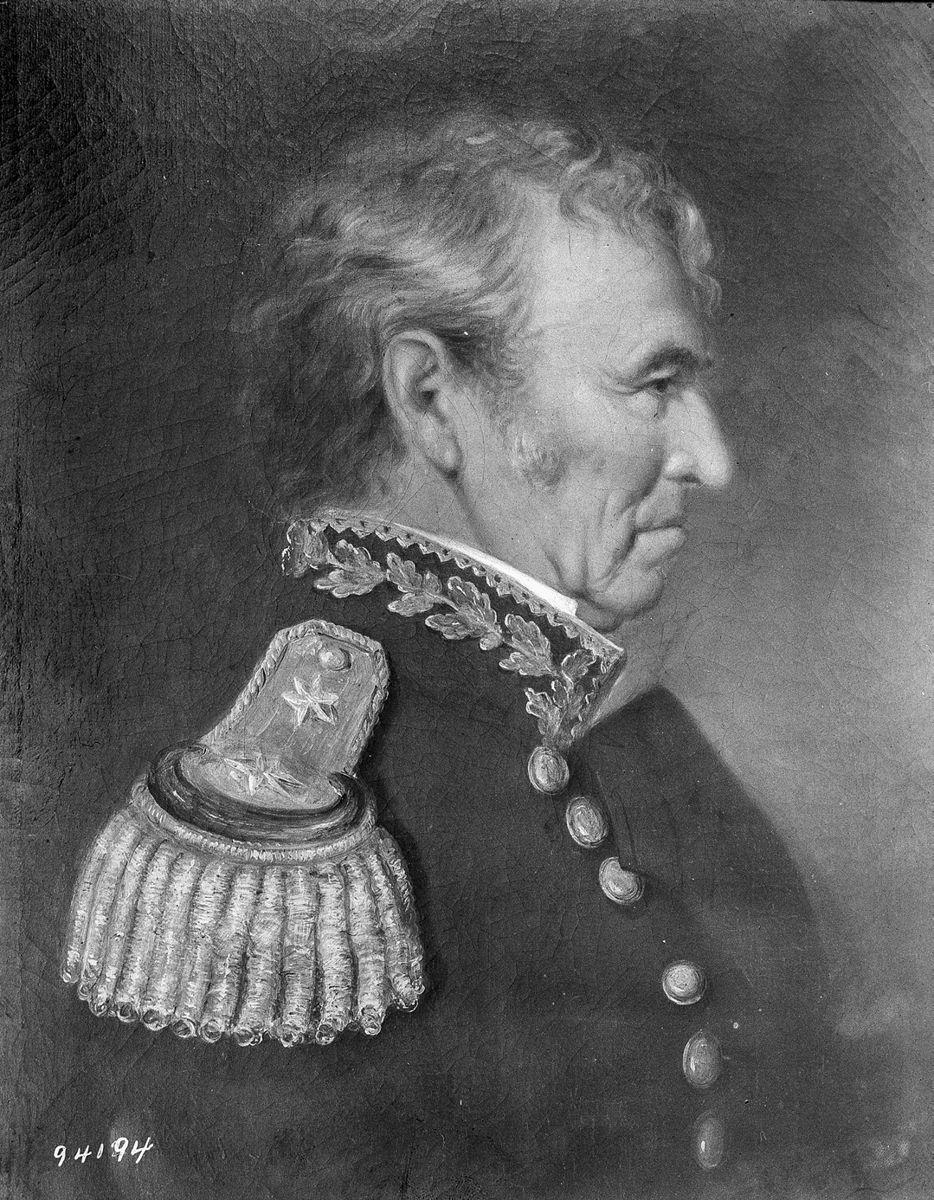
“I was in the action during the whole time, at the side of General Taylor, and communicating his orders. I assure you I may justly say I have had my ‘bapteme de feu.’ An officer of the General’s staff had his horse shot under him, not two yards from me, and some five horses and men were killed at various times right close to me.”5 Meade continued to serve in the advance to Camargo, Ceralvo, and Monterey, undertaking reconnaissance, mapping fortifications, and supervising road preparations. During the approach to Major General Zachary Taylor. (NARA)
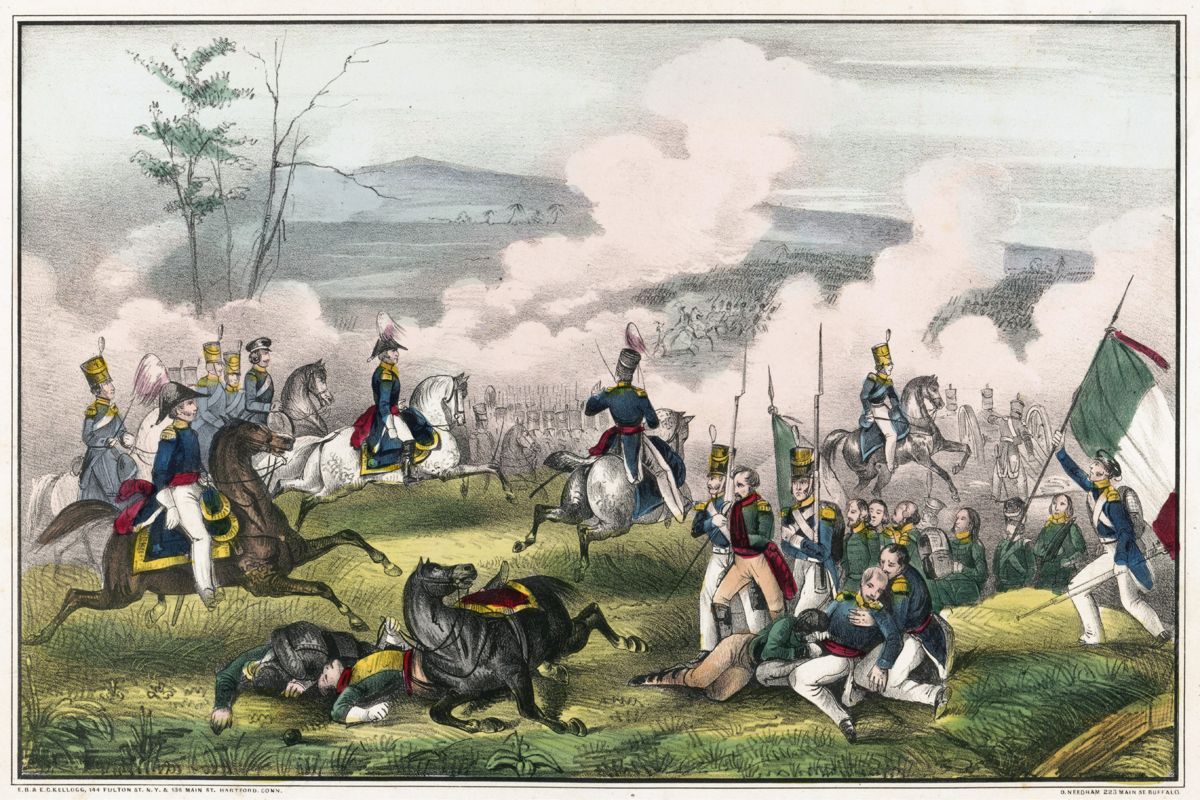
Battle of Palo Alto—May 8th 1846, between 2,900 Americans, under Genl. Taylor, and 6,000 Mexicans, commanded by Genl. Arista […] / E.B. & E.C. Kellogg, Hartford, Conn.; D. Needham, Buffalo. (Library of Congress)
Monterey on September 20, 1846, he joined General William Worth’s western column, guiding troops up Mt. Independencia at 2:30 a.m. on September 22 to seize its fortified crest. Worth commended his “intelligent zeal and gallantry.”6
Later Campaigns and Reassignment Political backlash against Taylor’s lenient surrender terms at Monterey prompted President James K. Polk to favor General Winfield Scott’s central Mexican campaign. Meade was reassigned to General Robert Patterson under Scott’s command and missed Taylor’s victory at Buena Vista. He landed with Patterson’s troops at Vera Cruz, though he was left without a meaningful assignment. When Meade protested, Scott ordered him back to Washington. His brevet to first lieutenant acknowledged his service, yet Taylor’s recommendation for promotion went unheeded. Not until 1851 did Meade receive a permanent promotion.7 Despite limited recognition, the Mexican War forged Meade’s reputation as a skilled and dependable officer of engineers. His detailed mapping and reconnaissance proved critical to Taylor’s success.8
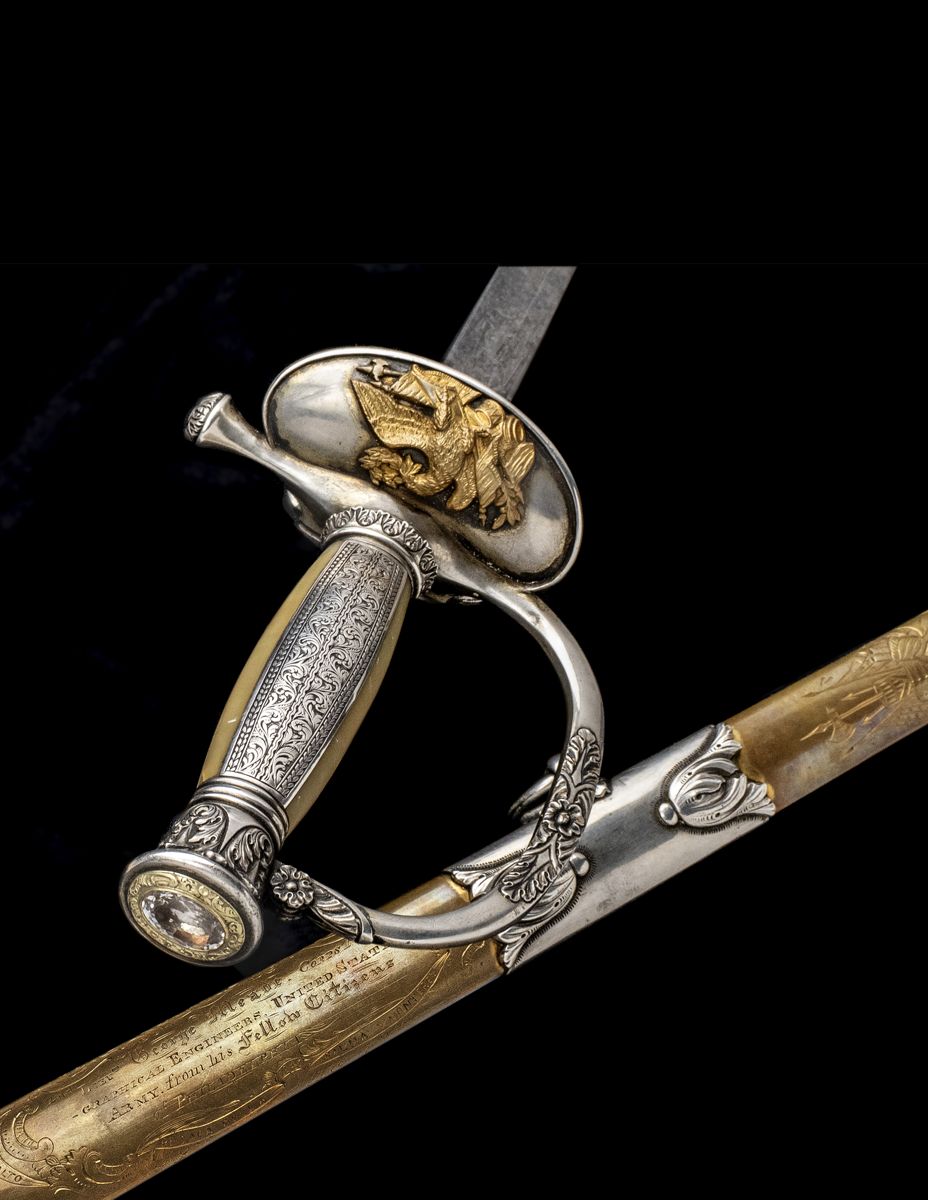
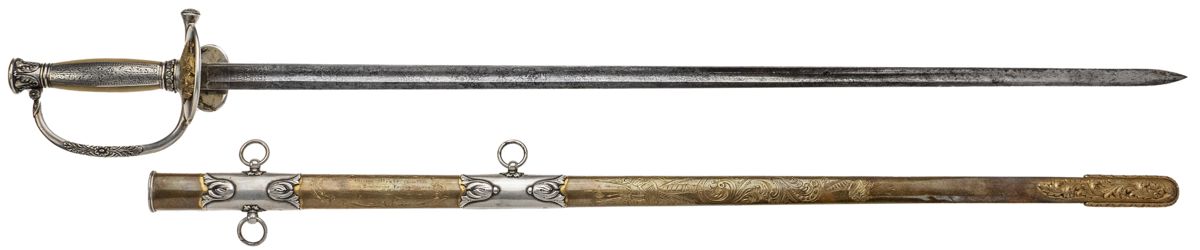
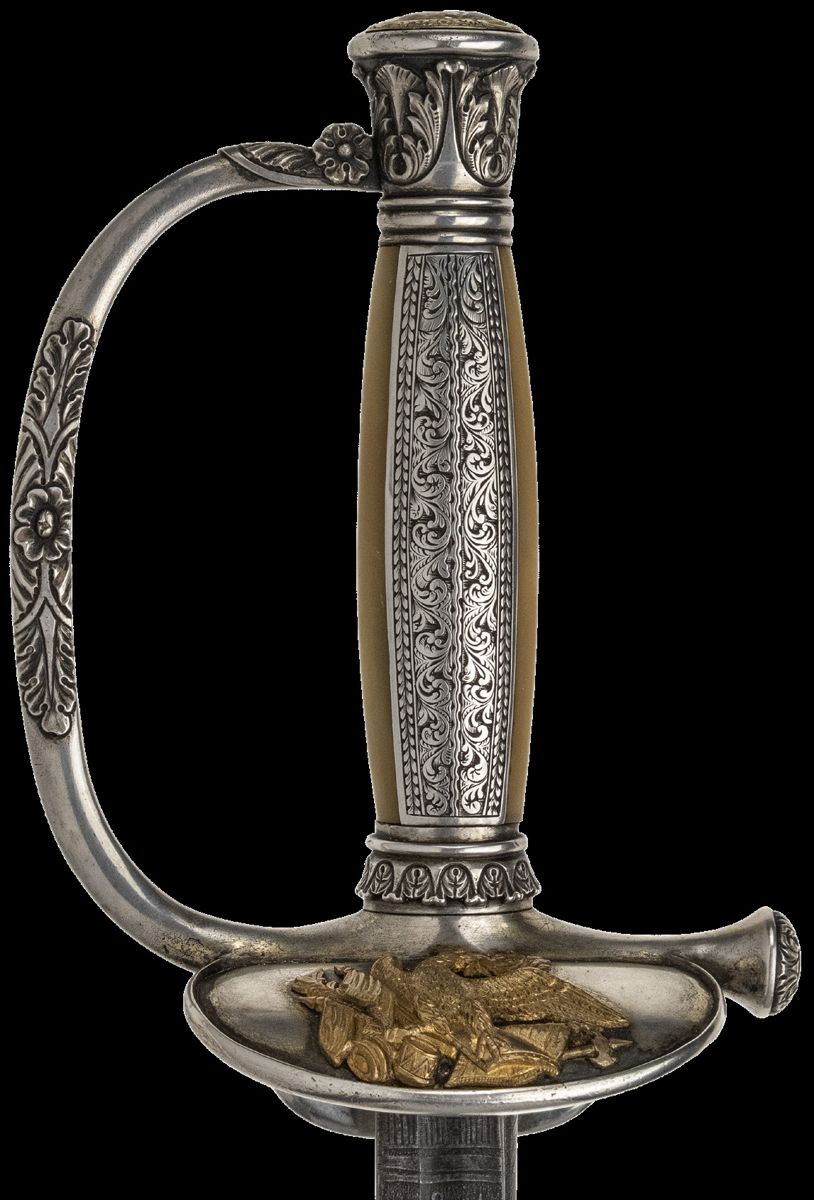
The Philadelphia Presentation Sword Among the surviving tributes to Meade’s Mexican War service is a magnificent presentation-grade M1840 Foot Officers’ sword, one of only two known examples remaining in private hands. It bears the battle honors Palo Alto, Resaca de la Palma, and Monterey, and was presented to Meade by “his fellow citizens of Philadelphia” in 1847 as a “tribute of their regard for his gallant conduct in the several actions in Mexico in which he was engaged.”9 Meade himself described Palo Alto as his “baptism of fire,” and later received a U.S. Army brevet “for gallant conduct in the several conflicts at Monterey, Mexico.”10
All sword photographs courtesy www.fleischersauctions.com.
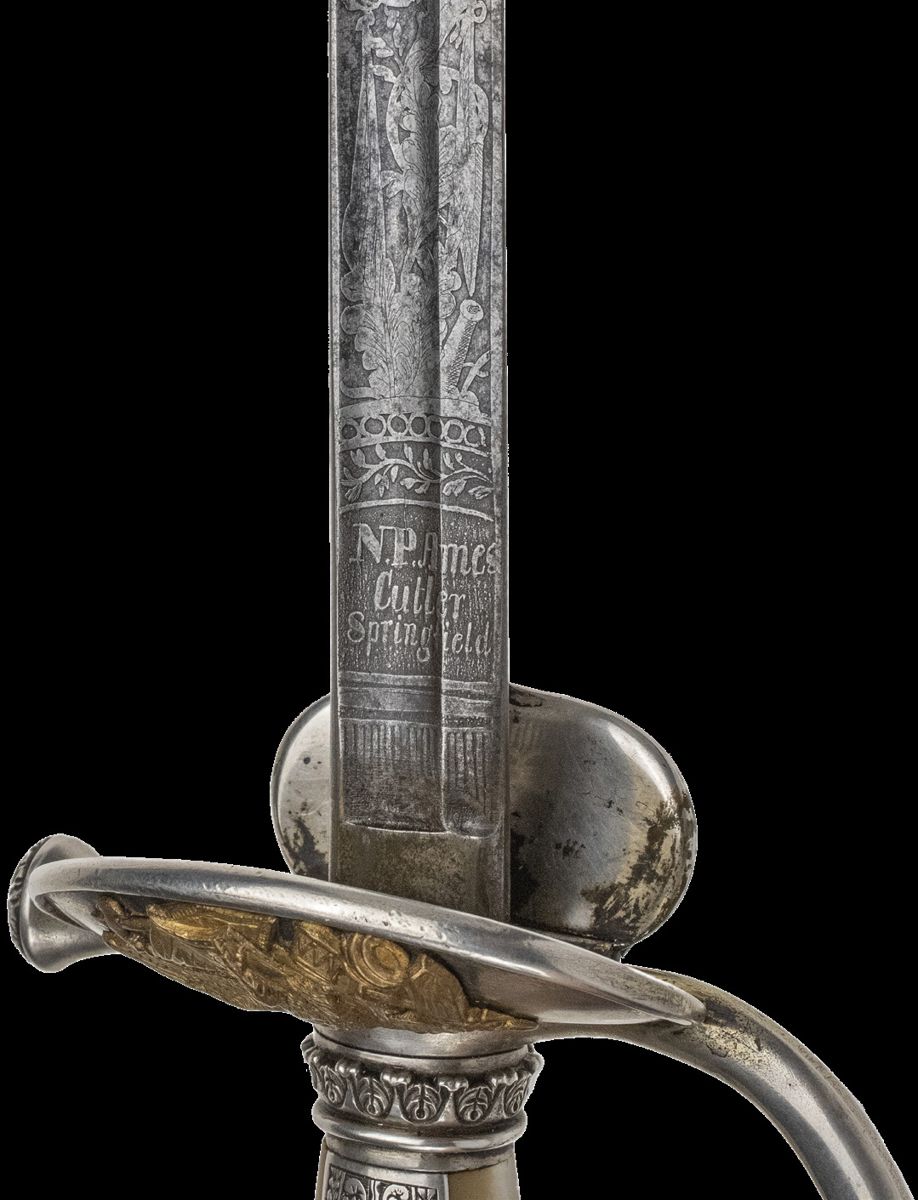
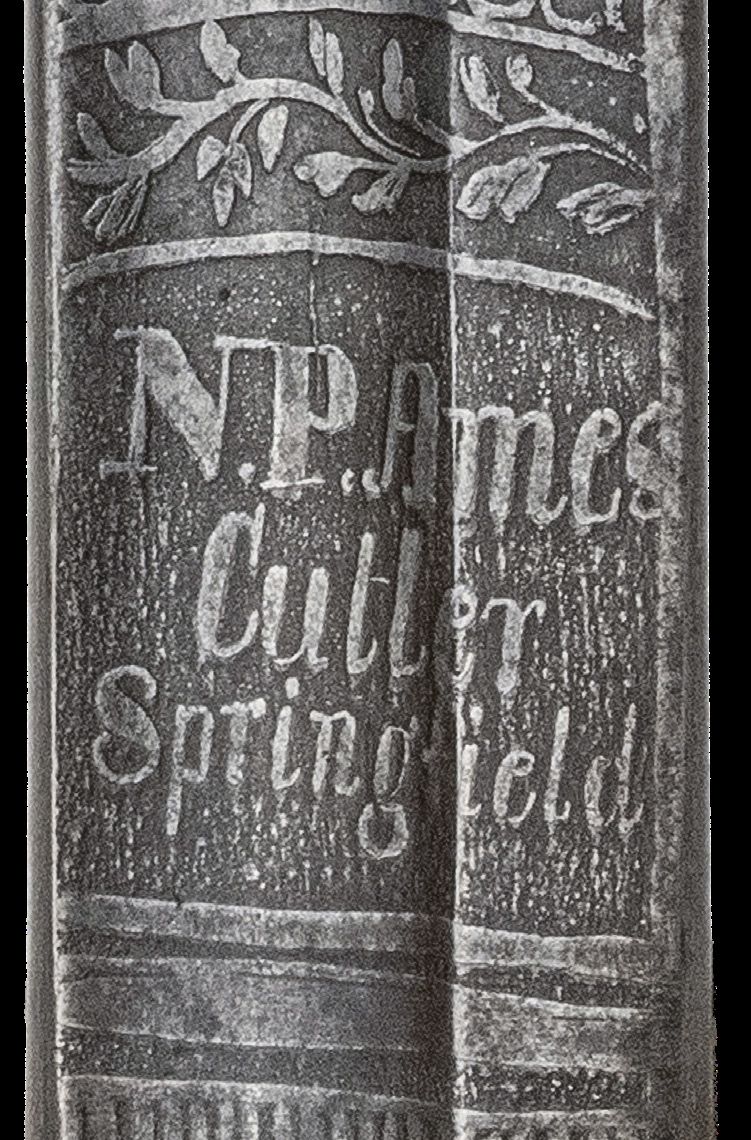
Maker’s name etched inside a wreath, “N.P. Ames/Cutler/Springfield.”
Manufacture and Presentation The sword was paid for by public subscription and produced by N.P. Ames, Springfield, Massachusetts, under order from Bailey & Company, Philadelphia. The transaction is recorded in the Ames manuscript notebooks and was reported in contemporary newspapers when displayed in Bailey & Co.’s storefront alongside other swords commissioned for distinguished officers.11
The “Rewards for Gallant Deeds”series included swords for: •
Capt. George A. McCall, 4th Regiment Infantry
•
Capt. Charles F. Smith, 2nd Regiment Artillery
•
1st Lieut. George W. Ayres, 3rd Regiment Artillery
•
1st Lieut. John C. Pemberton, 4th Regiment Artillery
•
1st Lieut. George W.F. Wood, 1st Regiment Infantry
•
and “2d Lieut. George Meade, Corps of Topographical Engineers, U.S. Army, from his fellow citizens of Philadelphia. Palo Alto, Resaca de la Palma and Monterey—1846.”12
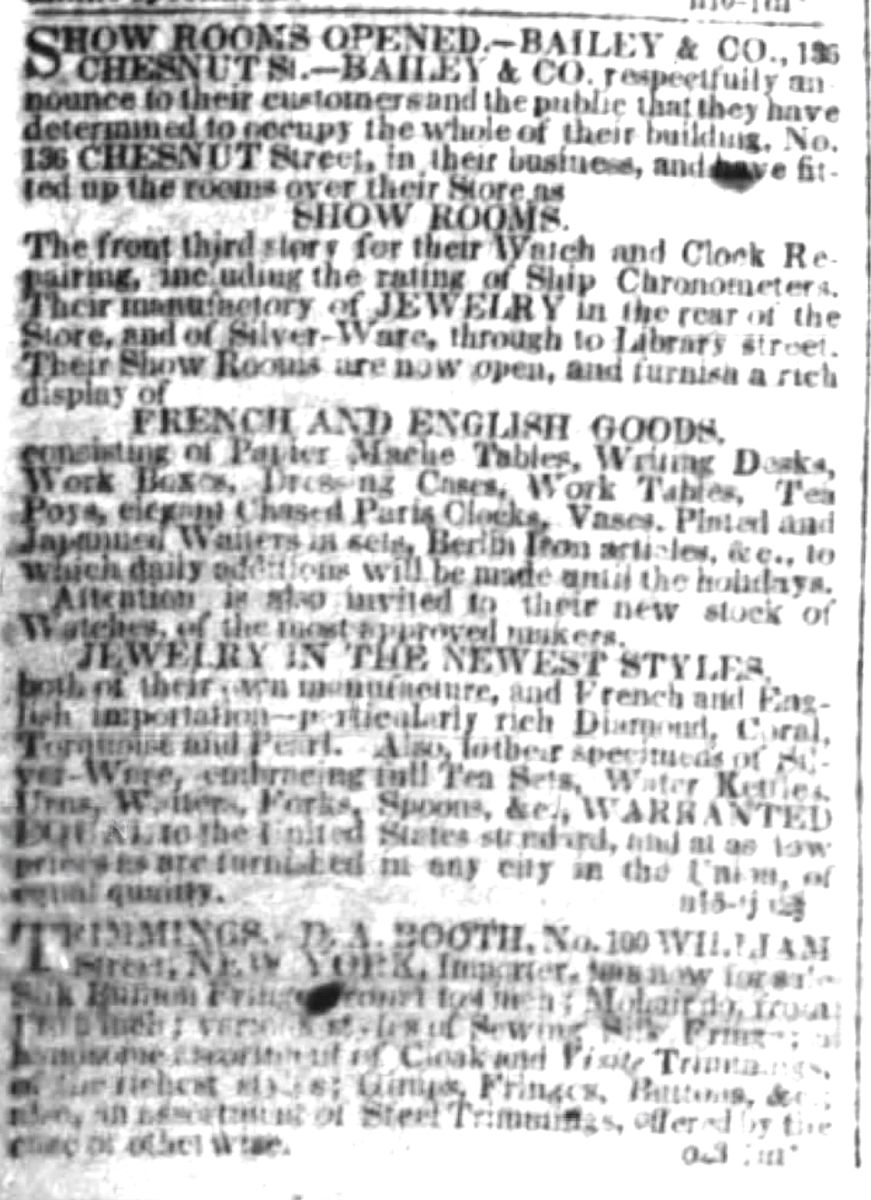
Announcement of Meade’s presentation sword published in the Republican Banner (Nashville, Tennessee), Fri., Sept 24, 1847, page 2.
Five presentations swords display in the window of Bailey & Co. (Public Ledger (Philadelphia, Pennsylvania), Mon., July 19, 1847, page 2)
“Rewards For Gallant Deeds” published in the Baltimore Sun (Baltimore, Maryland), Tue., July 20, 1847, page 1.
Description and Ornamentation
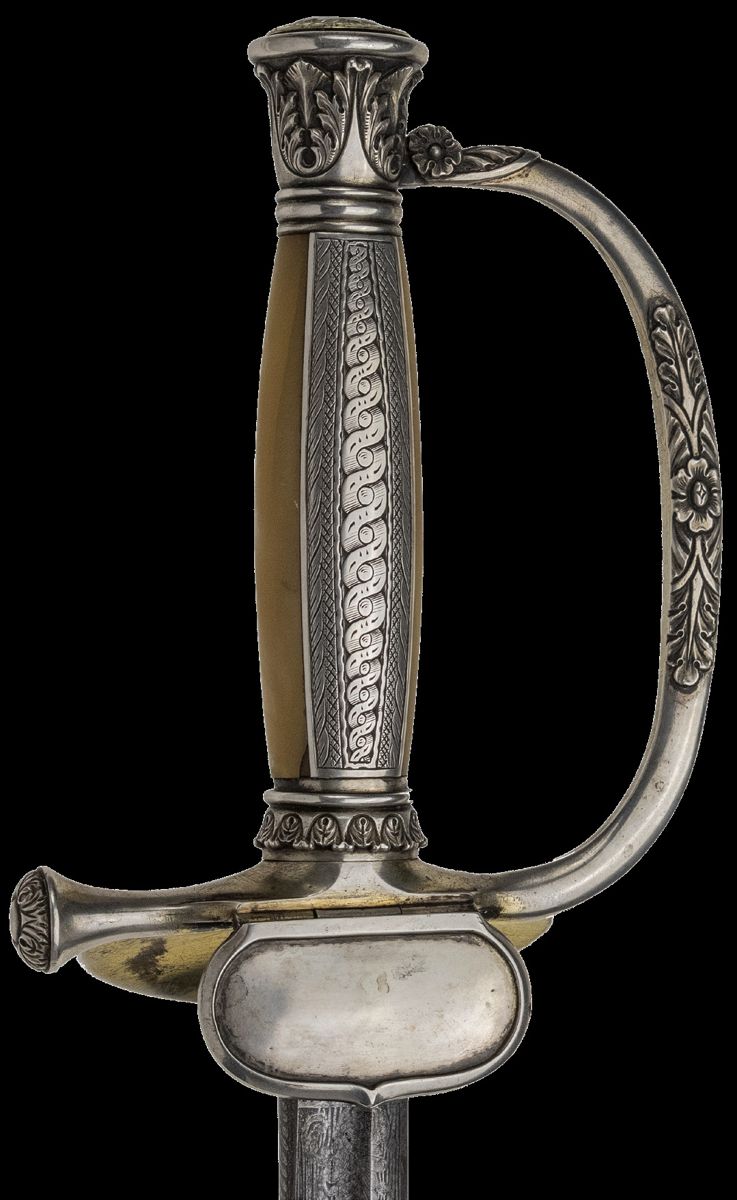
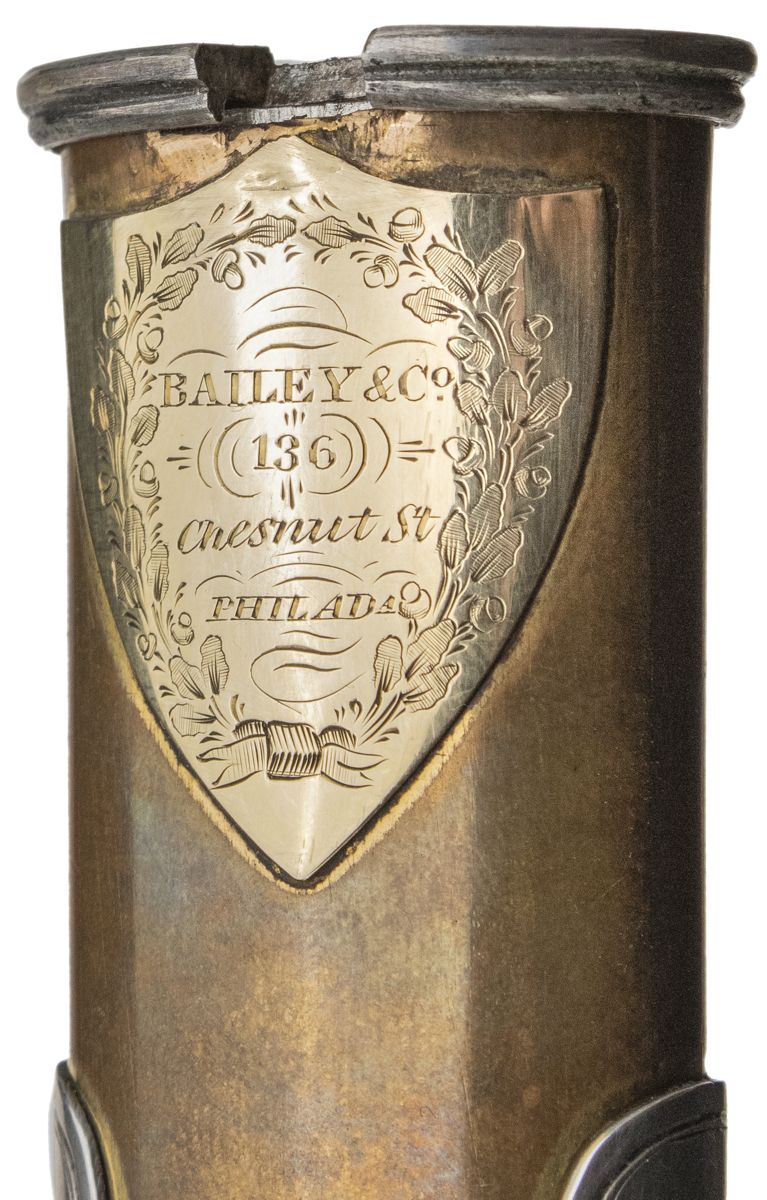
The sword features a solid silver hilt and scabbard mounts. The pommel is set with a clear faceted gemstone and adorned with acanthus leaves and foliate motifs. The mother-of-pearl grips are inlaid with engraved silver panels. Its knucklebow is cast and chased with rosettes and leaves, joining at the quillon block with a plain reverse folding counterguard and an obverse guard featuring a gilt eagle over a panoply of arms. The spadroon-form blade is etched with patriotic and martial designs—an eagle, liberty cap, and foliage—with the maker’s name, “N.P. Ames/Cutler/ Springfield,” within a wreath. The gilt brass scabbard is decorated with similar foliate motifs and fitted with upper and lower silver ring mounts bearing raised designs. On the reverse is a retailer’s plaque: “BAILEY & Co./136/ Chestnut St/PHILA,” identifying the Philadelphia jeweler who paid Ames $120 for the sword.
Engraved on the obverse in a long foliate and c-scroll bordered cartouche between the ring mounts is: “2nd LIEUT. George Meade. CORPS TOPO/-GRAPHICAL ENGINEERS, UNITED STATES/ARMY. From his Fellow Citizens/of PHILADELPHIA.” The battle honor of “PALO ALTO” appears in the border scrollwork at left and “RESACA DE LA PALMA & MONTEREY” with the date “1846” at lower center.
The obverse of the scabbard bears an engraved inscription bordered by C-scrolls reading:
“2nd LIEUT. George Meade. CORPS TOPO/-GRAPHICAL ENGINEERS, UNITED STATES/ARMY. From his Fellow Citizens/of PHILADELPHIA.” The decorative border includes “PALO ALTO” at left, and “RESACA DE LA PALMA & MONTEREY” with the date “1846” below—all corresponding to details mentioned in period newspaper accounts.
Conclusion The Meade presentation sword exemplifies the intersection of artistry, patriotism, and public gratitude in mid-19th-century America. Both a work of craftsmanship and a document of civic honor, it memorializes a young officer whose diligence, technical acumen, and courage under fire would later culminate in his leadership at Gettysburg. Through this sword, the citizens of Philadelphia not only commemorated Meade’s Mexican War service but also anticipated his enduring legacy as one of the Union’s most capable generals.
Endnotes
- Mark E. Neely Jr., The Mexican War and Its Heroes (Philadelphia: George S. Appleton, 1848).
- George Meade, The Life and Letters of George Gordon Meade, Vol. 1, ed. George Meade (New York: Charles Scribner’s Sons, 1913), 7–15.
- Francis P. McNamara, History of the Corps of Topographical Engineers (Washington, D.C.: U.S. Army Engineer Office, 1942), 88–91.
- Ezra J. Warner, Generals in Blue: Lives of the Union Commanders (Baton Rouge: Louisiana State University Press, 1964), 308–309.
- Meade, Life and Letters, 42–43.
- John S.D. Eisenhower, So Far from God: The U.S. War with Mexico, 1846–1848 (New York: Random House, 1989), 184–187.
- Ibid., 245–247.
- Raphael Semmes, Service Afloat and Ashore during the Mexican War (Cincinnati: W.H. Moore, 1851), 132–136.
- Public Ledger (Philadelphia), March 1847, “Presentation to Lieutenant Meade.”
- Meade, Life and Letters, 59.
- Ames Manufacturing Co., Order Book and Ledger, 1840–1850, Manuscript Collection, Springfield Armory Museum Archives.
- Public Ledger (Philadelphia), July 19, 1847, “Rewards for Gallant Deeds.”
About the Author
Adam Fleischer is President of Fleischer’s Auctions, one of the nation’s foremost houses specializing in 19th-century Americana and military artifacts, particularly Civil War relics. He holds a degree from Ohio Wesleyan University and maintains a lifelong commitment to the documentation, preservation, and dissemination of historical arms and ephemera. As a collector and historian, Fleischer specializes in edged weapons, presentation swords, and the material culture of American military history. His dual role as a scholar and auctioneer gives him rare insight into both the academic and market worlds of military antiques.
Maj. Gen. George Meade at his field headquarters, taken during the Civil War. (Library of Congress)