
An Interview with Tim Prince
Originally published May-June 2026 · pp. 28–34
that was not going to pan out. However, I found I had a natural ability to mix audio for bands, and by the time I graduated from college, I had many local bands as clients I did sound for. Everything in Nashville at that time was about word of mouth and who you knew, so I networked as much as I could. Many of the players who toured with national country acts also played in local bands when they were not on the road, and lots of touring crew guys who did sound, lights, and video were doing oneoffs and local work as well. At any rate, within a year of graduation, I got a call out of the blue from a management company that was looking for an audio guy for a band called Baillie & The Boys. The next thing I knew, I was touring as their Front of House Audio Engineer and Tour Manager. We spent a lot of time that year as the opening act for Reba McEntire, and I met all of her team of techs and management. About a year later, I got a call from Reba’s promoter, who was co-managing a new country artist named Aaron Tippin with Reba’s husband at the time. They hired me to work for Aaron, which I did from 1991–2001. Aaron is a big firearms enthusiast, a history buff, and had even been a Civil War reenactor when he was younger. He took me shooting for the first time since summer camp and gave me my first handgun shooting instruction. That was the first time I thought about buying and owning firearms. One part of my job was to handle the band’s routing and accommodations while it was on the road, and I used to try to find cool places for days off and layovers where there would be something for us to do while the drivers were sleeping. Over the years, I became the guy who would orchestrate historical day trips on those days off and took members of the
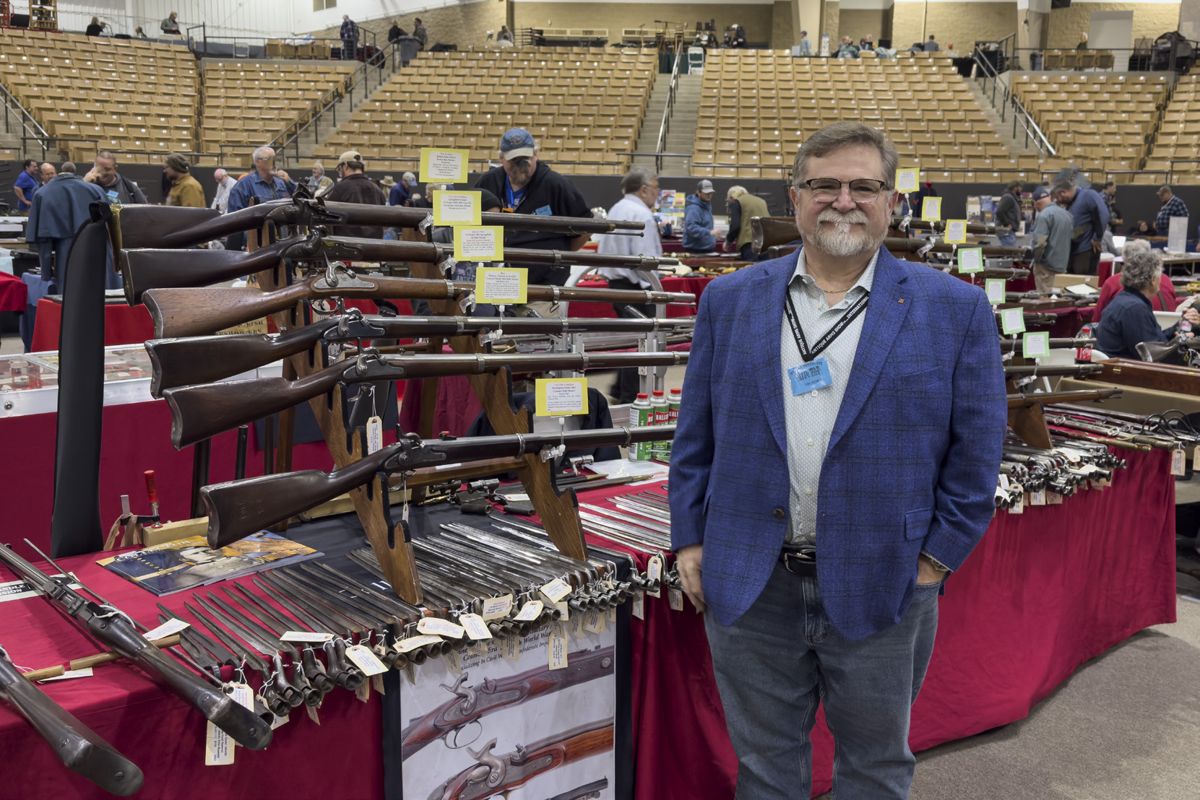
Tim Prince setup at the Franklin Civil War Show in 2025.
band and crew to places like Antietam, Gettysburg, and the Little Bighorn Battlefield. In that last case, there was no rental car company in Miles City, Mt., at the time, and Aaron paid the lady at the front desk of our hotel to let us use her minivan to visit that battlefield that day. During the trips, I discovered relic shops, something I had never known existed. All of a sudden, I realized I could go to a relic shop and buy those pieces of history that I had been looking at in books for more than a decade. Visiting places like The Horse Soldier, the Union Drummer Boy, and the Sharpsburg Arsenal really got me excited about collecting. The next thing I knew, I was collecting Civil War infantry long arms and more than once came home from a tour run with Aaron with a musket or two in my bus bunk with me. Those eastern relic shops made me look for places closer to home where I could acquire more things for my collection, and that led me to finding Larry Hicklen in Murfreesboro, Tenn., and, most importantly, Rafael Eledge in Shiloh, Tenn. During the early to mid-90s, I spent many days driving from Nashville to Shiloh to see what Rafael had new in the shop and to try to buy something for my collection. I started to attend shows, and luckily, one of the best shows in the country was at the Tennessee State Fairgrounds in Nashville, the old Nashville Civil War Show that is now the Middle Tennessee Civil War Show in Franklin. Another great show was in Dalton, Ga., about 2.5 hours from Nashville. Now I was going to shows on a regular basis and looking for antique arms shops when I was on the road. I was intense into collecting at that point.
At what point did you decide to move from collecting to dealing, and what motivated that transition? Attending antique arms and relic shows leads to relationships with dealers, who sometimes become friends. The most important of those relationships was with Rafael Eledge of Shiloh Relics, whom I have already mentioned, and Cliff Sophia of CS Arms. I can’t say enough about both of those men and the support and help they gave me in transitioning from collector to dealer. Like many collectors, as my collection grew, I realized the best way to upgrade items was to have a table at a big show where I could offer some of my older purchases for sale and shop for new items. It doesn’t take long to realize the best deals at the show are found during dealer setup, and having a table gave me access to the show before the public. About the year 2000, I attended the Mansfield, Ohio, Civil War Show for the first time as a “hobbyist dealer,” with one table next to Cliff Sophia. We talked all weekend and became friends, and he is still one of my best friends. He suggested that, since I was young (compared to most dealers) and tech-savvy, I should start an antique arms website as a part-time business. That sounded like a fun side hustle. At the time, I was still touring with some country artists but was also serving as the Operations Manager for a small national touring sound and lighting company in Nashville. The guy who had built the sound company’s website was a friend and a gun enthusiast, so he built me my first website for a few hundred dollars. I’d always thought it would be a cool business name to resurrect the College Hill Arsenal in Nashville early in the Civil War, so that’s what I did. That was 25 years ago. For the next 10 years, I built the business while still working a “real job” in the music industry. Luckily, the sound company owner was a good friend, and he didn’t care if I worked on my website when things were slow in the office, so some weeks I spent as much time working on my website while I was at work as I did doing my real job. Within a few years, my website had sort of taken over my life, and I was spending much more time on the antique arms business than I was in the music business. I started to go to more shows, and the side hustle became much more “full-time.” In 2010, I was coming back from the Mansfield Civil War show with fellow relic dealer John Walsh of Fort Donelson Relics. That was the weekend Nashville flooded. We couldn’t get back into Nashville that Sunday night because Interstate 65 was closed due to flooding. The sound company I worked for was located across the street from the Cumberland River on the east side. It was under several feet of water for several days. When we finally got into the offices and warehouse after the flooding subsided, we found millions of dollars’ worth of destroyed equipment and a business that was essentially out of business. The owner looked at me as we stood in ankle-deep river mud inside the building and asked if I wanted any part of the “rebuild.” I said “no.” I was the number-two man in the business and the highest-paid, and I think he was looking for a way to reduce costs during the rebuild. He said, “Why don’t you go sell guns and see if that works. If it doesn’t, we can talk about you coming back after we are up and running again.” I took the offer to leave and never looked back. I’ve been a fulltime antique arms dealer since the first week of May 2010. As they say, “when one door closes, another one opens.” It did for me. Being able to put 100% of my time and effort into the business allowed me to take things to the next level. It was scary initially and sometimes still is, as I don’t sell anything that anyone “needs.” It’s not like I sell milk and eggs. But I have loved every minute of it and have met some of the best people in the world as a result, both other dealers and customers. Being able to do this full-time allowed me to get involved in more research and writing, and also opened the door to becoming an appraiser on the PBS series Antiques Roadshow. When Rafael Eledge took a year off from the show in 2016, the producers asked him for recommendations to replace him, and I was one of the people he suggested. I’m blessed to still be working with the show a decade later. Just like the music business, many opportunities in this business come from who you know and networking.
Could you describe your earliest acquisition as a dealer that made you feel this business could succeed?
I remember around 2008 or so I was scouring the internet for auctions that had Civil War guns for sale, and I stumbled across a small auction house in Georgia that had a collection of Civil War carbines that were being offered along with a variety of antiques, most of which were not military. I bid on many items and won several of them for much less than their retail value. I sold the guns pretty quickly and made a good profit. That was the first time I realized that 1) you make your money when you buy the item, not when you sell it, and 2) I saw the potential to generate enough money from this business to actually make a living. Before those purchases, I had never seriously considered the potential to make a living selling antique arms, unless you had a shop in a high-traffic tourist area, preferably very close to a battlefield.
What does “quality” mean to you when selecting inventory? When do you decline something because it isn’t up to your standard? They say love means “never having to say you’re sorry.” In my business, I say I only offer items you don’t have to apologize for. Condition can vary from thick attic patina to mint condition, but what I’m looking for are items that are 100% original without repairs or restorations. While some items are so rare or so old that it is almost impossible to find an example without some restoration, I try to avoid anything that has been messed with. That’s what I consider quality: an item that is completely correct. I am offered items all the time, either on consignment or for purchase, that I turn down because they need repairs or restoration. I do sell items like that from time to time, but with all the issues disclosed up front and with complete transparency, I try to avoid that kind of material if I can. In general, if an item is offered on my website, it is something I liked enough to have in my collection when I was actively buying for myself. Another thing you won’t see me offering very often are identified items. While many collectors specialize in identified items, the only ones I am willing to offer are those I am 100% sure are really period-identified and not just loosely associated or attributed. Oral history cannot be relied on to be truly accurate, so I like concrete provenance for those kinds of items.
Of all the categories you deal in (long arms, handguns, edged weapons, bayonets, knives, sabers, etc.), which do you personally enjoy handling most and why? I’ve always been fascinated by the development of firearms, particularly in the mid-to-late 19th century, when the transition from single-shot muzzleloading arms to repeating metallic cartridge arms occurred so rapidly. I find the firearms from the 1850s to 1890s to be the most interesting, and I enjoy researching, writing about, and selling these experimental and developmental arms. I think you see more interesting ideas, mechanisms, and concepts in handguns than long arms during that period, so I guess I find those items to be the most fun to handle and sell.
What is the most dramatic, rare, or unusual edged weapon you’ve handled or sold (firearm, bayonet, fighting knife, accoutrement, etc..)? I’ve had the opportunity to handle and sell a wide variety of historical arms over the years, including some items owned and used by important historical figures. Many years ago, I had the opportunity to spend most of the day behind the scenes at the old Museum of the Confederacy and got to see and handle some of their amazing historical treasures. I had the chance to hold a Colt fluted Army revolver that belonged to Confederate Admiral Rafael Semmes, who commanded the CSS Alabama, as well as the sword of Colonel Walter Taylor, a senior aide to Confederate General Robert E. Lee. That same day, I got to see a map of the Shenandoah Valley, drawn by General Thomas “Stonewall” Jackson’s primary cartographer, Jedidiah Hotchkiss. Hotchkiss’ maps were so accurate and detailed that they were one of the keys to the success of Jackson’s Valley Campaign. All of those were pretty impressive items to get to see and handle in person. I’ve also been able to handle some fantastic items that came into Antiques Roadshow. Just this past year, I got to appraise a French & Indian War-era Dutch Musket marked to the Colony of South Carolina, and a militia musket presented to Dr. Richard Arnold of the Savannah, Ga., Republican Blues militia regiment. Arnold was a city doctor who co-founded the American Medical Association and served as mayor of Savannah several times. He was the person who surrendered Savannah to President Lincoln during the Civil War and saved it from being burned by General Sherman. That was a pretty neat piece of history to handle.
In terms of firearms, is there a single piece— revolver, rifle, shotgun—that you found particularly meaningful (emotionally, historically, or personally)? I’ve owned and brokered the sale of many great historical arms. Probably one of the coolest items was a Confederate-imported 2nd-quality Whitworth rifle. The gun was found wrapped in a blanket along with a Peterson 75 non-regulation Staff & Field officer’s sword and sword belt in the floorboards of a house in Colorado that was undergoing restoration. The gun had probably gone west with some Union officer after the war, having likely been taken as a trophy during the waning days of the war. The rifle had seen a lot of use and was probably used for hunting in the post-war era. All the parts of the Whitworth rifle were numbered, down to the screw necks. When I took the gun apart to document it, I found that one of the lock screws did not match, but I recognized the number. The screw in the gun was numbered to a Confederate Whitworth in the George Wray Jr. collection, now part of the Atlanta History Center’s museum. I called the military curator of the Atlanta History Center, Gordon Jones, and asked him if he had ever taken the Wray Whitworth apart, and he said, “No.” I asked him if he would do so, and I told him why. A couple of days later, he called to say the Wray gun had the lock screw numbered to the one on the gun I had. A Confederate document I found while researching our book, The English Connection, described the shipment of a few Whitworth rifles from the Western Theater of Operations to the Richmond Arsenal, where they were refurbished and then reissued to the Army of Northern Virginia. It is almost sure that these two rifles had been in that group and the lock screws got swapped accidentally during the refurbishment. That was one of those moments that gives you chills, being able to place two historical items in a very specific location at a particular moment in time. That was a pretty special moment.
How do you assess provenance and authenticity, especially for high-stakes items? Could you share a case in which questions of authenticity were tricky? I look at almost everything with a very jaundiced eye, particularly high-value items or items with alleged identifications. As such, these items have to prove they are what we want them to be, or what they are being represented as. I put minimal stock in things like family history and lore. Oral tradition is too easy to corrupt, simply by accident, without
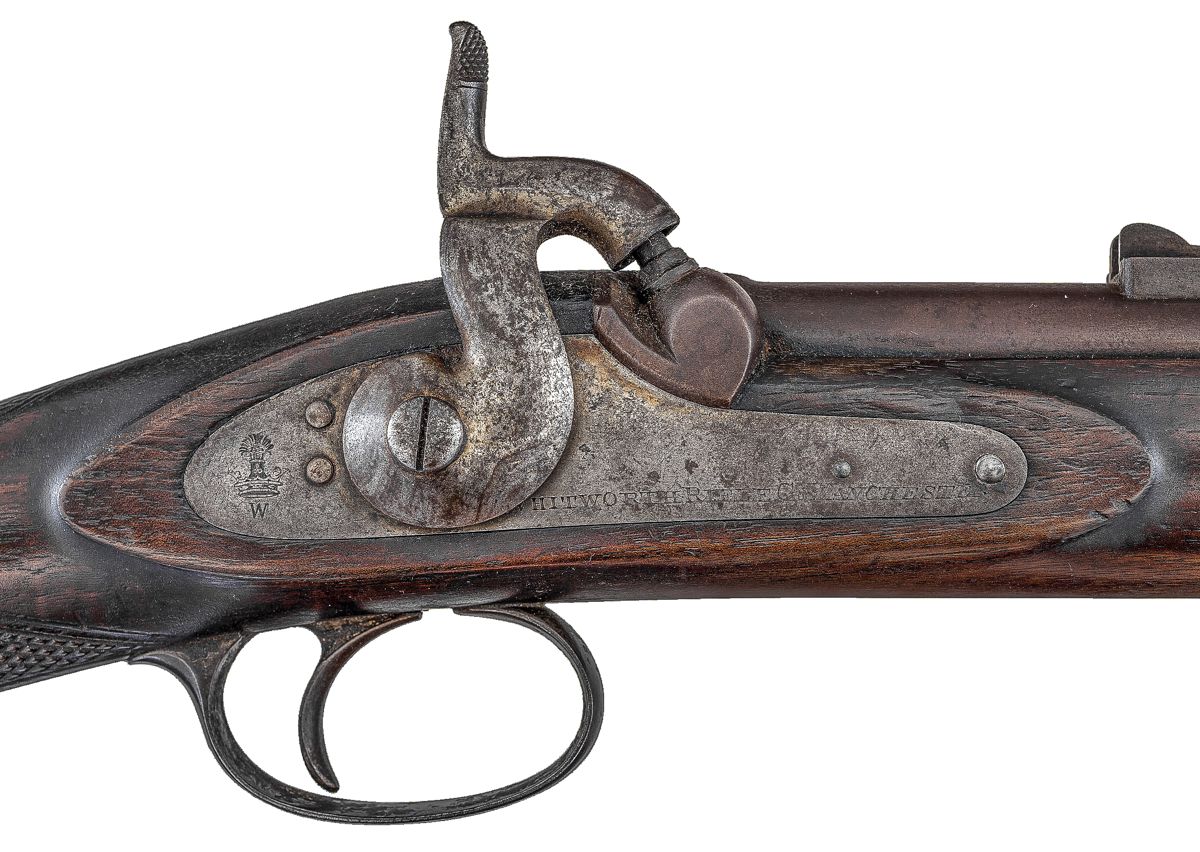
Lock of Confederate Whitworth B 902 marked “Whitworth Rifle Co MANCHESTER.”
Overall obverse view of Confederate-imported Whitworth B 902, found wrapped in a blanket in a house in Colorado. Photos of B 902 courtesy of Cowan’s Auctions–A Freeman’s | Hindman Company.
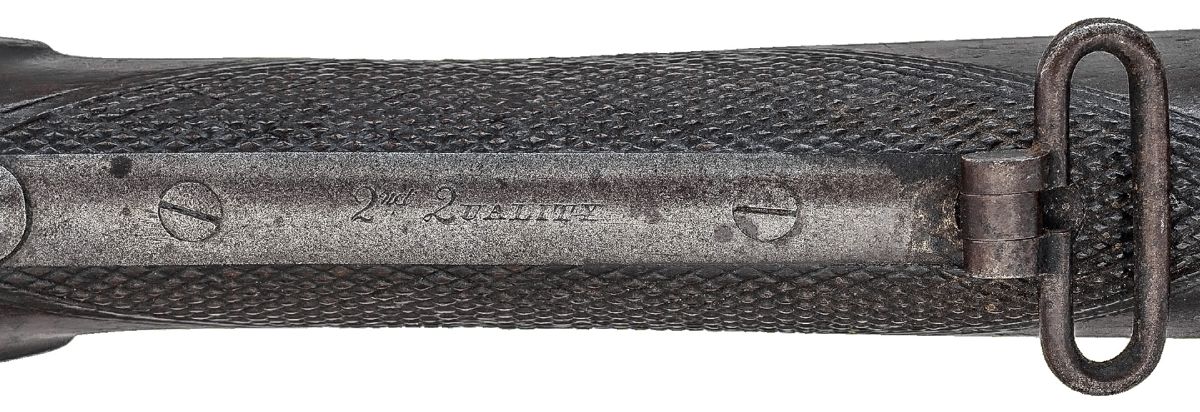
“2nd Quality” mark engraved on the triggerguard tang of Confederate Whitworth B 902. Note the use of a “Q” in “quality” that looks like a “2.” This is typical of the mark on B-series 2nd Quality guns.
any nefarious intentions. I like period documents, specific discussion of an item in letters, or period images of the item with the owner. I once owned a Mass Arms Adams revolver that was part of the 1,000 “Adams” revolvers that the state of Virginia purchased from Ames in 1860. The gun was captured by a Pennsylvania cavalryman who sent it home as a souvenir. The gun was accompanied by some letters from the soldier to his brother, one sent prior to the gun being sent home that discussed the action where he picked it up, and one that went with the gun. While the gun was not listed by name or serial number in the letters, one letter included the warning to his brother that the gun was not like a Colt, for if you pulled the trigger, it would fire. What he was describing was the double-action mechanism of the revolver, which allowed the gun to be fired without manually cocking the hammer, unlike the single-action Colt that required the hammer to be manually cocked first. That suggested that the letters really did relate to the gun. However, I wanted to be 100% sure. Further research based upon the description of the action, the date of the letter, and the combat history of a Pennsylvania cavalry regiment proved that on the day in question, the soldier’s regiment had engaged a Confederate regiment that was at least partially armed with Mass Arms Adams revolvers. That was sufficient evidence for me to indicate that the gun was the one referred to in the letters. I later wrote an article for Civil War News about that gun. It might be worth reprinting it in Military Antique Collector, because it was a great story.
Has there ever been a purchase you regretted—maybe because later evidence changed, or the condition was worse than expected? What did you learn from that? I think every dealer’s initial answer would be “I regret all of the items I purchased that I lost money on.” However, that is part of the learning curve, and you tend to remember the lessons that cost you money. As one long-time dealer I know likes to say, “If you’re not losing money every now and then, you’re not trying hard enough.” What I have learned is to stay in my lane and focus on what I know well, and to avoid what I am less knowledgeable about. Lack of knowledge can mean you end up buying a fake, a restored item without realizing it, or simply paying too much because you don’t know the market well enough. I’m an antique weapons dealer, and that is the bulk of what I do. If I’m offering other items outside that area, it is because they were part of a larger collection I acquired, and you can be sure I’ve reached out to dealers who are experts in that field to make sure the item is what it appears to be and is priced correctly for its condition and the market. I know enough about things like buttons, buckles, and uniforms to be dangerous, but I know people who know those kinds of items inside and out, and I can always get someone to consult with if I need to.
Which sale (or sales) do you consider the most successful—not just in terms of profit, but in historical significance or for advancing the reputation of College Hill Arsenal? One collection that really helped advance my status in this business was handling most of the late C.A. “Corky” Huey’s estate. Corky was part of the team of authors with whom I worked to help write The English Connection, and when I was a relatively young collector and budding dealer, he took me under his wing and served as a mentor. When Corky died unexpectedly, his widow utilized my services to appraise, catalog, and help sell Corky’s Confederate English import collection to the South Carolina Relic Room & Military Museum, where the McRae Papers are also part of the collection. I was also allowed to sell a large portion of his collection that was not related to the Relic Room acquisition. That was a major feather in my cap, as I got to handle some wonderful, high-end pieces that I would not have been able to purchase at the time.
Could you estimate how many items (or collections) you’ve handled over your career?
Over the last 25+ years, I have sold thousands of antique firearms, probably in the neighborhood of 3,000-4,000 long arms and a similar number of handguns. I’ve also sold a similar number of edged weapons, primarily bayonets and fighting knives. When I started going to shows, I had one table, then two, and then finally three. Over the last few years, I usually buy between eight and twelve tables at a show. I went from 8 feet of inventory to about 80 feet of inventory at any given show over the last 25 years. I guess that’s growth, but it’s also a lot of work at a show!
What are the main challenges you face as a dealer in antique firearms and edged weapons, especially in terms of legal, ethical, or logistical issues? Your reputation is the only thing you have in this business. As a result, I make sure that all items I sell are represented honestly and accurately, and that any defects or issues are disclosed up front. We all miss things from time to time, so standing behind the item after it is sold is paramount. The customer needs to be happy. My goal is to under-describe and to over-deliver. I always want a customer’s first reaction to be “that’s better than I thought it would be” when they take something out of the box. I don’t ever want my customers to be disappointed, and I work hard to make sure they are happy. The market for antique arms has changed over the last couple of decades. In some cases, it is almost as complicated to navigate the myriad laws that are starting to affect the antique arms business as it is to run a modern gun business. I used to sell a lot of antique arms to England and Europe, but changes in laws and shipping regulations have made that kind of business very difficult to navigate. As a result, I no longer offer international sales. Some states, like New Jersey, California, New York, and Massachusetts, regulate antique firearms to some degree, particularly those that fire metallic cartridges. As such, I need to stay very aware of the constantly changing state laws to operate my business within the law.
Your business spans from the Revolutionary War through World War II. How do you balance diversifying across time periods with deep specialization (e.g. Civil War)? The collector landscape is changing, as the Baby Boomer generation ages out of being active buyers and younger collectors enter the field. Younger collectors usually have smaller budgets and are more interested in 20th-century items than 19th-century items. As such, I try to make sure that I offer a wide variety of material, particularly at shows, that can appeal to all segments of the market. I also tend to offer rare items, high condition, or preferably both. If you are trying to sell the same brown or gray Civil War era contract muskets as 20 other dealers at a show, the only reason you make a sale is that you priced your item lower than the competition. Instead of joining the “race to the bottom” as I call it, I concentrate on selling things most other dealers don’t have.
How has the market for militaria and antique arms evolved over the years of your business, particularly with online sales, shows, and shifting collector interests? I entered the market as a dealer at a time when online marketplaces were replacing the old-school printed catalog method of doing business. For many of the old-time dealers and collectors, that was a difficult transition, but since I never offered a printed catalog or list, it was easy for me. Over the last two decades, the collector base has aged and changed, and younger collectors are more interested in 20th-century military items than in 19th-century items. Also, pop culture dramatically affects the market and collectors. The PBS Ken Burns Civil War series and movies like Glory and Gettysburg all provided a big boost to the Civil War collectibles market in the 1980s and 1990s. We have not seen a big media event like that in the Civil War in some time. However, more recently, HBO’s miniseries Band of Brothers and The Pacific have had similar effects on the World War II collectibles marketplace. WWII-themed video games have also impacted that market. If we want to see a new renaissance in Civil War collecting, the first thing we need is another major pop culture event. As we enter the 250th anniversary cycle for the American Revolution, I have had more customers reach out looking to add a Brown Bess musket or a US surcharged Charleville musket to their collection than ever before. The new PBS Ken Burns series about the American Revolution will no doubt boost interest in that segment of the market as well.
As someone who writes and researches (books, articles, appraisal work), how does that research inform your work as a dealer?
All of my research and writing has given me a better view of the context of the items that I sell than most dealers have, particularly from a developmental perspective. Some items I offer are very rare, but WHY are they rare? Was it because it was a bad idea, or because the idea was improved upon almost immediately? Or was it just too expensive for the market at the time? Was it because a cheaper item did the same thing, but maybe not quite as well? That is the kind of context that not every dealer has if they are not a student of arms history and development.
What is the best collection you ever sold or broke up, and what made it exceptional?
I’ve handled a lot of great items and collections, but Corky Huey’s was probably one of the most impactful in terms of its quality, breadth, and rarity.
Is there a particular item in your inventory (past or present) that you would have liked to keep for your personal collection? Why did it mean so much? In a perfect world, I would have loved to keep the Confederate-imported Whitworth rifle found in the floorboards in Colorado. The story of it being found, of it having a mismatched screw that put it and another well-known Confederate Whitworth in the same place, of it being refurbished in Richmond, and the rarity of the piece overall make it a great example of something I would have loved to keep.
Do you have any memorable stories from shows—finding unexpected items, bidding wars, dramatic consignments, or surprising buyers? In the early 2000s, I was at the Mansfield Civil War Show and found a wonderful Confederate Enfield during the dealer setup. I wanted to buy the gun, but the old gentleman selling it didn’t know what he wanted for it. I asked him to try to decide and to hold onto the gun while he figured out the price, and to give me the right of first refusal. He agreed, and rather than just stand there waiting for him to decide, I walked away for a few minutes. When I came back, Corky Huey was holding the gun and trying to buy it. To the seller’s credit, he told Corky that he had given me the right of first refusal, but still didn’t know what he wanted for the gun. Corky asked me to go outside with him to talk. Corky told me he wanted to add the gun to his collection and that he knew I was buying it to resell. To that end, he offered to pay me what would have been a fair profit on the gun to go away and let him buy it, without creating a bidding war with the seller. I agreed, took the money, and for the first time made a profit because I did not buy anything. In the 1990s, when mis-cataloged items were common, I concentrated on buying Civil War infantry long arms, particularly European-import arms. At that time, the reference works on the subject were few and far between, and most auction houses would misidentify the more oddball European import arms. In a classic example of you get paid for either what you do or what you know, my knowledge of European imports allowed me to buy a lot of misidentified Civil War imports during the 1990s for much less than they were worth.
What are some of the legal or ethical dilemmas that dealers like you must navigate when dealing with edged weapons, firearms, and militaria (especially relating to provenance, repatriation, or cultural heritage)? As noted earlier, more and more states are starting to regulate at least some portion of the antique arms market and their sales, so you have to be constantly aware of what changes are being made to those laws. Political correctness and sometimes the conflation of things like Confederate and Third Reich material, and the implication that the collecting of those items is tantamount to support for the ideologies supported by those combatants, can be problematic as well. Unlike Native American material, there is no concerted effort to return things to their “original owners,” but you do have to be aware that some items in collections may have been sold without a clear title. In particular, items like Civil War artillery or flags that may have been loaned out for display 100 or more years ago and never returned to the institution or government entity that loaned them, eventually ending up in the collector market. Those items often need to be returned to their original homes.
Looking ahead, what hopes or concerns do you have for the future of arms and militaria collecting, and where do you see yourself going in the next 5-10 years? The market is changing very quickly. Many oldtime collectors are aging out of the hobby, which means not only are they no longer buying, but their collections are also coming to market. This has caused downward pricing pressure in some market segments as supply increases and active buyers decrease. We need to actively recruit and support new collectors and mentor them as they enter the hobby. The digital revolutions of social media and AI are changing things as well. These days, a social media presence is essential for growing your business and reaching new, younger customers. Some larger dealers and auction houses are also turning to AI to write or help write catalog descriptions. For common items, this is sometimes okay, but for rare and complicated things, it rarely works well. AI is also not capable, at least yet, of determining authenticity or identifying repairs, restorations, or replaced parts. Just as the internet revolution and online marketplaces ended the days of paper catalogs for most dealers, these new innovations will change the face of dealing and collecting, and we as dealers need to remain agile and look for ways to leverage technology to grow our businesses. In terms of a legacy as a dealer, my work speaks for itself. As a contributing author to two major book projects and dozens of articles on arms, I feel reasonably confident that long after I am gone, people will still be reading things I have written. That is a very satisfying legacy as far as I am concerned. In the long run, I’d rather be known as a researcher, author, and scholar than just as an antique arms dealer.
About Tim Prince Tim Prince is a full-time dealer in fine and collectible military arms from the Colonial Period through WWII. He operates College Hill Arsenal, a web-based antique arms retail site. A long-time collector and researcher, he has been a contributing author to two major book projects about Civil War era arms including The English Connection and a book on southern retailer-marked and Confederate-used shotguns. He is the author of over 75 articles on weapons in Civil War News and Military Antique Collector. Tim is also a featured Arms & Militaria appraiser on the PBS Series Antiques Roadshow and serves as Director of Fleischer’s Auctions Firearms Division.