
John C. Tidball and His Presentation Sword
By Gordon Blaker · Originally published May-June 2026 · pp. 18–27
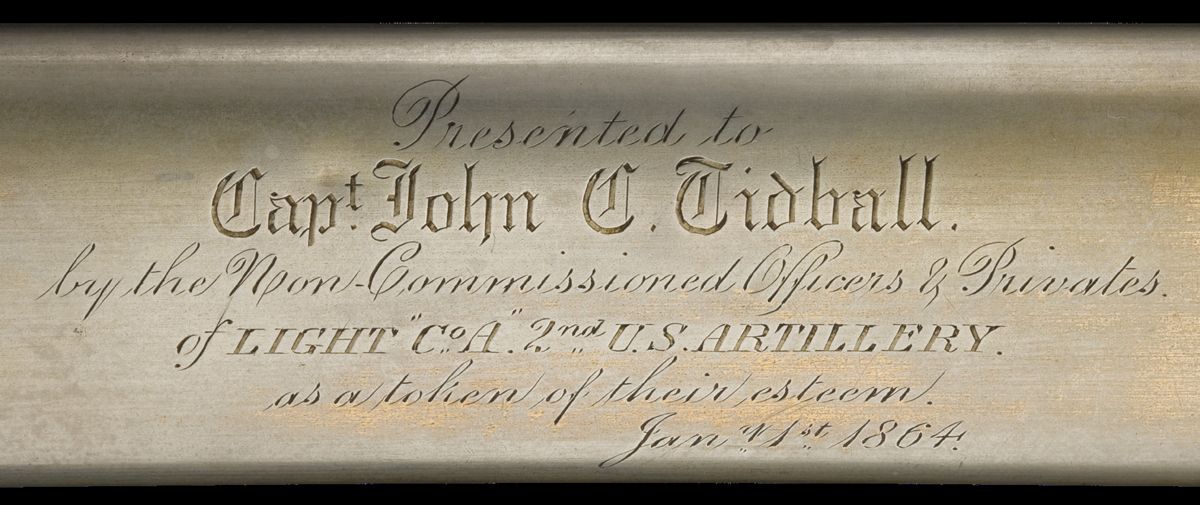
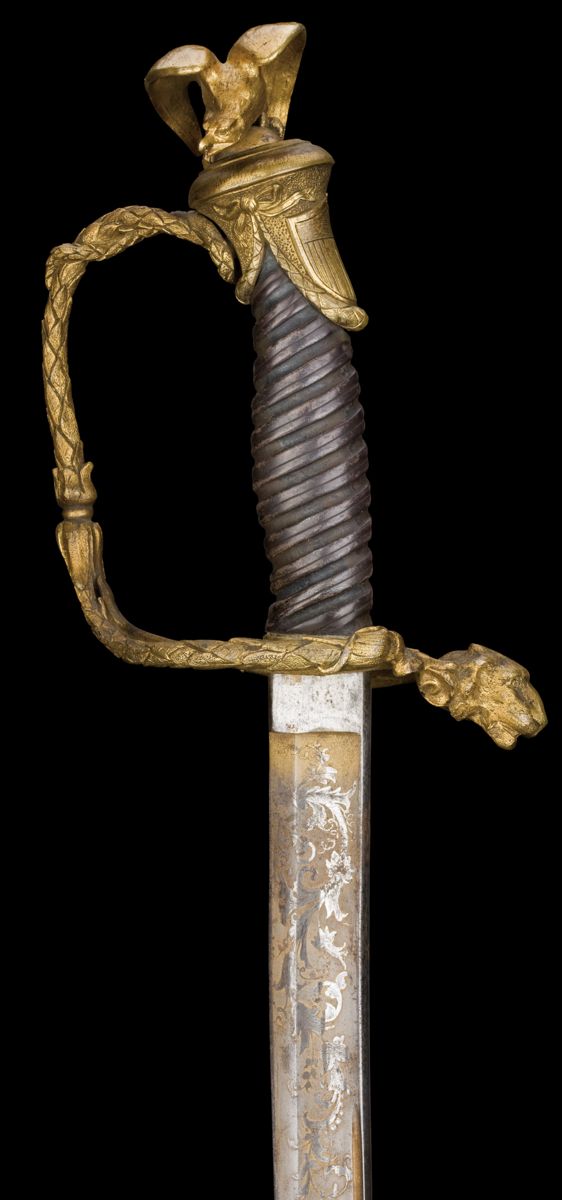
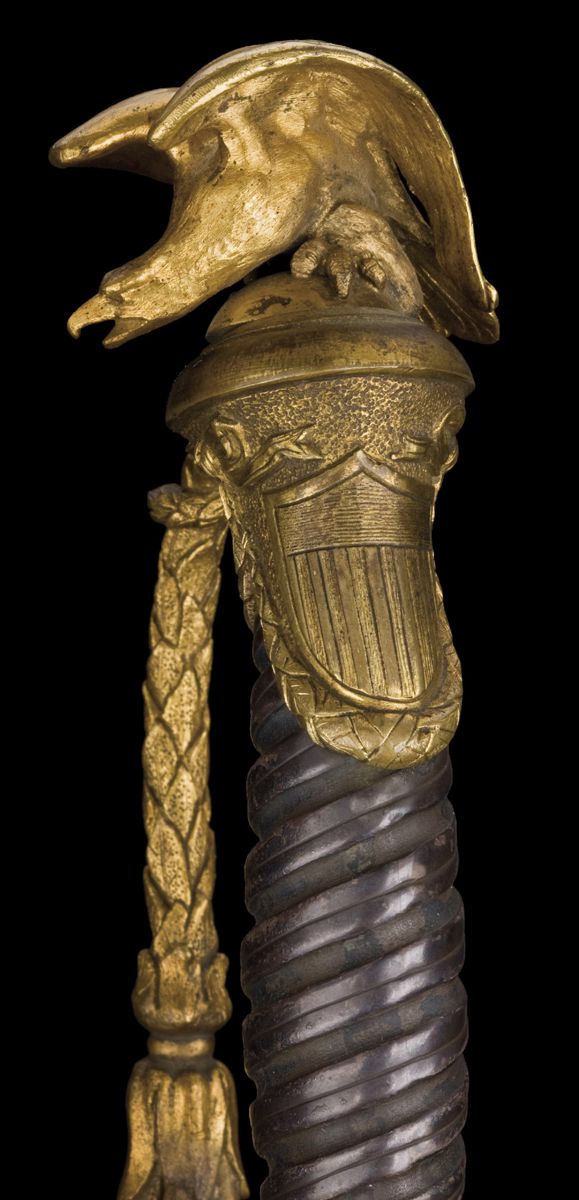
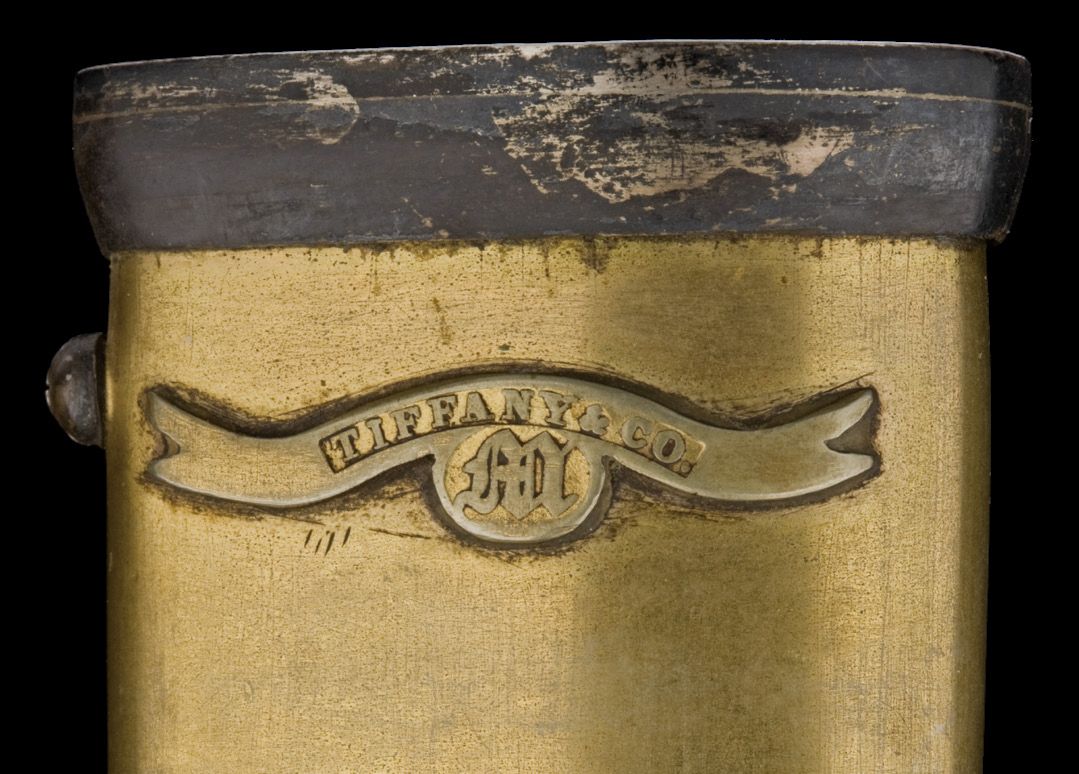
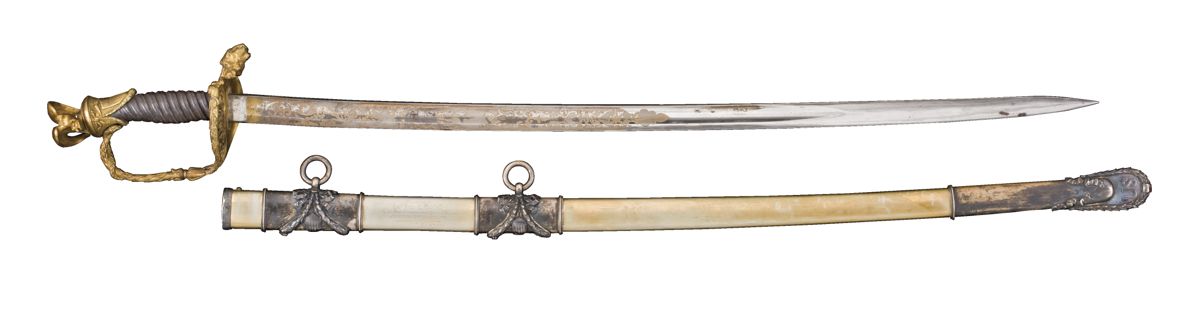
Ihad been a collector of swords, specifically Imperial German Army ones, since 1968. One day a gentleman seeking my assistance in selling a family sword approached me. The sword was a Civil War presentation piece. I had never had any interest in presentation pieces because they seemed overly gaudy. The name on the sword, Captain John Tidball, an artillery officer, was unknown to me. We went over the many ways he could sell it, advantages, disadvantages, and approximate timeline for each option. He explained he was in a desperate situation and needed the money immediately. There was something beautiful and elegant about this sword that drew me to it so I did something very spur of the moment. I made him an offer and he accepted. Now I owned a Civil War presentation sword so there was some research ahead. The first thing that an old friend told me about was the sword’s maker. Of course, I knew the name Tiffany, but was not aware that they made high end Civil War presentation swords. The sword has an ornate pierced gold guard with an eagle perched atop the pommel. The presentation, from the non-commissioned officers and privates of Light Company A, 2nd U.S. Artillery, on the scabbard is dated January 1, 1864. Over many years, I learned more about the remarkable owner, Captain John C. Tidball. The following is his story. John Caldwell Tidball was born to William and Maria Caldwell Tidball on January 25, 1825, in western Virginia near Wheeling Creek. In 1830, the family moved twenty-five miles west to Belmont County, Ohio, settling along the National Road. William Tidball opened a country store in the new town of Hendrysburg. John’s mother died of consumption on his ninth birthday. Young John went to school, clerked in the store, and helped work the family’s 100-acre farm. At the age of seventeen, John sought admission to the U.S. Military Academy. He achieved his goal and arrived at West Point on June 7, 1844. At the academy, Tidball received his best grades in chemistry and mathematics. He also perfected a natural talent for drawing, an important skill taught at the Academy. In tactics, he found his true calling in the light artillery and it would become his lifelong profession. He graduated in June 1848, finishing 11th in his class of 38. As a new second lieutenant of artillery, Tidball joined Battery E, 3rd Artillery at Fort Brown, Texas. After a brief stay, his battery was transferred to Fort Adams, Newport, R.I. In Newport he met his future wife, Mary Hunt Davis, the adopted daughter of the regimental surgeon. His next assignment was to Company M, 2nd Artillery, Oglethorpe Barracks,
Savannah, Ga., and then up the Savannah River to Augusta. In June 1849, Company M was sent to Florida upon the threat of a third war with the Seminoles. In Florida, the company served as construction workers, rather than artillerymen, building roads and bridges. Fortunately for history, Tidball was a prolific writer throughout his life and most of his writings survive, leaving a valuable record of his experiences. He remembered his time in the hot, humid disease-ridden terrain as the most difficult of his long Army career. Tidball was promoted to first lieutenant on March 31, 1853. John married Mary Davis in Philadelphia on May 27, 1853, just before departing for Fort Defiance, New Mexico Territory. There, 1st Lt. Tidball was selected to join an expedition to explore a possible railroad route along the 35th parallel. During this challenging expedition, he made detailed notes on the flora and fauna along with many fine illustrations. A number of his illustrations were published in the official Pacific Railway Reports. Upon reaching Los Angeles, the expedition was disbanded in March 1854, and Tidball took a ship back to New York City. In Newport, he reunited with Mary following a yearlong separation; the couple then moved to Carlisle, Penn., to await his next assignment. His next assignment was a return to Fort Defiance, but this time in charge of 150 recruits. Accompanied by Mary, he was leading his command across the Kansas prairies when a courier overtook them. Tidball received orders to immediately report to the U.S. Coast Survey in Washington, D.C. There he successfully completed a number of assignments leading to his becoming head of the Drawing Department in August 1855. During John and Mary’s time in Washington, the couple had two sons prior to Mary’s death in January 1858. His young sons went to live with John’s father in Ohio. After serving over four years with the U.S. Coast Survey, 1st Lt. Tidball returned to the artillery service. He was first posted to Fort Monroe, Va., with Battery B, 2nd Artillery in the autumn of 1859, then reassigned to Battery A at Fort Leavenworth, Kansas, in June 1860. As the nation approached war, his battery was one of a number of units quickly moved to the capitol in January 1861. After a brief time, the battery moved to Fort Hamilton, N.Y., where they boarded ship for a secret destination. Two weeks later, in April 1861, Tidball and Battery A unloaded at Fort Pickens, Fla., where they guarded the entrance to Pensacola Bay. While at Fort Pickens Tidball was promoted to captain and given command of Battery A. His pride at the promotion paled in comparison to receiving command of one of the Army’s most famous light artillery units.
In June 1861, Battery A was relieved, returned to New York City, and then south to Washington, D.C., arriving on July 16. At Washington Arsenal, the unit hastily loaded ammunition and moved south to Centreville, Va., to join the newly formed Union Army. July 21st found Tidball’s Battery A, 2nd Light Artillery with two 6-pdr. smoothbore bronze guns and two 12-pdr. howitzers stationed on a knoll along the Warrenton turnpike as part of the army reserve. From this position, Tidball witnessed the headlong retreat of the Union Army following the defeat at Bull Run.
photographer James Gibson (see title pages, courtesy Library of Congress. Colorized by CivilWarInColor. com). It shows a full-bearded Tidball and his three lieutenants wearing an interesting array of uniforms around one of their 3-inch ordnance rifles (No. 247, dated 1862).
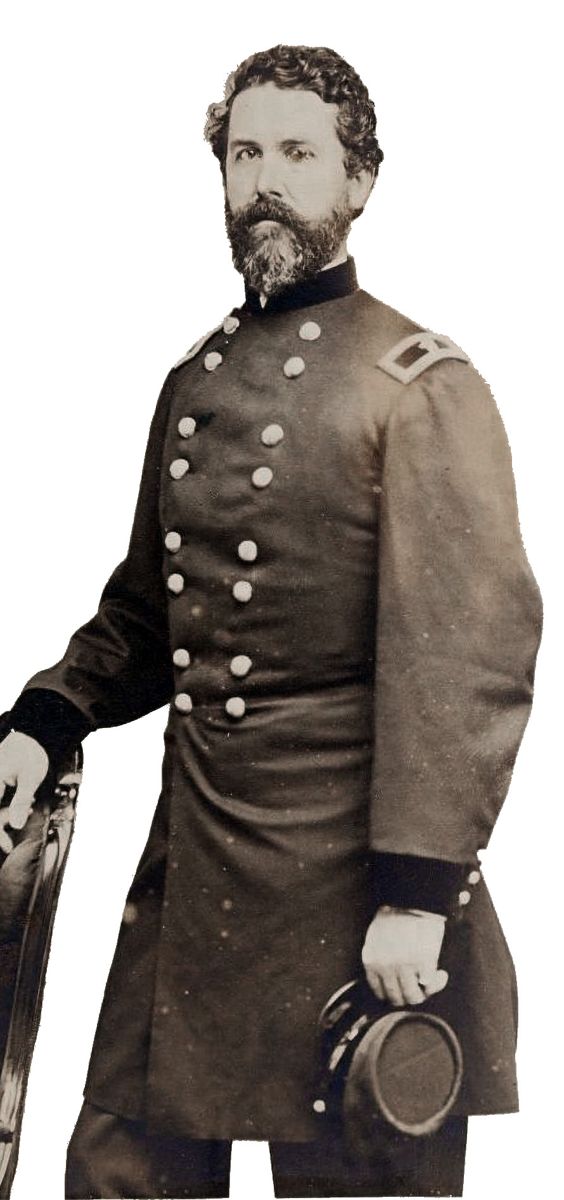
On June 25, the Seven Day’s Battles began at Oak Grove as McClellan’s Army began its withdrawal down the peninsula. Tidball’s Battery fought as part of the rearguard at Mechanicsville, and then again at Gaines’ Mill with General Fitz John Porter’s V Corps. Following the In the autumn action at Gaines’ of 1861, Captain Mill, General PorTidball reorgater recommended nized his battery Tidball for proas the first horse motion to brevet artillery battery, major. Battery in which all his A continued soldiers were their excellent mounted as rearguard service opposed to some at the Battles of riding the ammuGlendale and nition chests of Savage Station. the limbers and At Malvern Hill, caissons. This Battery A was gave his battery, brought into now armed the artillery line with six 3-inch late in the battle ordnance rifles, and played a a considerable major role in advance in speed stopping the of movement. last Confederate infantry assault. In spring 1862, Tidball shared General McClelthe disappointlan launched ment of most the Peninsula Union officers Carte de visites of Brevet Brigadier General (left) and Colonel Tidball (right). Campaign with with McClellan’s Battery A, 2nd Artillery serving in the 1st Artillery retreat after the battle that ended the Peninsula CamBrigade attached to General George Stoneman’s paign. Battery A was one of the last units to depart Cavalry. The four batteries of horse artillery, 24 the peninsula on July 2nd bound for New York. guns, were capable of keeping up with Stoneman’s horsemen. On May 5, 1862, Tidball and his battery In September 1862, Tidball’s old friend and menfought their first battle at Williamsburg, Va., joined tor, Henry Hunt, was appointed Chief of Artillery the pursuit of Confederate forces up the peninsula, for the Army of the Potomac. Tidball and his battery engaging in numerous engagements including the joined five other horse artillery batteries assigned Battle of Mechanicsville on to General Alfred Pleasanton’s Cavalry Division. May 24. On September 16, from a hill overlooking Antietam Creek, Tidball’s battery fired the opening shots of the The famous photograph war’s bloodiest day. On the 17th, Tidball’s guns devof Captain Tidball was astated Confederate infantry in Miller’s cornfield. In taken of Battery A’s officer’s the afternoon, Tidball’s Battery crossed the Middle (left to right: Lt. Robert Bridge with some of Pleasanton’s horsemen. Clarke, Capt. John C. Tidball, Lt. William N. DenniThe cavalry was soon driven back leaving Tidson, and Capt. Alexander ball’s battery alone against considerable Confederate C.M. Pennington) at Fair forces. Firing canister, Tidball advanced his guns Muzzle of No. 247. Oaks Station on June 1 by until he reached a commanding position where he continued to pound the Confederates. Eventually reinforced, Tidball held his advanced post and when nightfall ended the battle, Battery A had fired some 1,200 rounds and received the compliments of numerous Union generals. Captain Tidball was promoted to brevet lieutenant colonel.
In late summer 1864, Tidball briefly served as Commandant of Cadets at the United States Military Academy but returned to the Army of the Potomac as IX Corps Chief of Artillery under an old friend, Major General John Parke. At the end of 1864, Tidball was promoted to brevet brigadier general.
The next major event in John Tidball’s life came on May 24, 1863, when he was given command of the 2nd Brigade of Horse Artillery. He handed command of Battery A to Lt. John Calef. Tidball now led six horse artillery batteries in the Army of the Potomac’s Cavalry Corps. During Lee’s second invasion of the north, Tidball’s batteries sparred with the Confederates numerous times. His old battery fired the opening artillery rounds of the Battle of Gettysburg, and played a huge role in delaying the Confederate advance. Tidball’s batteries served in various locations around the three-day battle especially in the cavalry battle on the final day.
At Petersburg, Tidball excelled at the Battle of Fort Stedman on March 25, 1865. After Confederates took the Union fort, Tidball deployed his batteries to prevent the Confederates from receiving any reinforcements. The lack of reinforcements and the well-directed fire of Tidball’s artillery soon allowed Union forces to push the Confederates back to their lines. For his service at Fort Stedman, Tidball received the praise of General Grant and promotion to brevet major general. Tidball’s last major effort was implementing the IX Corps artillery support during the attack that shattered the Confederate lines and forced Lee’s withdrawal from Petersburg.
Throughout the first part of the war, Tidball watched as his peers received promotions by leaving the artillery to rise rapidly in the infantry ranks. In August 1863, Tidball was finally promoted, but not in the regulars. The governor of New York gave Tidball command of the 4th New York Heavy Artillery Regiment occupying the defenses of the capitol. The horse artilleryman spent the autumn and winter of 1863–64 bringing his new command of heavy artillerymen up to his high standards of training and discipline.
Tidball led his brigade in the Grand Review and then led the 4th New York Heavy Artillery to New York City where they mustered out. With the end of the war, Brevet Major General John Tidball once again became a captain and resumed command of Battery A. In August 1867, Tidball was finally promoted to major in the Regular Army. Until 1872, Major Tidball had a variety of western assignments from San Francisco to Kodiak,Alaska.
In March 1864, Tidball and his heavy artillery regiment joined General Grant and the Army of the Potomac. Colonel Tidball was made commander of General Winfield Hancock’s II Corps artillery brigade’s nine batteries. At the Wilderness, two batteries played a key role in halting the Confederate advance and averting a Union disaster. At Spotsylvania Court House, Tidball’s batteries provided excellent support to II Corps including turning twenty-four Confederate captured cannon against their former owners. In spring 1864, Grant reorganized the artillery reducing the batteries to four guns each, which increased Tidball’s Artillery Brigade to twelve batteries. The 4th NY Heavy Artillery, still under Tidball’s command, was converted to infantry. At Cold Harbor, he employed ninety-one artillery pieces in support of a II Corps’ attack. As both sides dug in, Tidball continually increased his use of mortars, eventually using everything from small 24-pounder Coehorns to massive 10-inch mortars.
In 1874, he returned to artillery service at the Artillery School at Fort Monroe. There he wrote The Manual of Heavy Artillery Service published in 1880, which stayed in use until at least 1900. In 1881, General Sherman selected Tidball to be one of his six aide-de-camps and his artillery advisor. When Sherman retired in 1884, Tidball became Commandant of the Artillery School. He served there until his retirement on January 25, 1889, after forty-five years in the Army. In retirement, he wrote extensively about his service and family history. In 1904, he finally received the coveted rank of brigadier general. He passed away in Montclair, N.J., on May 15, 1906, at age 81, and was buried at West Point. Fortunately, many of Tidball’s writings have survived, providing an invaluable account of his military career and the times. One of his descendants, Eugene C. Tidball, authored an excellent biography entitled No Disgrace to My Country: the Life of John C. Tidball, (Kent State University Press, 2002). Personally, I feel honored to own the presentation sword of such an exceptional artillery officer.
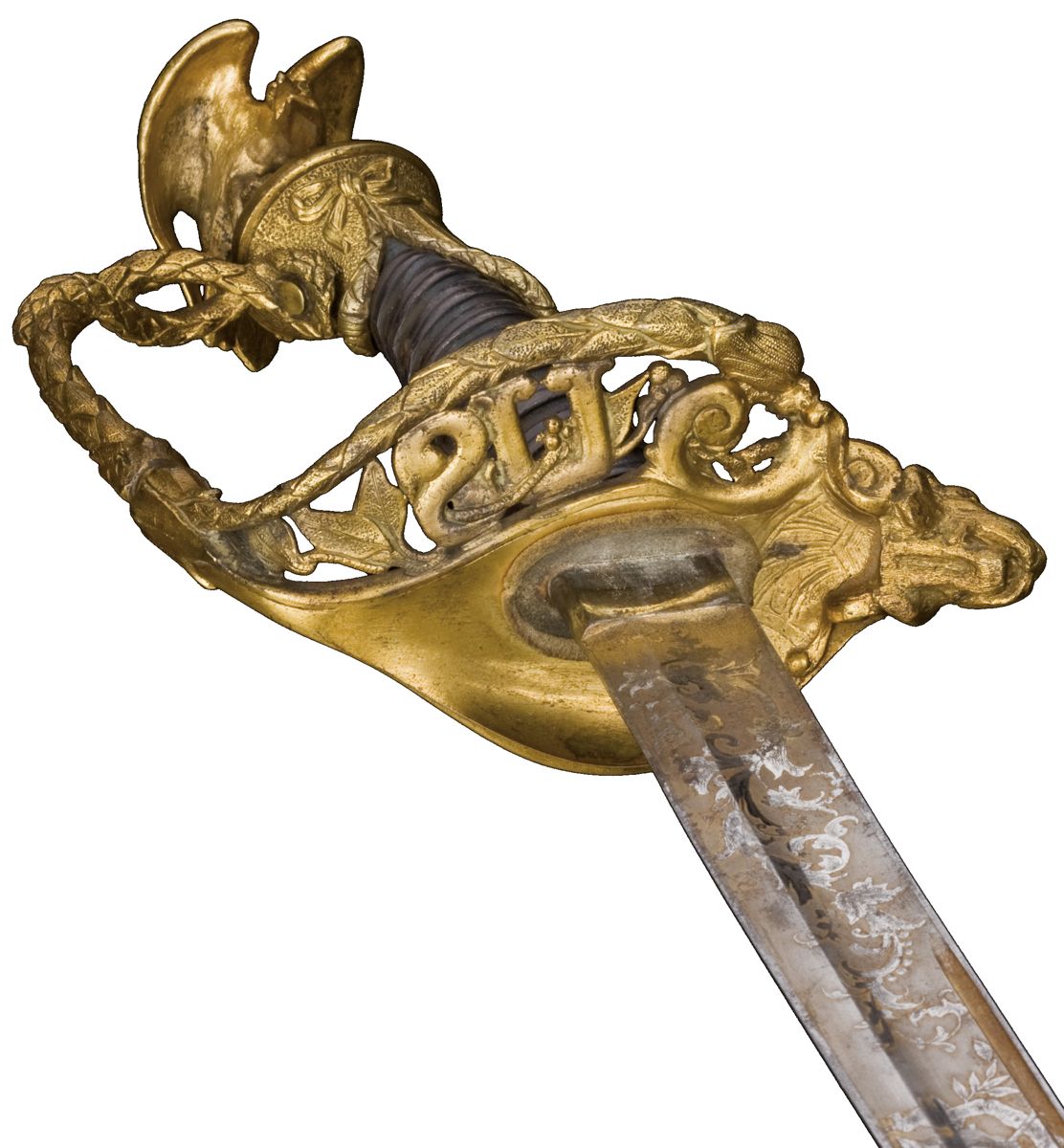
Angled view of the hilt illustrating the beautiful craftsmanship of Tiffany & Co.
Presentation engraving on the scabbard
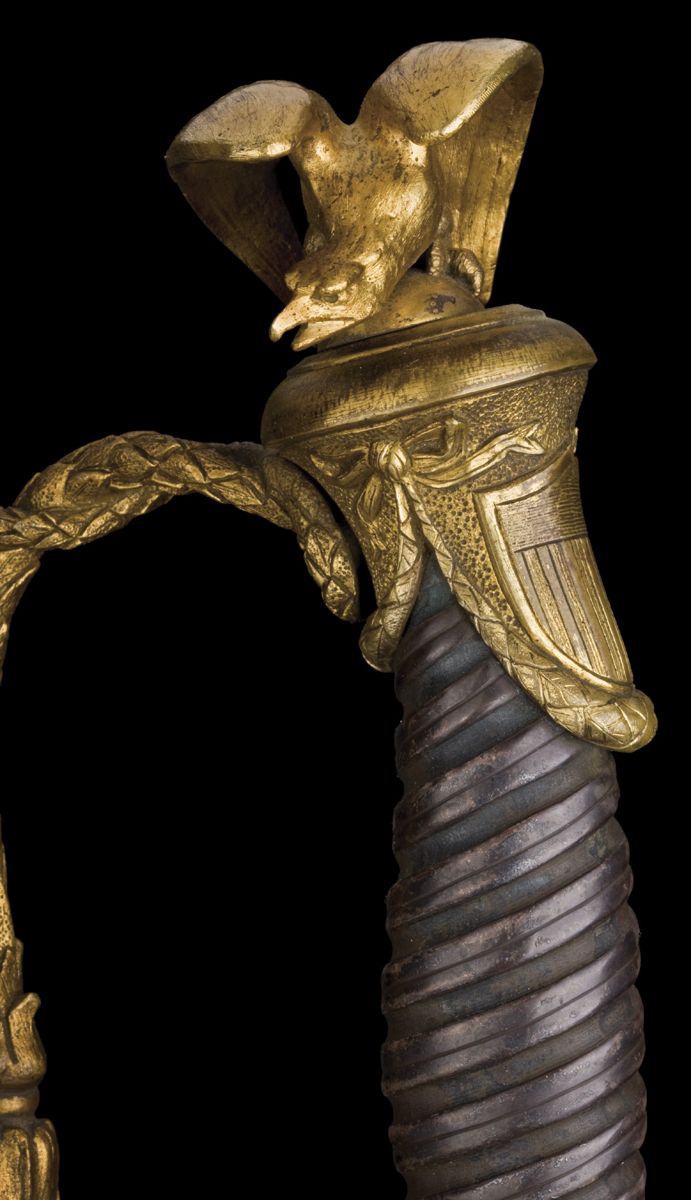
Extremely high grade presentation staff officer’s sword with a raised relief patriotic Union shield on the pommel cap and a highly detailed gargoyled positioned American eagle unique to Tiffany.
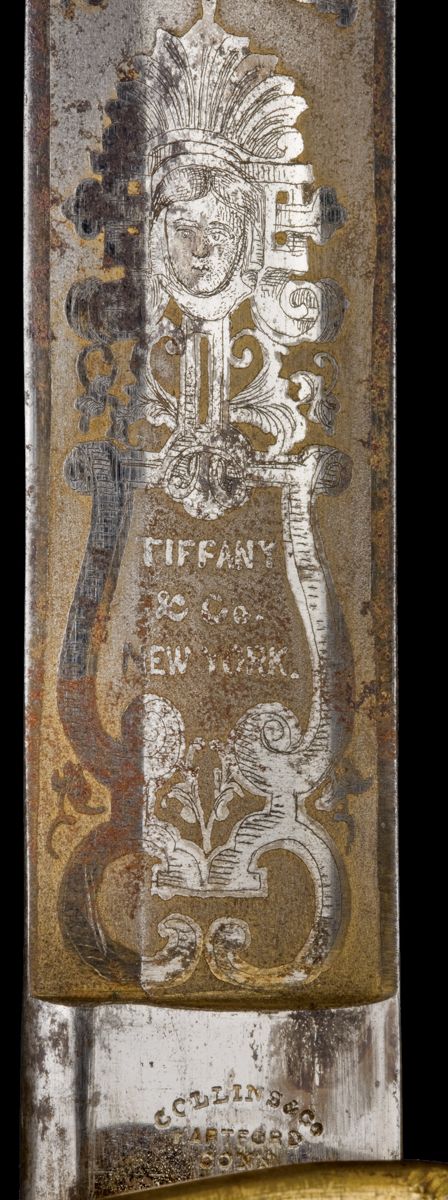
Tiffany & Co. etching on blade.
Detailed view of the presentation sword’s hilt and blade.
Tiffany marking on the scabbard.
Overall view of the Tidball sword and scabbard.
Gordon A. Blaker is the Curator of the U.S. Army Artillery Museum at Fort Sill, Okla., which he opened in June 2009. He is a retired Armor and Cavalry officer. Mr. Blaker entered the museum profession in 1995. He served as Curator at the Augusta Museum of History, Augusta, Ga., from 1997 to 2006. Mr. Blaker is the author of two books and co-author of one book on military history subjects.
How did your journey as a collector begin, and what was it about Civil War arms that first drew your interest?
I’ve always felt that to some degree, collecting, whether it is firearms, general antiques, comic books, or sports memorabilia, is something that is in your DNA; some people are more predisposed to accumulating “stuff” as George Carlin used to say, and some people are not. In most cases, collectors seem to grow up in a home where one or both of their parents are collectors, and that environment fosters any inherent disposition towards collecting. In my experience, most collectors come from a family where some level of collecting was going on with their parents, even if the objects they collected were very different. In my case, I grew up in a home where my mother had been a middle school teacher and really loved history. Many of our family vacations when I was growing up involved places like historical sites, battlefields, and museums. This created an interest in history at a young age. My mother was also an antique collector. She liked antique furniture, but also things like 19th-century kitchen knick-knacks. As I grew up, the various homes we lived in were decorated with more and more antique furniture and furnishings. Her passion for those antique items, their history, and the time periods they were from certainly influenced me. A couple of specific events in my childhood certainly put me on the pathway to where I am today. One was that I was given a copy of The Book of the Continental Soldier by Harold Peterson for either a birthday or a Christmas present when I was about 10 years old. That was the first book I had seen that went into any depth about the material culture of American soldiers. That really piqued my interest in the things used by the soldiers of the American Revolution. We had just celebrated the American Bicentennial in 1975, and as an 8-year-old child that July, I was swept away by the pageantry of that commemoration and the celebration of our national birth. As a result, my initial passion was for the American Revolution. I have friends who are Civil War dealers and collectors who are 10 to 20 years older than I am, and they had similar experiences growing up during the Centennial of the Civil War from 1961–1965. It molded them and set them on their pathway to Civil War collecting. The second pivotal event was when I was probably about 12: my mother came back from a big antique show in South Florida, where we lived at the time, with a little English flintlock box-lock pocket pistol. This was really odd, as she is not a “gun person” at all and really doesn’t like guns. But something about this little pistol spoke to her, and she brought it home, and for years it was displayed on her antique desk. That little gun simply fascinated me. I wanted to learn about it, find out when it was made, learn about the maker, and learn what I could about its history and potential use. As a kid in the late 1970s, I didn’t know about collector firearms books or where I could find information to research the gun. I stumbled upon a Flayderman’s Guide to Antique American Firearms in a bookstore and asked my mother to buy it for me so I could research the pistol, not knowing it was an English gun that I would learn nothing about in Flayderman’s. That was a seminal event for me, and I spent many nights over the next few years falling asleep reading Flayderman’s. It was simply enthralling. I remember being an early teenager and being fascinated by some of the more interesting percussion revolvers like the Butterfield and those by Savage and North. Those odd mechanisms really intrigued me. To this day, I’m still very passionate about the development of firearms technology, the early attempts to create repeating arms and breechloading arms. I really enjoyed looking at some of the convoluted ideas that people had in the 19th century about how to “build the better mousetrap,” as it were. I’m not exactly sure when my focus changed from the American Revolution to the American Civil War, but it probably started not long after Flayderman’s acquisition. I remember we were visiting a Civil War battlefield somewhere, and a couple of living historians were doing interpretation that day. It was the classic “Johnny Reb” and “Billy Yank” presentation, where the interpreters were in full kit and went through the similarities and differences in the gear carried by a Southern and a Northern soldier in the field. Again, it was a material culture thing, with objects you could touch. That really grabbed my attention. In 1985, I moved to Nashville to attend Vanderbilt University and began developing an interest in the Western Theater of the American Civil War. Up until that point, most of my Civil War knowledge was about the Eastern Theater and was very Virginia-centric. However, walking around the area near the campus, I found lots of historical markers about the Battle of Nashville, something I really knew nothing about. That got me interested in learning more about the Civil War events beyond the major battles like Antietam, Gettysburg, and Appomattox. What got me into actually collecting historical arms, rather than just being interested in them from an academic standpoint, was a combination of events that happened early in my first career, before I became an antique arms dealer. My first career was in the music business. I had actually gone to college in Nashville in the hopes of getting into the music business as a performer. I was a guitar player, sang a little, and played in bands all through college in the Nashville nightclub and frat party scene. However, I quickly found out that everyone in Nashville is a guitar player, and most were better than I was, so